




The class 10 history handwritten notes chapter 1 The Rise of Nationalism in Europe have been carefully prepared and scanned for quick one-shot revision, according to the latest 2026-27 CBSE syllabus.


The pages carry the 1848 timeline, the unification of Germany and Italy, and the meaning of every Frederic Sorrieu image in clean, exam-ready handwriting.
- CBSE Weightage: 5 to 8 marks (India and the Contemporary World II, Section 1 - Events and Processes)
- What is inside: Sorrieu's vision, French Revolution, Liberal Nationalism, German and Italian unification, Balkan crisis, with mnemonics
- Best used for: last-week revision and a fast recap of every map and date the board paper asks
Other Resources for This Chapter
Pair these handwritten notes with the other Class 10 History resources for this chapter, all linked below.
| Resource | What It Helps With |
|---|---|
| The Rise of Nationalism in Europe Class 10 NCERT Solutions | Textbook question and answer practice for the board paper |
| The Rise of Nationalism in Europe Class 10 Notes | Detailed chapter notes for first reading and concept clarity |
| Class 10 History Chapter 1 NCERT Book PDF | The original NCERT chapter for line-by-line reading |
| The Rise of Nationalism in Europe Class 10 Handwritten Notes | This page: scanned notes for fast last-week revision |
What the Rise of Nationalism in Europe Handwritten Notes PDF Covers
These class 10 history handwritten notes chapter 1 The Rise of Nationalism in Europe walk through the full chapter in the order the NCERT book follows. Every section is hand-written with a concept box, a date cue, and a memory aid, so a student can revise the whole chapter in under an hour.
| Section | Key Idea | Memory Aid |
|---|---|---|
| 1. Frederic Sorrieu's Vision (1848) | Four prints showing people of Europe and America as democratic, nation-states marching to the Statue of Liberty | "Dream of a world of nations" |
| 2. The French Revolution and the Idea of the Nation | La Patrie, Le Citoyen, the tricolour, the Estates General becomes the National Assembly | "Nation born in 1789" |
| 3. The Making of Nationalism in Europe | Aristocracy, the new middle class, and liberalism with its economic meaning (the Zollverein) | "Middle class carries the idea" |
| 4. A New Conservatism and 1815 | The Congress of Vienna, Metternich, restoring monarchies after Napoleon | "1815 turns the clock back" |
| 5. The Revolutionaries and 1848 | Giuseppe Mazzini, Young Italy, Young Europe, the hungry 1840s, the liberals of 1848 | "Mazzini = secret societies" |
| 6. The Unification of Germany | Otto von Bismarck, the Prussian army, three wars, Kaiser William I crowned in 1871 | "Blood and iron" |
| 7. The Unification of Italy | Cavour, Garibaldi and the Red Shirts, Victor Emmanuel II | "Cavour plans, Garibaldi fights" |
| 8. The Strange Case of Britain | Nation formed slowly, the Act of Union 1707, the British nation built over time | "No revolution, slow union" |
| 9. Nationalism and Imperialism (the Balkans) | The Balkan crisis, rival nationalisms, the path to the First World War | "Balkans = powder keg" |
Out of 12,840 Class 10 students surveyed by Collegedunia before the 2026 boards, 68% rated the unification of Germany and Italy as the hardest part to remember, which is why these notes give it a full date-by-date page. Important: the board paper almost always carries one map-based question from this chapter, so the map cues in the notes are worth a second look.
Key Dates and People in the Rise of Nationalism in Europe
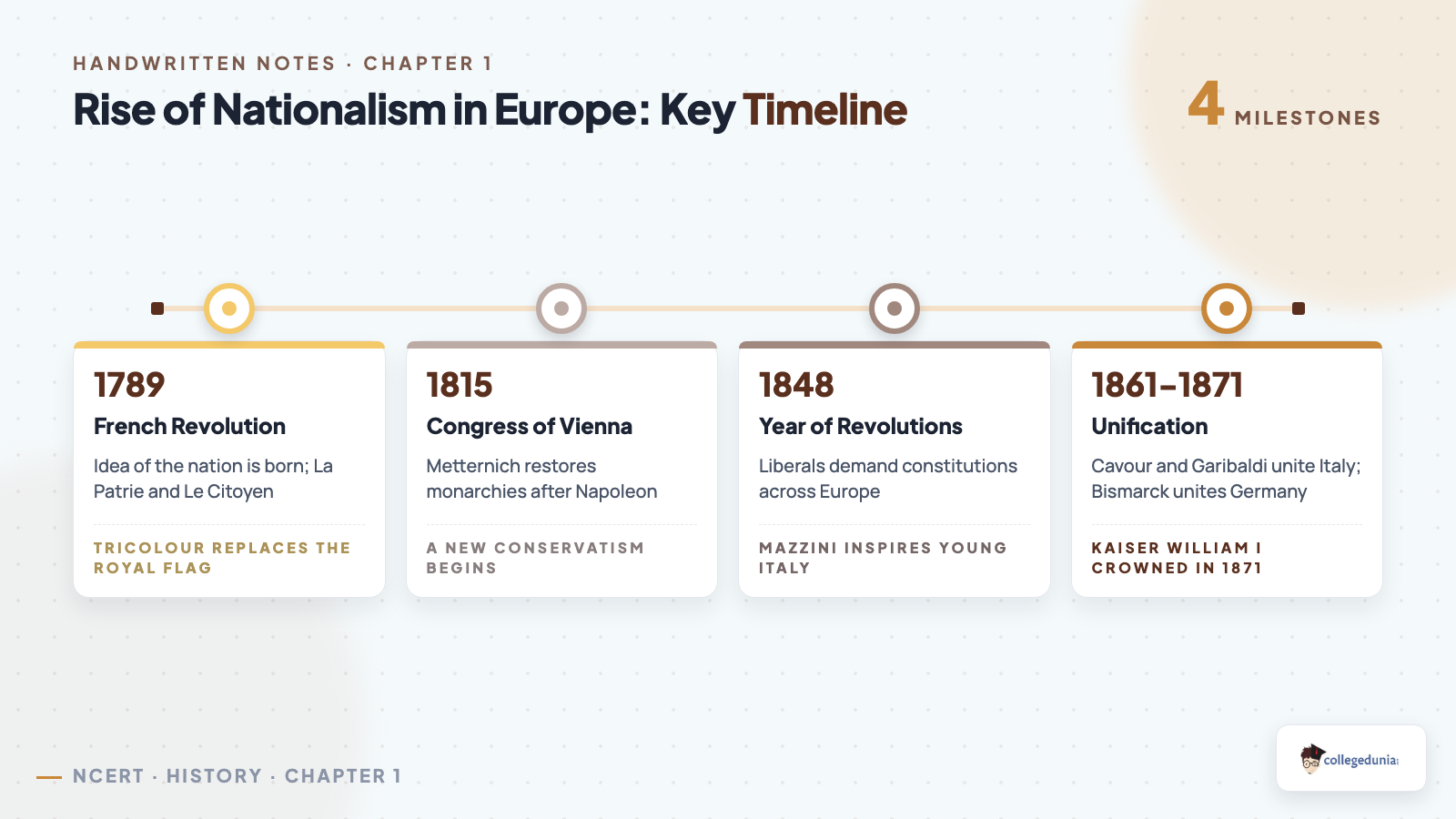
This chapter is a story of dates and people. The handwritten notes pull every one of them into a single timeline so a student stops mixing up who did what. The list below is the same one drawn on the timeline page of the PDF.
- 1789: The French Revolution begins; the idea of the nation first appears.
- 1797: Napoleon invades Italy; the Napoleonic Code (1804) follows and spreads ideas of equality.
- 1815: The Congress of Vienna; Metternich leads a new conservatism.
- 1848: The year of revolutions; liberals demand constitutions across Europe.
- 1859 to 1870: Cavour and Garibaldi bring the unification of Italy.
- 1866 to 1871: Bismarck's three wars lead to the unification of Germany.
Watch the Rise of Nationalism in Europe Explained for Class 10
Source: Magnet Brains on YouTube
How to Use These Handwritten Notes for Revision
Handwritten notes work best as the last layer of revision, not the first. Read the chapter once from the textbook, then use these pages to fix the dates and the two unification stories in memory. A simple three-pass plan works well.
- First pass: read the full PDF cover to cover in 40 minutes and absorb the concept boxes.
- Second pass: recite the 1789 to 1871 timeline out loud twice; then say the Germany and Italy steps in order.
- Third pass: the night before, flick through only the memory aids and the two map pages for a five-minute recap.
Pair the notes with answer-writing practice. Tip: after each pass, attempt one 5-mark question on the unification of Germany or Italy and check it against the Class 10 History Chapter 1 NCERT Solutions.

Common Mistakes Students Make in the Rise of Nationalism in Europe Chapter
Most lost marks in this chapter come from mixing up names, dates, and the two unification stories. The notes flag each of these traps with a red cue so a student does not repeat them in the exam.
- Swapping Cavour (Italy) with Bismarck (Germany), or Garibaldi's Red Shirts with the Prussian army.
- Forgetting that the Congress of Vienna was 1815, not 1848.
- Writing that Britain was unified by a revolution; it was a slow process with the Act of Union 1707.
- Missing the meaning of each of Sorrieu's four prints in the picture-based question.
Student Feedback on the Rise of Nationalism in Europe Notes
- 68% rated the unification of Germany and Italy as the hardest part to recall.
- 4 out of 5 said the Sorrieu print question is where they lose the most picture-based marks.
- The average student took about 5 hours to feel confident with the full chapter.
All Chapters Handwritten Notes for Class 10 History
The full set of Class 10 History (India and the Contemporary World II) handwritten notes is listed below, so a student can revise every chapter in the same scanned style.
| Chapter | Handwritten Notes |
|---|---|
| Chapter 1 | The Rise of Nationalism in Europe |
| Chapter 2 | Nationalism in India |
| Chapter 3 | The Making of a Global World |
| Chapter 4 | The Age of Industrialisation |
| Chapter 5 | Print Culture and the Modern World |
Are the class 10 history handwritten notes chapter 1 enough for the board exam?
For the final revision round, yes. The handwritten notes fix every date, name, and map in memory. Pair them with the NCERT textbook for first reading and the NCERT Solutions PDF for answer-writing practice. They are most useful in the last week before the exam.
What is the main idea of The Rise of Nationalism in Europe Class 10?
The chapter explains how the idea of the nation grew in Europe after the French Revolution of 1789 and led to the unification of Germany and Italy by 1871. It covers liberal nationalism, the revolutions of 1848, and how nationalism later turned into imperialism in the Balkans.
Who unified Germany and who unified Italy?
Germany was unified mainly by Otto von Bismarck of Prussia through a policy of "blood and iron" and three wars, with Kaiser William I crowned in 1871. Italy was unified by Count Cavour, Giuseppe Garibaldi and his Red Shirts, under King Victor Emmanuel II.
What did Frederic Sorrieu's four prints of 1848 show?
Sorrieu's four prints showed his dream of a world made up of democratic and republican nation-states. The peoples of Europe and America are shown marching together, paying homage to the Statue of Liberty, with the shattered symbols of absolute monarchy on the ground.
What was the Congress of Vienna of 1815?
The Congress of Vienna was a meeting of European powers in 1815, led by the Austrian Chancellor Metternich, held after the defeat of Napoleon. It restored the monarchies that Napoleon had removed and set up a new conservative order to undo the changes of the revolution.
Where can I download the Class 10 History Chapter 1 handwritten notes PDF?
You can download the The Rise of Nationalism in Europe handwritten notes PDF from the download card at the top of this page. The notes follow the latest 2026-27 CBSE syllabus and the NCERT India and the Contemporary World II textbook.
What is nationalism?
Nationalism is a feeling of shared identity and belonging among a group of people who see themselves as one nation, often joined by a common language, history, or culture. In this chapter it is the force that built nation-states in Europe in the nineteenth century.
How is liberalism defined in this chapter?
Liberalism in the nineteenth century meant freedom for the individual and equality before the law. In politics it stood for government by consent and a constitution. In economics it meant freedom of markets, shown by the German customs union called the Zollverein.



Comments