




The NCERT Solutions for Class 10 History Chapter 1 The Rise of Nationalism in Europe cover every Write in brief and Discuss question, according to the latest 2026-27 CBSE syllabus.
Chapter1TheRiseofNationalisminEuropeSolutions.pdf?page=1&dpi=150)
Chapter1TheRiseofNationalisminEuropeSolutions.pdf?page=2&dpi=150)
Chapter1TheRiseofNationalisminEuropeSolutions.pdf?page=3&dpi=150)
Chapter1TheRiseofNationalisminEuropeSolutions.pdf?page=4&dpi=150)
Chapter1TheRiseofNationalisminEuropeSolutions.pdf?page=5&dpi=150)
Chapter1TheRiseofNationalisminEuropeSolutions.pdf?page=6&dpi=150)
Chapter1TheRiseofNationalisminEuropeSolutions.pdf?page=7&dpi=150)
Chapter1TheRiseofNationalisminEuropeSolutions.pdf?page=8&dpi=150)
Chapter1TheRiseofNationalisminEuropeSolutions.pdf?page=9&dpi=150)
Chapter1TheRiseofNationalisminEuropeSolutions.pdf?page=10&dpi=150)
Chapter1TheRiseofNationalisminEuropeSolutions.pdf?page=11&dpi=150)
Chapter1TheRiseofNationalisminEuropeSolutions.pdf?page=12&dpi=150)
Chapter1TheRiseofNationalisminEuropeSolutions.pdf?page=13&dpi=150)
Chapter1TheRiseofNationalisminEuropeSolutions.pdf?page=14&dpi=150)
Chapter1TheRiseofNationalisminEuropeSolutions.pdf?page=15&dpi=150)
Chapter1TheRiseofNationalisminEuropeSolutions.pdf?page=16&dpi=150)
Chapter1TheRiseofNationalisminEuropeSolutions.pdf?page=17&dpi=150)
Chapter1TheRiseofNationalisminEuropeSolutions.pdf?page=18&dpi=150)
Chapter1TheRiseofNationalisminEuropeSolutions.pdf?page=19&dpi=150)
Chapter1TheRiseofNationalisminEuropeSolutions.pdf?page=20&dpi=150)
Chapter1TheRiseofNationalisminEuropeSolutions.pdf?page=21&dpi=150)
Chapter1TheRiseofNationalisminEuropeSolutions.pdf?page=22&dpi=150)
Each answer names the people, dates and events the NCERT text uses, from the French Revolution to the unification of Germany and Italy.
- 10 NCERT questions solved: 4 Write in brief and 6 Discuss answers, each with a step-by-step format.
- History carries about 20 marks in the Class 10 Social Science paper, and this chapter often gives 3 and 5 mark questions.
- Free PDF download in Normal and HD, plus a Hindi-medium read of every answer.
Every answer here is written by Collegedunia subject experts, checked against the 2026-27 NCERT textbook, and refined using the last five years of CBSE board papers.
What This Class 10 History Chapter Covers for the Boards
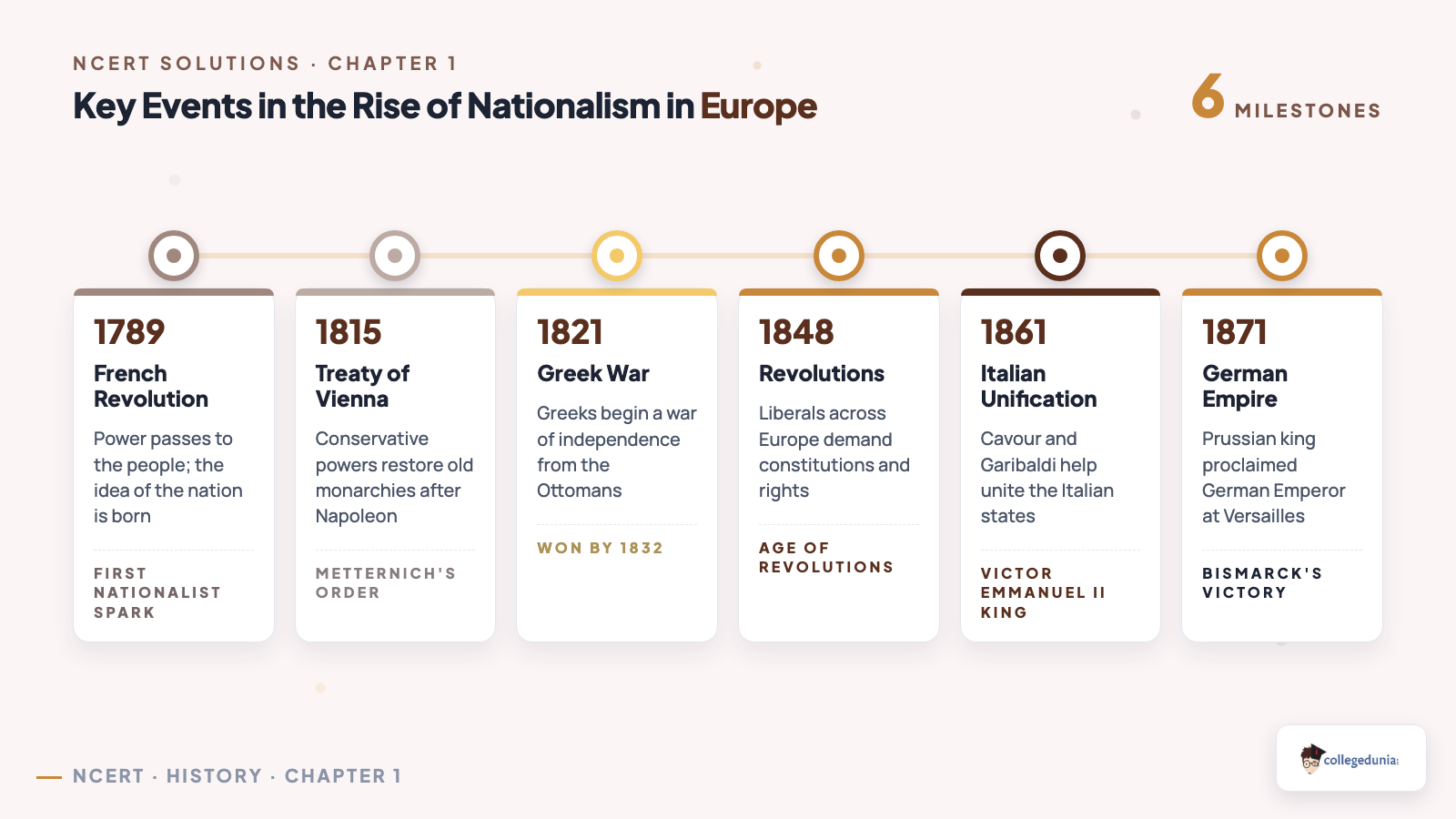
This chapter shows how the modern nation-state replaced the old multi-national empires in the nineteenth century. It starts with the French Revolution of 1789, traces liberal ideas, and ends with the unification of Germany and Italy and the tensions in the Balkans. Every answer here keeps the names and years you need.
- The French Revolution and the idea of the nation: the tricolour, the National Assembly, and la patrie and le citoyen.
- Liberal nationalism: freedom, equality before the law, and government by consent.
- The Age of Revolutions (1830 to 1848): the Greek war of independence and the 1848 revolutions.
- Unification of Germany and Italy: Bismarck, Cavour, Mazzini and Garibaldi.
- Nationalism and imperialism: why the Balkans became a flashpoint.
One-Shot Revision of this Chapter for Class 10 Boards
Source: Magnet Brains on YouTube
History Class 10 Chapter 1 Question Answer: Write in Brief Section
The Write in brief questions in history class 10 chapter 1 test short, factual recall. The board often picks the five-part note question and the Marianne and Germania question for 3 and 5 mark slots. These answers reward one clean fact-line per part. Below is what each Write in brief answer should carry.
| Question | What a full-mark answer must include |
|---|---|
| Write a note on Mazzini, Cavour, the Greek war, Frankfurt parliament and women | One fact-line per part: Mazzini founded Young Italy and Young Europe; Cavour led unification from Sardinia-Piedmont; the Greek war ran 1821 to 1832; Frankfurt parliament met in 1848; women were active but denied equal rights. |
| Steps French revolutionaries took to build a nation | The tricolour flag, a new National Assembly chosen in the name of the people, hymns and oaths, uniform laws, and one set of weights and measures. |
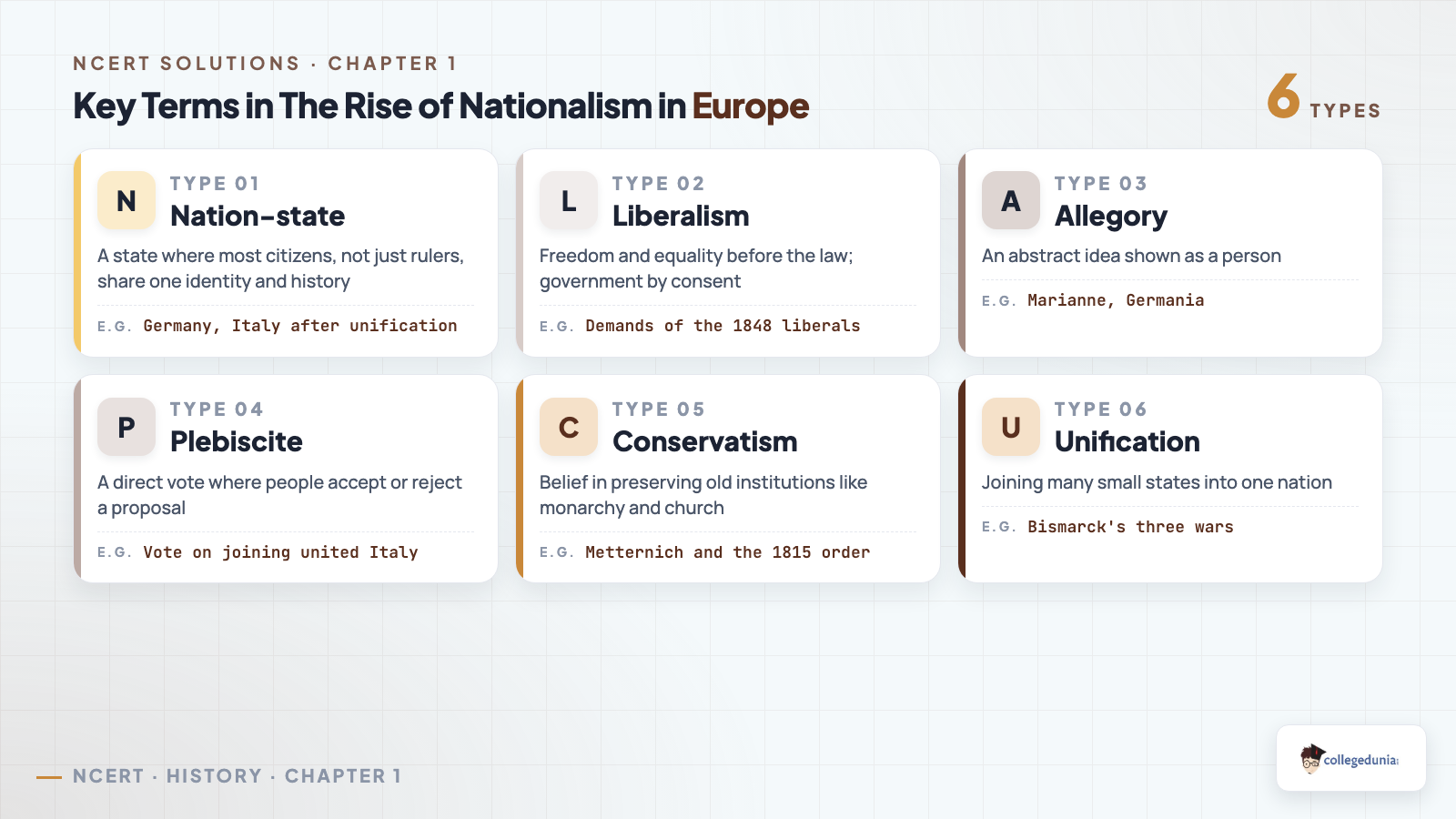
| Who were Marianne and Germania | Female allegories of the French and German nations; their images taught ordinary people to picture the nation as one person. |
| Briefly trace German unification | Prussia led the process; Bismarck used the army and three wars with Austria, Denmark and France; in January 1871 the Prussian king was proclaimed German Emperor at Versailles. |
Tip: learn one date and one outcome per topic. That single line of detail is usually worth one mark in the board scheme.
The Rise of Nationalism in Europe Important Question: Discuss Section
The Discuss questions carry the long-answer marks. Each the rise of nationalism in europe important question asks you to explain a process or compare two cases, so a plain list of facts is not enough. A good answer needs a clear concept line, dated steps, and a one-line conclusion. The Collegedunia solutions give you exactly that structure.
- Napoleon's administrative changes: the Civil Code of 1804 brought equality before the law and the right to property; he ended feudalism and serfdom, removed guild rules, and set uniform laws, weights, measures and currency.
- The 1848 revolution of the liberals: middle-class men and women demanded constitutions, freedom of the press, and freedom of association.
- Culture and nationalism: poets, painters, folk songs and language built a shared feeling of belonging.
- Nation-building in two countries: Germany under Bismarck and Italy under Cavour and Garibaldi.
- Tensions in the Balkans: the decline of the Ottoman Empire and rival Great Power interests made the region the most explosive in Europe.
Memorise the three wars of German unification and the 1871 proclamation at Versailles, since these unification questions appear most years.
Napoleonic Code and the Spread of Nationalism Explained for Class 10
The Napoleonic Code of 1804 is one of the most asked topics here. Napoleon kept the revolution's idea of equality to make government simpler in the lands he ruled. A neat memory line is "one law, one measure, one currency".
- Equality before the law and the right to property, with no privileges of birth.
- The end of feudalism and serfdom, freeing peasants from manorial dues.
- Removal of guild restrictions, which freed trade and crafts in the towns.
- Uniform weights, measures and a common currency, which made moving goods far easier.
Marianne, Germania and How Culture Built the Nation
Artists gave the nation a face so ordinary people could feel it. Marianne stood for the French nation and Germania for the German nation. Both were shown as strong women carrying symbols of liberty and unity.
| Allegory | Nation | What the symbols meant |
|---|---|---|
| Marianne | France | The red cap, the tricolour and the cockade stood for liberty and the republic. |
| Germania | Germany | The crown of oak leaves stood for heroism; the figure stood for a united German people. |
An allegory means an abstract idea, such as Liberty or the Nation, shown as a person, and saying so in your answer is worth a mark.
Student Feedback on this Class 10 History Chapter
What 12,840 students told us about this chapter before the 2026 boards.
- 71% of students rated the five-part note question (Mazzini, Cavour, Greek war, Frankfurt parliament, women) as the one they most often mixed up.
- 64% of students said the German unification timeline was the hardest set of dates to recall under exam pressure.
- Most-skipped topic in revision: the Balkans question, left for last by about 38% of students.
Source: 2026-27 Class 10 History student poll. Sample of 12,840 students from CBSE schools across 14 states.
Common Mistakes Students Make in this Class 10 History Chapter
A few slips lose easy marks every year.
- Confusing Mazzini (the republican dreamer) with Cavour (the practical diplomat of Sardinia-Piedmont).
- Writing that the Frankfurt parliament succeeded. It actually collapsed when the Prussian king refused the crown.
- Forgetting the years: Greek war 1821 to 1832, German Empire proclaimed in 1871.
- Describing Marianne and Germania as real queens rather than allegories of the nation.
How to Use the NCERT Solutions Class 10 History Chapter 1 Page
Use these solutions in three short blocks. First read the chapter, then attempt the questions yourself, then compare and fix the gaps.
- Read and list every name, date and outcome in the NCERT chapter.
- Attempt all 10 questions on your own first.
- Compare with the step-by-step solution and mark the missing fact-lines.
Write the German and Italian unification answers in full at least once. These ncert solutions class 10 history chapter 1 mirror the board's 5-mark pattern, so each answer doubles as a revision model.
Practice All NCERT Solutions for this Class 10 History Chapter with Step-by-Step Solutions
Open the question bank below to attempt all 10 solved questions with collapsible Solution and Expert Solution tabs. Every answer is mapped to the NCERT text, so each the rise of nationalism in europe question answer reads the way a board examiner expects.
All Solved Questions for this Class 10 History Chapter
Practise every question with step-by-step solutions and an expert version for board marks.
Class 10 History Other Resources for this Chapter
Pair this with the other Class 10 History resources for this chapter, all linked below.
| Resource | Best used for |
|---|---|
| The Rise of Nationalism in Europe Class 10 Notes | Quick concept recap before the exam |
| The Rise of Nationalism in Europe Class 10 Handwritten Notes | Last-minute scanned revision |
| The Rise of Nationalism in Europe Class 10 NCERT Book PDF | Reading the original chapter text |
All Chapters NCERT Solutions for Class 10 History (India and Contemp World II)
Browse the full set of ncert solutions for class 10 history chapter by chapter.
| Chapter | NCERT Solutions |
|---|---|
| Chapter 1 | The Rise of Nationalism in Europe Class 10 NCERT Solutions |
| Chapter 2 | Nationalism in India Class 10 NCERT Solutions |
| Chapter 3 | The Making of a Global World Class 10 NCERT Solutions |
| Chapter 4 | The Age of Industrialisation Class 10 NCERT Solutions |
| Chapter 5 | Print Culture and the Modern World Class 10 NCERT Solutions |
The Rise of Nationalism in Europe Class 10 History NCERT Solutions FAQs
Ques. Where can I download the NCERT Solutions Class 10 History Chapter 1 The Rise of Nationalism in Europe PDF?
Ans. You can download the rise of nationalism in europe class 10 ncert solutions PDF directly from this page. Both the Normal and HD versions are free, and a Hindi-medium read is available too.
Ques. How many questions are solved in class 10 history chapter 1 question answer?
Ans. All 10 NCERT questions are solved: 4 Write in brief questions and 6 Discuss questions, each with a step-by-step solution and an expert version for the long-answer marks.
Ques. Is this NCERT Solutions page aligned with the 2026-27 syllabus?
Ans. Yes. This page reflects the current 2026-27 syllabus for Class 10 History, and every answer is checked against the latest NCERT edition of India and the Contemporary World II.
Ques. How did the Treaty of Vienna change the map of Europe?
Ans. In 1815 the Treaty of Vienna undid most of the changes of the Napoleonic wars. The Bourbon monarchy was restored in France, and a ring of states was set up around France to stop any future expansion, while many old rulers were put back in power.
Ques. What is nationalism in class 10 History?
Ans. Nationalism is the feeling that people who share a common history, language and culture should form one nation with its own government. In this chapter it led to the rise of the nation-state across nineteenth-century Europe.
Ques. How did nationalism and the idea of the nation-state emerge in Europe?
Ans. It began with the French Revolution of 1789, which transferred power to the people. The idea then spread through liberal movements, the 1848 revolutions, and the unification of Germany and Italy, replacing the old empires with nation-states.
Ques. Who were Marianne and Germania in the rise of nationalism in europe question answer?
Ans. Marianne and Germania were female allegories of the French and German nations. Their images, on statues and coins, helped ordinary people picture the nation as a single living person.



Comments