




The class 10 history handwritten notes chapter 5 Print Culture and the Modern World have been carefully prepared and scanned for quick one-shot revision, according to the latest 2026-27 CBSE syllabus.


The pages trace the first woodblock print in China and Japan, Gutenberg's printing press, the print revolution in Europe, and the arrival of print in India, all in clean, exam-ready handwriting.
- CBSE Weightage: 5 to 8 marks (India and the Contemporary World II, Section 1 - Events and Processes)
- What is inside: first print in East Asia, Gutenberg press, print in Europe, print in India, Bengal Gazette, censorship, with mnemonics
- Best used for: last-week revision and a fast recap of every date and term the board paper asks
What the Print Culture and the Modern World Handwritten Notes PDF Covers
These class 10 history handwritten notes chapter 5 Print Culture and the Modern World walk through the full chapter in the order the NCERT book follows. Every section is hand-written with a concept box, a date cue, and a memory aid, so a student can revise the whole chapter in under an hour.
| Section | Key Idea | Memory Aid |
|---|---|---|
| 1. The First Printed Books | Hand printing with woodblocks began in China, Japan and Korea long before Europe | "East Asia printed first" |
| 2. Print Comes to Japan | Buddhist missionaries brought print; the Diamond Sutra is the oldest dated printed book | "Diamond Sutra = oldest print" |
| 3. Print Comes to Europe | Marco Polo brought woodblock knowledge; demand for books grew with the universities | "Marco Polo carried print" |
| 4. Gutenberg and the Printing Press | Johann Gutenberg built the first printing press around 1448; the Bible was his first print | "Gutenberg = 1448 press" |
| 5. The Print Revolution | Books became cheaper, ideas spread fast, and a new reading public was born | "Cheap books = mass reading" |
| 6. Print and Reform / Religious Debate | Print fuelled the Reformation; Martin Luther's writings spread widely | "Luther rode the press" |
| 7. Print Comes to India | Portuguese priests set up the first press in Goa in 1556; the Bengal Gazette came in 1780 | "Goa 1556, Gazette 1780" |
| 8. Religious Reform and Public Debate | Print let reformers like Rammohun Roy and others debate widely-read social issues | "Reformers used print" |
| 9. Print and Censorship | The colonial state used the Vernacular Press Act of 1878 to curb Indian newspapers | "1878 = press gag" |
Out of 12,840 Class 10 students surveyed by Collegedunia before the 2026 boards, 68% rated the print-in-Europe and Gutenberg timeline as the hardest part to keep in order, which is why these notes give it a full date-by-date page. Important: the board paper almost always carries one source-based question on censorship or the Vernacular Press Act, so those cues in the notes are worth a second look.
Watch Print Culture and the Modern World Explained for Class 10
Source: Magnet Brains on YouTube
Key Dates and Terms in Print Culture and the Modern World
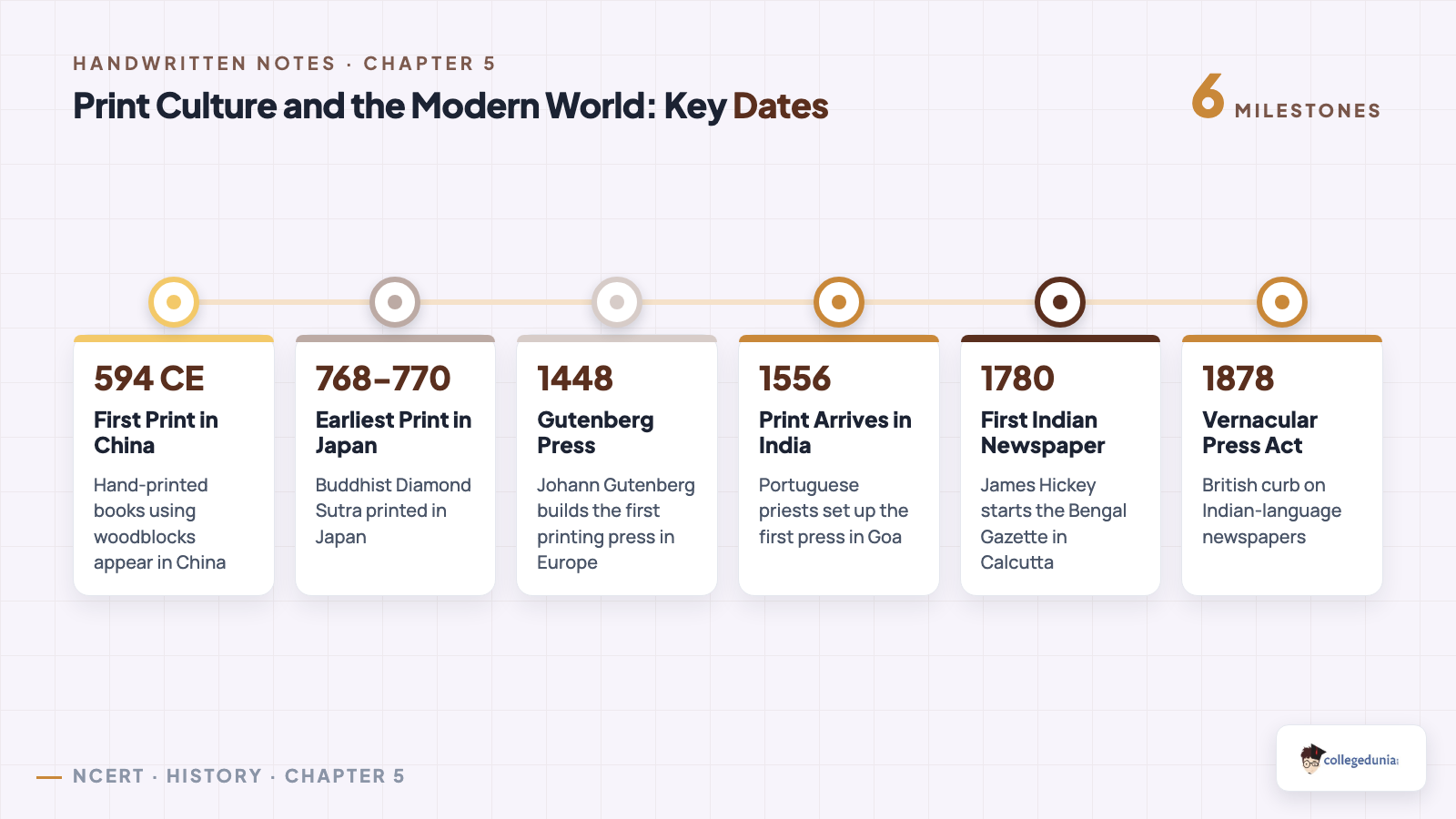
This chapter is a story of how print travelled across the world. The handwritten notes pull every date and term into a single timeline so a student stops mixing up what happened when. The list below is the same one drawn on the timeline page of the PDF.
- 594 CE: Hand printing with woodblocks begins in China.
- 768 to 770: The Diamond Sutra, the oldest dated printed book, is printed in Japan.
- 1295: Marco Polo returns to Italy and carries woodblock printing knowledge to Europe.
- 1448: Johann Gutenberg builds the first printing press in Europe.
- 1556: Portuguese priests set up the first press in Goa.
- 1780: James Hickey starts the Bengal Gazette, India's first weekly newspaper.
- 1878: The colonial state passes the Vernacular Press Act to curb Indian newspapers.
How to Use These Handwritten Notes for Revision
Handwritten notes work best as the last layer of revision, not the first. Read the chapter once from the textbook, then use these pages to fix the dates and the spread of print in memory. A simple three-pass plan works well.
- First pass: read the full PDF cover to cover in 40 minutes and absorb the concept boxes.
- Second pass: recite the China-to-India print timeline out loud twice; then name how print reached Europe and India in order.
- Third pass: the night before, flick through only the memory aids and the censorship page for a five-minute recap.
Pair the notes with answer-writing practice. Tip: after each pass, attempt one 5-mark question on print and censorship and check it against the Class 10 History Chapter 5 NCERT Solutions.
Common Mistakes Students Make in the Print Culture and the Modern World Chapter
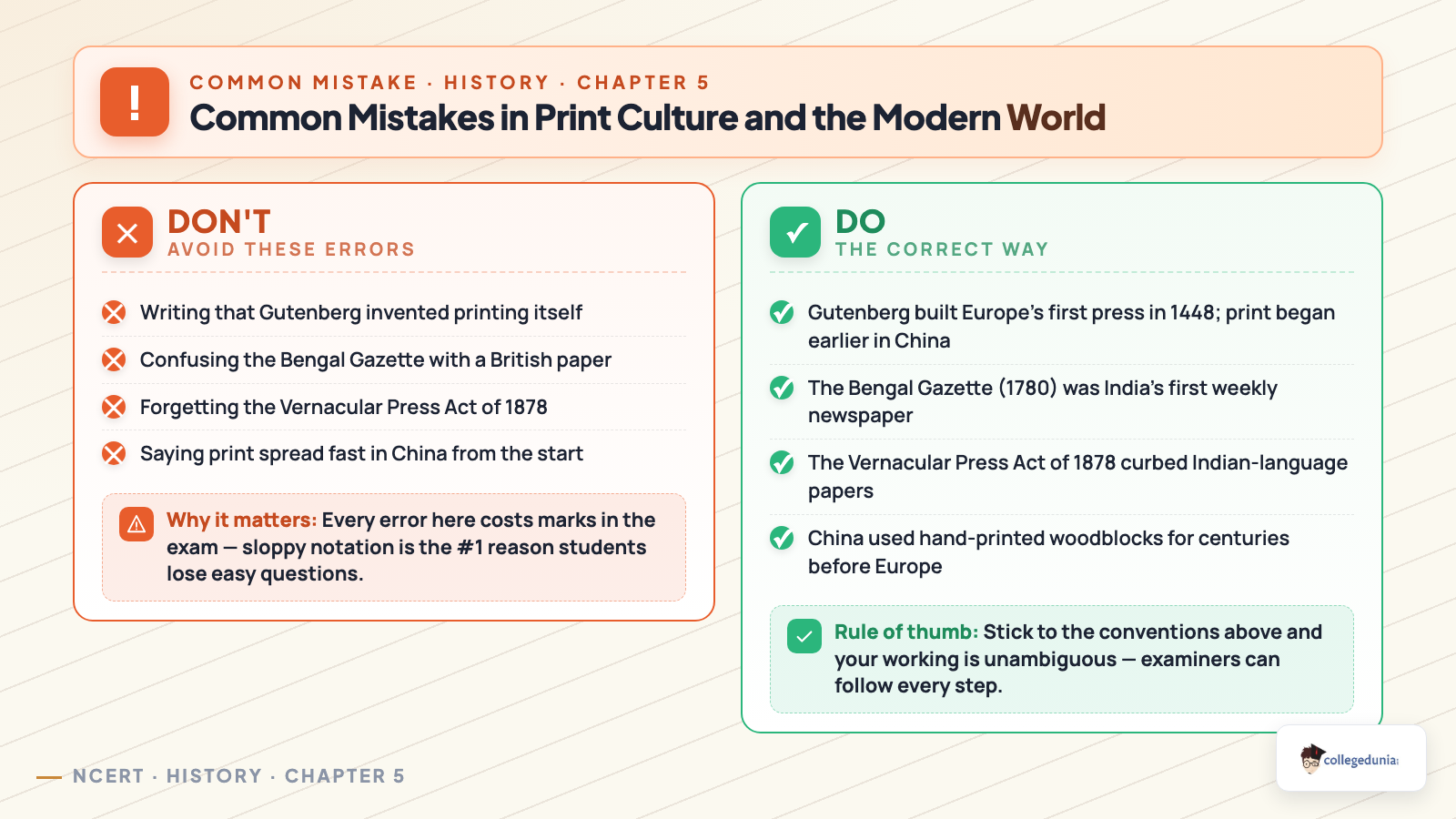
Most lost marks in this chapter come from mixing up the dates, crediting the wrong person with the press, and forgetting the censorship laws. The notes flag each of these traps with a red cue so a student does not repeat them in the exam.
- Writing that Gutenberg invented printing itself; print began centuries earlier in China.
- Confusing the Bengal Gazette with a British paper; it was India's first weekly newspaper of 1780.
- Forgetting the Vernacular Press Act of 1878 in the censorship source question.
- Saying print spread fast in Europe from the start; the print revolution took time to build.
Student Feedback on the Print Culture and the Modern World Notes
- 68% rated the print-in-Europe and Gutenberg timeline as the hardest part to keep in order.
- 4 out of 5 said the censorship and Vernacular Press Act source question is where they lose the most marks.
- The average student took about 5 hours to feel confident with the full chapter.
All Chapters Handwritten Notes for Class 10 History
The full set of Class 10 History (India and the Contemporary World II) handwritten notes is listed below, so a student can revise every chapter in the same scanned style.
| Chapter | Handwritten Notes |
|---|---|
| Chapter 1 | The Rise of Nationalism in Europe |
| Chapter 2 | Nationalism in India |
| Chapter 3 | The Making of a Global World |
| Chapter 4 | The Age of Industrialisation |
| Chapter 5 | Print Culture and the Modern World |
Other Resources for This Chapter
Pair these handwritten notes with the other Class 10 History resources for this chapter, all linked below.
| Resource | What It Helps With |
|---|---|
| Print Culture and the Modern World Class 10 NCERT Solutions | Textbook question and answer practice for the board paper |
| Print Culture and the Modern World Class 10 Notes | Detailed chapter notes for first reading and concept clarity |
| Class 10 History Chapter 5 NCERT Book PDF | The original NCERT chapter for line-by-line reading |
| Print Culture and the Modern World Class 10 Handwritten Notes | This page: scanned notes for fast last-week revision |
Are the class 10 history handwritten notes chapter 5 enough for the board exam?
For the final revision round, yes. The handwritten notes fix every date, term, and turning point in memory. Pair them with the NCERT textbook for first reading and the NCERT Solutions PDF for answer-writing practice. They are most useful in the last week before the exam.
What is the main idea of Print Culture and the Modern World Class 10?
The chapter explains how printing technology spread from East Asia to Europe and then to India, and how it changed reading, religion, and politics. It covers the first printed books, Gutenberg's press, the print revolution, print in India, and the role of print in reform and censorship.
Who invented the printing press and when?
Johann Gutenberg built the first printing press in Europe around 1448. His first major printed work was the Bible. Printing itself, using woodblocks, had already existed in China, Japan and Korea for centuries before Gutenberg's press in Europe.
When did print come to India?
Print came to India in 1556, when Portuguese priests set up the first printing press in Goa. The first Indian weekly newspaper, the Bengal Gazette, was started by James Augustus Hickey in 1780 in Calcutta.
What was the Vernacular Press Act of 1878?
The Vernacular Press Act of 1878 was a law passed by the colonial government to control Indian-language newspapers. It gave the state power to censor reports and editorials and to seize printing presses, because nationalist newspapers were spreading anti-colonial ideas.
Where can I download the Class 10 History Chapter 5 handwritten notes PDF?
You can download the Print Culture and the Modern World handwritten notes PDF from the download card at the top of this page. The notes follow the latest 2026-27 CBSE syllabus and the NCERT India and the Contemporary World II textbook.
What was the print revolution?
The print revolution was the shift from hand-copied books to printed books in Europe after Gutenberg's press. Books became cheaper and faster to produce, a new reading public grew, and ideas, including those of the Reformation, spread quickly across the continent.
How did print help religious reform in India?
Print let reformers publish their ideas cheaply and reach a wide public. Social and religious reformers used newspapers, pamphlets and books to debate issues like widow remarriage and caste, so public debate on reform spread far beyond a small circle of scholars.



Comments