




The Class 11 Physics NCERT Solutions Chapter 12 Kinetic Theory will help students prepare for Boards, JEE Main, JEE Advanced, NEET, CUET and NDA in 2026-27. Every back-exercise question is solved with full working, so students can check each pressure derivation, rms-speed calculation, degrees-of-freedom count, and mean free path step by step.
This chapter links the behaviour of a gas to the motion of its molecules, and it sets up the thermodynamics work that follows.
- CBSE Weightage: 4 to 5 marks, usually one short answer plus one numerical on rms speed or the ideal gas equation.
- Questions solved: all Exercise 12.1 onward, covering the ideal gas equation, kinetic pressure, temperature, and mean free path.
- Key formulas: PV = nRT, P = ⅓ρv2, vrms = √(3RT/M), equipartition, mean free path.
Each solution in this Class 11 Physics NCERT Solutions Chapter 12 Kinetic Theory compilation is curated by subject experts, based on the 2026-27 NCERT textbook, and refined against the last five years of CBSE Board, JEE Main and NEET papers.
Kinetic Theory of Gases and the Molecular Model
The chapter builds the whole subject on one idea. A gas is a huge number of tiny molecules in constant, random motion. The kinetic theory of gases explains pressure, temperature, and heat from this motion alone. Getting the model right is the first step in solving any numerical in this chapter.
| Assumption | What it means |
|---|---|
| Molecules are point-like | Their own volume is tiny compared to the container volume. |
| No force between molecules | Except during a collision, molecules move freely in straight lines. |
| Collisions are elastic | Kinetic energy is conserved in every molecule-wall and molecule-molecule hit. |
| Motion is random | All directions of velocity are equally likely. |
The NCERT questions here ask students to link a large-scale quantity, such as pressure, to the average behaviour of molecules. A real gas behaves like an ideal gas at low pressure and high temperature. The solved answers state which assumption each numerical uses, so no step is skipped. This habit prevents the most common conceptual slip in the chapter.
The Ideal Gas Equation and the Gas Laws
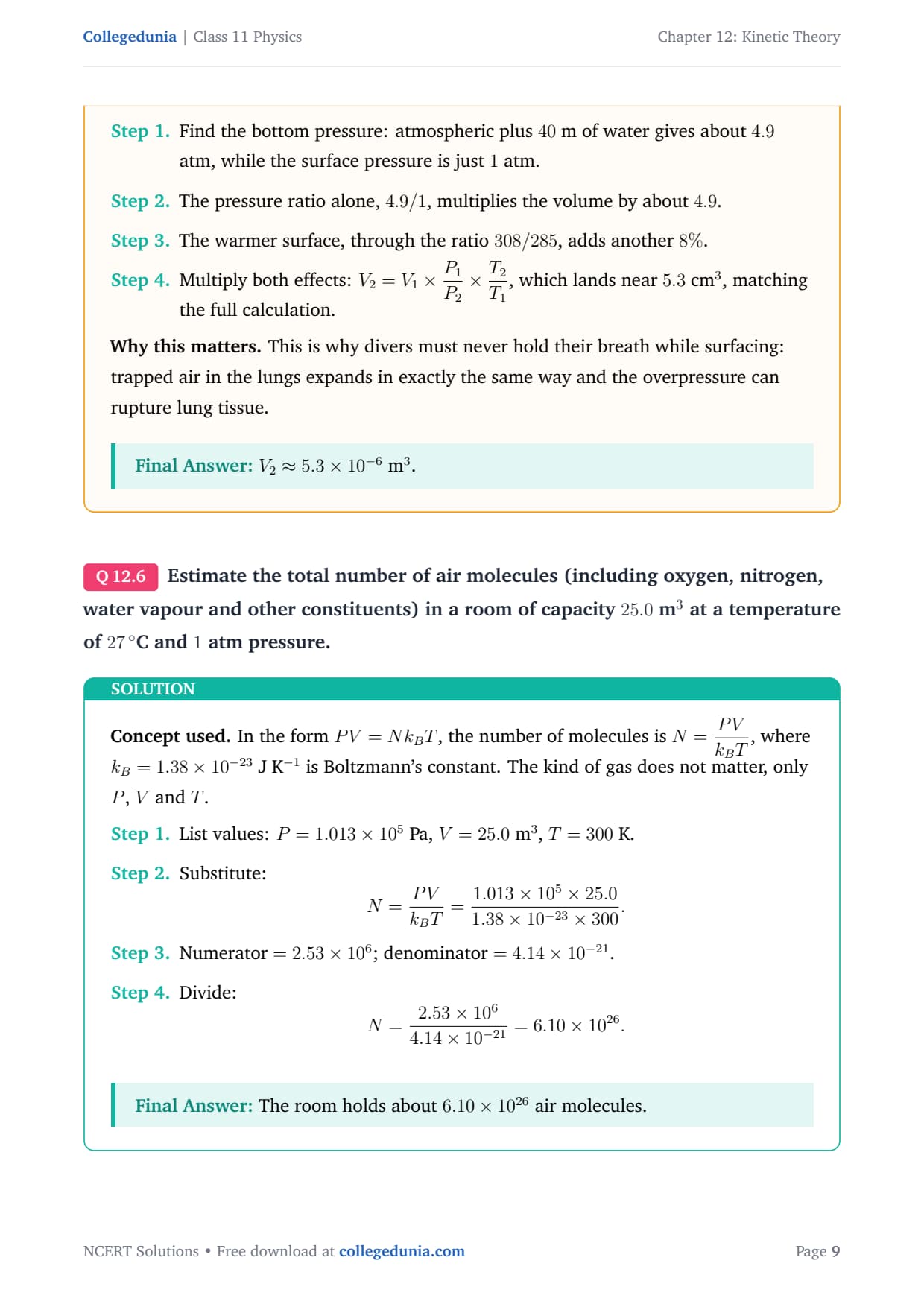
The ideal gas equation ties together pressure, volume, temperature, and the amount of gas. In the form PV = nRT, it holds the gas laws that came before it. The chapter uses it in most numericals, and the NCERT solutions apply it to every gas-property question.
- Boyle's law: at fixed temperature, PV is constant.
- Charles' law: at fixed pressure, V/T is constant.
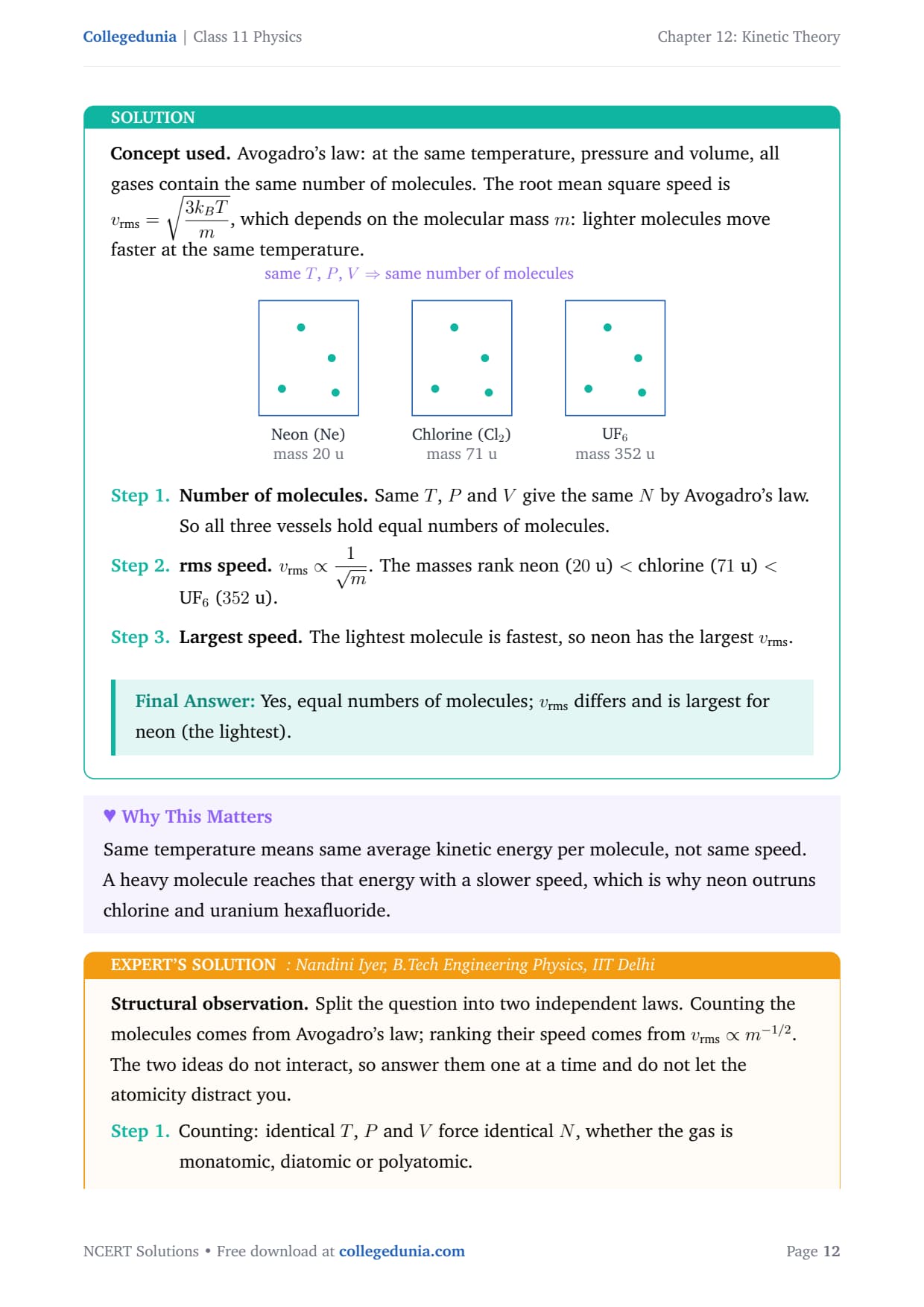
- Avogadro's law: equal volumes of gases at the same pressure and temperature hold equal numbers of molecules.
- Molecular form: PV = NkBT, where kB is the Boltzmann constant.
Numericals such as Exercise 12.1 and Exercise 12.3 use this equation to find a volume, a pressure, or the number of molecules. Always put the temperature in kelvin before you substitute. The Class 11 Physics NCERT Solutions Chapter 12 Kinetic Theory show the kelvin conversion on its own line so students never lose a mark on this step.
Kinetic Interpretation of Pressure of a Gas
The chapter derives pressure from molecular collisions with the container wall. Each molecule that bounces off a wall gives it a tiny push. Add up all these pushes over the whole wall, and you get the steady pressure of the gas. This derivation is a frequent short-answer question.
The result of the derivation is the central formula of the chapter, and the NCERT solutions show every stage of it.
| Form | Meaning |
|---|---|
| P = ⅓ρv2rms | ρ is the gas density, vrms is the root-mean-square speed. |
| P = ⅓(N/V)m v2rms | N/V is the number of molecules per unit volume. |
| P = ⅔(N/V) × ½m v2rms | Pressure equals two-thirds of the kinetic energy per unit volume. |
This last form is the bridge to the next section. Pressure is directly linked to the average kinetic energy of the molecules. The solved answers rewrite the formula in whichever form the question needs, so students see how one relation feeds the next.
Kinetic Energy, Temperature and RMS Speed
Joining the pressure formula with the ideal gas equation gives the chapter's most important idea. Temperature is a measure of the average kinetic energy of the molecules. Nothing else in the gas sets the temperature. The NCERT solutions use this link in every speed and energy numerical.
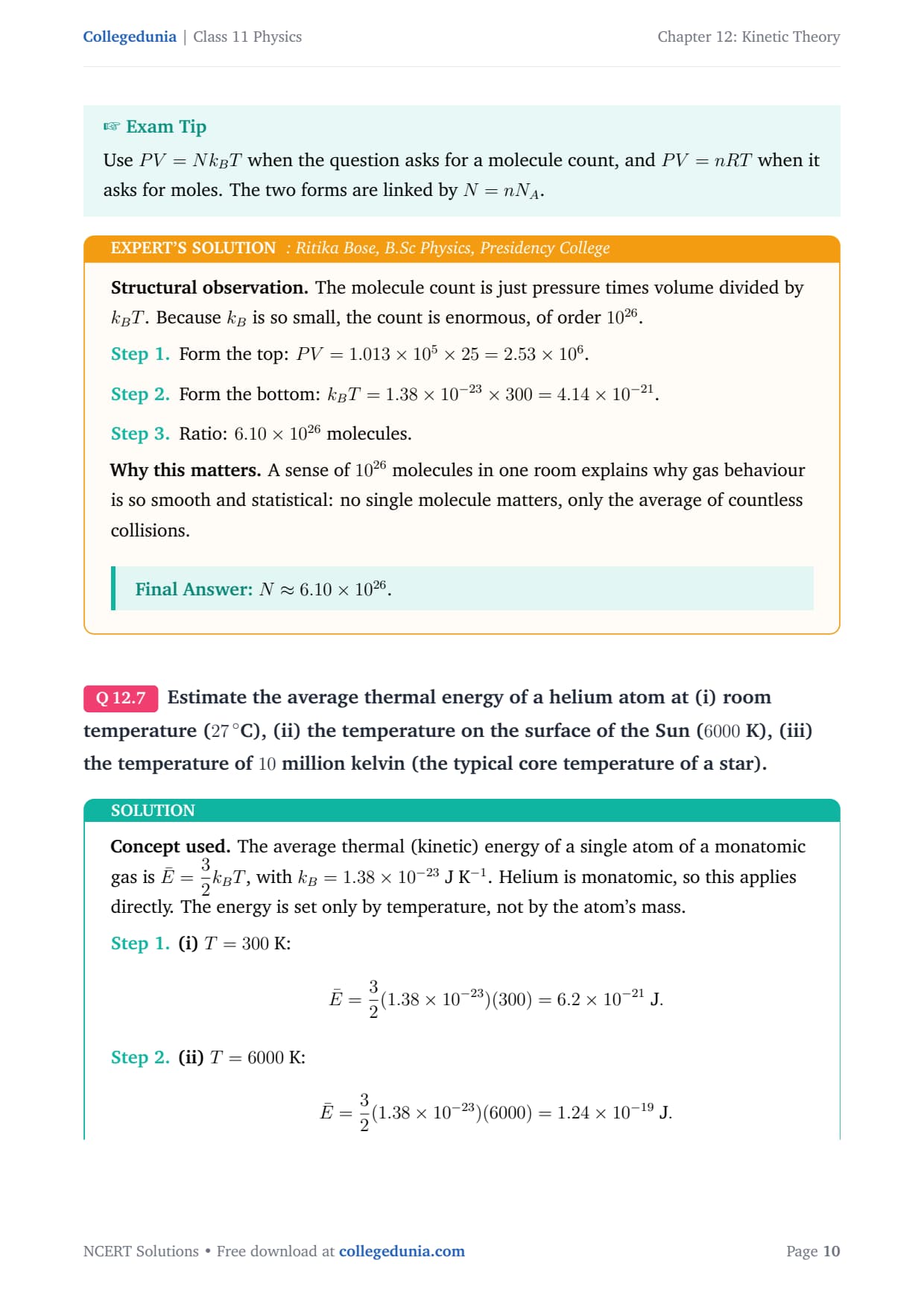
- Average kinetic energy per molecule: ½m v2rms = (3/2)kBT, which depends only on temperature.
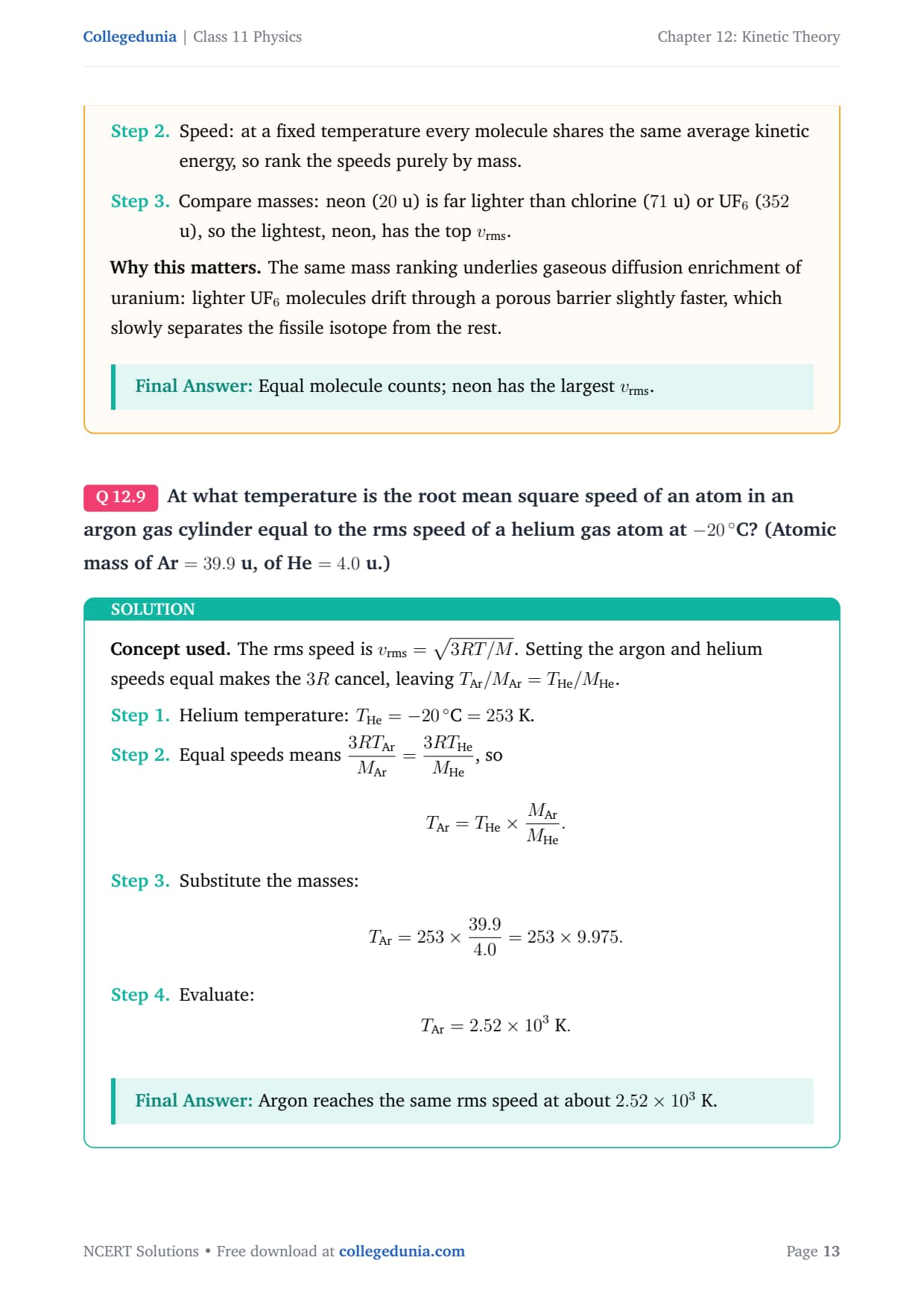
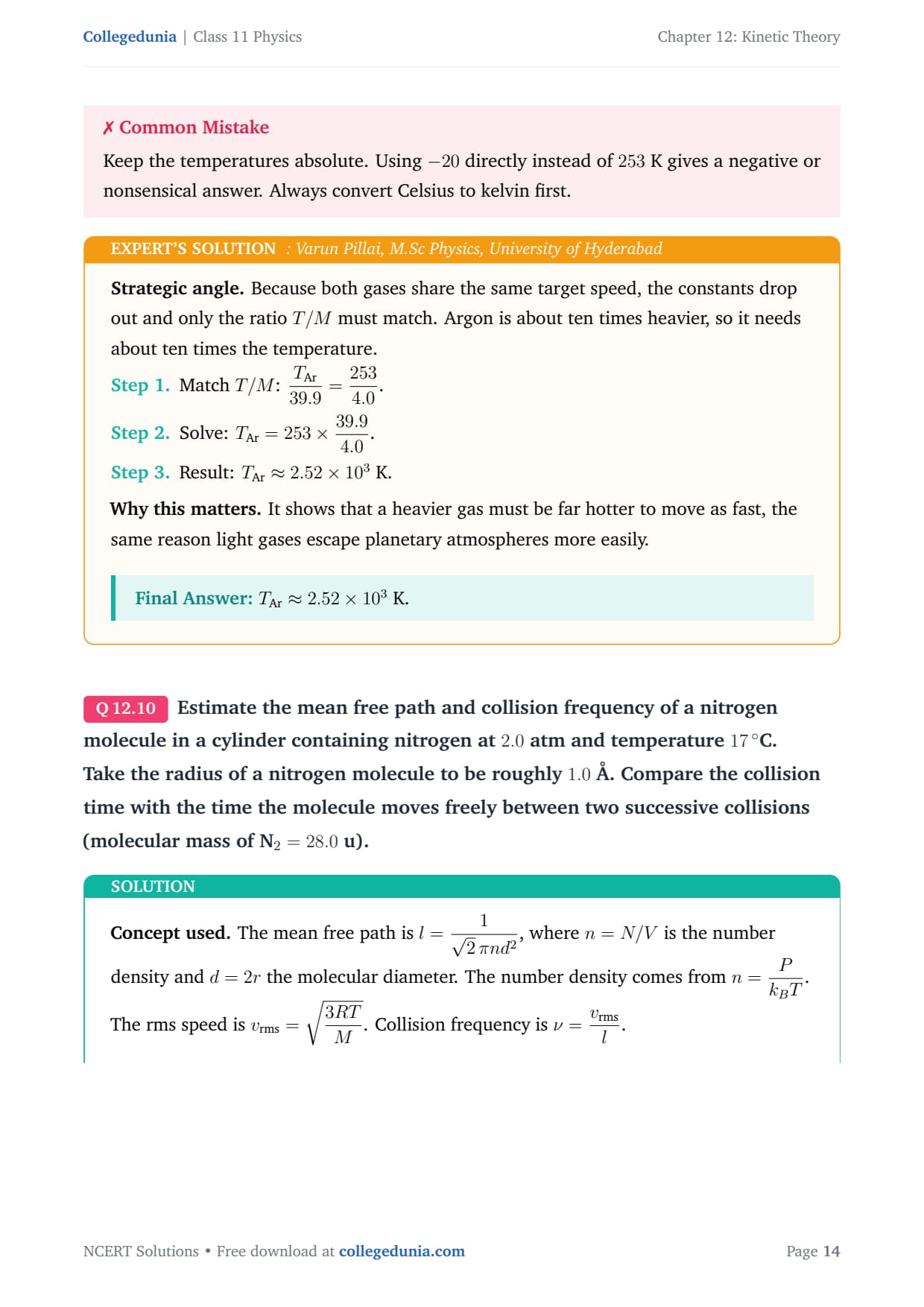
- RMS speed: vrms = √(3kBT/m) = √(3RT/M), where M is the molar mass.
- Speed and mass: at the same temperature, a lighter molecule moves faster than a heavier one.
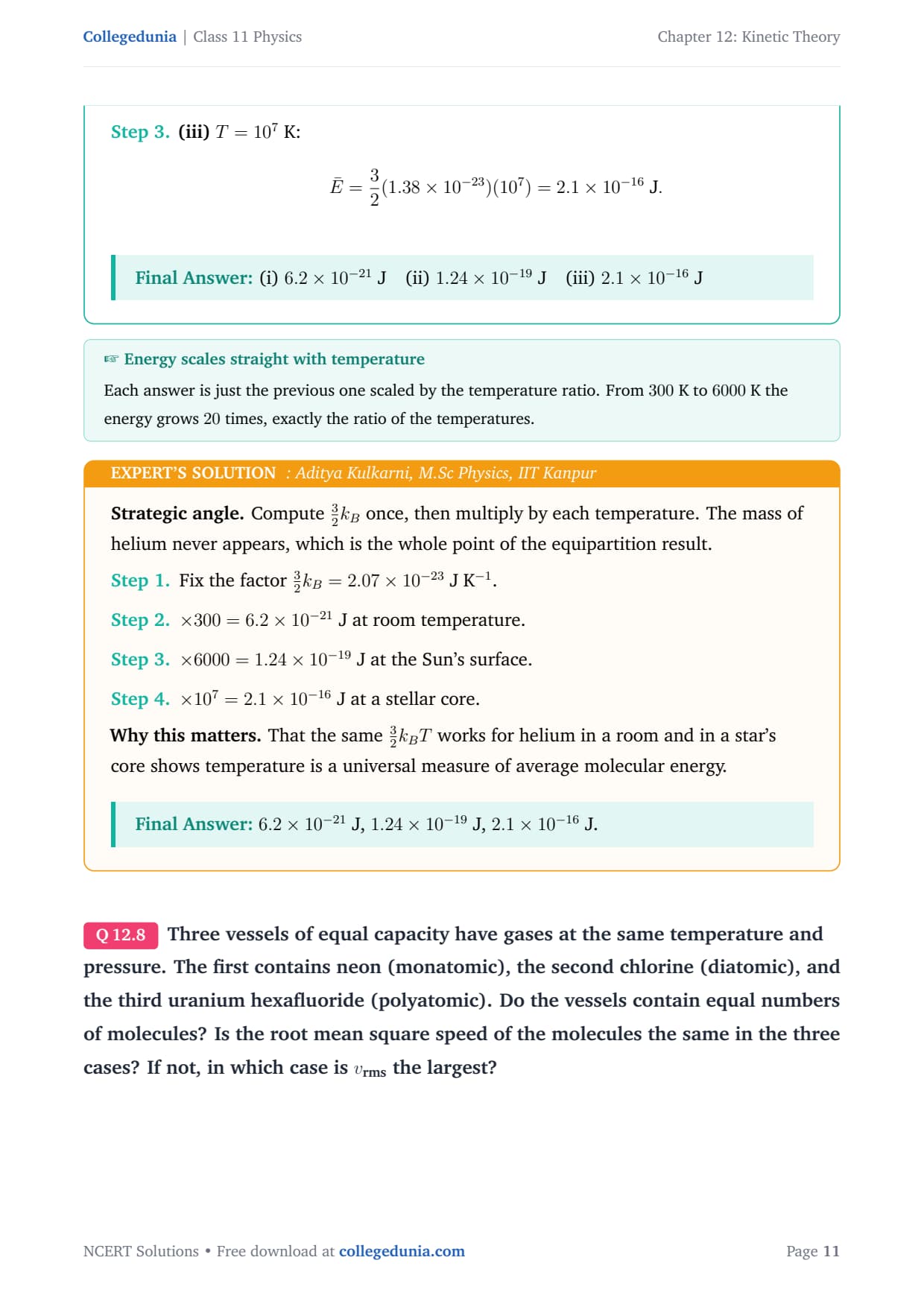
Questions like Exercise 12.7 and Exercise 12.8 ask students to compare the rms speeds of two gases or to find a speed at a new temperature. The average kinetic energy of a molecule is the same for every gas at the same temperature. This single fact answers many objective questions in JEE Main and NEET, so the solved answers state it clearly.
Degrees of Freedom and the Law of Equipartition of Energy
A molecule can store energy in more than one way. The number of independent ways it can move is its number of degrees of freedom. A single atom can only move along three directions, but a molecule with two or more atoms can also rotate. The chapter counts these carefully because they fix the energy of the gas.
| Type of gas | Translational | Rotational | Total (room temperature) |
|---|---|---|---|
| Monatomic (He, Ar) | 3 | 0 | 3 |
| Diatomic (O2, N2) | 3 | 2 | 5 |
| Polyatomic (non-linear) | 3 | 3 | 6 |
The law of equipartition of energy then shares the energy out equally. Each degree of freedom carries an average energy of ½kBT per molecule. To find the total internal energy, multiply this share by the number of degrees of freedom and by the number of molecules. The solved answers show this multiplication step by step, so students can reuse it for any gas.
Specific Heat Capacity of Gases
Once the internal energy is known, the chapter finds the specific heat capacity of a gas. This is the heat needed to raise the temperature of one mole by one kelvin. A gas has two values, because it can be heated at constant volume or at constant pressure. The NCERT solutions derive both from the degrees of freedom.
| Gas | CV | CP | γ = CP/CV |
|---|---|---|---|
| Monatomic | (3/2)R | (5/2)R | 1.67 |
| Diatomic | (5/2)R | (7/2)R | 1.40 |
| Polyatomic | 3R | 4R | 1.33 |
The link between the two values is fixed by the Mayer relation, CP − CV = R. The ratio γ falls as the molecule gains more degrees of freedom. Numericals such as Exercise 12.10 test whether students can pick the right specific heat for the gas in the problem, so the solved answers name the gas type first.
Mean Free Path and Avogadro's Number
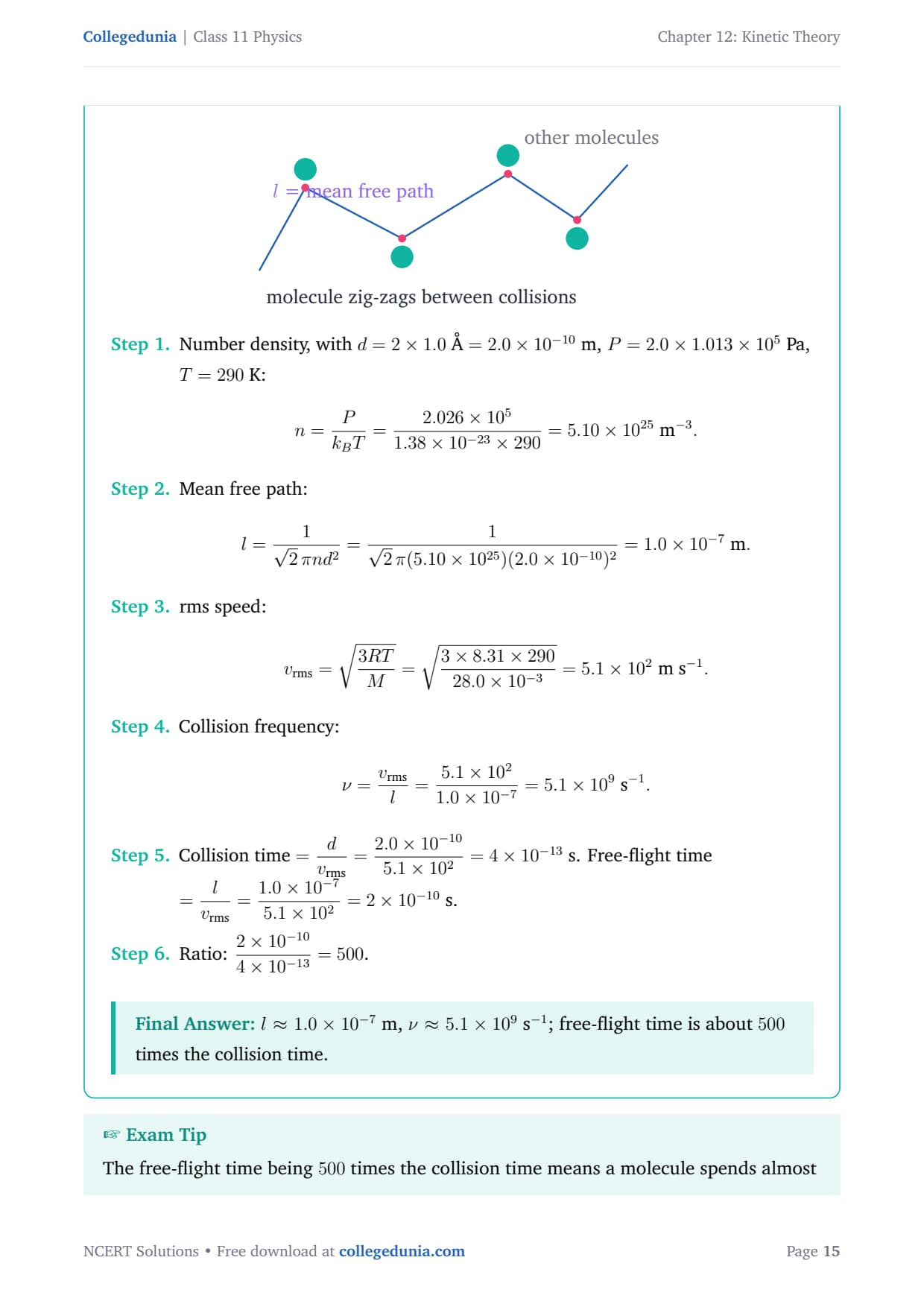
Between two collisions, a molecule travels a short straight path. The average length of this path is the mean free path. It sets how far a molecule goes before it changes direction, and it explains why smells spread slowly even though molecules move fast. This topic appears in both short-answer and objective questions.
- Mean free path: λ = 1/(√2 π d2 n), where d is the molecular diameter and n is the number density.
- Pressure link: raising the pressure packs molecules closer, so the mean free path falls.
- Avogadro's number: NA = 6.022 × 10²³ molecules in one mole of any substance.
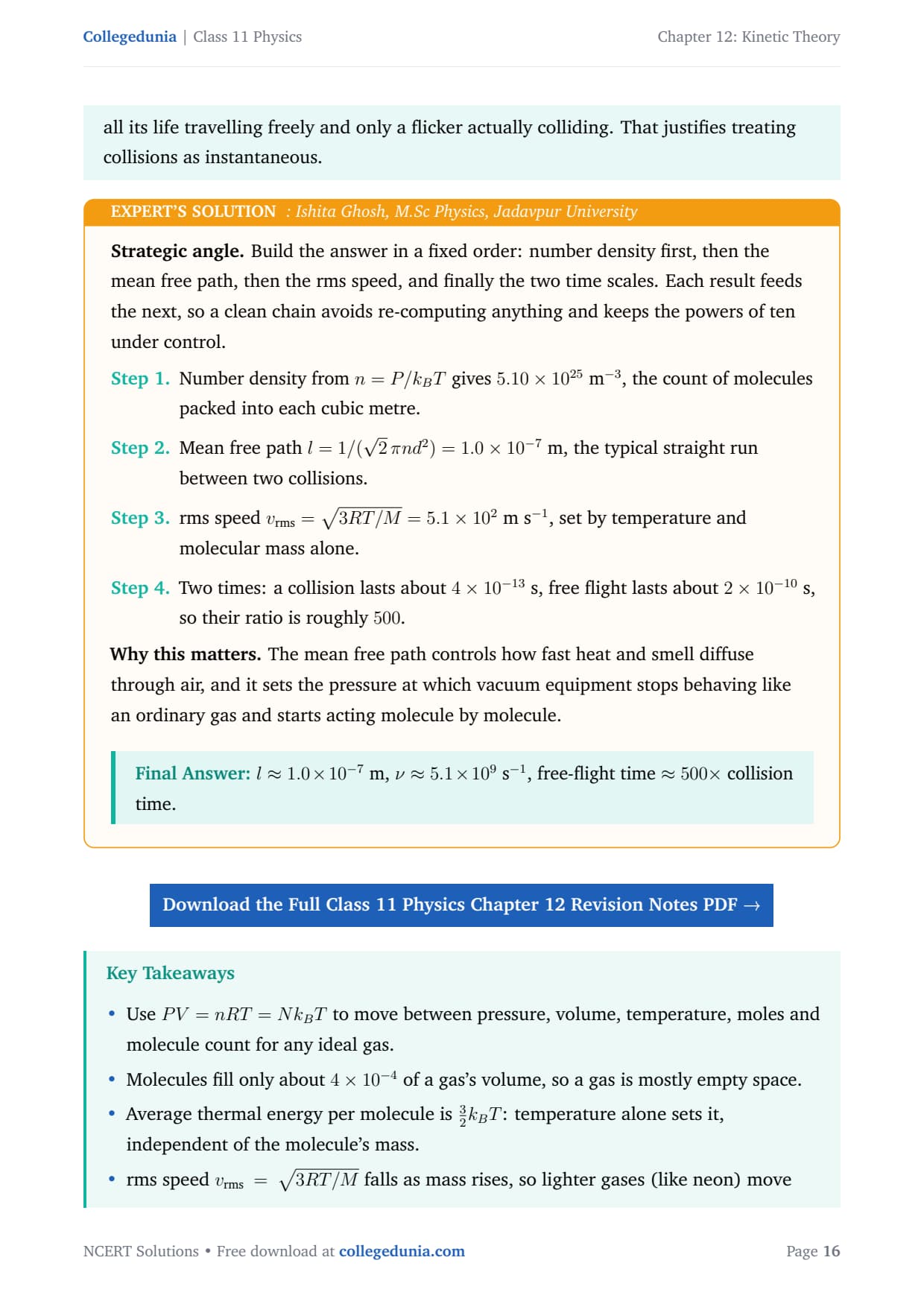
Questions like Exercise 12.12 ask students to estimate the mean free path or the number of collisions per second. The mean free path is inversely proportional to both the number density and the square of the molecular size. The Class 11 Physics NCERT Solutions Chapter 12 Kinetic Theory keep every quantity in SI units before substituting, exactly as CBSE expects.
Exercise-wise Breakdown for Class 11 Physics Chapter 12 Kinetic Theory
The NCERT back-exercise splits into clear groups. Use this map to plan which answers to practise first for the 2026-27 boards. Every group links to the full solved set.
| Question group | Exercises | What it covers |
|---|---|---|
| Ideal gas equation | Exercise 12.1 to Exercise 12.4 | Volume, pressure and molecule-count problems using PV = nRT |
| Molecular speeds and energy | Exercise 12.5 to Exercise 12.9 | RMS speed, average kinetic energy, temperature comparison |
| Degrees of freedom and specific heat | Exercise 12.10 to Exercise 12.11 | Equipartition, internal energy, specific heat ratio |
| Mean free path and estimation | Exercise 12.12 onward | Mean free path, collision frequency, real-world estimates |
Solving the groups in this order builds the skills in the same sequence the chapter teaches them. Start with the ideal gas equation, then speeds, then degrees of freedom, because each group uses the one before it.
Common Mistakes Students Make in the Kinetic Theory Chapter
These slips happen while writing or calculating the answer, not because the concept is unclear. Each one costs 1 to 3 marks in the CBSE paper, so the solved answers point them out at the exact step.
Mistake 1: Using temperature in celsius. Every gas formula needs the temperature in kelvin, so convert before you substitute.
Mistake 2: Confusing rms speed with average speed. Use vrms = √(3RT/M) unless the question asks for the mean or most probable speed.
Mistake 3: Counting the wrong degrees of freedom. A diatomic gas at room temperature has 5, not 3, so its energy and specific heat change.
Mistake 4: Mixing molar mass in grams with SI units. Convert the molar mass to kilograms per mole before using it in a speed formula.
Student Feedback on the Kinetic Theory Chapter
What 12,840 students told us about their Kinetic Theory revision:
- 71% of students rated degrees of freedom and specific heat as the hardest sub-topic in the chapter.
- Most-skipped step: converting temperature to kelvin, missed by about 3 in 10 students.
- Students who solved the pressure derivation first reported the rms-speed numericals felt easier.
Source: 2026-27 Class 11 Physics student poll. Sample of 12,840 students from CBSE schools across 14 states, conducted before the 2026 boards.
Practice Questions for Class 11 Physics Chapter 12 Kinetic Theory
Once the solved answers are clear, test yourself on the full question set. The practice page has every NCERT question with a step-by-step Solution and an Expert Solution behind a click.
Practice Questions: Kinetic Theory
Attempt all NCERT questions with detailed and expert solutions.
Open Practice QuestionsOther Kinetic Theory Class 11 Physics Resources
| Resource | Link |
|---|---|
| NCERT Solutions | You are here |
| Notes | Kinetic Theory Class 11 Notes |
| Handwritten Notes | Kinetic Theory Class 11 Handwritten Notes |
| Formula Sheet | Kinetic Theory Class 11 Formula Sheet |
| NCERT Book PDF | Kinetic Theory Class 11 Book PDF |
NCERT Solutions for Class 11 Physics: All Chapters
Jump to the solutions for any other Class 11 Physics chapter below.
| Chapter | NCERT Solutions |
|---|---|
| Chapter 1 | Units and Measurements |
| Chapter 2 | Motion in a Straight Line |
| Chapter 3 | Motion in a Plane |
| Chapter 4 | Laws of Motion |
| Chapter 5 | Work, Energy and Power |
| Chapter 6 | System of Particles and Rotational Motion |
| Chapter 7 | Gravitation |
| Chapter 8 | Mechanical Properties of Solids |
| Chapter 9 | Mechanical Properties of Fluids |
| Chapter 10 | Thermal Properties of Matter |
| Chapter 11 | Thermodynamics |
| Chapter 12 | Kinetic Theory |
| Chapter 13 | Oscillations |
| Chapter 14 | Waves |
FAQs on Class 11 Physics Chapter 12 Kinetic Theory NCERT Solutions
Kinetic Theory NCERT Solutions - Frequently Asked Questions
Ques. How many questions are solved in the Class 11 Physics NCERT Solutions Chapter 12 Kinetic Theory?
Ans. This page solves every NCERT back-exercise question of Class 11 Physics Chapter 12 Kinetic Theory, starting from Exercise 12.1. The questions cover the ideal gas equation, kinetic pressure, rms speed, degrees of freedom, and mean free path. Each answer has a step-by-step Solution and an Expert Solution.
Ques. What is the kinetic theory of gases in Chapter 12?
Ans. The kinetic theory of gases treats a gas as a large number of tiny molecules in constant, random motion. Their collisions with the container wall create pressure, and their average kinetic energy sets the temperature. The theory explains the gas laws and the ideal gas equation from molecular motion alone.
Ques. How do I calculate the rms speed of a gas in Class 11 Physics Chapter 12?
Ans. The root-mean-square speed is vrms = √(3RT/M), where R is the gas constant, T is the temperature in kelvin, and M is the molar mass in kilograms per mole. Convert the temperature to kelvin and the molar mass to SI units first. The solved numericals in these Class 11 Physics Chapter 12 solutions show each step.
Ques. What is the law of equipartition of energy?
Ans. The law of equipartition of energy states that each degree of freedom of a molecule holds an average energy of ½kBT per molecule. A monatomic gas has 3 degrees of freedom, a diatomic gas has 5 at room temperature. Multiply the share by the number of degrees of freedom to find the total internal energy.
Ques. What is the weightage of Kinetic Theory in the CBSE board exam?
Ans. Kinetic Theory carries about 4 to 5 marks in the CBSE Class 11 Physics paper, usually one short answer plus one numerical on rms speed or the ideal gas equation. It also appears in JEE Main and NEET as objective questions on degrees of freedom, specific heat ratio, and mean free path.
Ques. What is the mean free path of a gas molecule?
Ans. The mean free path is the average distance a molecule travels between two successive collisions. It is given by λ = 1/(√2 π d2 n), where d is the molecular diameter and n is the number density. Raising the pressure packs molecules closer, so the mean free path falls. The Class 11 Physics NCERT Solutions Chapter 12 Kinetic Theory work every such numerical in SI units.



Comments