




The Class 11 Physics NCERT Solutions Chapter 13 Oscillations will help students prepare for Boards, JEE Main, JEE Advanced, NEET, CUET and NDA in 2026-27. Every back-exercise question is solved with full working, so students can check each time period, angular frequency, phase, and energy calculation step by step.
This chapter builds the mathematics of simple harmonic motion that the next chapter on Waves uses directly.
- CBSE Weightage: 4 to 6 marks, usually one short answer plus one numerical on SHM, springs, or the simple pendulum.
- Questions solved: all Exercise 13.1 onward, covering periodic motion, SHM, energy in SHM, springs, and pendulums.
- Key formulas: displacement equation of SHM, time period of a spring and a pendulum, total energy in SHM.
Each solution in this Class 11 Physics NCERT Solutions Chapter 13 Oscillations compilation is curated by subject experts, based on the 2026-27 NCERT textbook, and refined against the last five years of CBSE Board, JEE Main and NEET papers.
Periodic and Oscillatory Motion in Class 11 Physics Chapter 13
The chapter starts by separating two ideas that students often mix up. A periodic motion repeats after a fixed time, like the hands of a clock or a planet in orbit. An oscillatory motion is a periodic motion that moves to and fro about a fixed mean position, like a swing or a vibrating string. Every oscillation is periodic, but not every periodic motion is an oscillation.
- Period (T): the time for one full oscillation, measured in seconds.
- Frequency (ν): the number of oscillations per second, ν = 1/T, measured in hertz.
- Angular frequency (ω): ω = 2π/T = 2πν, measured in radian per second.
- Displacement: the distance of the body from its mean position at any instant.
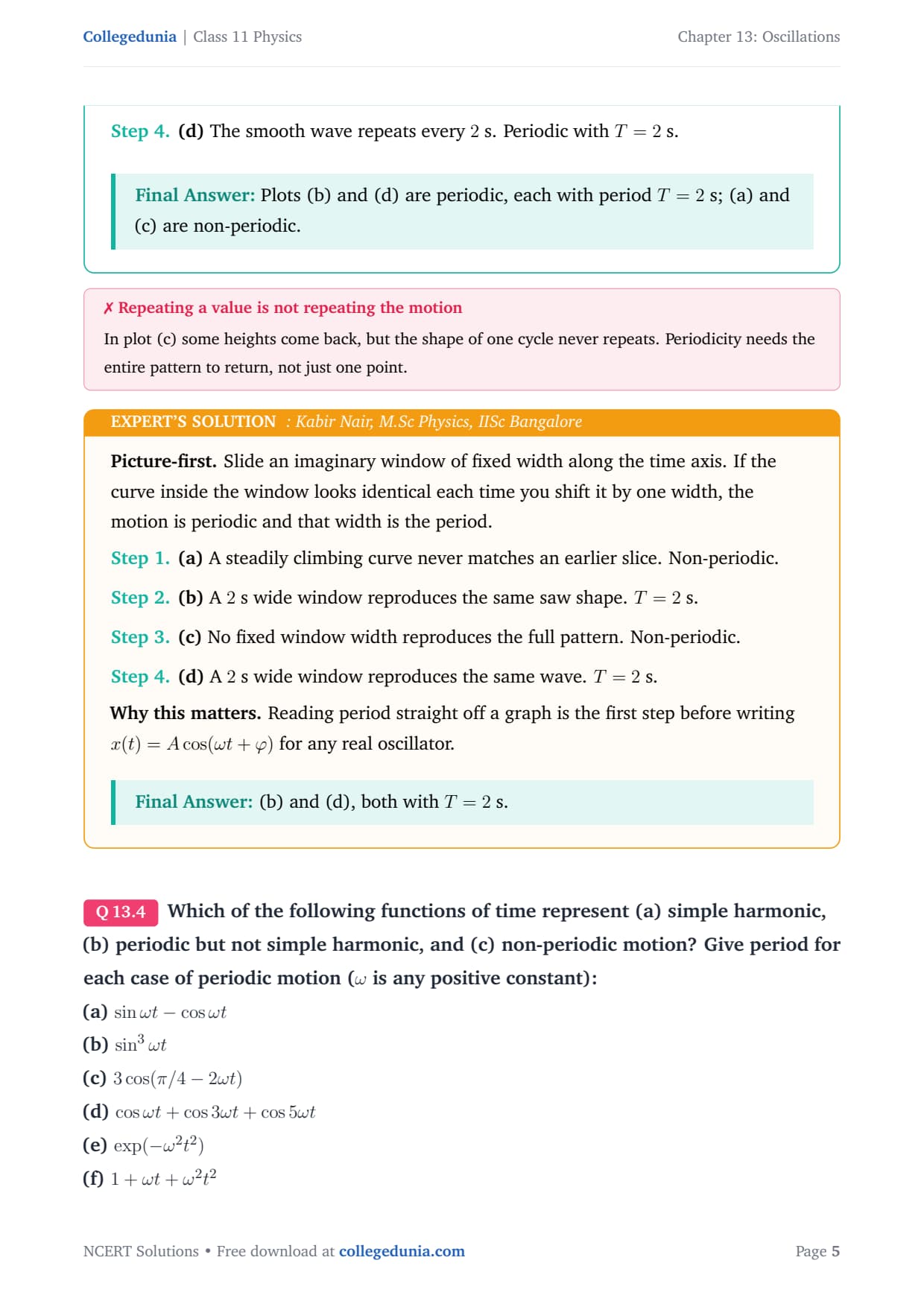
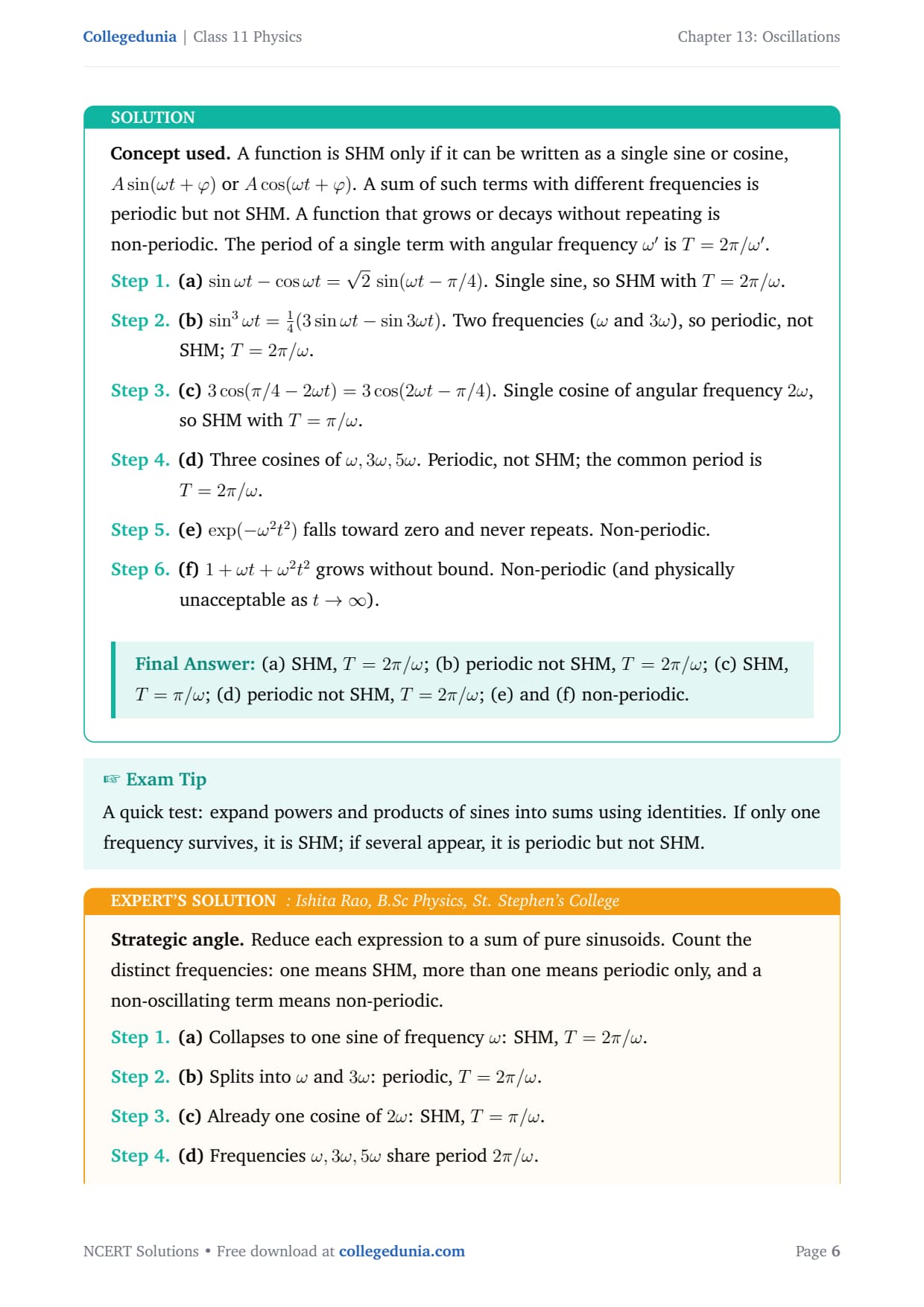
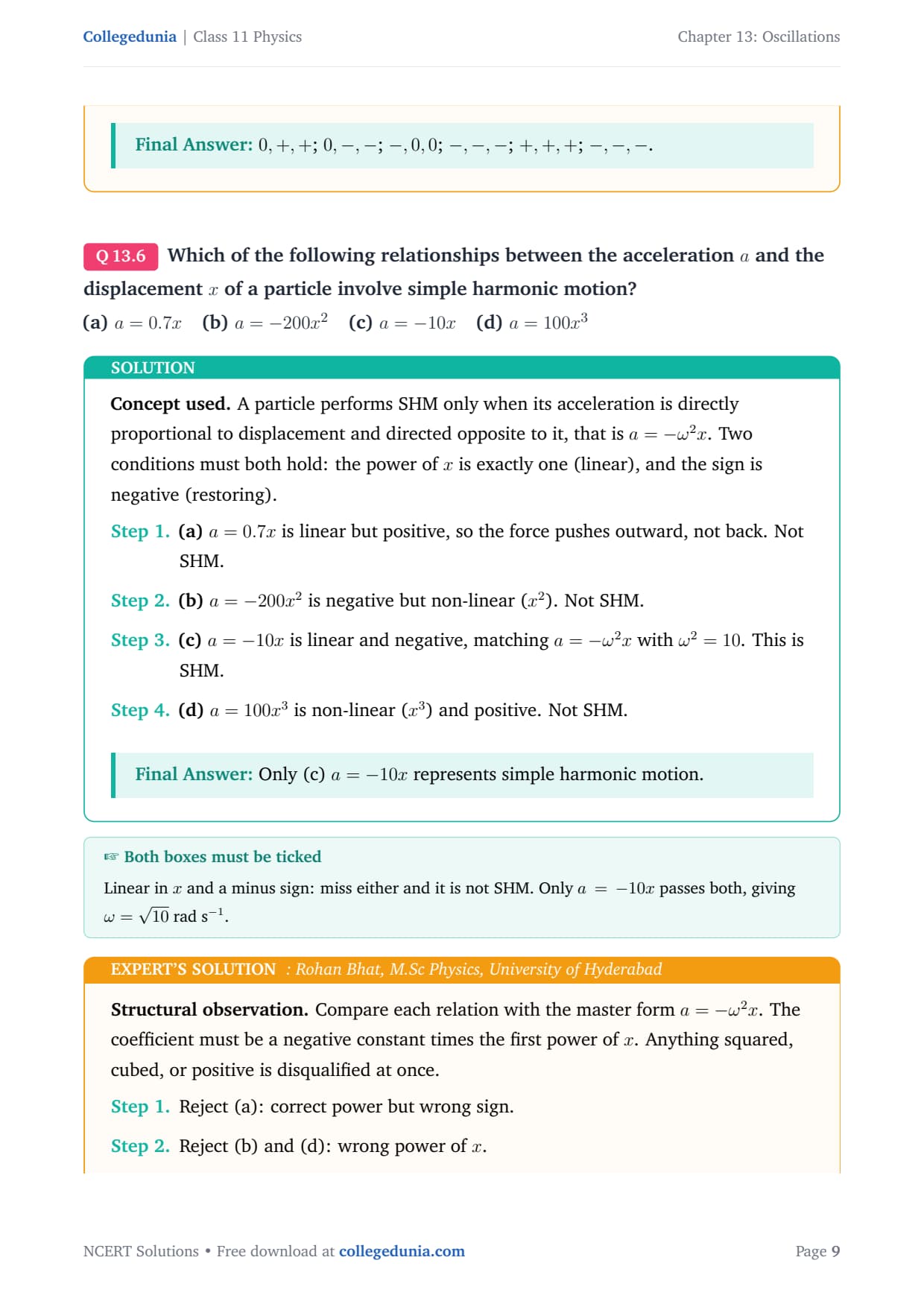
The NCERT questions here, such as Exercise 13.1, ask students to decide whether a given motion is periodic, simple harmonic, or neither. A motion is simple harmonic only if the restoring force is directly proportional to the displacement and points toward the mean position. The solved answers apply this single test to every example so students learn to sort the cases quickly.
Simple Harmonic Motion: Displacement, Velocity and Acceleration
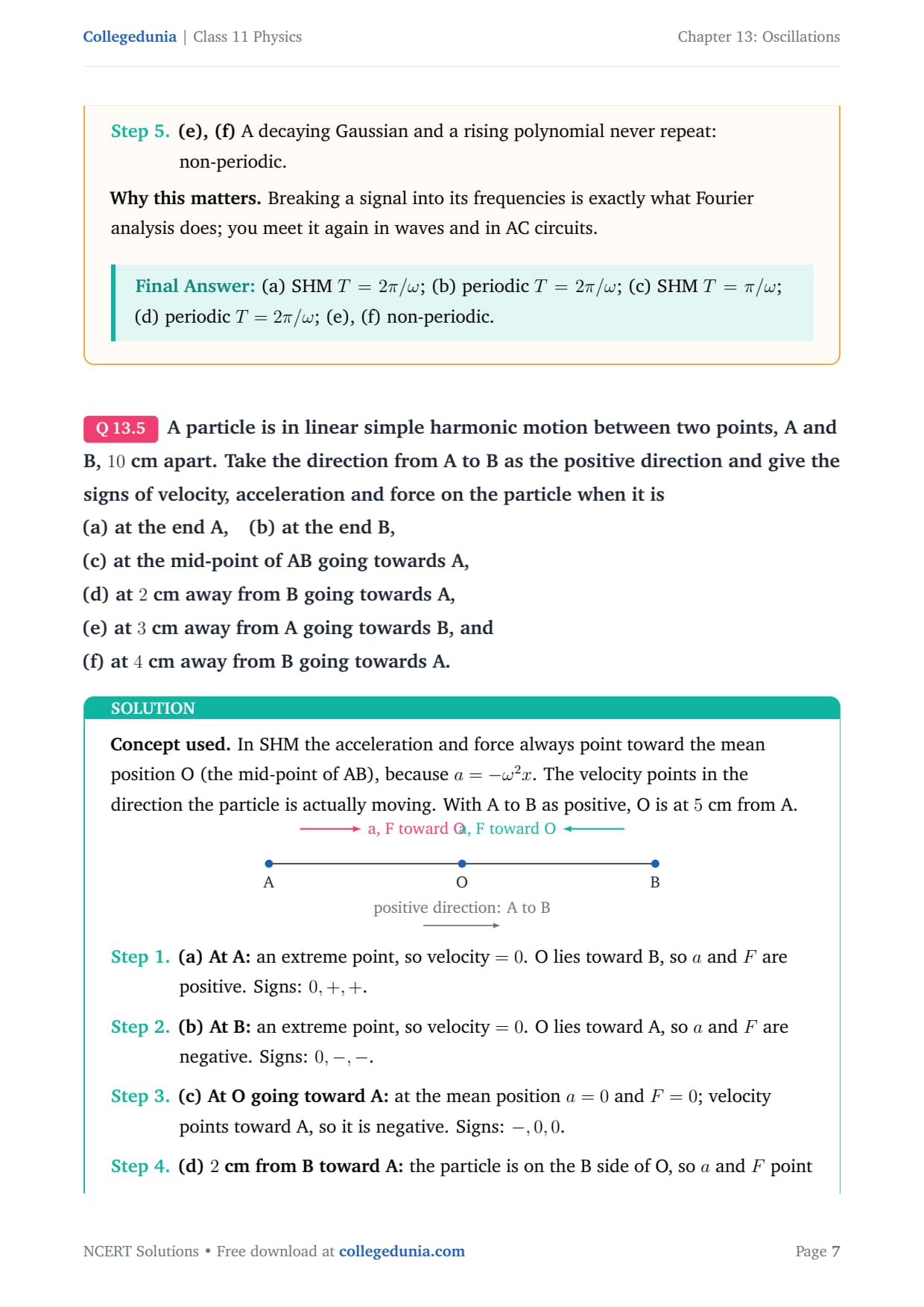
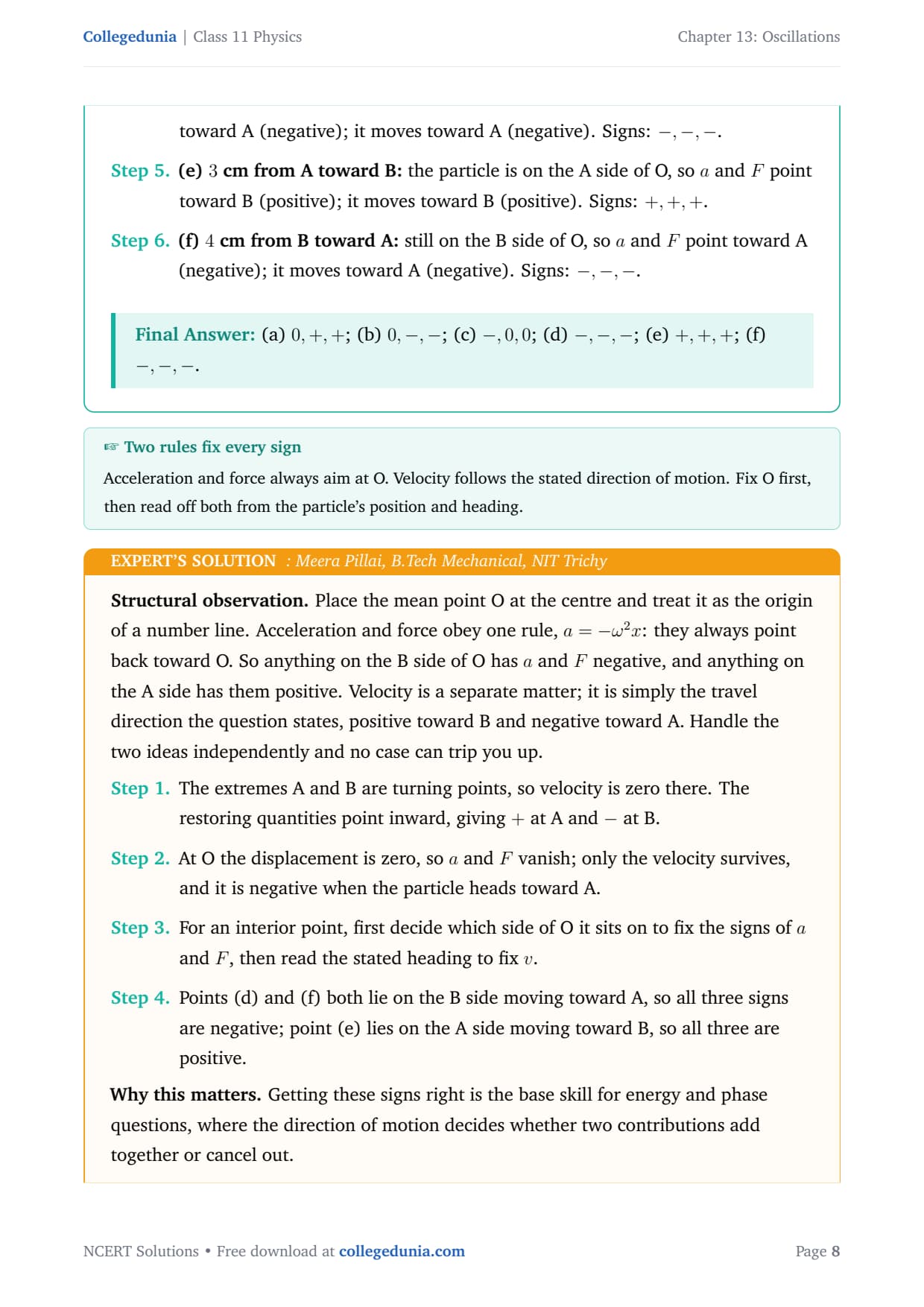
Simple harmonic motion (SHM) is the simplest oscillation. The body moves so that its acceleration always points to the mean position and its size is proportional to the displacement. This gives the standard displacement equation that the whole chapter is built on.
| Quantity | Equation | Maximum value |
|---|---|---|
| Displacement | x = A cos(ωt + φ) | A (amplitude) |
| Velocity | v = -Aω sin(ωt + φ) | Aω |
| Acceleration | a = -ω2 x | Aω2 |
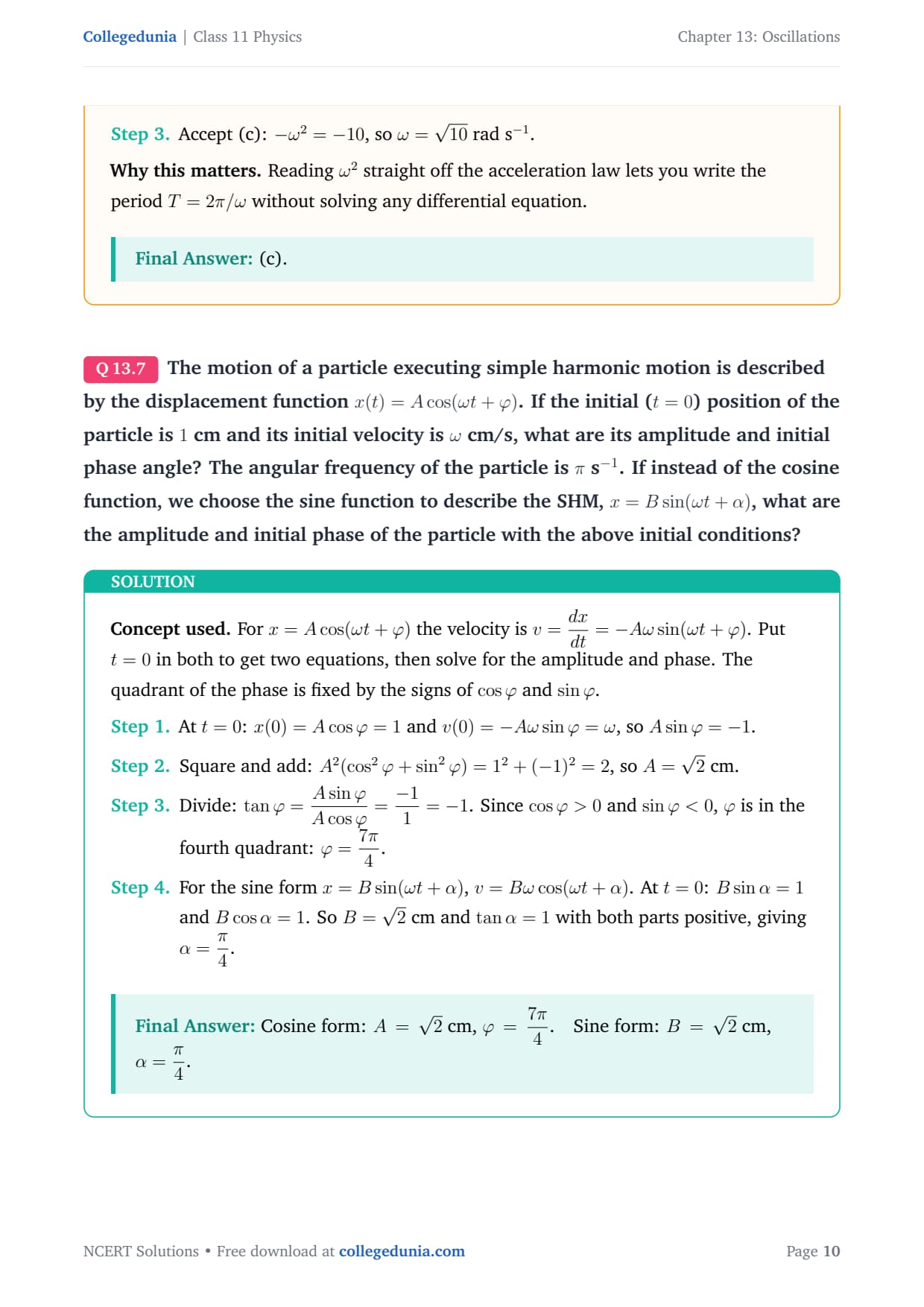
Numericals like Exercise 13.4 give the displacement equation and ask for the amplitude, period, and phase. The velocity is largest at the mean position and zero at the ends; the acceleration is largest at the ends and zero at the mean. The defining relation of SHM is a = -ω2 x, and the Class 11 Physics NCERT Solutions Chapter 13 Oscillations show how to read ω straight from this equation.
Phase and SHM as a Projection of Uniform Circular Motion
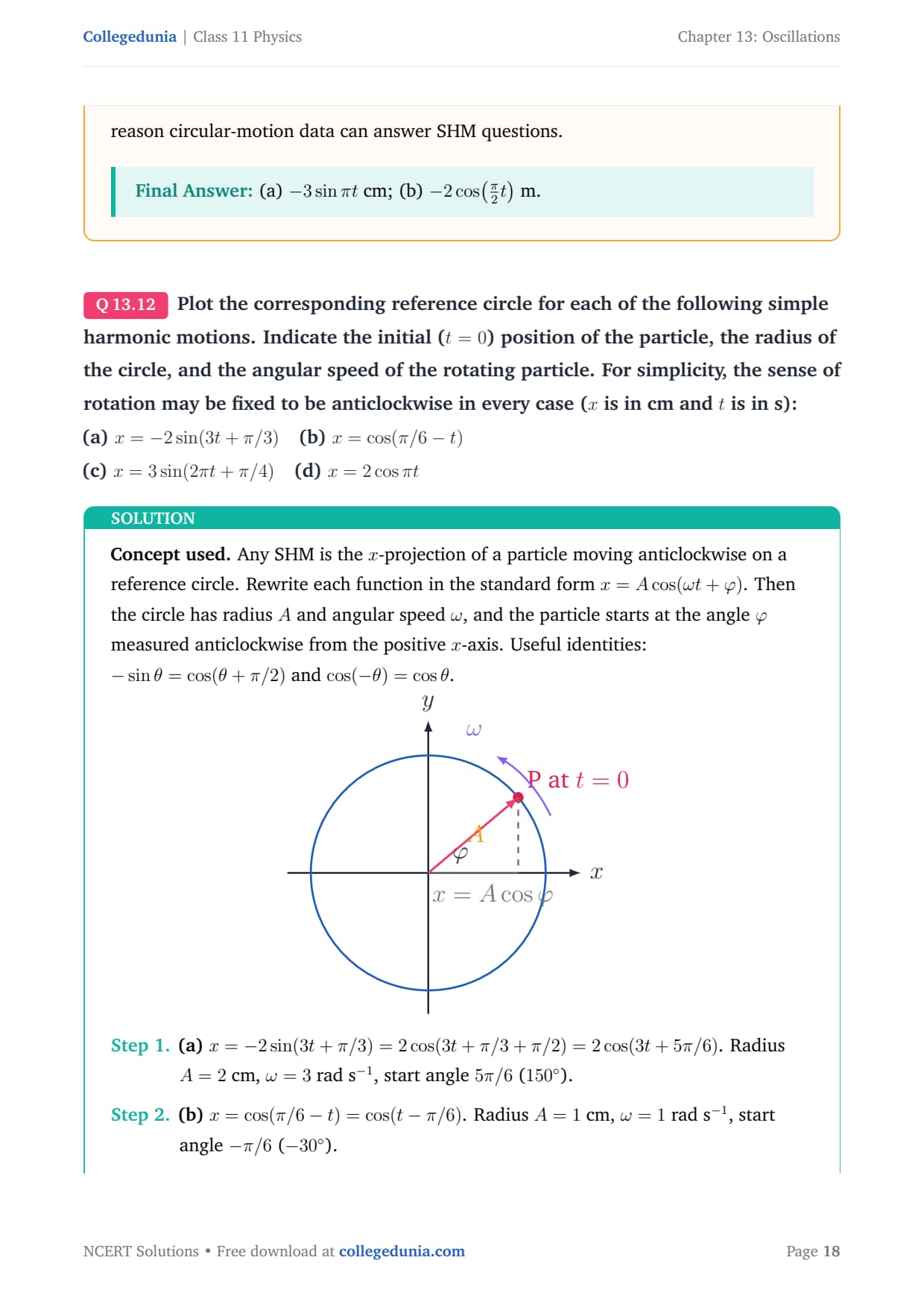
The phase of an oscillation is the quantity (ωt + φ) inside the cosine. It fixes the state of the particle at any instant, both its position and its direction of motion. The term φ is the phase constant, set by where the particle starts at t = 0.
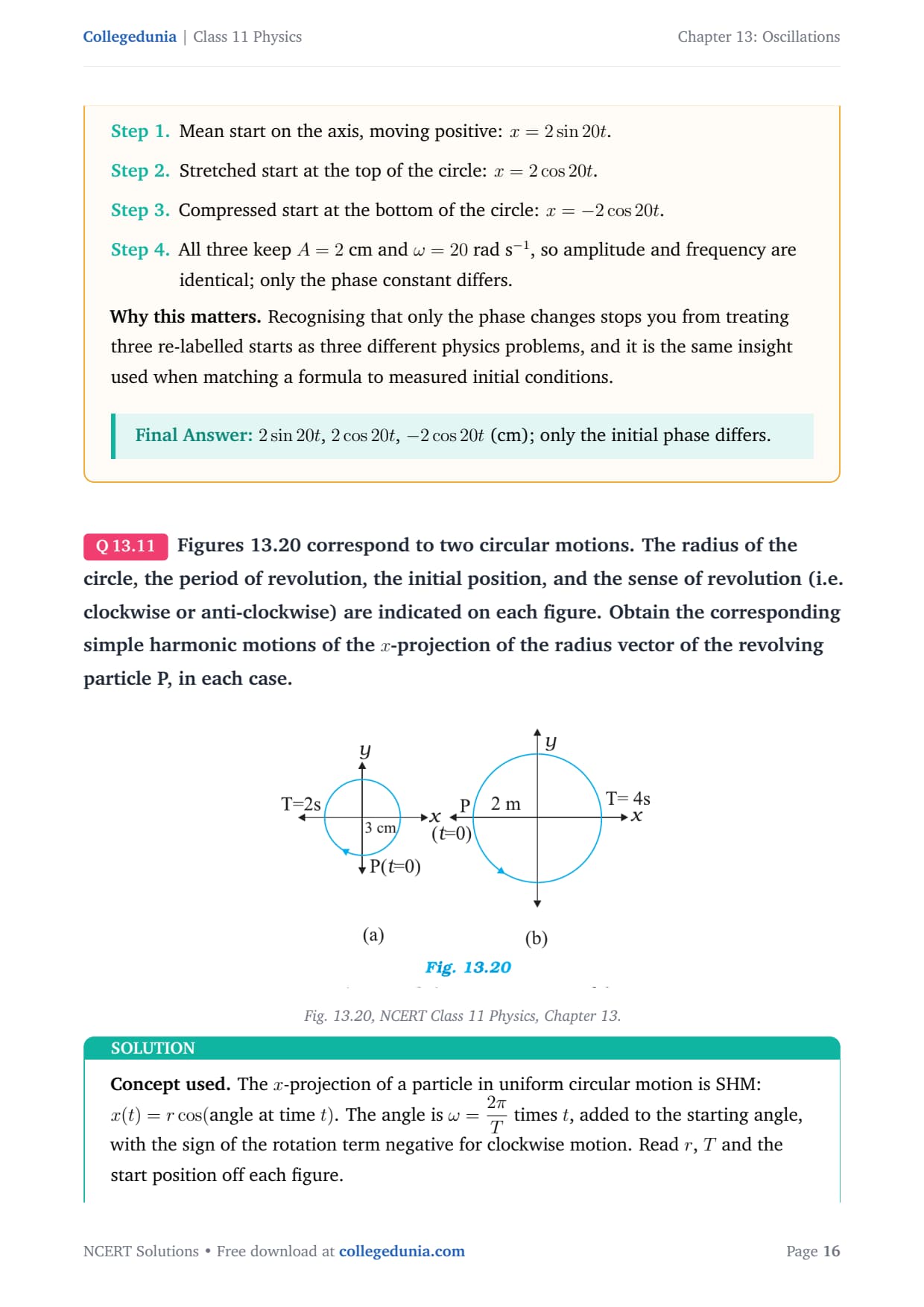
NCERT explains SHM using a neat geometric picture that appears in short-answer questions.
- Take a particle moving in a circle of radius A at a steady angular speed ω.
- Drop a perpendicular from the particle onto any one diameter.
- The foot of that perpendicular moves back and forth along the diameter in simple harmonic motion.
This is why SHM is called the projection of uniform circular motion on a diameter. The radius of the circle equals the amplitude, and the angular speed of the circle equals the angular frequency of the SHM. The solved answers use this model to explain why the displacement follows a cosine, which makes the phase questions much easier to picture.
Energy in Simple Harmonic Motion for Class 11 Physics Chapter 13
An oscillating body keeps trading energy between two forms. The NCERT solutions show that the total mechanical energy stays constant while kinetic and potential energy rise and fall. This is a favourite topic for both board short answers and JEE Main objective questions.
| Energy | Expression | Where it is maximum |
|---|---|---|
| Kinetic energy | ½ mω2(A2 - x2) | at the mean position |
| Potential energy | ½ mω2 x2 | at the extreme positions |
| Total energy | ½ mω2 A2 | constant everywhere |
Questions on this topic ask for the ratio of kinetic to potential energy at a given displacement, or for the point where they are equal. The total energy of SHM stays the same at every point and is proportional to the square of the amplitude. Kinetic and potential energy each vary, but their sum never changes. The solved answers state this rule before substituting numbers, so students see why the total does not depend on position.
Oscillations of a Spring and the Force Law
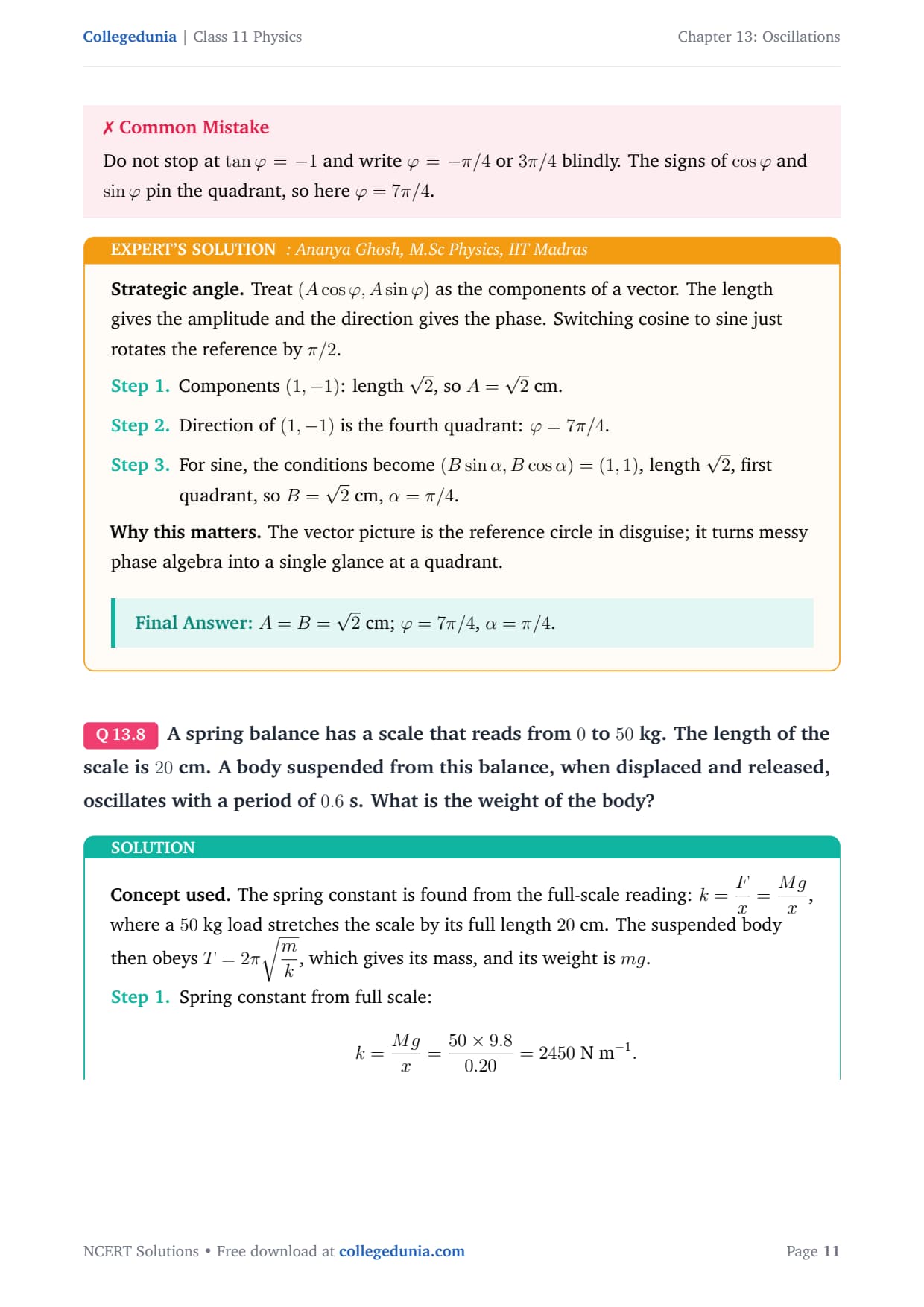
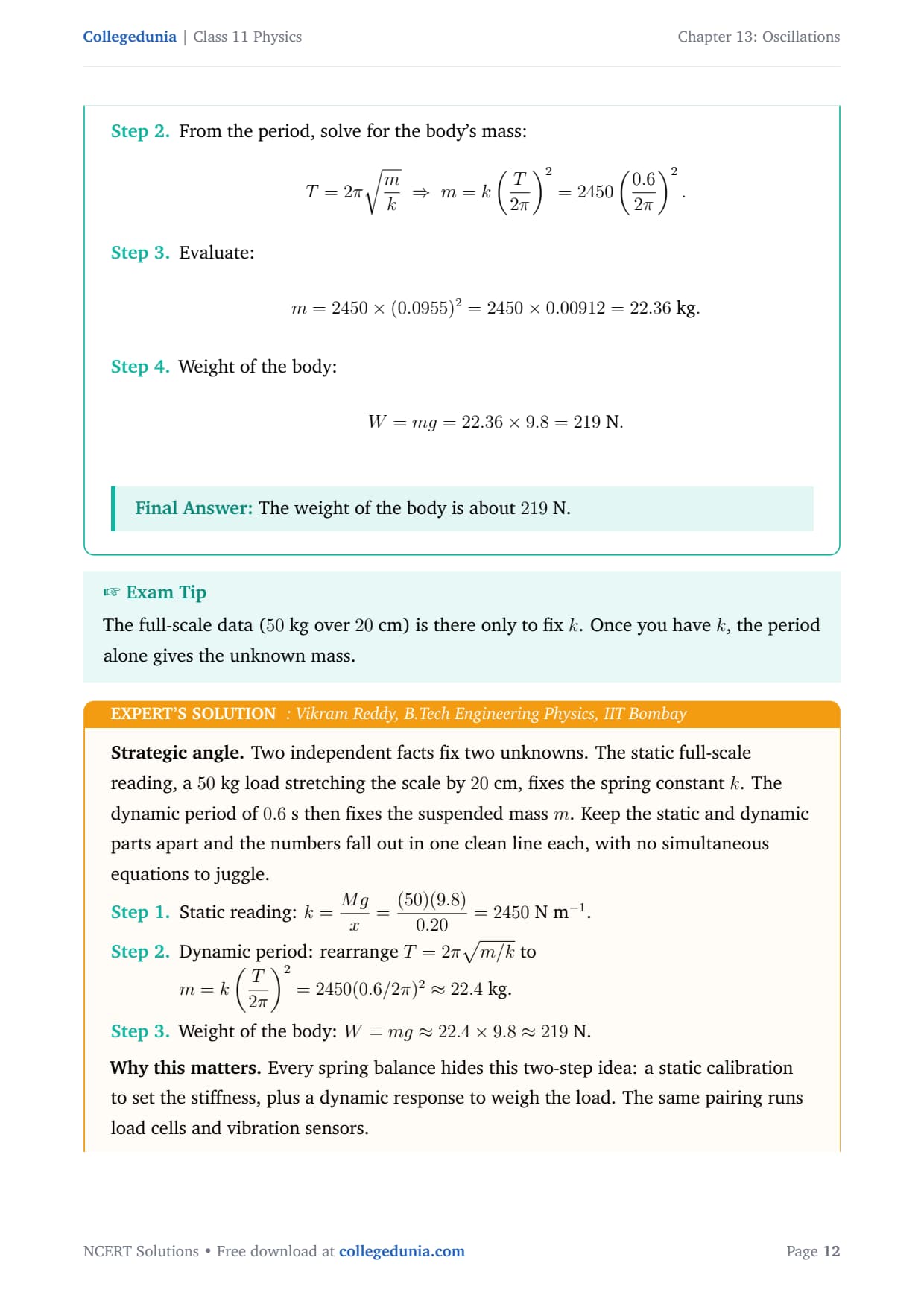
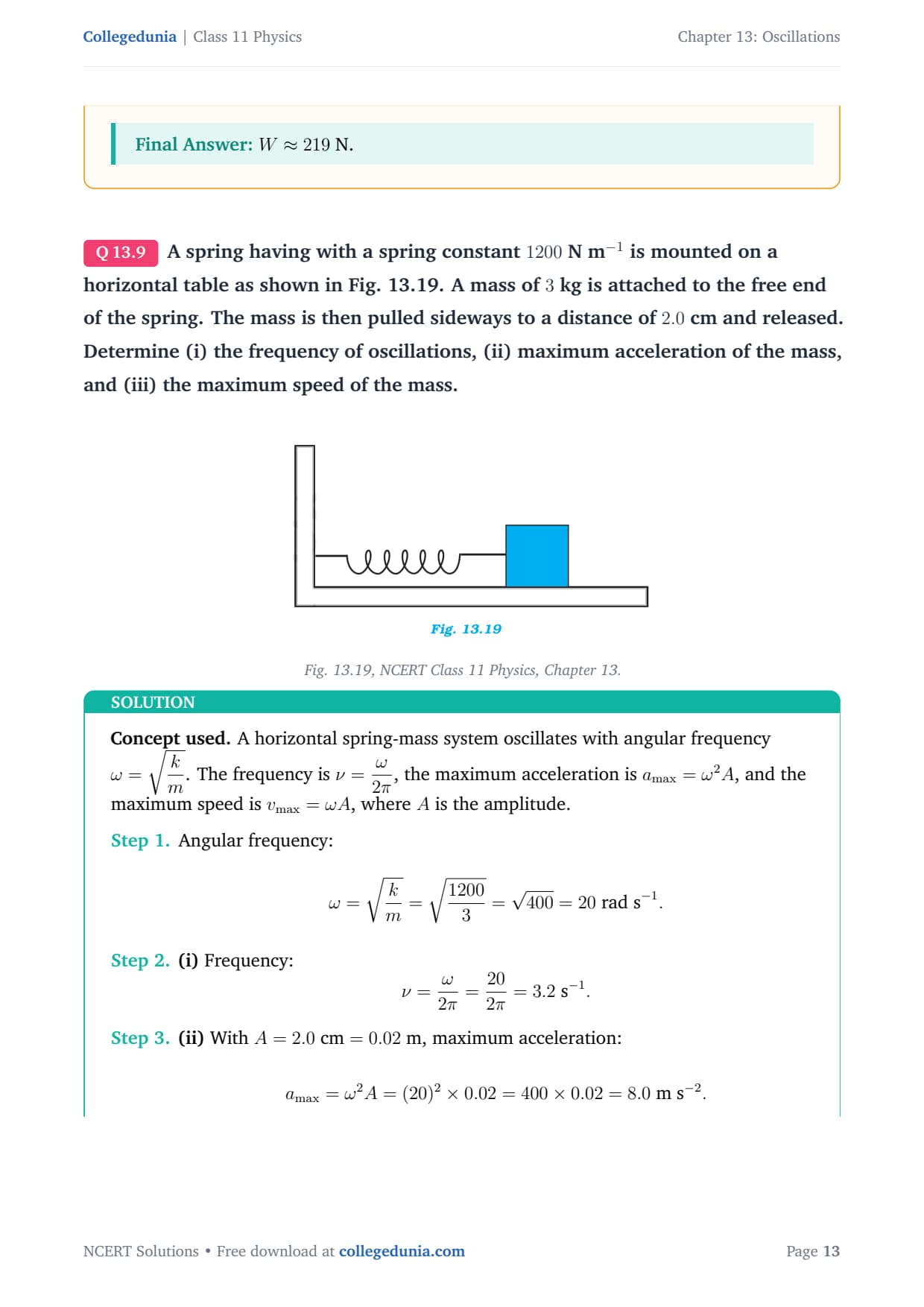
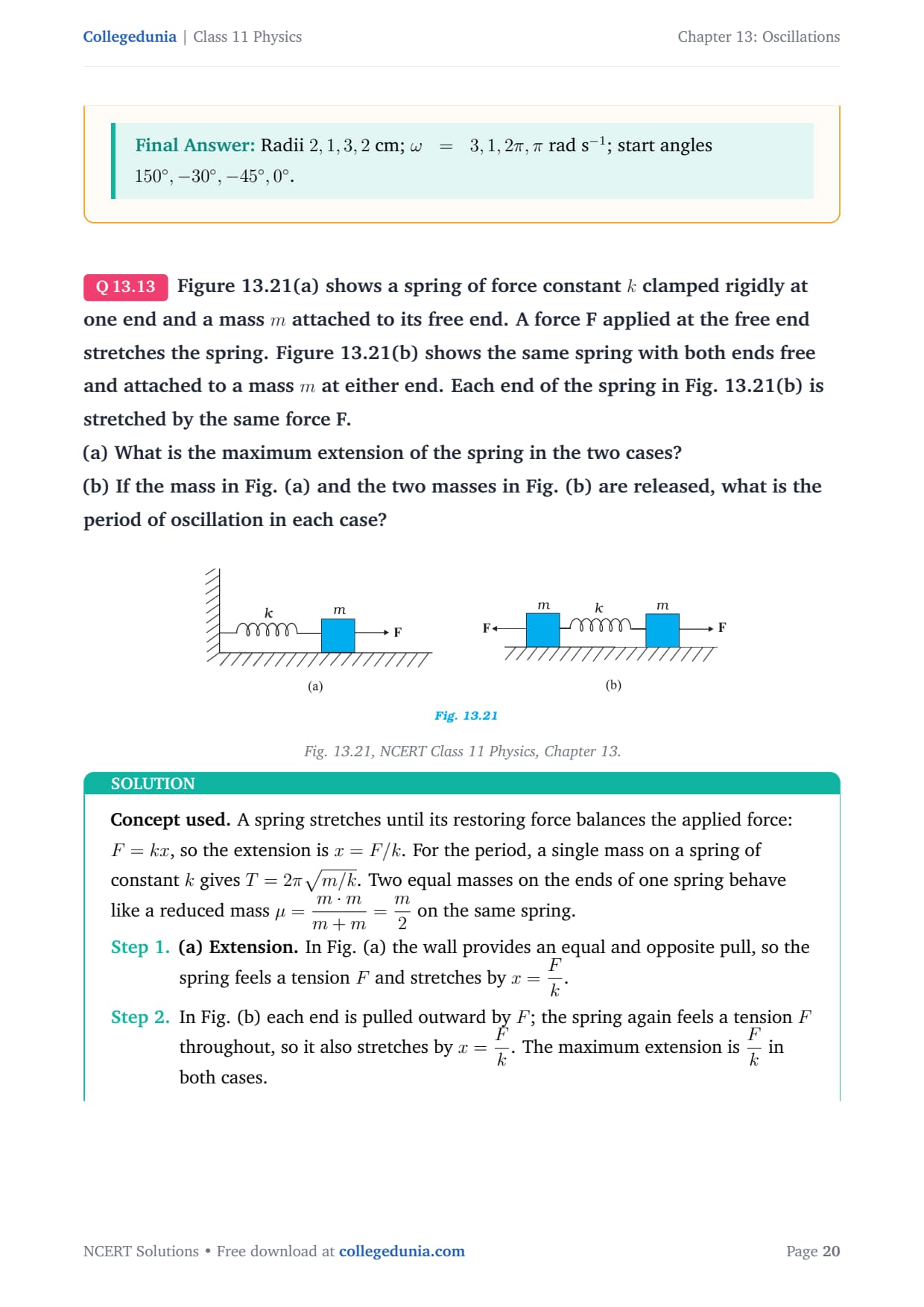
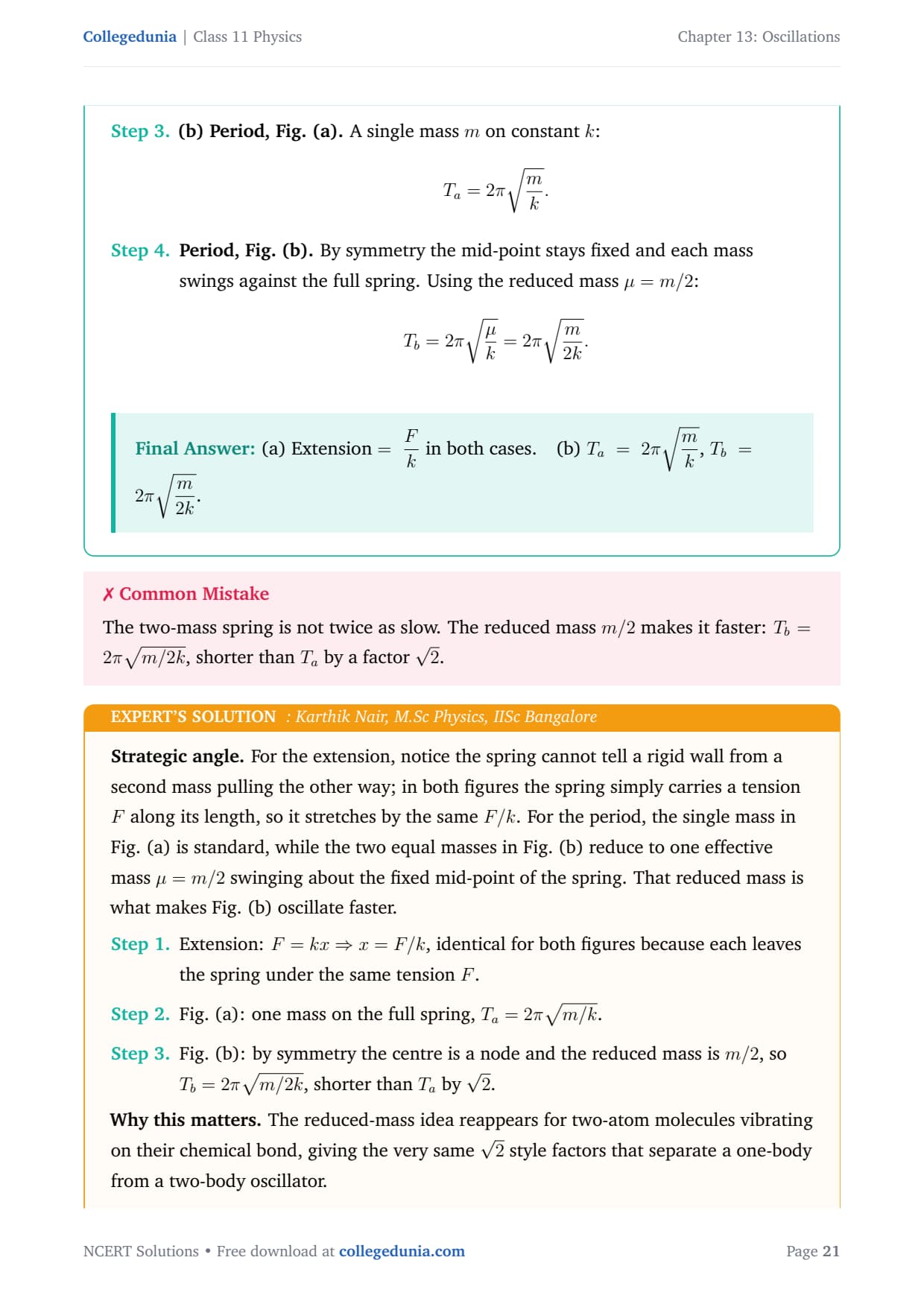
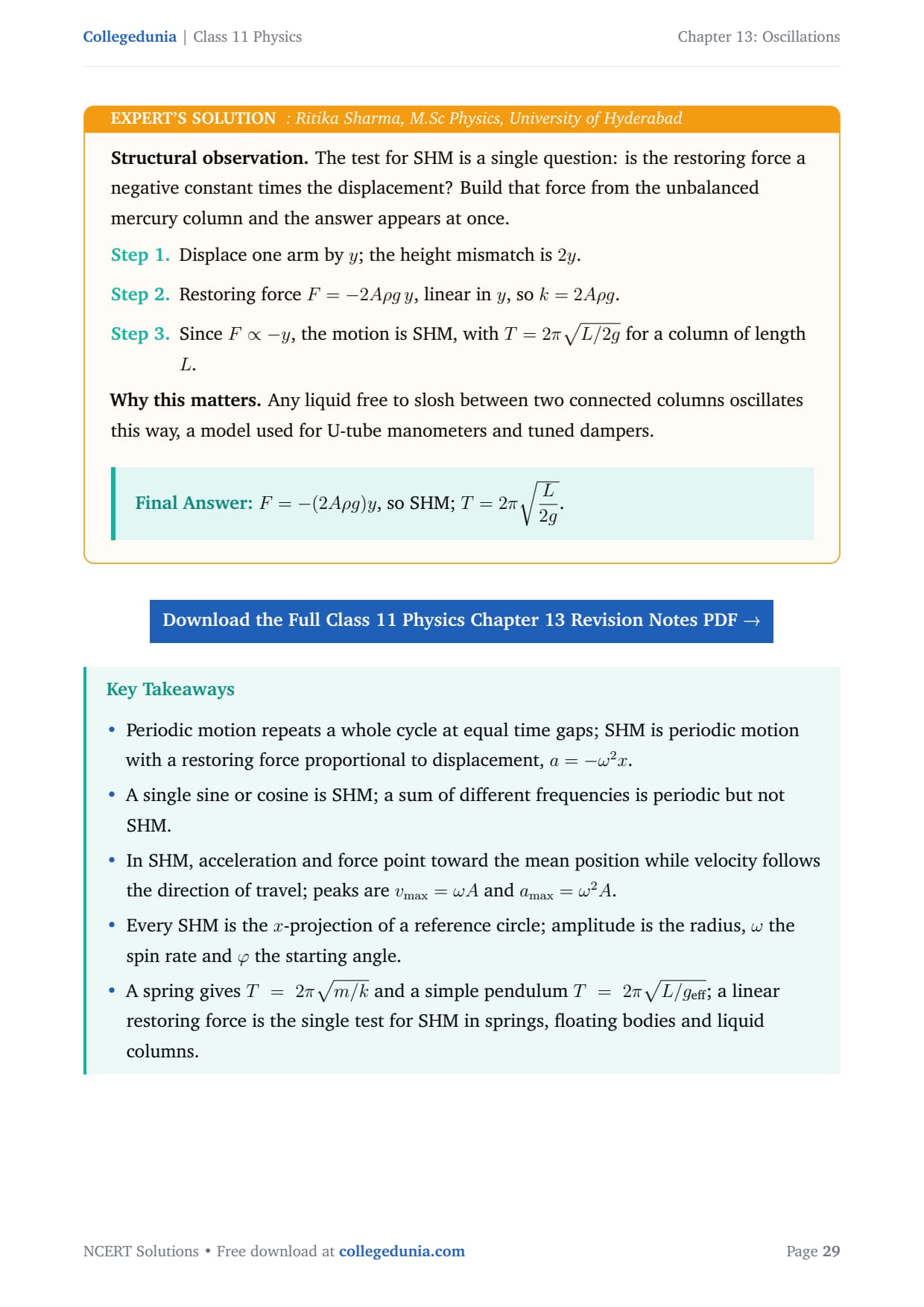
A block on a spring is the standard model of SHM in this chapter. When the spring is stretched or compressed by x, it pulls the block back with a restoring force given by Hooke's law, F = -kx, where k is the spring constant. This force law is exactly the SHM condition, so the block oscillates.
- Force law: F = -kx, the minus sign shows the force opposes the displacement.
- Angular frequency: ω = √(k/m), larger for a stiffer spring or a lighter block.
- Time period: T = 2π √(m/k), independent of the amplitude.
Numericals such as Exercise 13.7 give the mass and spring constant and ask for the period or frequency. The time period of a spring depends only on the mass and the spring constant, not on how far you pull it. This surprises many students, so the solved answers point it out at the exact step and warn against adding amplitude into the formula.
The Simple Pendulum and Its Time Period
The simple pendulum is a small bob on a light string. For small swings, the restoring force is again proportional to the displacement, so the bob moves in SHM. This section carries a standard derivation that CBSE asks for directly.
| Quantity | Relation |
|---|---|
| Time period | T = 2π √(L/g) |
| Depends on | length L and gravity g only |
| Does not depend on | mass of the bob or amplitude (for small angles) |
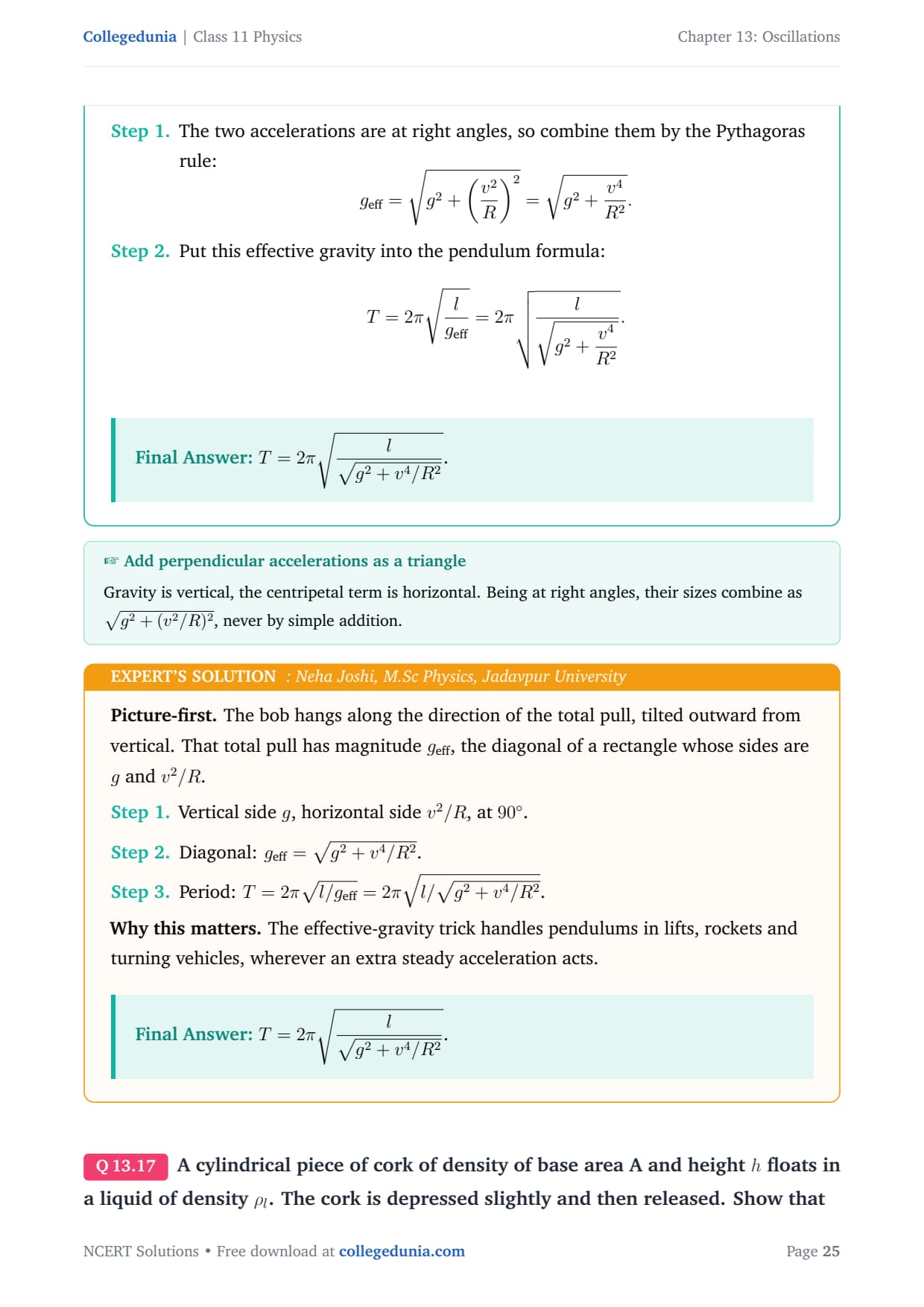
Questions like Exercise 13.5 ask students to find the length for a given period, or the change in period when the pendulum is moved to a different value of g. The period of a simple pendulum depends only on its length and the value of g, never on the mass of the bob. The small-angle condition matters, and the solved answers state it clearly, because the SHM result fails for large swings.
Damped and Forced Oscillations and Resonance
Real oscillations do not go on forever. This last section explains why, and it appears in short-answer and assertion-reason questions. The NCERT solutions keep the ideas separate so students do not confuse damping with forcing.
- Free oscillation: a body left to oscillate at its own natural frequency with no outside push.
- Damped oscillation: friction or air resistance removes energy, so the amplitude falls slowly over time.
- Forced oscillation: an outside periodic force drives the body at the driving frequency, not its natural one.
- Resonance: when the driving frequency matches the natural frequency, the amplitude grows very large.
Resonance happens only when the driving frequency equals the natural frequency of the body. This is why soldiers break step on a bridge and why a radio tunes to one station. The solved answers link each definition to a real example, which makes the theory questions in this section easy to answer in the exam.
Exercise-wise Breakdown for Class 11 Physics Chapter 13 Oscillations
The NCERT back-exercise splits into clear groups. Use this map to plan which answers to practise first for the 2026-27 boards. Every group links to the full solved set.
| Question group | Exercises | What it covers |
|---|---|---|
| Periodic motion and SHM basics | Exercise 13.1 to Exercise 13.3 | Identifying periodic and simple harmonic motion, period and frequency |
| Displacement equation and phase | Exercise 13.4 to Exercise 13.6 | Amplitude, angular frequency, phase constant, velocity and acceleration |
| Springs and pendulums | Exercise 13.7 to Exercise 13.10 | Time period of springs, simple pendulum numericals |
| Energy, damping and resonance | Exercise 13.11 onward | Energy in SHM, damped and forced oscillations, resonance |
Solving the groups in this order builds the skills in the same sequence the chapter teaches them. Start with the SHM equation, then springs and pendulums, then energy and damping, because each group uses the one before it.
Common Mistakes Students Make in the Oscillations Chapter
These slips happen while writing or calculating the answer, not because the concept is unclear. Each one costs 1 to 3 marks in the CBSE paper, so the solved answers point them out at the exact step.
Mistake 1: Adding amplitude into the time period. The period of a spring or pendulum does not depend on how far it is pulled.
Mistake 2: Confusing angular frequency with frequency. Remember ω = 2πν, so the two differ by a factor of 2π.
Mistake 3: Using the pendulum formula for large swings. The result T = 2π √(L/g) holds only for small angles.
Mistake 4: Treating total energy as changing during the motion. Kinetic and potential energy vary, but their sum stays constant.
Student Feedback on the Oscillations Chapter
What 12,840 students told us about their Oscillations revision:
- 64% of students rated the phase and phase-constant questions as the hardest part of the chapter.
- Most-skipped step: writing angular frequency as 2πν, missed by about 3 in 10 students.
- Students who learned SHM as the projection of circular motion first reported the displacement equation felt easier.
Source: 2026-27 Class 11 Physics student poll. Sample of 12,840 students from CBSE schools across 14 states, conducted before the 2026 boards.
Practice Questions for Class 11 Physics Chapter 13 Oscillations
Once the solved answers are clear, test yourself on the full question set. The practice page has every NCERT question with a step-by-step Solution and an Expert Solution behind a click.
Practice Questions: Oscillations
Attempt all NCERT questions with detailed and expert solutions.
Open Practice QuestionsOther Oscillations Class 11 Physics Resources
| Resource | Link |
|---|---|
| NCERT Solutions | You are here |
| Notes | Oscillations Class 11 Notes |
| Handwritten Notes | Oscillations Class 11 Handwritten Notes |
| Formula Sheet | Oscillations Class 11 Formula Sheet |
| NCERT Book PDF | Oscillations Class 11 Book PDF |
NCERT Solutions for Class 11 Physics: All Chapters
Jump to the solutions for any other Class 11 Physics chapter below.
| Chapter | NCERT Solutions |
|---|---|
| Chapter 1 | Units and Measurements |
| Chapter 2 | Motion in a Straight Line |
| Chapter 3 | Motion in a Plane |
| Chapter 4 | Laws of Motion |
| Chapter 5 | Work, Energy and Power |
| Chapter 6 | System of Particles and Rotational Motion |
| Chapter 7 | Gravitation |
| Chapter 8 | Mechanical Properties of Solids |
| Chapter 9 | Mechanical Properties of Fluids |
| Chapter 10 | Thermal Properties of Matter |
| Chapter 11 | Thermodynamics |
| Chapter 12 | Kinetic Theory |
| Chapter 13 | Oscillations |
| Chapter 14 | Waves |
FAQs on Class 11 Physics Chapter 13 Oscillations NCERT Solutions
Oscillations NCERT Solutions - Frequently Asked Questions
Ques. How many questions are solved in the Class 11 Physics NCERT Solutions Chapter 13 Oscillations?
Ans. This page solves every NCERT back-exercise question of Class 11 Physics Chapter 13 Oscillations, starting from Exercise 13.1. The questions cover periodic motion, simple harmonic motion, energy in SHM, springs, and the simple pendulum. Each answer has a step-by-step Solution and an Expert Solution.
Ques. What is simple harmonic motion in Chapter 13 Oscillations?
Ans. Simple harmonic motion is an oscillation in which the acceleration is proportional to the displacement from the mean position and always points toward it. Its defining relation is a = -ω2 x, and the displacement follows x = A cos(ωt + φ).
Ques. What is the time period of a simple pendulum in Class 11 Physics Chapter 13?
Ans. For small swings, the time period of a simple pendulum is T = 2π √(L/g), where L is the length and g is the acceleration due to gravity. It does not depend on the mass of the bob or the amplitude. The solved numericals in these Class 11 Physics Chapter 13 solutions show each step.
Ques. What is resonance in the Oscillations chapter?
Ans. Resonance happens in a forced oscillation when the frequency of the outside driving force matches the natural frequency of the body. At this point the body absorbs the most energy and its amplitude becomes very large. Common examples are a swing pushed at the right moment and a radio tuned to one station.
Ques. What is the weightage of Oscillations in the CBSE board exam?
Ans. Oscillations carries about 4 to 6 marks in the CBSE Class 11 Physics paper, usually one short answer plus one numerical on SHM, springs, or the simple pendulum. It also appears in JEE Main and NEET as objective questions on the SHM equation, energy, and resonance.
Ques. How does the total energy in SHM stay constant?
Ans. In simple harmonic motion the kinetic energy is largest at the mean position and the potential energy is largest at the ends, but at every point their sum equals ½ mω2 A2. Since this total depends only on the amplitude, it stays constant through the motion. The NCERT Solutions for Class 11 Physics Chapter 13 Oscillations follow this rule in every energy numerical.



Comments