




The Class 11 Physics NCERT Solutions Chapter 8 Mechanical Properties of Solids will help students prepare for Boards, JEE Main, JEE Advanced, NEET, CUET and NDA in 2026-27. Every back-exercise question is solved with full working, so students can check each stress and strain value, modulus calculation, and elongation numerical step by step.
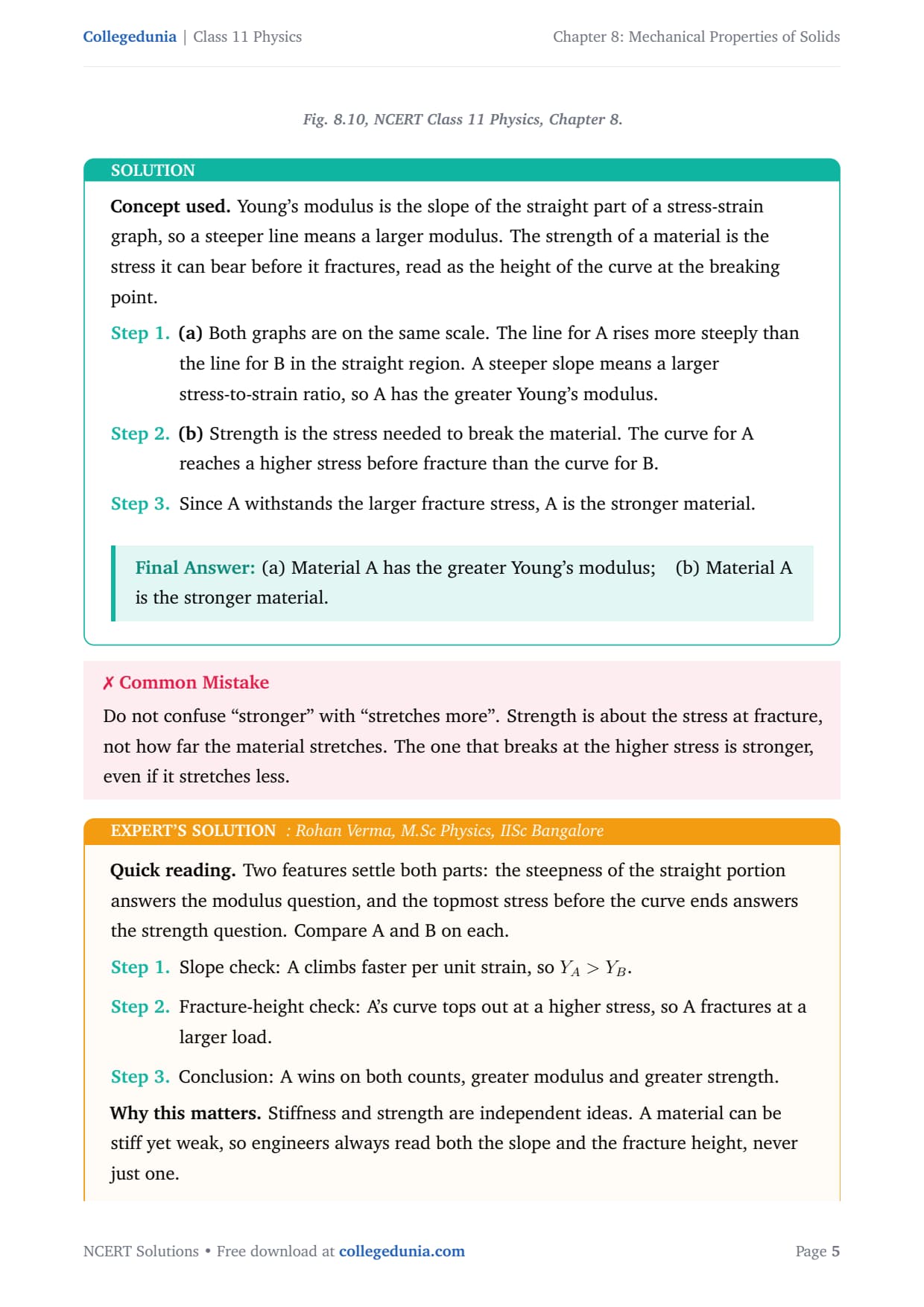
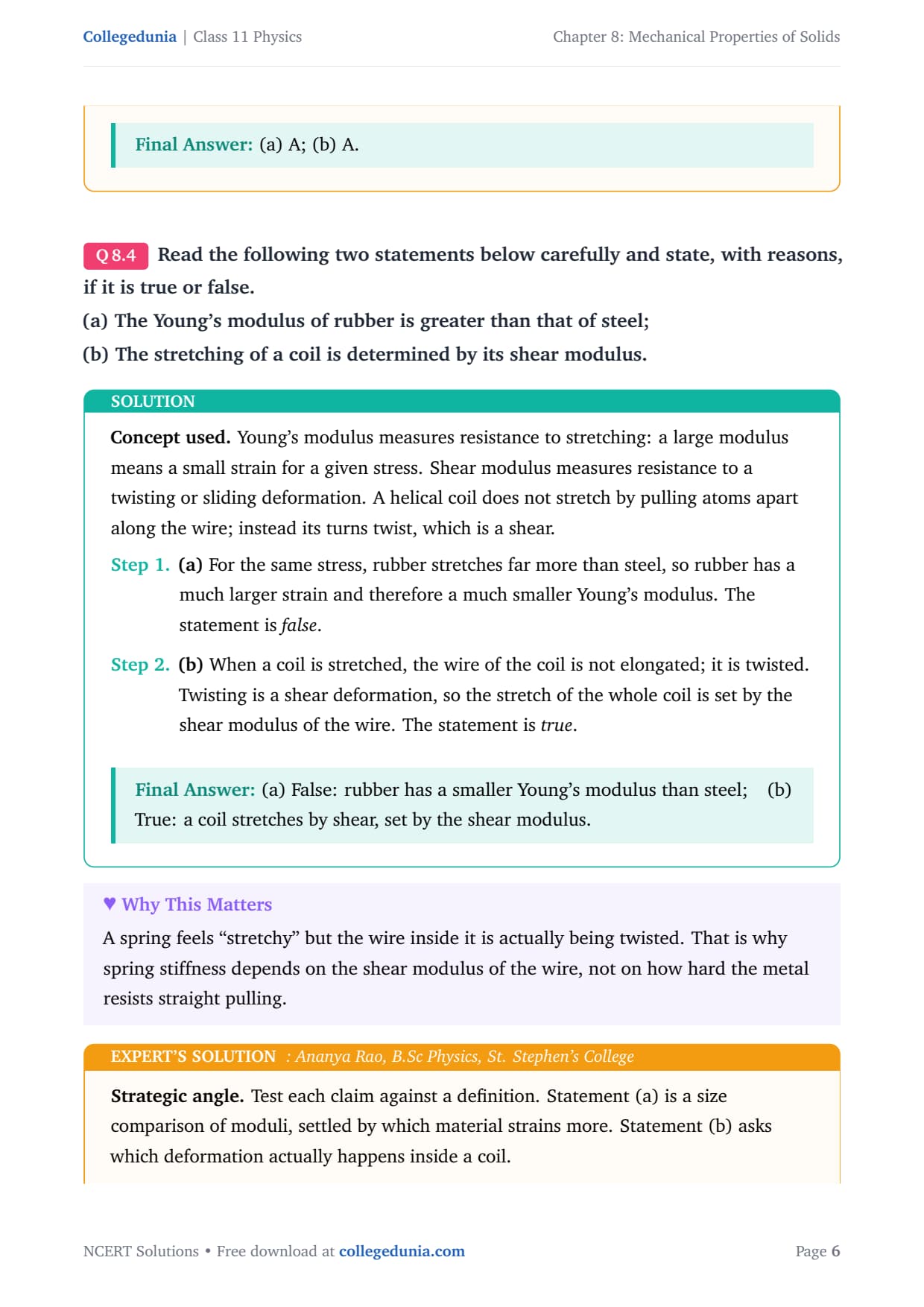
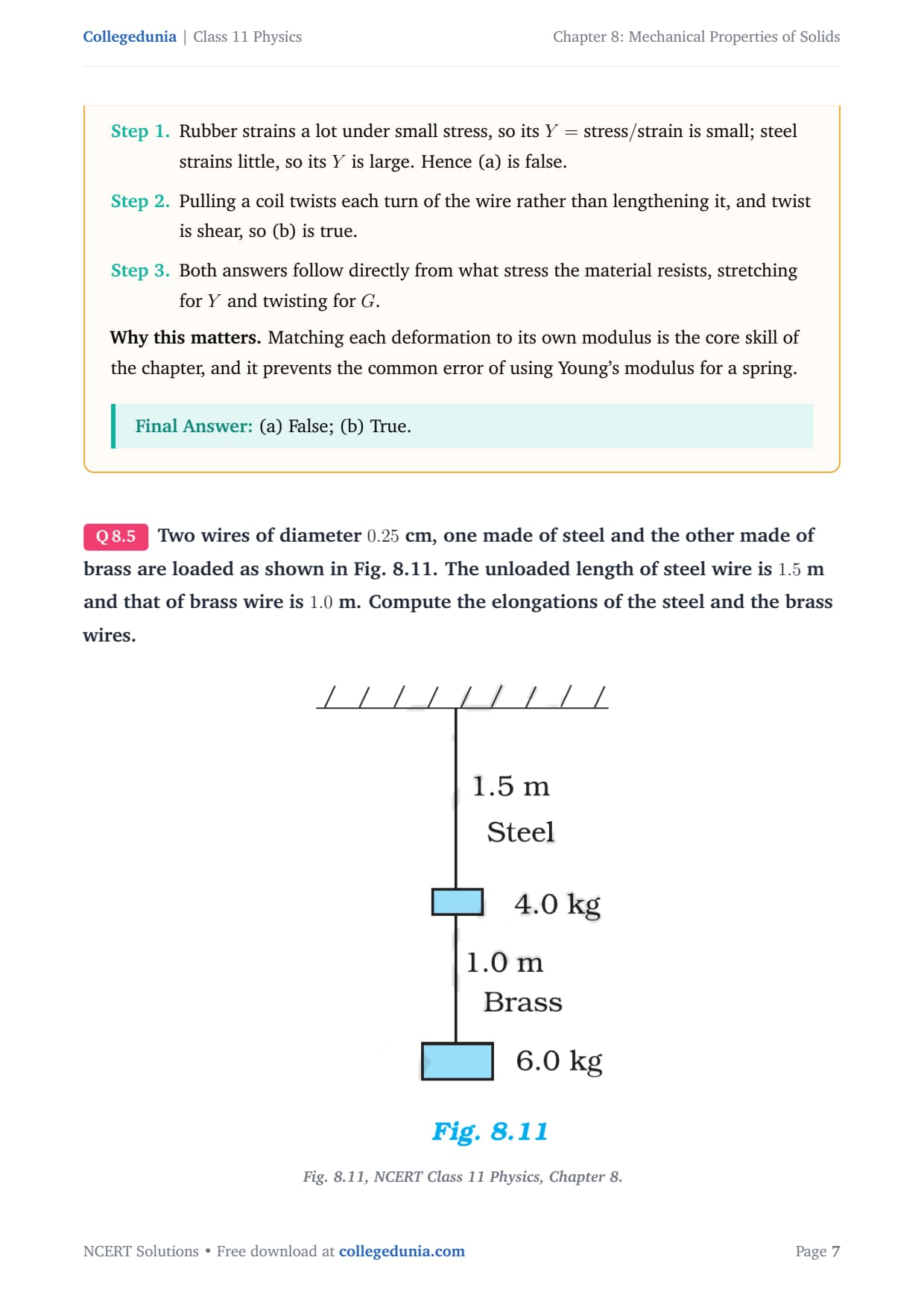
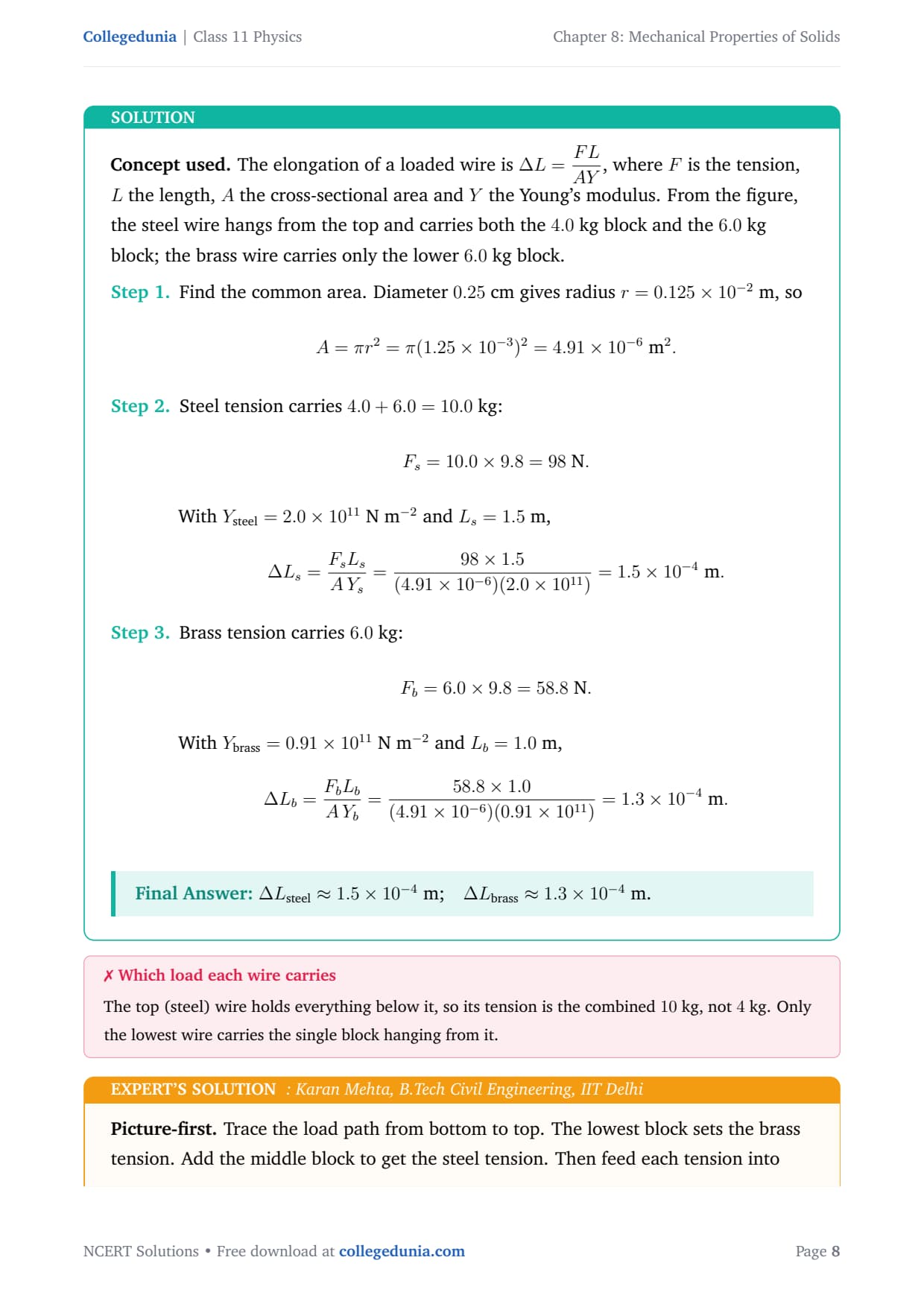
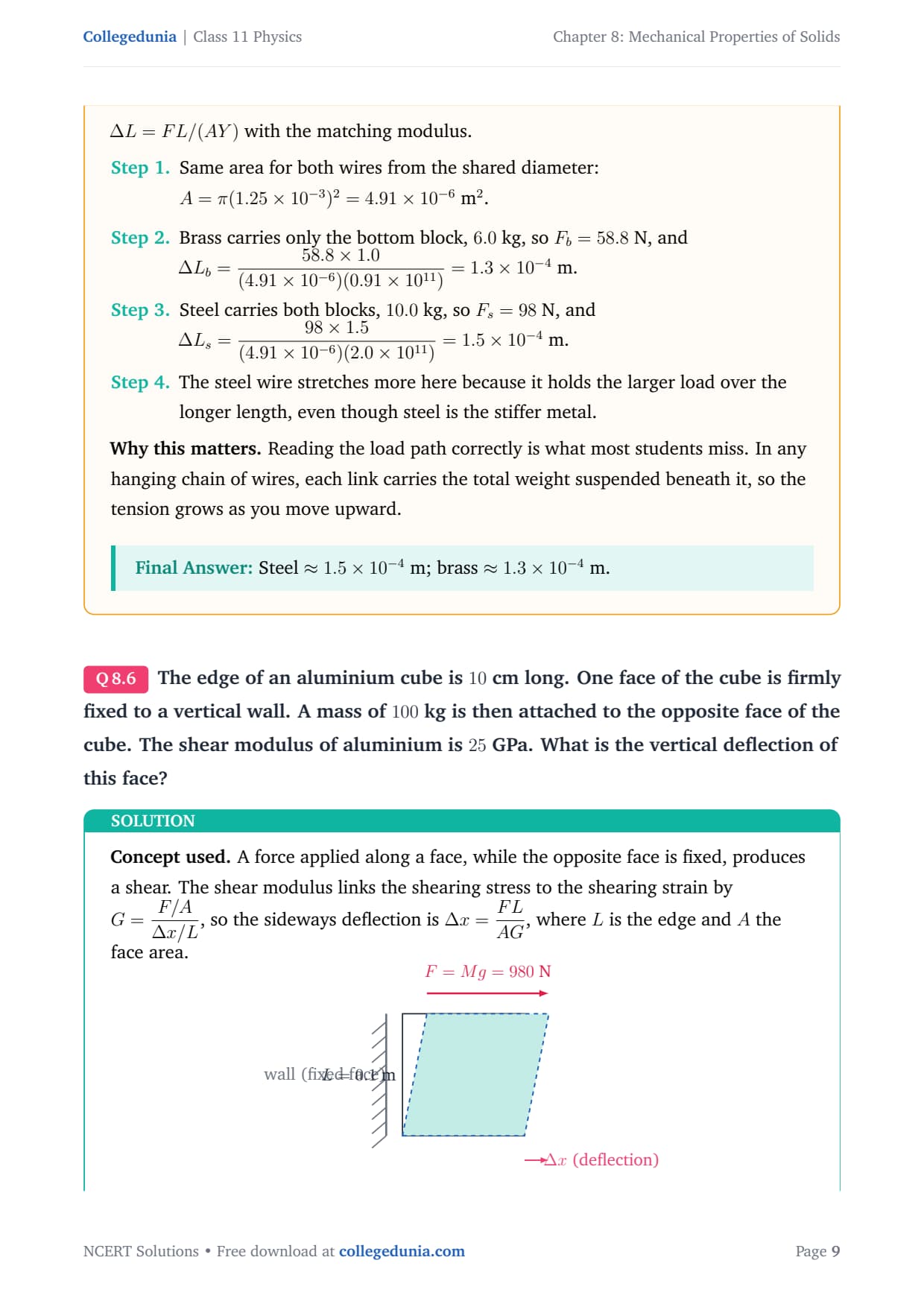
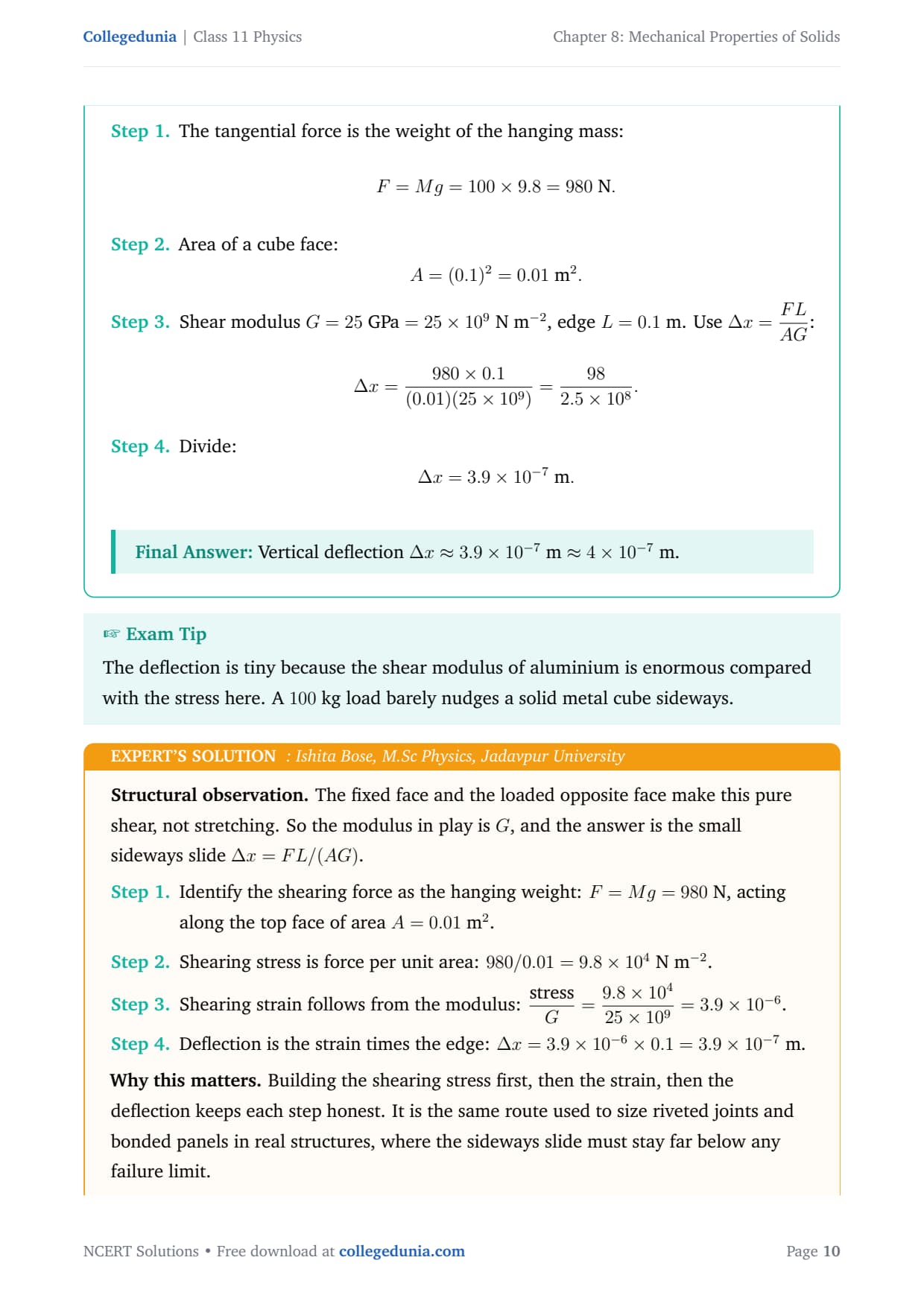
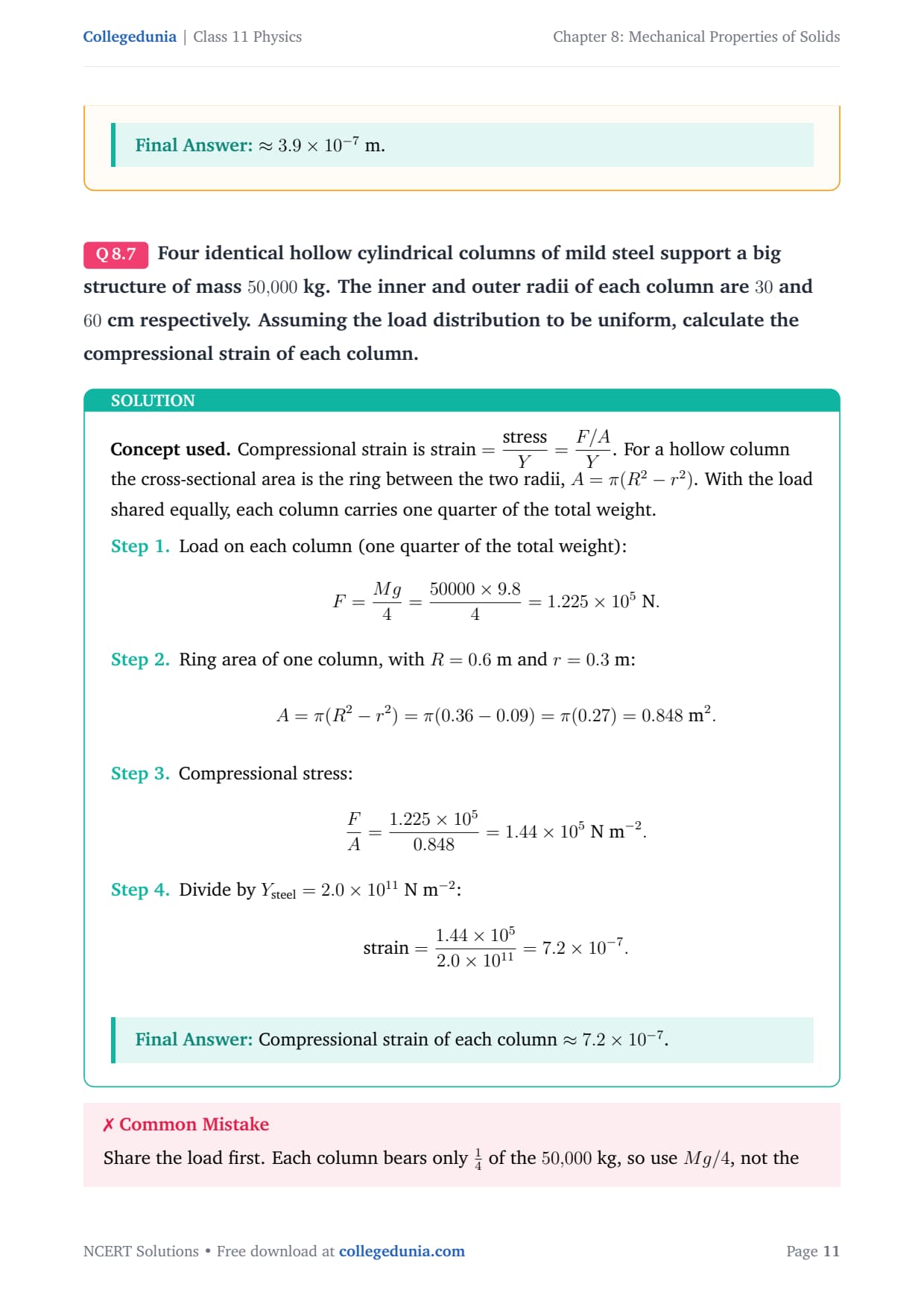
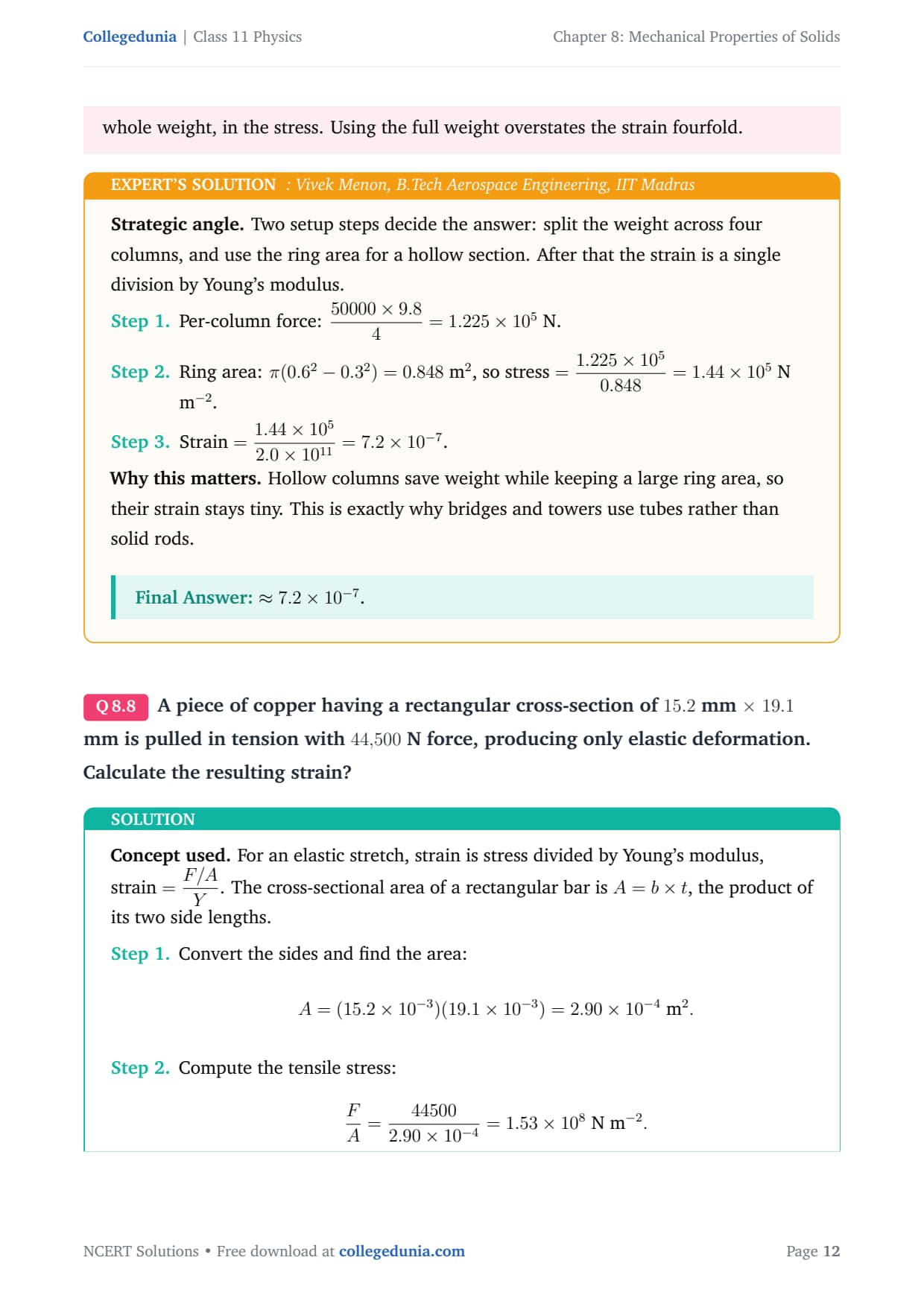
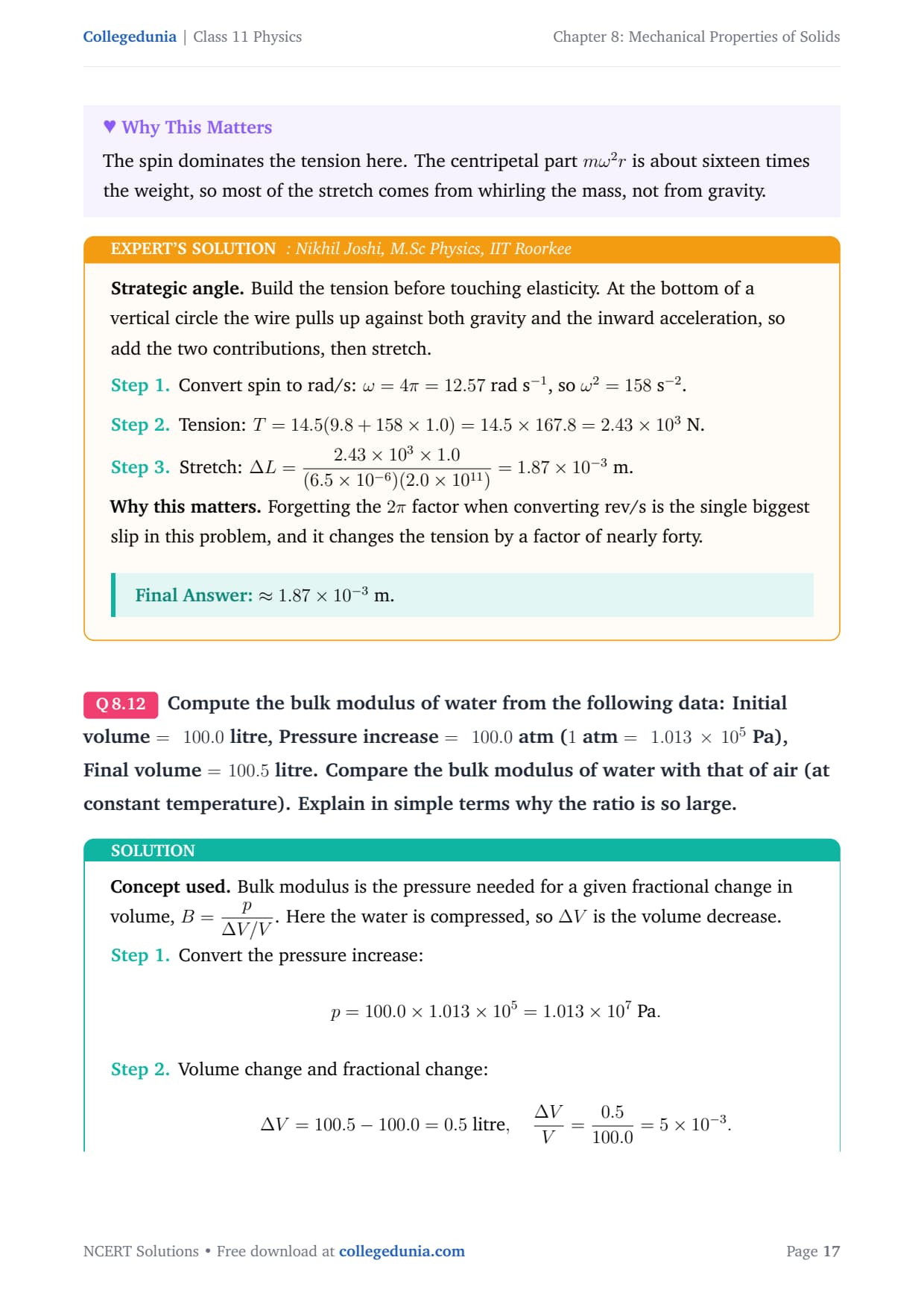
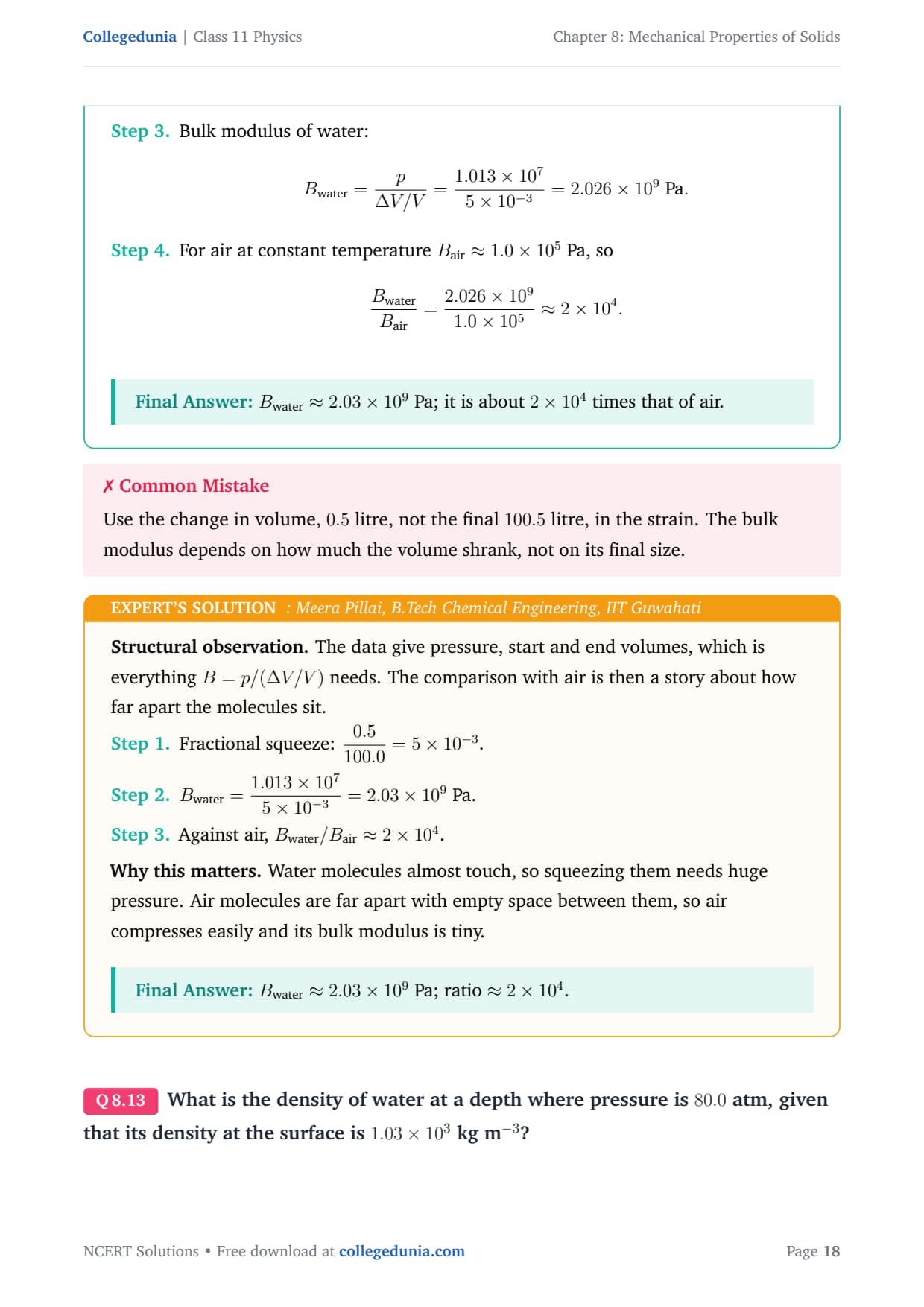
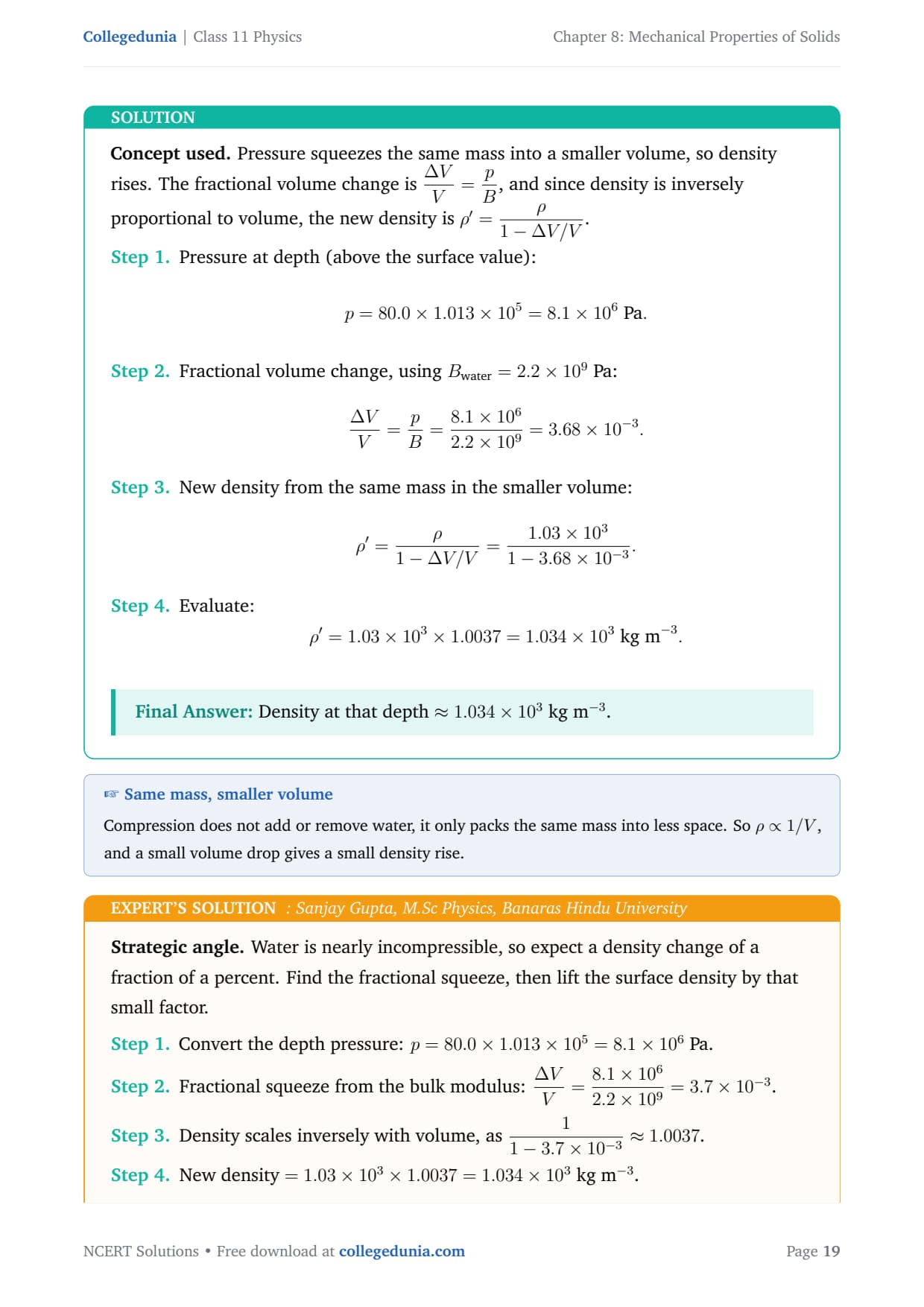
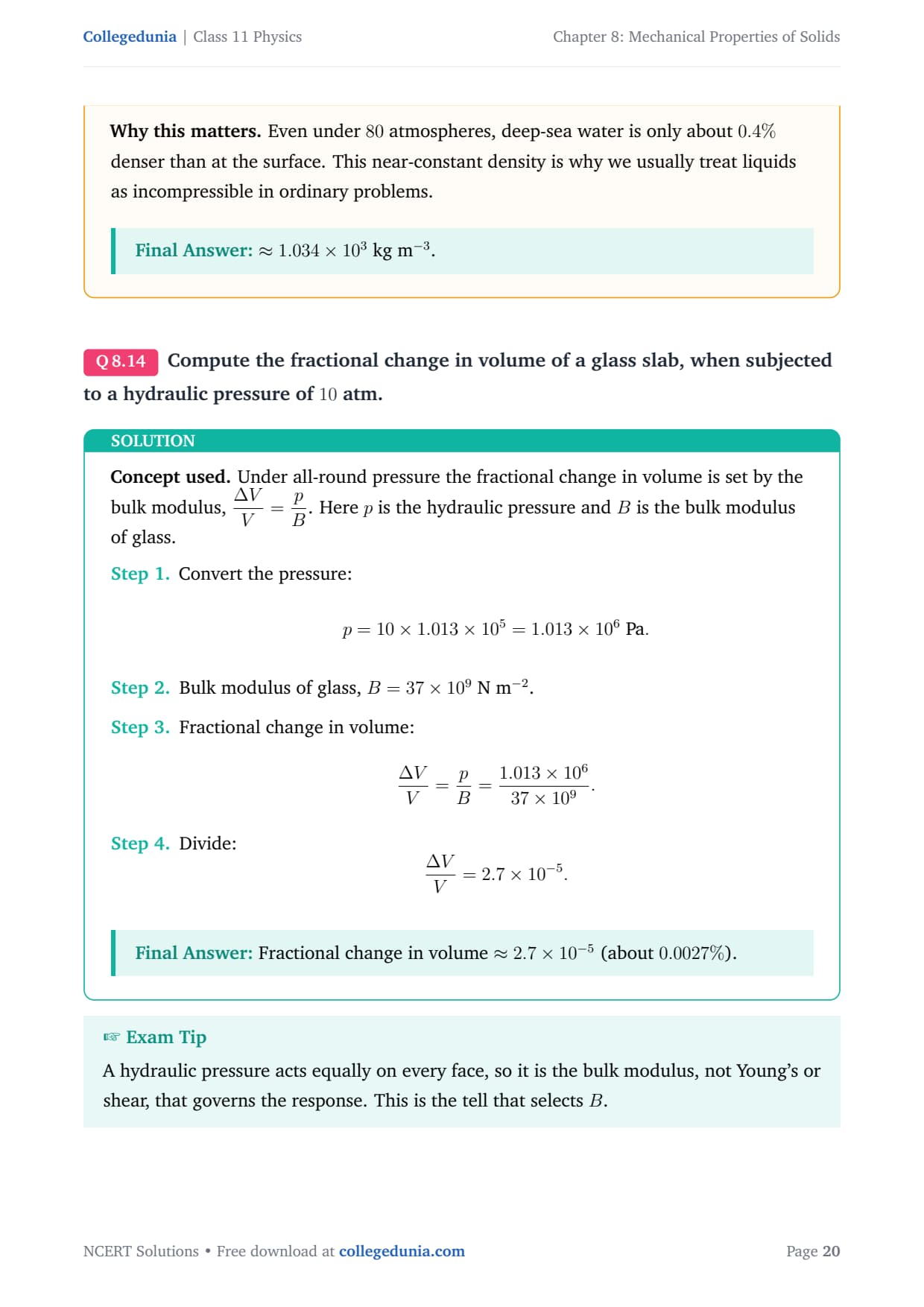
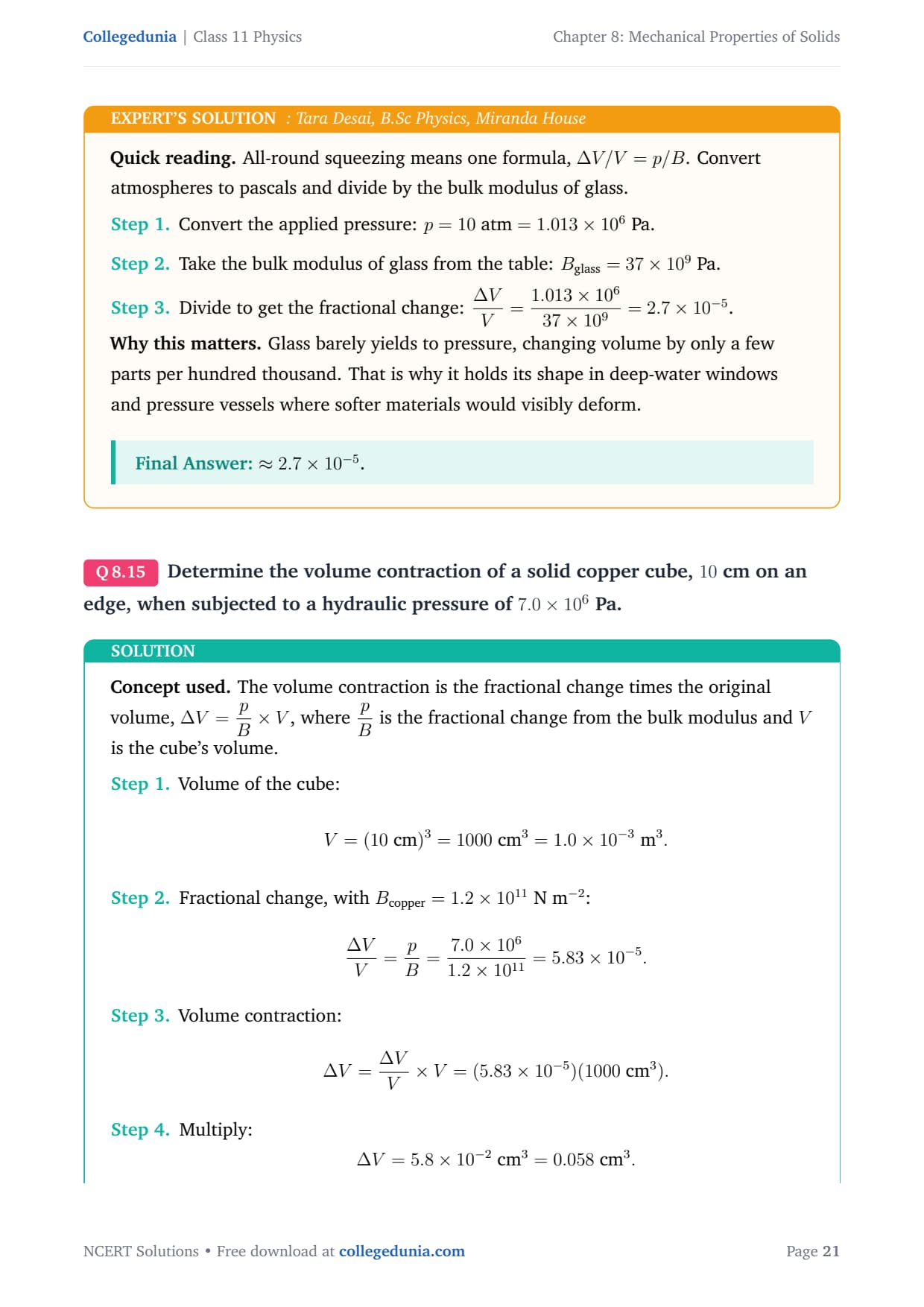
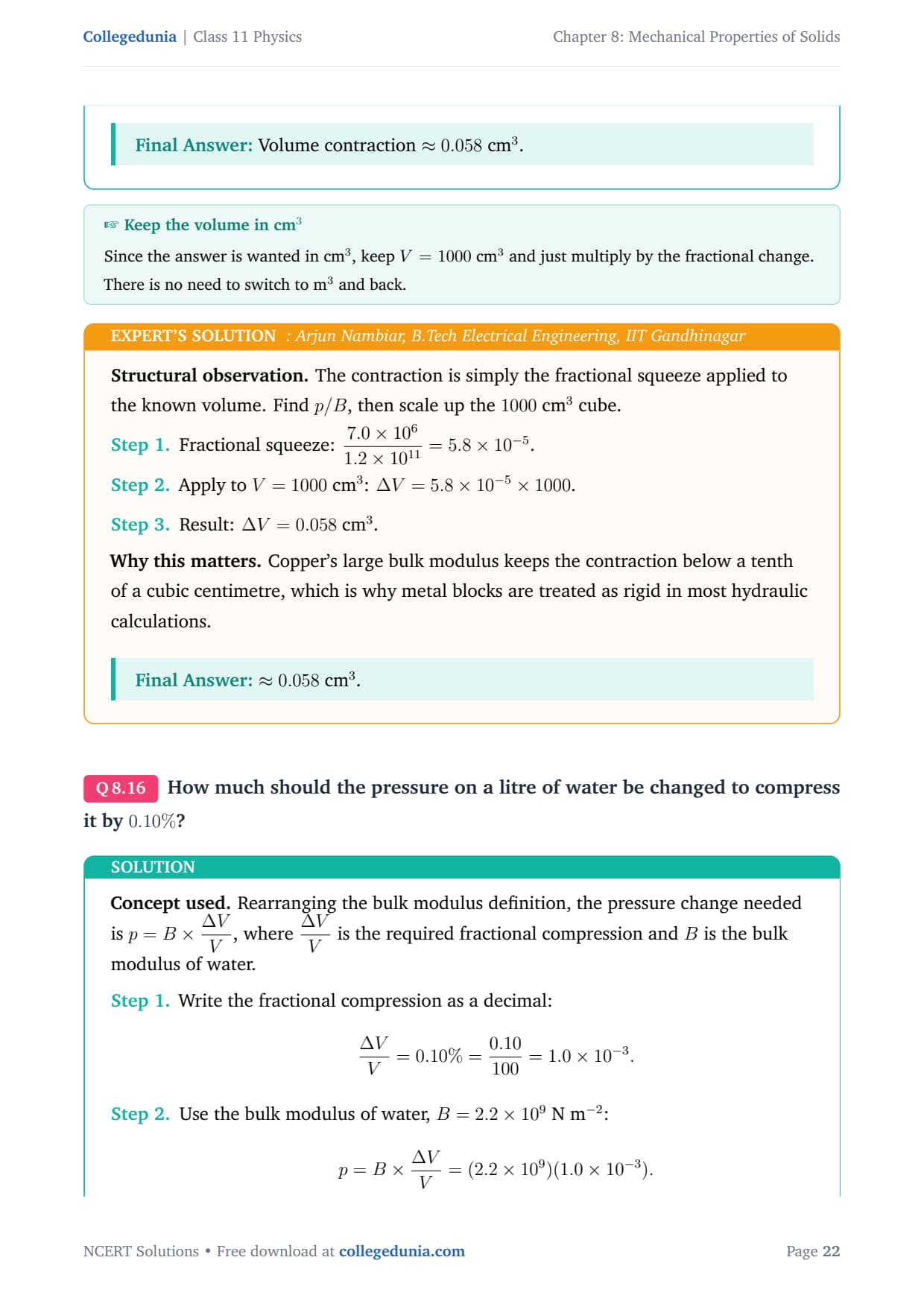
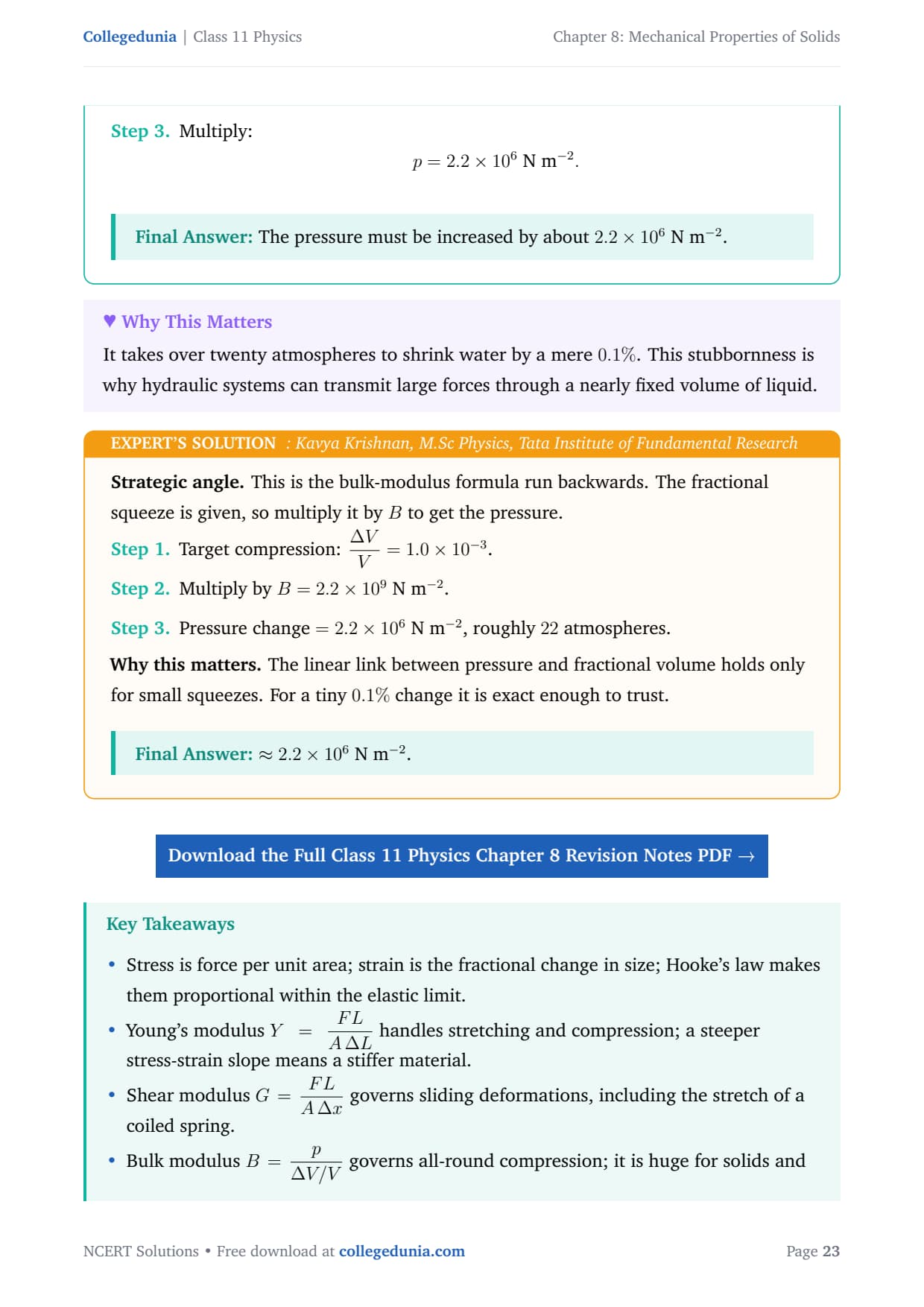
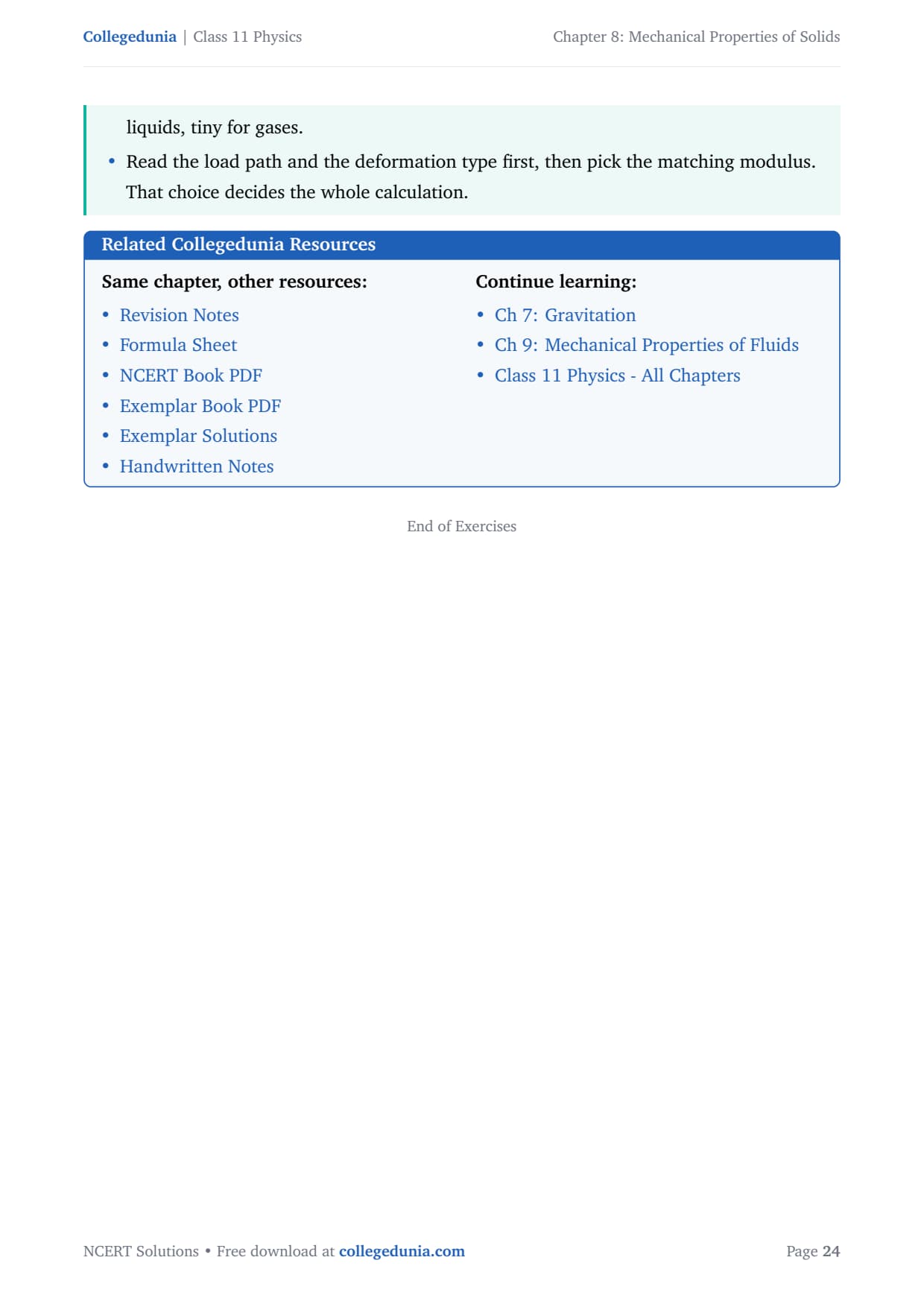
This chapter explains how solids stretch, compress and twist under load, and the answers show the exact formula used at every stage.
- CBSE Weightage: 4 to 5 marks, usually one numerical on Young's modulus plus one short answer on elastic behaviour.
- Questions solved: all Exercise 8.1 onward, covering stress, strain, Hooke's law, elastic moduli and elastic potential energy.
- Key formulas: stress = force/area, strain = change/original, Young's modulus, bulk modulus, shear modulus, Poisson's ratio.
Each solution in this Class 11 Physics NCERT Solutions Chapter 8 Mechanical Properties of Solids compilation is curated by subject experts, based on the 2026-27 NCERT textbook, and refined against the last five years of CBSE Board, JEE Main and NEET papers.
Stress and Strain: The Two Basic Ideas of the Chapter
Every question in this chapter starts from two quantities. Stress is the internal restoring force per unit area when a body is deformed. Strain is the change in shape or size divided by the original value. Both must be found correctly before any modulus can be used, so the NCERT solutions always write them on separate lines.
| Type | Stress | Strain produced |
|---|---|---|
| Longitudinal (tensile or compressive) | Force along the length / area | Change in length / original length |
| Shearing (tangential) | Force along the surface / area | Sideways shift / height (angle of shear) |
| Hydraulic (volume) | Pressure from all sides | Change in volume / original volume |
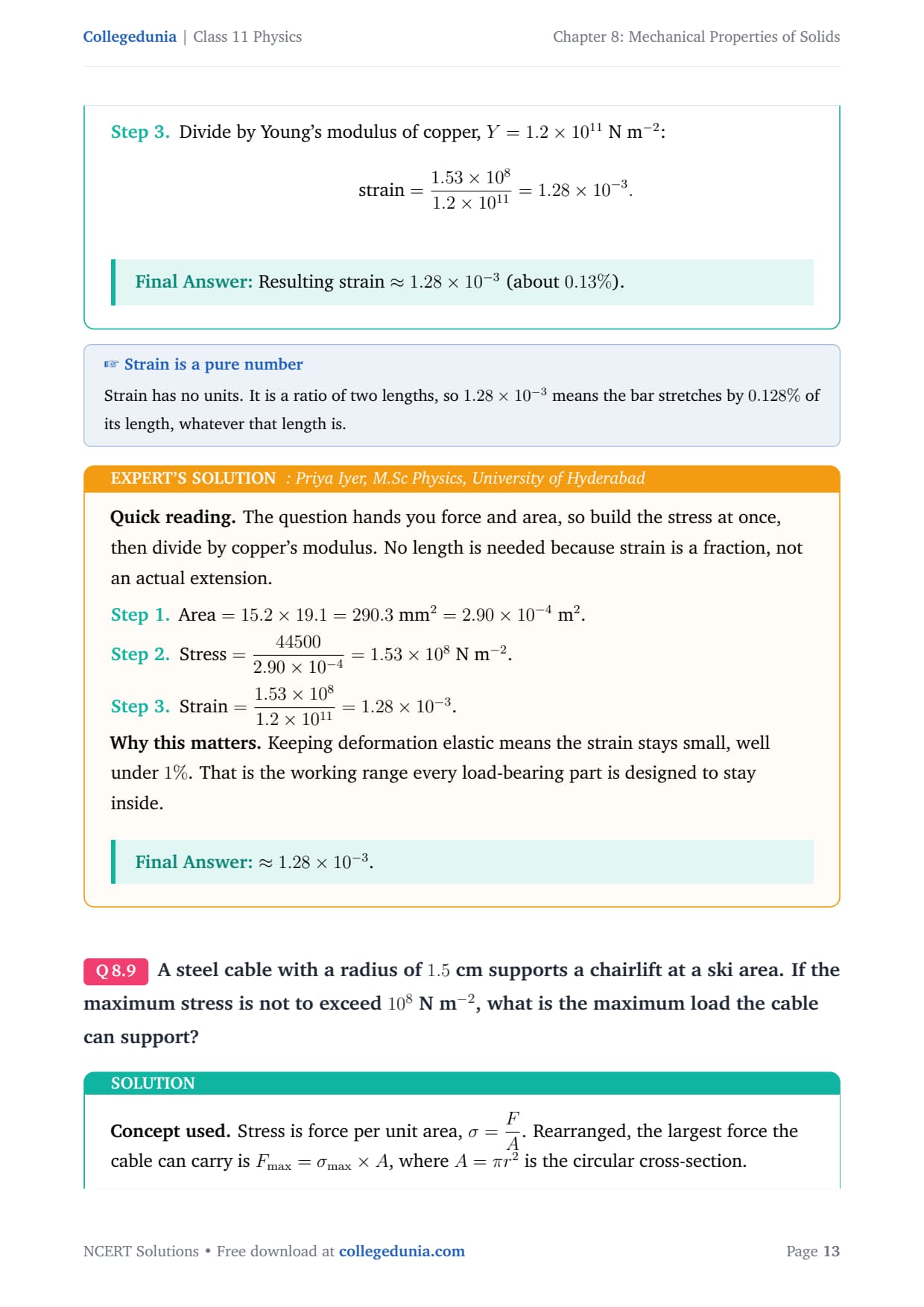
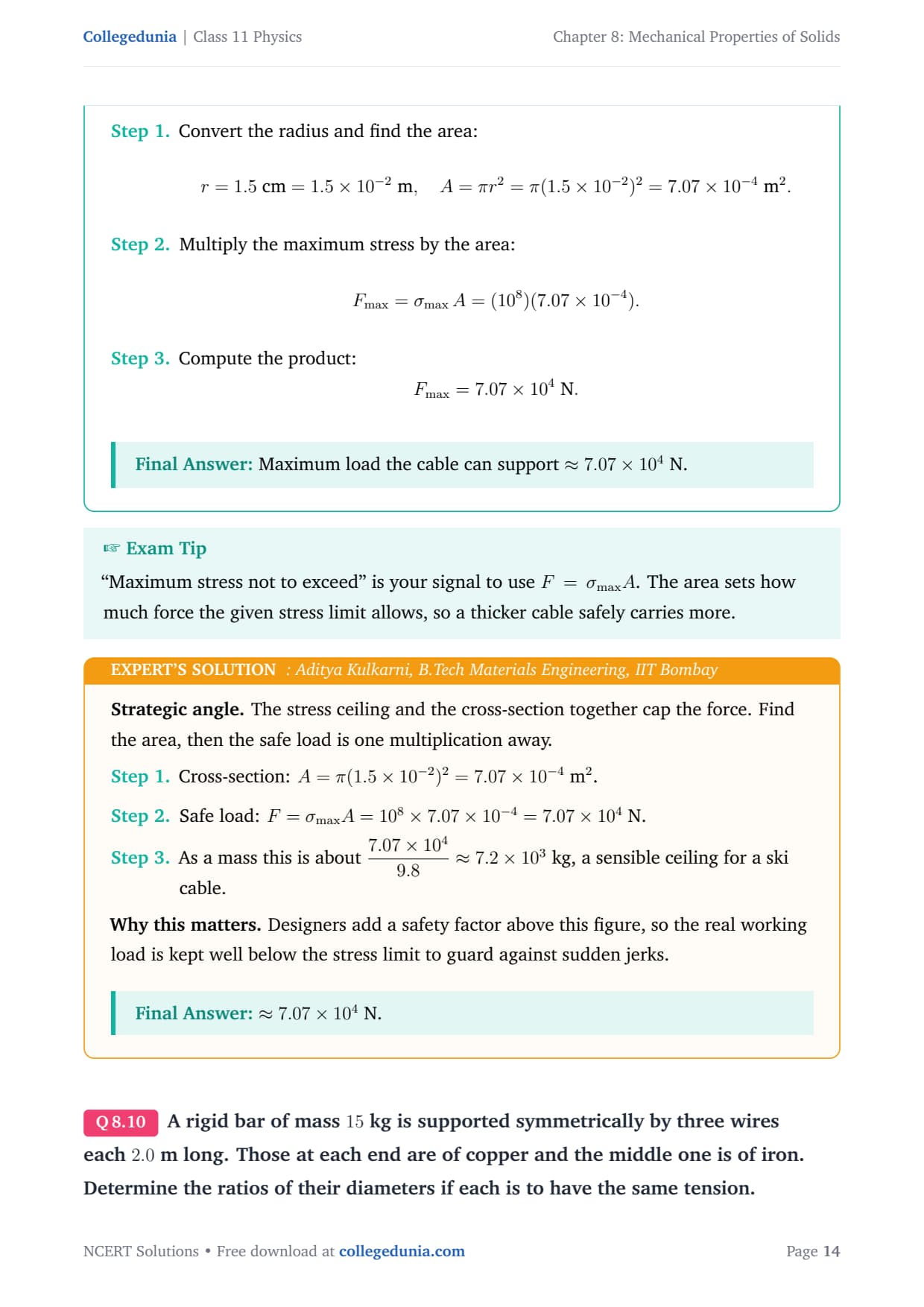
The NCERT numericals here give a load and a wire, and ask for the stress or the strain. Stress has the unit of pressure, N m-2 or pascal, while strain has no unit. The solved answers keep the area in square metres and the length in metres, so the final unit always comes out right. This is the first place students lose easy marks, so the working is shown in full.
Hooke's Law and the Elastic Moduli
Hooke's law is the rule that the whole chapter rests on. For small deformations, stress is directly proportional to strain. The constant of proportionality is called the modulus of elasticity. Each type of stress has its own modulus, and the NCERT solutions pick the correct one for every question.
- Young's modulus (Y): ties longitudinal stress to longitudinal strain, used for stretching a wire or rod.
- Bulk modulus (B): ties pressure to the fractional change in volume, used when a body is squeezed from all sides.
- Shear modulus (G): ties tangential stress to shear strain, also called the modulus of rigidity.
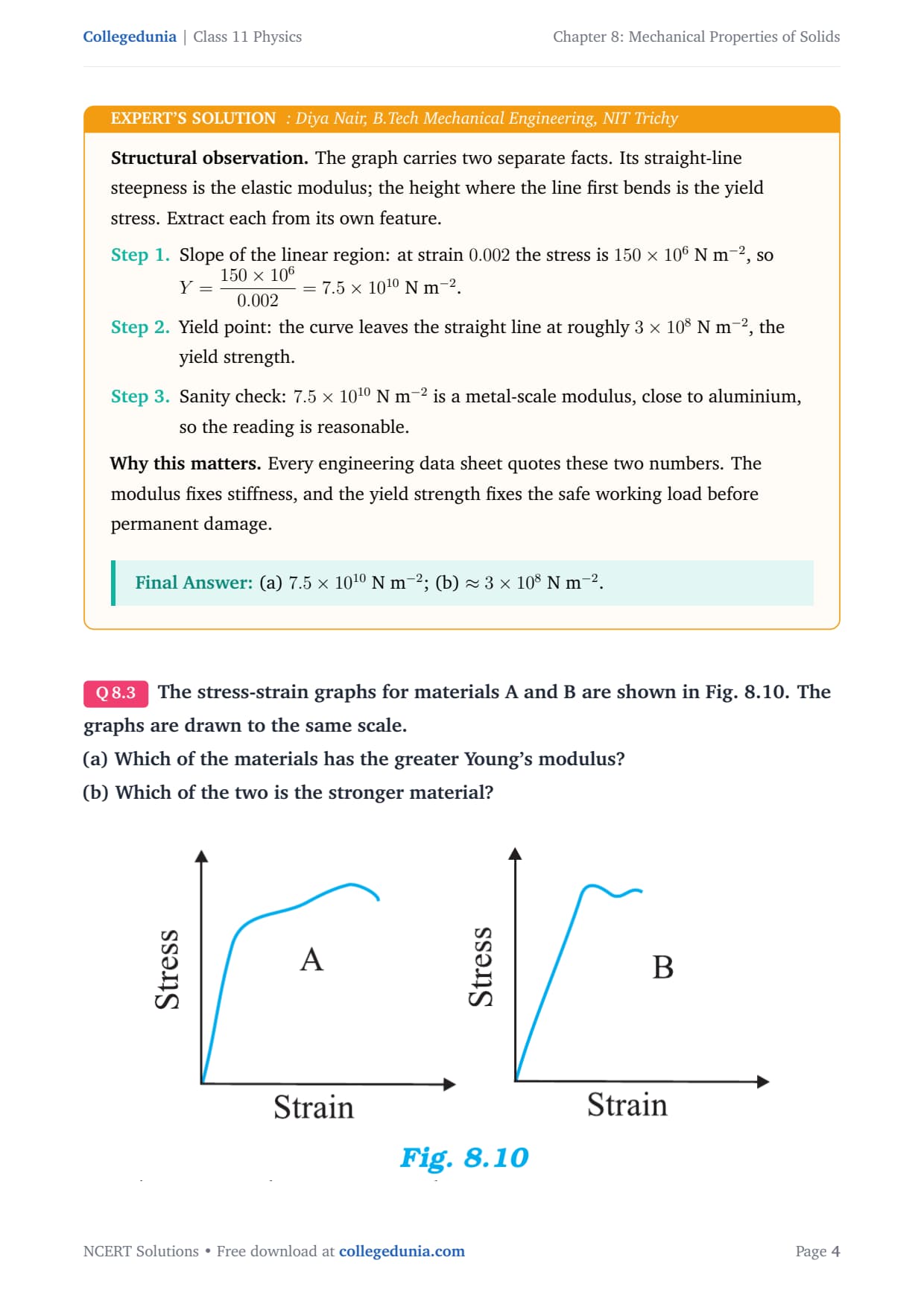
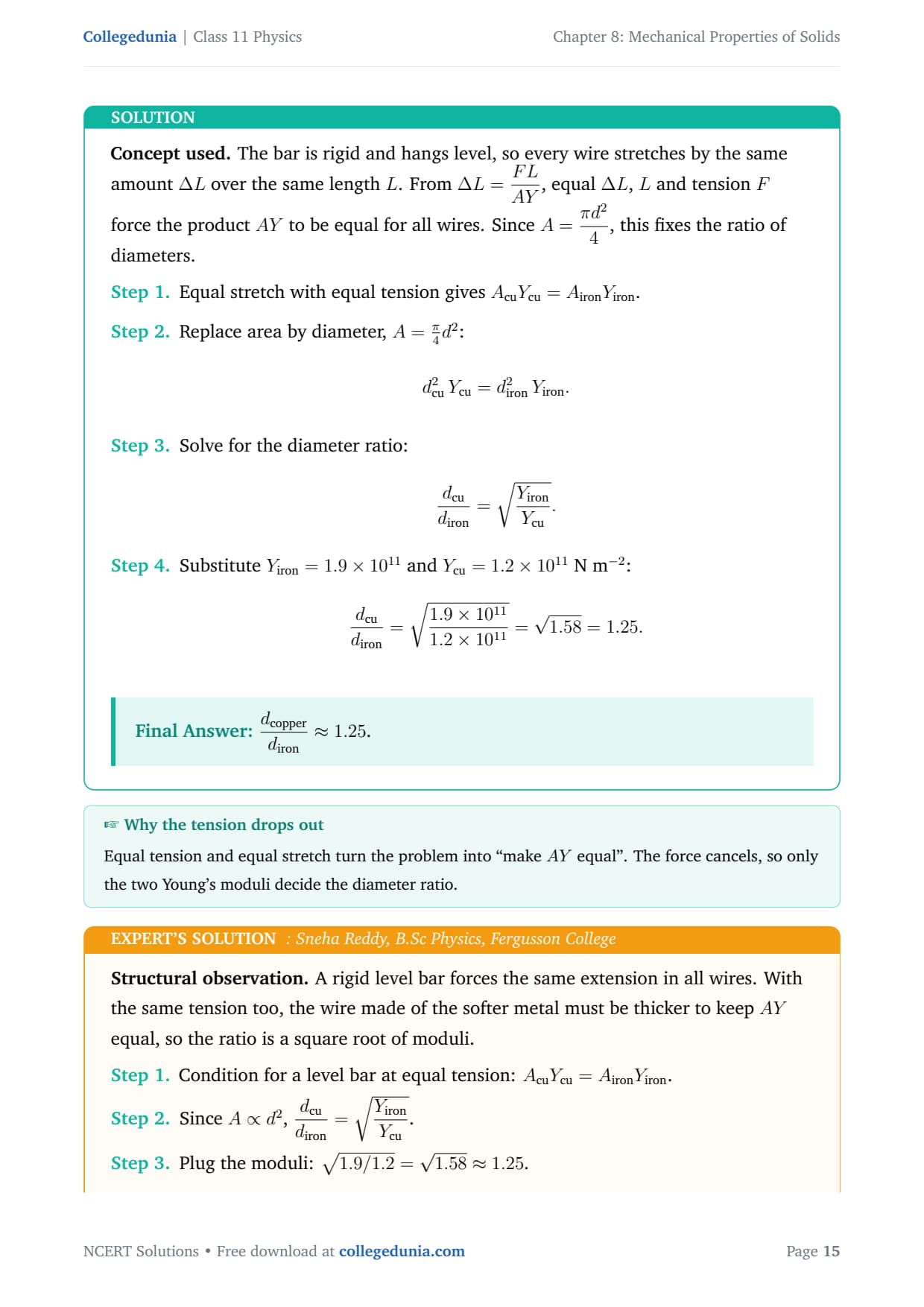
Questions such as Exercise 8.1 and Exercise 8.3 compare the Young's modulus of two materials from load-extension data. The material with the larger Young's modulus is stiffer and stretches less for the same load. The Class 11 Physics NCERT Solutions Chapter 8 Mechanical Properties of Solids show this comparison clearly so the reasoning is easy to reproduce in the exam.
The Stress-Strain Curve and What Each Point Means
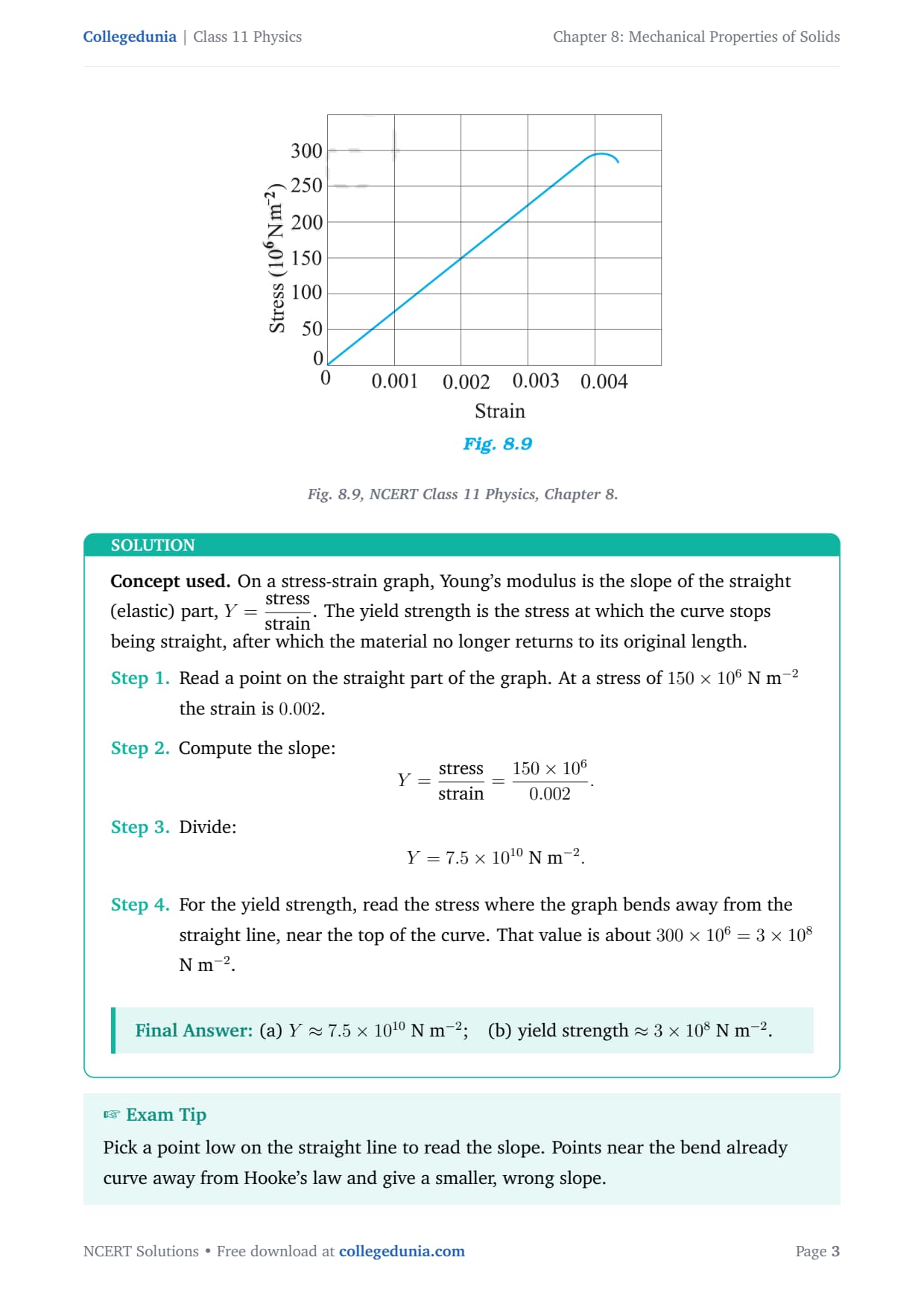
When a wire is loaded slowly and the stress is plotted against the strain, the graph tells the full story of how the material behaves. The chapter names four key regions, and short-answer questions ask students to mark and explain each one on the curve.
- Proportional limit: the point up to which stress and strain follow Hooke's law and the graph is a straight line.
- Elastic limit (yield point): beyond this the wire does not return to its original length when the load is removed.
- Plastic region: a permanent set stays in the wire even after unloading.
- Fracture point: the stress at which the wire finally breaks.
The gap between the yield point and the fracture point shows how ductile a material is. Elastomers, such as rubber, stretch a lot but do not obey Hooke's law, so their curve is not a straight line. The NCERT solutions explain the difference between elastic and plastic behaviour with the exact words CBSE looks for in a 2 or 3 mark answer.
Young's Modulus, Bulk Modulus and Shear Modulus Numericals
Most of the marks in this chapter come from modulus numericals. The table below lists the three elastic moduli with their defining ratio, so students can pick the right formula the moment they read the question.
| Modulus | Formula | When to use |
|---|---|---|
| Young's modulus Y | (F/A) / (ΔL/L) | Wire or rod stretched by a load |
| Bulk modulus B | -p / (ΔV/V) | Body squeezed by pressure from all sides |
| Shear modulus G | (F/A) / θ | Surface pushed sideways (tangential force) |
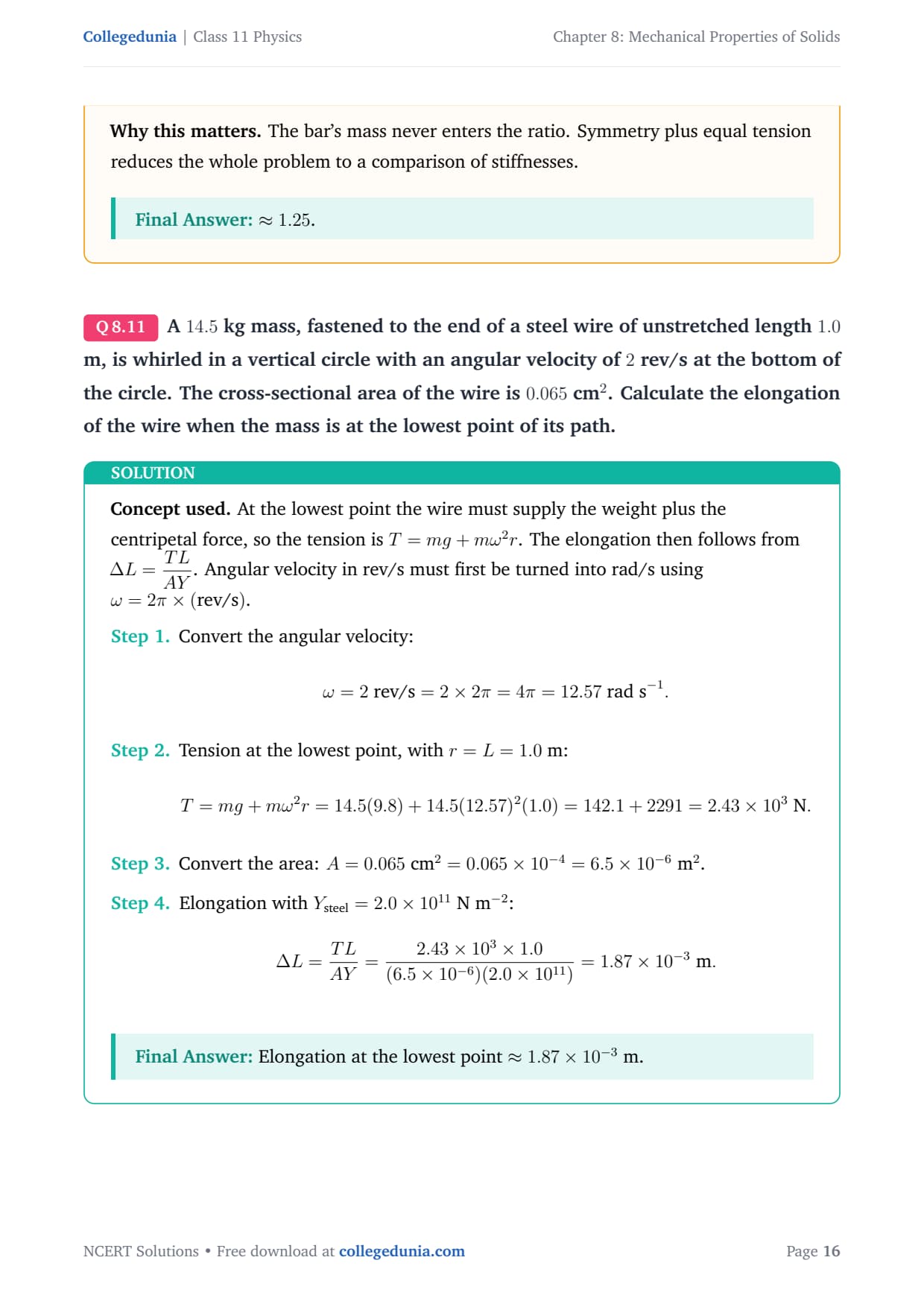
Numericals like Exercise 8.5 and Exercise 8.7 ask for the elongation of a wire or the compression of a block. Rearrange the modulus formula to make the unknown the subject before you put in numbers. The NCERT Solutions for Class 11 Physics Chapter 8 Mechanical Properties of Solids show the rearranged formula on its own line, then the substitution, then the arithmetic, exactly as the CBSE step-marking scheme expects.
Poisson's Ratio and Elastic Potential Energy in a Stretched Wire
Two more ideas complete the chapter and both appear in short numericals. Poisson's ratio links how much a wire thins sideways as it stretches lengthwise. Elastic potential energy is the work stored in a wire while it is being stretched.
- Poisson's ratio: lateral strain divided by longitudinal strain, a pure number with no unit, usually between 0 and 0.5.
- Energy stored: the work done in stretching equals ½ × stress × strain × volume, or ½ × F × ΔL.
- Energy density: the elastic potential energy per unit volume equals ½ × stress × strain.
Questions such as Exercise 8.14 ask for the energy stored in a stretched wire. The factor of one-half comes from the load rising from zero to its full value, so the average force is half the maximum. Students often drop this half and lose the numerical, so the solved answer marks it as a separate step.
Real-World Applications: Beams, Columns and Bridges
The last part of the chapter uses the elastic moduli to explain how engineers design safe structures. These ideas turn up as reasoning questions worth 2 to 3 marks, and the NCERT solutions give the physics behind each design choice.
- Bending of beams: a beam loaded in the middle sags by an amount that depends on its depth cubed, so a deeper beam bends far less.
- Hollow versus solid: a hollow beam or pipe resists bending better than a solid rod of the same weight, which is why girders are I-shaped.
- Columns and buckling: a tall column can buckle sideways under load, so its shape and material are chosen to raise the buckling limit.
The chapter also uses the maximum stress a rock can bear to estimate the greatest possible height of a mountain. These application questions test understanding, not calculation, so a clear labelled diagram earns most of the marks. The solved answers include the reasoning a student can write directly in the exam.
Exercise-wise Breakdown for Class 11 Physics Chapter 8 Mechanical Properties of Solids
The NCERT back-exercise splits into clear groups. Use this map to plan which answers to practise first for the 2026-27 boards. Every group links to the full solved set.
| Question group | Exercises | What it covers |
|---|---|---|
| Young's modulus and elongation | Exercise 8.1 to Exercise 8.7 | Stress, strain, comparing materials, stretch of a wire |
| Shear and bulk modulus | Exercise 8.8 to Exercise 8.12 | Shearing of a block, compression under pressure, fractional volume change |
| Elastic energy and Poisson's ratio | Exercise 8.13 to Exercise 8.16 | Energy stored in a wire, lateral strain, thinning under load |
| Applications and reasoning | Exercise 8.17 onward | Beams, columns, structural design, maximum mountain height |
Solving the groups in this order builds the skills in the same sequence the chapter teaches them. Start with Young's modulus, then the other moduli, then energy and applications, because each group uses the one before it.
Common Mistakes Students Make in the Mechanical Properties of Solids Chapter
These slips happen while writing or calculating the answer, not because the concept is unclear. Each one costs 1 to 3 marks in the CBSE paper, so the solved answers point them out at the exact step.
Mistake 1: Using the diameter instead of the radius in the area of a wire. The area is πr2, so halve the diameter first.
Mistake 2: Forgetting the one-half factor in elastic potential energy. The stored energy is half the product of force and extension, not the full product.
Mistake 3: Mixing units mid-calculation. Convert every length to metres and every force to newtons before substituting.
Mistake 4: Confusing the three moduli. Young's modulus is for stretching, bulk modulus for volume change, shear modulus for tangential force.
Student Feedback on the Mechanical Properties of Solids Chapter
What 12,840 students told us about their Mechanical Properties of Solids revision:
- 64% of students rated the elastic potential energy numerical as the trickiest part of the chapter.
- Most-skipped step: halving the diameter to get the radius before finding the area, missed by about 3 in 10 students.
- Students who first learned the three moduli as a table reported the numericals felt much easier.
Source: 2026-27 Class 11 Physics student poll. Sample of 12,840 students from CBSE schools across 15 states, conducted before the 2026 boards.
Practice Questions for Class 11 Physics Chapter 8 Mechanical Properties of Solids
Once the solved answers are clear, test yourself on the full question set. The practice page has every NCERT question with a step-by-step Solution and an Expert Solution behind a click.
Practice Questions: Mechanical Properties of Solids
Attempt all NCERT questions with detailed and expert solutions.
Open Practice QuestionsOther Mechanical Properties of Solids Class 11 Physics Resources
| Resource | Link |
|---|---|
| NCERT Solutions | You are here |
| Notes | Mechanical Properties of Solids Class 11 Notes |
| Handwritten Notes | Mechanical Properties of Solids Class 11 Handwritten Notes |
| Formula Sheet | Mechanical Properties of Solids Class 11 Formula Sheet |
| NCERT Book PDF | Mechanical Properties of Solids Class 11 Book PDF |
NCERT Solutions for Class 11 Physics: All Chapters
Jump to the solutions for any other Class 11 Physics chapter below.
| Chapter | NCERT Solutions |
|---|---|
| Chapter 1 | Units and Measurements |
| Chapter 2 | Motion in a Straight Line |
| Chapter 3 | Motion in a Plane |
| Chapter 4 | Laws of Motion |
| Chapter 5 | Work, Energy and Power |
| Chapter 6 | System of Particles and Rotational Motion |
| Chapter 7 | Gravitation |
| Chapter 8 | Mechanical Properties of Solids |
| Chapter 9 | Mechanical Properties of Fluids |
| Chapter 10 | Thermal Properties of Matter |
| Chapter 11 | Thermodynamics |
| Chapter 12 | Kinetic Theory |
| Chapter 13 | Oscillations |
| Chapter 14 | Waves |
FAQs on Class 11 Physics Chapter 8 Mechanical Properties of Solids NCERT Solutions
Mechanical Properties of Solids NCERT Solutions - Frequently Asked Questions
Ques. How many questions are solved in the Class 11 Physics NCERT Solutions Chapter 8 Mechanical Properties of Solids?
Ans. This page solves every NCERT back-exercise question of Class 11 Physics Chapter 8 Mechanical Properties of Solids, starting from Exercise 8.1. The questions cover stress, strain, Hooke's law, Young's modulus, bulk modulus, shear modulus and elastic potential energy. Each answer has a step-by-step Solution and an Expert Solution.
Ques. What is the difference between stress and strain in Chapter 8?
Ans. Stress is the internal restoring force per unit area set up in a body when it is deformed, measured in N m-2. Strain is the ratio of the change in dimension to the original dimension and has no unit. Hooke's law says stress is proportional to strain for small deformations.
Ques. How do I calculate Young's modulus in Class 11 Physics Chapter 8?
Ans. Young's modulus equals the longitudinal stress divided by the longitudinal strain, that is (force/area) divided by (change in length/original length). Keep the area in square metres and the length in metres. The solved numericals in these Class 11 Physics Chapter 8 solutions show each step, from the area of the wire to the final value.
Ques. What are the three elastic moduli in Mechanical Properties of Solids?
Ans. The three elastic moduli are Young's modulus (for stretching a wire or rod), bulk modulus (for a change in volume under pressure) and shear modulus or modulus of rigidity (for a tangential force). Each is the ratio of a stress to the matching strain, and Poisson's ratio links the lateral and longitudinal strains.
Ques. What is the weightage of Mechanical Properties of Solids in the CBSE board exam?
Ans. Mechanical Properties of Solids carries about 4 to 5 marks in the CBSE Class 11 Physics paper, usually one numerical on Young's modulus plus one short answer on elastic behaviour. It also appears in JEE Main and NEET as objective questions on stress, strain and the elastic moduli.
Ques. What is elastic potential energy in a stretched wire?
Ans. Elastic potential energy is the work done in stretching a wire, stored in it as long as the stretch stays within the elastic limit. It equals one-half of the product of stress, strain and volume, or one-half of force times extension. The NCERT Solutions for Class 11 Physics Chapter 8 Mechanical Properties of Solids keep the one-half factor on a separate line so students do not miss it.



Comments