




The Class 9 Science NCERT Notes for Chapter 3 Tissues in Action bring together every plant and animal tissue that the 2026-27 Exploration book actually teaches. These notes explain meristem, parenchyma, collenchyma, sclerenchyma, xylem and phloem, then the four animal tissues, in plain language. Each idea is tied to one simple rule the chapter repeats: a tissue's structure fits its function.
- What is inside: full plant tissue and animal tissue notes, labelled tables, mnemonics, and a quick-revision recap for last-day study.
- Main skills: naming each tissue, linking its structure to its job, and telling close pairs like tendon and ligament apart.
- Why it matters: this chapter builds the tissue base needed for Class 10 biology and the early NEET foundation years.
Every note in these Class 9 Science NCERT Notes for Chapter 3 Tissues in Action is prepared by subject teachers, matched to the 2026-27 NCERT Exploration book, and checked against the Revise, Reflect, Refine exercise.

Student Feedback
In a Collegedunia poll of 12,840 Class 9 students taken before their 2026-27 annual exams, 71% said the plant tissue names were the hardest part of Tissues in Action to keep straight. Most students mixed up collenchyma and sclerenchyma. Students who drew each tissue once and wrote its single main job reported the fastest recall during revision.
Source: 2026-27 Class 9 Science student poll. Sample of 12,840 students from CBSE schools across 15 states.
Tissues in Action One Shot Revision for Class 9 Science
Source: Magnet Brains on YouTube
What Class 9 Science Chapter 3 Tissues in Action Covers
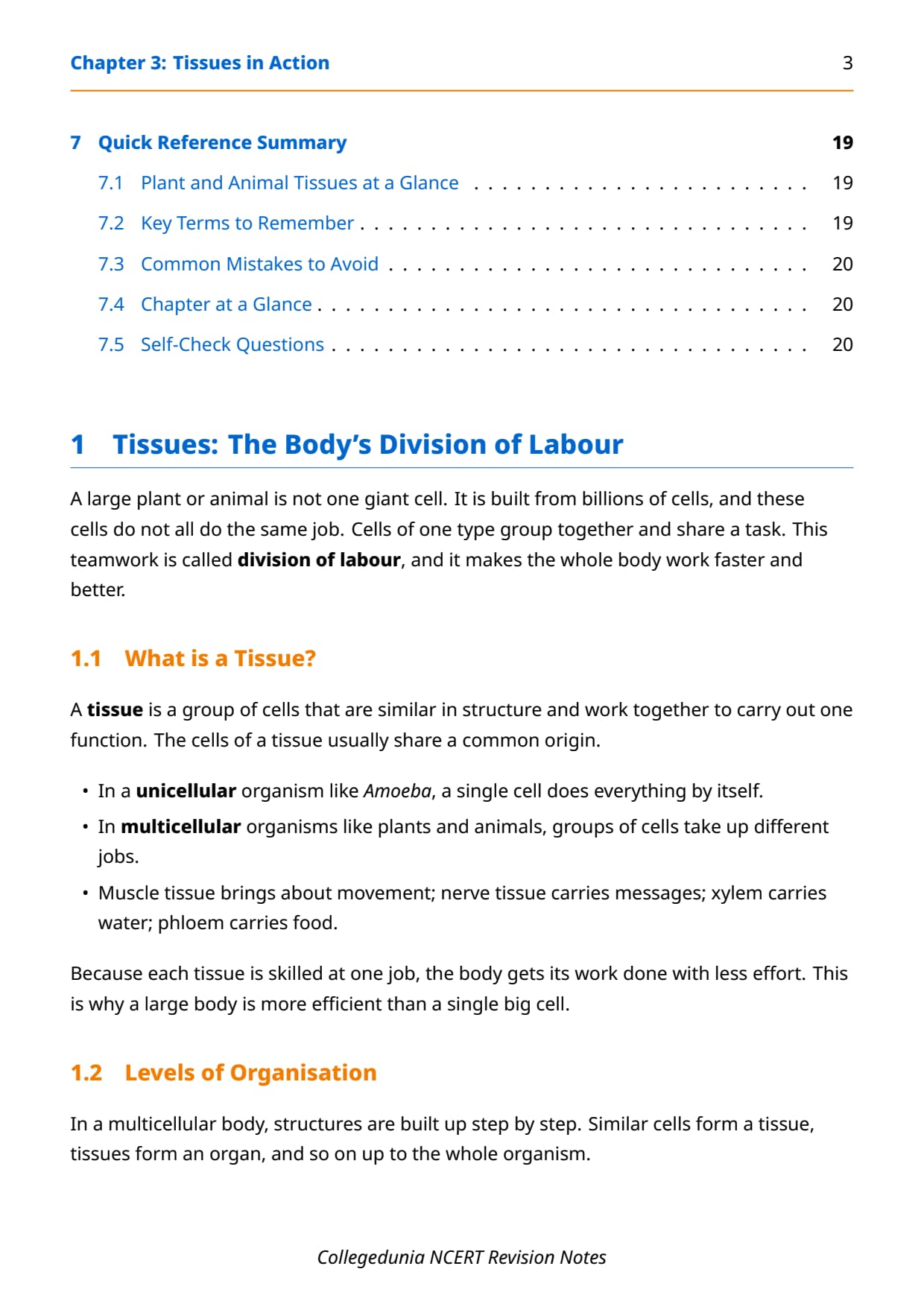
A tissue is a group of similar cells that work together to do one job. In the body, similar tissues form organs, organs form organ systems, and systems form the whole organism. This grouping creates a division of labour that makes the body work faster and better.
- Plant tissues: dividing meristematic tissue (apical, lateral, intercalary) and permanent tissue (parenchyma, collenchyma, sclerenchyma, epidermis, xylem, phloem).
- Animal tissues: epithelial (covering and lining), connective (blood, bone, cartilage, tendon, ligament), muscular and nervous.
- Support systems: the musculoskeletal system, the main joint types, and the skeletal system that gives the body its frame.
The one rule that runs through the whole chapter is structure fits function. Thin walls help exchange, thick lignified walls give strength, and long fibres carry signals. Learn that link once and most of the chapter falls into place.
Why Plant and Animal Tissues Are Different in Class 9 Science
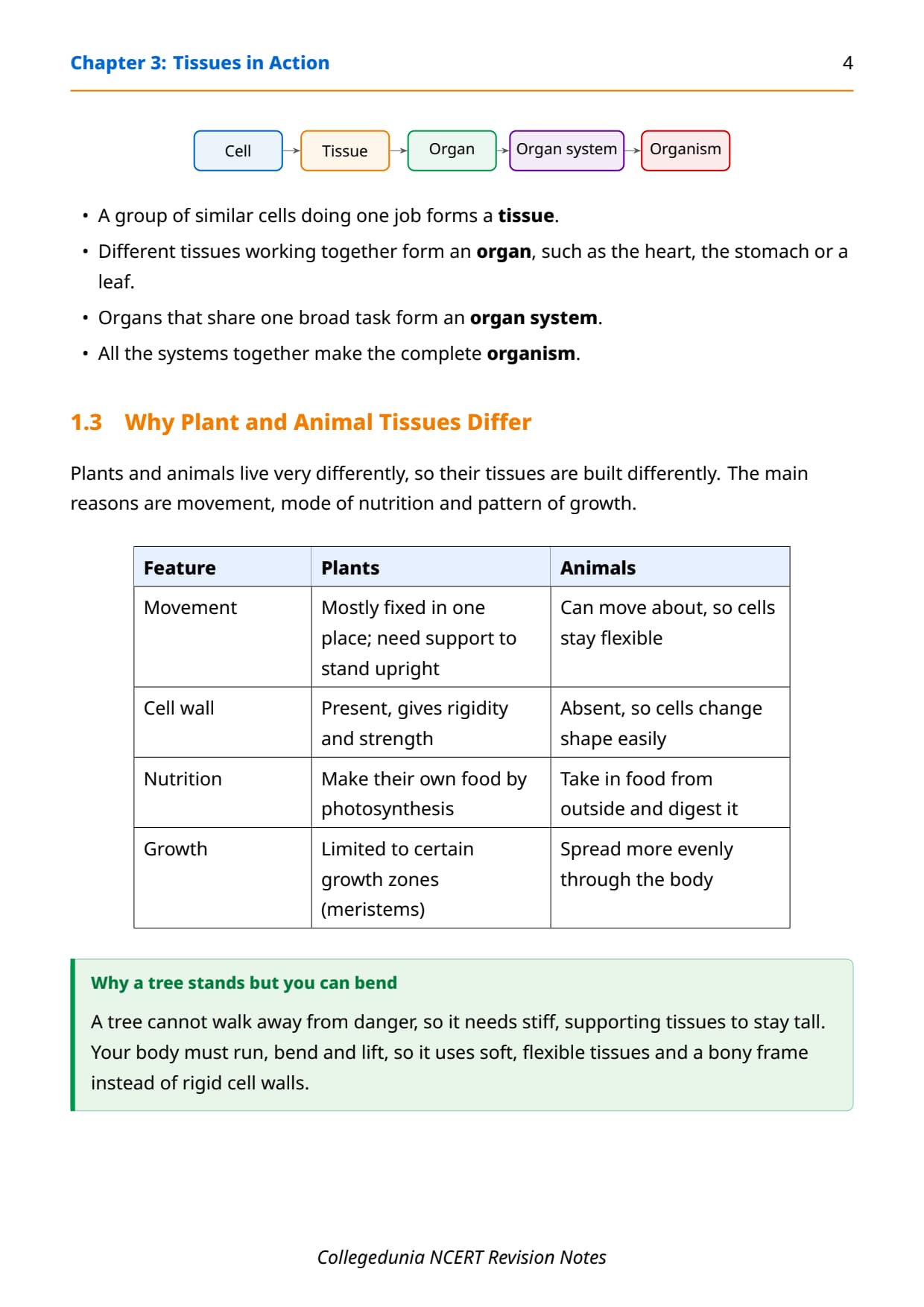
Plants and animals build their bodies in different ways, so their tissues differ too. Plants stay fixed in one place and need firm support. Animals move, so their cells need to change shape. These two facts explain most of the structural differences you will read about.
- Cell wall: plant cells have a rigid wall for strength and support, while animal cells have only a flexible membrane, which suits movement.
- Nutrition: plants make food by photosynthesis, so they carry many food-making and food-storing tissues, unlike animals.
- Growth pattern: plants grow mainly at fixed tips and zones, while animals grow all over the body in a more even way.
Because plants cannot run from harm, they invest in dead, strong tissues like sclerenchyma for support. Animals instead rely on living, active tissues that react and move. Keep this difference in mind and the plant and animal sections stop feeling like two separate chapters.
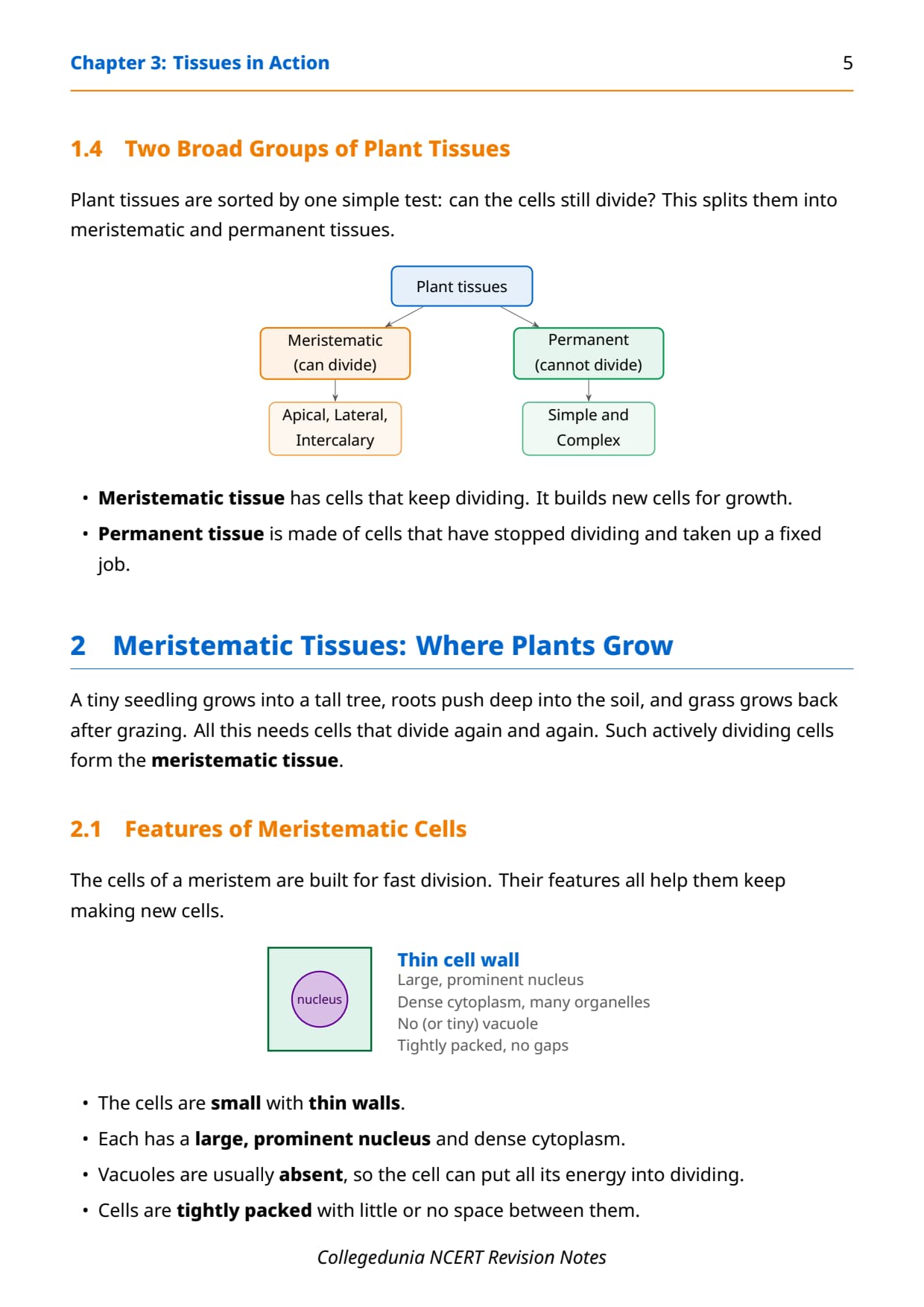
Meristematic Tissue in Tissues in Action: How Plants Grow
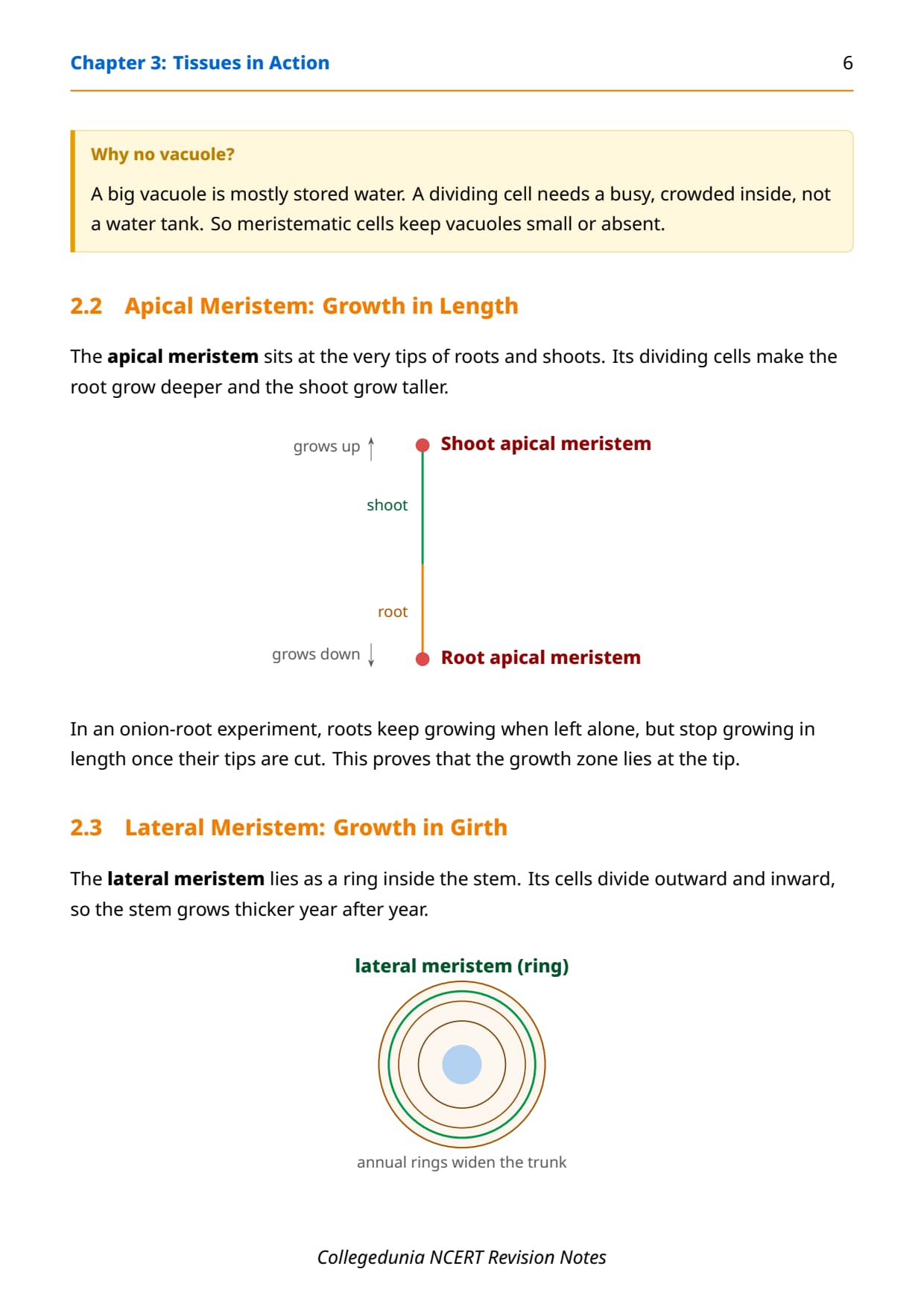
Plants grow in three ways: they increase in length, increase in girth, and regrow after being cut or grazed. All of this growth needs a tissue of actively dividing cells called meristematic tissue. Its cells are small, thin-walled, tightly packed, and have a large nucleus with dense cytoplasm and almost no vacuoles.
- Apical meristem: sits at the tips of roots and shoots and makes the plant grow in length.
- Lateral meristem (cambium): lies in a ring around the stem and increases its girth, forming the annual rings you see in a cut tree trunk.
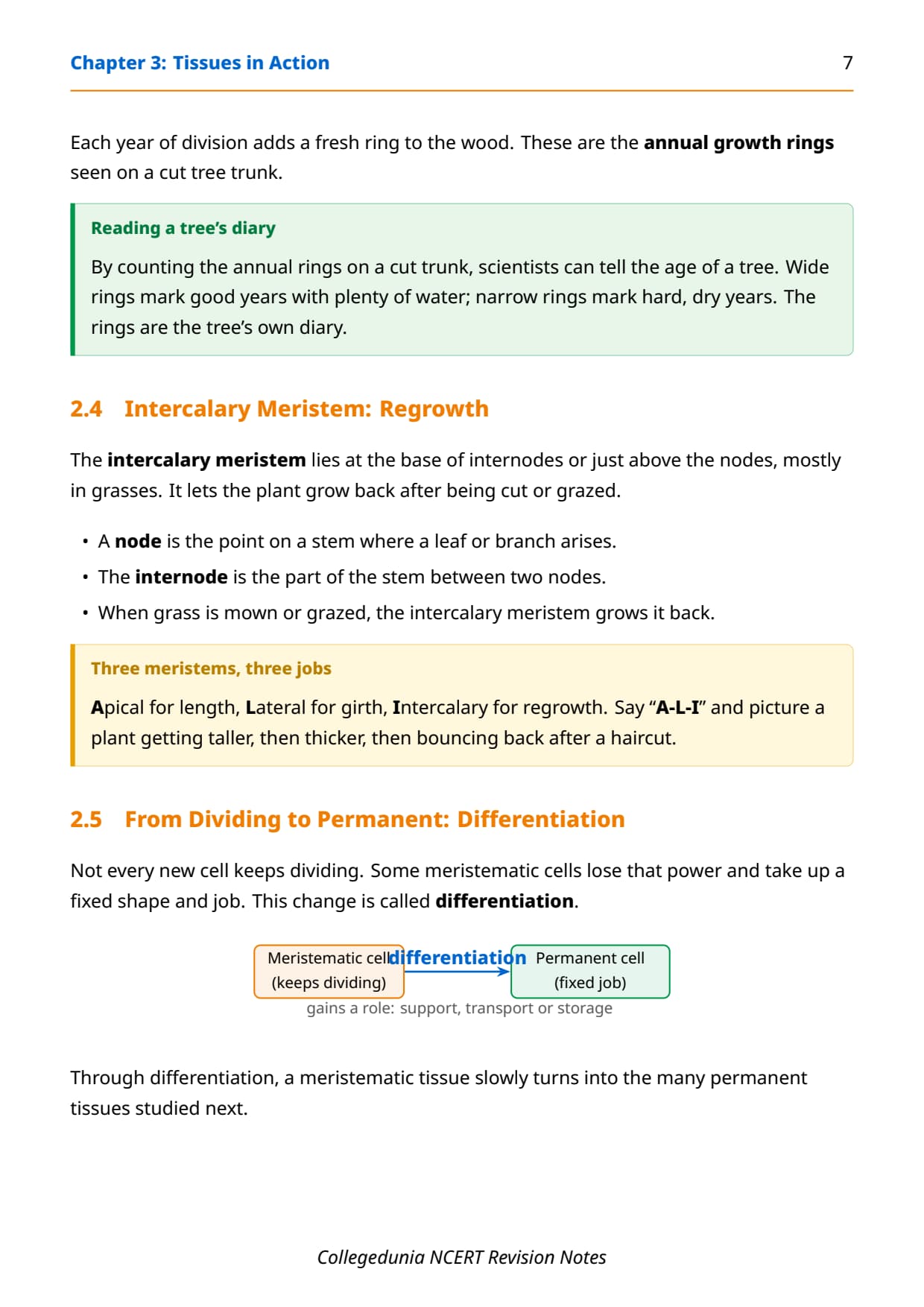
- Intercalary meristem: sits near the nodes and base of internodes and helps grass and hedges regrow after mowing or grazing.
Some new cells stay meristematic, while others lose the power to divide and become specialised. This change from dividing tissue to fixed, specialised tissue is called differentiation. It is how a plant turns simple dividing cells into support, transport and storage tissues.
Plant Permanent Tissue Notes: Simple and Complex Types
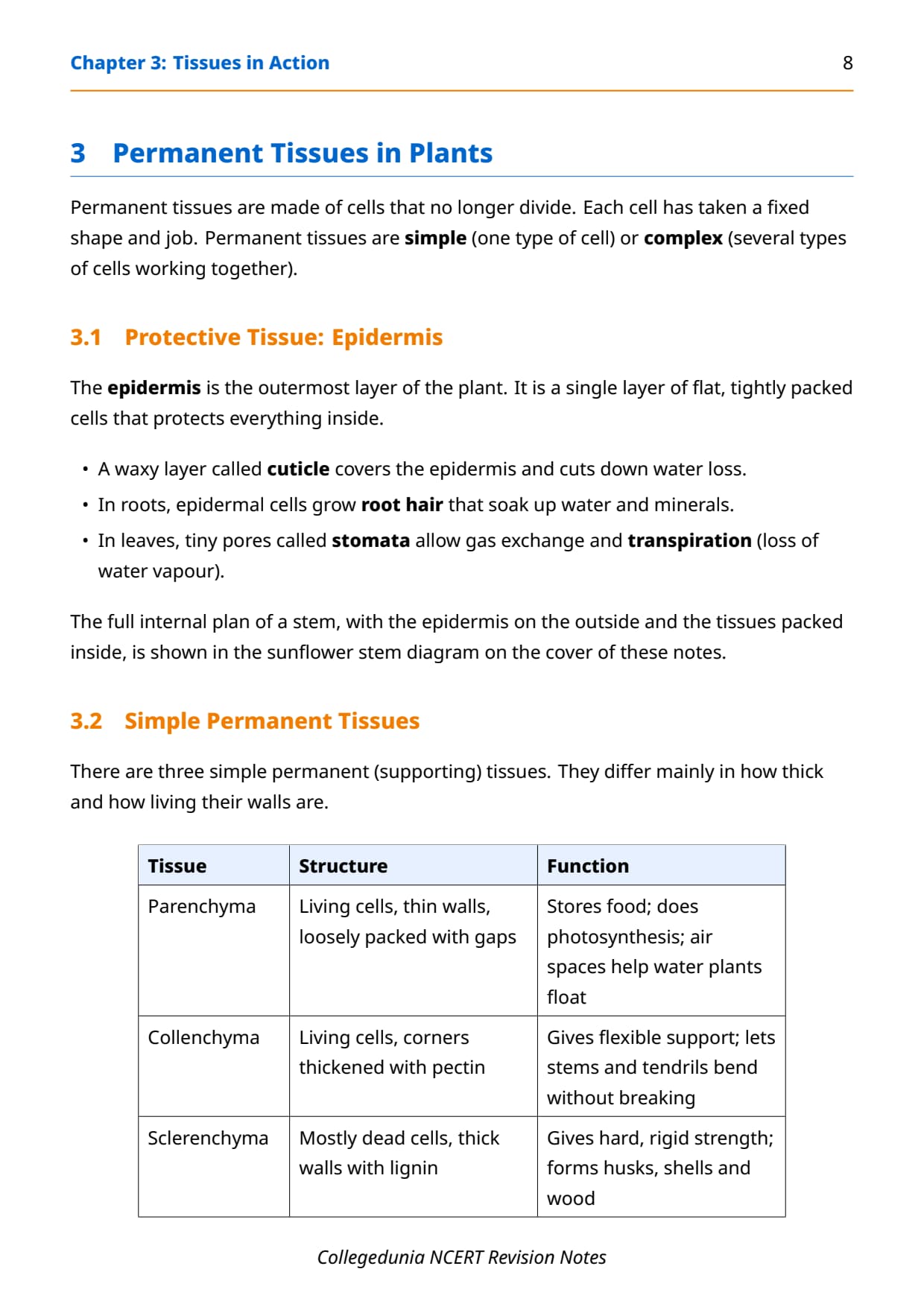
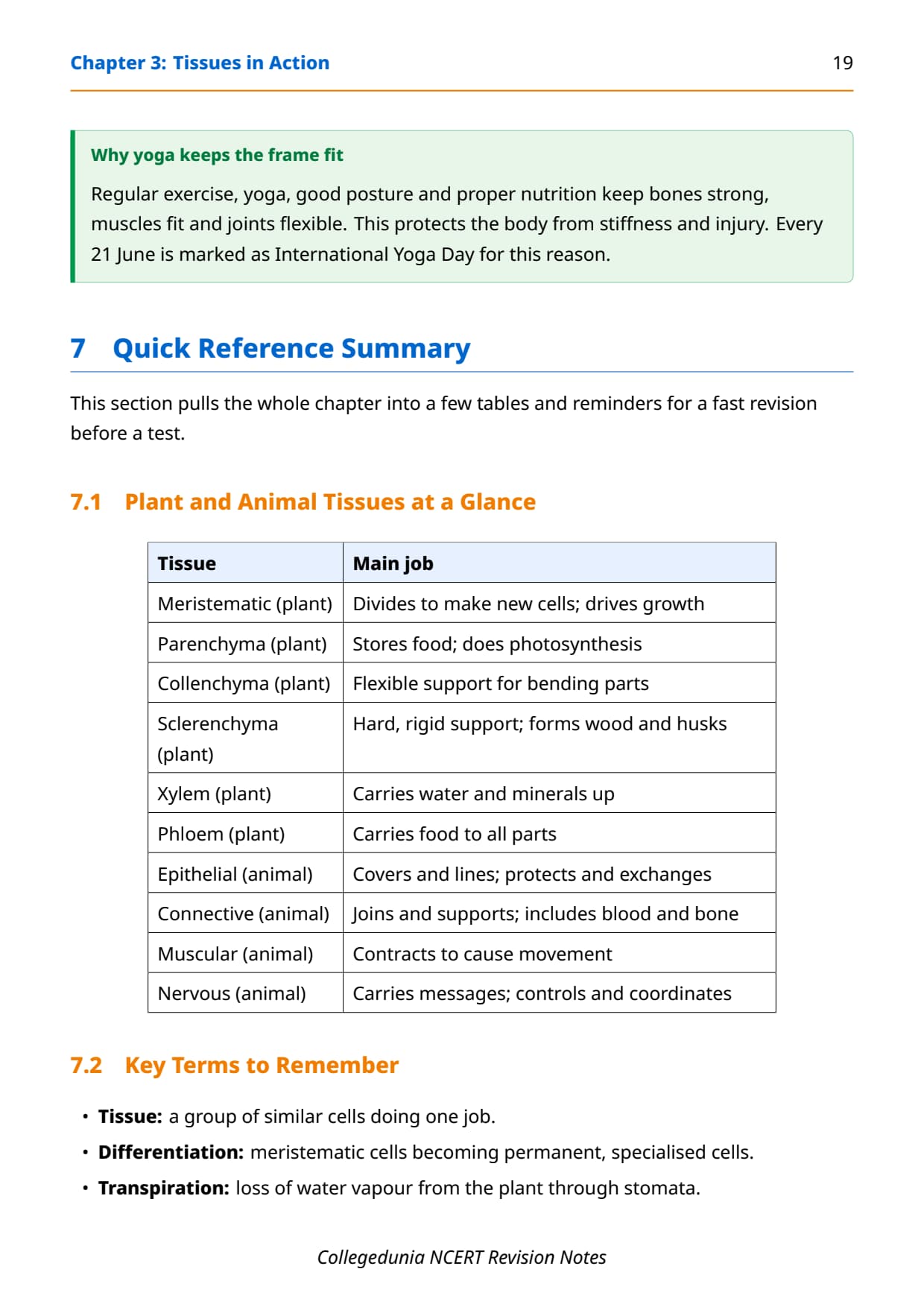
Permanent tissues are made of cells that have stopped dividing and taken up a fixed job. They can be simple (one cell type) or complex (several cell types working as one team). The table below sorts the main permanent tissues by their job and their key feature.
| Tissue | Type | Key feature and job |
|---|---|---|
| Epidermis | Protective | Single tight layer with a waxy cuticle; guards against water loss, injury and microbes |
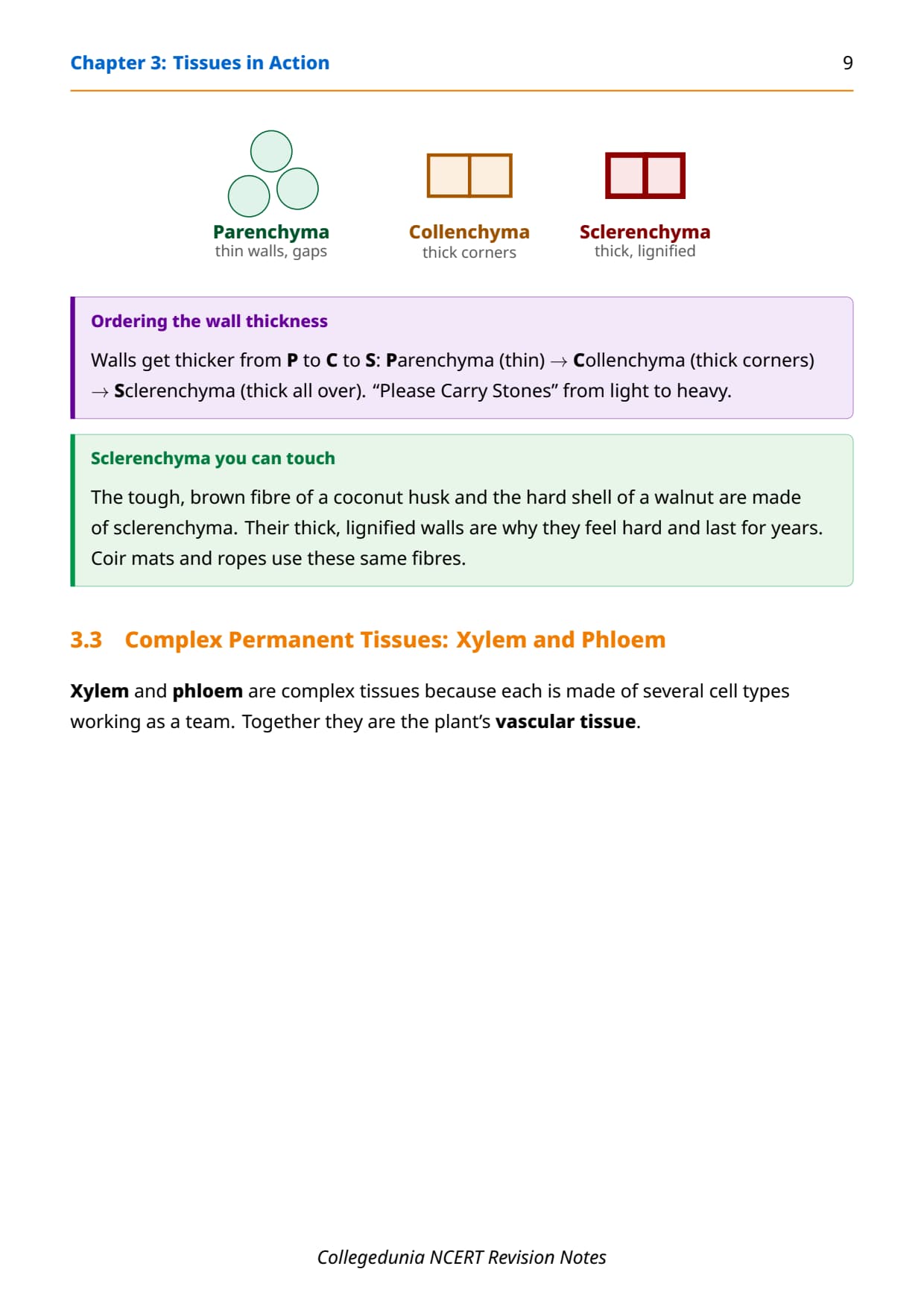
| Parenchyma | Simple, supporting | Living thin-walled cells; stores food and does photosynthesis in green parts |
| Collenchyma | Simple, supporting | Living cells thickened at the corners; gives flexible support so stems bend, not break |
| Sclerenchyma | Simple, supporting | Dead cells with thick lignified walls; gives hardness, as in coconut husk and nut shells |
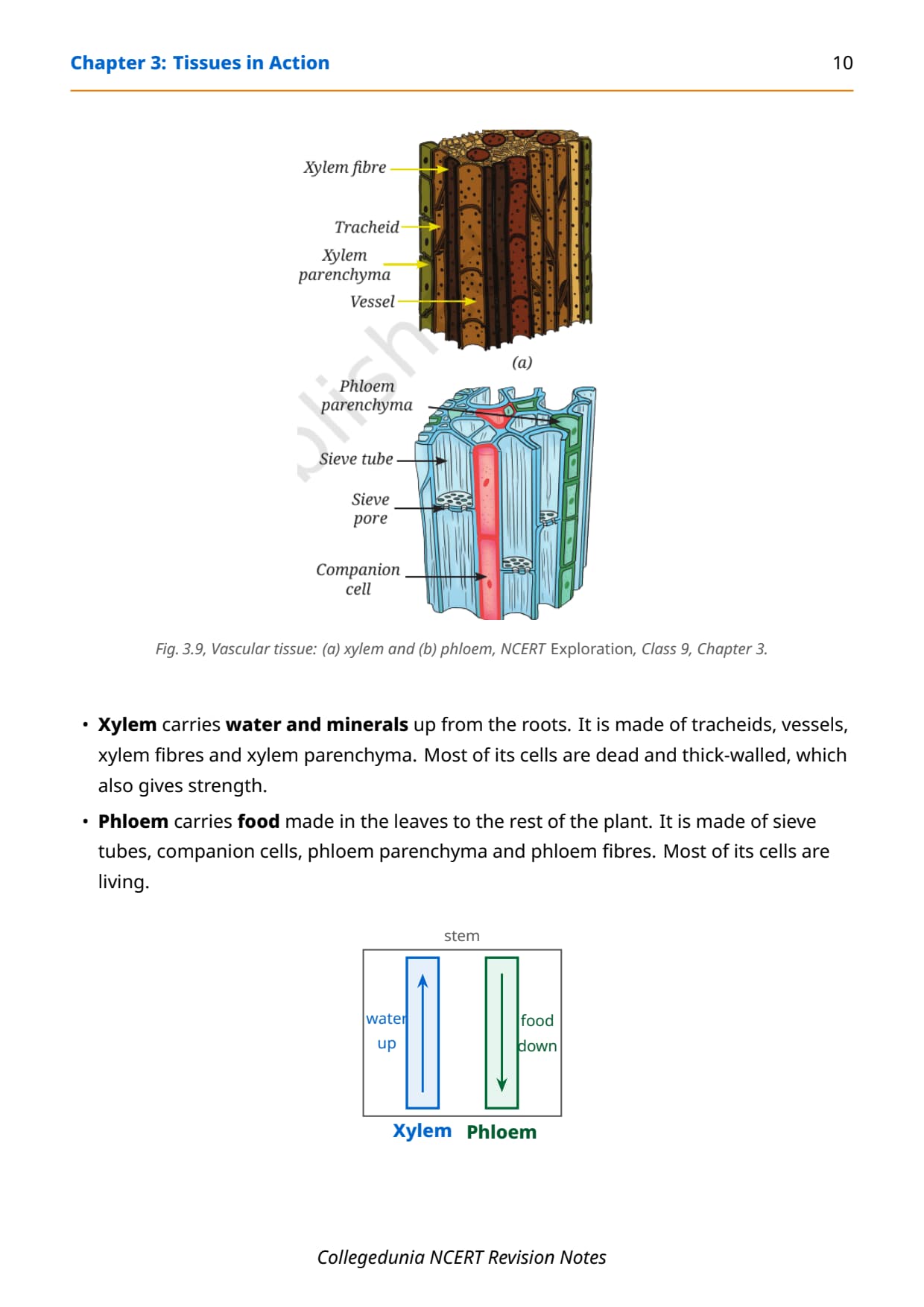
| Xylem | Complex, conducting | Carries water and minerals upward; made of tracheids, vessels, xylem parenchyma and fibres |
| Phloem | Complex, conducting | Carries food from leaves; made of sieve tubes, companion cells, phloem parenchyma and fibres |
The epidermis also carries useful add-ons. Root hairs increase the surface for absorbing water, and leaf pores called stomata allow gas exchange and transpiration. Transpiration then creates a pull that helps xylem move water up the plant.
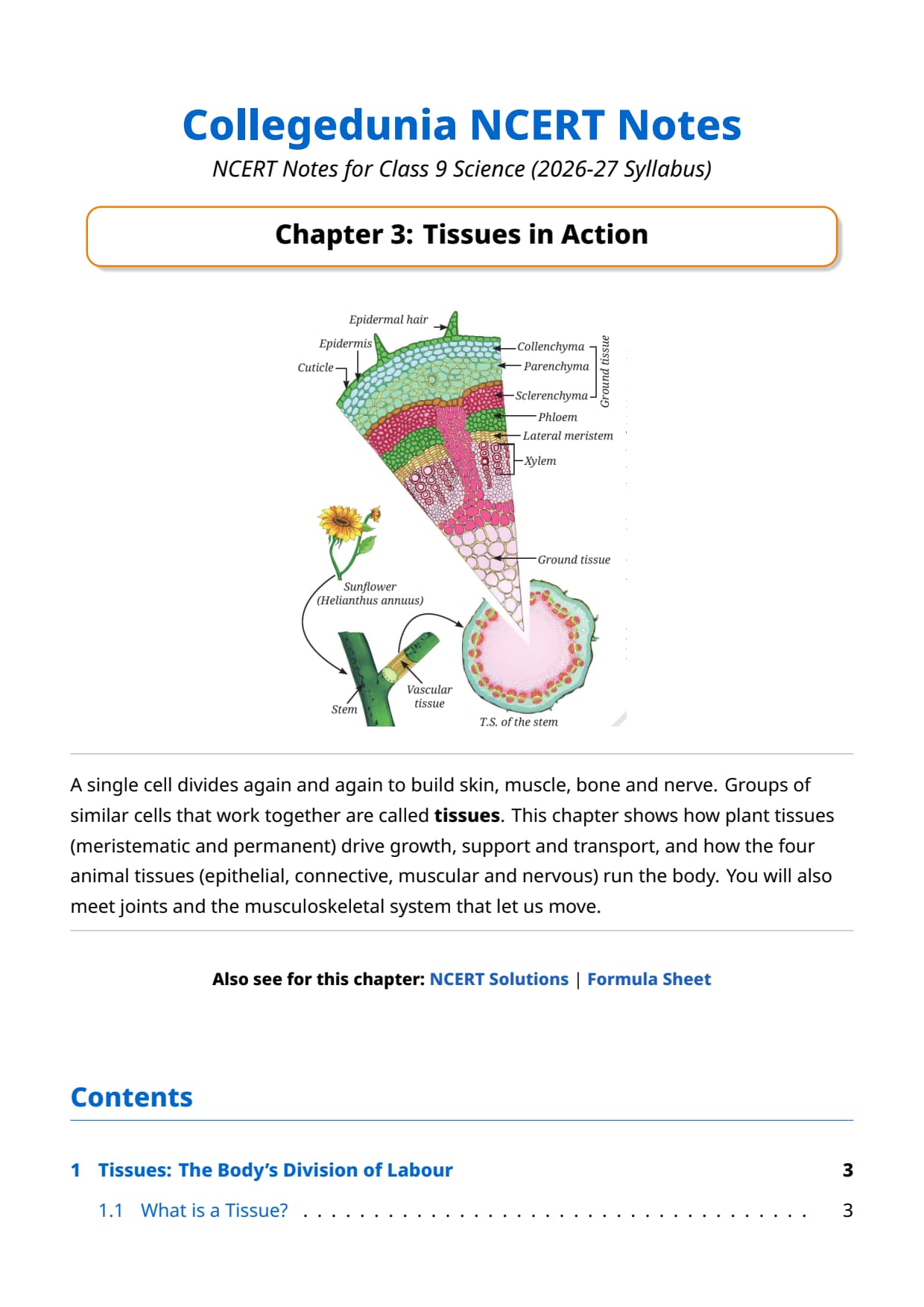
Plant Tissue Systems: Dermal, Ground and Vascular
In a real plant, tissues do not work alone. They are organised into three larger groups called tissue systems. Reading a plant section under a microscope becomes easy once you can name these three layers.
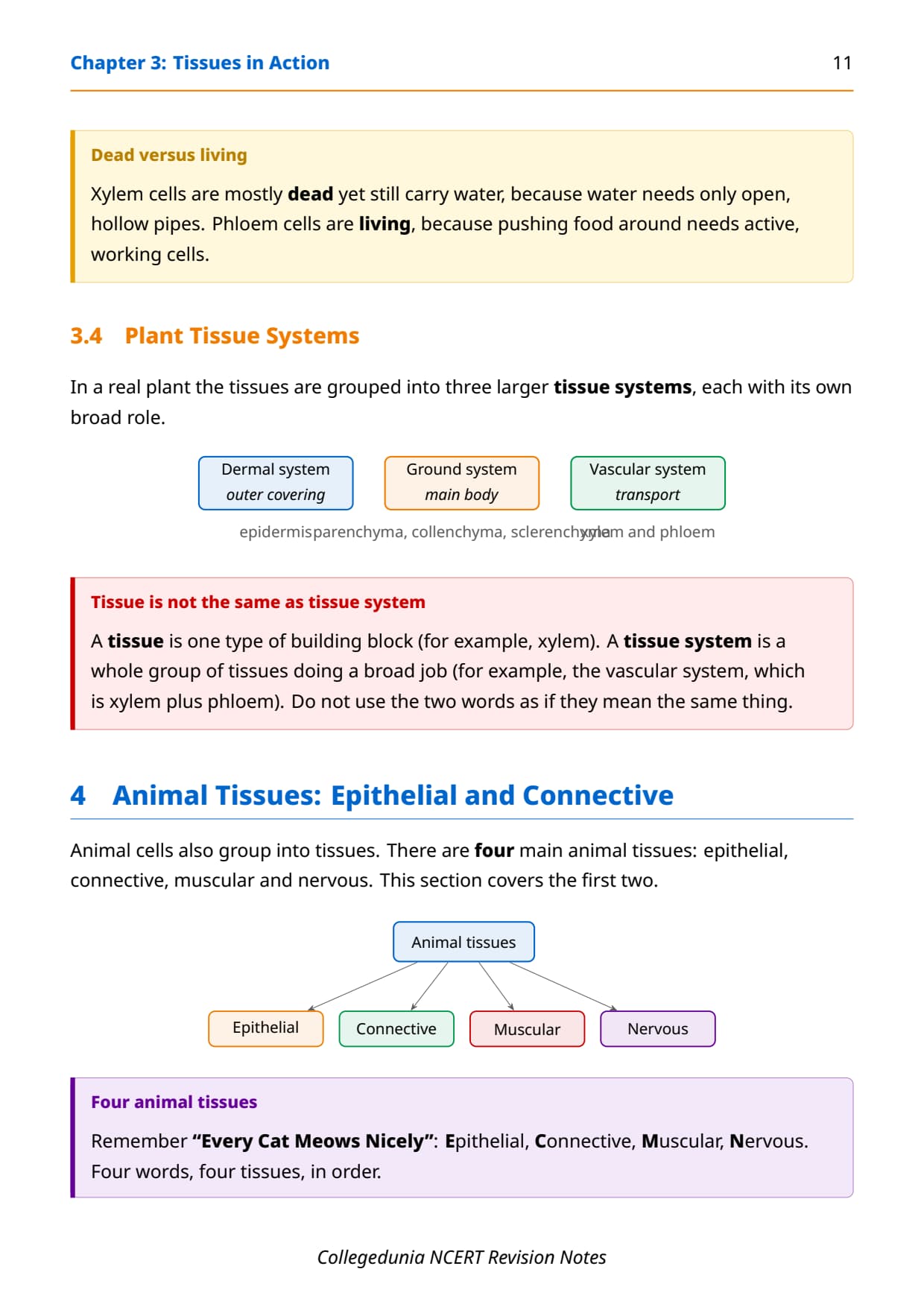
- Dermal tissue system: the outer covering (epidermis) that protects inner parts and cuts water loss.
- Ground tissue system: the main body between the dermal and vascular tissues; it holds parenchyma, collenchyma and sclerenchyma.
- Vascular tissue system: the transport network of xylem and phloem that links roots, stem and leaves.
Indian scientists helped build this field. Sipra Guha Mukherjee and S. C. Maheshwari grew whole plants from anther cells, while F. C. Steward showed that a single carrot phloem cell can regrow a full plant, a property called totipotency.
Animal Epithelial Tissue Notes for Class 9 Science
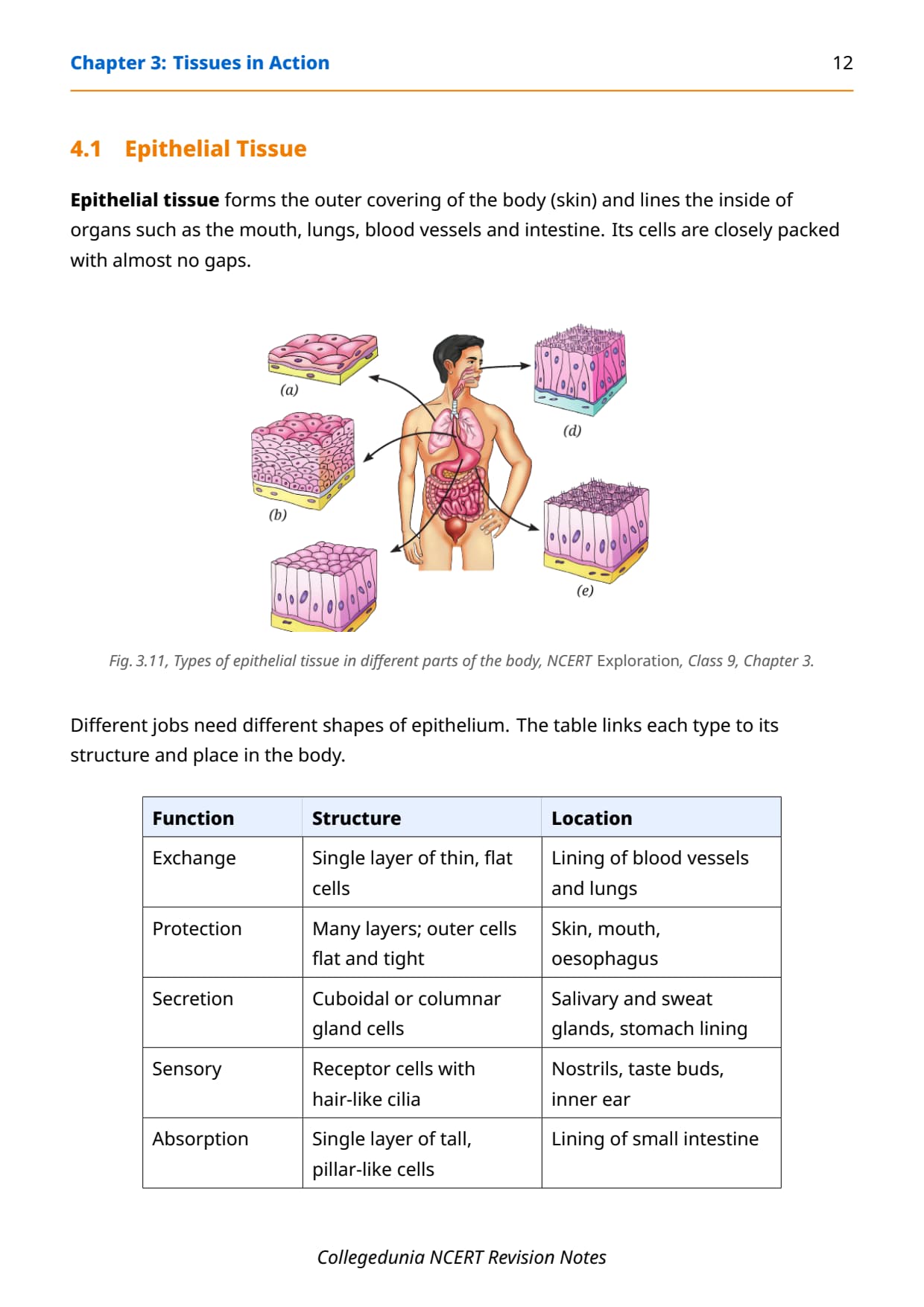
Epithelial tissue forms the outer cover of the body and lines the inner organs, such as the mouth, lungs, blood vessels and intestine. Its cells are packed tightly with very little space between them, which blocks germs and cuts water loss. Different jobs need different shapes, as shown below.
| Function | Structure | Location in the body |
|---|---|---|
| Exchange of gases and liquids | Single layer of thin, flat cells | Lining of blood vessels and lungs |
| Protection from injury and microbes | Many layers of flat, tightly packed cells | Skin, mouth and oesophagus |
| Secretion of mucus, enzymes, sweat | Cuboidal or columnar gland cells | Salivary glands, sweat glands, stomach lining |
| Sensing smell, taste, sound, balance | Receptor cells with hair-like cilia | Nostrils, taste buds and inner ear |
| Absorption of nutrients and water | Single layer of tall, pillar-like cells | Lining of the small intestine |
The pattern here is simple and worth a highlight: thin single layers speed up exchange, while many thick layers give protection. A quick reason-based question in the exam often just tests this one link between layer thickness and job.
Connective Tissue Notes: Blood, Bone, Cartilage and More
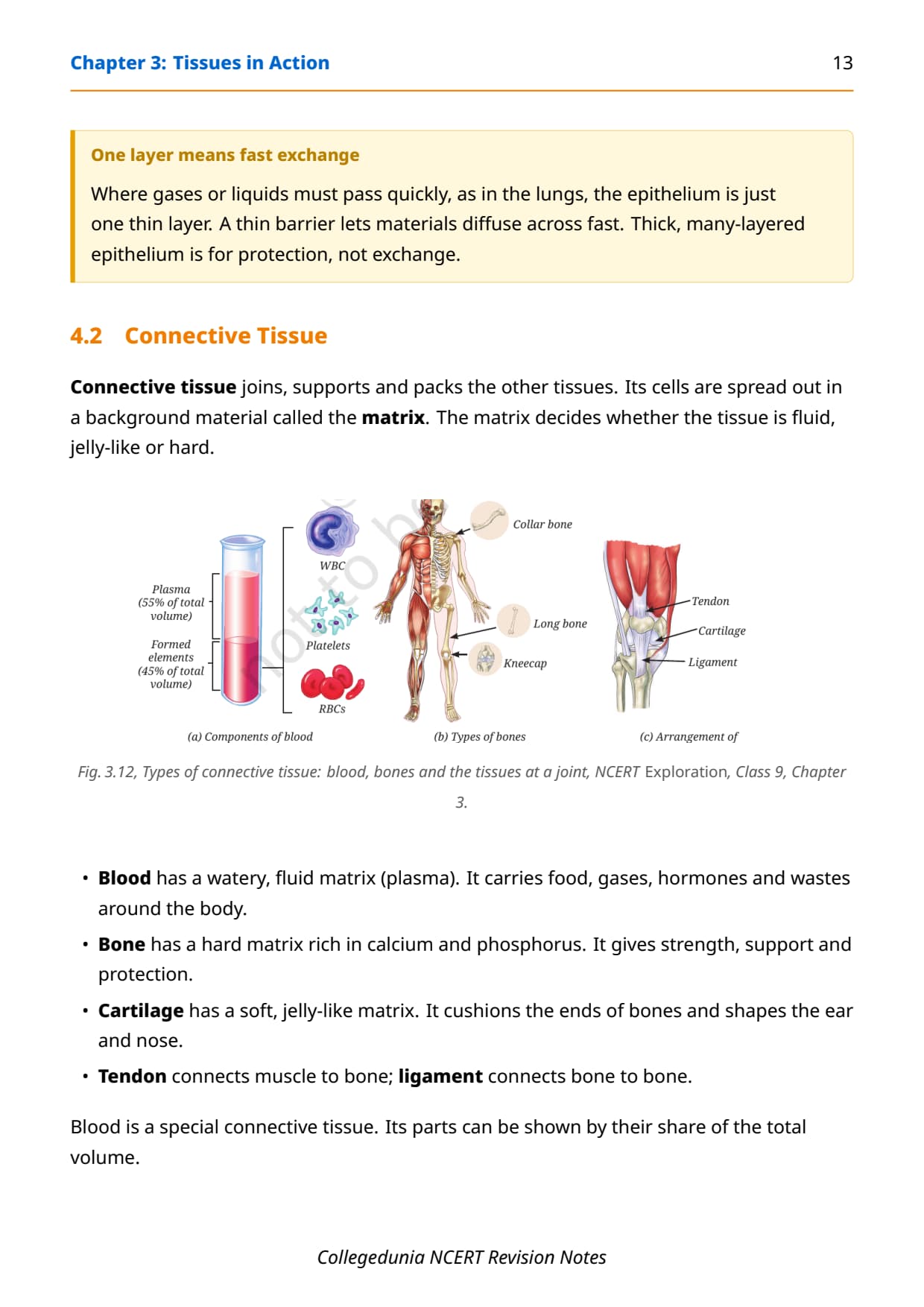
A tissue that connects and supports other tissues is called connective tissue. Its cells sit in a background material called the matrix, and the matrix decides how the tissue feels. Blood has a watery matrix, while bone has a hard, solid matrix.
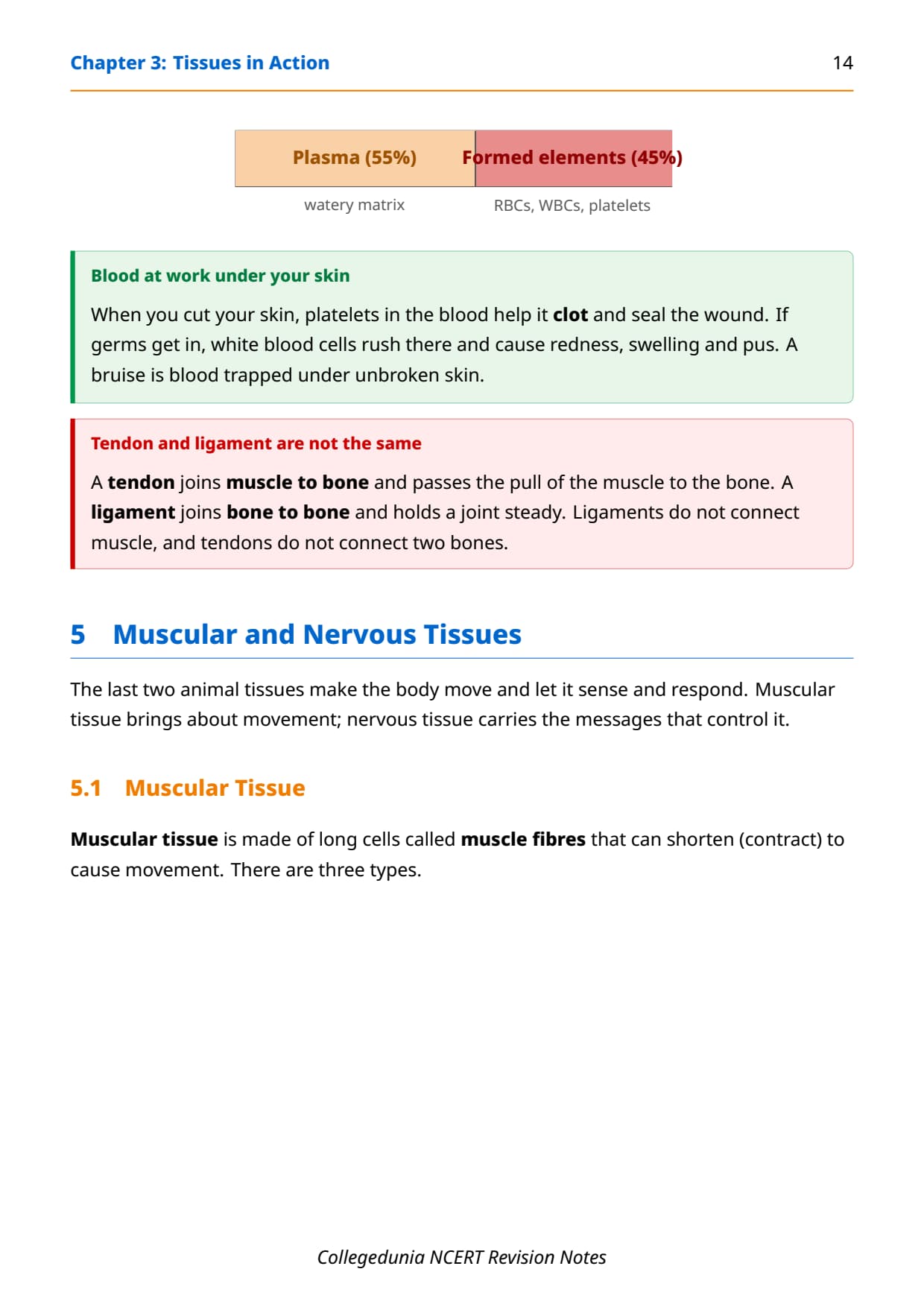
- Blood: a fluid connective tissue; plasma carries red cells, white cells and platelets to transport gases, food and wastes.
- Bone: a hard matrix rich in calcium and phosphorus; gives strength, support and protection.
- Cartilage: a soft, jelly-like matrix; cushions the ends of bones and absorbs shock.
- Tendon: joins muscle to bone and passes the muscle's pull to the bone during movement.
- Ligament: joins bone to bone, holds a joint together and limits over-movement.
Muscular and Nervous Tissue in Tissues in Action
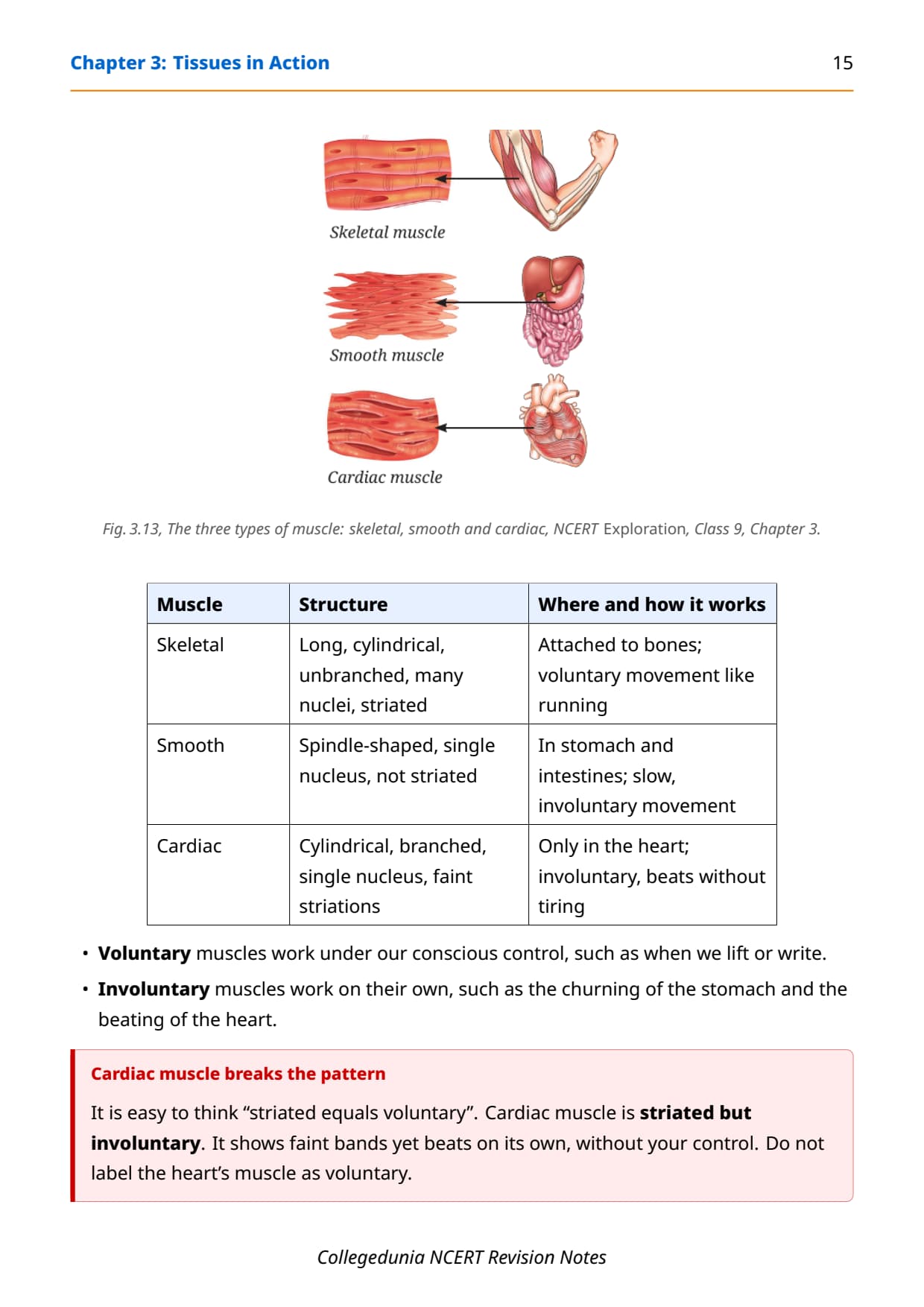
Muscular tissue causes movement, and nervous tissue controls and coordinates it. Some movements, like running or writing, are under your control and are called voluntary movements. Others, like the heartbeat or food moving in the gut, run on their own and are called involuntary movements.
- Skeletal muscle: long, striated, multinucleate fibres attached to bones; drives voluntary movement.
- Smooth muscle: spindle-shaped cells with one nucleus and no stripes; runs slow, involuntary jobs like digestion.
- Cardiac muscle: branched, striated cells found only in the heart; beats tirelessly without fatigue.
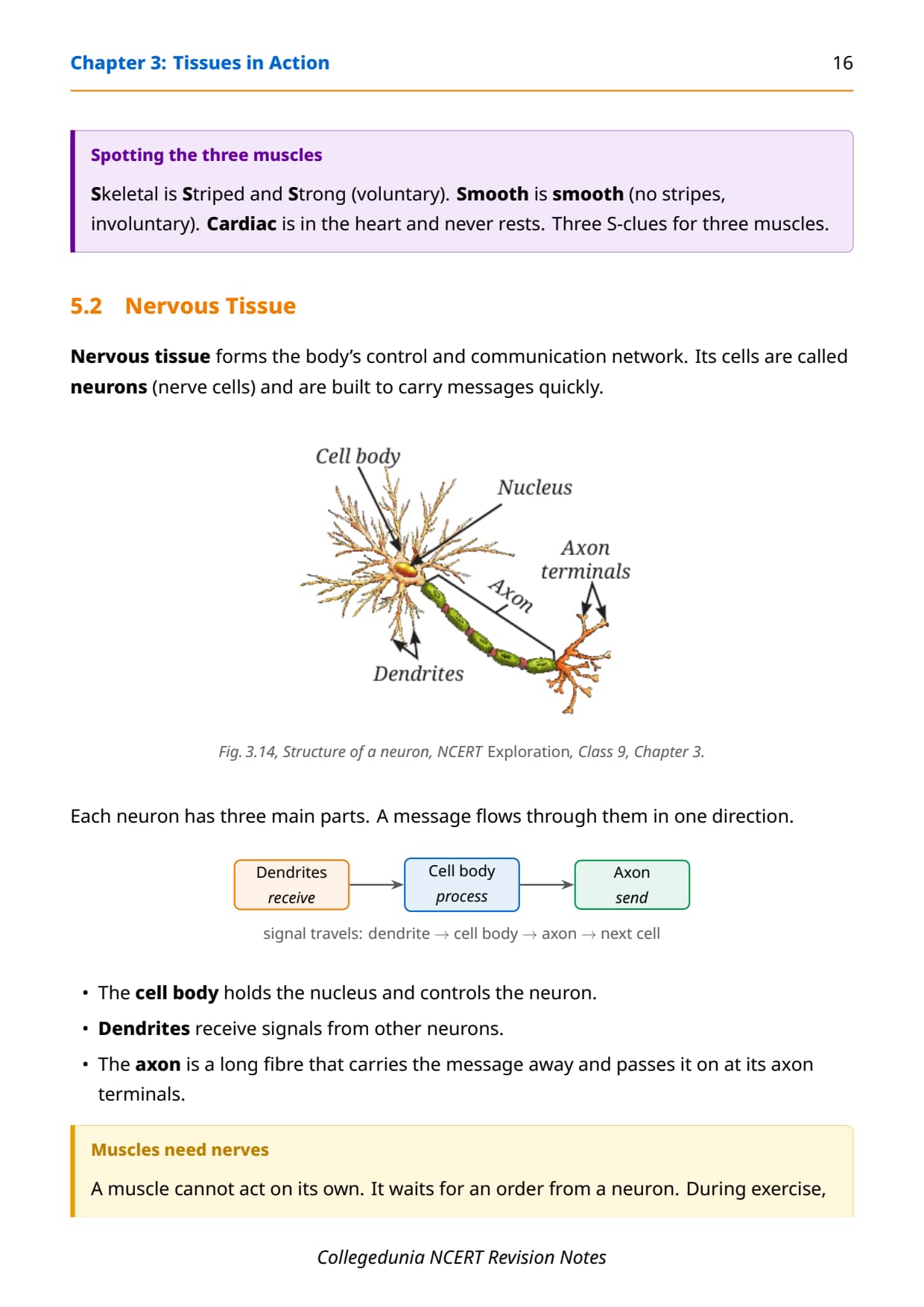
Nervous tissue is built from cells called neurons. Each neuron has a cell body, branching dendrites that receive signals, and a long axon that carries messages to other cells. The brain uses this network to sense, decide and respond, often in a fraction of a second.
The Musculoskeletal System, Joints and Skeleton
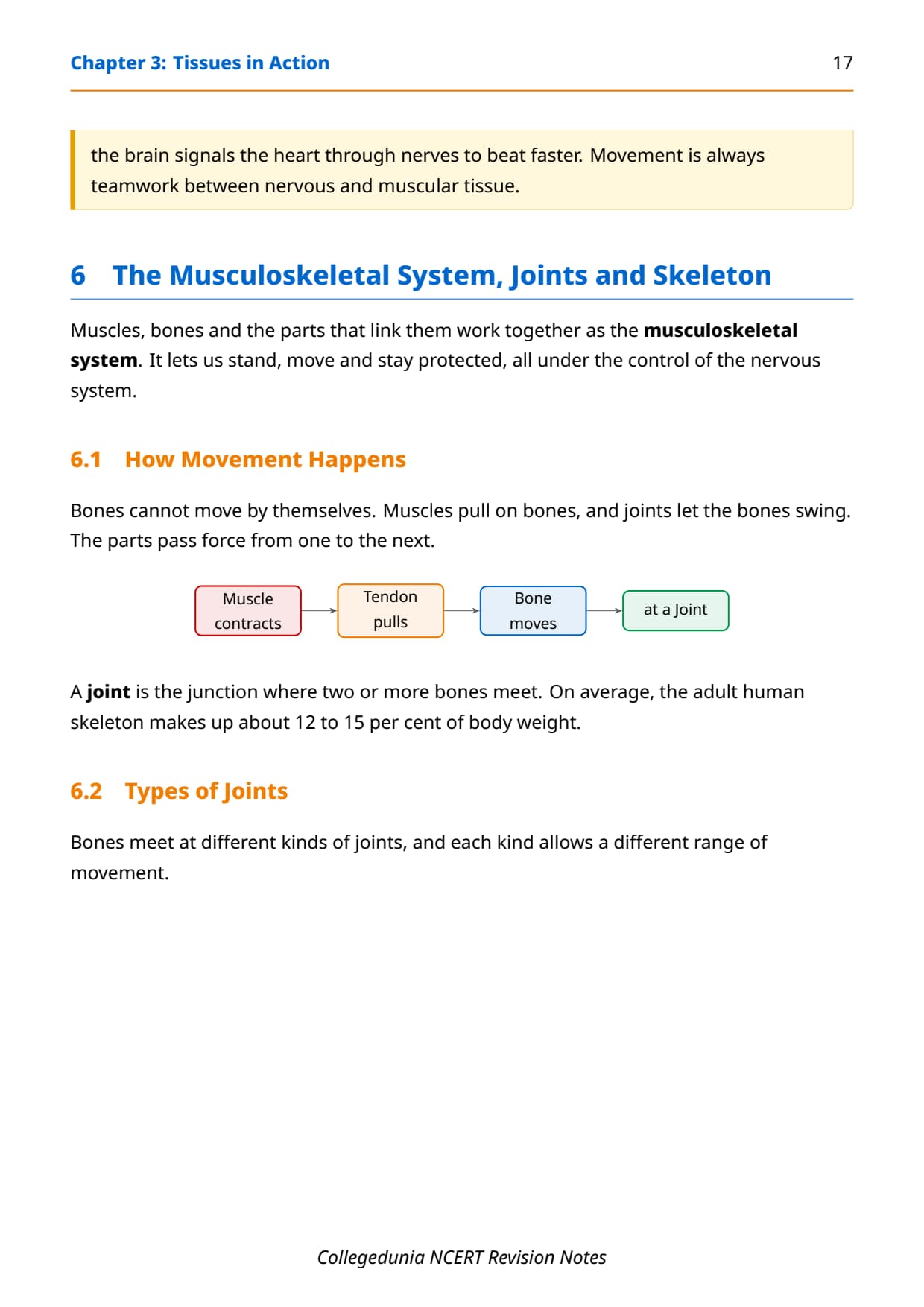
The musculoskeletal system is made of bones, muscles, joints, cartilage, tendons and ligaments. It lets the body stand upright, move and protect delicate organs. Muscles pull on bones, tendons pass the force, and a joint lets the bone turn. A joint is the junction where two or more bones meet.
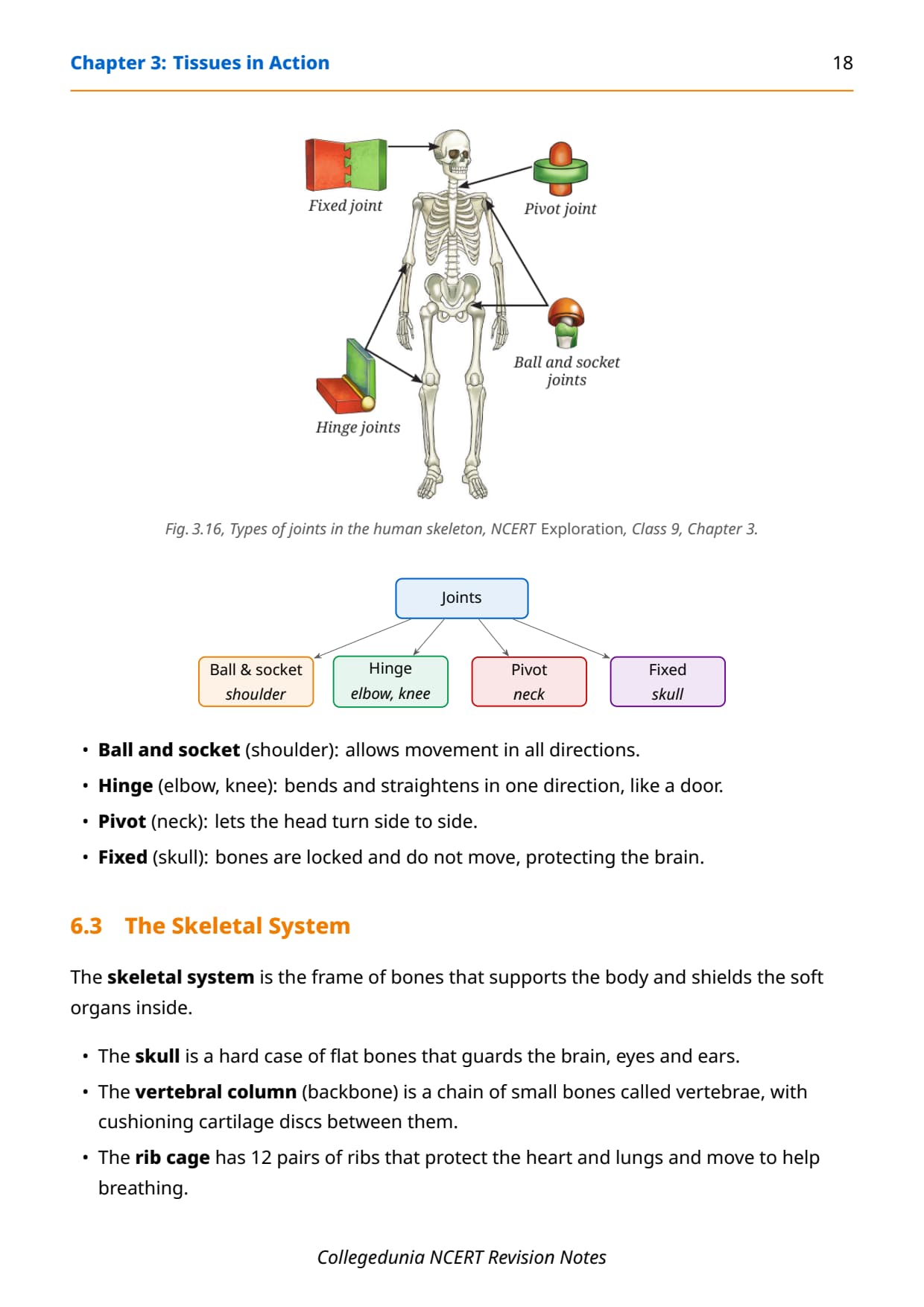
- Ball and socket joint: at the shoulder and hip; allows movement in all directions.
- Hinge joint: at the elbow and knee; bends and straightens in one direction, like a door hinge.
- Pivot joint: where the skull meets the neck; lets the head turn side to side.
- Fixed joint: between the flat bones of the skull; the bones cannot move, which keeps the brain safe.
The skeletal system gives the frame. The backbone, or vertebral column, is made of small bones called vertebrae with cartilage discs between them for cushioning. The rib cage guards the heart and lungs, yet its flexible cartilage still lets the chest expand for breathing. On average, bones make up about 12 to 15 per cent of adult body weight.
Tissues in Action Topic-wise Weightage for Class 9 Science
Not every topic in Tissues in Action carries the same exam value. The table below shows which sub-topics show up most often in the Class 9 Science annual exam, so you can plan your revision time.
| Sub-topic | Weightage | Exam frequency |
|---|---|---|
| Plant permanent tissues (parenchyma to sclerenchyma) | High | Almost every year |
| Xylem and phloem structure and job | High | Almost every year |
| Meristem types (apical, lateral, intercalary) | Medium | 3 out of 5 years |
| Animal tissues and their functions | Medium | 3 out of 5 years |
| Joints and the skeletal system | Low | 1 out of 5 years |
Tissues in Action Topics Students Often Confuse
Many marks in this chapter are lost to a few close pairs that look alike but do different jobs. Fix these three pairs first and reason-based questions become simple.
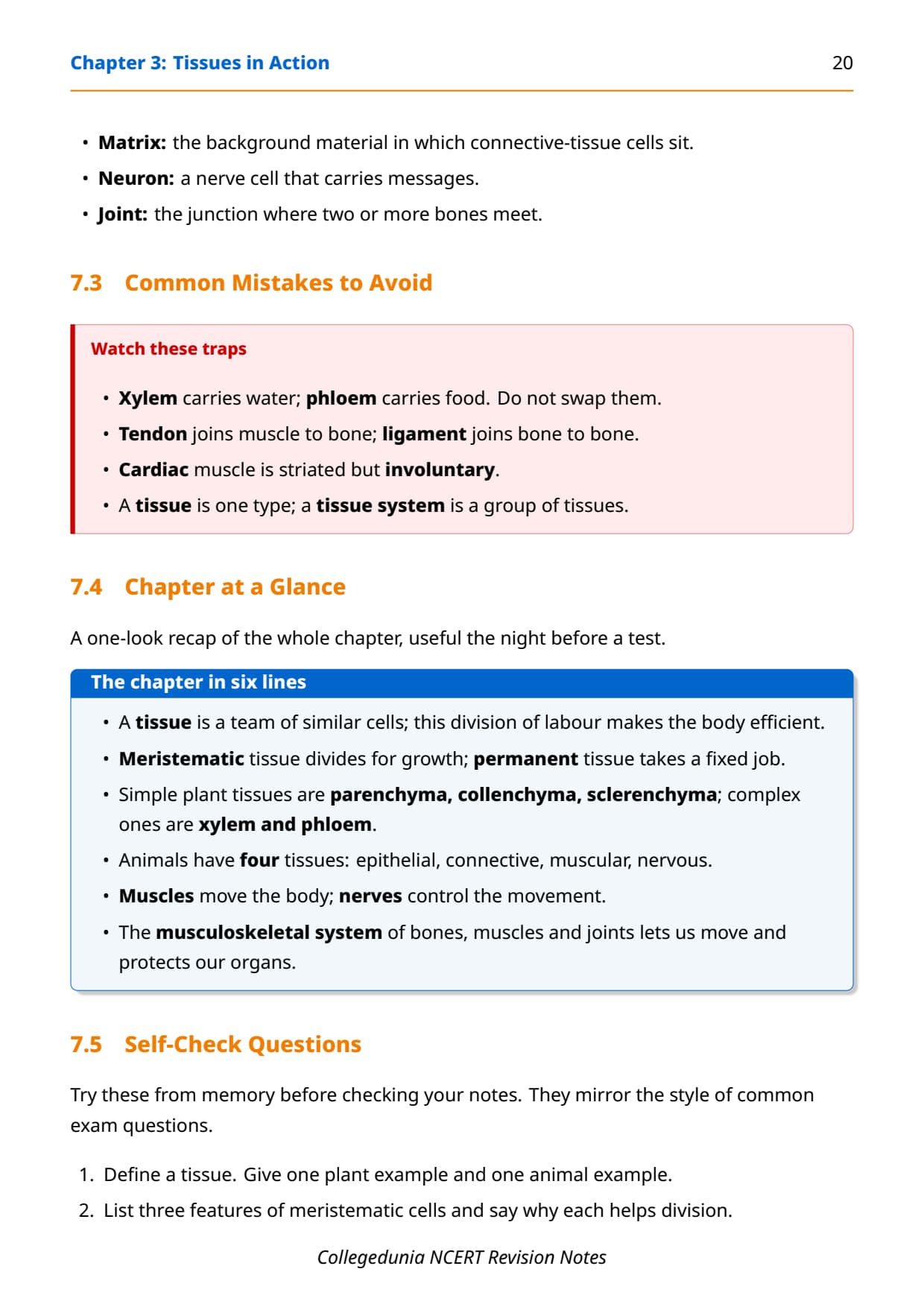
- Collenchyma vs Sclerenchyma - collenchyma is living and flexible; sclerenchyma is dead, hard and lignified for rigid strength.
- Xylem vs Phloem - xylem carries water upward and is mostly dead; phloem carries food both ways and is mostly living.
- Tendon vs Ligament - tendon joins muscle to bone; ligament joins bone to bone at a joint.
Common Mistakes Students Make in the Tissues in Action Chapter
These slips cost easy marks in the annual exam. A quick read of the list below before the test helps you avoid the traps that catch most students.
- Calling all xylem cells dead. Xylem parenchyma is alive; the rest are dead.
- Saying meristem cells have large vacuoles. They have little or no vacuole, which keeps them dividing.
- Swapping the jobs of tendon and ligament in a movement question.
- Writing that phloem only moves food upward. Phloem can move food in both directions.
Tissues in Action Quick Revision and Mnemonics
Use this last-day recap to lock the chapter in memory. Read it once the night before and again on exam morning for a fast, confident revision of Tissues in Action.
- Three meristems: "A-L-I" - Apical for length, Lateral for girth, Intercalary for regrowth.
- Three simple tissues: Parenchyma stores, Collenchyma bends, Sclerenchyma hardens.
- Four animal tissues: "Cover, Connect, Move, Message" - epithelial, connective, muscular, nervous.
- Three muscles: Skeletal moves you, Smooth runs your gut, Cardiac never tires.
How These Tissues in Action Notes Pair with NCERT Solutions
These notes give you the concept base, and the NCERT Solutions give you the answer practice. Use both together for the best result in the Class 9 Science annual exam. A simple three-step plan works well.
- Read the notes first: learn each tissue and its one main job from these Class 9 Science NCERT Notes for Chapter 3 Tissues in Action.
- Draw and label: sketch xylem, phloem, a neuron and the joint types once, then write a single-line function under each.
- Solve and check: attempt the Revise, Reflect, Refine questions, then compare with the step-by-step NCERT Solutions.
Related Links:
More Tissues in Action Class 9 Science Resources
Use the other Collegedunia resources for this chapter alongside these notes.
| Resource | Open |
|---|---|
| Revision Notes | Tissues in Action Class 9 Notes |
| NCERT Solutions | Tissues in Action Class 9 NCERT Solutions |
| Handwritten Notes | Tissues in Action Class 9 Handwritten Notes |
| NCERT Book PDF | Tissues in Action Class 9 NCERT Book PDF |
NCERT Notes for Class 9 Science: All Chapters
Open the revision notes for any other chapter of the new Class 9 Science Exploration book.
| Chapter | Notes |
|---|---|
| Chapter 2 | Cell: The Building Block of Life Notes |
| Chapter 3 | Tissues in Action Notes |
| Chapter 4 | Describing Motion Around Us Notes |
| Chapter 6 | How Forces Affect Motion Notes |
| Chapter 11 | Reproduction: How Life Continues Notes |
| Chapter 12 | Patterns in Life Notes |
Tissues in Action Class 9 Science NCERT Notes FAQs
Ques. Where can I download the Class 9 Science Chapter 3 Tissues in Action NCERT Notes PDF?
Ans. You can download the Tissues in Action NCERT Notes PDF directly from this page. Both the Normal and HD versions are free and match the 2026-27 Exploration book.
Ques. What are the three types of meristematic tissue in Tissues in Action?
Ans. The three types are apical meristem at the root and shoot tips, which adds length, lateral meristem or cambium around the stem, which adds girth, and intercalary meristem near the nodes, which helps grass regrow after cutting.
Ques. What is the difference between collenchyma and sclerenchyma?
Ans. Collenchyma is made of living cells thickened at the corners, so it gives flexible support and lets stems bend. Sclerenchyma is made of dead cells with thick lignified walls, so it gives rigid, hard support, as in coconut husk.
Ques. What are the four types of animal tissue in Class 9 Science?
Ans. The four animal tissues are epithelial tissue, which covers and lines the body, connective tissue like blood and bone, which connects and supports, muscular tissue, which causes movement, and nervous tissue, which controls and coordinates the body.
Ques. How many pages are the Class 9 Science Tissues in Action NCERT Notes?
Ans. The Tissues in Action NCERT Notes PDF runs about 8 to 12 pages. It covers all plant and animal tissues, tissue systems, joints and the skeletal system, with tables, diagrams and a quick-revision recap.
Ques. What is a tissue?
Ans. A tissue is a group of similar cells that work together to perform one function. In simple tissues the cells are alike, while in complex tissues like xylem and phloem, several cell types work together as a single team.



Comments