




These Class 9 Science Chapter 3 Tissues in Action handwritten notes turn the whole chapter into neat, colour-coded pages you can revise in one sitting. Tissues in Action is a core biology chapter in the new 2026-27 Exploration book. The notes cover plant tissues, the four animal tissues, and how muscles, bones and joints let us move, all with labelled diagrams drawn by hand. Download the free PDF and use it for a fast recap before any test.
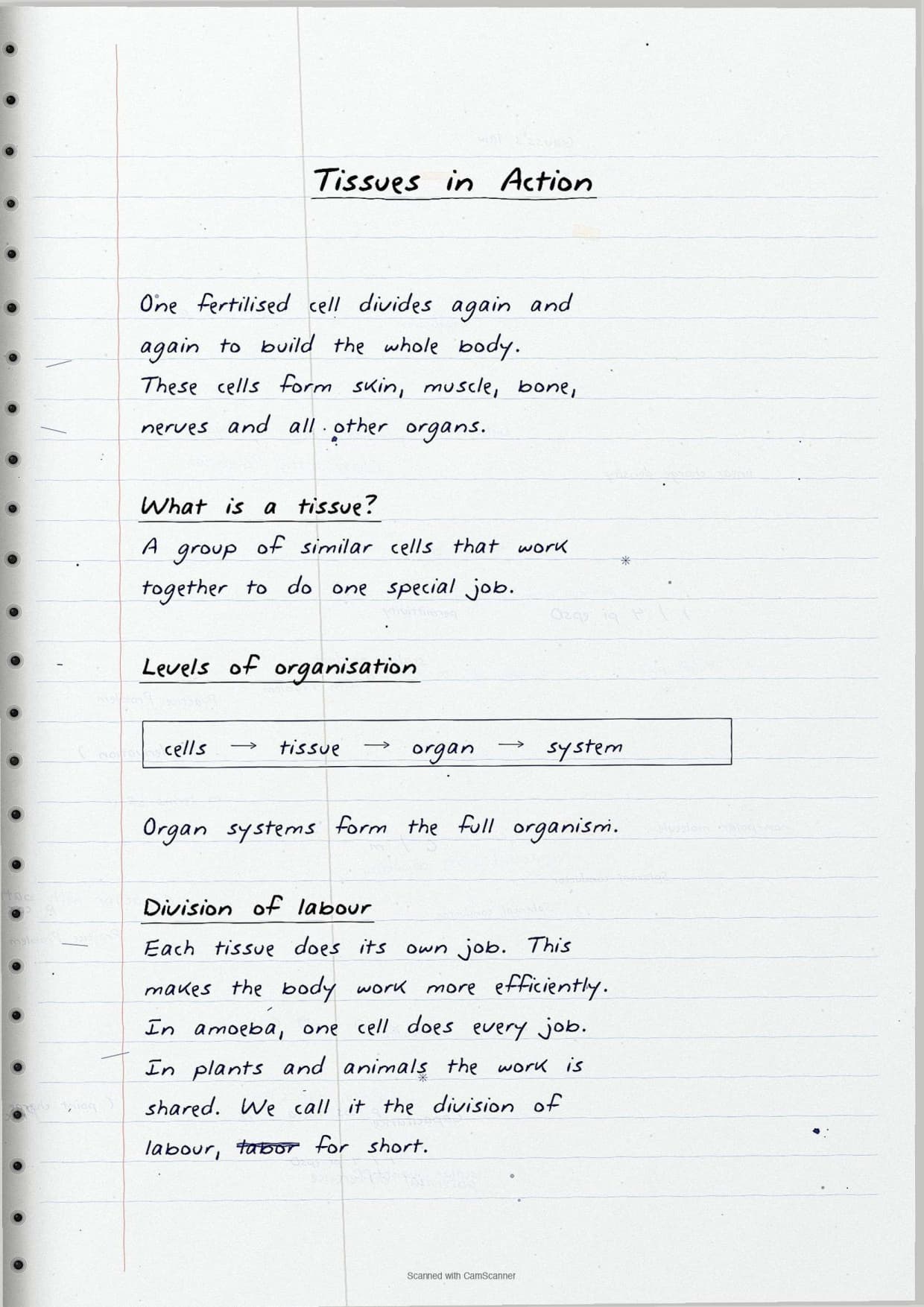
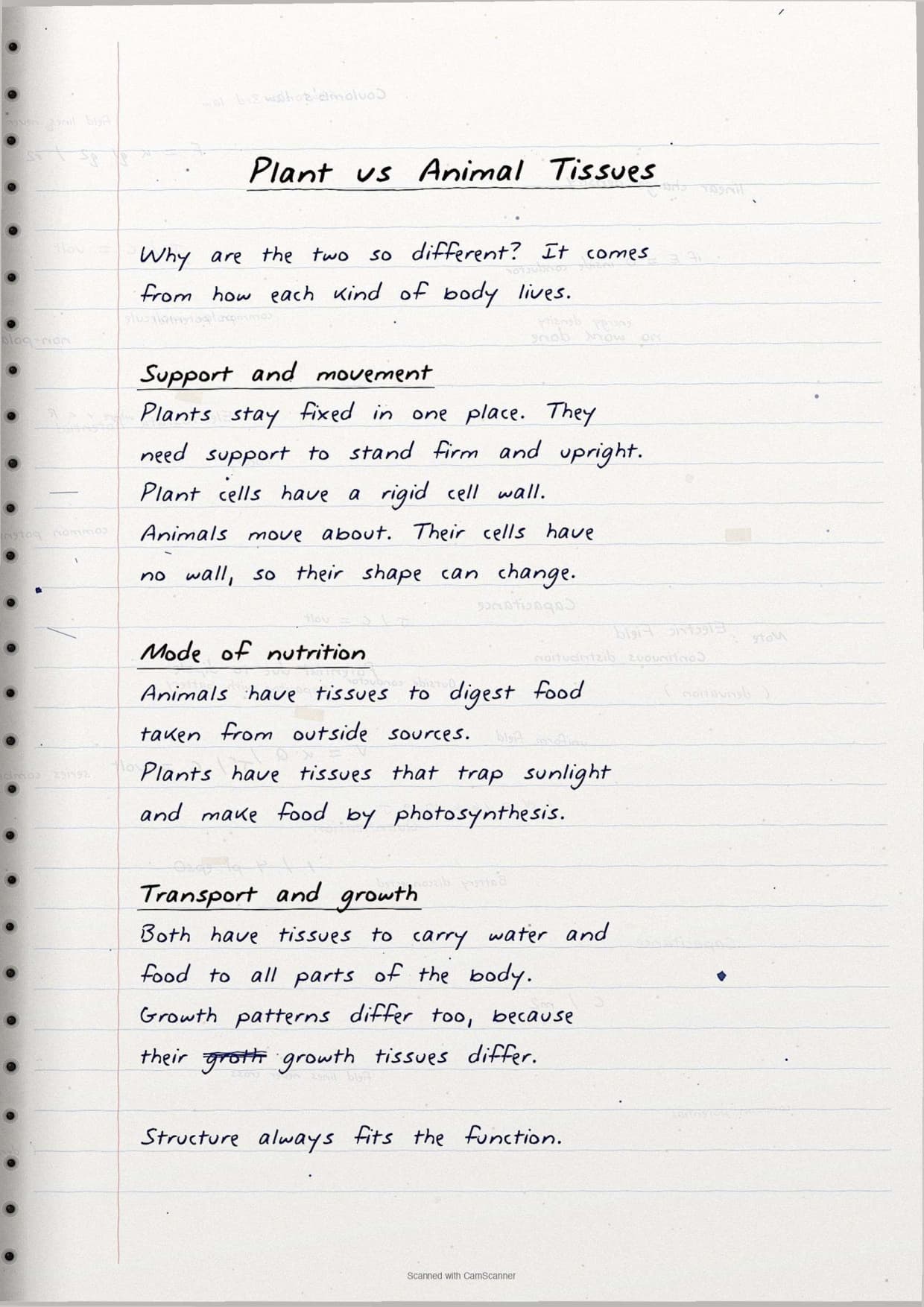
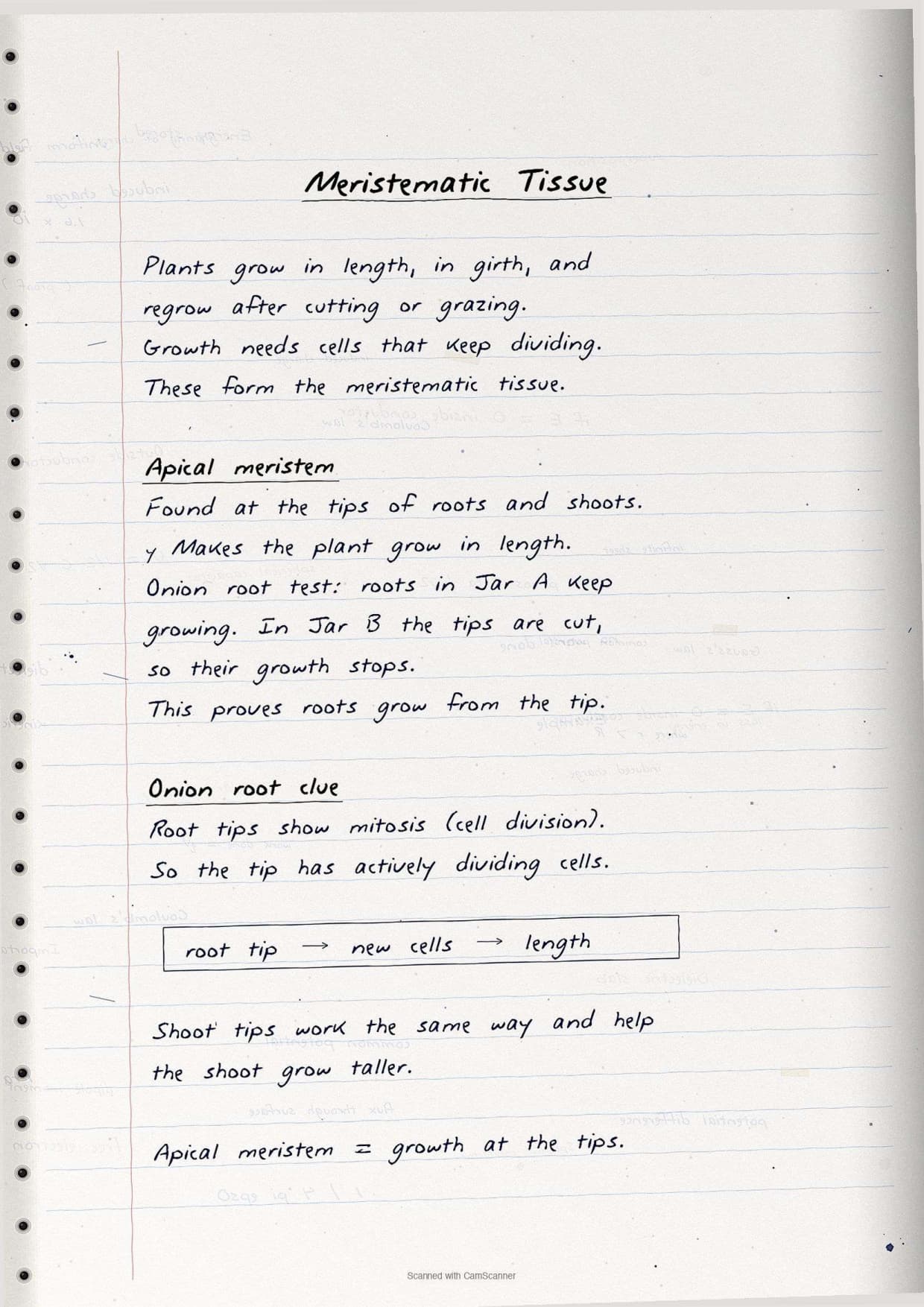
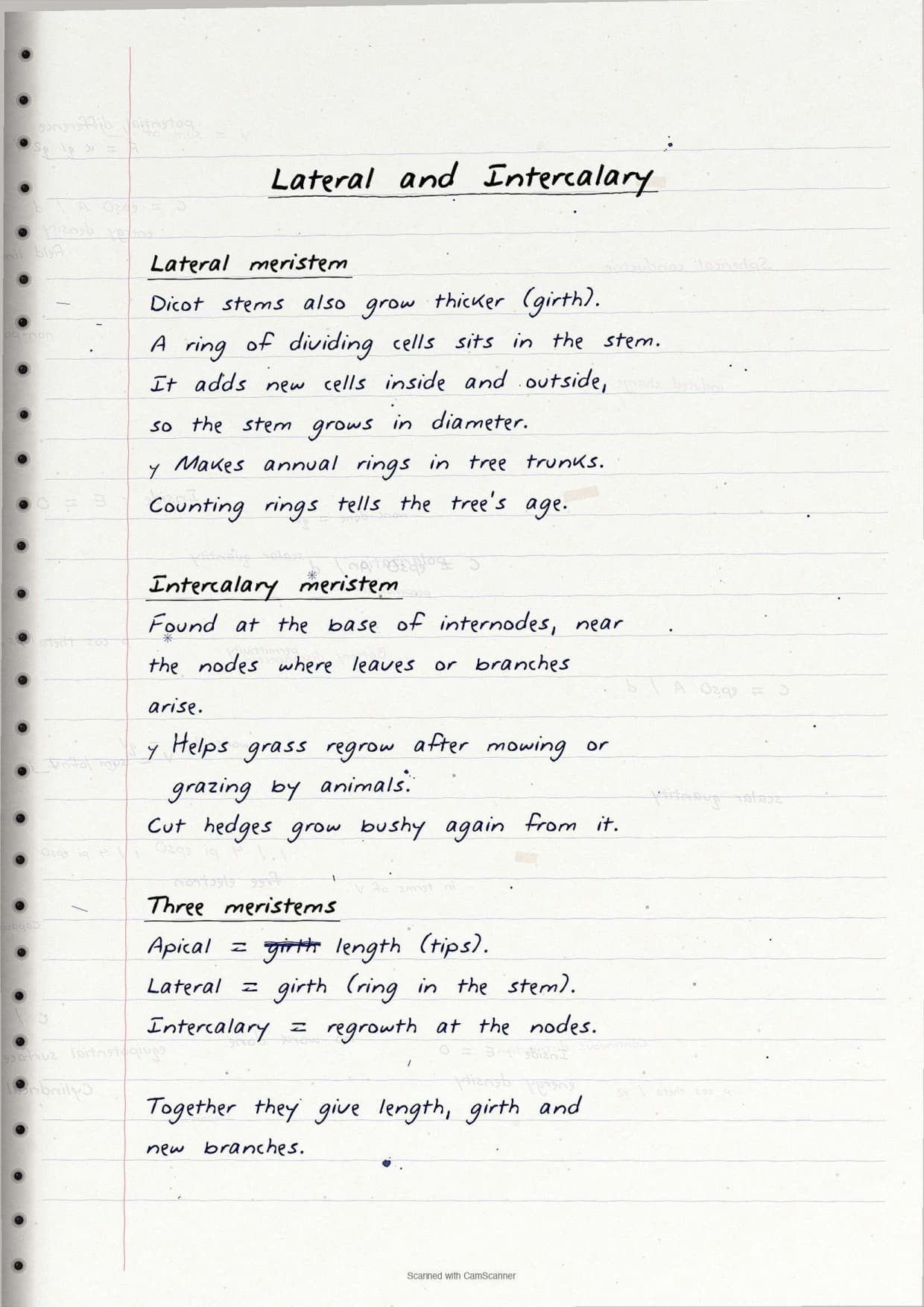
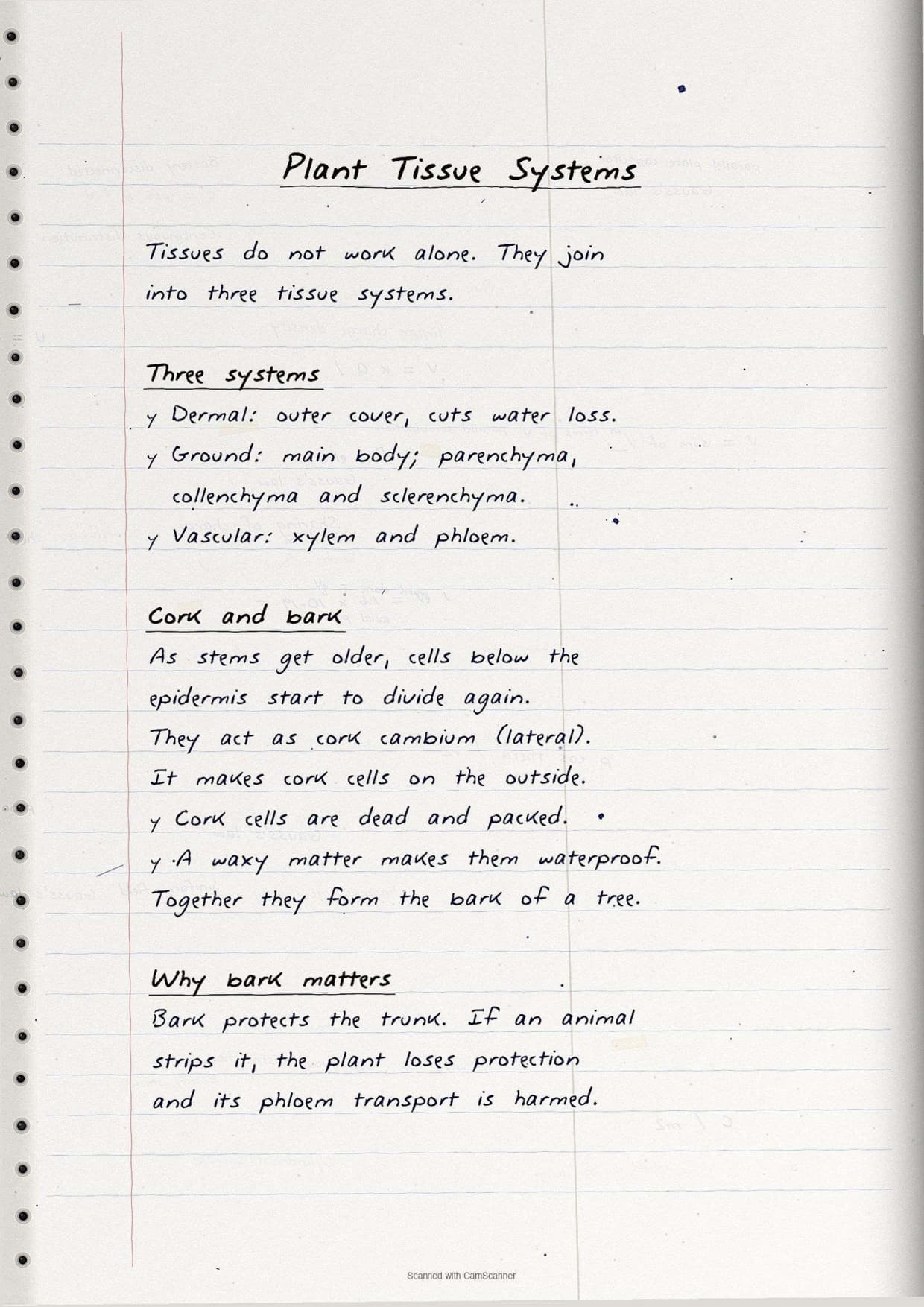
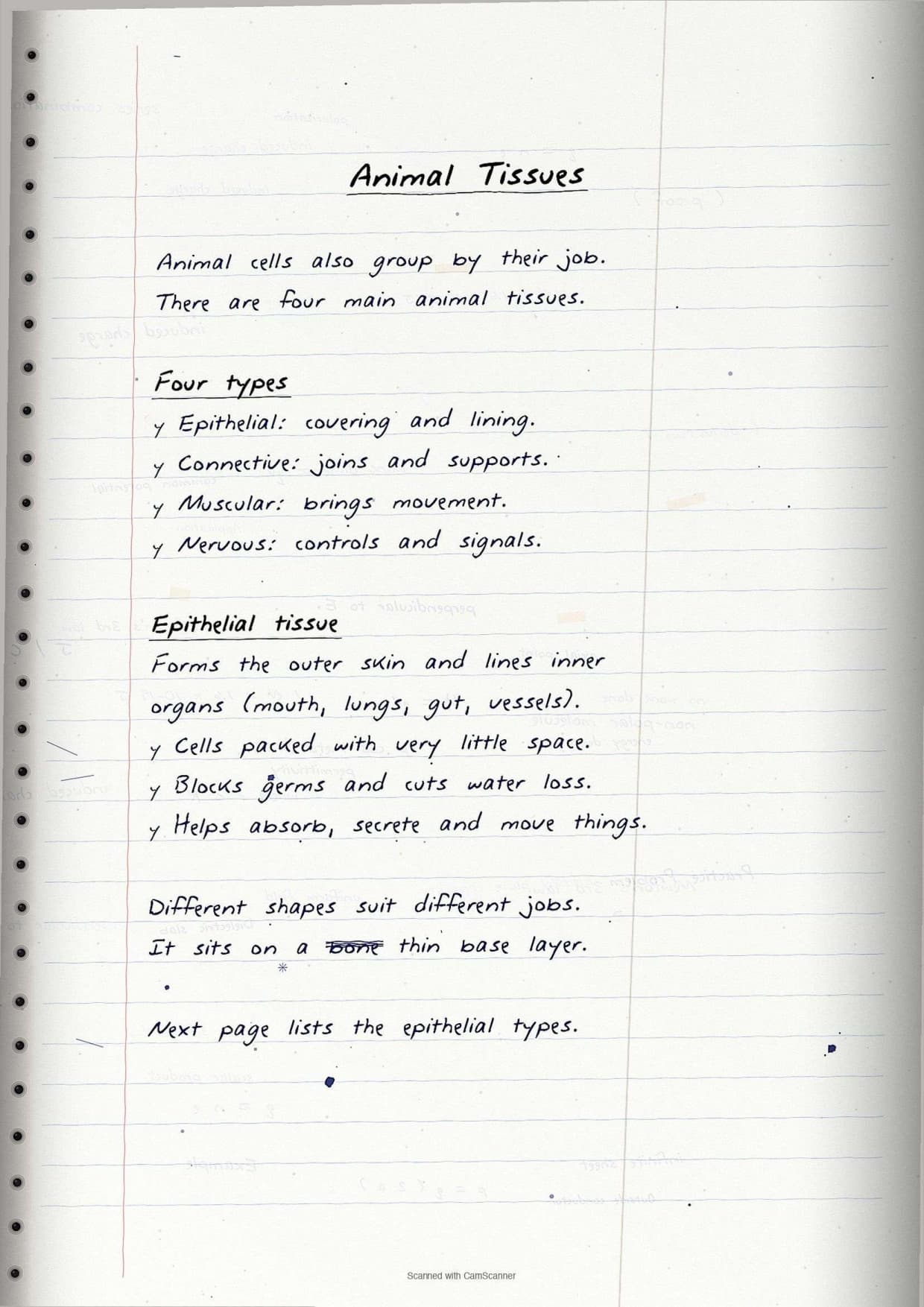
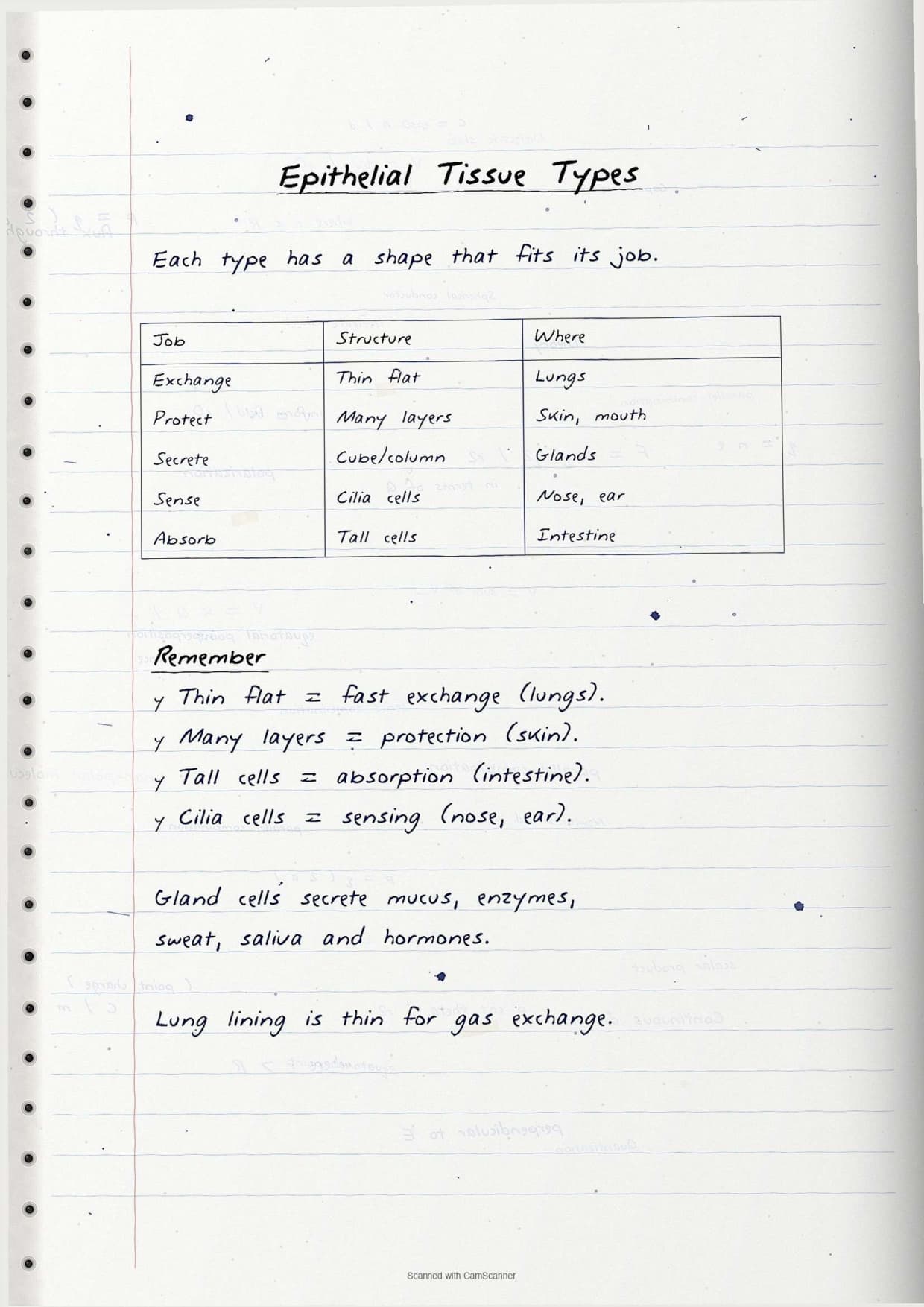
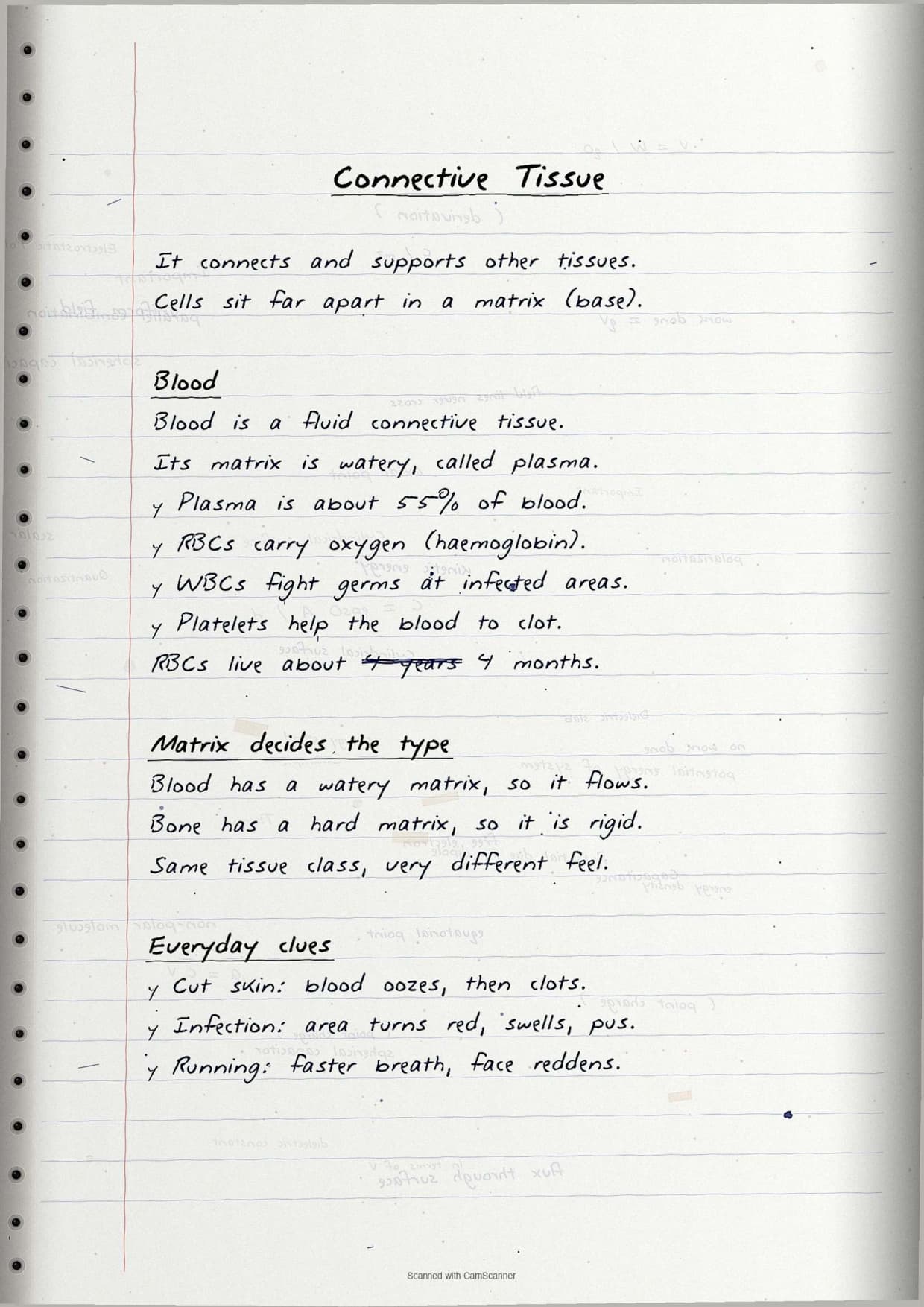
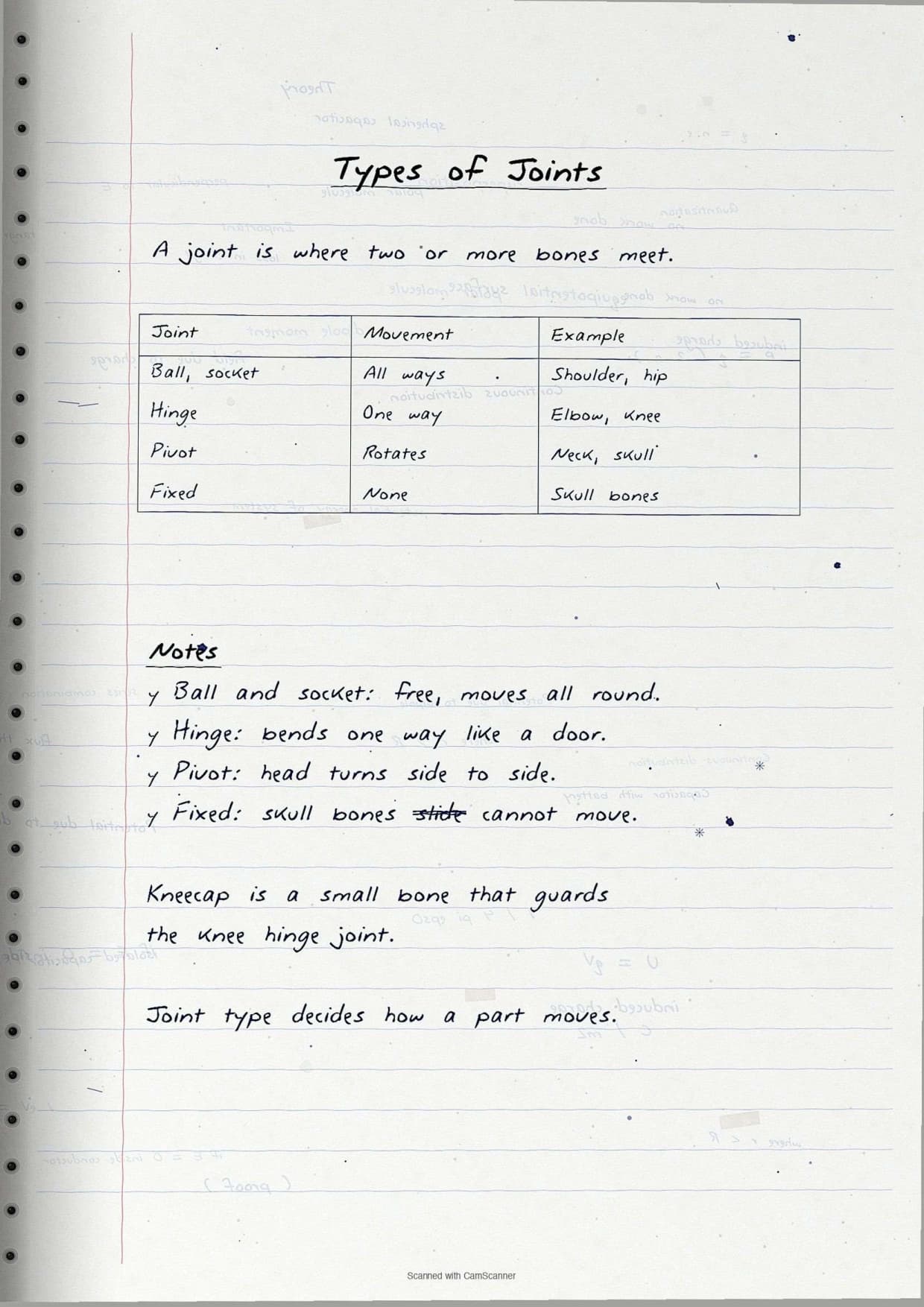
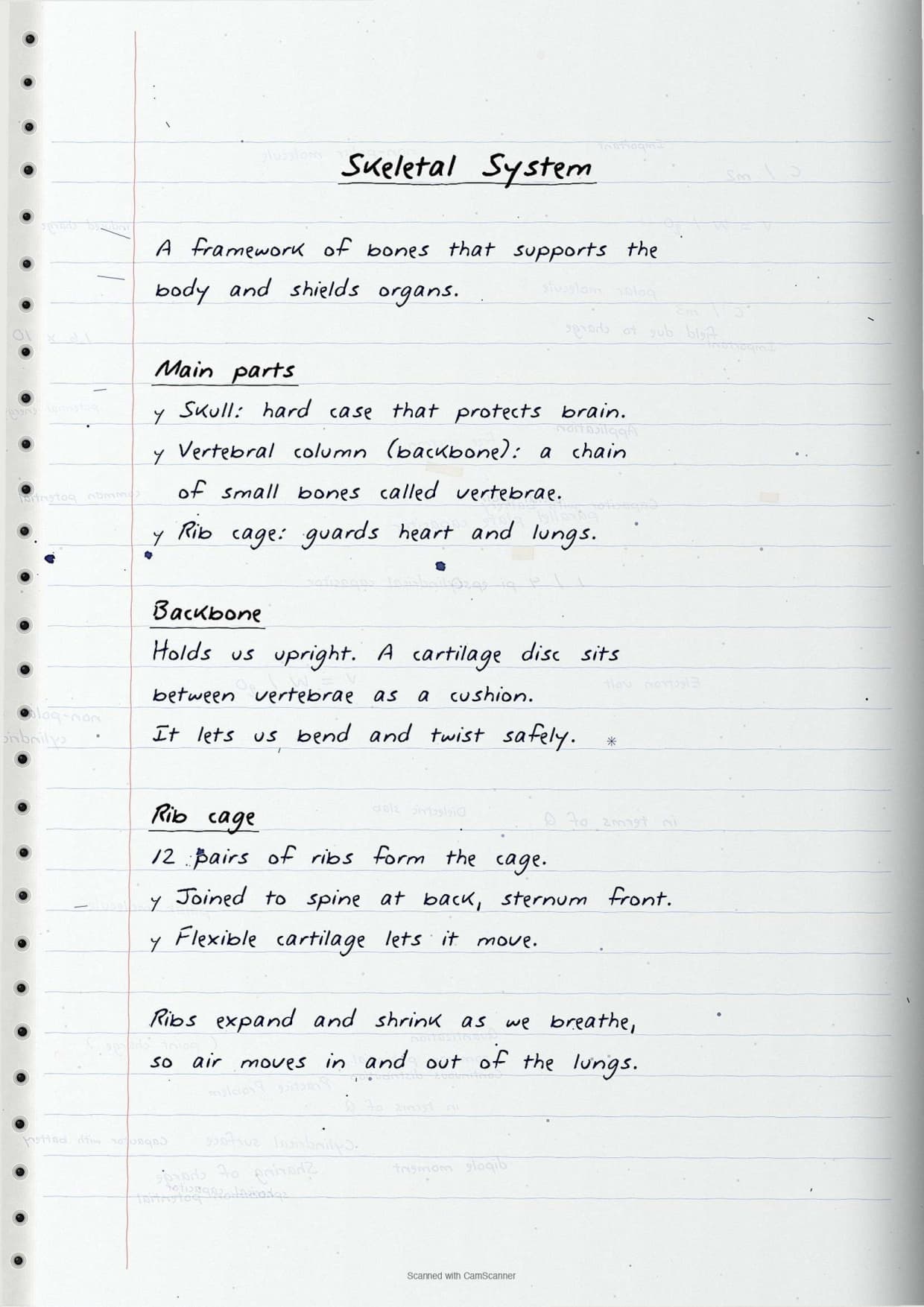
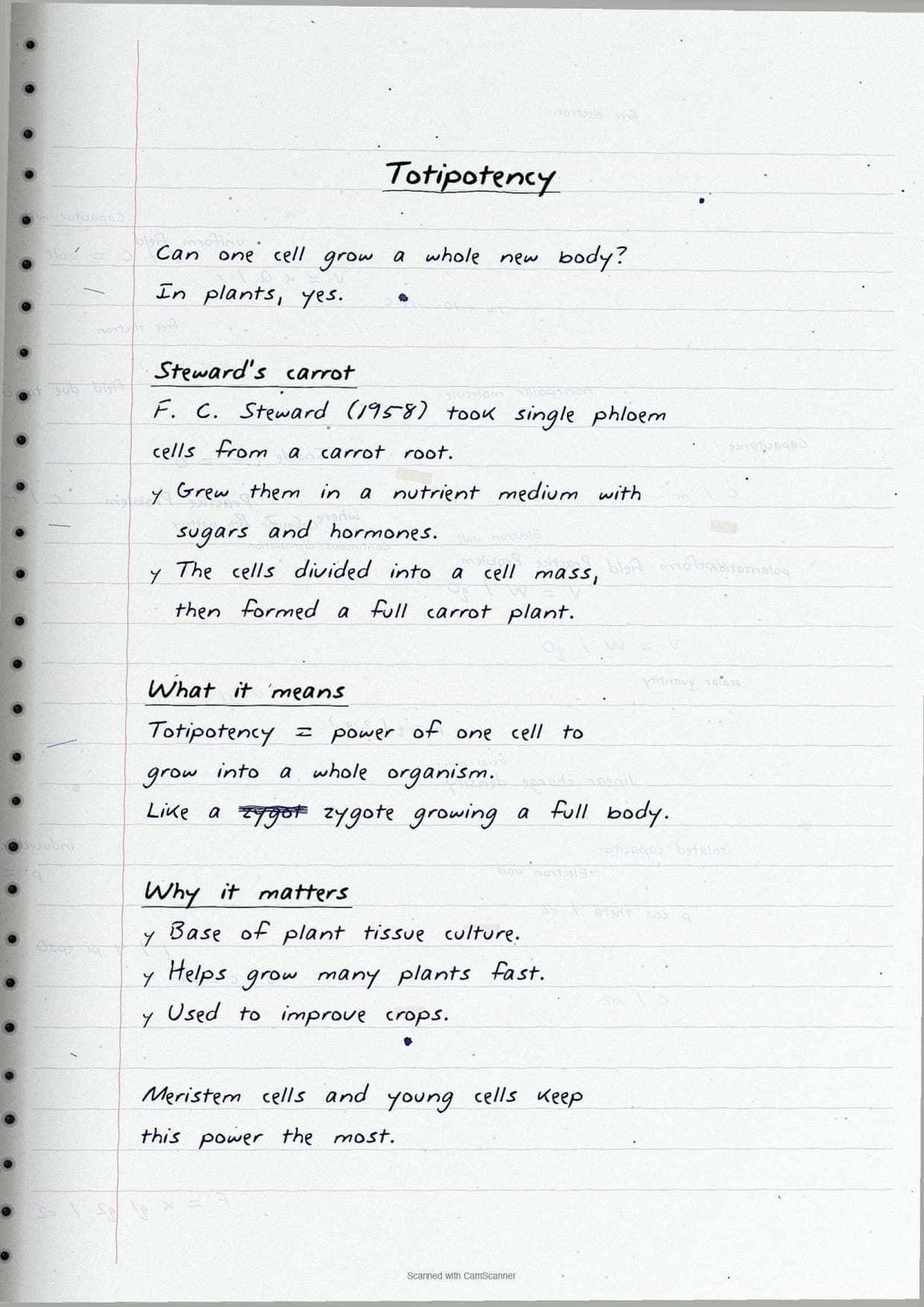
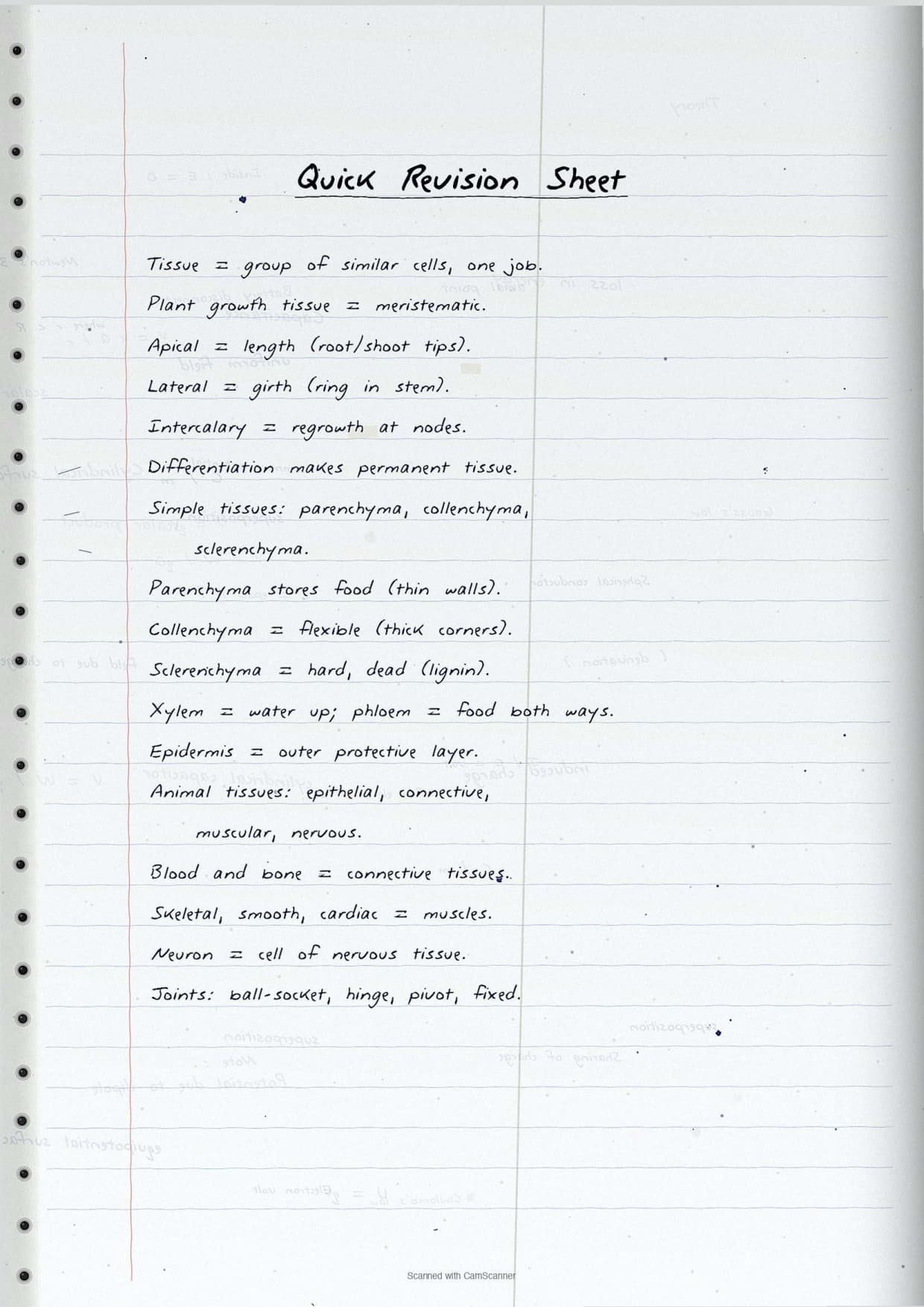
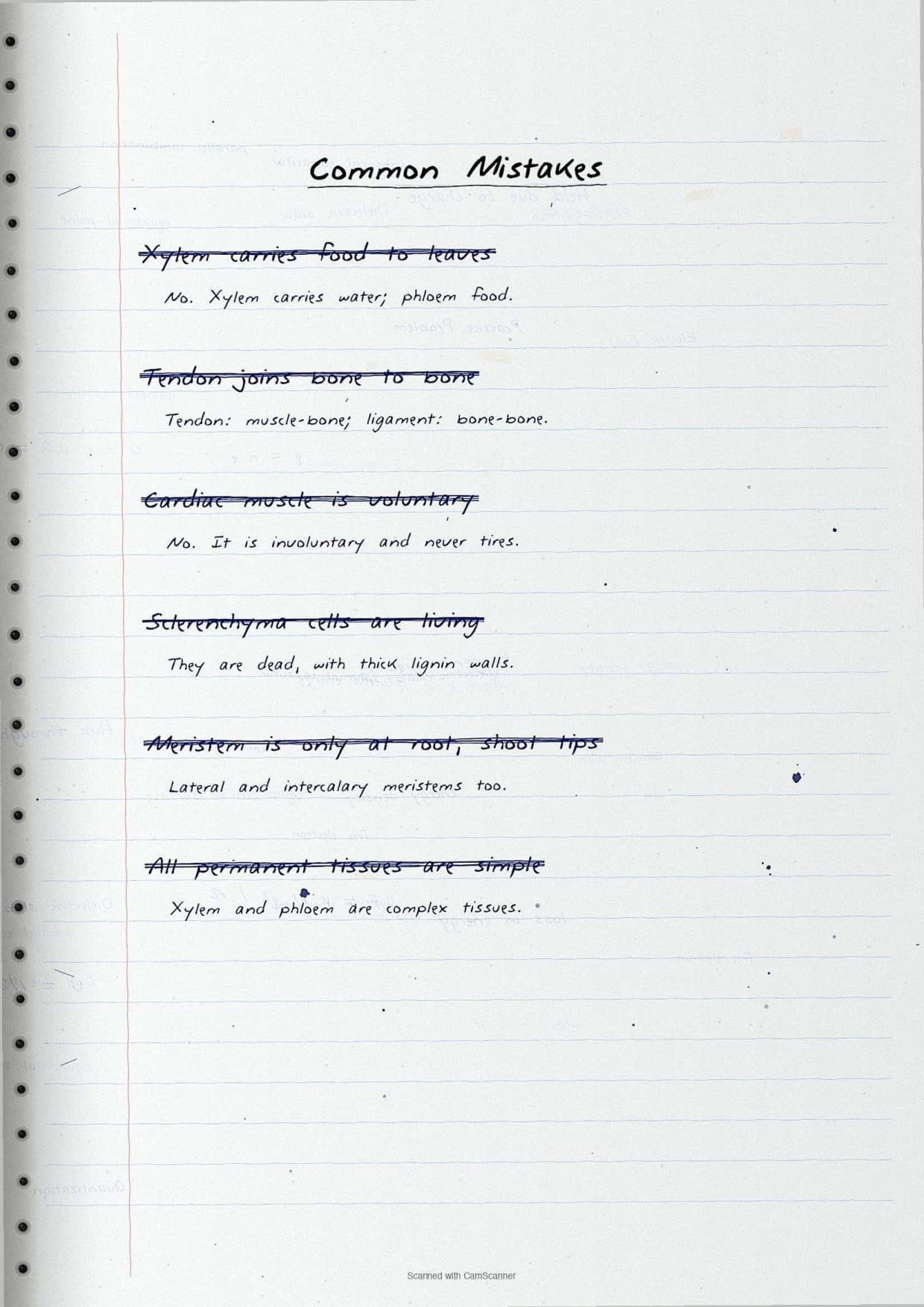
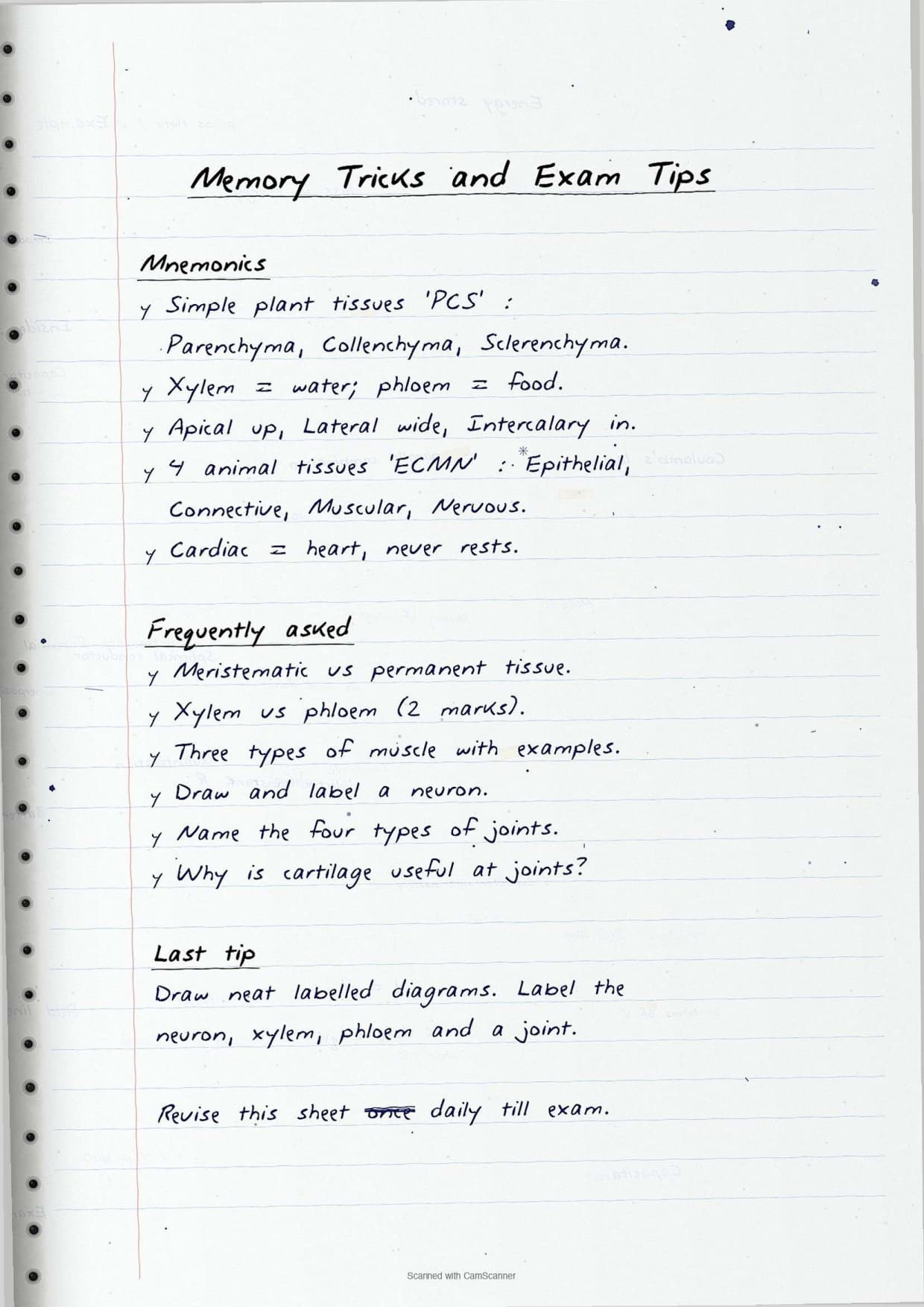
- Full chapter in handwritten form: meristematic and permanent plant tissues, xylem and phloem, the four animal tissues, and joints, all on ruled pages.
- Tissues in Action is a steady source of 1, 3 and 5 mark questions in the Class 9 Science paper, so these quick-revision notes save real time.
- Free PDF download in Normal and HD, with hand-drawn labelled diagrams, comparison tables and red-marked mistakes.
Student Feedback: what 9,400 students told us about revising Tissues in Action from handwritten notes before the 2026 tests.
- 71% of students said the hand-drawn plant tissue classification was the fastest thing to recall in the exam hall.
- 63% of students found xylem and phloem the easiest pair to mix up under pressure.
- Most students revised these pages the night before a class test rather than a week ahead.
Source: 2026-27 Class 9 Science student poll. Sample of 9,400 students from CBSE schools across 11 states.
|
Table of Contents |
What the Tissues in Action Class 9 Handwritten Notes Cover
These class 9 science handwritten notes chapter 3 Tissues in Action put the full chapter on ruled pages, in the order the exam tests it. You get the story of how many similar cells team up as a tissue, a labelled sketch of each plant and animal tissue, and simple lines that explain how muscles, bones and joints work together for movement.
- Plant tissues: meristematic tissue for growth, and the permanent tissues parenchyma, collenchyma, sclerenchyma, xylem and phloem.
- Animal tissues: epithelial, connective, muscular and nervous, with the job and location of each in one line.
- Movement: the musculoskeletal system, the main joints, and how the skeleton protects the organs inside.
Tissues in Action Class 9 Explained in One Shot
Source: Magnet Brains on YouTube
Tissues and the Division of Labour in Class 9 Science Chapter 3
A big plant or animal is not one giant cell. It is built from billions of cells, and they do not all do the same job. Cells of one kind group together and share a task. This teamwork is called the division of labour, and it makes the whole body work faster and better. A tissue is a group of cells that are similar in structure and work together to carry out one function, and the cells of a tissue usually share a common origin.
- In a unicellular organism like Amoeba, a single cell does everything by itself.
- In multicellular plants and animals, groups of cells take up different jobs, so muscle tissue moves the body while nerve tissue carries messages.
- Similar cells form a tissue, tissues form an organ, organs form an organ system, and all the systems make the whole organism.
Plant and animal tissues are built differently because the two live in different ways. Plants stay fixed in one place and make their own food, so they have stiff cell walls and grow only at special zones. Animals move about and take food from outside, so their cells are soft and flexible. The handwritten page sets this contrast in a small red-headed box so the reason is easy to recall.
Meristematic Tissues: Where Plants Grow in Class 9 Science Chapter 3
Plant tissues are sorted by one simple test drawn in the notes: can the cells still divide? Cells that keep dividing form meristematic tissue, and cells that have stopped dividing form permanent tissue. The hand-drawn tree below is how the notes split the whole plant-tissue family at a glance.
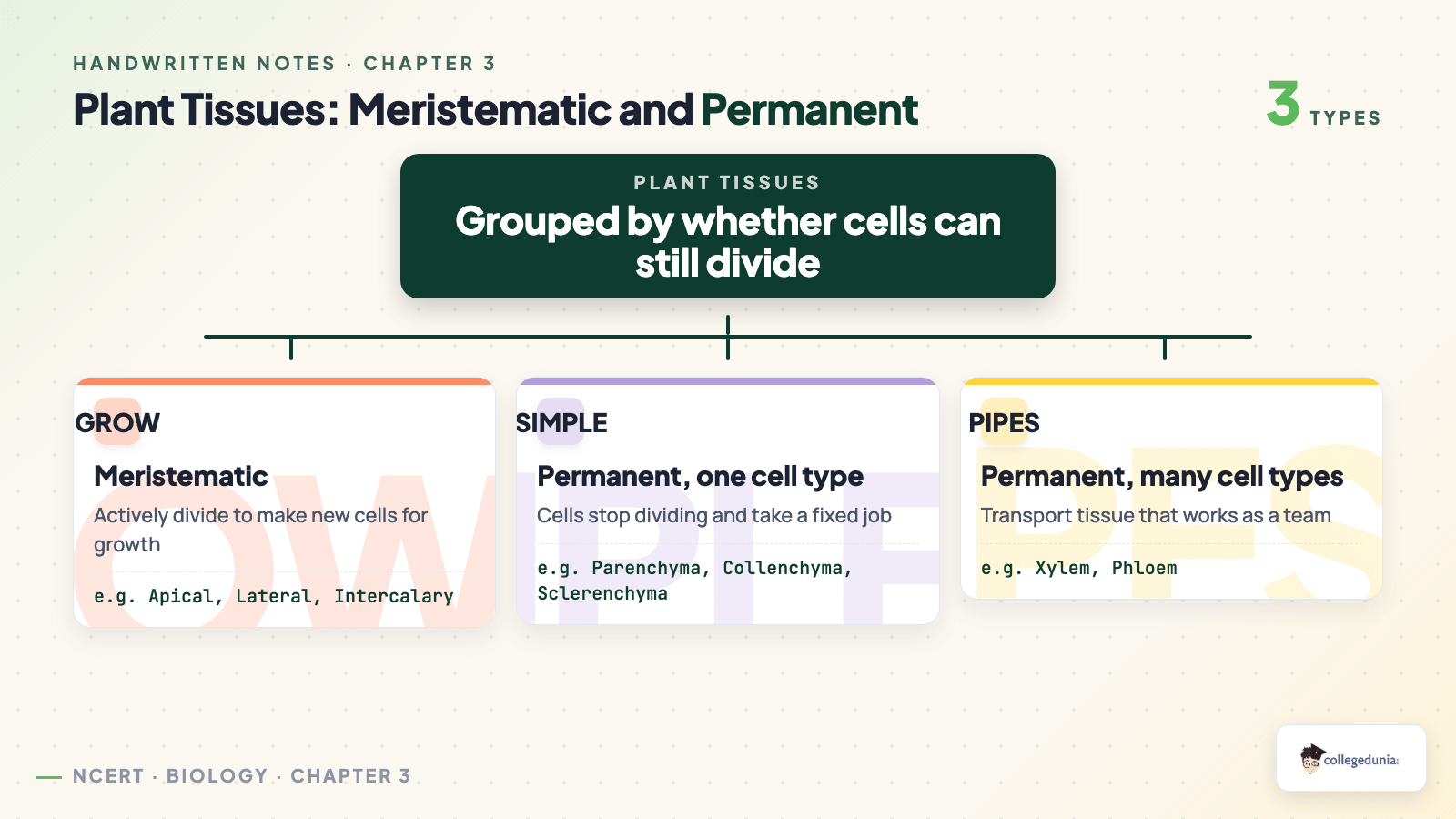
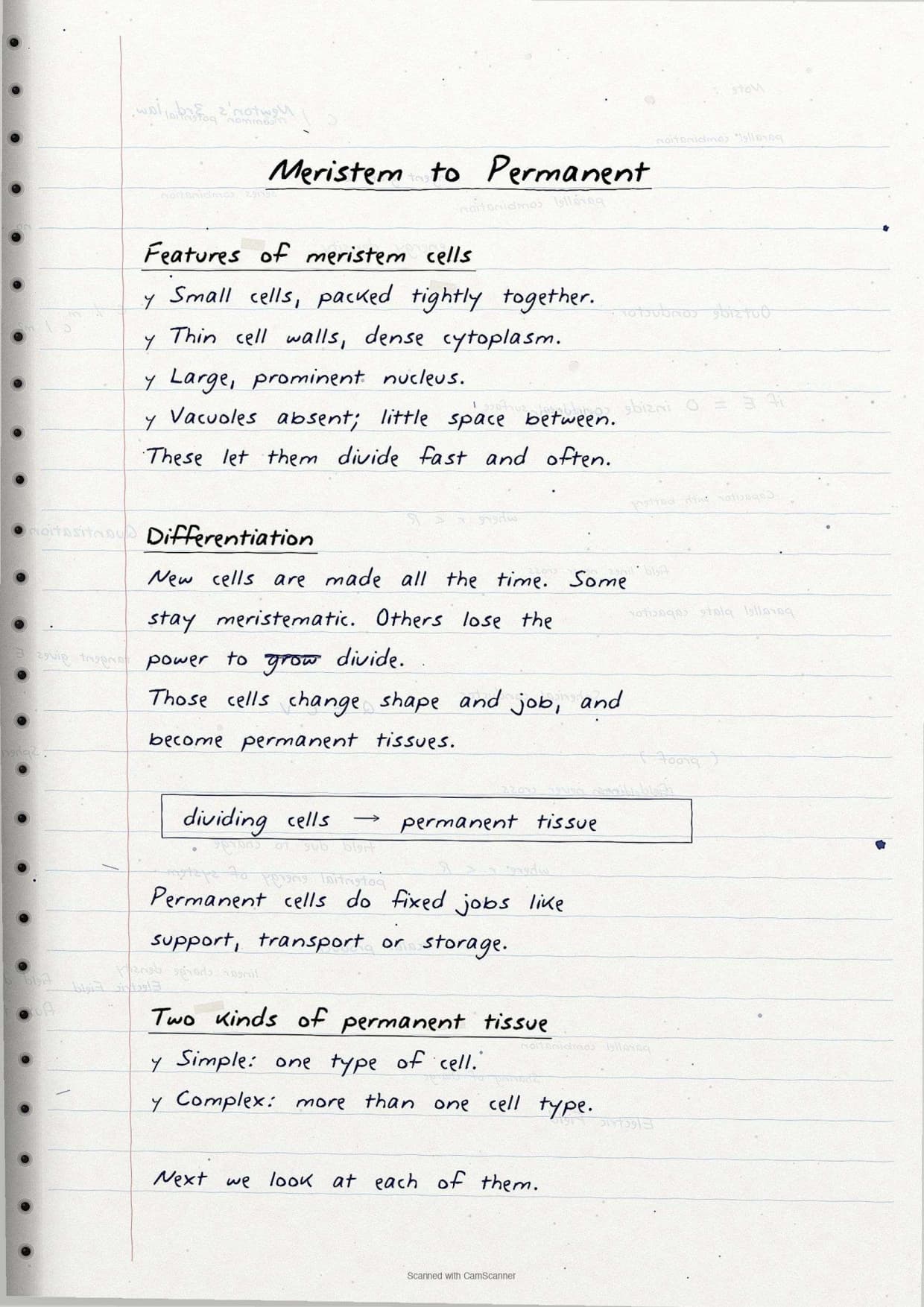
Meristematic cells are built for fast division. They are small with thin walls, hold a large, prominent nucleus and dense cytoplasm, have no big vacuole, and are packed tightly with no gaps. There are three meristems, each with its own kind of growth.
| Meristem | Where it is | Growth it causes |
|---|---|---|
| Apical | Tips of roots and shoots | Growth in length; roots go deeper, shoots grow taller |
| Lateral | A ring inside the stem | Growth in girth; the stem grows thicker each year |
| Intercalary | Base of internodes, mostly in grasses | Regrowth after the plant is cut or grazed |
Tip: a quick line the notes box in red is A-L-I: Apical for length, Lateral for girth, Intercalary for regrowth. When a meristematic cell loses its power to divide and takes a fixed shape and job, that change is called differentiation, and it makes all the permanent tissues studied next.
Permanent Plant Tissues: Parenchyma, Collenchyma and Sclerenchyma
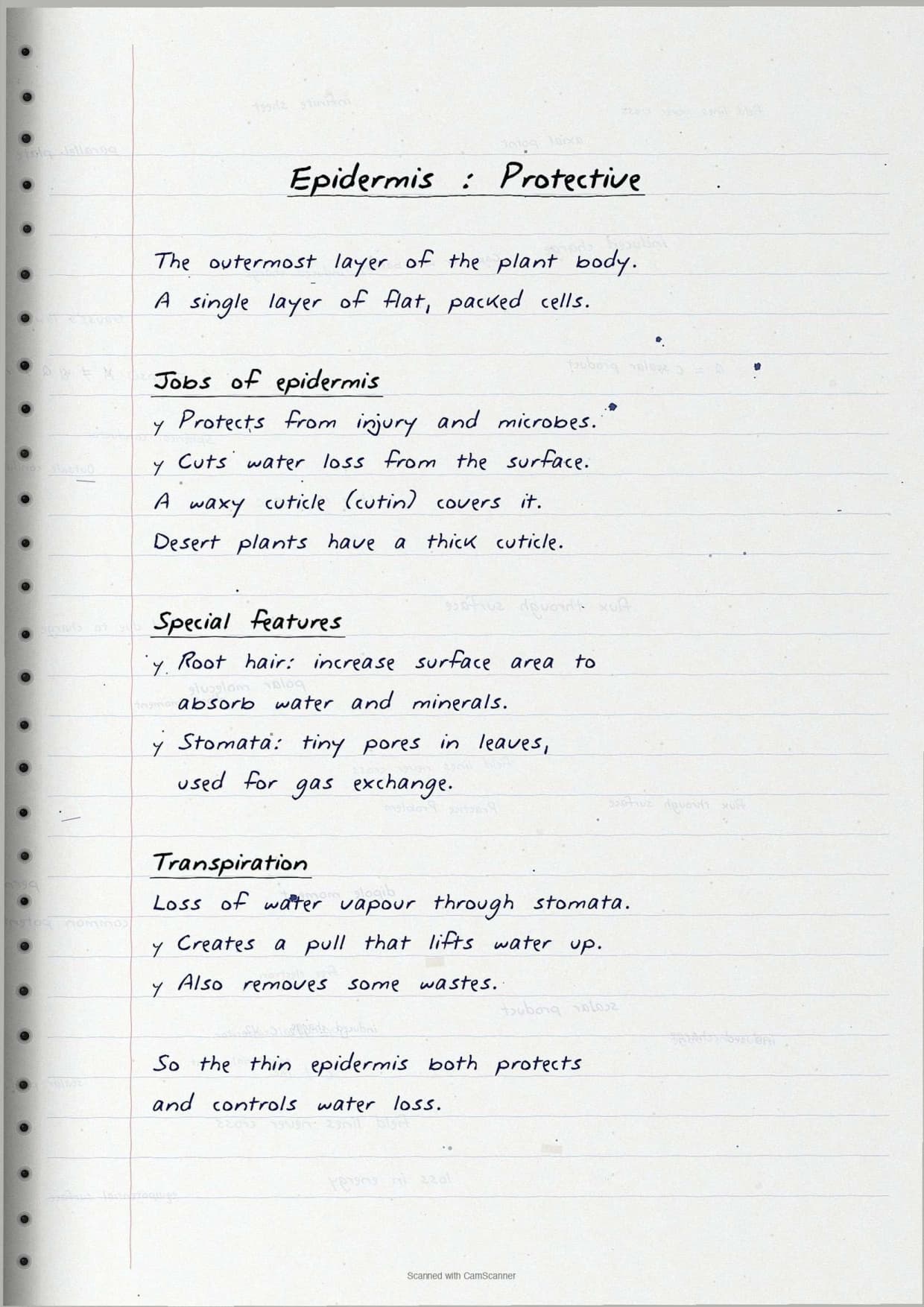
Permanent tissues are made of cells that no longer divide, and each cell has taken a fixed shape and job. The outermost layer is the epidermis, a single layer of flat cells with a waxy cuticle that cuts water loss; in roots it grows root hair, and in leaves it carries tiny pores called stomata for gas exchange. Inside, three simple permanent tissues give the plant its support, and they differ mainly in how thick and how living their walls are.
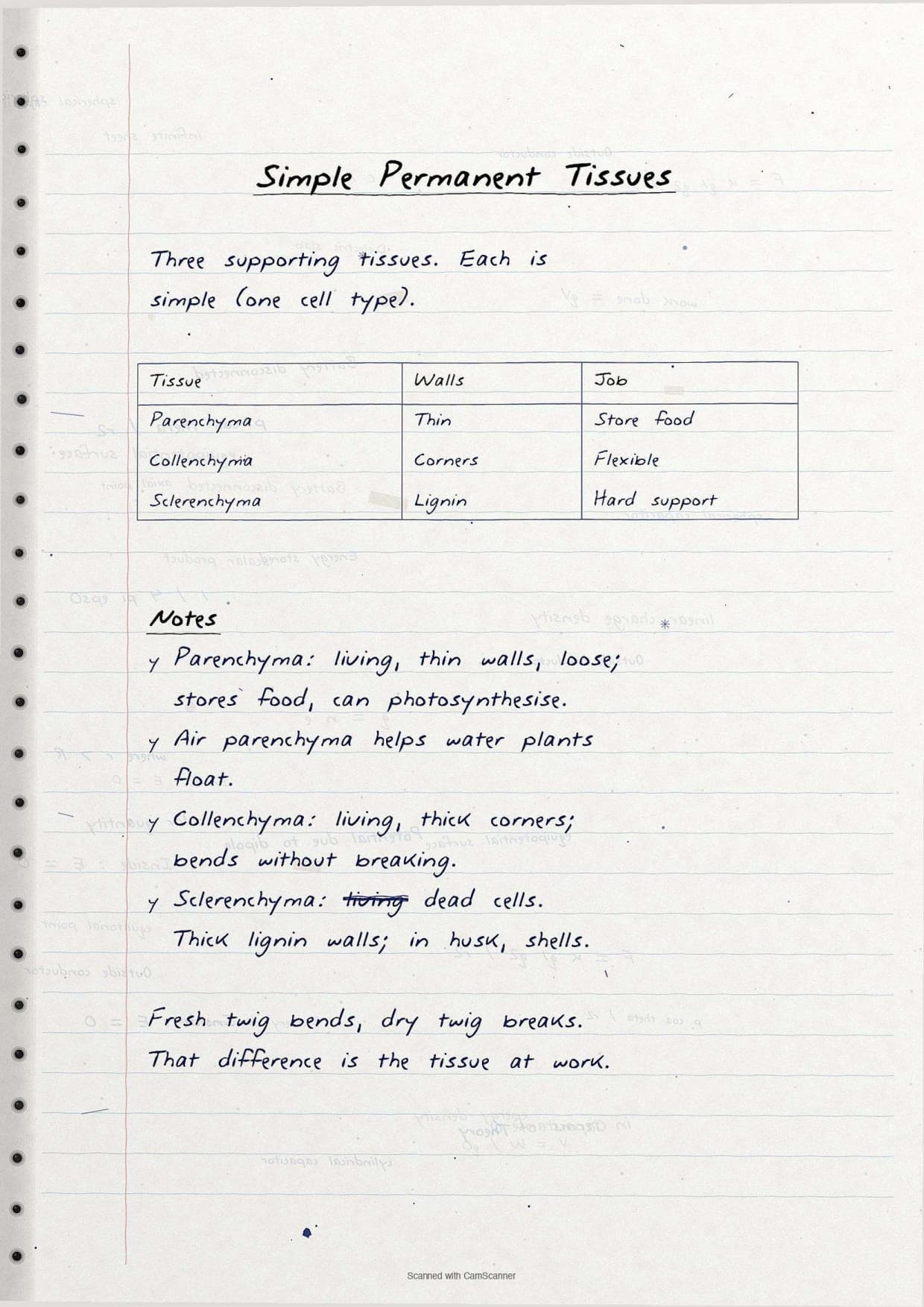
| Tissue | Structure | Function |
|---|---|---|
| Parenchyma | Living cells, thin walls, loosely packed with gaps | Stores food, does photosynthesis; air spaces help water plants float |
| Collenchyma | Living cells, corners thickened with pectin | Flexible support; lets stems and tendrils bend without breaking |
| Sclerenchyma | Mostly dead cells, thick walls with lignin | Hard, rigid strength; forms husks, shells and wood |
A simple memory line in the notes is that walls get thicker from P to C to S: Parenchyma is thin, Collenchyma has thick corners, and Sclerenchyma is thick all over. The tough brown fibre of a coconut husk and the hard shell of a walnut are both made of sclerenchyma, which is why they feel hard and last for years.
Xylem vs Phloem in Tissues in Action Class 9 Science
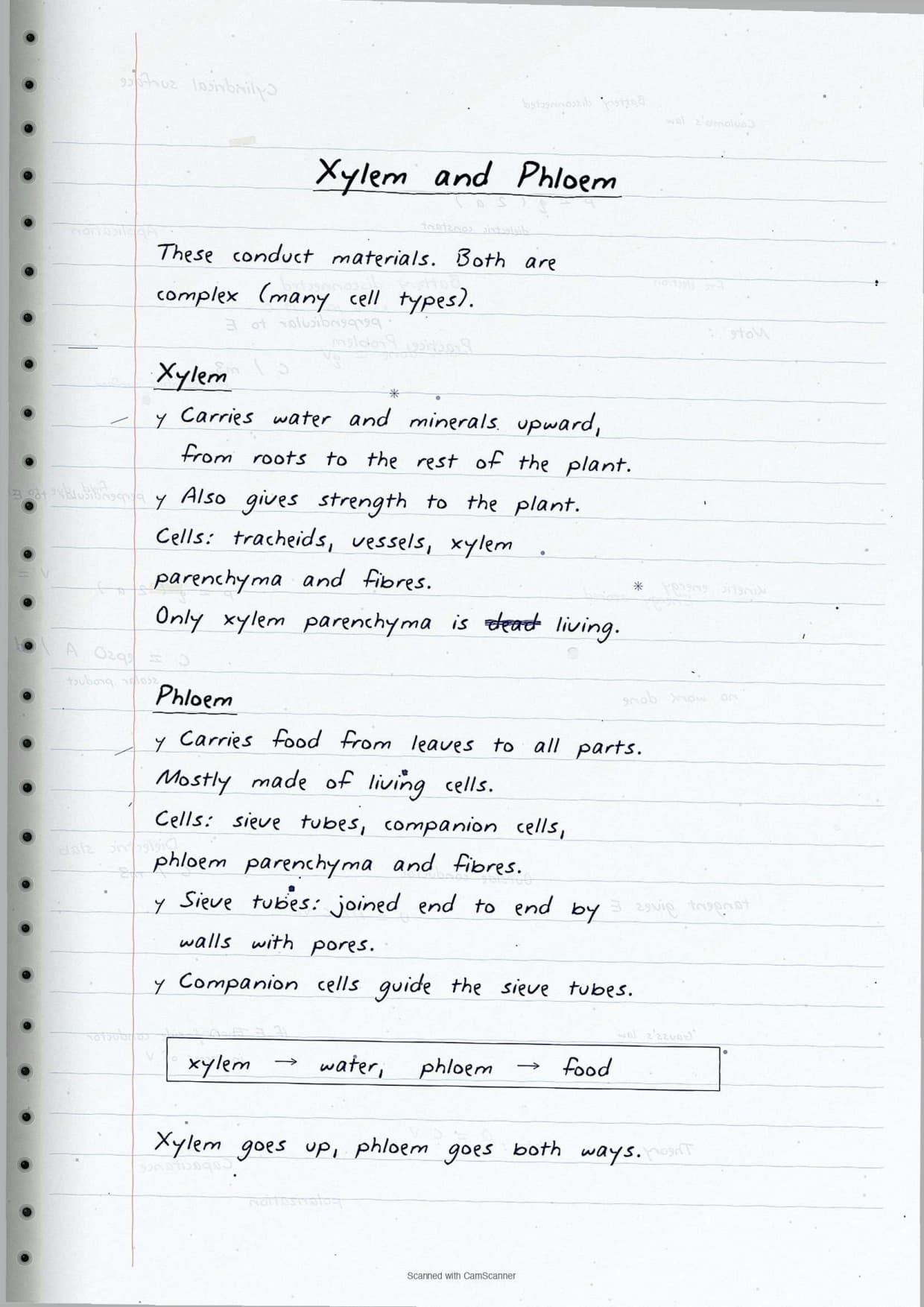
The two complex permanent tissues, xylem and phloem, are each made of several cell types working as a team. Together they form the plant's vascular tissue. Students mix these two up more than any other pair in the chapter, so the notes keep them side by side in the hand-drawn table below.
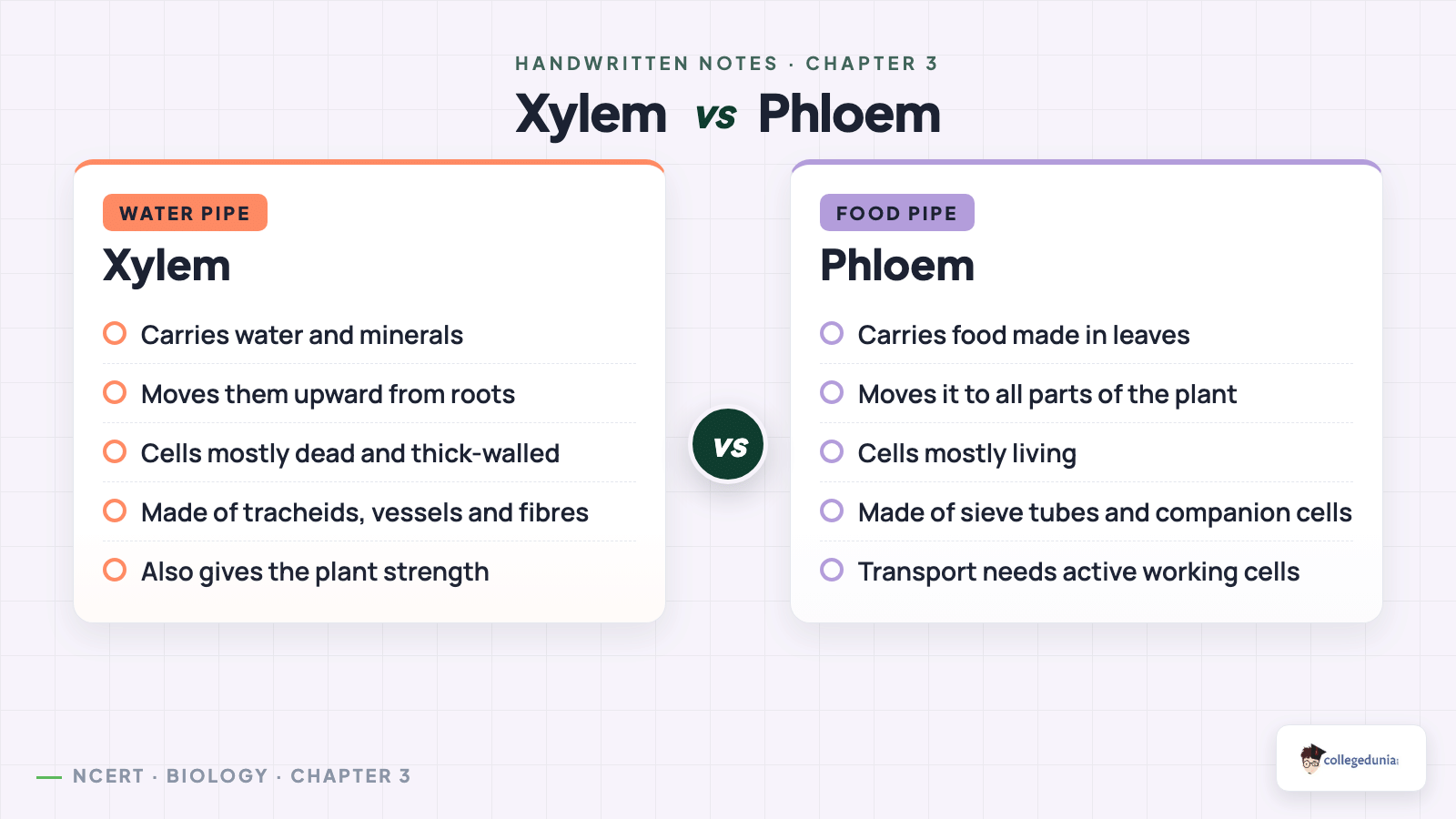
| Feature | Xylem | Phloem |
|---|---|---|
| What it carries | Water and minerals | Food made in the leaves |
| Direction | Upward, from roots to leaves | To all parts of the plant |
| State of cells | Mostly dead and thick-walled | Mostly living |
| Made of | Tracheids, vessels, fibres, parenchyma | Sieve tubes, companion cells, fibres, parenchyma |
Tip: xylem cells are mostly dead yet still carry water, because water needs only open, hollow pipes. Phloem cells are living, because pushing food around needs active, working cells. Remember the letters: Xylem for water going up, phloem for food.
Animal Tissues: Epithelial and Connective for Class 9
Animal cells also group into tissues, and there are four main types: epithelial, connective, muscular and nervous. A simple line the notes use to fix the order is Every Cat Meows Nicely. This section covers the first two.
Epithelial tissue forms the outer covering of the body (skin) and lines the inside of organs such as the mouth, lungs, blood vessels and intestine. Its cells are closely packed with almost no gaps. Where gases or liquids must pass quickly, as in the lungs, the epithelium is just one thin layer; where the body needs protection, as in the skin, it is many layers thick.
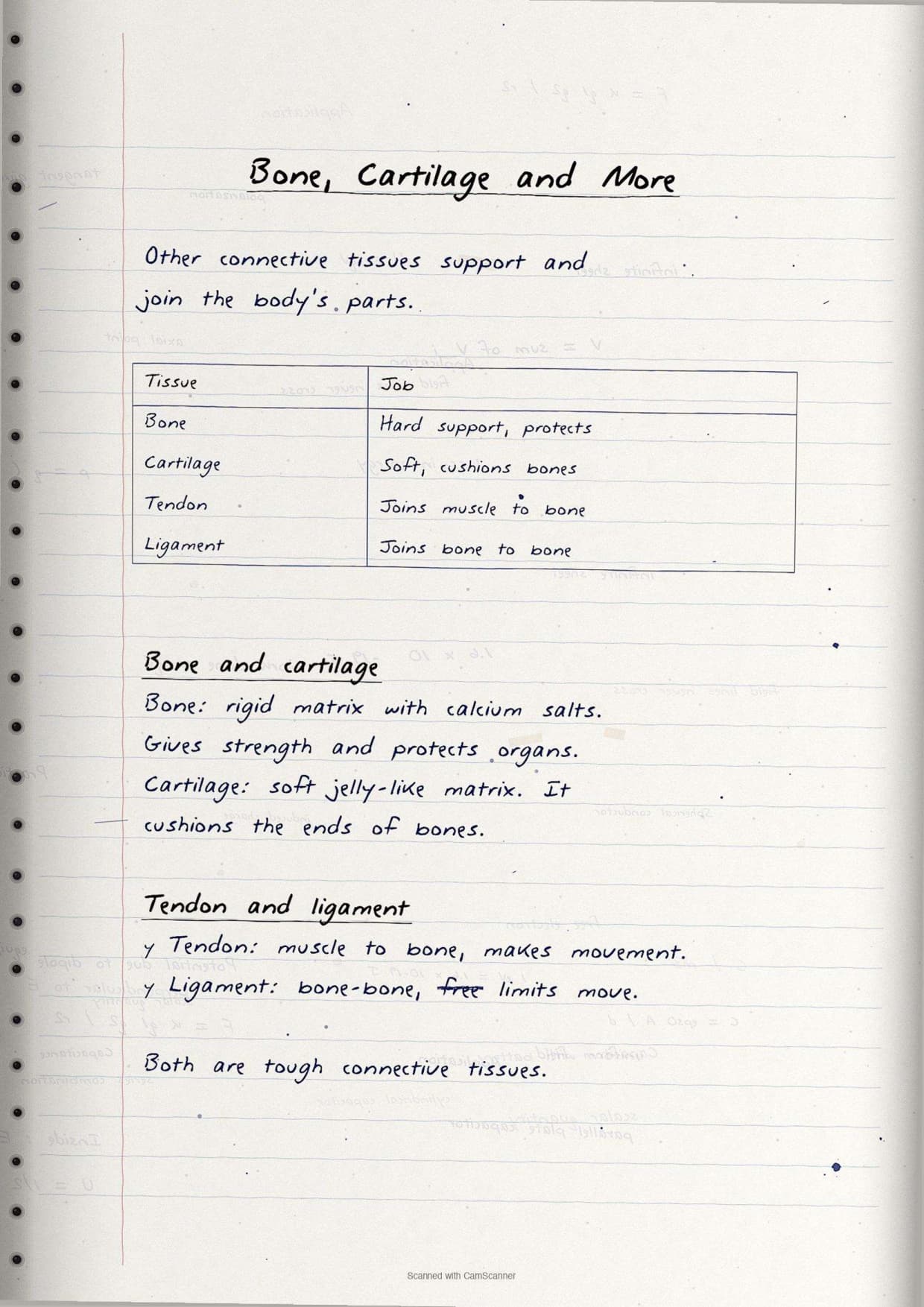
Connective tissue joins, supports and packs the other tissues. Its cells sit apart in a background material called the matrix, and the matrix decides whether the tissue is fluid, jelly-like or hard.
| Connective tissue | Matrix | Main job |
|---|---|---|
| Blood | Watery, fluid (plasma) | Carries food, gases, hormones and wastes |
| Bone | Hard, rich in calcium and phosphorus | Strength, support and protection |
| Cartilage | Soft, jelly-like | Cushions bone ends; shapes the ear and nose |
| Tendon / Ligament | Tough fibres | Tendon joins muscle to bone; ligament joins bone to bone |
The notes flag one trap in red here: a tendon joins muscle to bone, while a ligament joins bone to bone. They are easy to swap, so the page circles both with a small sketch of a joint.
Muscular, Nervous Tissue and the Musculoskeletal System
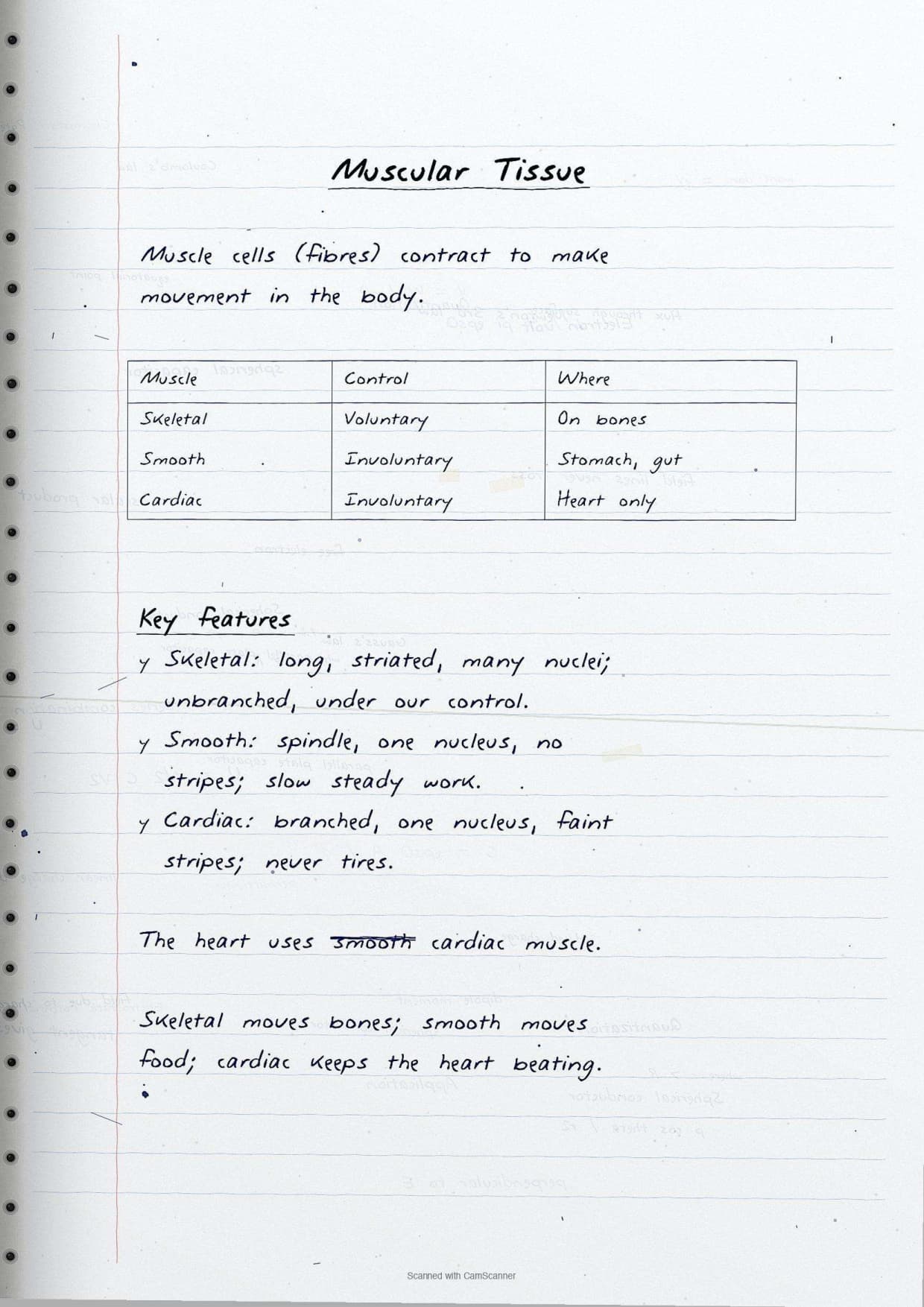
The last two animal tissues make the body move and let it sense and respond. Muscular tissue is made of long cells called muscle fibres that shorten, or contract, to cause movement. There are three types, and the notes box the one that breaks the pattern in red.
| Muscle | Where it works | Control |
|---|---|---|
| Skeletal | Attached to bones; long, striated fibres | Voluntary, under our control |
| Smooth | Stomach and intestine; spindle-shaped, not striated | Involuntary, works on its own |
| Cardiac | Only in the heart; branched, faintly striated | Involuntary, beats without tiring |
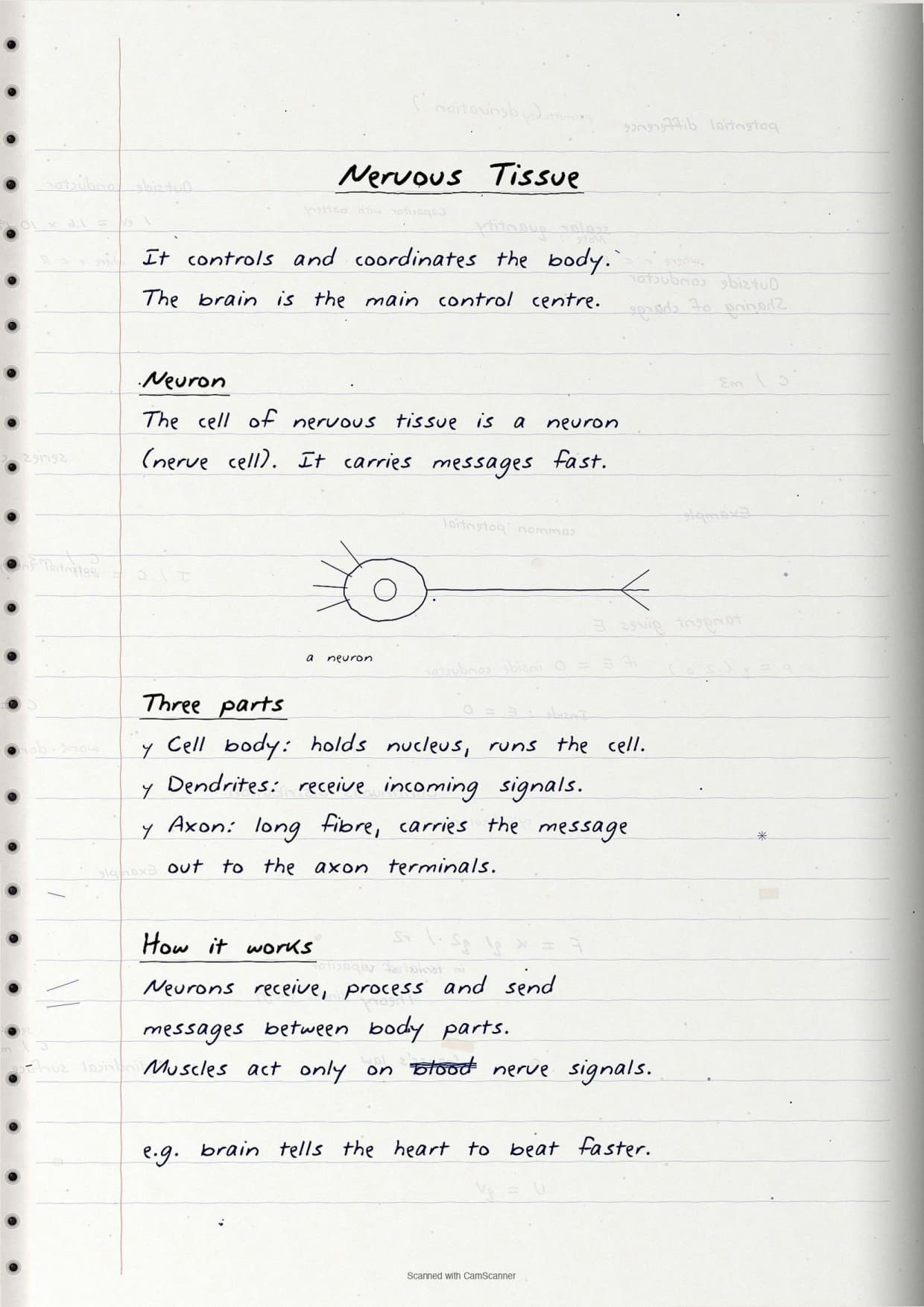
Nervous tissue is the body's control network. Its cells are neurons, built to carry messages fast. A message flows in one direction: dendrites receive the signal, the cell body processes it, and the long axon sends it on to the next cell. A muscle never acts on its own; it waits for an order from a neuron, so movement is always teamwork between nervous and muscular tissue.
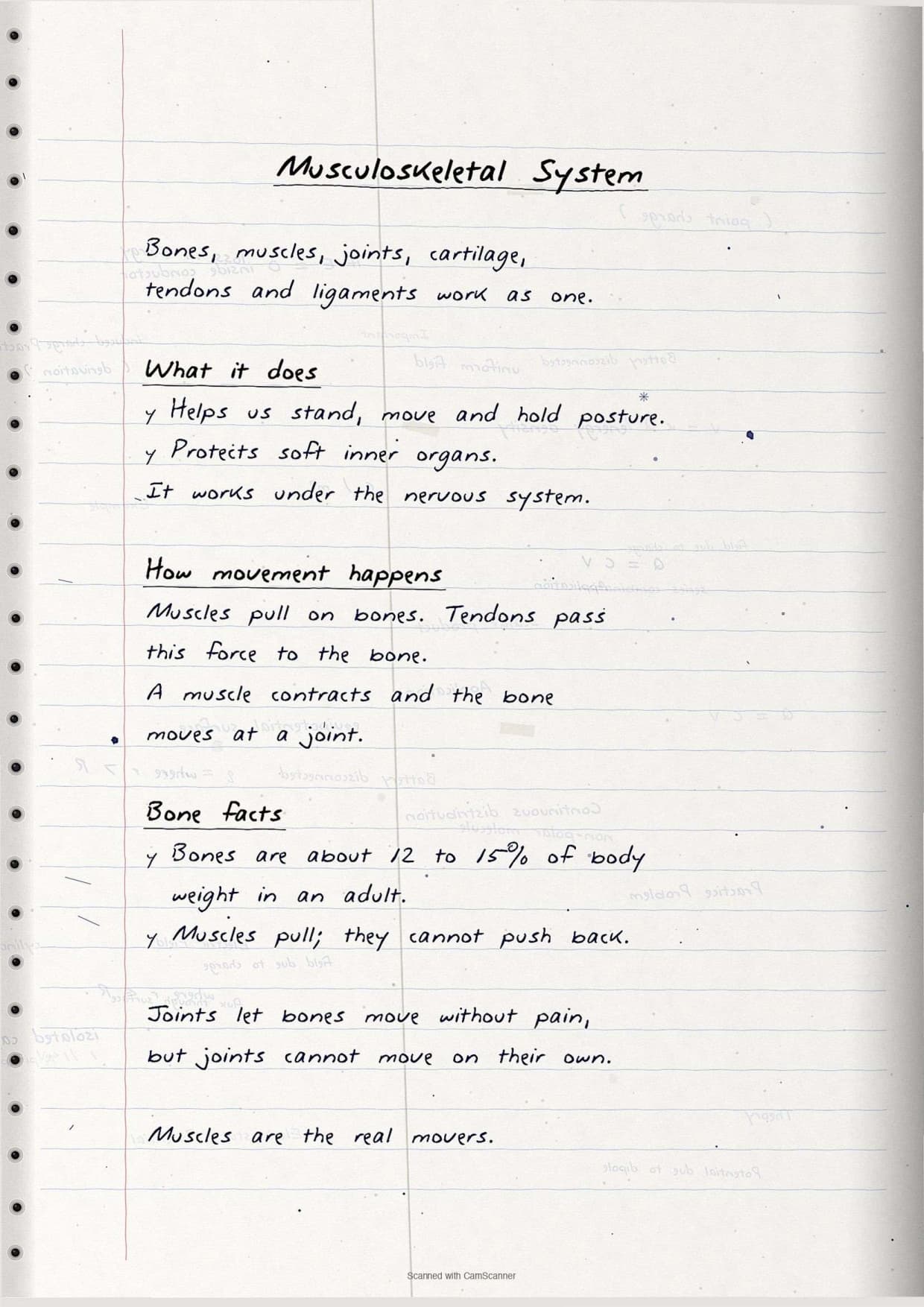
Muscles, bones and the parts that link them work as the musculoskeletal system. A muscle contracts, its tendon pulls a bone, and the bone swings at a joint. The main joints are the ball and socket (shoulder, moves every way), the hinge (elbow and knee, bends one way), the pivot (neck, turns the head) and the fixed joint (skull, locked to guard the brain).
Why These Handwritten Notes Help You Revise Tissues in Action Faster
Handwritten notes work because your eye remembers the position of a fact on the page, not just the words. These pages are built for the last revision before a Class 9 Science test, when you have little time and need the whole chapter at a glance.
- Hand-drawn diagrams: the plant tissue tree, the labelled neuron and the three muscle types sit next to their notes, so the shapes stick.
- Colour cues: key terms like differentiation, matrix and cardiac are boxed, so they are easy to spot.
- Compact tables: the xylem-versus-phloem and three-muscle tables fit on one page for a five-minute recap.
Common Mistakes Students Make in the Tissues in Action Chapter
A few slips lose easy marks in this chapter every year, so the handwritten notes flag them in red.
- Swapping xylem and phloem. Xylem carries water up; phloem carries food to all parts.
- Mixing up a tendon (muscle to bone) with a ligament (bone to bone).
- Calling cardiac muscle voluntary. It is striated but works on its own, so it is involuntary.
- Using tissue and tissue system as the same word. A tissue is one building block; a tissue system is a whole group of tissues doing a broad job.
More Tissues in Action Class 9 Science Resources
Pair these handwritten notes with the other Class 9 Science resources for this chapter, all linked below and built for the 2026-27 session.
| Resource | Open |
|---|---|
| Handwritten Notes | Tissues in Action Class 9 Science Handwritten Notes |
| NCERT Solutions | Tissues in Action Class 9 Science NCERT Solutions |
| Revision Notes | Tissues in Action Class 9 Science Notes |
| Formula Sheet | Tissues in Action Class 9 Science Formula Sheet |
| NCERT Book PDF | Tissues in Action Class 9 Science NCERT Book PDF |
NCERT Handwritten Notes for Class 9 Science: All Chapters
Browse the full set of handwritten notes for class 9 science chapter by chapter of the new Exploration book.
Tissues in Action Class 9 Science Handwritten Notes FAQs
Ques. Where can I download the Class 9 Science Chapter 3 Tissues in Action handwritten notes PDF?
Ans. You can download the handwritten notes PDF directly from this page. Both the Normal and HD versions are free, and every topic is written by hand for the 2026-27 session.
Ques. What topics do these Tissues in Action Class 9 handwritten notes cover?
Ans. They cover the division of labour, meristematic and permanent plant tissues, parenchyma, collenchyma and sclerenchyma, xylem and phloem, the four animal tissues, and the musculoskeletal system with its main joints.
Ques. What is the difference between xylem and phloem in Class 9?
Ans. Xylem carries water and minerals upward from the roots and is made mostly of dead, thick-walled cells. Phloem carries food made in the leaves to all parts of the plant and is made mostly of living cells.
Ques. Are these handwritten notes aligned with the 2026-27 syllabus?
Ans. Yes. The notes follow the new 2026-27 NCERT book Exploration, where Tissues in Action is Chapter 3. Every diagram and table is checked against that latest edition.
Ques. Are handwritten notes good enough for last-minute revision of this chapter?
Ans. Yes. Handwritten notes are built for a quick one-shot recap. The labelled diagrams and compact comparison tables let you revise the whole chapter in a few minutes before a test.
Ques. What is the difference between a tendon and a ligament?
Ans. A tendon joins muscle to bone and passes the pull of the muscle to the bone. A ligament joins bone to bone and holds a joint steady, so it does not connect any muscle.



Comments