




The NCERT notes for Class 9 Science Chapter 11 Reproduction How Life Continues gather every process, diagram and definition the exam actually tests. Reproduction is a core biology chapter in the new 2026-27 Exploration book. These notes explain asexual and sexual reproduction, the flower, and reproduction in animals and humans in plain English, with labelled tables you can revise in one sitting.
These class 9 science ncert notes chapter 11 Reproduction How Life Continues are written by Collegedunia subject experts, checked against the 2026-27 NCERT Exploration textbook, and refined using recent CBSE exam trends.
- Full concept cover: asexual methods, meiosis and variation, flower and pollination, and reproduction in animals and human beings in one place.
- Reproduction is a steady source of 1, 3 and 5 mark questions in the Class 9 Science paper, so it is worth learning well.
- Free PDF download in Normal and HD, with labelled diagrams and quick revision tables.
|
Table of Contents |
What Reproduction How Life Continues Class 9 Notes Cover
These notes show how living things make more of their own kind so a species does not vanish. You learn the two main routes to new life, name each asexual method, and follow the flower from pollination to seed. The reproduction how life continues class 9 chapter ends with reproduction in animals and human beings.
- Two types: asexual reproduction (one parent, identical clones) versus sexual reproduction (two parents, varied offspring).
- Asexual methods: fission, budding, spore formation, fragmentation, regeneration and vegetative propagation.
- Sexual reproduction: gametes, why meiosis halves chromosomes, and how variation arises.
- Plants, animals and humans: flower parts, pollination, fertilisation, and the male and female human systems.
Reproduction How Life Continues Class 9 Full Chapter Explained
Source: Magnet Brains on YouTube
Reproduction and Its Two Main Types in Class 9 Science Chapter 11
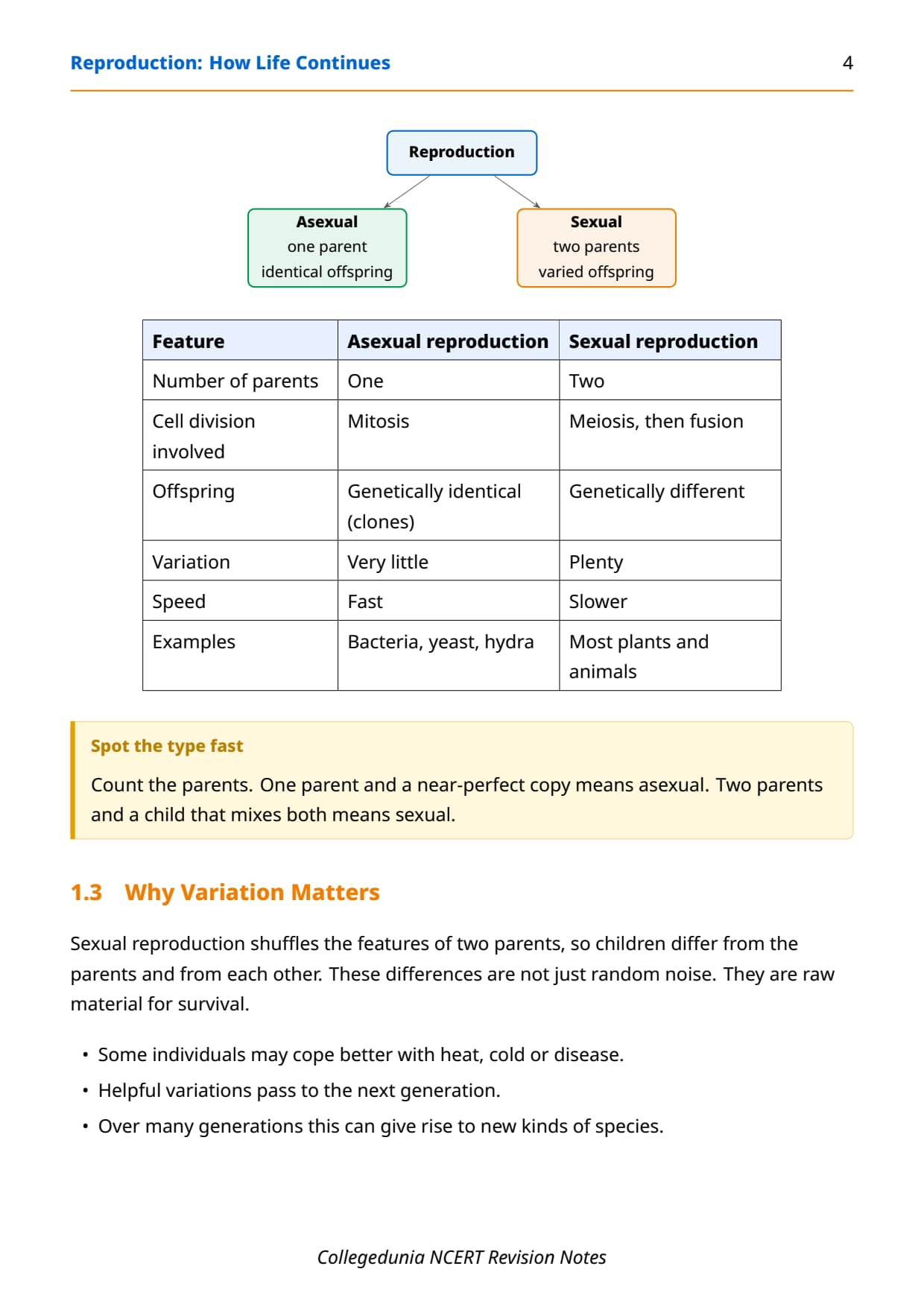
Every organism has a fixed life span, so it must leave behind new individuals of its own kind. Reproduction is that process, and it keeps life on the Earth going. Living things reproduce in two broad ways, and the key difference is the number of parents and how alike the offspring are.
| Feature | Asexual reproduction | Sexual reproduction |
|---|---|---|
| Number of parents | One | Two |
| Cell division | Mitosis | Meiosis, then fusion |
| Offspring | Genetically identical (clones) | Genetically different |
| Variation | Very little | Plenty |
| Examples | Bacteria, yeast, hydra | Most plants and animals |
Tip: to spot the type fast, just count the parents. One parent and a near-perfect copy means asexual; two parents and a child that mixes both means sexual. Sexual reproduction shuffles features, which creates the variation that helps a species adapt over generations.
Asexual Reproduction Methods in Reproduction How Life Continues Class 9
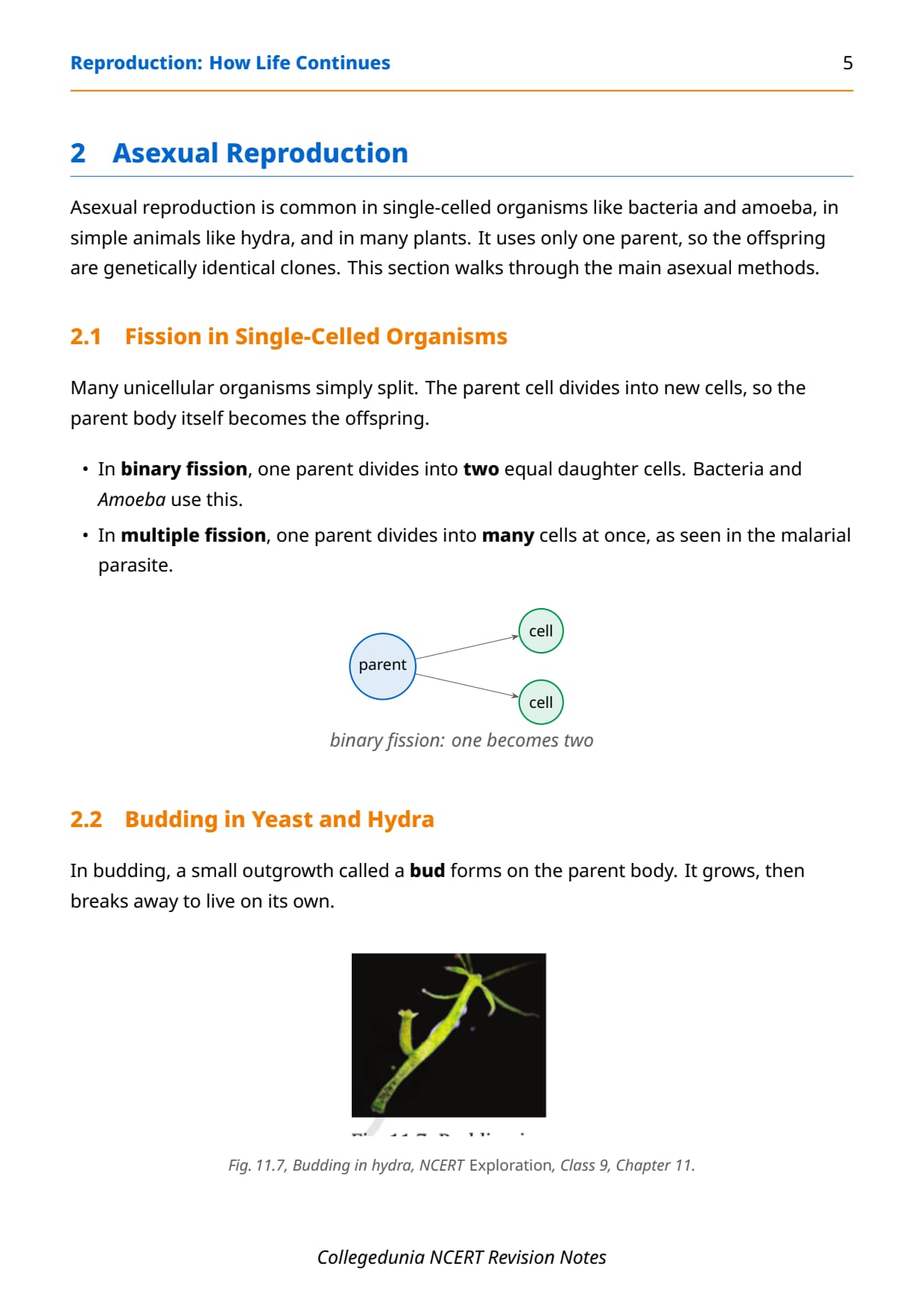
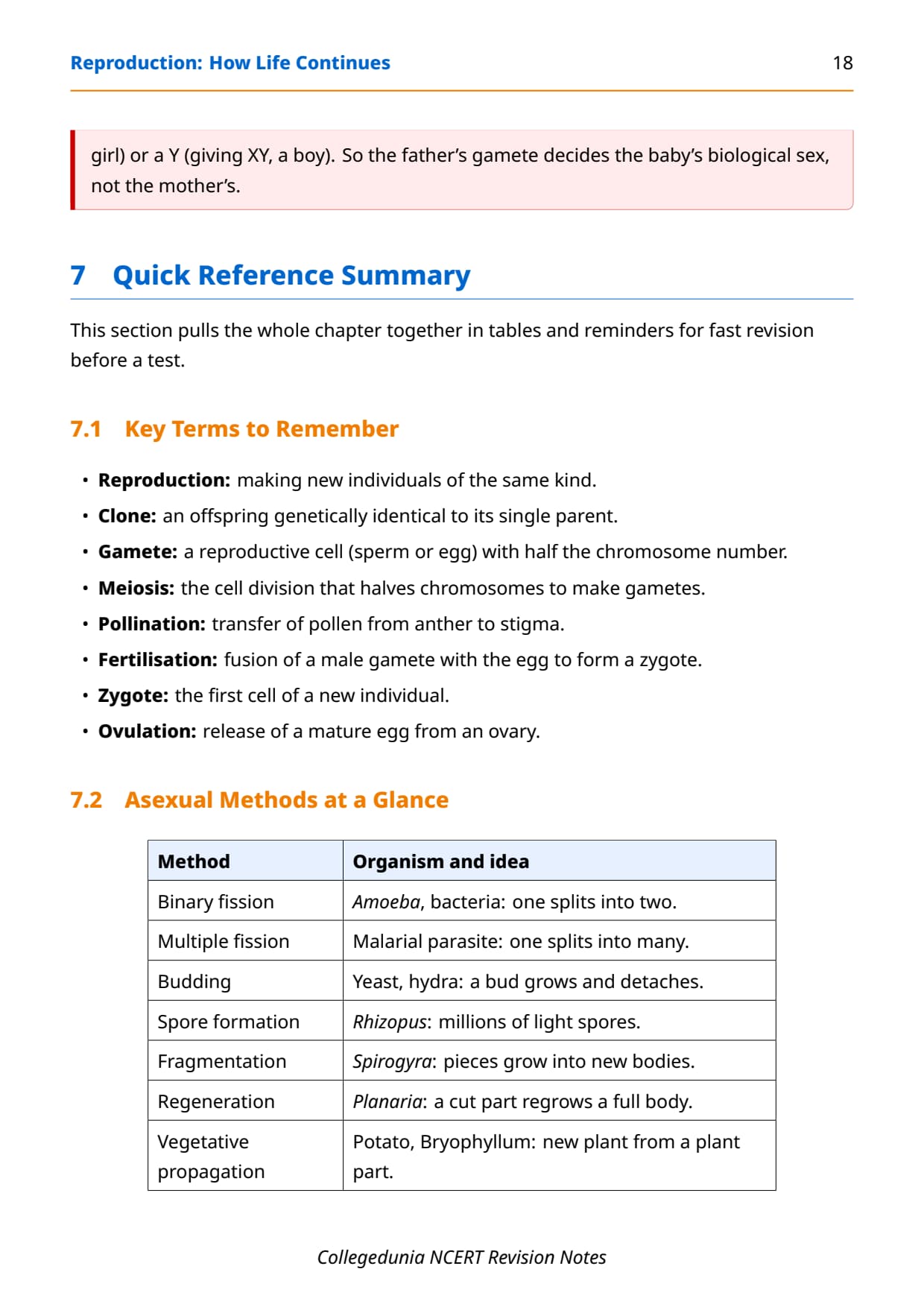
Asexual reproduction needs only one parent, so the offspring are identical clones. It is common in bacteria, amoeba, simple animals like hydra, and many plants. The class 9 science chapter 11 notes group the main methods below.
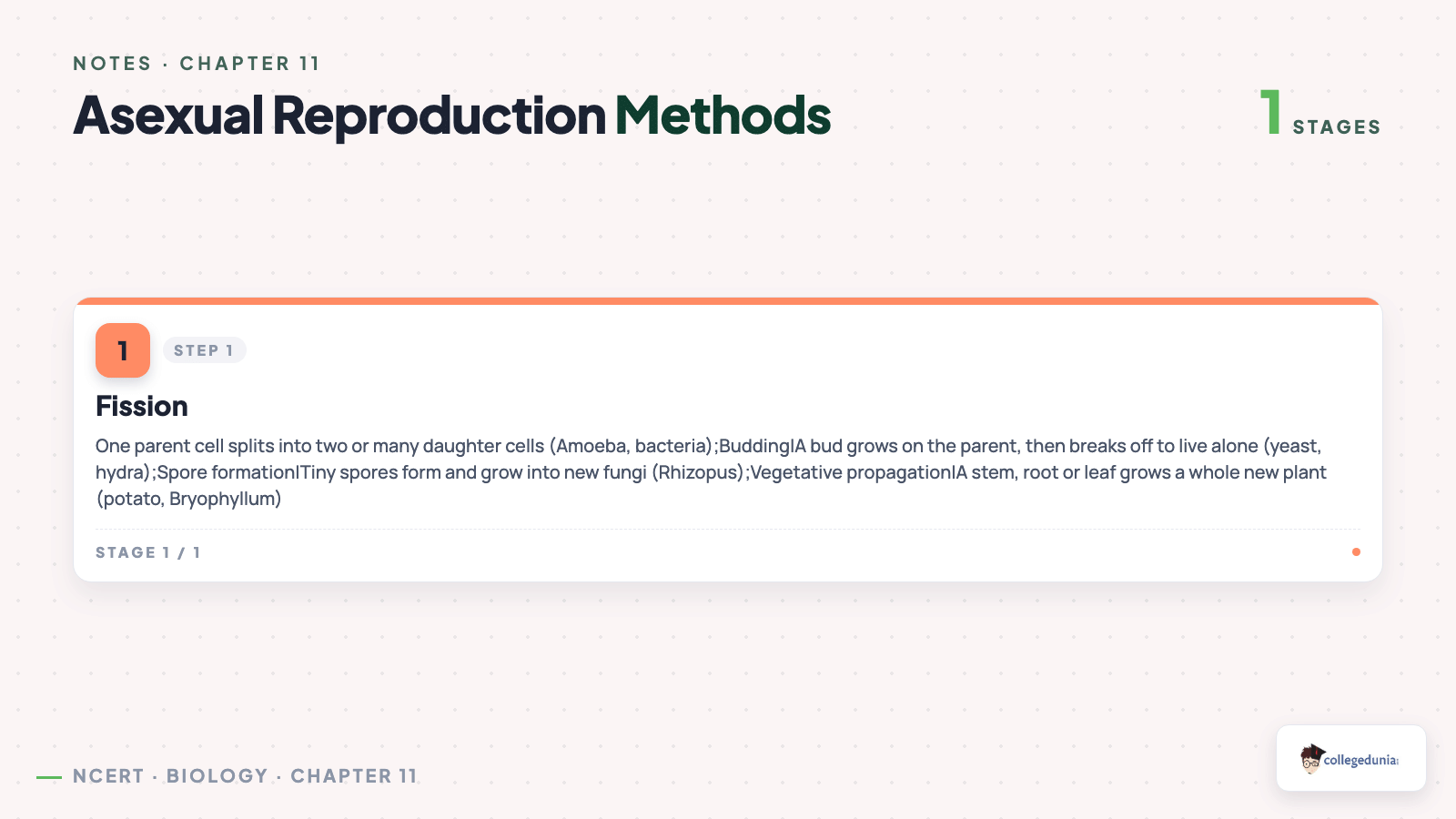
| Method | How it works | Example |
|---|---|---|
| Binary fission | One parent cell splits into two equal daughter cells | Bacteria, Amoeba |
| Multiple fission | One parent divides into many cells at once | Malarial parasite |
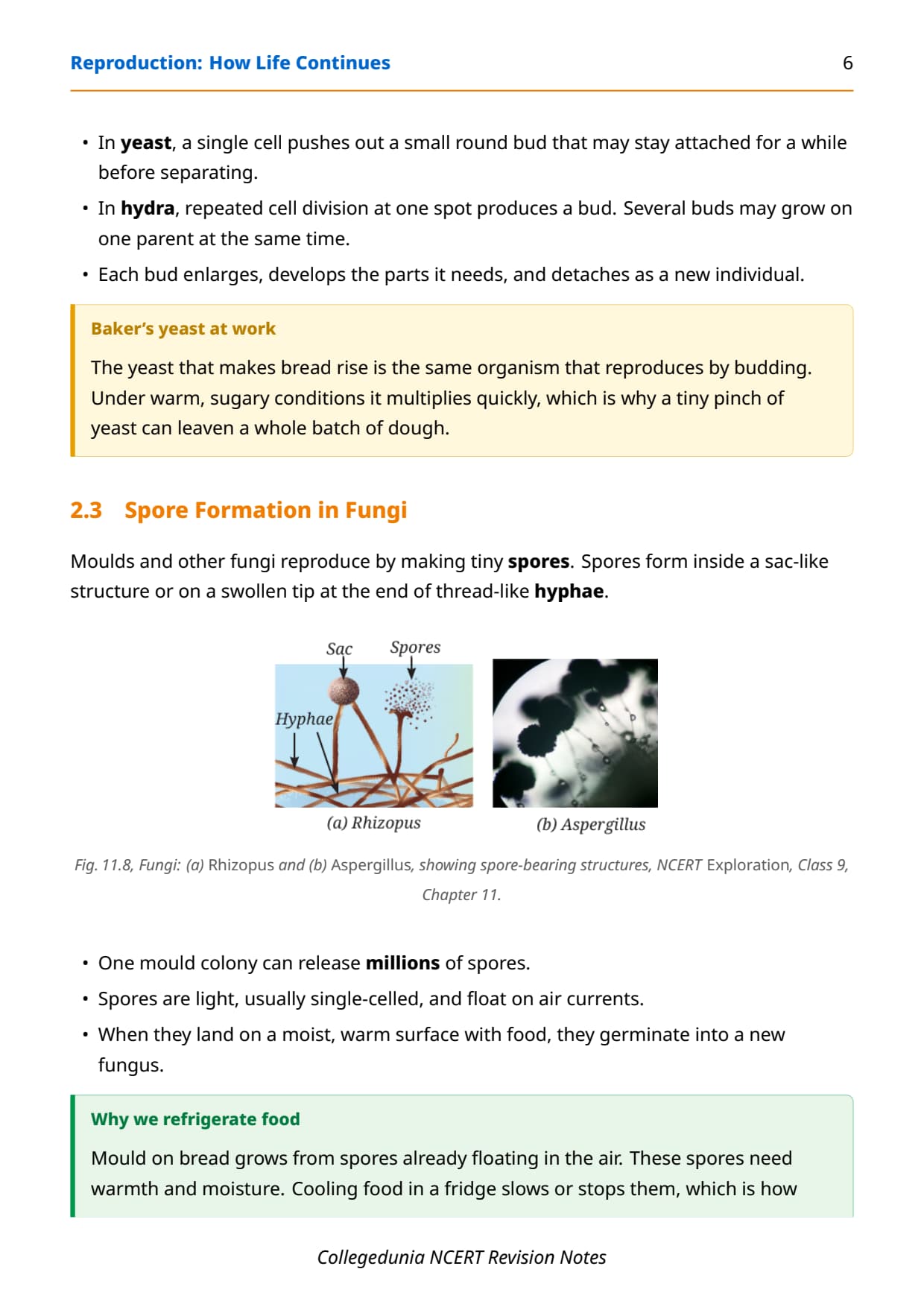
| Budding | A bud grows on the parent, then breaks off | Yeast, Hydra |
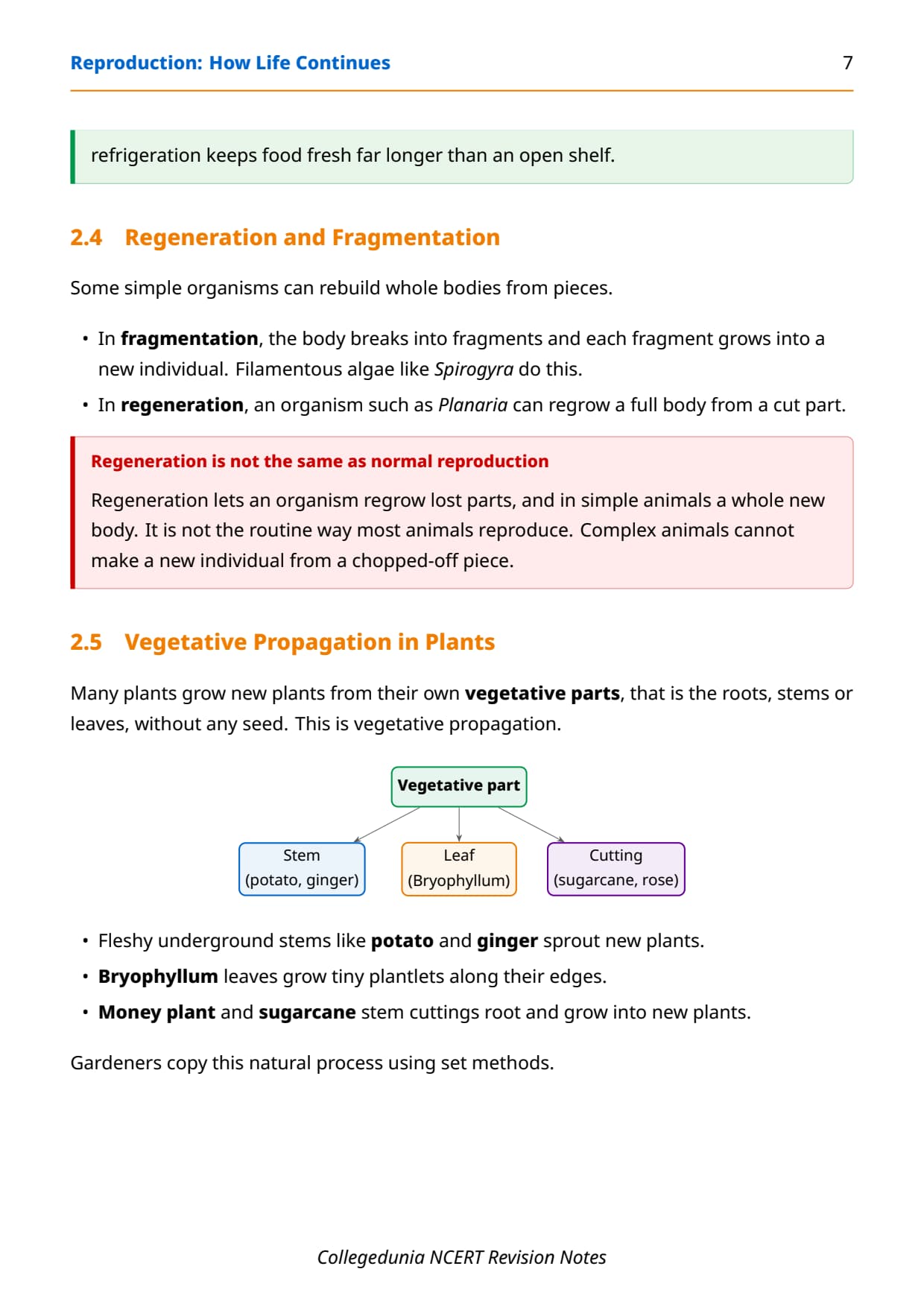
| Spore formation | Tiny spores form and grow into new organisms | Rhizopus, other fungi |
| Fragmentation | The body breaks into pieces, each grows anew | Spirogyra |
| Regeneration | A cut part regrows into a full body | Planaria |
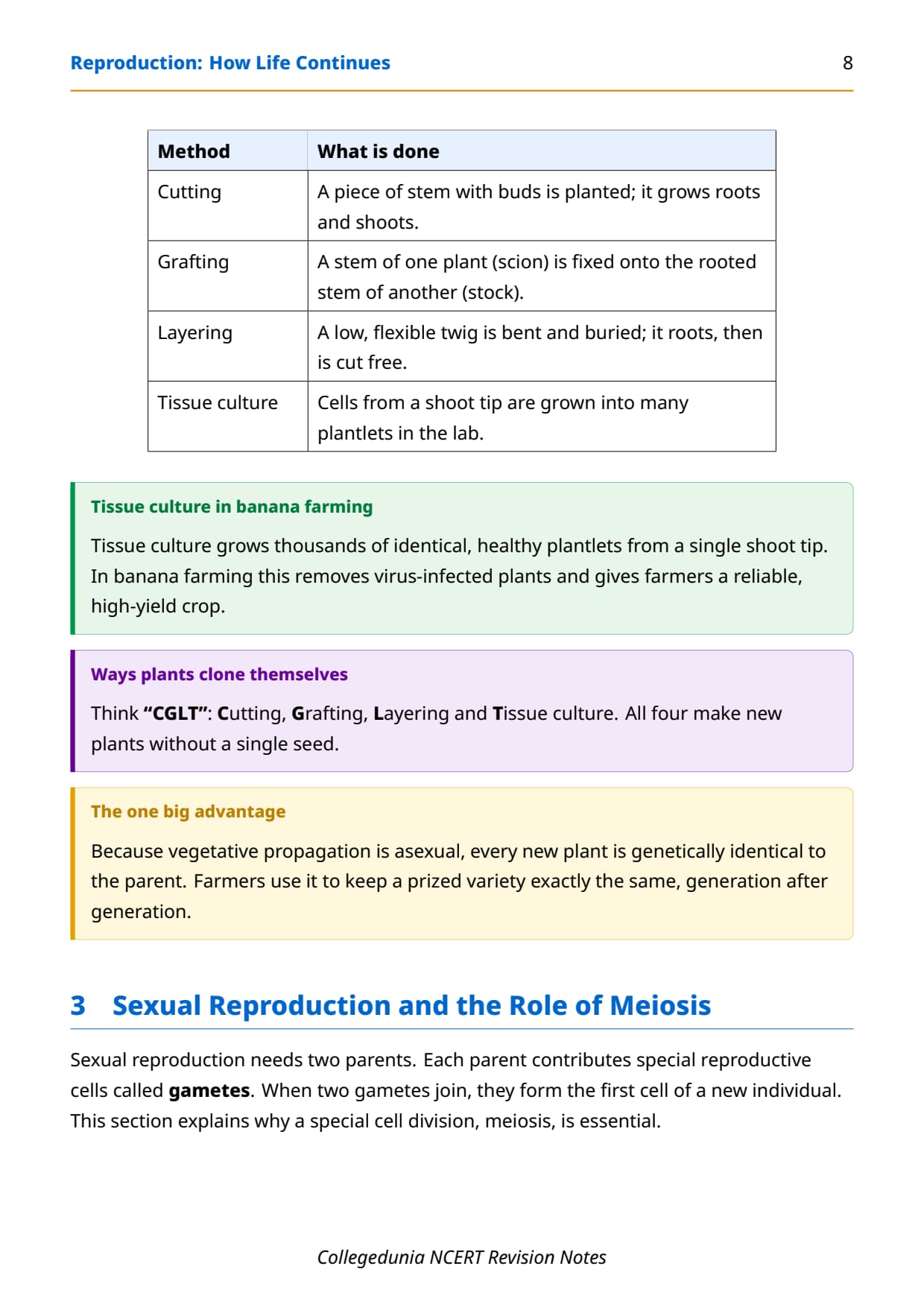
Many plants also grow new plants from their vegetative parts, the roots, stems or leaves, without any seed. Potato and ginger stems sprout, Bryophyllum leaves grow plantlets along their edges, and money plant cuttings root easily. Gardeners copy this by cutting, grafting, layering and tissue culture. Remember the mnemonic CGLT. Because it is asexual, every new plant is an exact copy of the parent, which is why farmers use it to keep a prized variety unchanged.
Sexual Reproduction and the Role of Meiosis in Class 9 Science Chapter 11
Sexual reproduction needs two parents, each giving a special reproductive cell called a gamete. In animals the male gamete is the sperm and the female gamete is the egg. When two gametes fuse in fertilisation, they form a zygote, the first cell of a new individual.
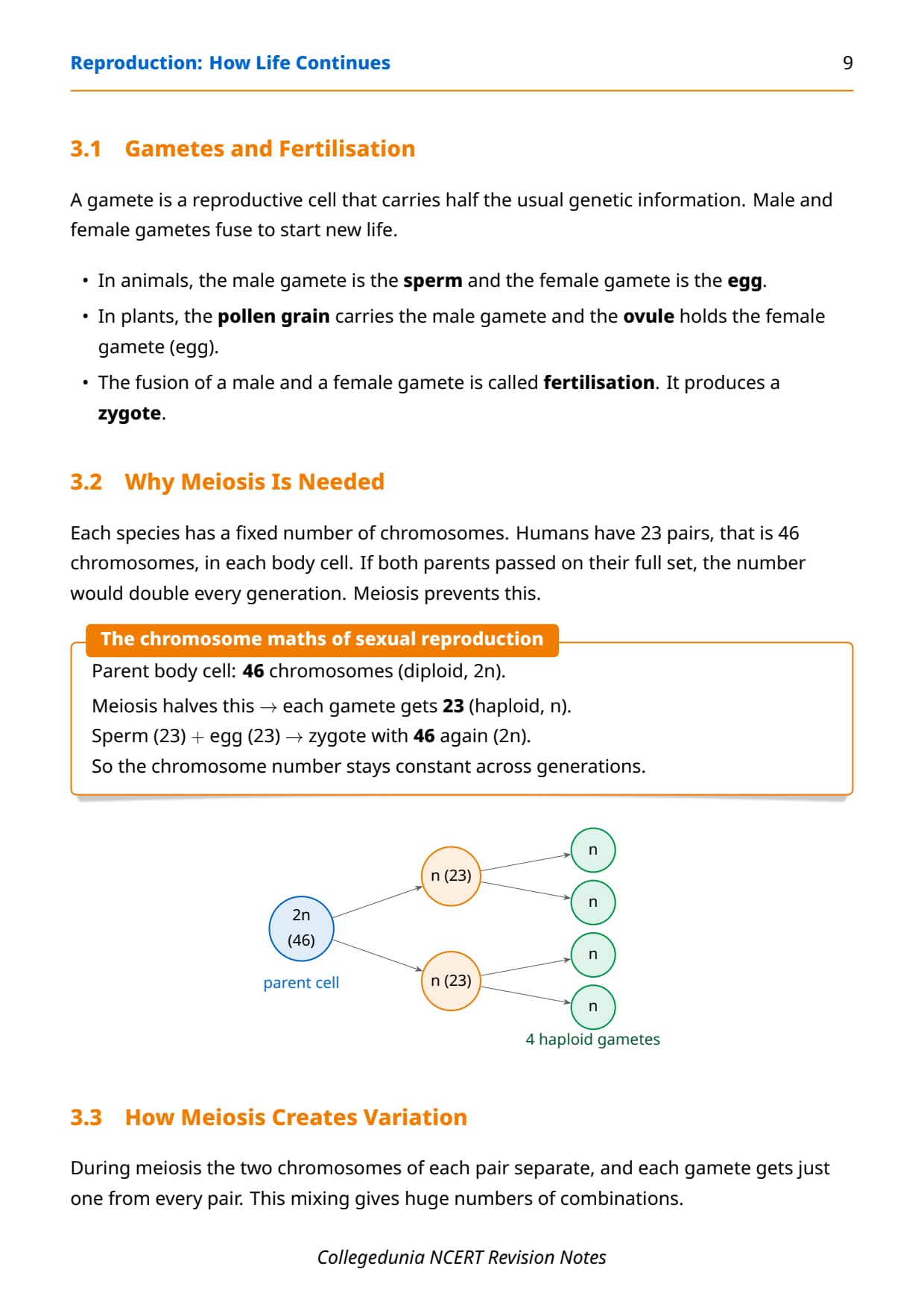
Each species keeps a fixed chromosome number, so a special cell division called meiosis is essential. Humans have 46 chromosomes (23 pairs) in each body cell.
| Step | Chromosome number |
|---|---|
| Parent body cell (diploid, 2n) | 46 |
| Each gamete after meiosis (haploid, n) | 23 |
| Zygote after sperm (23) plus egg (23) | 46 again |
So meiosis halves the number, and fertilisation restores it. Recall it as halve, then combine. Meiosis also separates the two chromosomes of each pair at random, so each gamete carries a unique mix. This shuffling is why every child differs from the parents and from siblings, and it is the raw material for evolution.
Flower Parts and Pollination in Reproduction How Life Continues Class 9
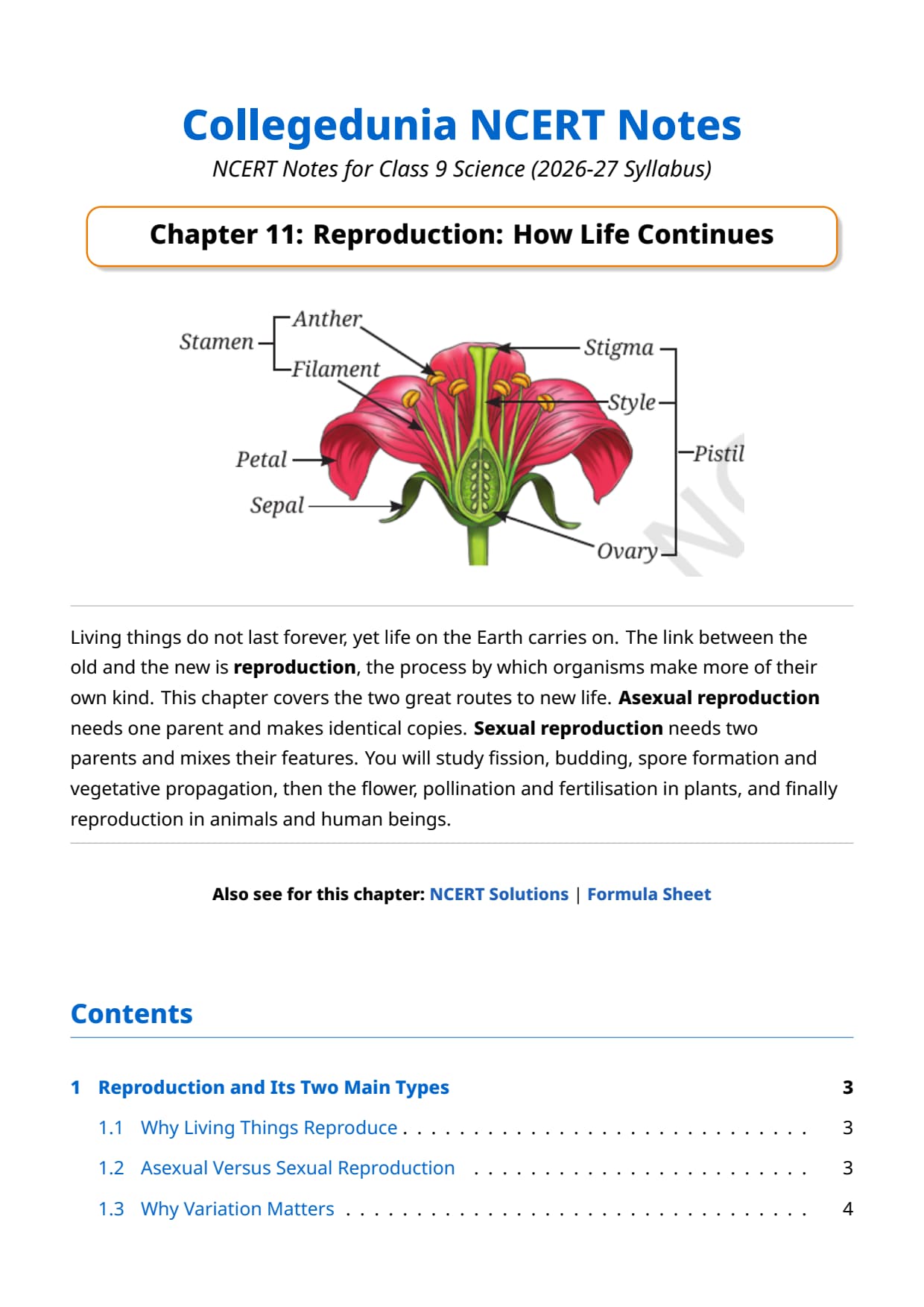
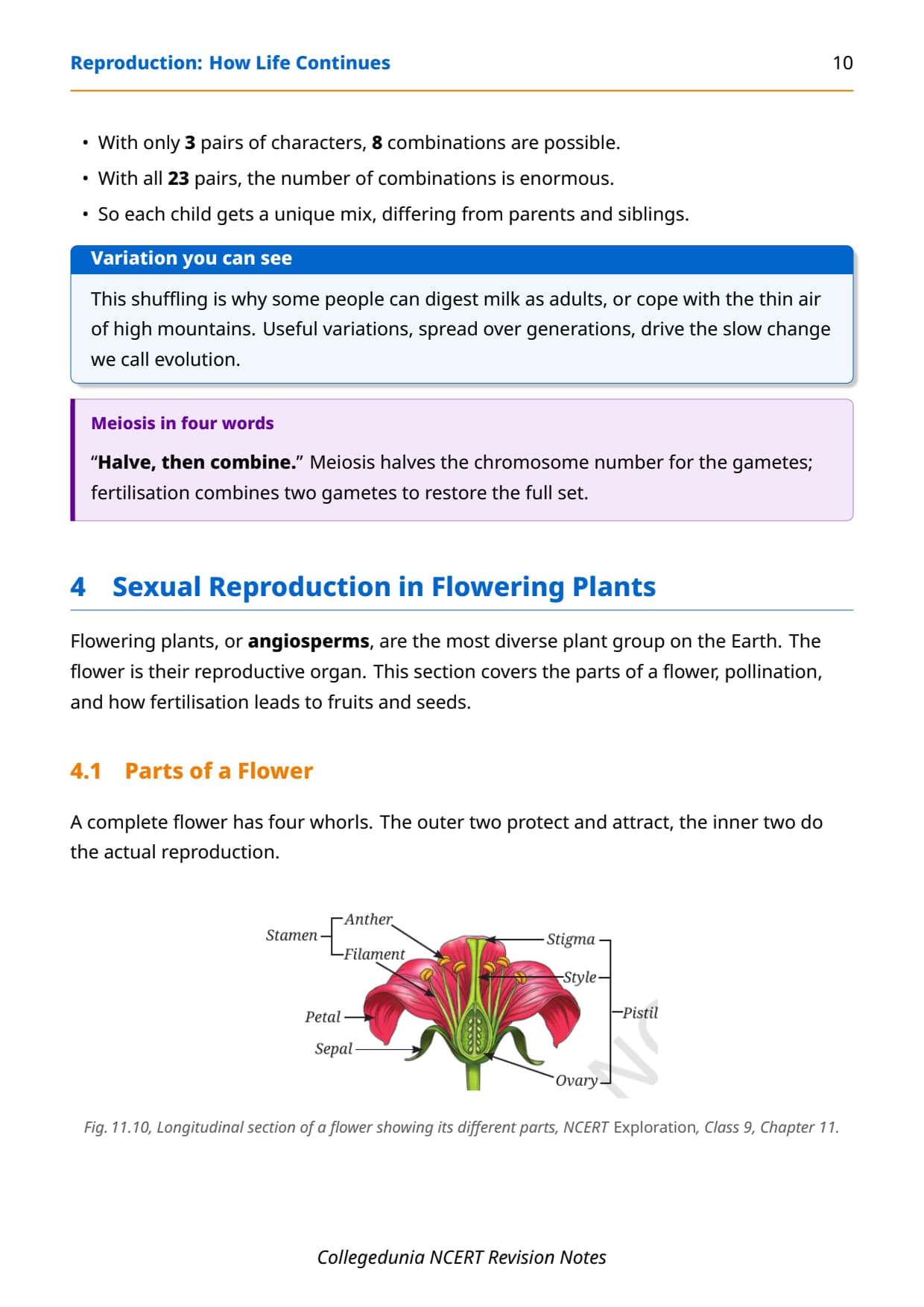
Flowering plants, or angiosperms, reproduce through the flower. A complete flower has four whorls: the outer two protect and attract, the inner two do the actual reproduction. Fix on the male and female whorls first and the rest follows.
| Part | Type | Function |
|---|---|---|
| Sepal | Outer, green | Protects the flower in the bud stage |
| Petal | Coloured | Attracts pollinators; protects inner parts |
| Stamen (male) | Anther and filament | Anther makes pollen grains with male gametes |
| Pistil (female) | Stigma, style, ovary | Receives pollen; ovary holds ovules with egg cells |
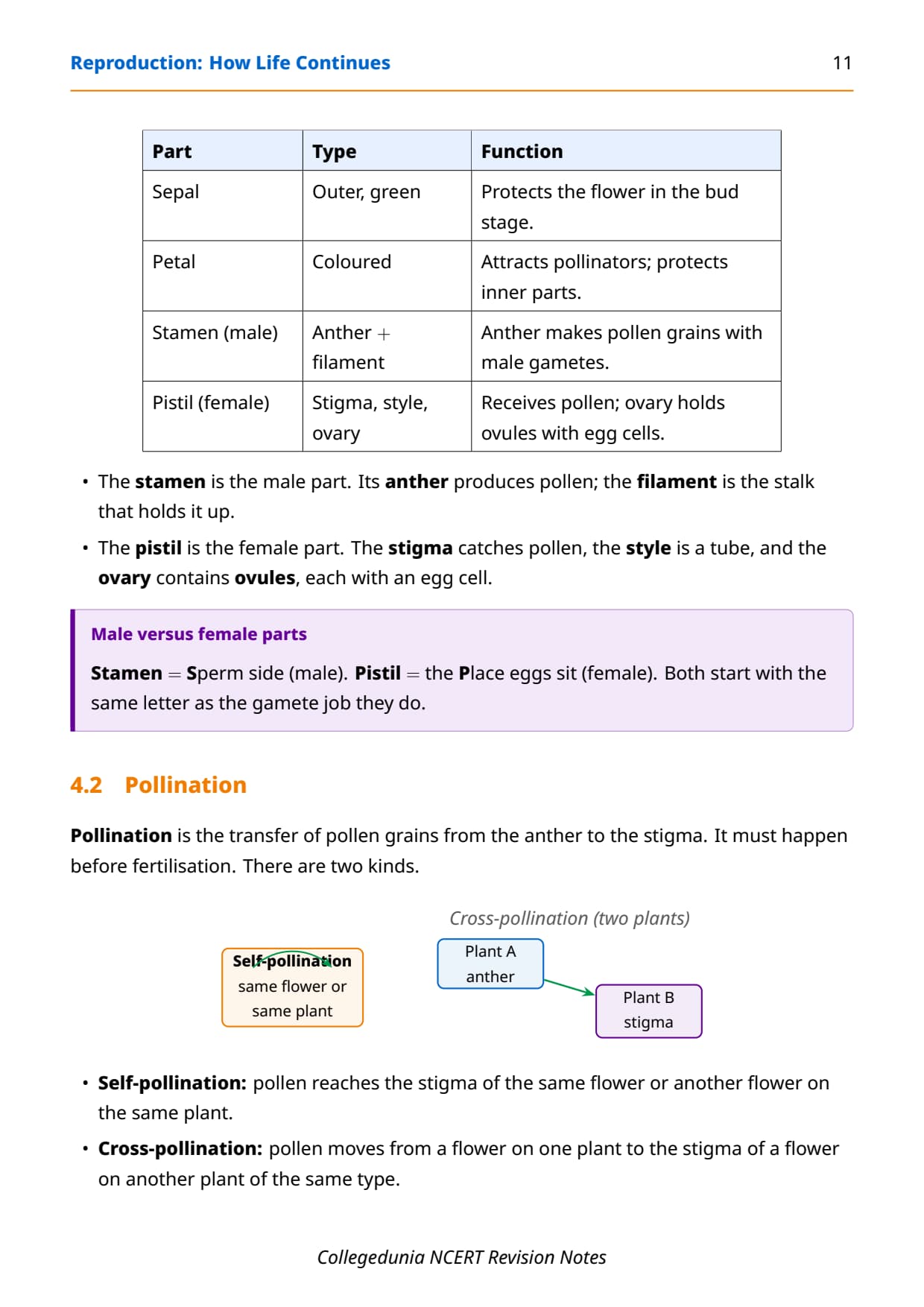
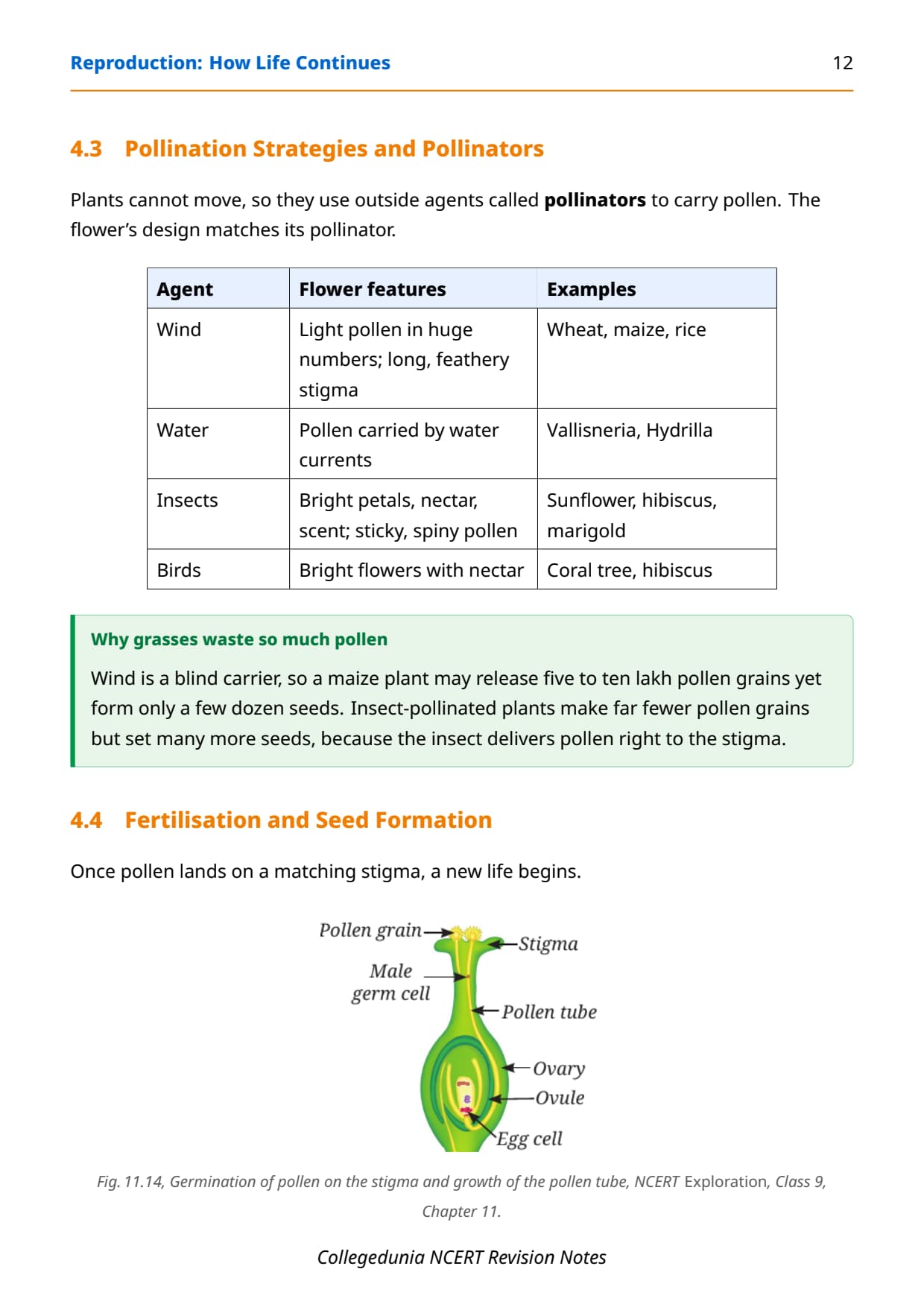
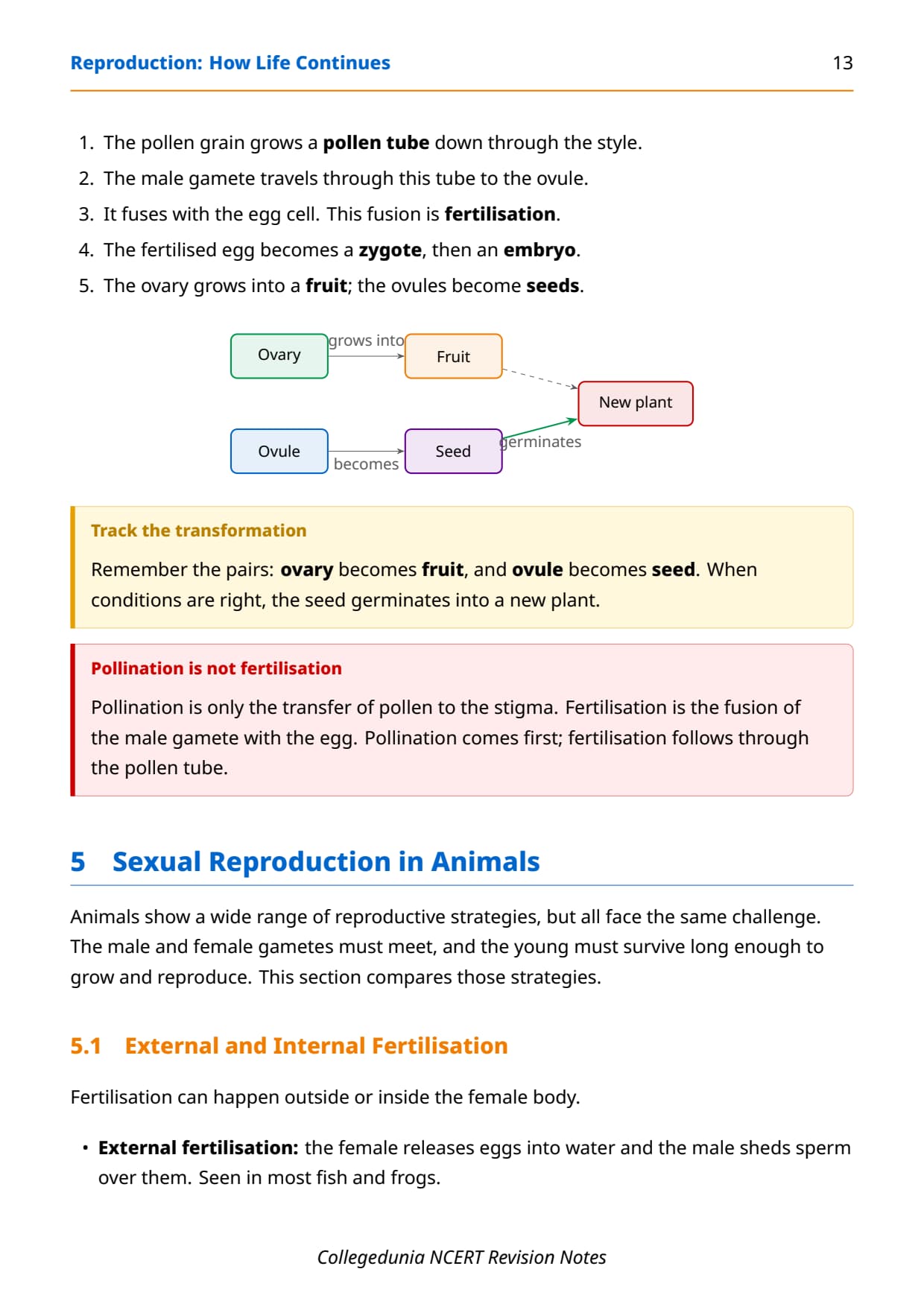
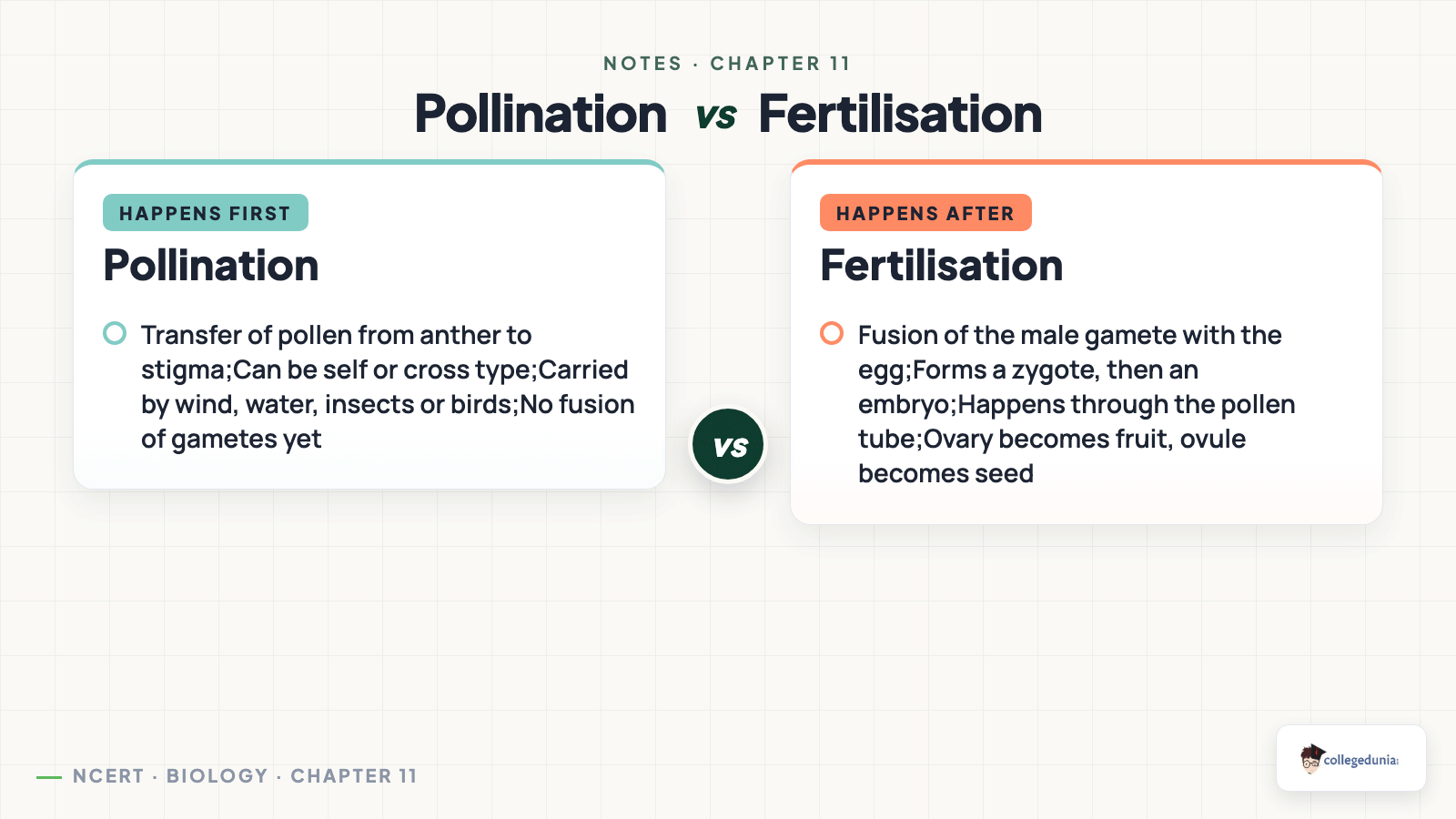
Pollination is the transfer of pollen from the anther to the stigma, and it must happen before fertilisation. In self-pollination pollen reaches the same or another flower on the same plant; in cross-pollination it moves to a flower on a different plant. Wind, water, insects and birds all act as pollinators. Once pollen lands, it grows a pollen tube down the style, the male gamete fuses with the egg, and the ovary becomes a fruit while the ovule becomes a seed.
Tip: pollination is not fertilisation. Pollination is only the transfer of pollen to the stigma; fertilisation is the fusion of the male gamete with the egg that follows through the pollen tube.
Sexual Reproduction in Animals for Class 9 Science Chapter 11
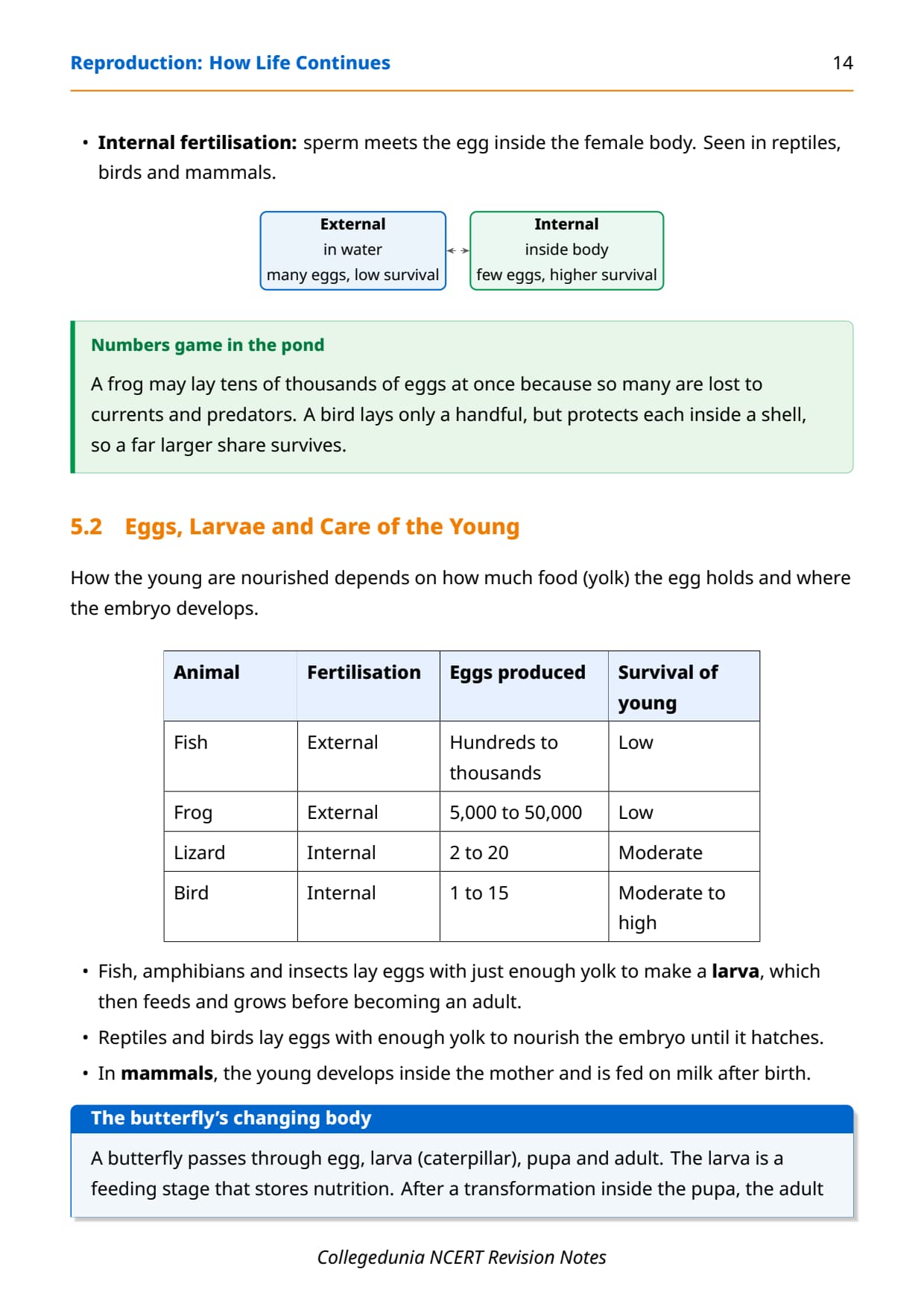
All animals face the same challenge: the male and female gametes must meet, and the young must survive long enough to grow up. Fertilisation can happen outside or inside the female body, and this shapes how many eggs an animal makes.
| Type | Where it happens | Eggs produced | Survival of young |
|---|---|---|---|
| External | In water, outside the body | Hundreds to thousands | Low |
| Internal | Inside the female body | Few | Moderate to high |
Fish and frogs use external fertilisation and lay huge numbers of eggs, because so many are lost to currents and predators. Reptiles, birds and mammals use internal fertilisation and produce far fewer eggs, each better protected. In mammals the young develops inside the mother and is fed on milk after birth. Some animals, such as the butterfly, also pass through a larva stage that feeds and grows before the adult body forms.
Reproduction in Human Beings Explained for Class 9 Science Chapter 11
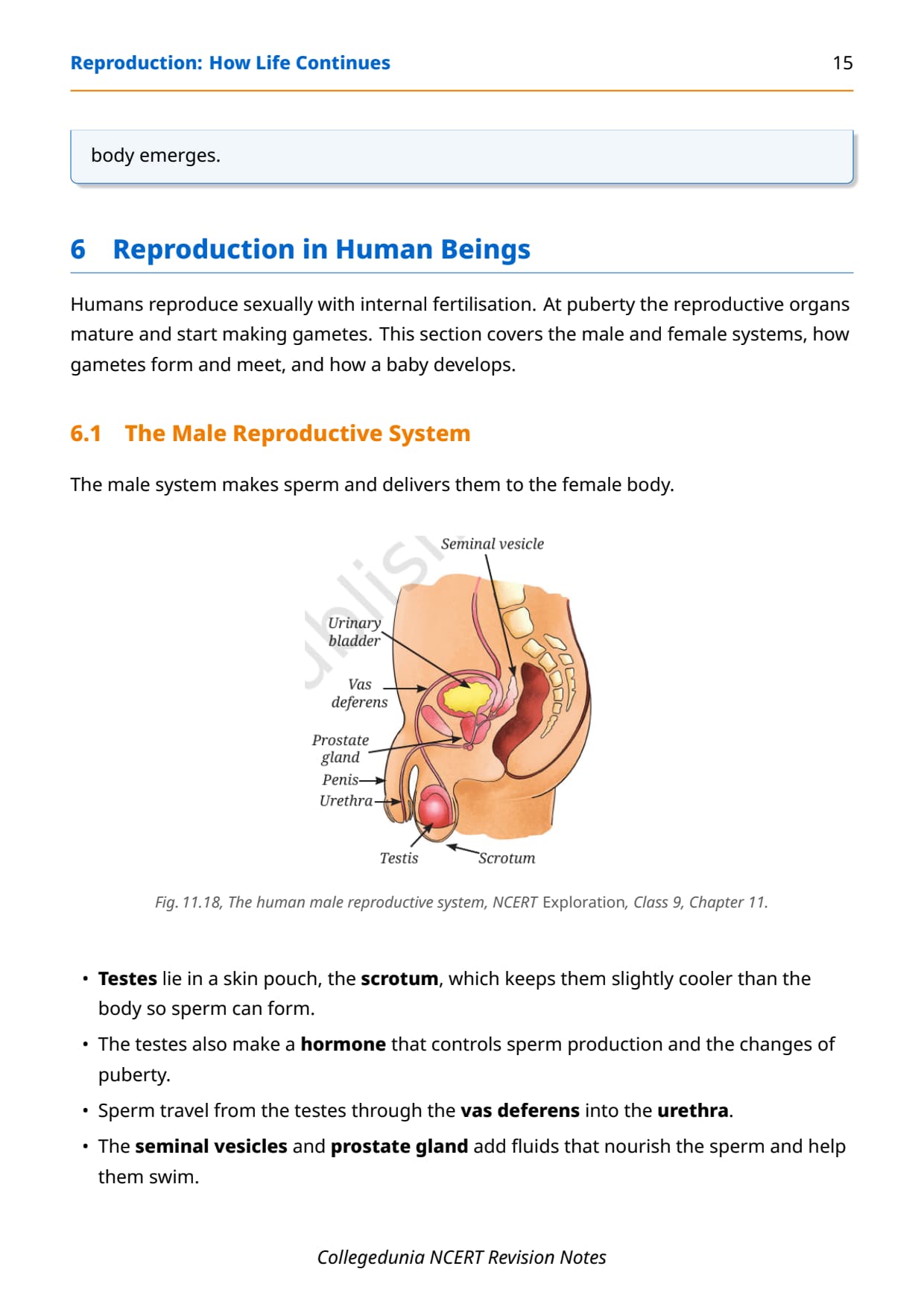
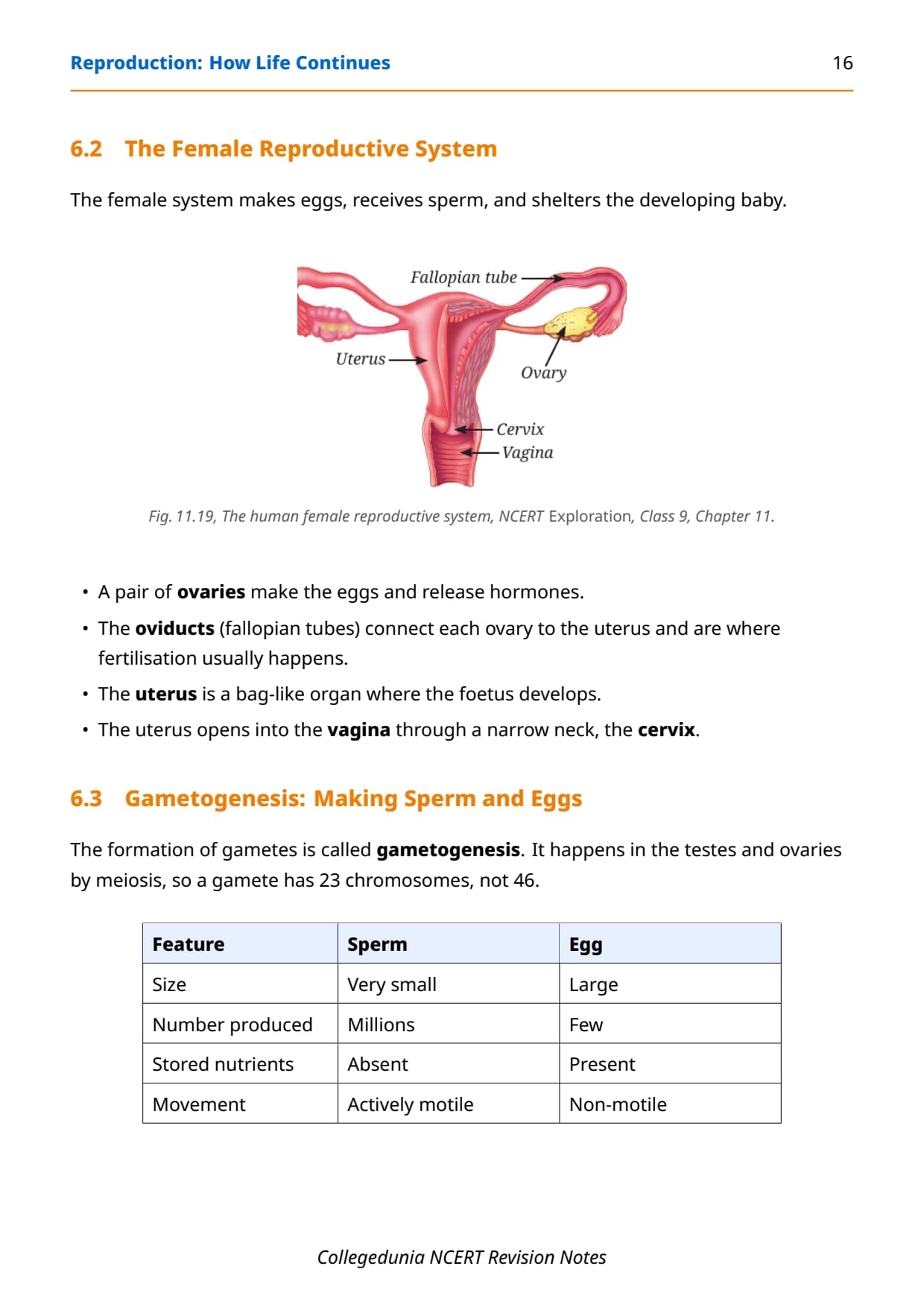
Humans reproduce sexually with internal fertilisation. At puberty the reproductive organs mature and start making gametes. The male system makes sperm and delivers them, while the female system makes eggs and shelters the developing baby.
| Organ | System | Role |
|---|---|---|
| Testes (in the scrotum) | Male | Make sperm and a hormone; the scrotum keeps them slightly cool |
| Vas deferens and urethra | Male | Carry sperm out of the body |
| Ovaries | Female | Make eggs and release hormones |
| Oviducts (fallopian tubes) | Female | Carry the egg; usual site of fertilisation |
| Uterus | Female | Bag-like organ where the foetus develops |
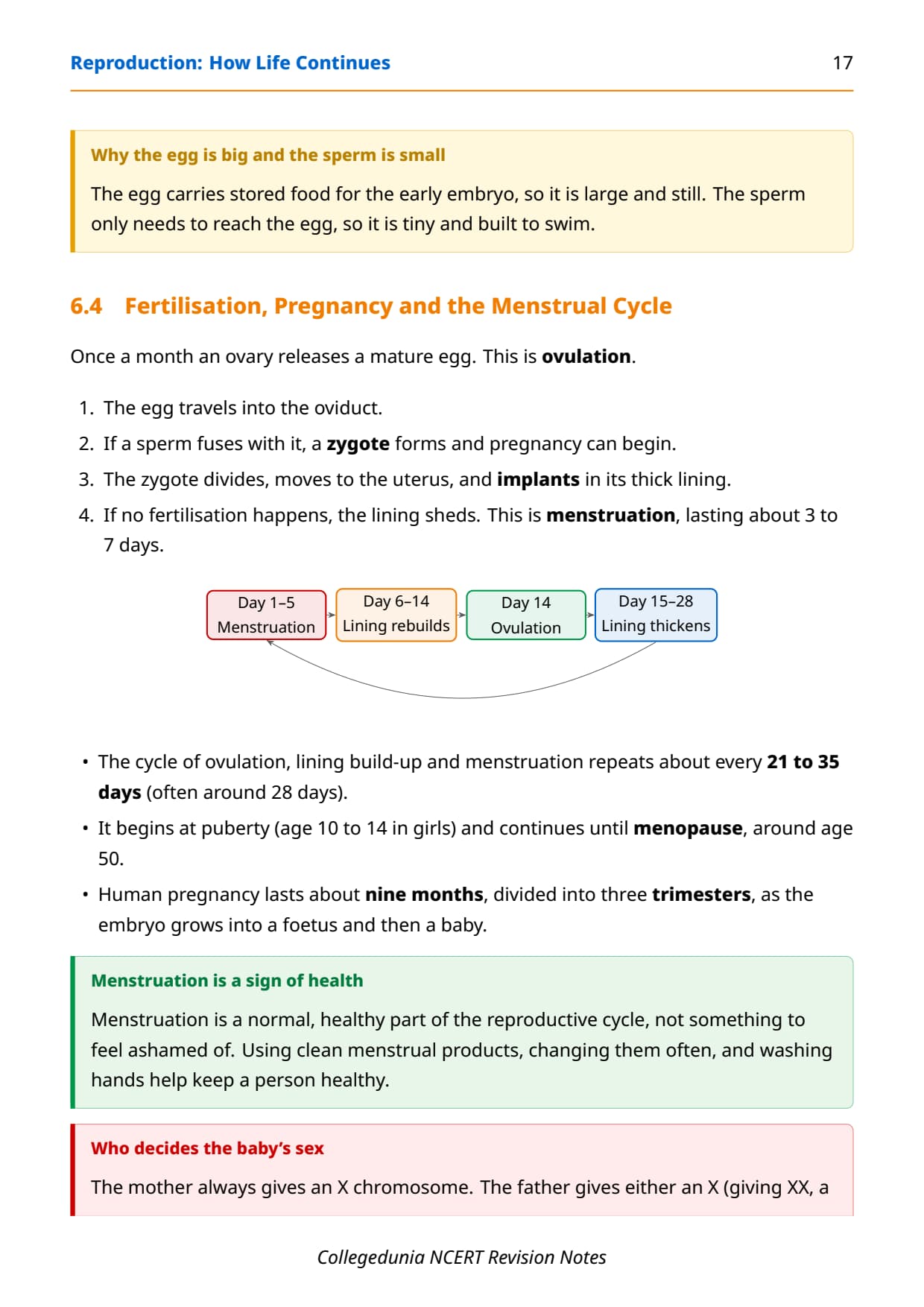
Once a month an ovary releases a mature egg, which is called ovulation. If a sperm fuses with the egg, a zygote forms, moves to the uterus and implants in its thick lining. If no fertilisation happens, the lining sheds as menstruation, lasting about 3 to 7 days. The full cycle repeats about every 28 days, from puberty until menopause around age 50. A human pregnancy lasts about nine months, split into three trimesters.
Tip: the mother always gives an X chromosome. The father gives either an X (XX, a girl) or a Y (XY, a boy), so the father's gamete decides the baby's biological sex.
Student Feedback on Reproduction How Life Continues Class 9 Notes
What 11,470 students told us about their reproduction how life continues revision before the 2026 boards.
- 68% of students said the asexual-methods table was the fastest part of the chapter to revise from these notes.
- 61% of students found the chromosome maths of meiosis (46 to 23 and back) the easiest to slip on under exam pressure.
- Most-skipped topic in revision: the difference between pollination and fertilisation, left for last by about 33% of students.
Source: 2026-27 Class 9 Science student poll. Sample of 11,470 students from CBSE schools across 14 states.
Common Mistakes Students Make in the Reproduction How Life Continues Chapter
A few slips lose easy marks in this chapter every year.
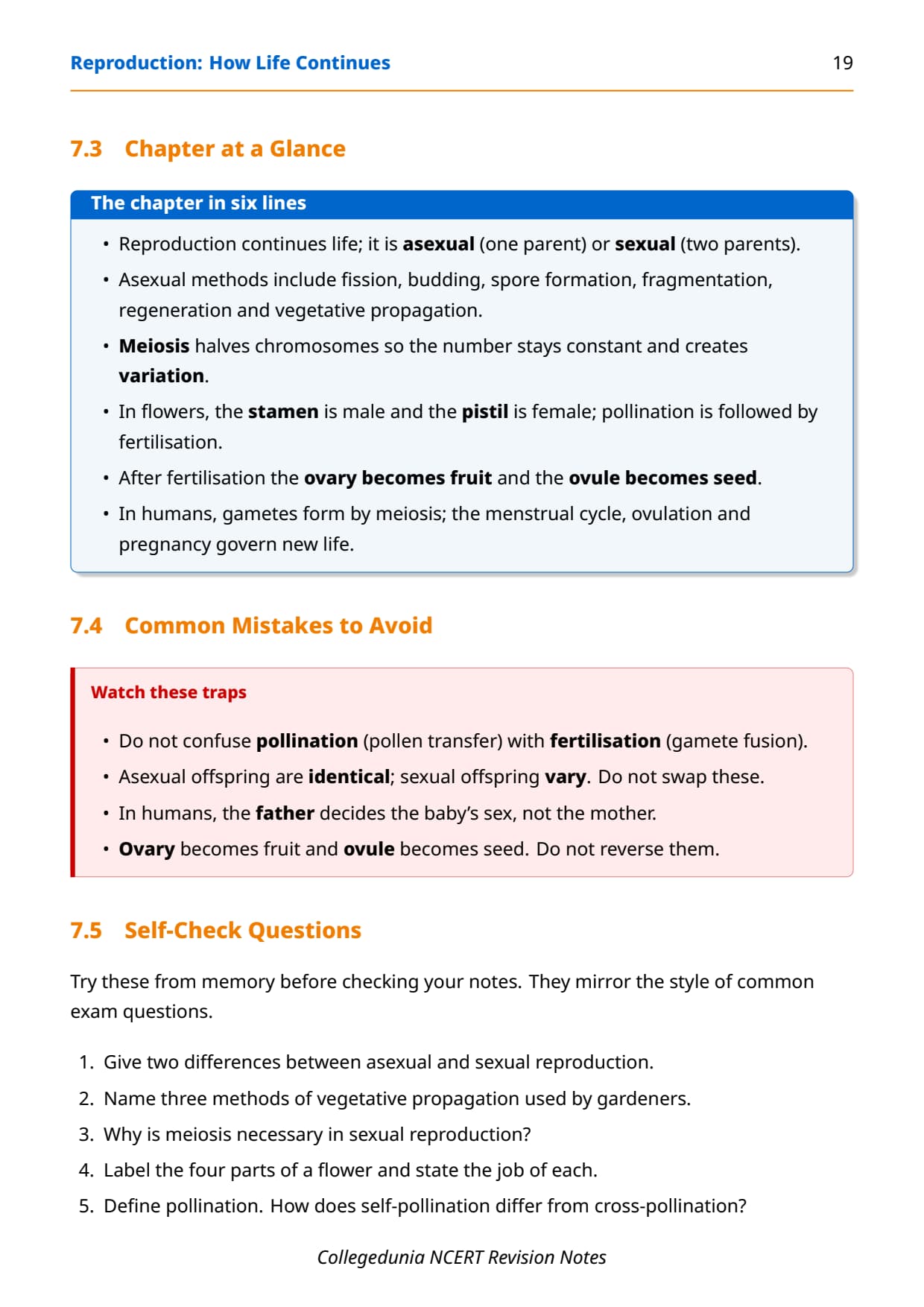
- Confusing pollination (transfer of pollen) with fertilisation (fusion of gametes). Pollination comes first.
- Thinking regeneration is normal reproduction. It only regrows lost parts; complex animals cannot make a new body from a piece.
- Forgetting that meiosis halves the chromosome number, so gametes are haploid (23), not diploid (46).
- Saying the mother decides the baby's sex. The father's gamete (X or Y) decides it.
How to Use the Reproduction How Life Continues Class 9 Notes
Use these notes in three simple blocks. First read for meaning, then learn the tables, then test yourself with a blank diagram.
- Read the chapter once and match each asexual method to one clear example.
- Learn the key tables: asexual versus sexual, the flower parts, and external versus internal fertilisation.
- Test yourself by labelling a blank flower and writing the 46 to 23 to 46 chromosome line from memory.
Draw and label a flower at least once before the exam. Flower labelling, the pollination-versus-fertilisation difference, and the asexual-methods table are asked almost every year.
How These Class 9 Science Chapter 11 Notes Pair with the Solutions and NCERT Book
These notes work best next to the other Class 9 Science resources for this chapter. Read the notes first, then solve, then read the original text for depth.
- Use the NCERT Solutions to attempt all the Revise, Reflect, Refine questions after you finish these notes.
- Use the Handwritten Notes for a quick one-shot recap on the night before a test.
- Use the NCERT Book PDF to read the full chapter text and study the original diagrams.
Reproduction How Life Continues Class 9 Other Resources for this Chapter
Pair these notes with the other Class 9 Science resources for this chapter, all linked below.
| Resource | Best used for |
|---|---|
| Reproduction How Life Continues Class 9 NCERT Solutions | Solving all the chapter questions step by step |
| Reproduction How Life Continues Class 9 Handwritten Notes | Last-minute one-shot revision |
| Reproduction How Life Continues Class 9 NCERT Book PDF | Reading the original chapter text |
All Chapters NCERT Notes for Class 9 Science
Browse the full set of ncert notes for class 9 science chapter by chapter.
| Chapter | NCERT Notes |
|---|---|
| Chapter 2 | Cell the Building Block of Life Class 9 Notes |
| Chapter 3 | Tissues in Action Class 9 Notes |
| Chapter 4 | Describing Motion Around Us Class 9 Notes |
| Chapter 5 | Exploring Mixtures and their Separation Class 9 Notes |
| Chapter 6 | How Forces Affect Motion Class 9 Notes |
| Chapter 7 | Work, Energy, and Simple Machines Class 9 Notes |
| Chapter 8 | Journey Inside the Atom Class 9 Notes |
| Chapter 9 | Atomic Foundations of Matter Class 9 Notes |
| Chapter 10 | Sound Waves Characteristics and Applications Class 9 Notes |
| Chapter 11 | Reproduction How Life Continues Class 9 Notes |
| Chapter 12 | Patterns in Life Diversity and Classification Class 9 Notes |
| Chapter 13 | Earth as a System Energy, Matter, and Life Class 9 Notes |
Reproduction How Life Continues Class 9 Notes FAQs
Ques. Where can I download the NCERT Notes Class 9 Science Chapter 11 Reproduction How Life Continues PDF?
Ans. You can download the class 9 science chapter 11 notes PDF directly from this page. Both the Normal and HD versions are free, and every topic is written in plain English for the 2026-27 session.
Ques. What topics do the reproduction how life continues class 9 notes cover?
Ans. The notes cover the two types of reproduction, asexual methods like fission, budding, spore formation and vegetative propagation, sexual reproduction and meiosis, the flower and pollination, and reproduction in animals and human beings.
Ques. Are these ncert notes for class 9 science chapter 11 aligned with the 2026-27 syllabus?
Ans. Yes. These notes follow the new 2026-27 NCERT book Exploration, where Reproduction How Life Continues is Chapter 11. Every table and diagram is checked against that latest edition.
Ques. What is the difference between asexual and sexual reproduction?
Ans. Asexual reproduction needs one parent and gives identical clones through mitosis. Sexual reproduction needs two parents, uses meiosis and fertilisation, and gives offspring that differ from the parents and from each other.
Ques. Why is meiosis important in sexual reproduction?
Ans. Meiosis halves the chromosome number, so each gamete carries 23 chromosomes instead of 46. When a sperm and an egg fuse, the zygote gets 46 again, so the number stays constant across generations. Meiosis also creates variation.
Ques. What is the difference between pollination and fertilisation?
Ans. Pollination is the transfer of pollen from the anther to the stigma. Fertilisation is the fusion of the male gamete with the egg to form a zygote. Pollination happens first, and fertilisation follows through the pollen tube.
Ques. What does the ovary and the ovule become after fertilisation?
Ans. After fertilisation the ovary grows into the fruit and each ovule becomes a seed. When conditions are right, the seed germinates into a new plant, which is how flowering plants continue their kind.



Comments