




The NCERT notes for Class 9 Science Chapter 12 Patterns in Life Diversity and Classification gather every kingdom, group and naming rule that the exam actually tests. This is the biodiversity chapter in the new 2026-27 Exploration book. These notes explain biodiversity, the five kingdom system, plant and animal groups, and binomial naming in plain English, with labelled tables you can revise in one sitting.
These class 9 science ncert notes chapter 12 Patterns in Life Diversity and Classification are written by Collegedunia subject experts, checked against the 2026-27 NCERT Exploration textbook, and refined using recent CBSE exam trends.
- Full concept cover: biodiversity, basis of classification, the five kingdoms, plant and animal groups, hierarchy and binomial nomenclature in one place.
- This chapter is a steady source of 1, 3 and 5 mark questions in the Class 9 Science paper, so it is worth learning well.
- Free PDF download in Normal and HD, with labelled diagrams and quick revision tables.

|
Table of Contents |
What Patterns in Life Diversity and Classification Class 9 Notes Cover
These notes show why the Earth's living things are grouped in an orderly way. You learn what biodiversity is, how the five kingdom system sorts organisms, and how plants and animals are split into smaller groups. The patterns in life diversity and classification class 9 chapter ends with the naming system and why protecting biodiversity matters.
- Biodiversity: the variety of life, endemic species, and why India is a biodiversity hotspot.
- Five kingdoms: Monera, Protista, Fungi, Plantae and Animalia, and the four features that separate them.
- Plant and animal groups: algae to flowering plants, and invertebrates versus vertebrates.
- Naming and hierarchy: the seven levels from Kingdom to Species, and two-word binomial names.
Patterns in Life Diversity and Classification Class 9 Full Chapter Explained
Source: Physics Wallah on YouTube
Biodiversity and Why We Need Classification in Class 9 Science Chapter 12
Biodiversity is the whole variety of living organisms on the Earth, from tiny bacteria to giant whales, along with the habitats they live in. Every organism has a role: ocean algae make most of our oxygen, fungi and bacteria recycle dead matter, and bees and birds pollinate flowers. Humans depend on this variety for food, medicine and shelter.
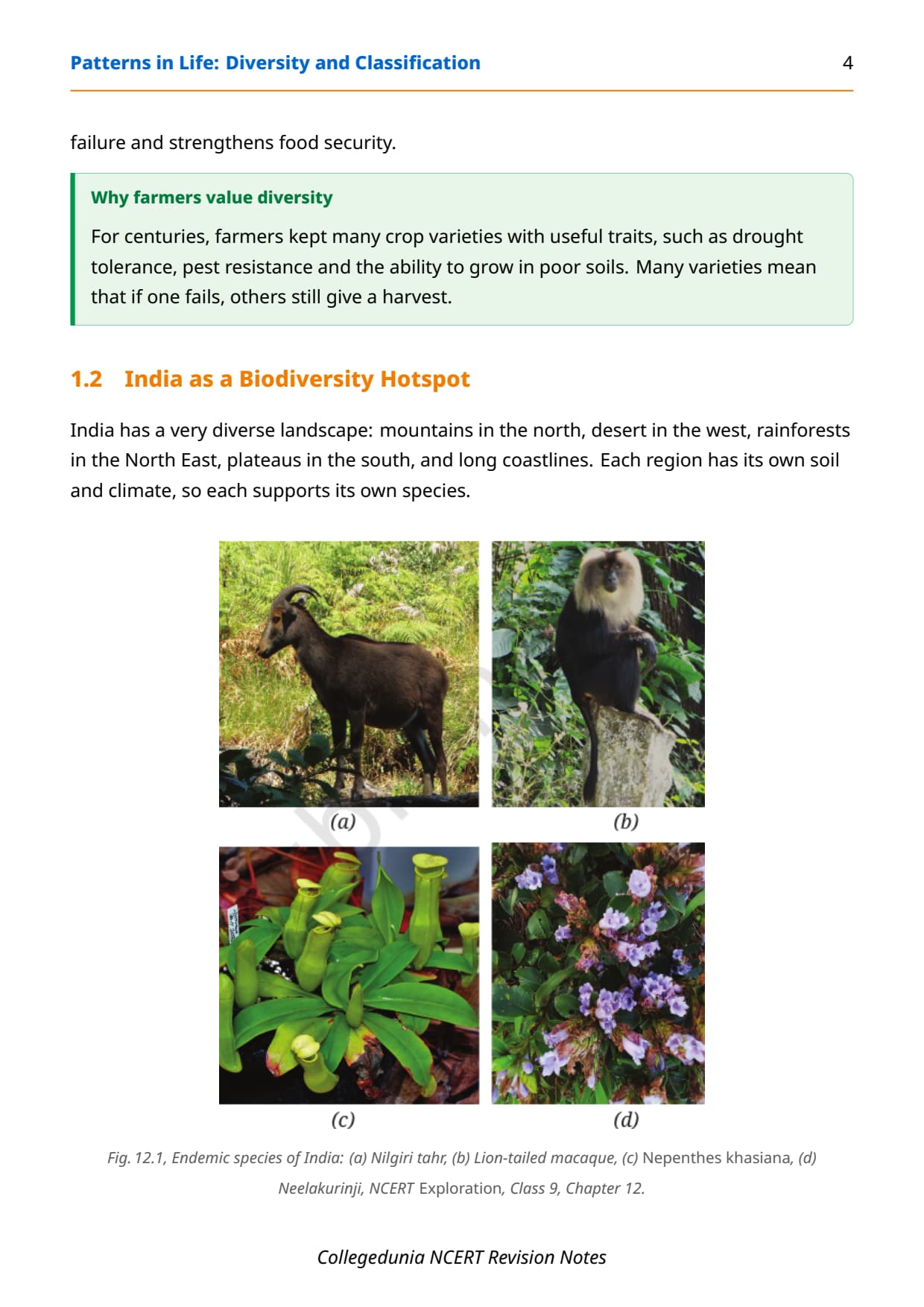
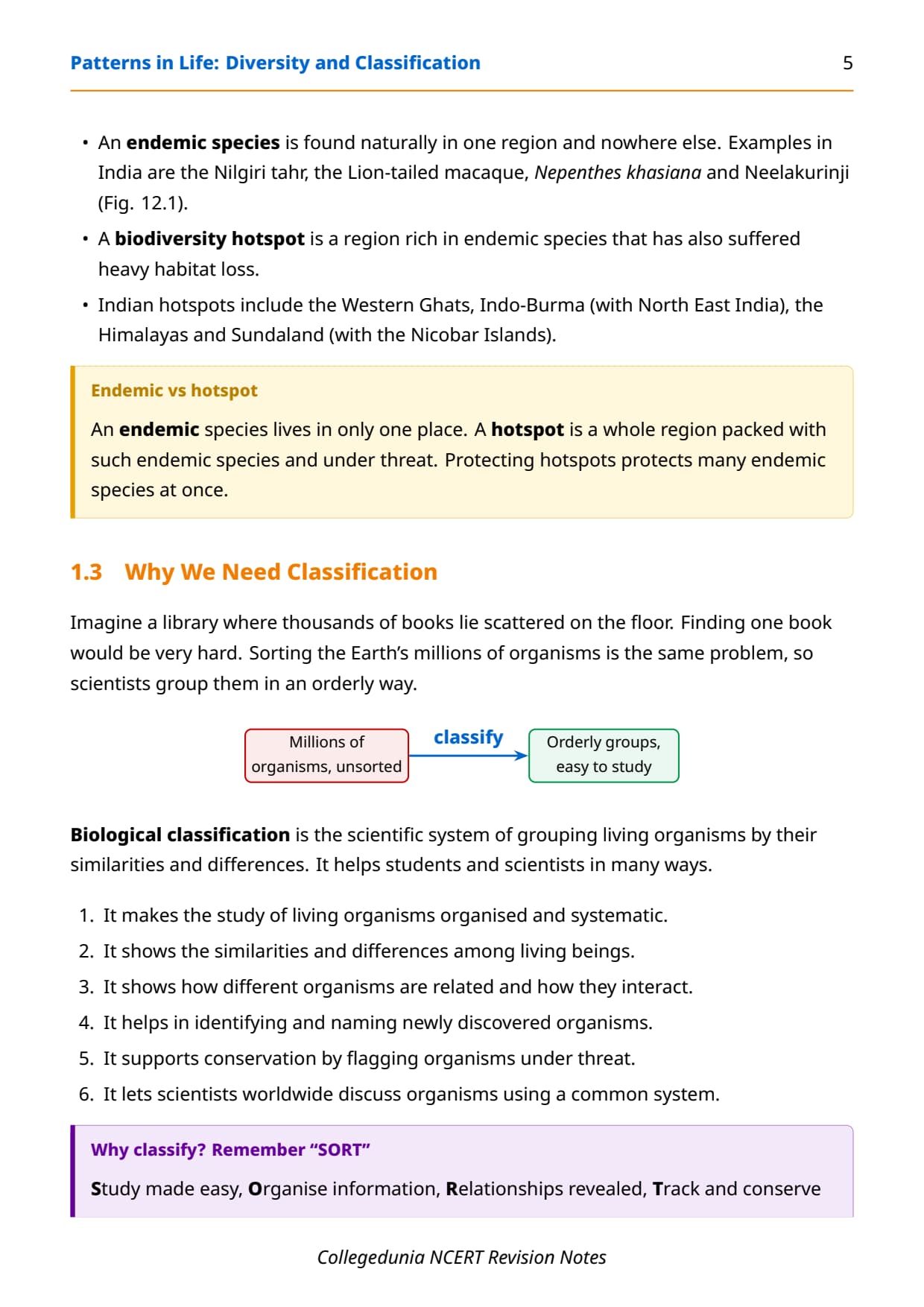
- An endemic species is found naturally in one region and nowhere else, such as the Nilgiri tahr or the Lion-tailed macaque of India.
- A biodiversity hotspot is a region rich in endemic species that has also lost much of its habitat. Indian hotspots include the Western Ghats and the Himalayas.
Sorting the Earth's millions of organisms is like tidying a library with books all over the floor. Biological classification is the scientific system of grouping organisms by their similarities and differences. It makes study organised, shows how organisms are related, helps name new species, and supports conservation.
Tip: use SORT to recall why we classify. Study made easy, Organise information, Relationships revealed, and Track and conserve species.
The Basis of Classification for Patterns in Life Diversity and Classification Class 9
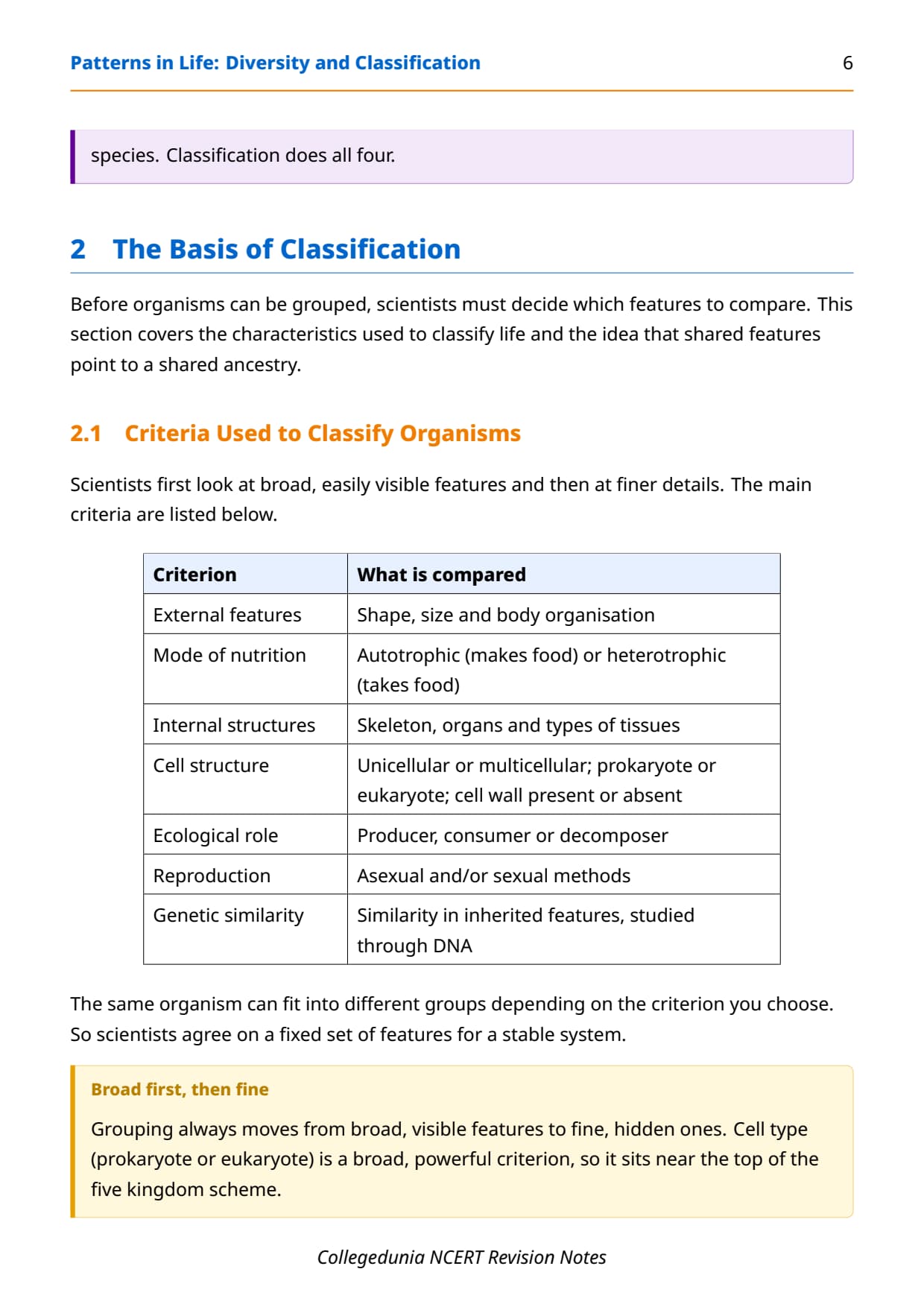
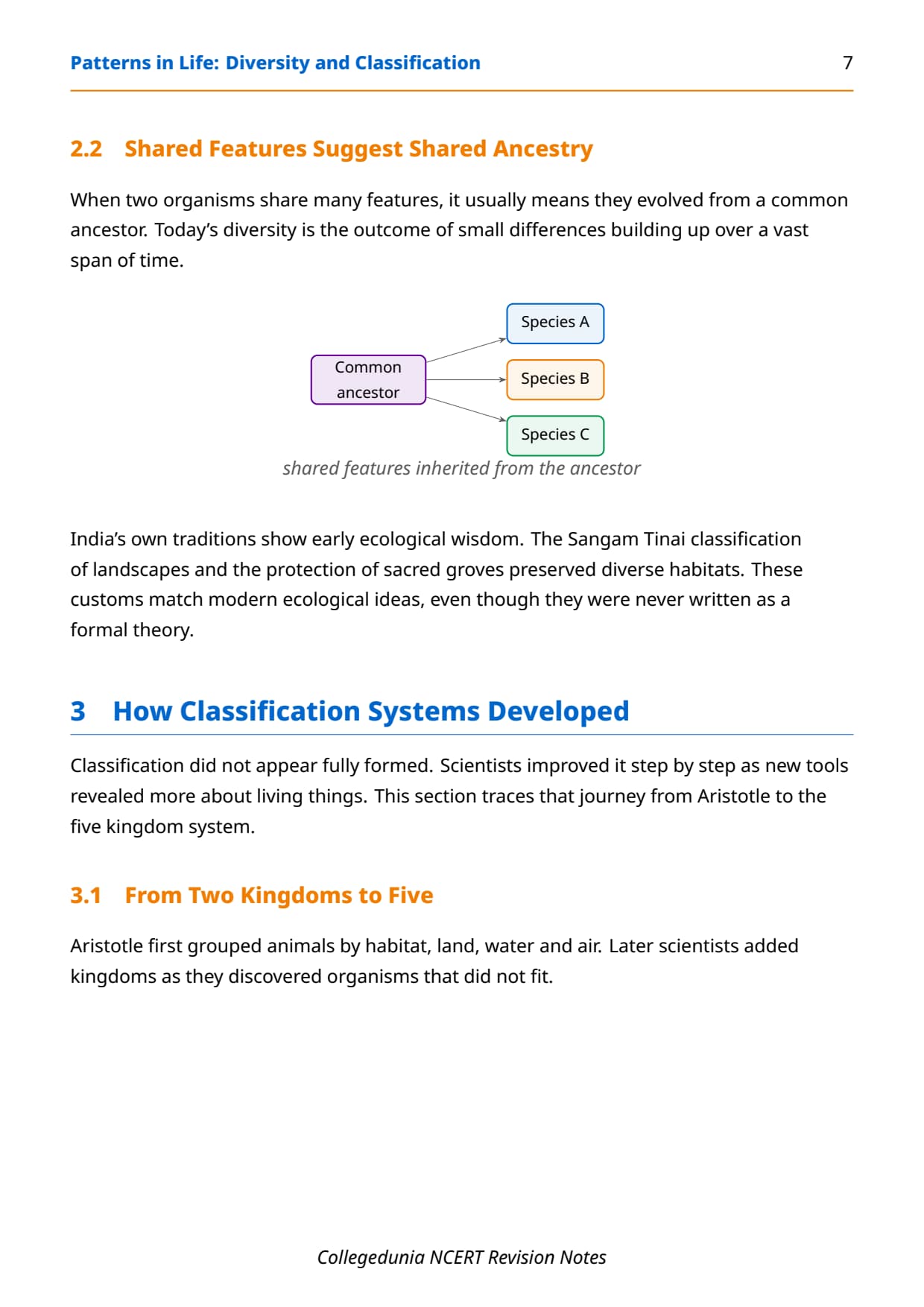
Before organisms can be grouped, scientists decide which features to compare. They look at broad, visible features first and then at finer, hidden ones. When two organisms share many features, it usually means they share a common ancestor.
| Criterion | What is compared |
|---|---|
| Cell structure | Unicellular or multicellular; prokaryote or eukaryote; cell wall present or absent |
| Mode of nutrition | Autotrophic (makes food) or heterotrophic (takes food) |
| External features | Shape, size and body organisation |
| Internal structures | Skeleton, organs and types of tissues |
| Reproduction | Asexual and/or sexual methods |
| Genetic similarity | Similarity in inherited features, studied through DNA |
Cell type, whether a cell is a prokaryote or a eukaryote, is a broad and powerful criterion, so it sits near the top of the five kingdom scheme. Grouping always moves from broad, visible features to fine, hidden ones.
The Five Kingdom Classification in Class 9 Science Chapter 12
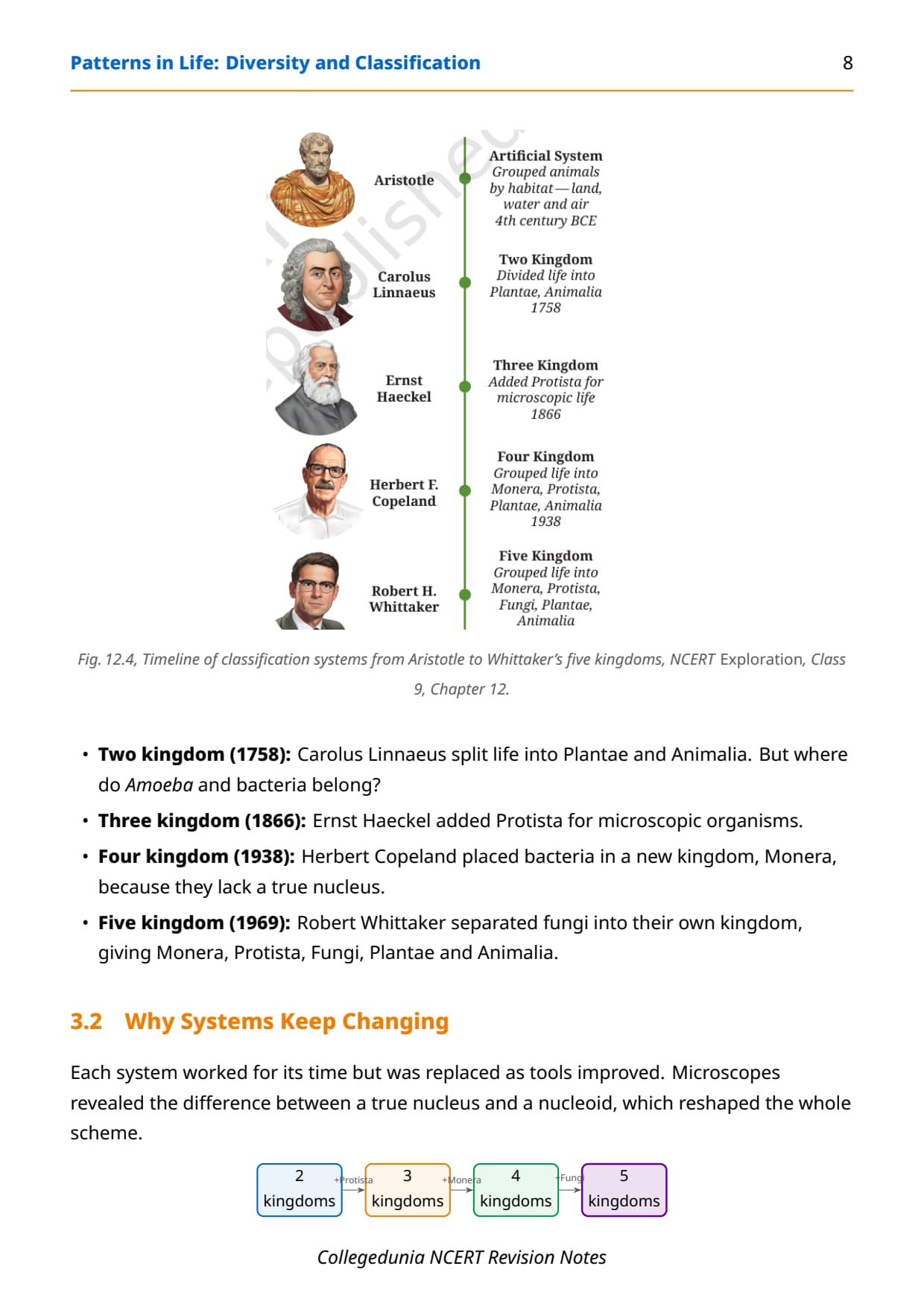
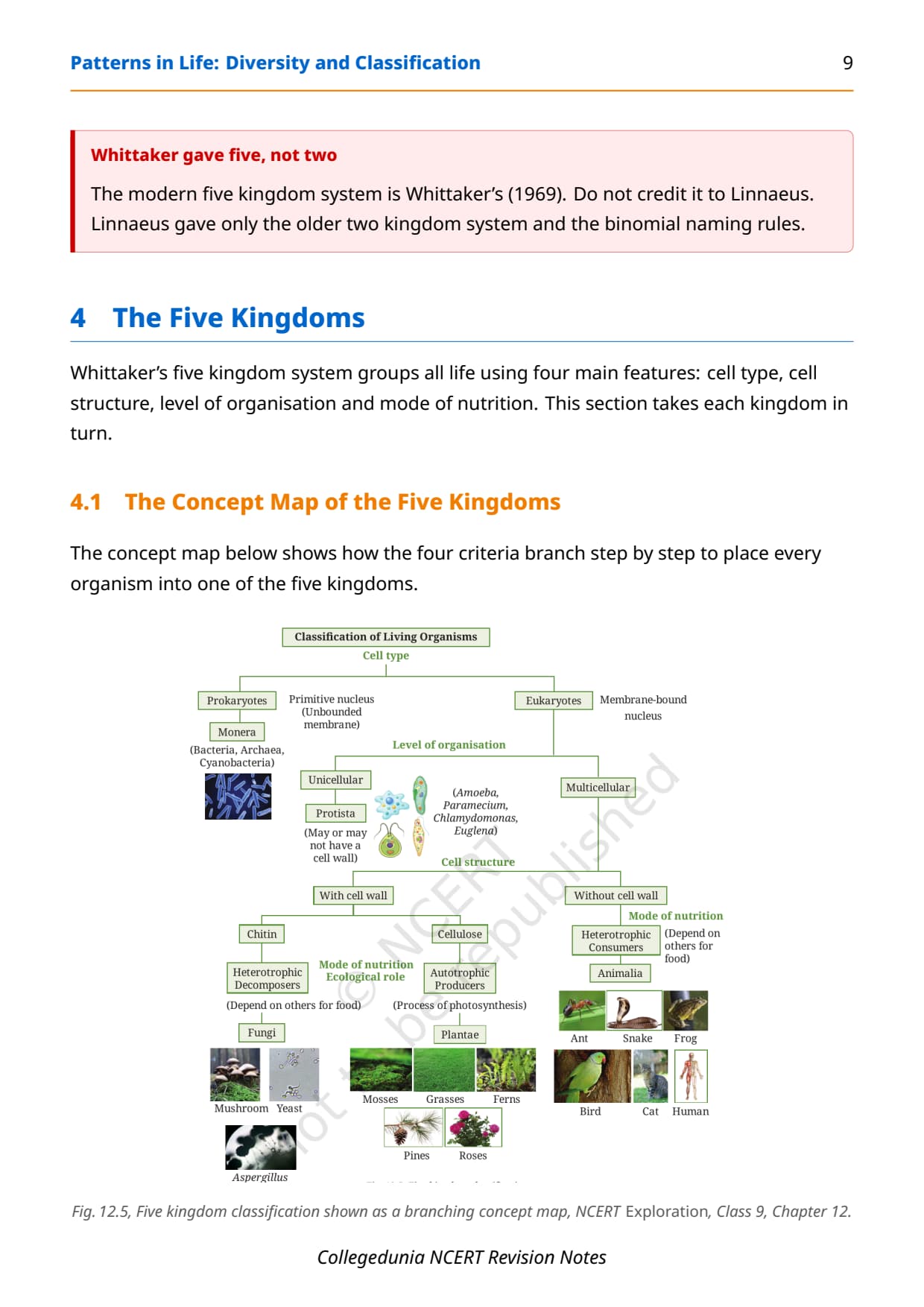
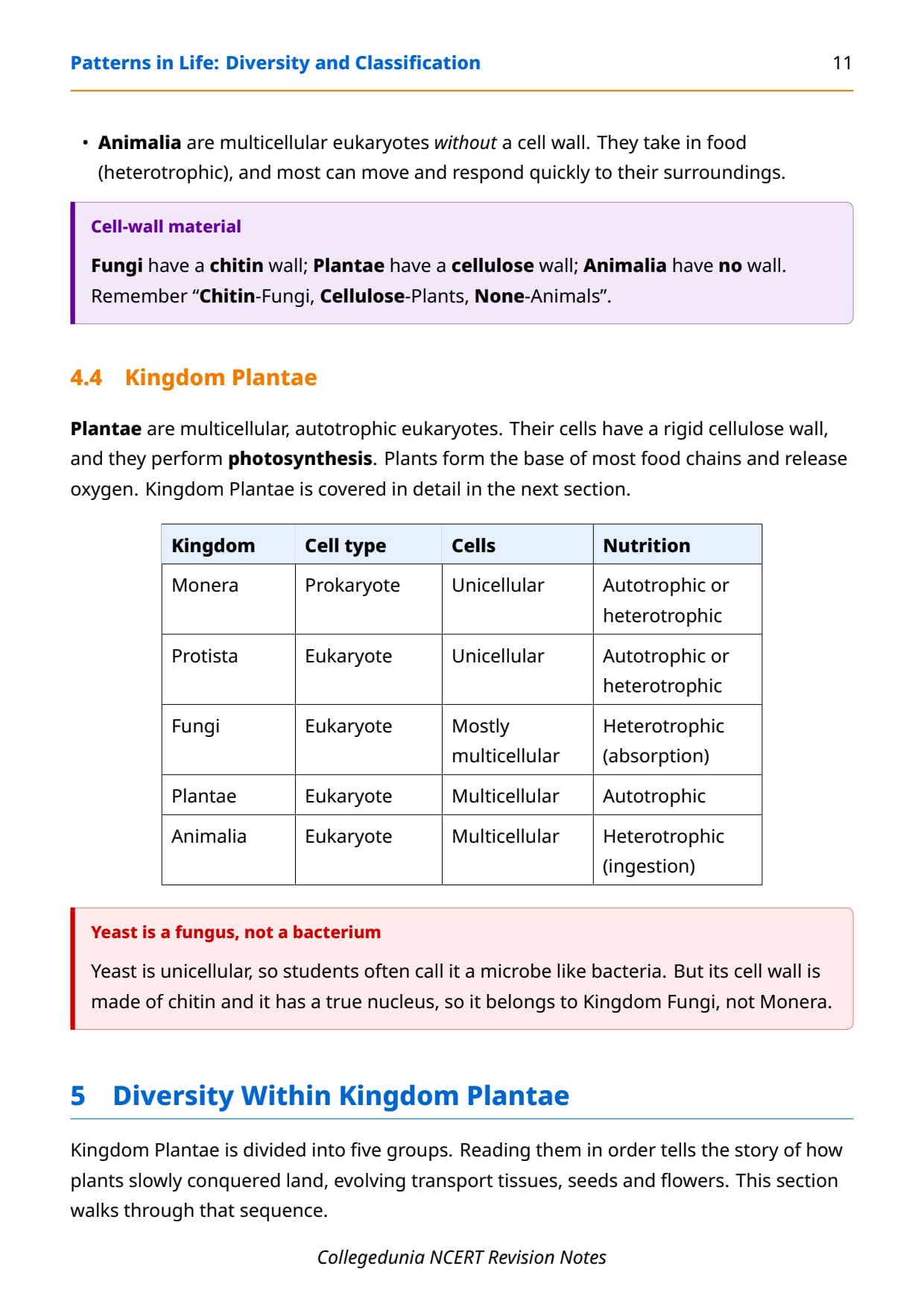
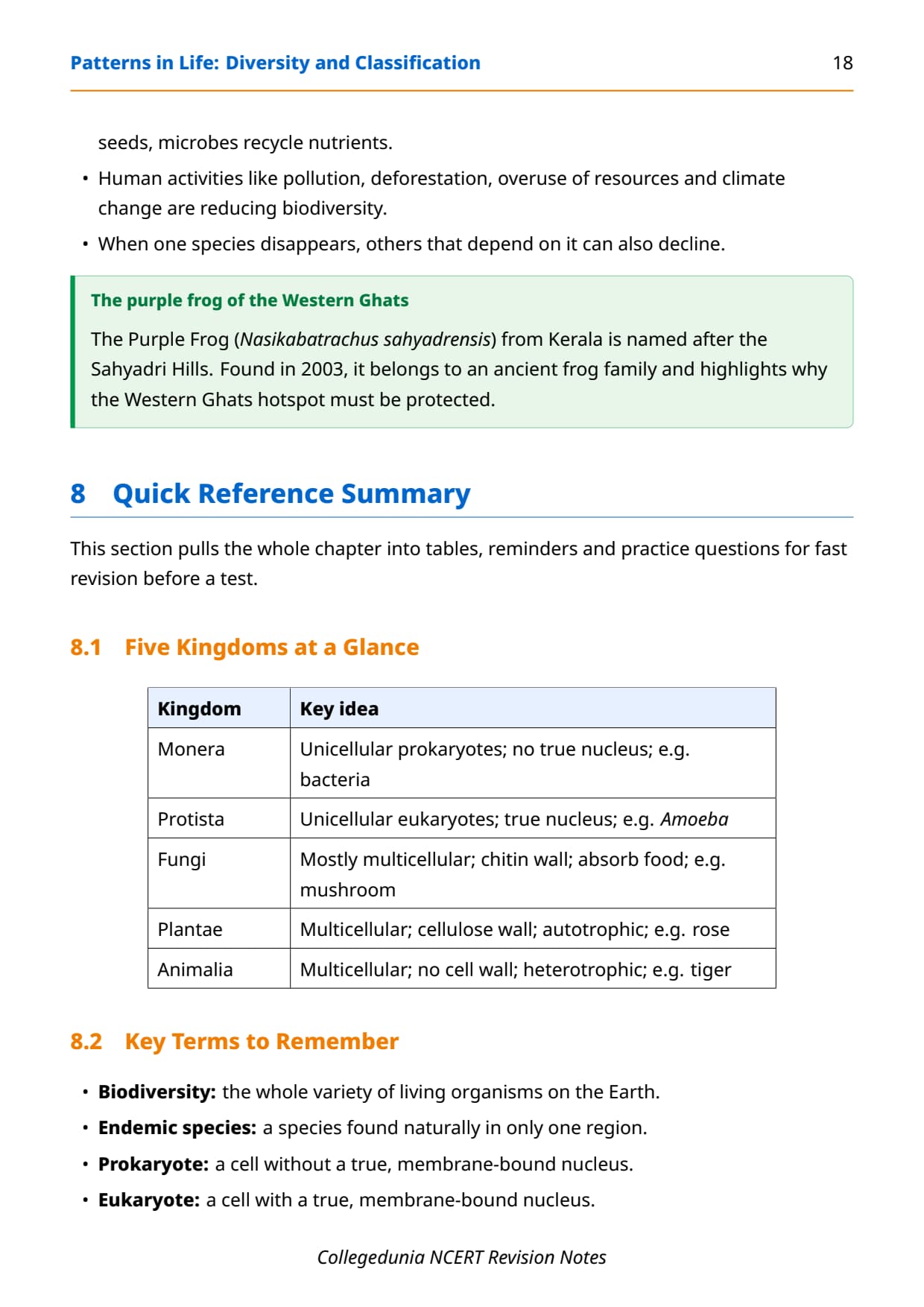
Robert Whittaker gave the five kingdom system in 1969. It groups all life using four features: cell type, level of organisation, cell structure and mode of nutrition. Earlier systems grew from two kingdoms (Linnaeus) to three, then four, then five, as better microscopes revealed the difference between a true nucleus and a nucleoid.

| Kingdom | Cell type | Cells | Nutrition |
|---|---|---|---|
| Monera | Prokaryote | Unicellular | Autotrophic or heterotrophic |
| Protista | Eukaryote | Unicellular | Autotrophic or heterotrophic |
| Fungi | Eukaryote | Mostly multicellular | Heterotrophic (absorption) |
| Plantae | Eukaryote | Multicellular | Autotrophic |
| Animalia | Eukaryote | Multicellular | Heterotrophic (ingestion) |
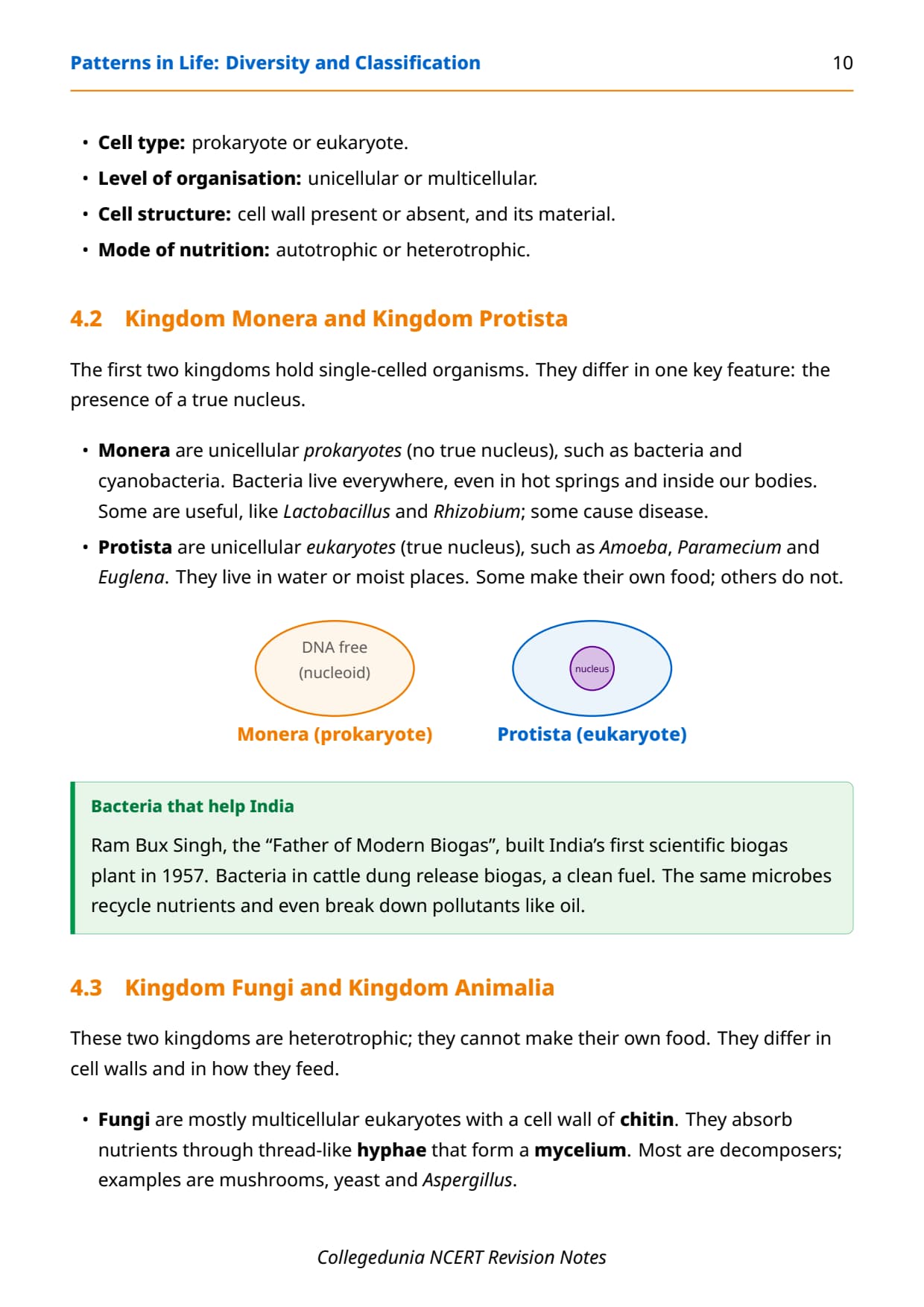
Monera (like bacteria) are prokaryotes with no true nucleus, while Protista (like Amoeba) are unicellular eukaryotes with a true nucleus. Fungi have a wall of chitin and absorb food, plants have a cellulose wall and make food, and animals have no cell wall and take in food.
Tip: for cell walls remember Chitin-Fungi, Cellulose-Plants, None-Animals. This one line answers a common exam question.
Diversity Within Kingdom Plantae for Class 9 Science Chapter 12
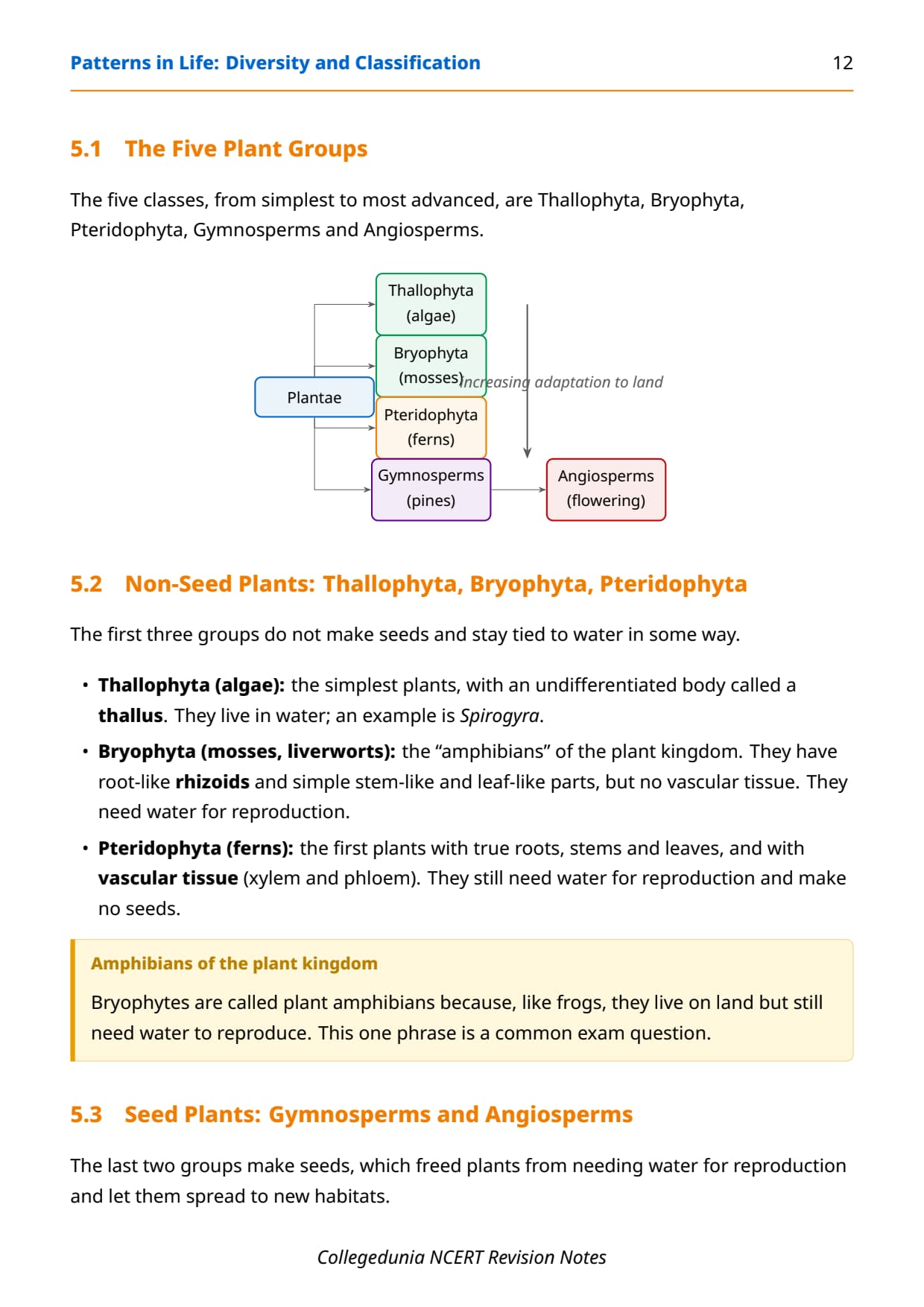
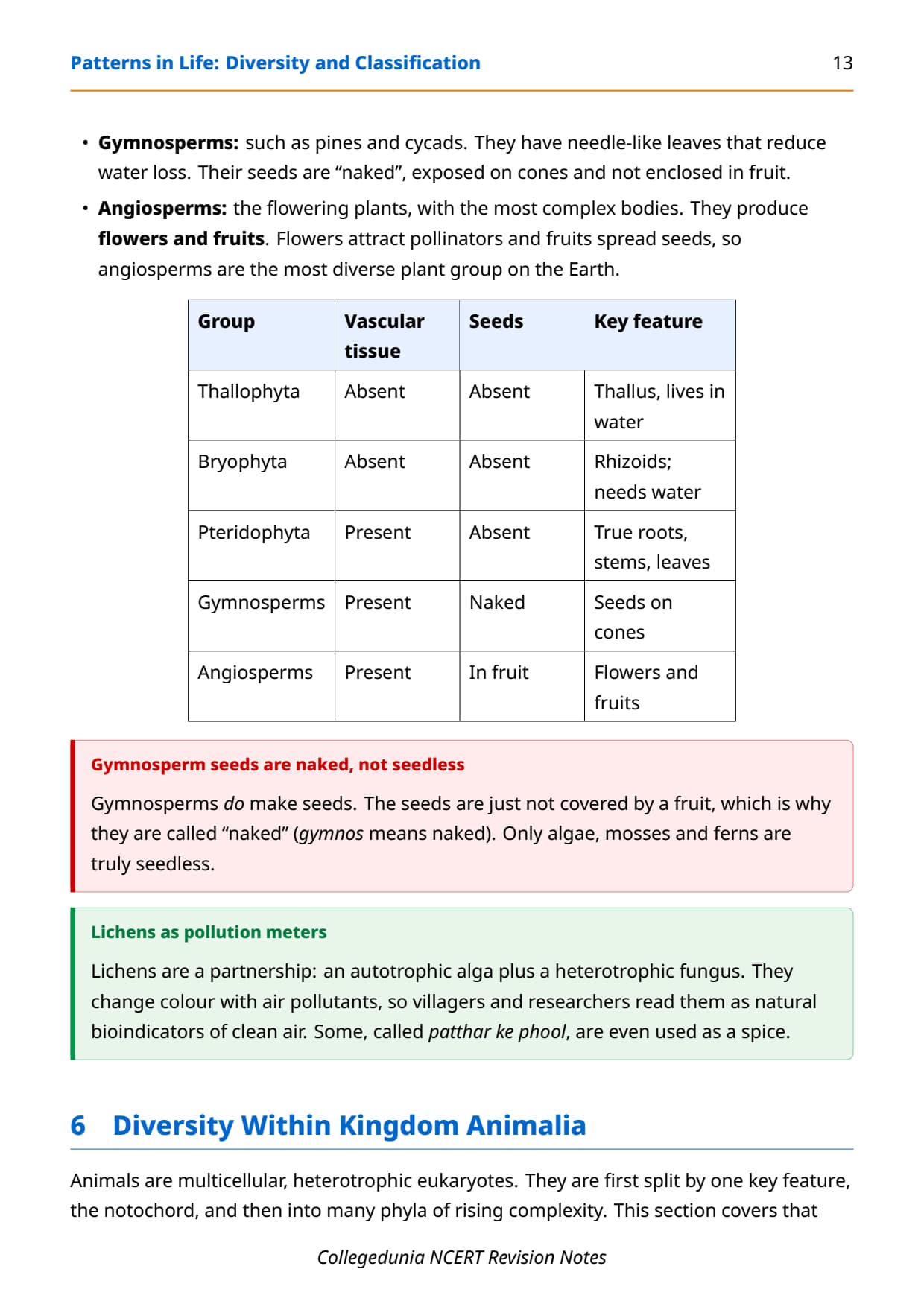
Kingdom Plantae is divided into five groups, read from simplest to most advanced: Thallophyta, Bryophyta, Pteridophyta, Gymnosperms and Angiosperms. Reading them in order tells the story of how plants slowly adapted to land, gaining transport tissue, then seeds, then flowers.
| Group | Vascular tissue | Seeds | Key feature |
|---|---|---|---|
| Thallophyta (algae) | Absent | Absent | Thallus body; lives in water |
| Bryophyta (mosses) | Absent | Absent | Rhizoids; needs water to reproduce |
| Pteridophyta (ferns) | Present | Absent | True roots, stems and leaves |
| Gymnosperms (pines) | Present | Naked | Seeds on cones, not in fruit |
| Angiosperms (flowering) | Present | In fruit | Flowers and fruits |
The first three groups make no seeds. Bryophytes are called the amphibians of the plant kingdom because, like frogs, they live on land but still need water to reproduce. The last two groups make seeds, which freed plants from needing water to reproduce.
Tip: gymnosperm seeds are naked, not absent. The word gymnos means naked, so the seeds simply sit on cones without a fruit around them. Only algae, mosses and ferns are truly seedless.
Diversity Within Kingdom Animalia for Patterns in Life Diversity and Classification Class 9
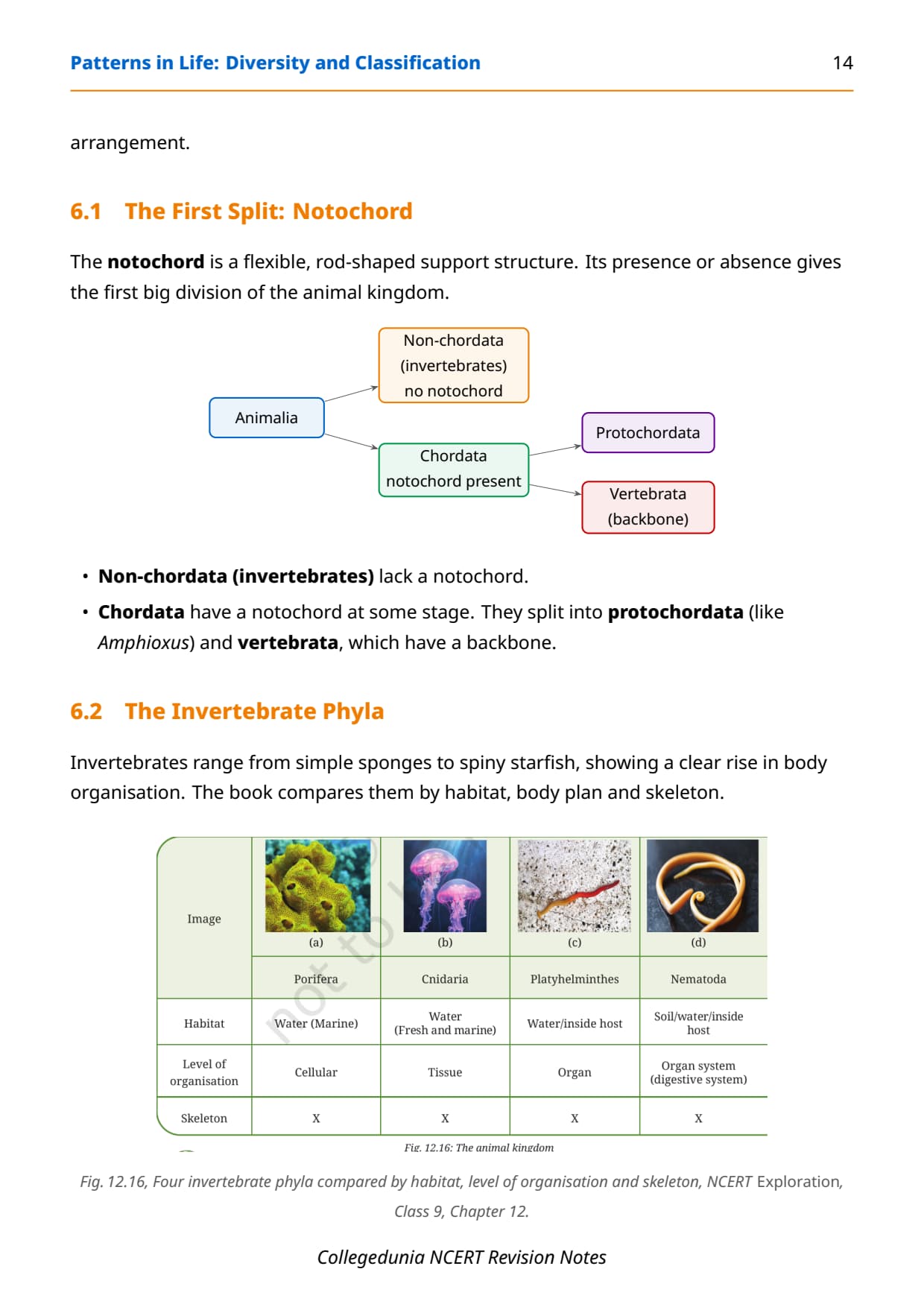
Animals are multicellular, heterotrophic eukaryotes with no cell wall. The animal kingdom is first split by one feature, the notochord, which is a flexible rod that supports the body. Animals without it are invertebrates (non-chordates); those with it are chordates, which include the vertebrates that have a backbone.

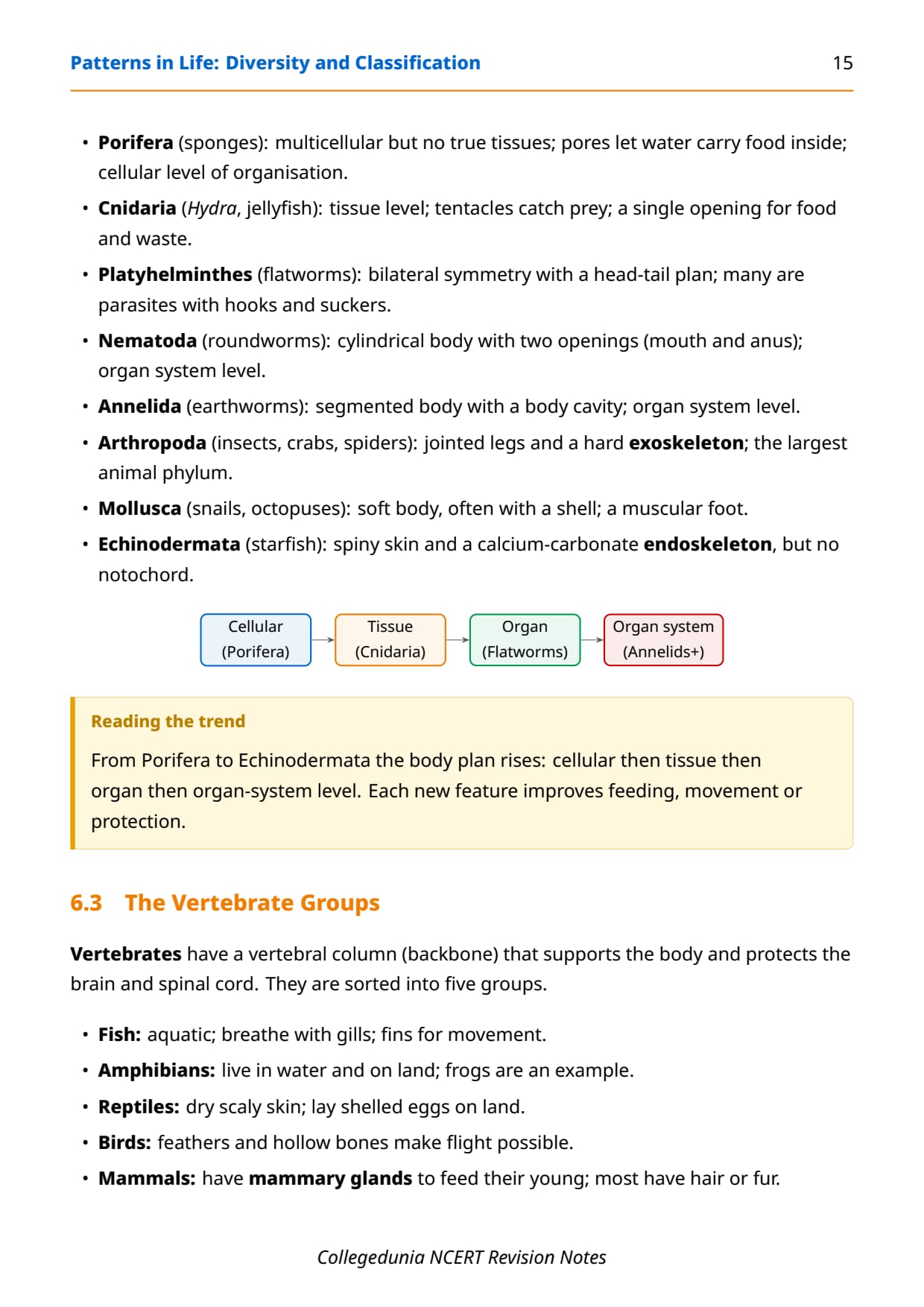
- Invertebrate phyla rise in complexity: Porifera (sponges), Cnidaria (Hydra), Platyhelminthes (flatworms), Nematoda (roundworms), Annelida (earthworms), Arthropoda (insects, the largest phylum), Mollusca (snails) and Echinodermata (starfish).
- Vertebrates are sorted into five groups: fish, amphibians, reptiles, birds and mammals. Mammals have mammary glands to feed their young.
Tip: remember the five vertebrate groups with FARBM, that is Fish, Amphibians, Reptiles, Birds, Mammals, in order from water to land to air.
Hierarchy and Binomial Nomenclature in Class 9 Science Chapter 12
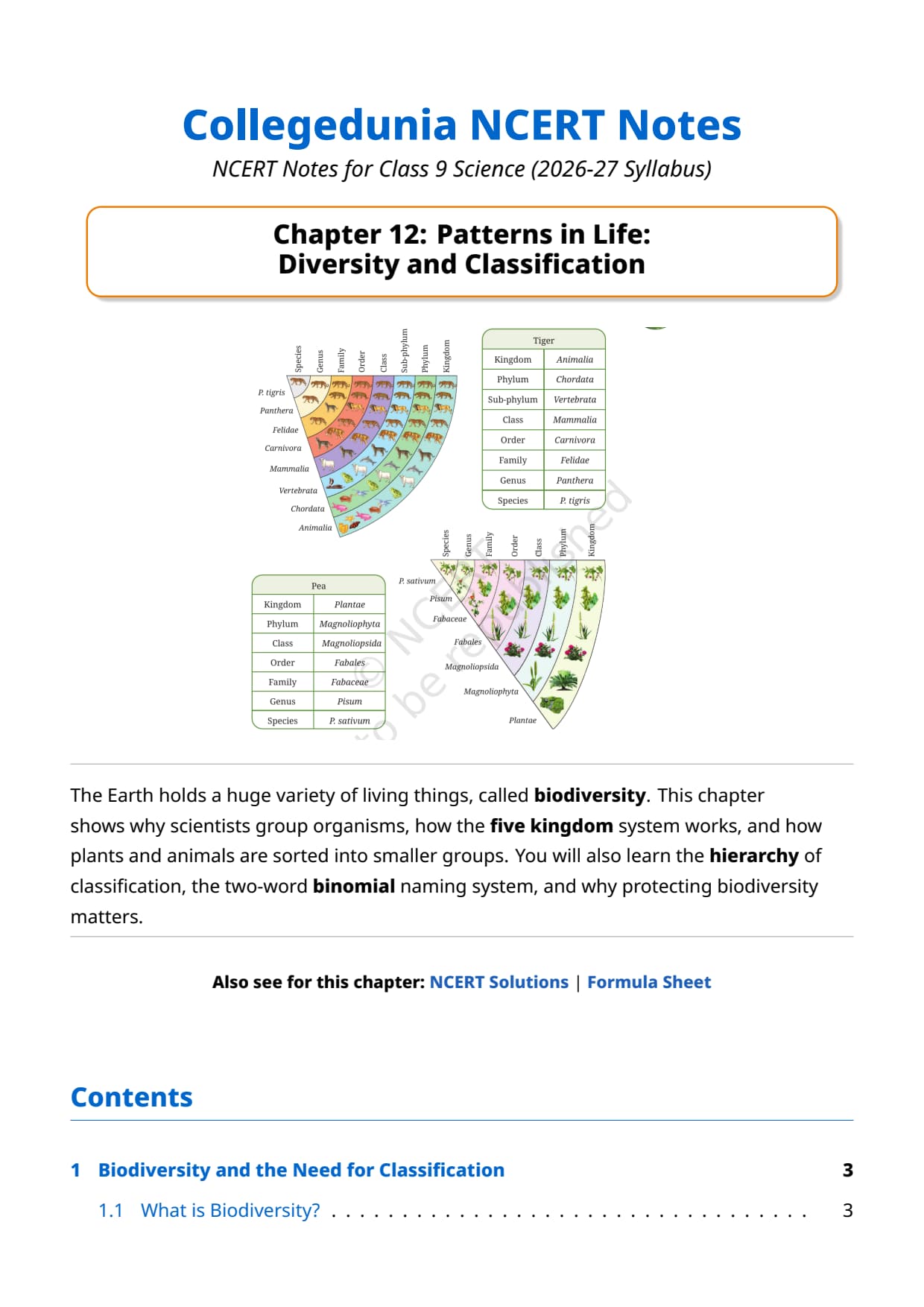
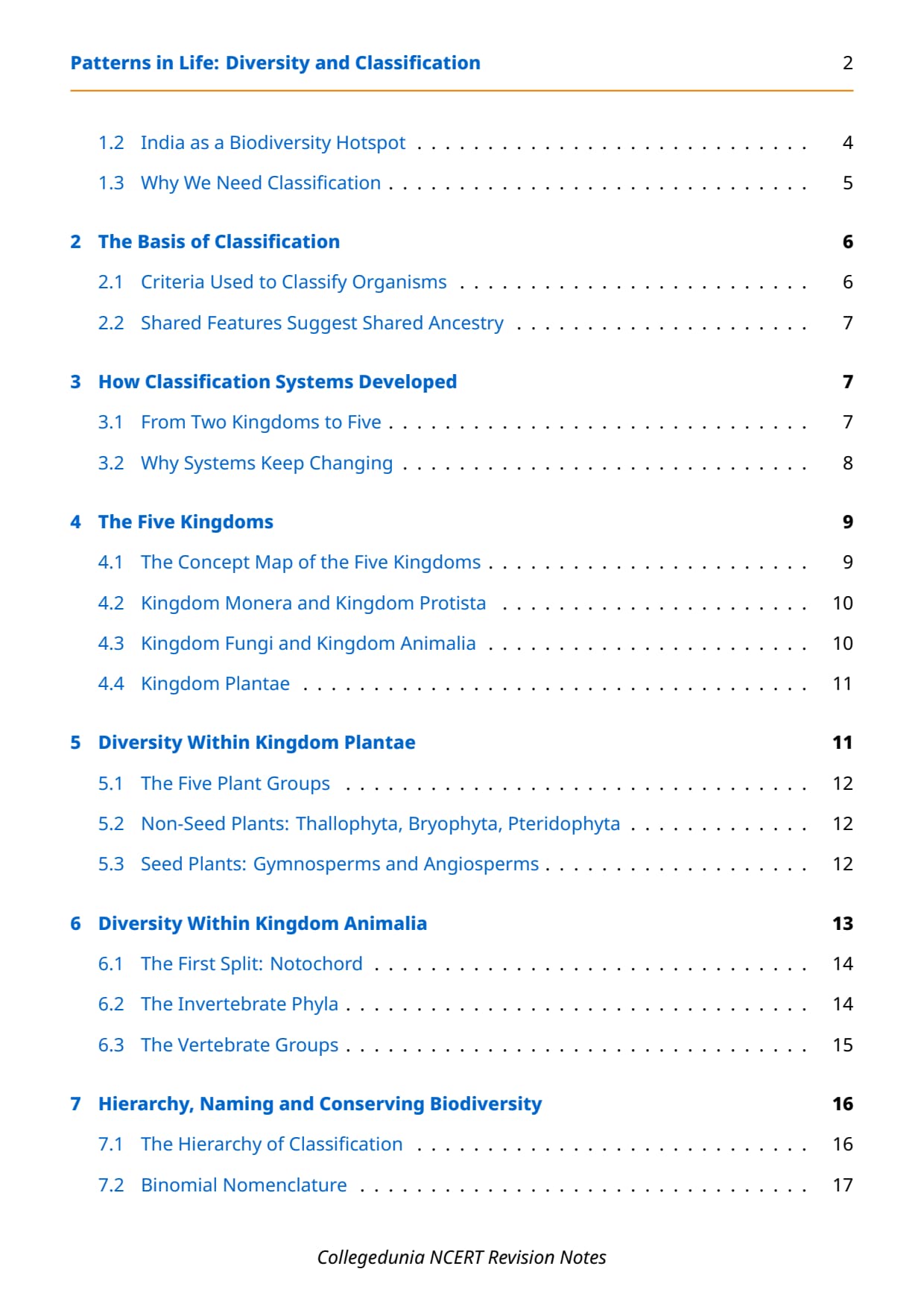
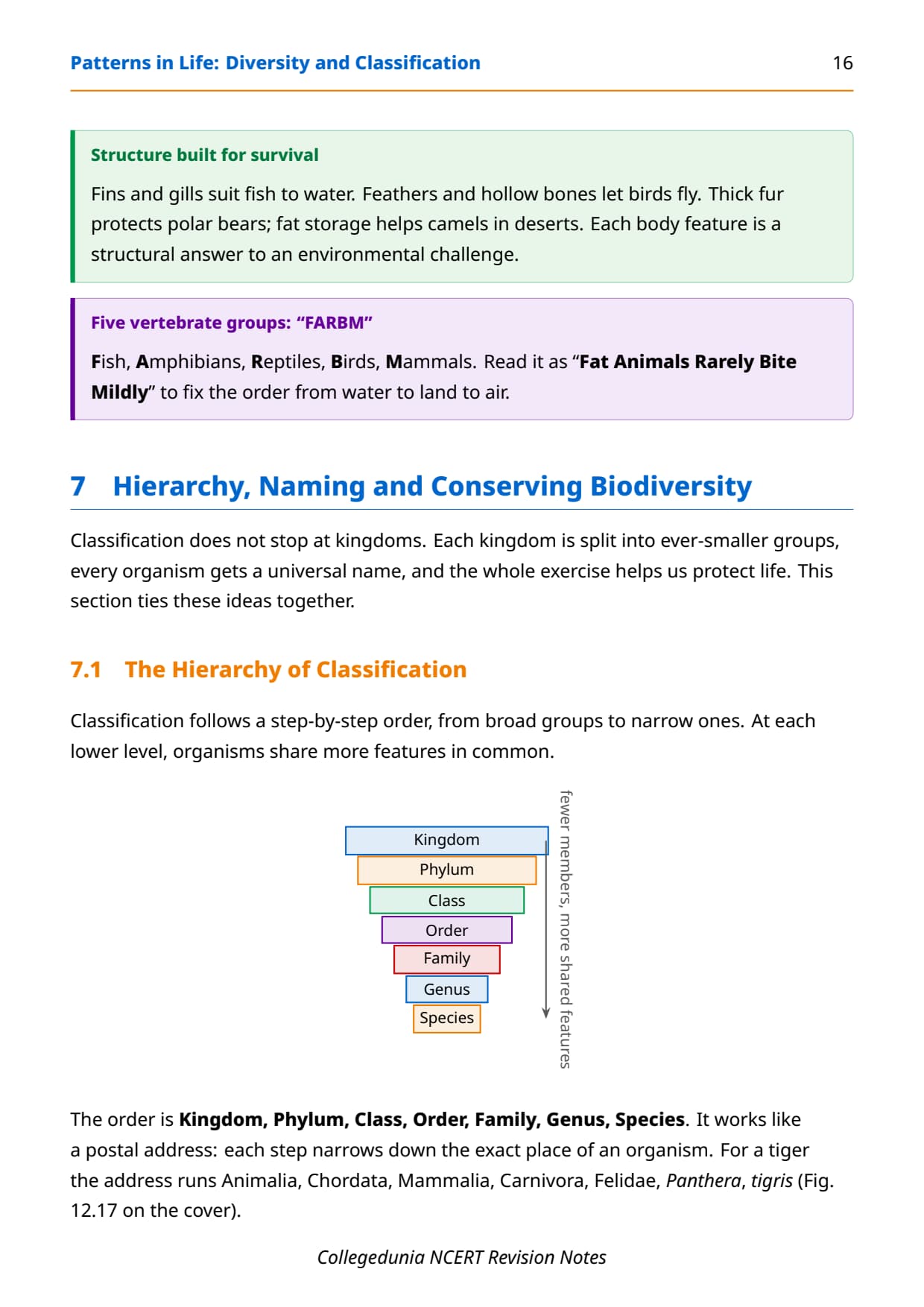
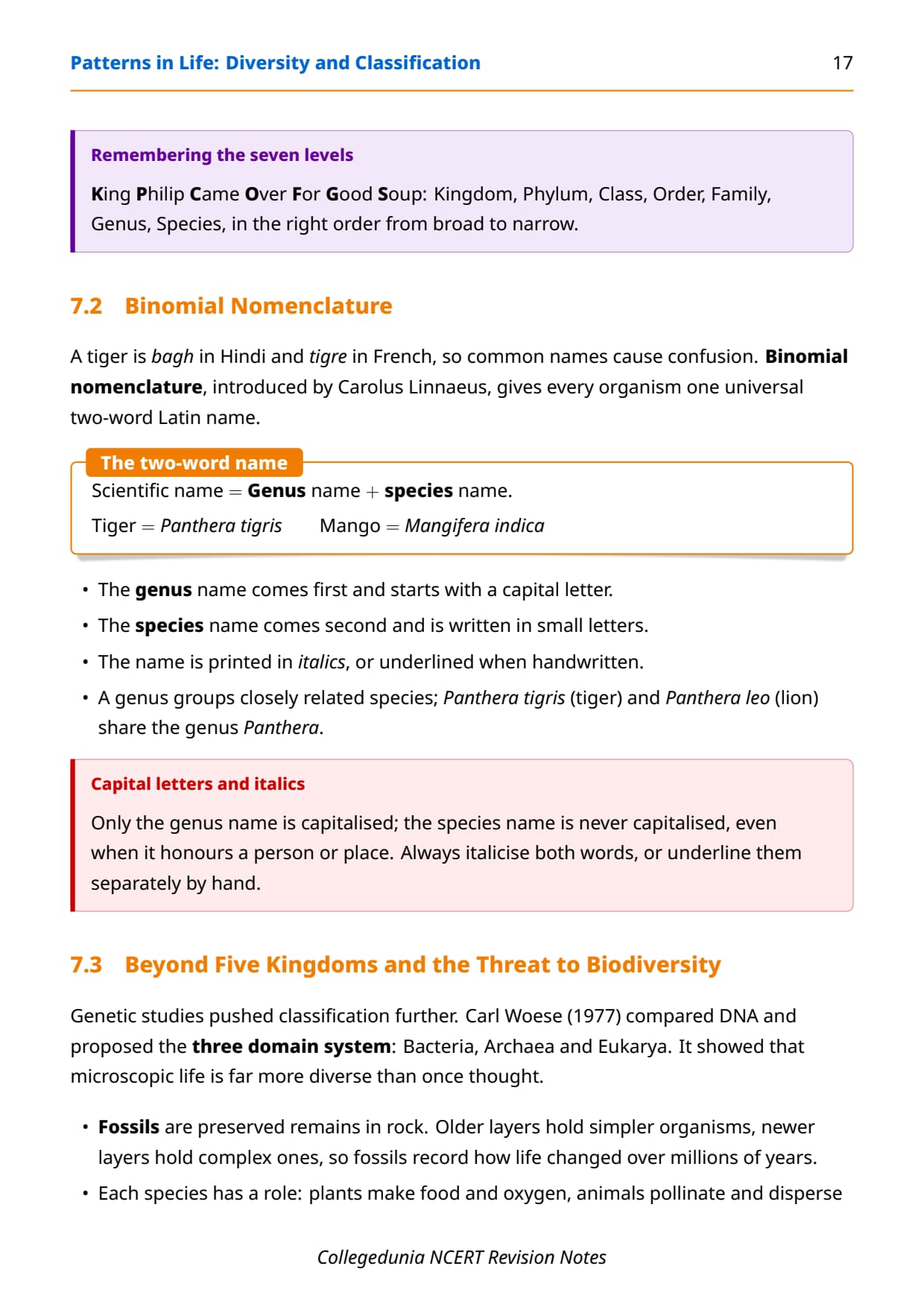
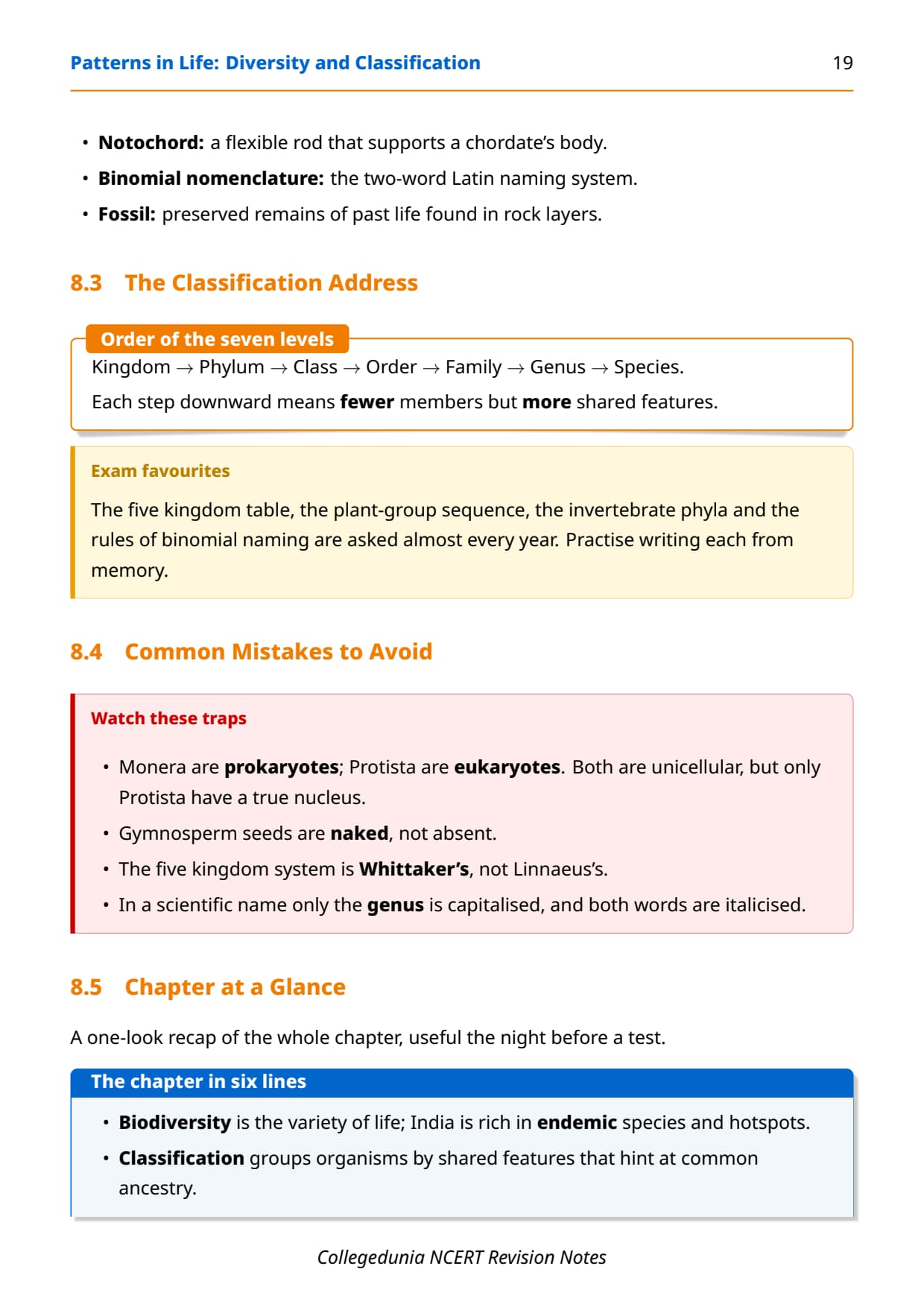
Classification does not stop at kingdoms. Each kingdom is split into ever-smaller groups. The full order is Kingdom, Phylum, Class, Order, Family, Genus, Species. It works like a postal address, where each step narrows down the exact place of an organism. At each lower level, organisms share more features.
Common names cause confusion, since a tiger is bagh in Hindi and tigre in French. Binomial nomenclature, introduced by Carolus Linnaeus, gives every organism one universal two-word Latin name.
| Rule | How it is written |
|---|---|
| First word | Genus name, starts with a capital letter |
| Second word | Species name, written in small letters |
| Style | Printed in italics, or underlined when written by hand |
| Example | Tiger is Panthera tigris; mango is Mangifera indica |
Use King Philip Came Over For Good Soup to fix the seven levels in order. Later, Carl Woese used DNA to propose the three domain system (Bacteria, Archaea, Eukarya), and today biodiversity faces threats from pollution, deforestation and climate change, so conservation matters more than ever.
Student Feedback on Patterns in Life Diversity and Classification Class 9 Notes
What 11,460 students told us about their patterns in life diversity and classification revision before the 2026 boards.
- 74% of students said the five kingdom table was the fastest part of the chapter to revise from these notes.
- 62% of students found the invertebrate phyla the easiest set of names to forget under exam pressure.
- Most-skipped topic in revision: the rules of binomial naming, left for last by about 31% of students.
Source: 2026-27 Class 9 Science student poll. Sample of 11,460 students from CBSE schools across 14 states.
Common Mistakes Students Make in the Patterns in Life Diversity and Classification Chapter
A few slips lose easy marks in this chapter every year.
- Crediting the five kingdom system to Linnaeus. It is Whittaker's (1969); Linnaeus gave the older two kingdom system and the naming rules.
- Saying gymnosperm seeds are absent. Their seeds are naked, sitting on cones without a fruit.
- Mixing up Monera and Protista. Both are unicellular, but only Protista have a true nucleus.
- Capitalising the species name. Only the genus name is capitalised, and both words are italicised.
How to Use the Patterns in Life Diversity and Classification Class 9 Notes
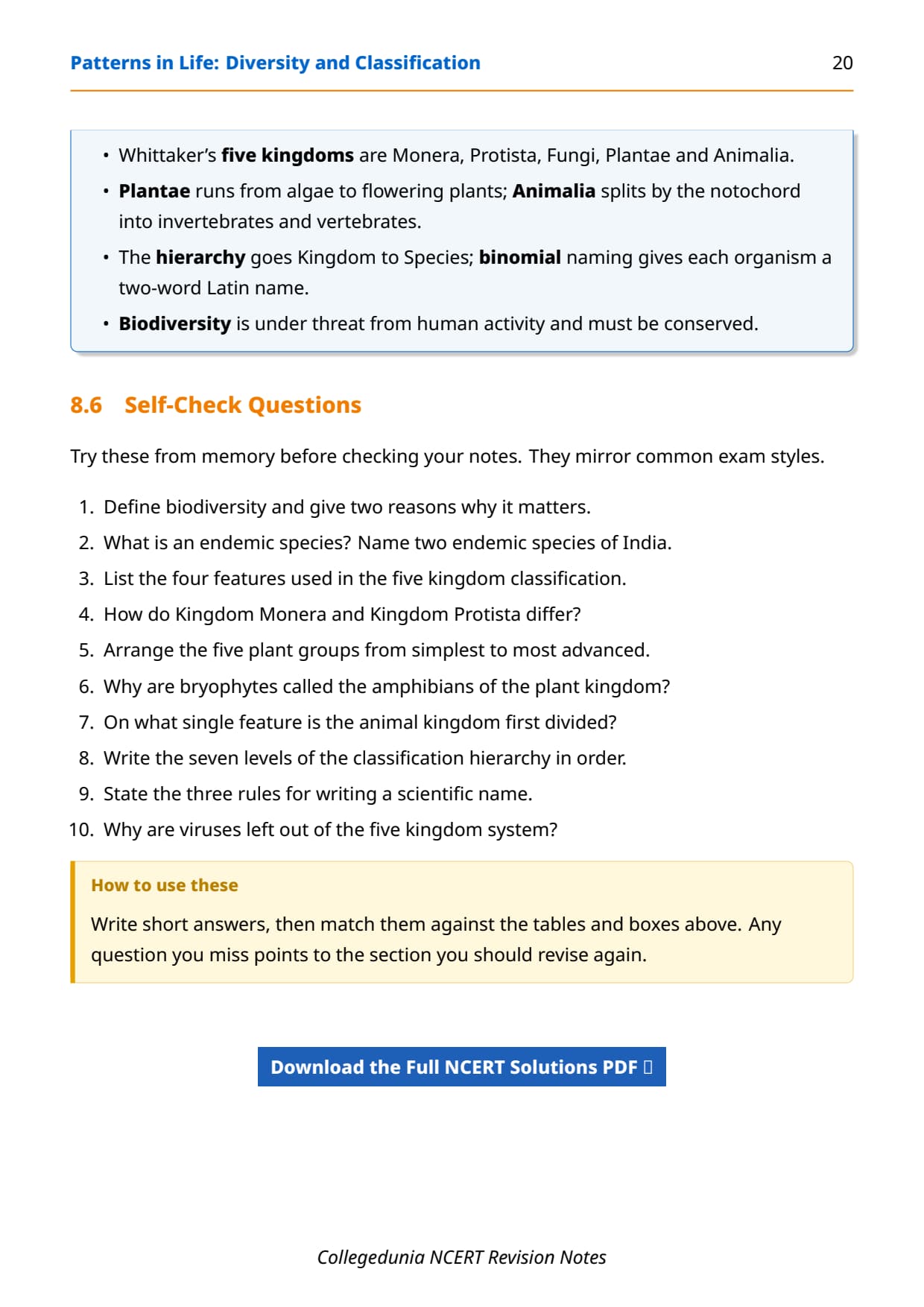
Use these notes in three simple blocks. First read for meaning, then learn the tables, then test yourself from memory.
- Read the chapter once and match each kingdom to its cell type and mode of nutrition.
- Learn the key tables: the five kingdoms, the five plant groups, and the rules of binomial naming.
- Test yourself by writing the seven levels of the hierarchy and two scientific names from memory.
The five kingdom table, the plant-group sequence, the invertebrate phyla and the rules of binomial naming are asked almost every year, so practise writing each one without looking.
How These Class 9 Science Chapter 12 Notes Pair with the Solutions and NCERT Book
These notes work best next to the other Class 9 Science resources for this chapter. Read the notes first, then solve, then read the original text for depth.
- Use the NCERT Solutions to attempt every Revise, Reflect, Refine question after you finish these notes.
- Use the Handwritten Notes for a quick one-shot recap on the night before a test.
- Use the NCERT Book PDF to read the full chapter text and study the original diagrams.
Patterns in Life Diversity and Classification Class 9 Other Resources for this Chapter
Pair these notes with the other Class 9 Science resources for this chapter, all linked below.
| Resource | Best used for |
|---|---|
| Patterns in Life Diversity and Classification Class 9 NCERT Solutions | Solving all chapter questions step by step |
| Patterns in Life Diversity and Classification Class 9 Handwritten Notes | Last-minute one-shot revision |
| Patterns in Life Diversity and Classification Class 9 NCERT Book PDF | Reading the original chapter text |
All Chapters NCERT Notes for Class 9 Science
Browse the full set of ncert notes for class 9 science chapter by chapter.
| Chapter | NCERT Notes |
|---|---|
| Chapter 2 | Cell the Building Block of Life Class 9 Notes |
| Chapter 3 | Tissues in Action Class 9 Notes |
| Chapter 4 | Describing Motion Around Us Class 9 Notes |
| Chapter 5 | Exploring Mixtures and their Separation Class 9 Notes |
| Chapter 6 | How Forces Affect Motion Class 9 Notes |
| Chapter 7 | Work, Energy, and Simple Machines Class 9 Notes |
| Chapter 8 | Journey Inside the Atom Class 9 Notes |
| Chapter 9 | Atomic Foundations of Matter Class 9 Notes |
| Chapter 10 | Sound Waves Characteristics and Applications Class 9 Notes |
| Chapter 11 | Reproduction How Life Continues Class 9 Notes |
| Chapter 12 | Patterns in Life Diversity and Classification Class 9 Notes |
| Chapter 13 | Earth as a System Energy, Matter, and Life Class 9 Notes |
Patterns in Life Diversity and Classification Class 9 Notes FAQs
Ques. Where can I download the NCERT Notes Class 9 Science Chapter 12 Patterns in Life Diversity and Classification PDF?
Ans. You can download the class 9 science chapter 12 notes PDF directly from this page. Both the Normal and HD versions are free, and every topic is written in plain English for the 2026-27 session.
Ques. What topics do the patterns in life diversity and classification class 9 notes cover?
Ans. The notes cover biodiversity and endemic species, the basis of classification, the five kingdoms, the five plant groups, the invertebrate and vertebrate animal groups, the classification hierarchy, and binomial nomenclature.
Ques. What are the five kingdoms of classification in Class 9 Science?
Ans. The five kingdoms given by Robert Whittaker in 1969 are Monera, Protista, Fungi, Plantae and Animalia. They are separated using cell type, level of organisation, cell structure and mode of nutrition.
Ques. What is biodiversity?
Ans. Biodiversity is the whole variety of living organisms found on the Earth, including plants, animals, fungi and microbes, together with the habitats in which they live. India is one of the world's biodiversity-rich countries.
Ques. What is binomial nomenclature in Patterns in Life Diversity and Classification Class 9?
Ans. Binomial nomenclature is the two-word Latin naming system introduced by Carolus Linnaeus. The first word is the capitalised genus name and the second is the small-letter species name, and both are written in italics, for example Panthera tigris.
Ques. Are these ncert notes for class 9 science chapter 12 aligned with the 2026-27 syllabus?
Ans. Yes. These notes follow the new 2026-27 NCERT book Exploration, where Patterns in Life Diversity and Classification is Chapter 12. Every table and diagram is checked against that latest edition.
Ques. Why are bryophytes called the amphibians of the plant kingdom?
Ans. Bryophytes, such as mosses, live on land but still need water to complete reproduction, just as amphibians like frogs live on land yet return to water. This dependence on water for reproduction earns them the name.



Comments