




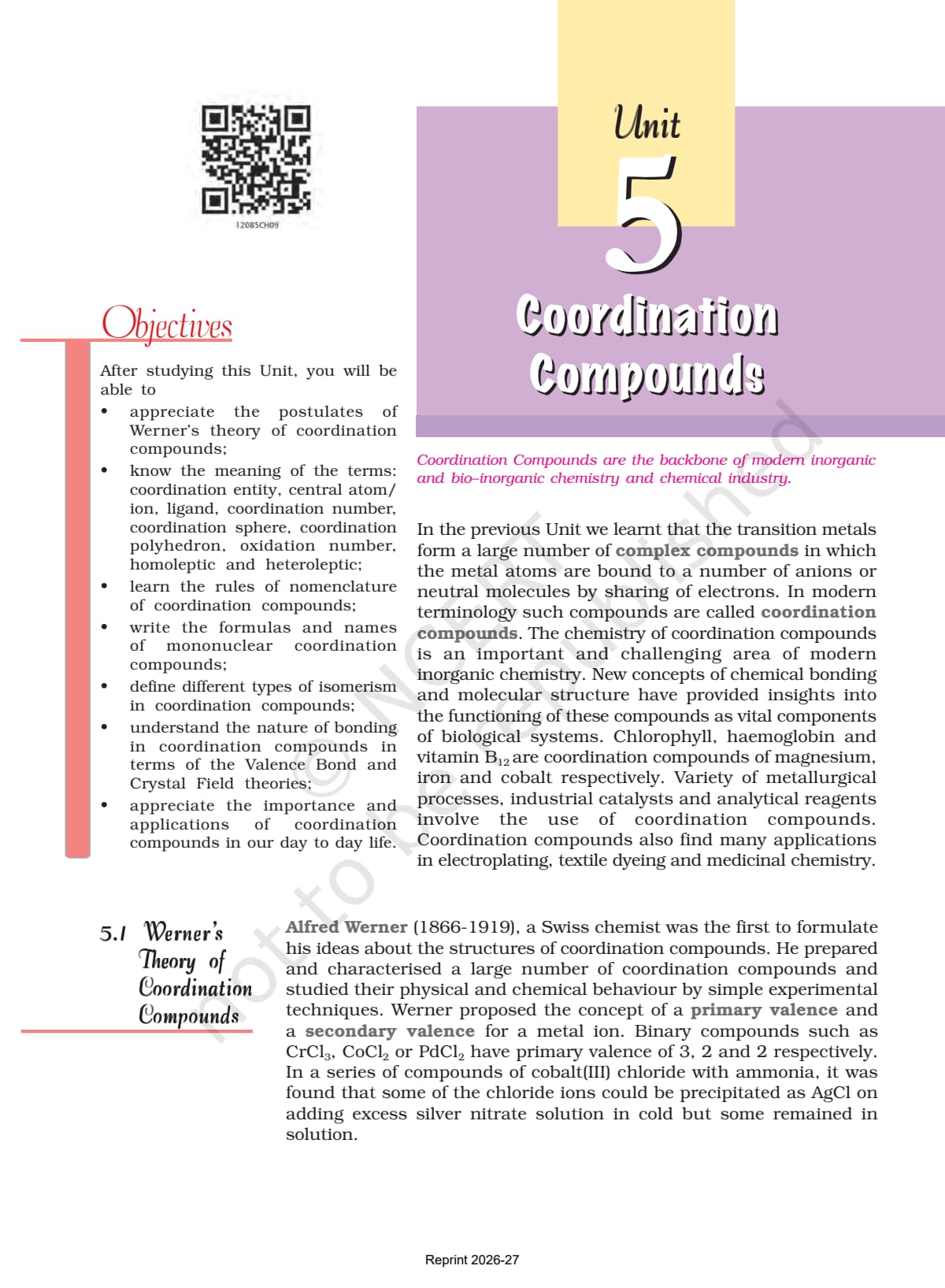
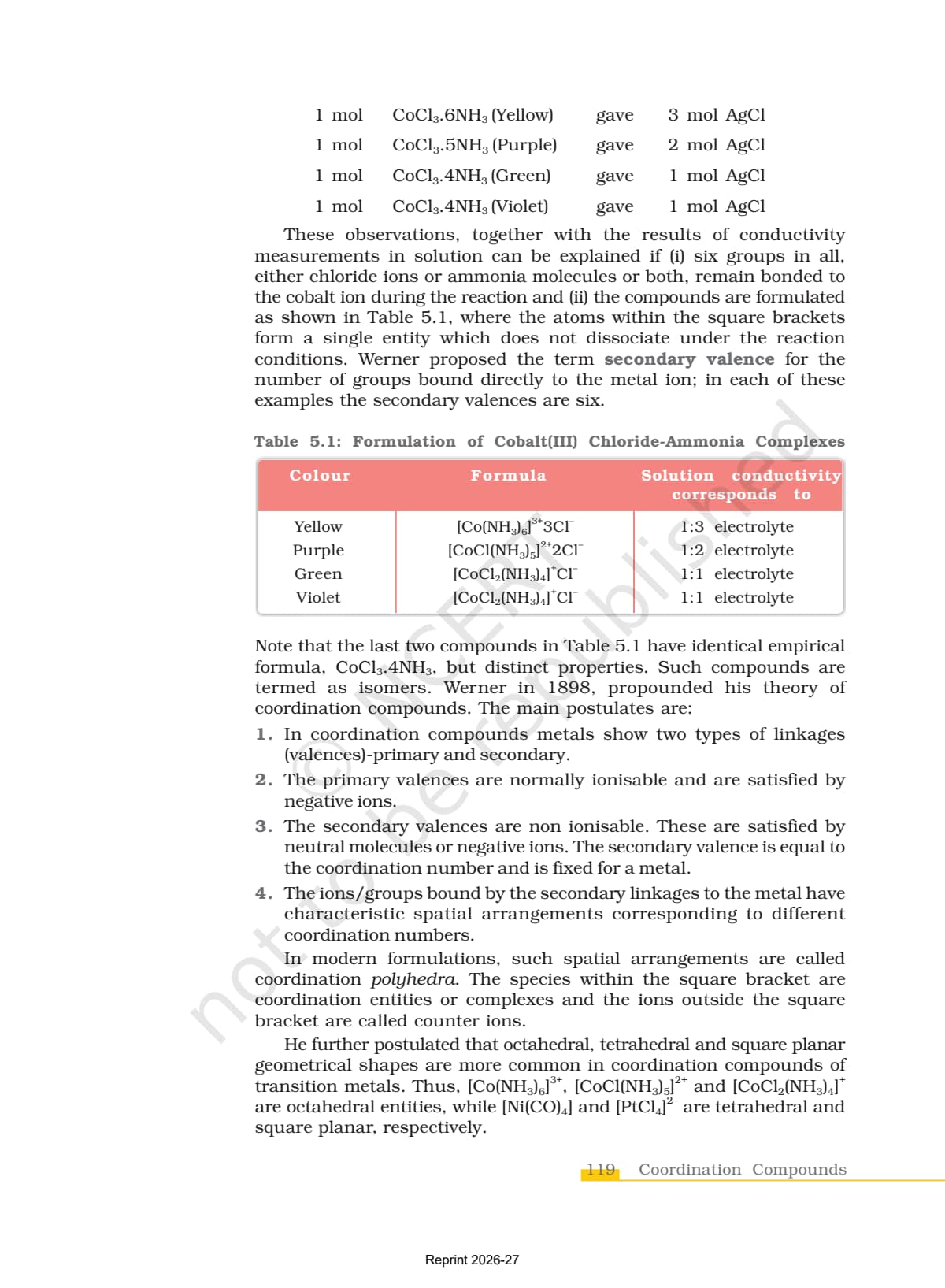
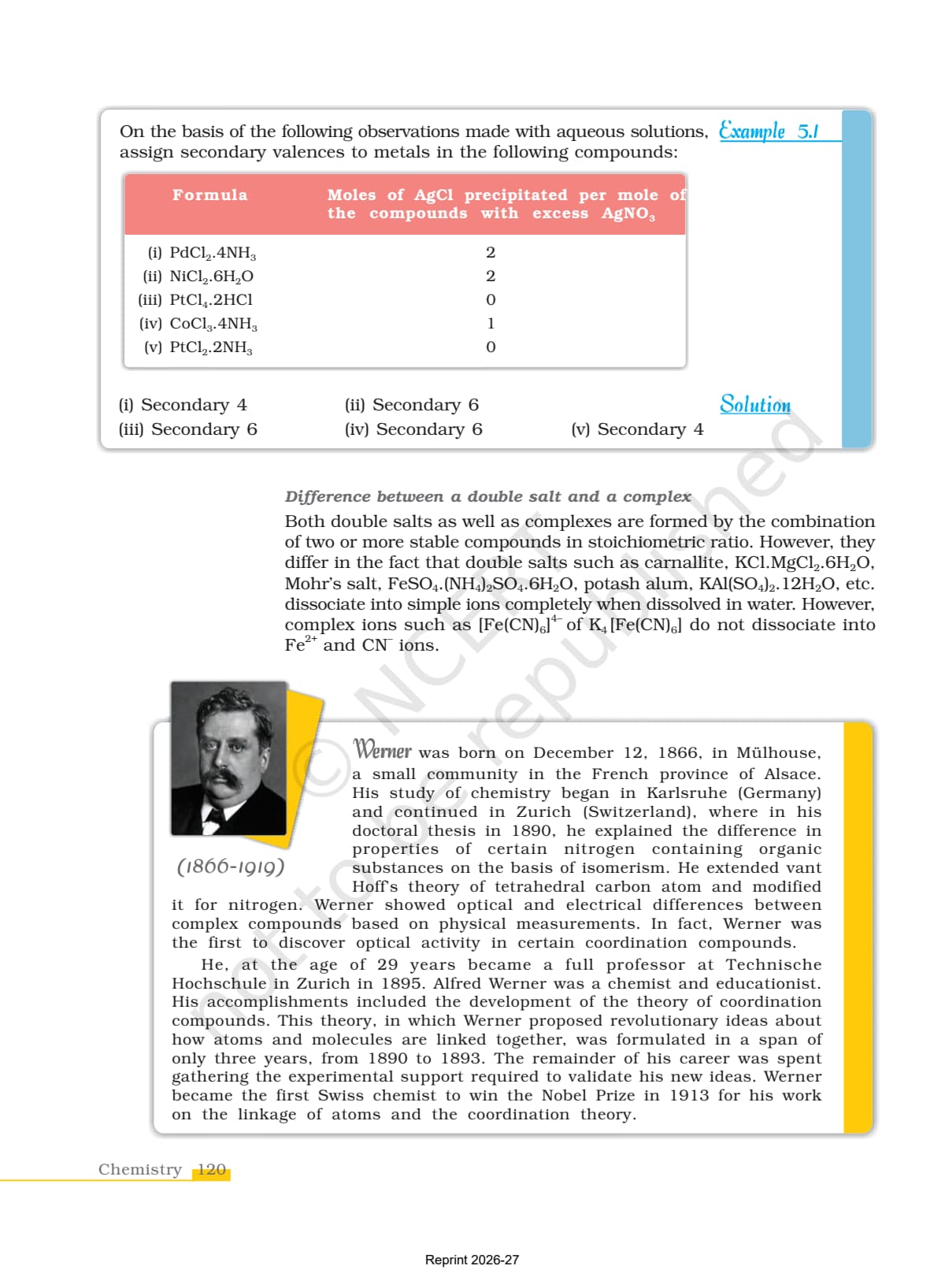
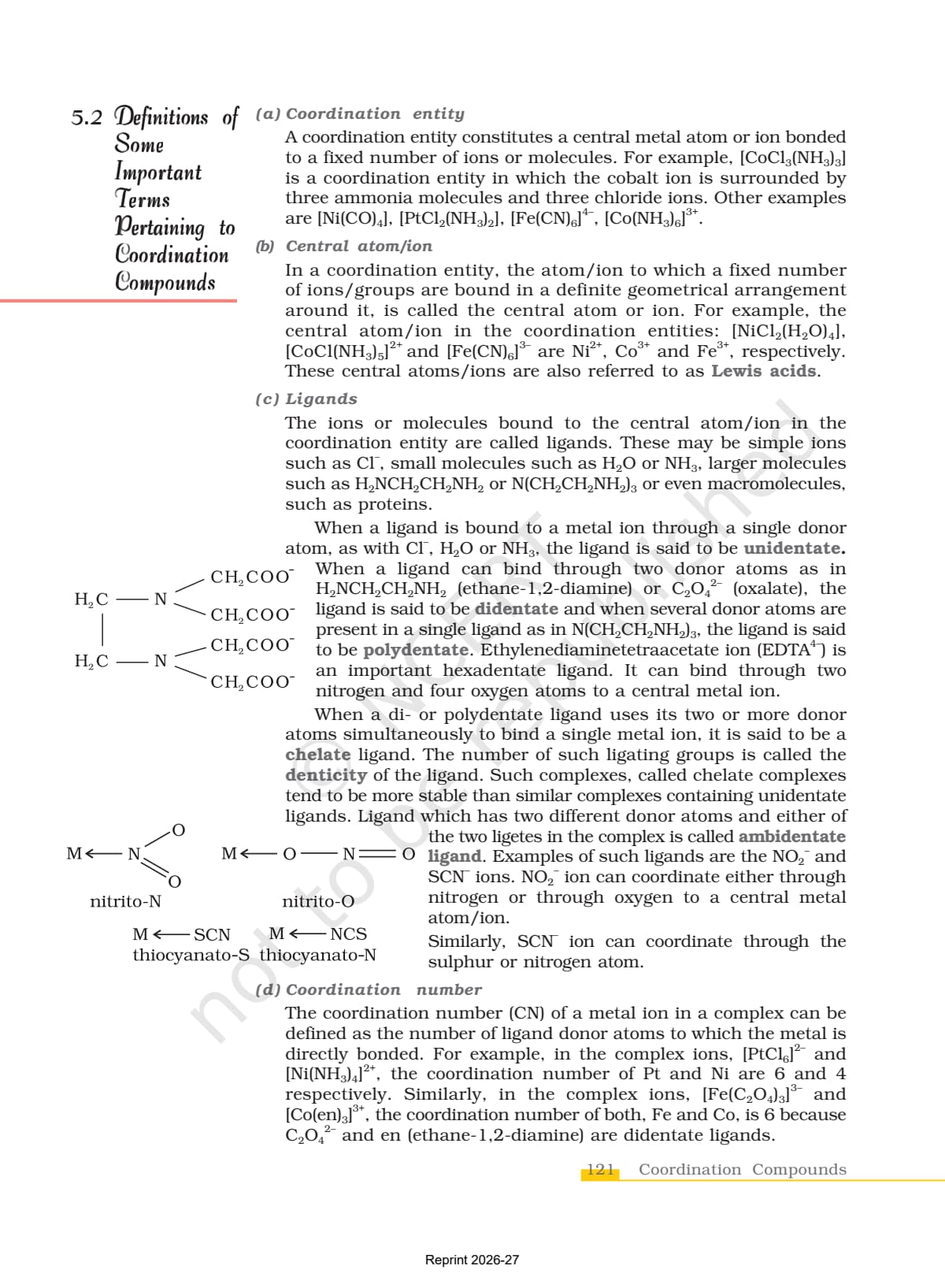
The 2026-27 NCERT keeps Chapter 5 Coordination Compounds as a full Inorganic unit on Werner's theory, IUPAC nomenclature, isomerism, Valence Bond Theory, Crystal Field Theory, and metal carbonyls. It is the highest-weightage chapter in the Class 12 Chemistry Boards. Download the official NCERT Book PDF below.
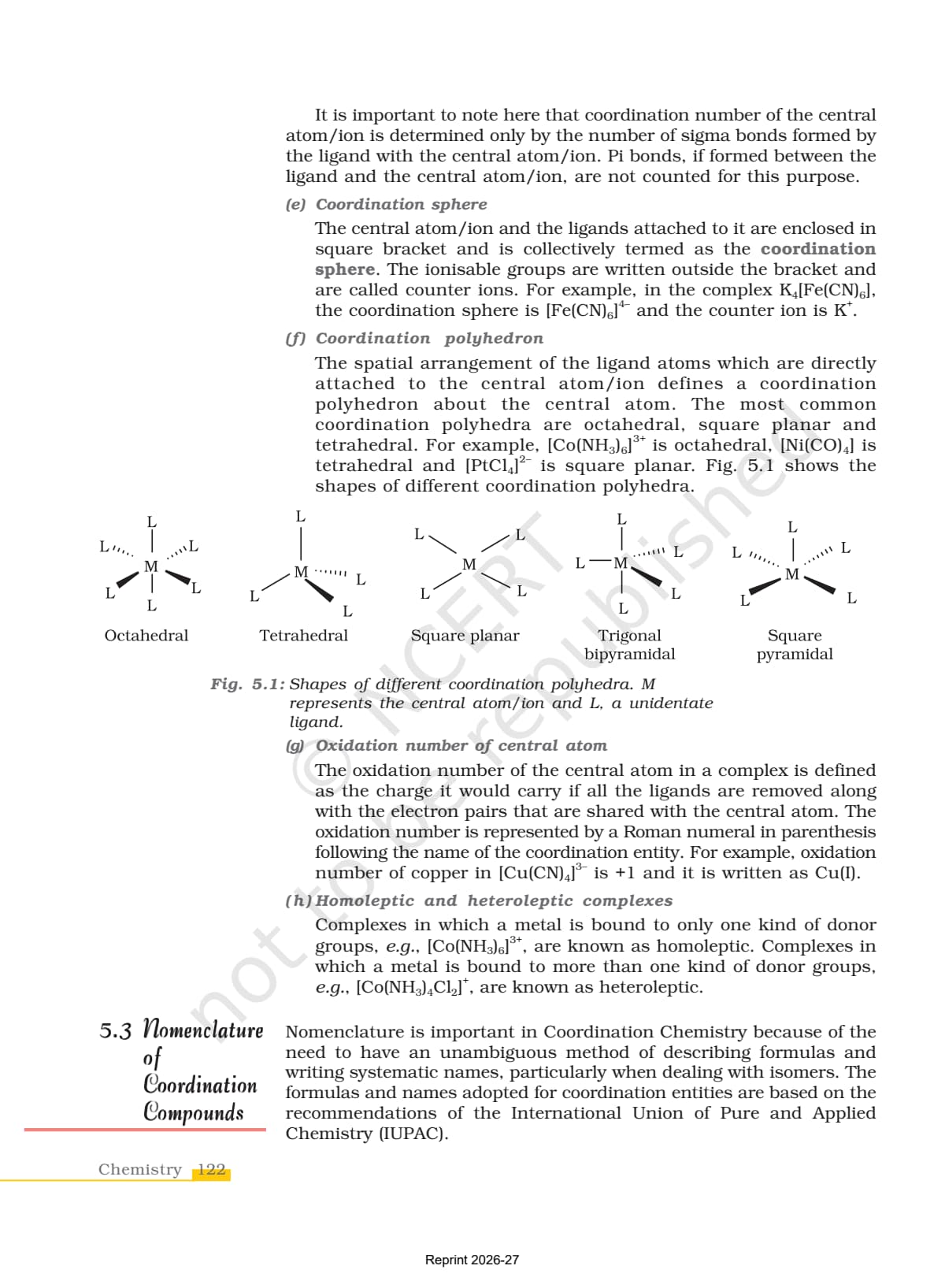
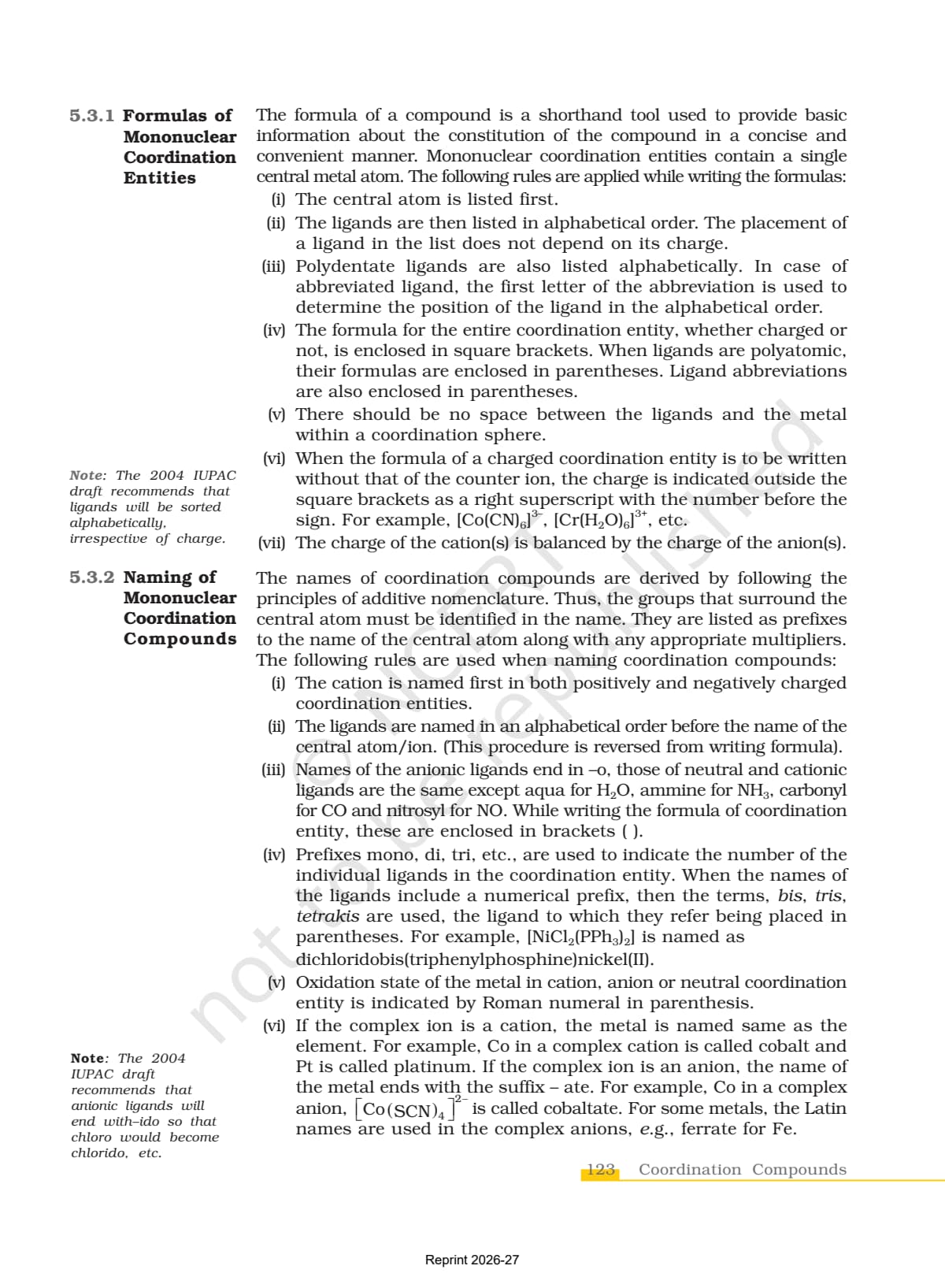
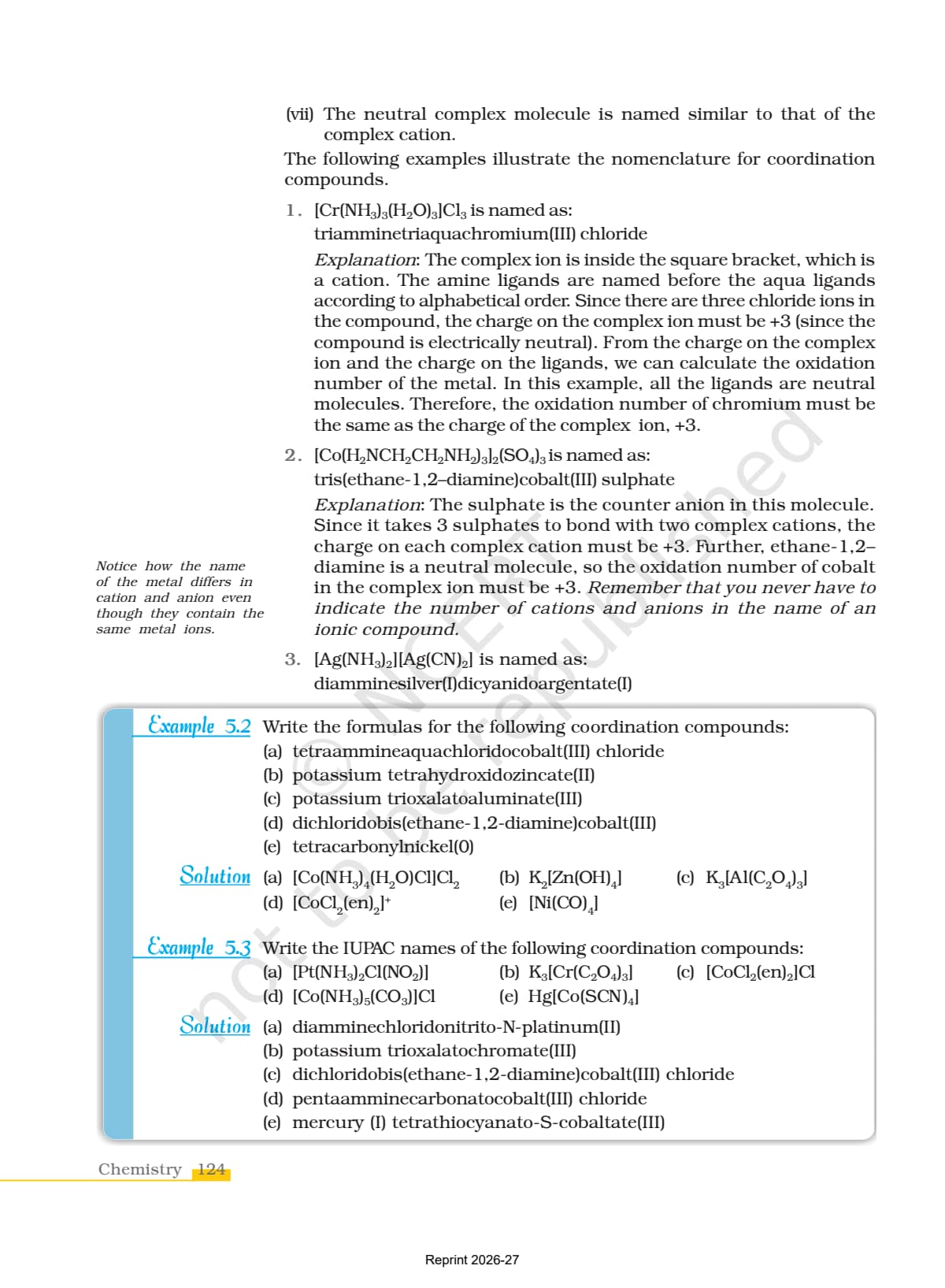
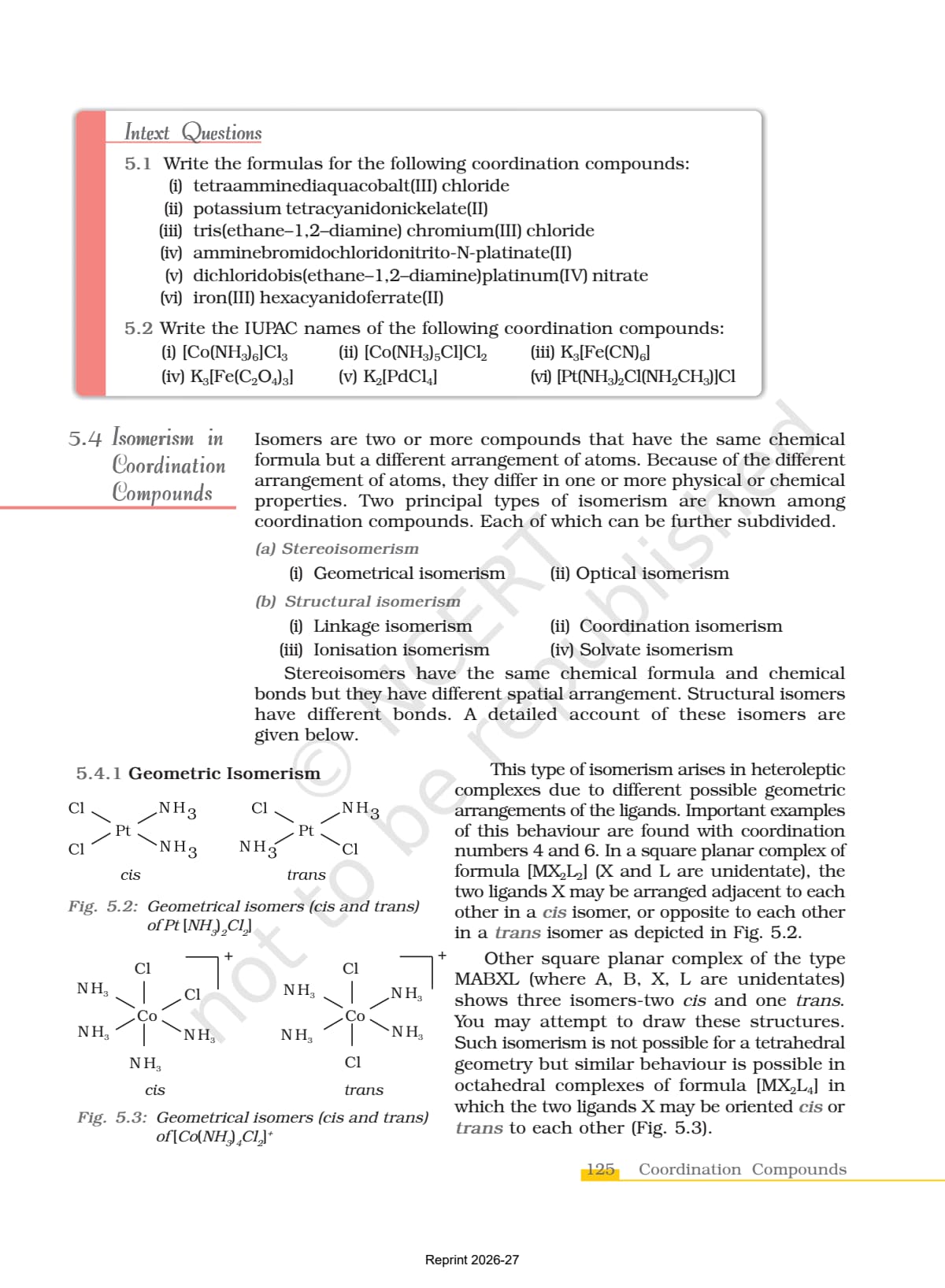
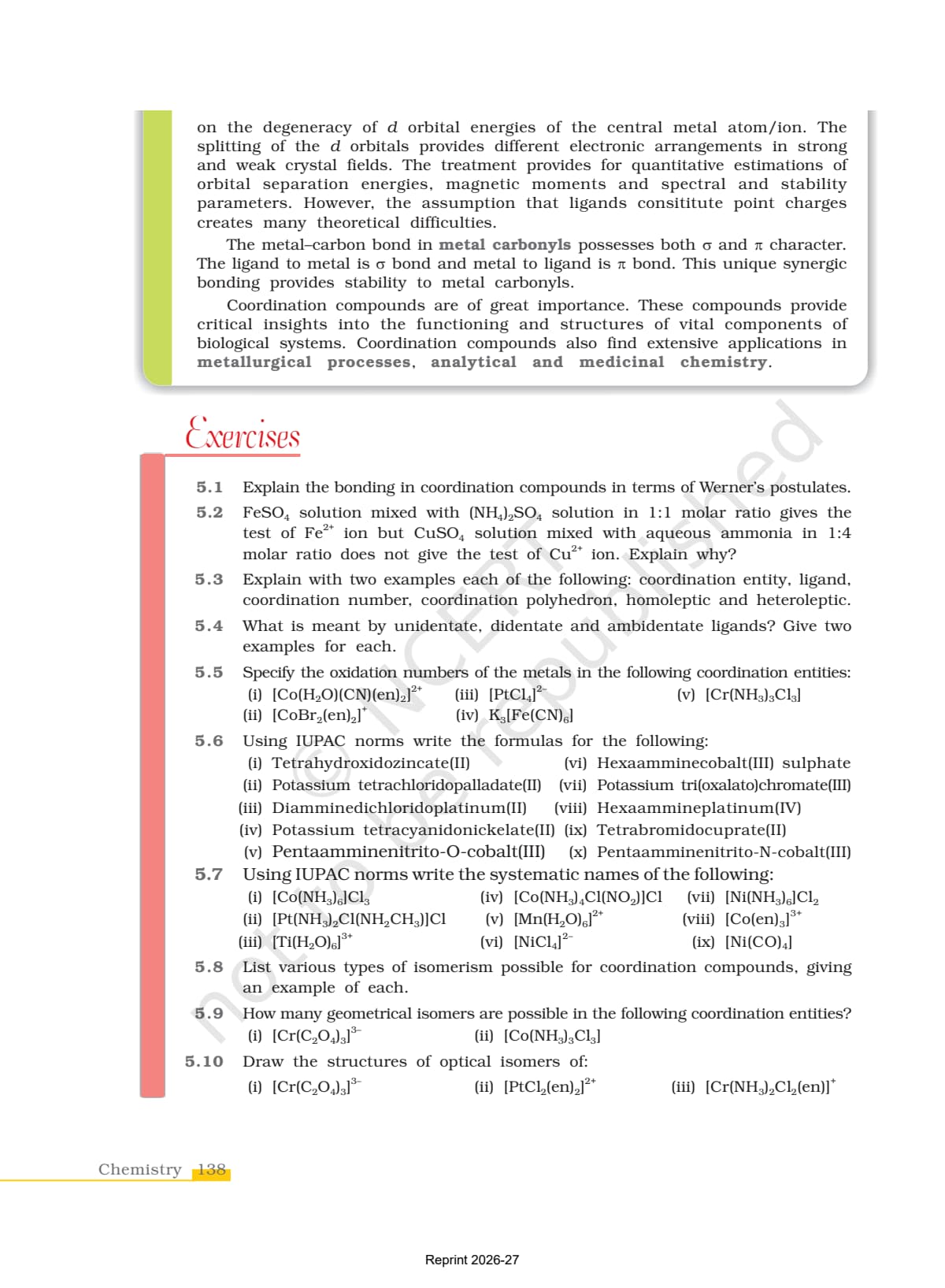
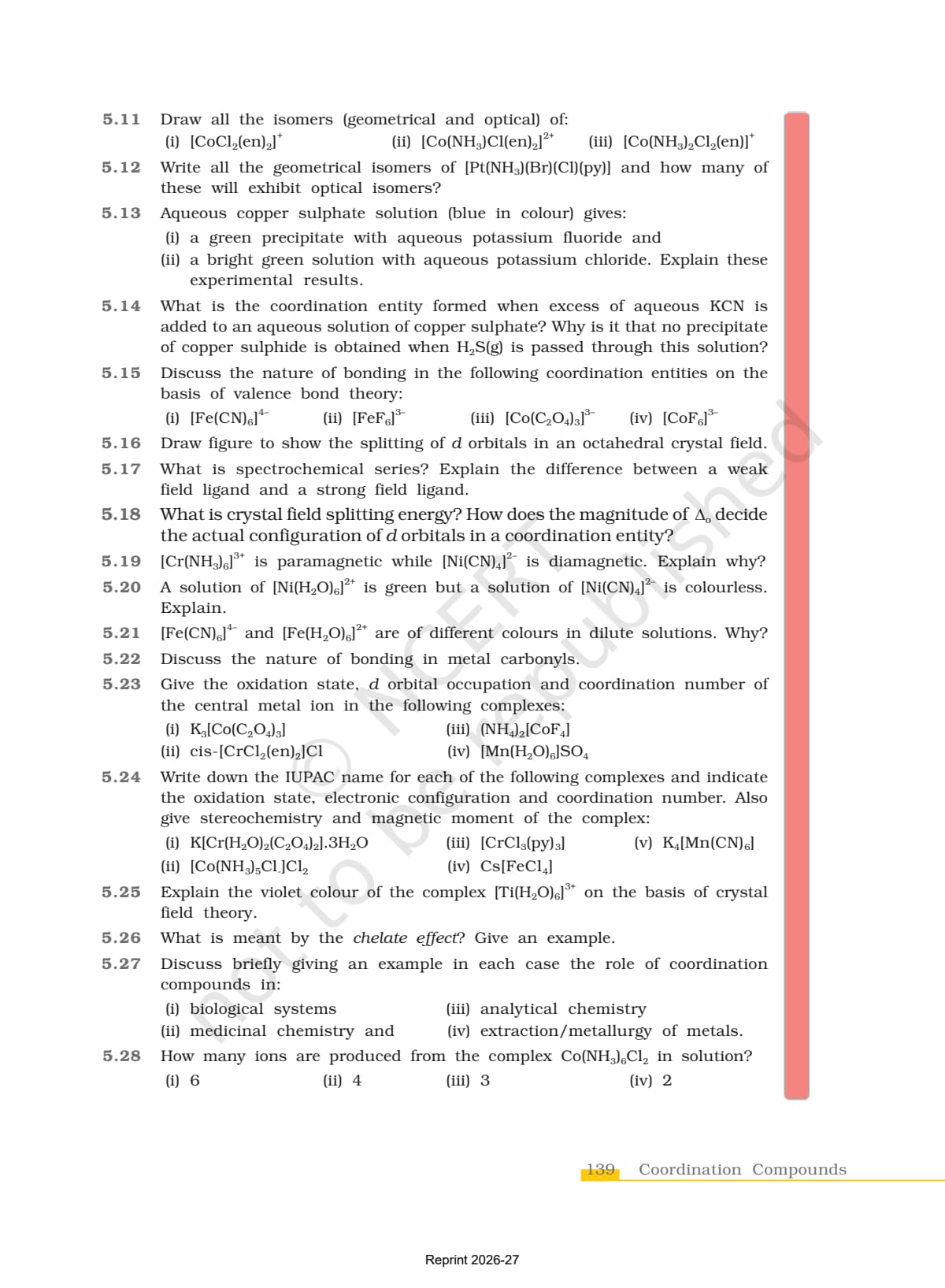
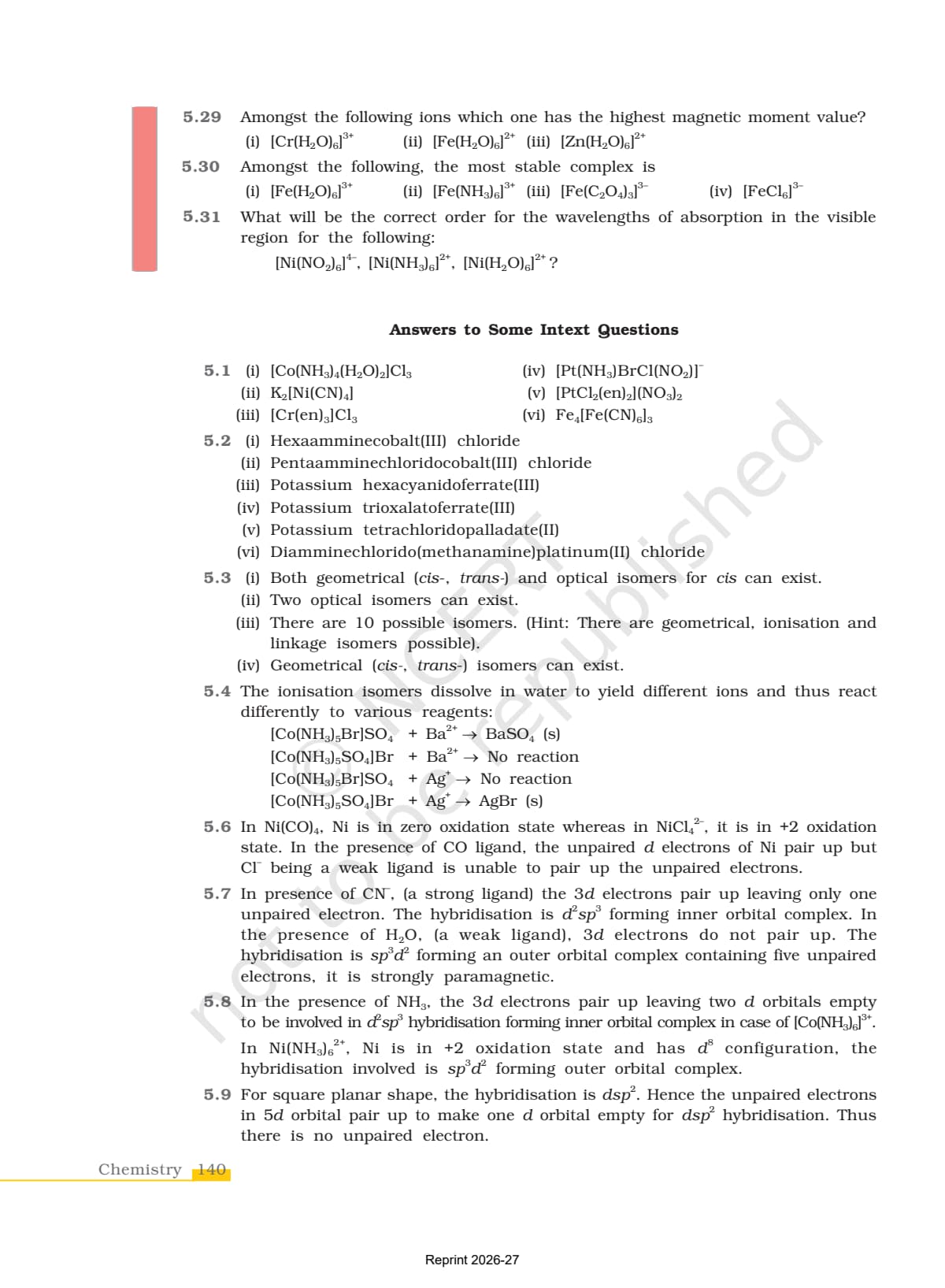
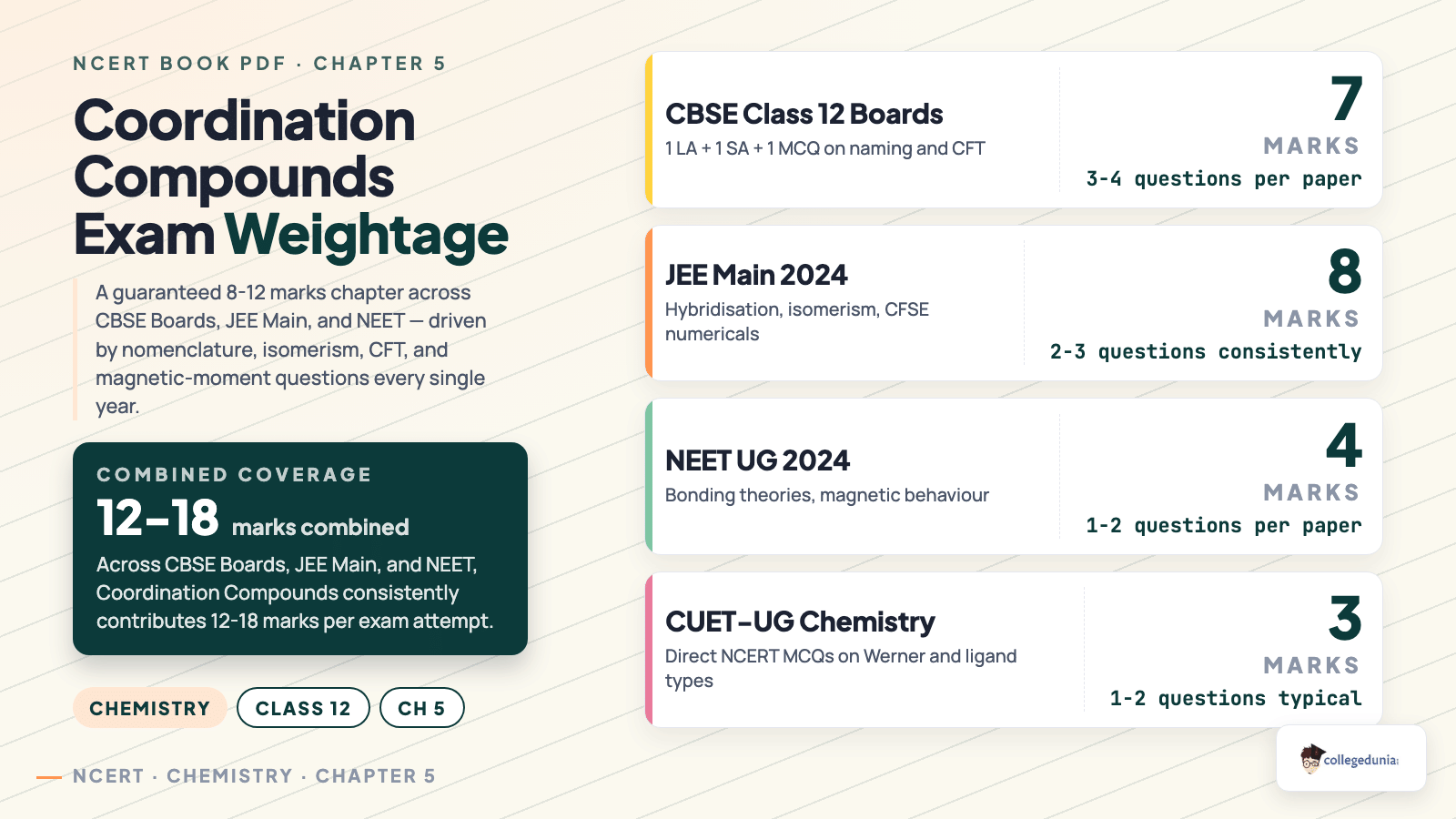
- CBSE Weightage: 7 to 9 marks (one 3-mark IUPAC + isomerism question plus one 5-mark CFT/hybridisation case)
- JEE Main Weightage: 4 to 5% (3 to 4 questions per shift, mix of CFT, isomerism, and EAN)
- NEET Weightage: 3 to 4 questions per year
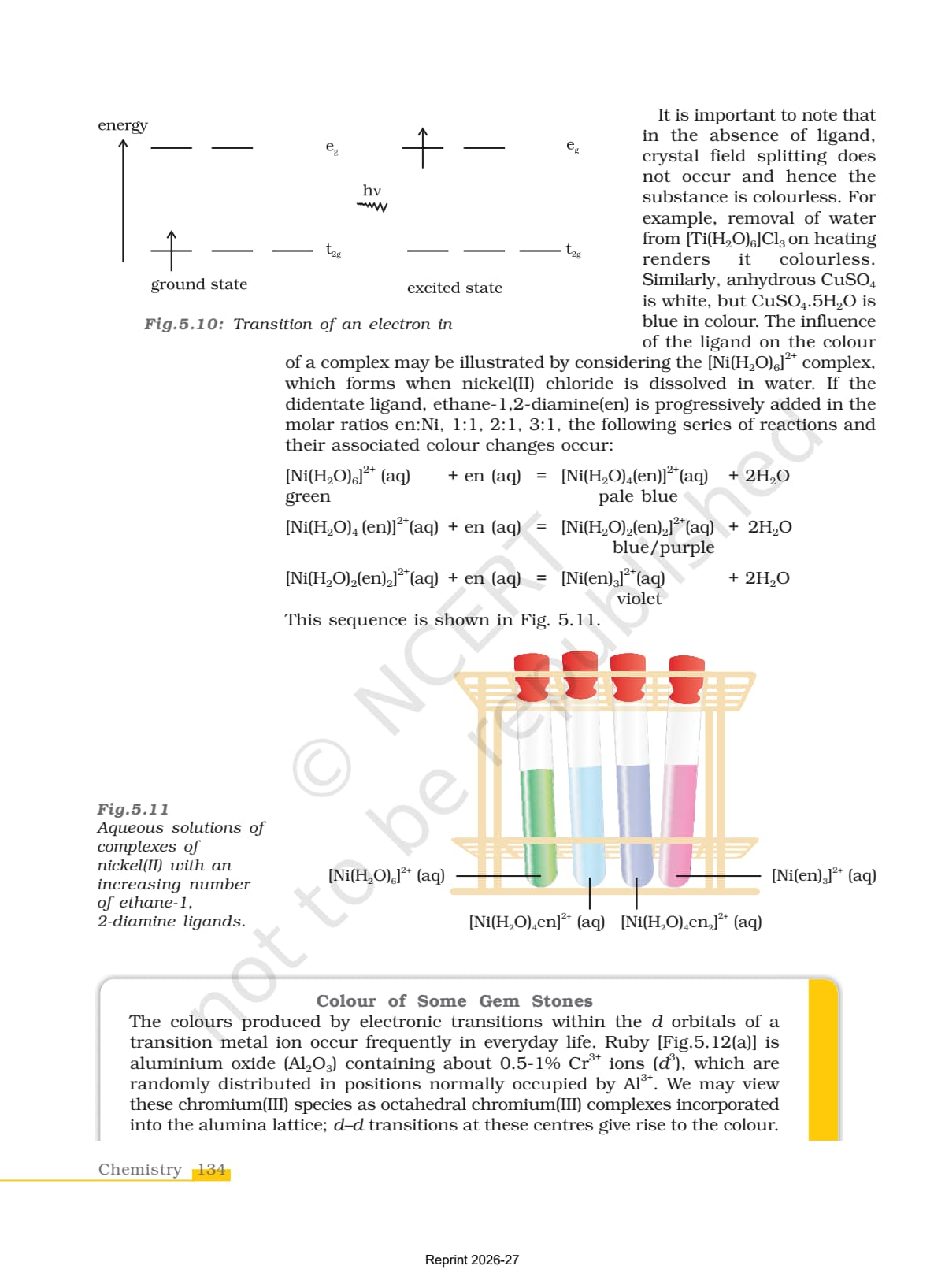
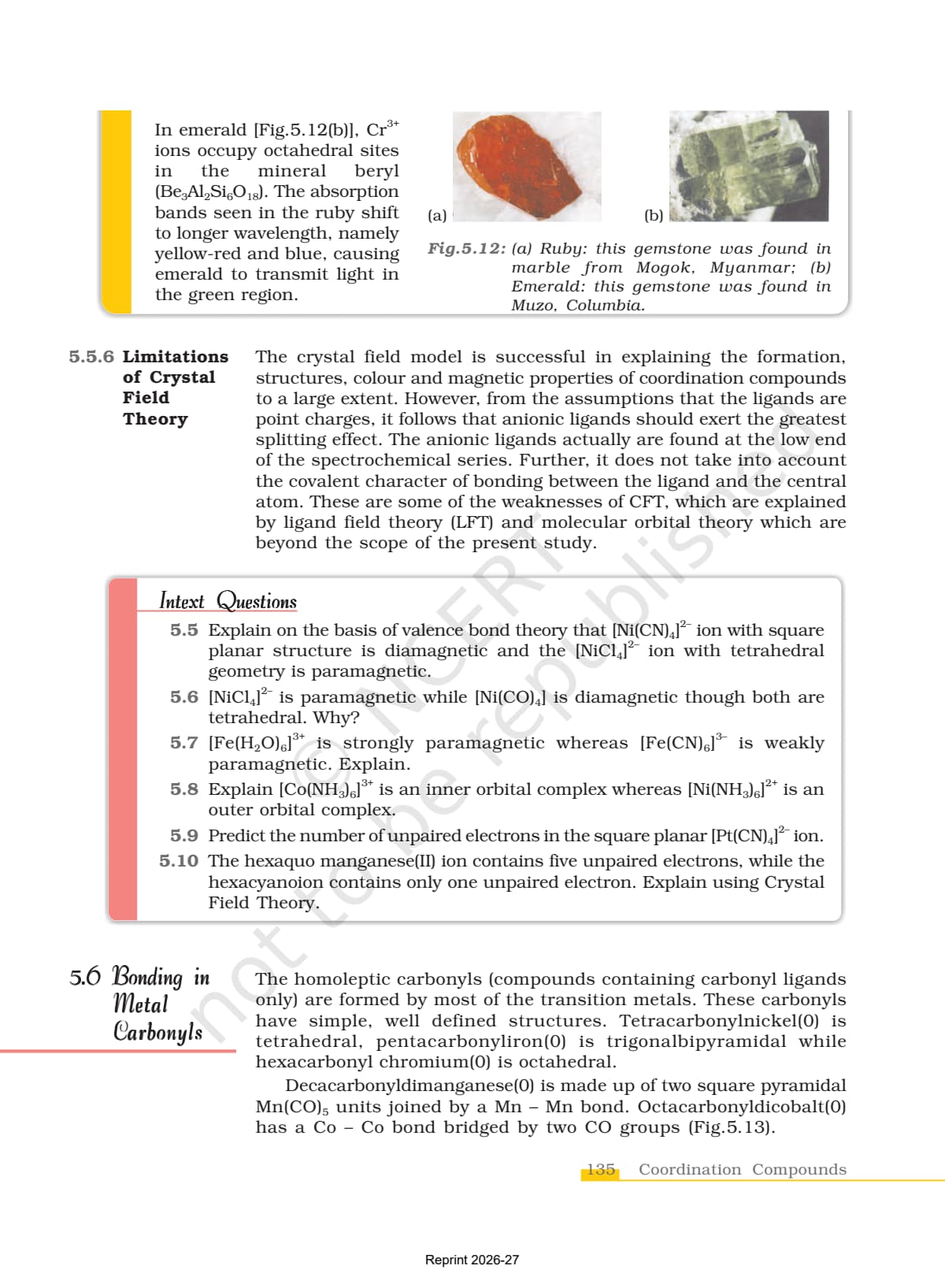
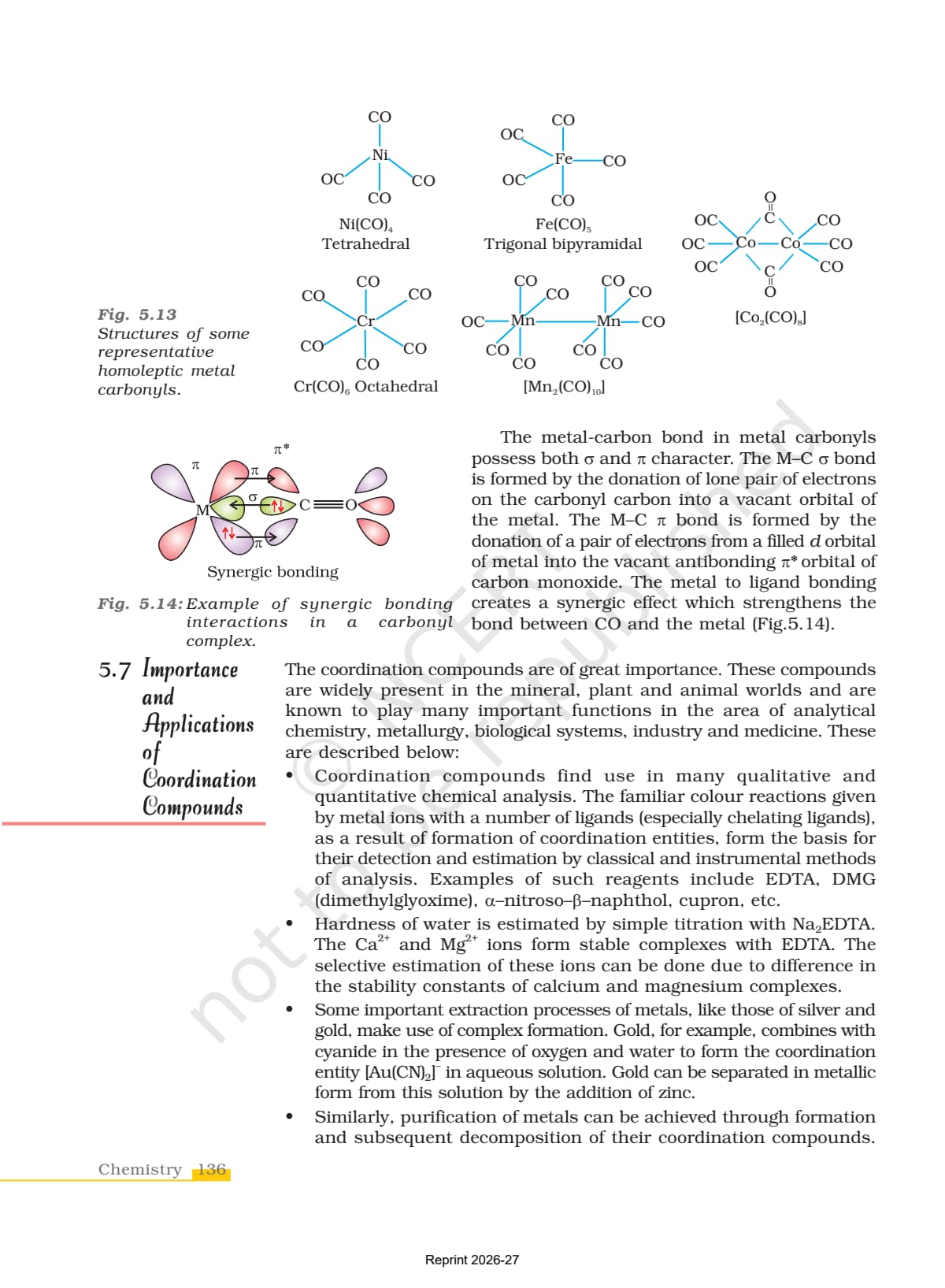
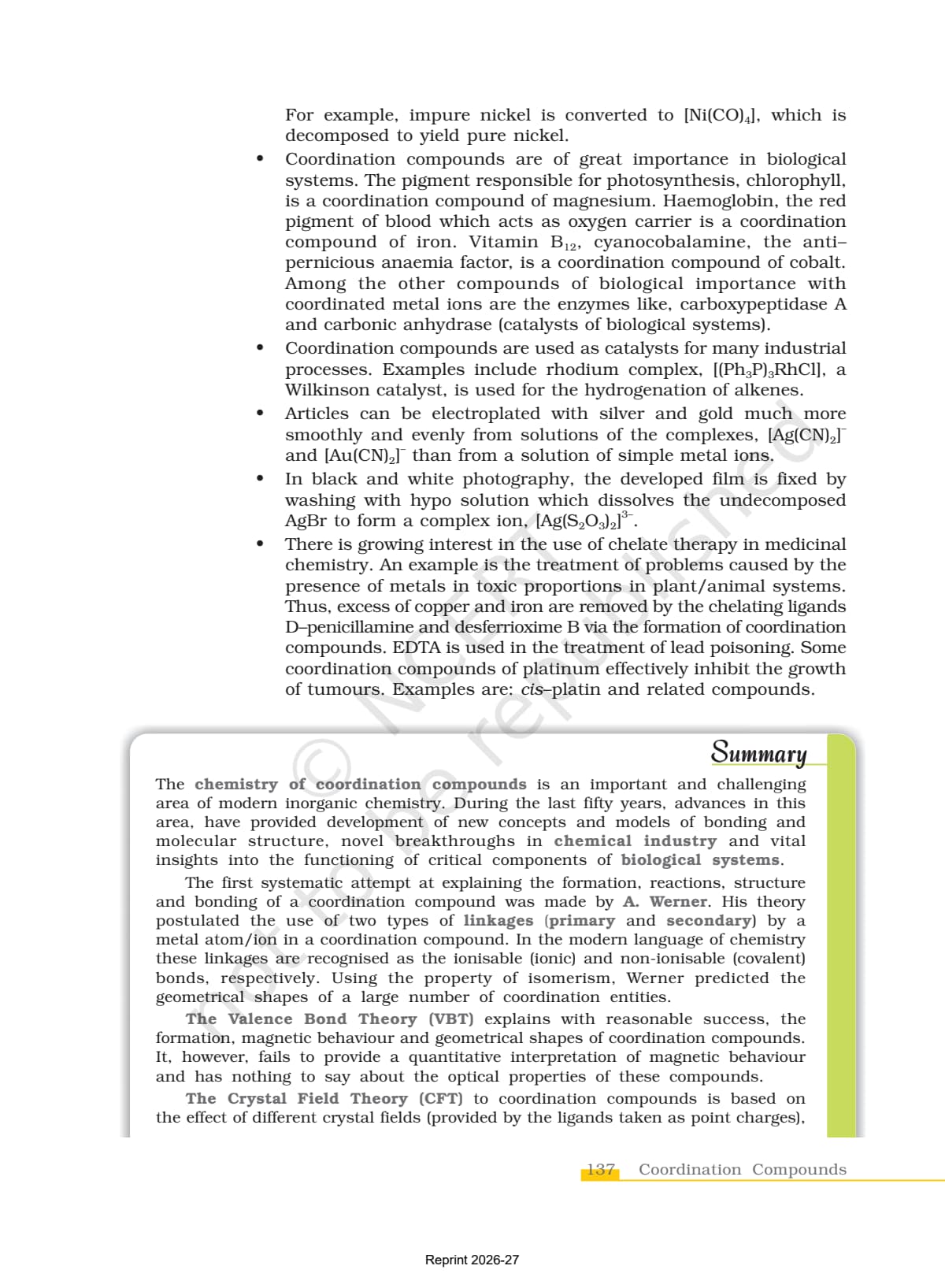
The PDF above is the full official NCERT print for Chapter 5 of the Class 12 Chemistry Part-I book.
Sourced from the official NCERT 2026-27 edition and cross-verified against the CBSE Class 12 Chemistry syllabus for the 2026 Board exam.
Also Check:
- Class 12 Chemistry Chapter 4 The d- and f-Block Elements NCERT Book PDF
- Class 12 Chemistry Chapter 6 Haloalkanes and Haloarenes NCERT Book PDF
- CBSE Class 12 Chemistry Syllabus 2026-27
Coordination Compounds Weightage Compared Across Class 12 Chemistry Chapters
The chart below maps average CBSE Board marks across all 10 chapters of the 2026-27 Class 12 Chemistry book. Coordination Compounds tops the list alongside Solutions at 8 marks.
Coordination Compounds Class 12 Chemistry Explained
Source: Magnet Brains on YouTube
How Collegedunia's NCERT Book PDF Helps You with Coordination Compounds
The official NCERT print is the source of truth for CBSE Boards. This page adds the navigation the PDF itself lacks.
- 2026-27 alignment: latest NCERT print, with every rationalisation change flagged below.
- Section map: jump straight to any sub-topic by page number.
- Reading sequence: which sections and intext examples give the highest mark return.
Coordination Compounds NCERT Intext Examples and Their Sub-Topics
Chapter 5 carries 9 solved intext examples, each targeting one skill that recurs in CBSE numericals. The table tags every example with its sub-topic.
| Example | Sub-topic | Skill tested |
|---|---|---|
| 5.1 | Oxidation state of central metal in [Co(NH3)5Cl]Cl2 | Apply charge balance to find +x on Co |
| 5.2 | Formula from name (potassium tetrahydroxidozincate(II)) | Write formula in correct order using IUPAC rules |
| 5.3 | IUPAC name of [Pt(NH3)2Cl(NH2CH3)]Cl | Alphabetise ligands, indicate stereochemistry |
| 5.4 | Geometrical isomers of [Pt(NH3)2Cl2] | Draw cis and trans square-planar pairs |
| 5.5 | Optical isomers of [Co(en)3]3+ | Draw enantiomeric octahedral pair |
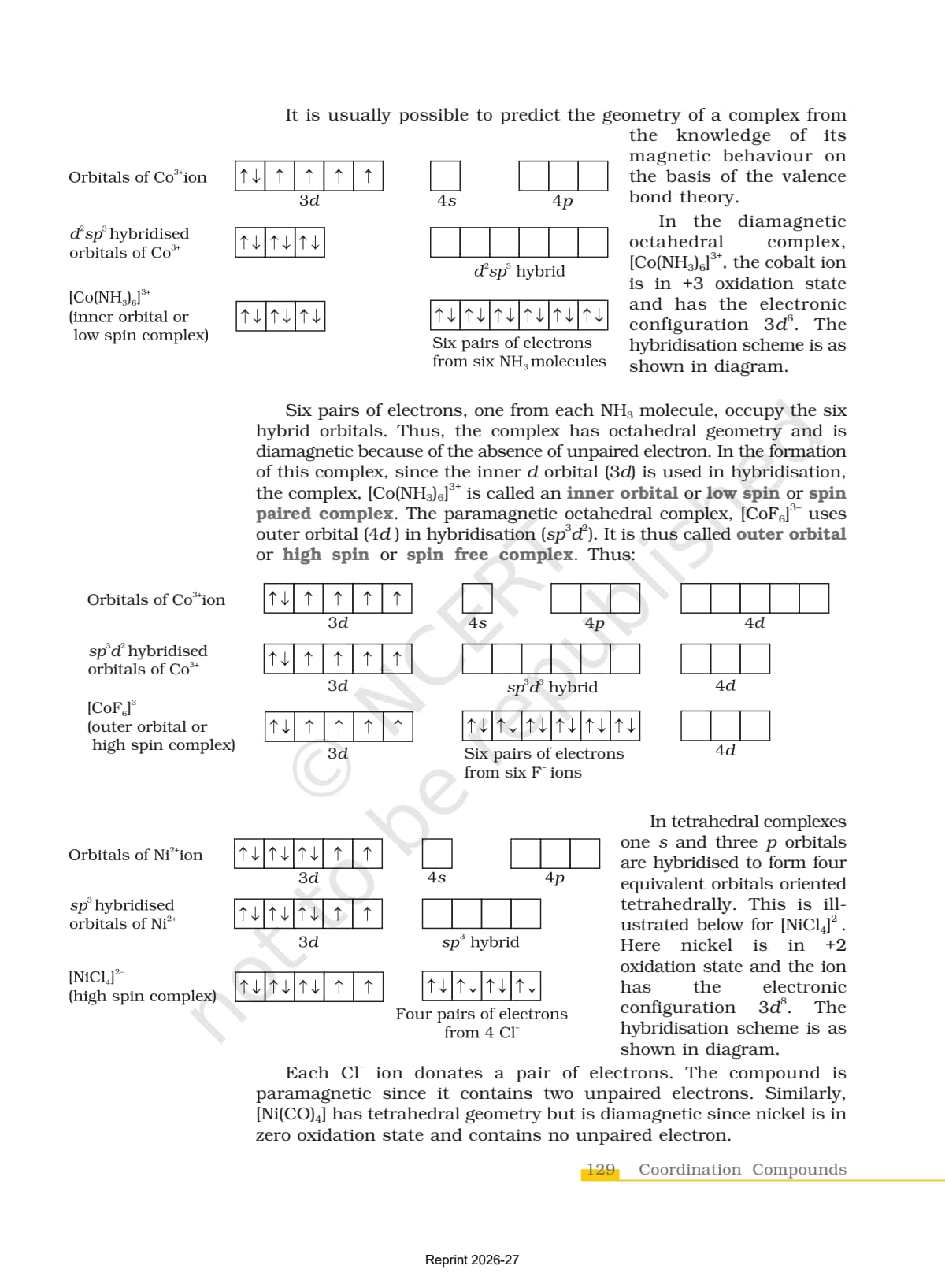
| 5.6 | Hybridisation and shape of [NiCl4]2- | Apply VBT to a tetrahedral d8 complex |
| 5.7 | Predict magnetic moment of [Co(NH3)6]3+ | Use μ = √n(n+2) BM with VBT pairing |
| 5.8 | CFSE for an octahedral high-spin d5 ion | Apply CFSE = (-0.4 nt2g + 0.6 neg)o |
| 5.9 | EAN rule for [Fe(CO)5] | Add metal d-electrons and electron pairs donated |
Coordination Compounds NCERT Book: Section-by-Section Breakdown with Page Numbers
The chapter has eight numbered sections plus a summary and exercises. Sections 5.3, 5.4, and 5.5 together carry most of the CBSE marks.
| Section | Title | Pages | What it covers |
|---|---|---|---|
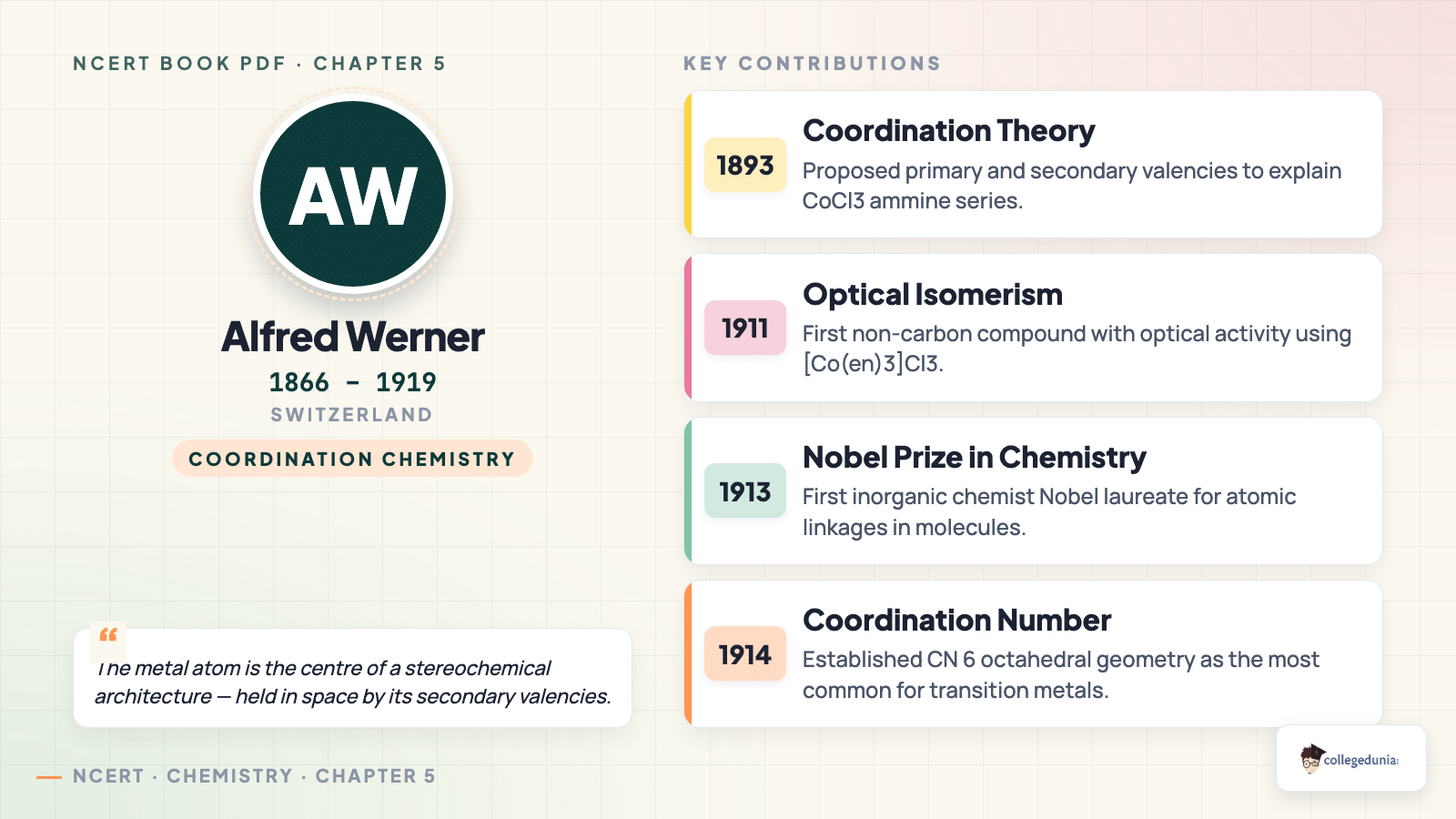
| 5.1 | Werner's Theory of Coordination Compounds | 1-4 | Primary vs secondary valencies, conductivity evidence for cobalt-ammine series |
| 5.2 | Definitions of Some Important Terms | 4-6 | Coordination entity, ligand, denticity, chelate, coordination number, oxidation number |
| 5.3 | Nomenclature of Coordination Compounds | 6-10 | Formula and IUPAC name rules, ligand prefixes, oxidation-state notation |
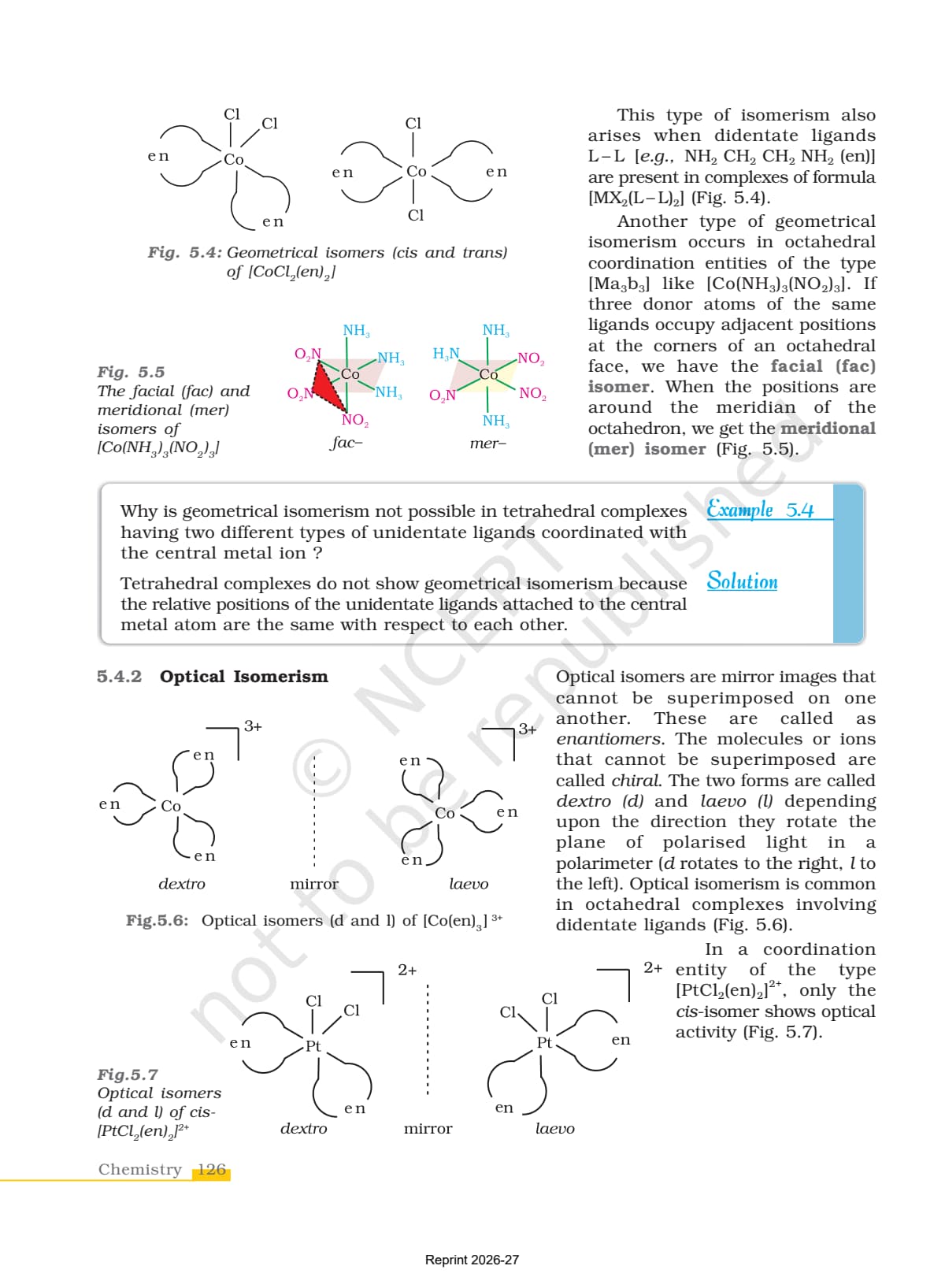
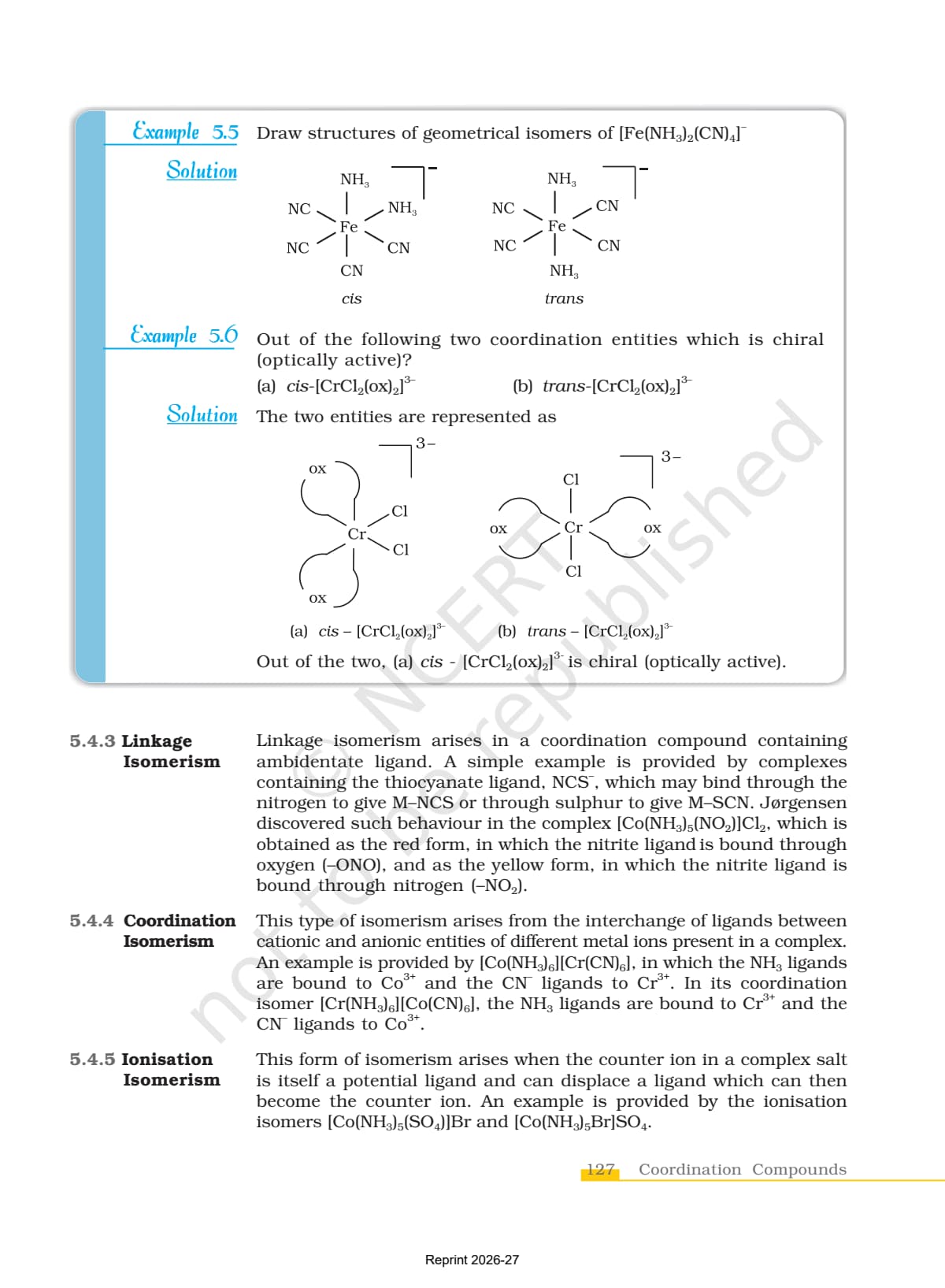
| 5.4 | Isomerism in Coordination Compounds | 10-14 | Stereoisomerism (geometric, optical) and structural isomerism (linkage, ionisation, coordination, solvate) |
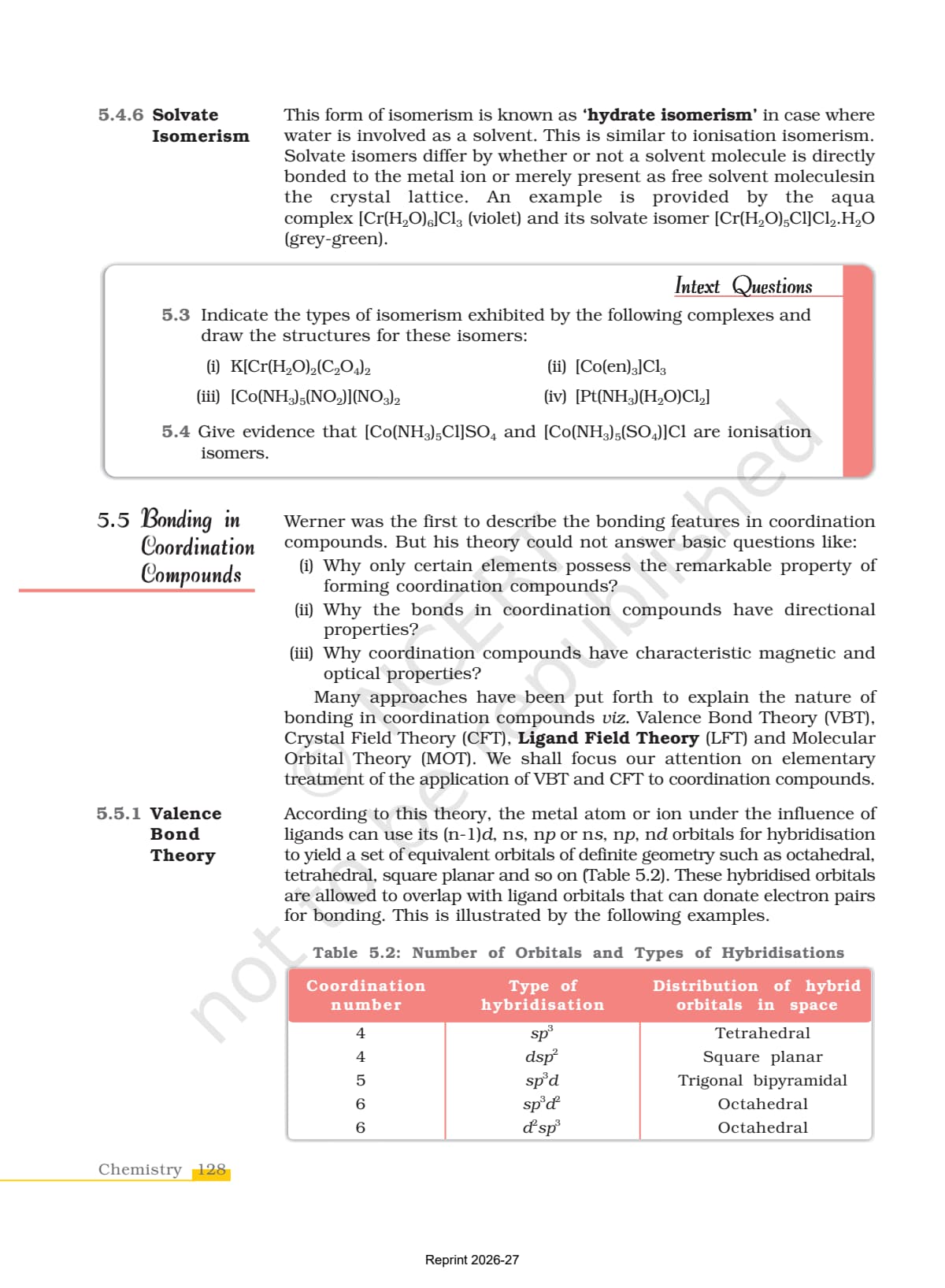
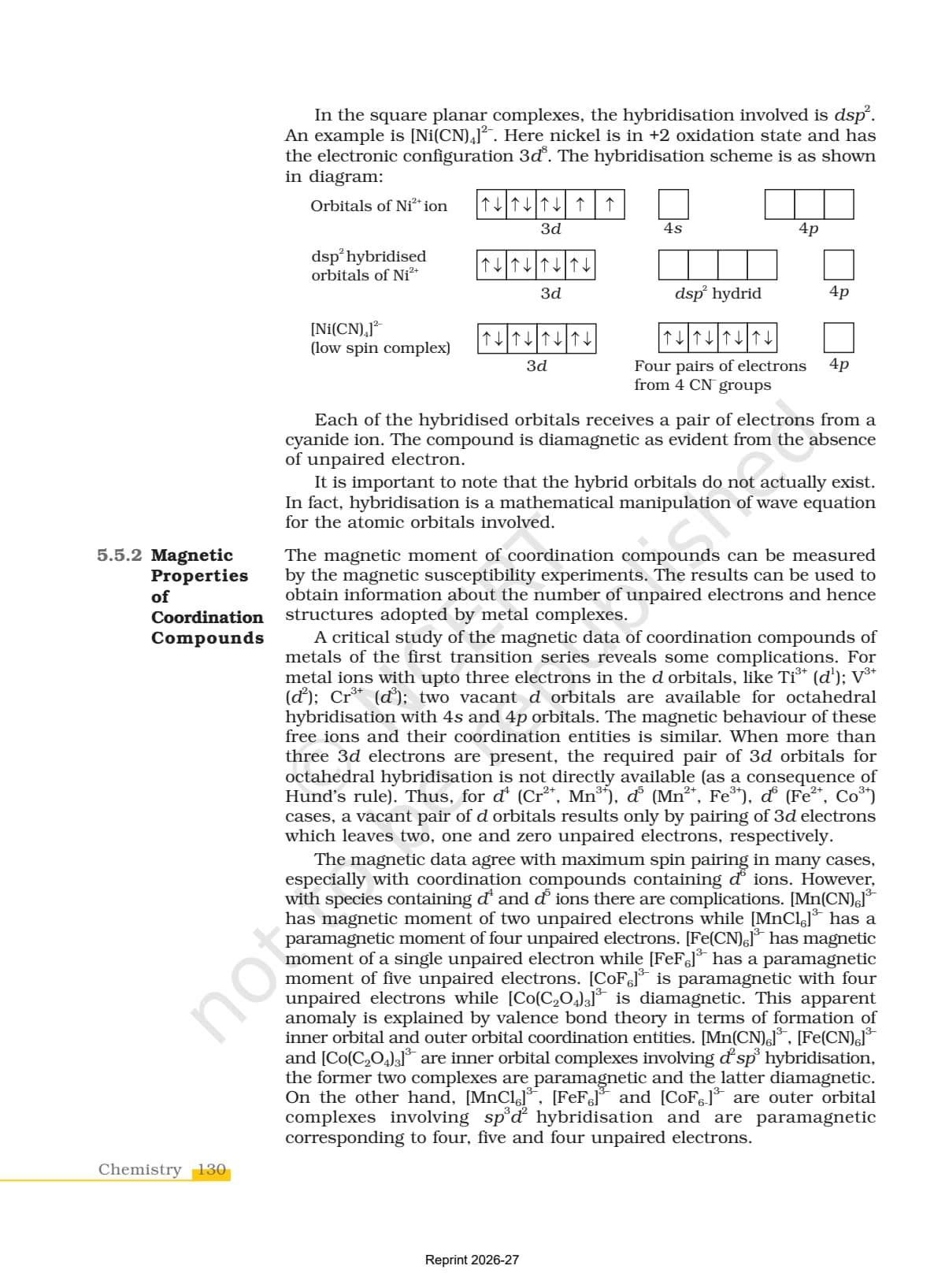
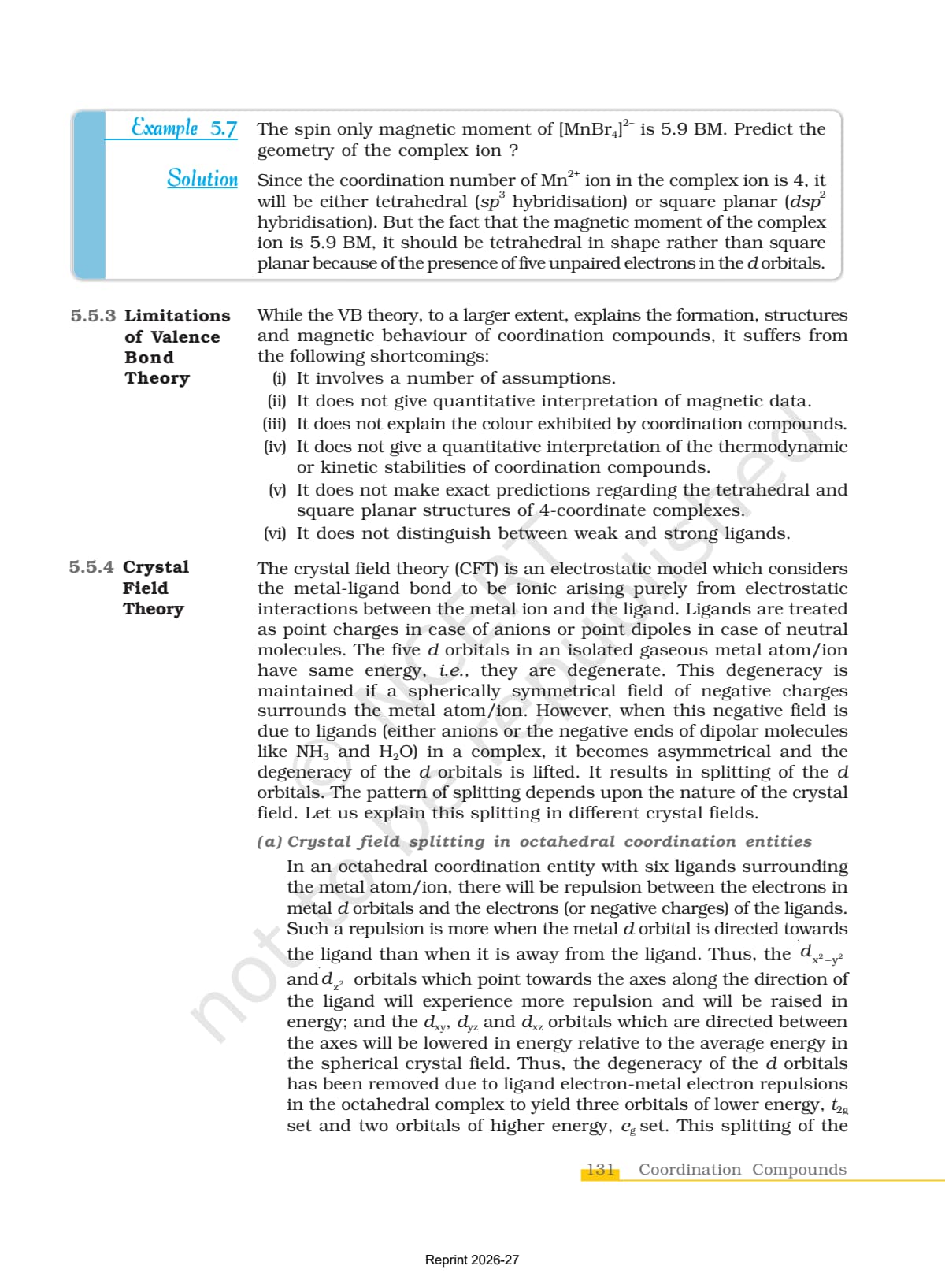
| 5.5 | Bonding in Coordination Compounds | 14-22 | Valence Bond Theory, inner/outer orbital complexes, magnetic moment predictions |
| 5.6 | Bonding in Metal Carbonyls | 22-24 | Sigma donation and pi back-bonding, structures of [Ni(CO)4], [Fe(CO)5], [Cr(CO)6] |
| 5.7 | Stability of Coordination Compounds | 24-26 | Stability constants K and beta, factors affecting stability, chelate effect |
| 5.8 | Importance and Applications | 26-28 | Biological systems, metallurgy, analysis, photography |
| - | Summary, Exercises (35 Qs) | 28-36 | End-of-chapter problems for board-level practice |
The 35 exercises split into IUPAC naming, isomerism drawing, VBT/CFT application, and short-answer items, with the IUPAC and VBT blocks the most repeated in CBSE Boards.
How to Read Coordination Compounds from the NCERT Class 12 Chemistry Book
The PDF rewards a three-pass read rather than a single linear read.
- Pass 1 - Skim: read only the section headings, the summary, and the boxed nomenclature rules.
- Pass 2 - Deep read: read sections 5.1 to 5.6 in order, hand-draw the cis/trans/d/l isomers, and solve every intext example first.
- Pass 3 - Practice: attempt all 35 exercises, checking the Collegedunia NCERT Solutions only after a genuine try.
What Changed in Coordination Compounds for 2026-27 NCERT (Rationalisation Note)
The 2026-27 print keeps Coordination Compounds but trimmed a few sub-topics and renumbered it from old Chapter 9 to Chapter 5.
| Sub-topic | Status in 2026-27 | Notes |
|---|---|---|
| Werner's theory and definitions | Kept | Core section, unchanged |
| IUPAC nomenclature of mononuclear complexes | Kept | Core section, unchanged |
| Stereoisomerism and structural isomerism | Kept | All four structural isomer types retained |
| Valence Bond Theory (VBT) | Kept | Inner / outer orbital treatment intact |
| Bonding in metal carbonyls (pi back-bonding) | Kept | Compact one-page section retained |
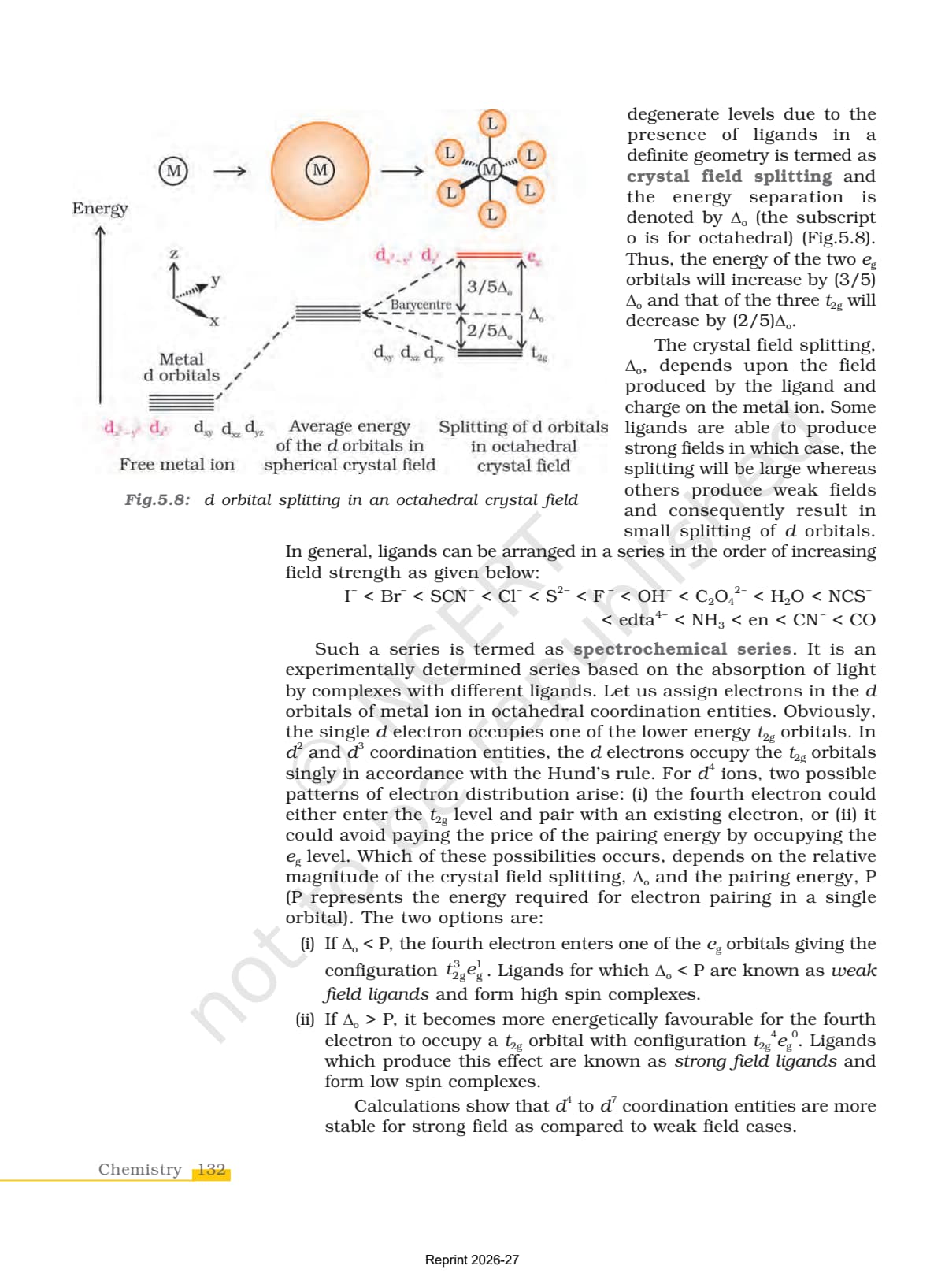
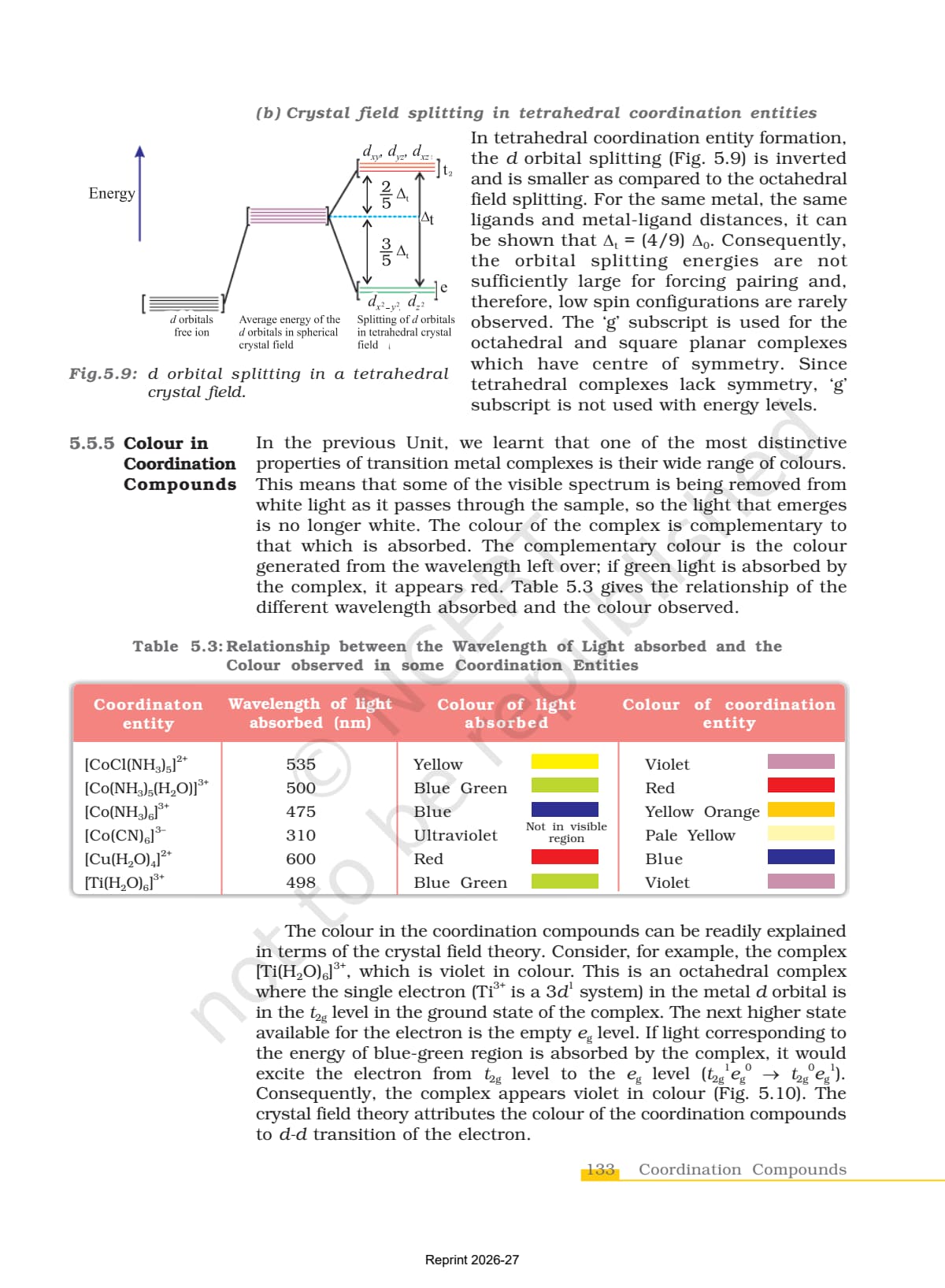
| Crystal Field Theory (CFT) | Trimmed | Splitting diagrams kept, but colour and limitations discussion condensed |
| Stability constants and applications | Kept | Detailed numerical treatment retained |
Students on the older 2022 print carry about 3 extra pages of trimmed CFT content. This page hosts the latest official 2026-27 NCERT.
Author, Edition and Publisher Information for the Coordination Compounds NCERT PDF
The PDF is the official publication, not a third-party reprint. Study from the latest print, as the rationalisation and renumbering changes are not back-ported to older copies.
- Book: Chemistry Part-I, Class 12 (Textbook for Class XII)
- Chapter: 5 - Coordination Compounds (legacy Chapter 9 in pre-rationalisation prints)
- Publisher: National Council of Educational Research and Training (NCERT)
- Edition: 2026-27 reprint (post-rationalisation)
- Total pages in the chapter: 36, including summary and exercises
- Language editions: English, Hindi (Rasayan Vigyan Bhag-I)
Related Links:
- Class 12 Chemistry NCERT Book PDF (All Chapters)
- CBSE Class 12 Chemistry Sample Papers 2026
- CBSE Class 12 Chemistry Previous Year Question Papers
Student Feedback
In a Collegedunia poll of 900 Class 12 students, 78% said the VBT hybridisation and magnetic-moment examples (5.6 and 5.7) were the toughest part of Coordination Compounds to master.
Other Resources for Coordination Compounds Class 12 Chemistry
- Coordination Compounds Class 12 Chemistry NCERT Book PDF
- Coordination Compounds Class 12 Chemistry NCERT Solutions
- Coordination Compounds Class 12 Chemistry Notes
- Coordination Compounds Class 12 Chemistry Formula Sheet
- Coordination Compounds Class 12 Chemistry NCERT Exemplar Book PDF
- Coordination Compounds Class 12 Chemistry NCERT Exemplar Solutions
- Coordination Compounds Class 12 Chemistry Handwritten Notes
NCERT Book PDF for Class 12 Chemistry: All Chapters
The table lists every chapter of the Class 12 Chemistry 2026-27 NCERT, each linking to its dedicated Collegedunia NCERT Book PDF page.
| Chapter | Resource |
|---|---|
| Chapter 1 | Solutions NCERT Book PDF |
| Chapter 2 | Electrochemistry NCERT Book PDF |
| Chapter 3 | Chemical Kinetics NCERT Book PDF |
| Chapter 4 | The d- and f-Block Elements NCERT Book PDF |
| Chapter 6 | Haloalkanes and Haloarenes NCERT Book PDF |
| Chapter 7 | Alcohols, Phenols and Ethers NCERT Book PDF |
| Chapter 8 | Aldehydes, Ketones and Carboxylic Acids NCERT Book PDF |
| Chapter 9 | Amines NCERT Book PDF |
| Chapter 10 | Biomolecules NCERT Book PDF |
Coordination Compounds Class 12 Chemistry NCERT Book PDF FAQs
Ques. Where can I download the Class 12 Chemistry Chapter 5 Coordination Compounds NCERT Book PDF?
Ans. You can download the Coordination Compounds Class 12 Chemistry NCERT Book PDF directly from this page. Both the Normal and HD versions are available and both are free, with no registration required.
Ques. Is the Coordination Compounds chapter aligned with the 2026-27 NCERT?
Ans. Yes. The PDF reflects the current 2026-27 syllabus for Class 12 Chemistry. The chapter retains all eight core sections on Werner's theory, definitions, IUPAC nomenclature, isomerism, VBT, bonding in metal carbonyls, stability, and applications; the extended discussion of CFT colour and limitations has been condensed in the new edition.
Ques. How many pages is the Class 12th Chemistry Coordination Compounds NCERT Book PDF?
Ans. The chapter runs roughly 36 pages, including the 8 numbered sections, 9 intext examples, the summary, and the 35 end-of-chapter exercises.
Ques. How many marks does Coordination Compounds carry in the CBSE Class 12 Chemistry Board exam?
Ans. Coordination Compounds typically carries 7 to 9 marks in the Class 12 Chemistry Board exam. It is jointly the highest-weightage chapter alongside Solutions. The marks are usually split as one 3-mark IUPAC + isomerism question plus one 5-mark hybridisation or CFT case study.
Ques. Why was the chapter renumbered from 9 to 5?
Ans. The 2026-27 NCERT reduced the Class 12 Chemistry book from 16 chapters (across Parts I and II) to a single 10-chapter Part-I book. Coordination Compounds moved from old Chapter 9 to current Chapter 5 in this consolidation. The chapter content itself is largely retained; only the numbering changed.
Ques. Which intext examples in Coordination Compounds are most important for Boards?
Ans. Examples 5.3 (IUPAC naming), 5.4 (geometric isomers), 5.6 (VBT hybridisation of tetrahedral complex), and 5.7 (magnetic moment prediction) are the highest-yield. Practise each at least twice before the exam.
Ques. Has any topic been removed from Coordination Compounds in the latest NCERT edition?
Ans. No major sub-topic was fully removed. The Crystal Field Theory discussion of colour and the limitations of CFT was trimmed to a shorter form in the 2026-27 print; all eight numbered sections and both bonding theories (VBT and CFT) are intact.
Ques. How long should I take to complete the Coordination Compounds NCERT chapter?
Ans. A four-day plan of about 10 to 11 hours total is realistic - one day for Werner's theory and definitions, one for IUPAC nomenclature, one for isomerism plus VBT, and one for carbonyls/stability/applications plus full revision.



Comments