




Haloalkanes and Haloarenes is the gateway to substitution, elimination, and nearly every functional-group conversion in the later Class 12 Organic Chemistry chapters. This page gives you the full official 2026-27 NCERT chapter PDF.


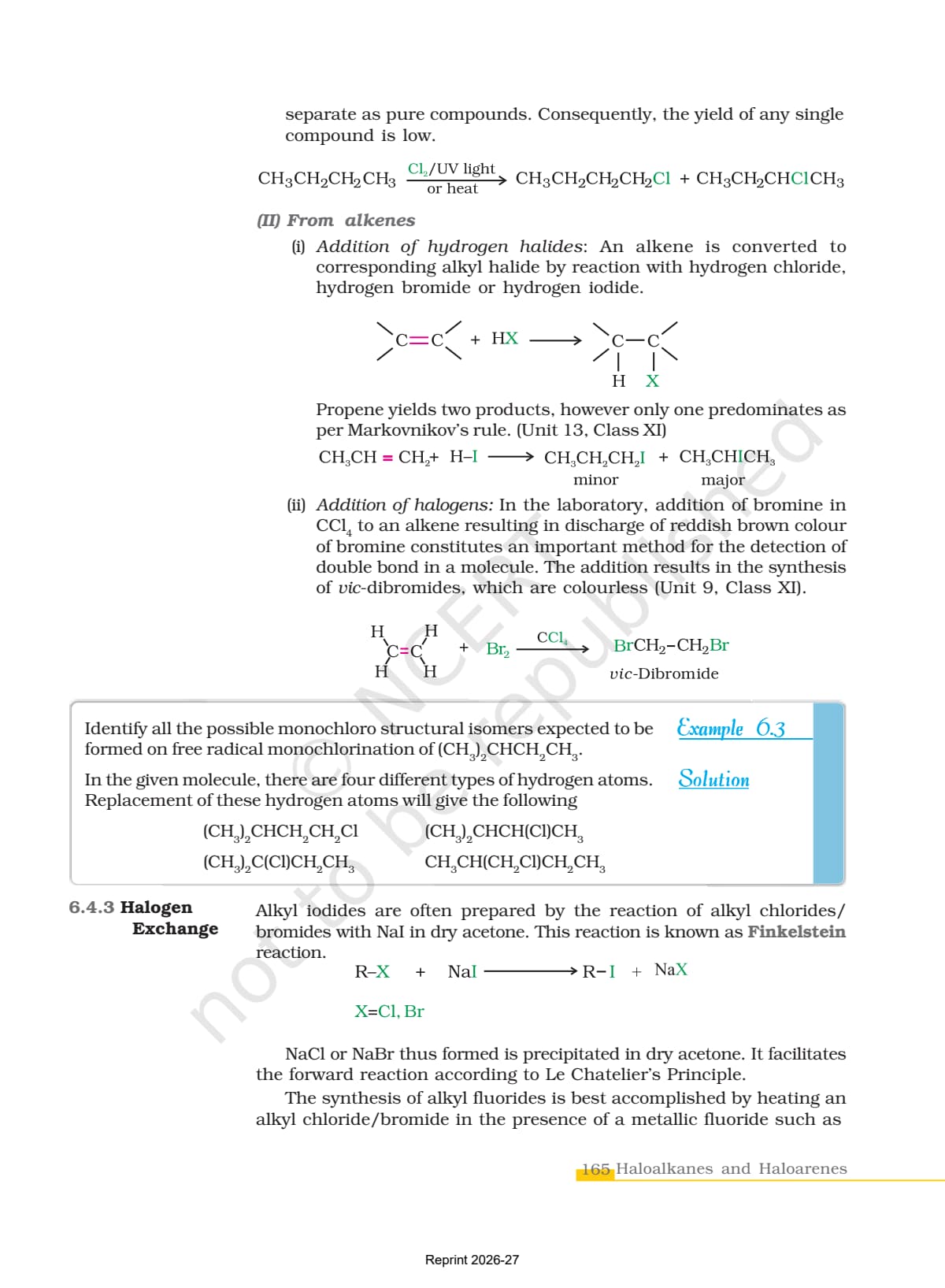
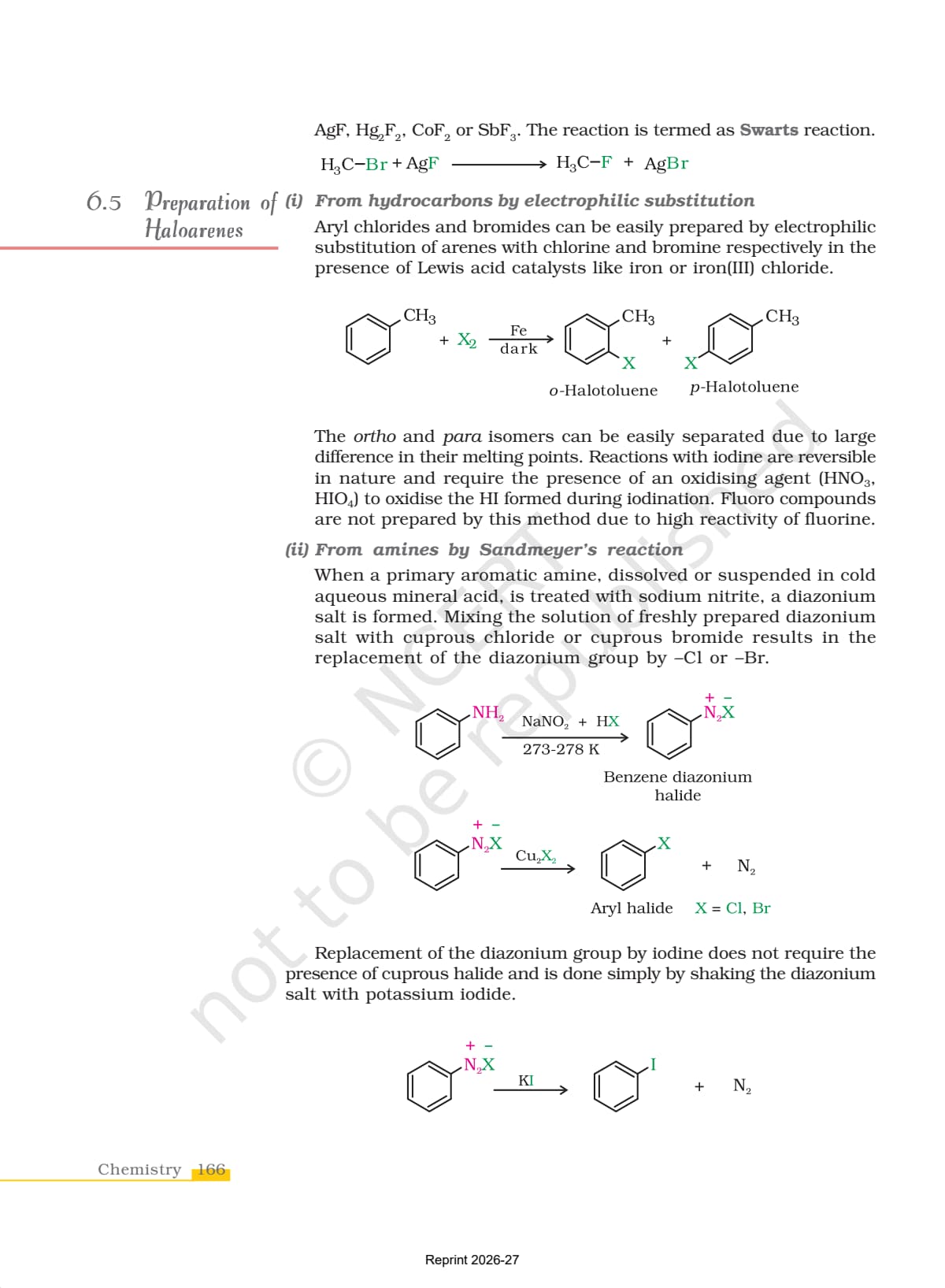
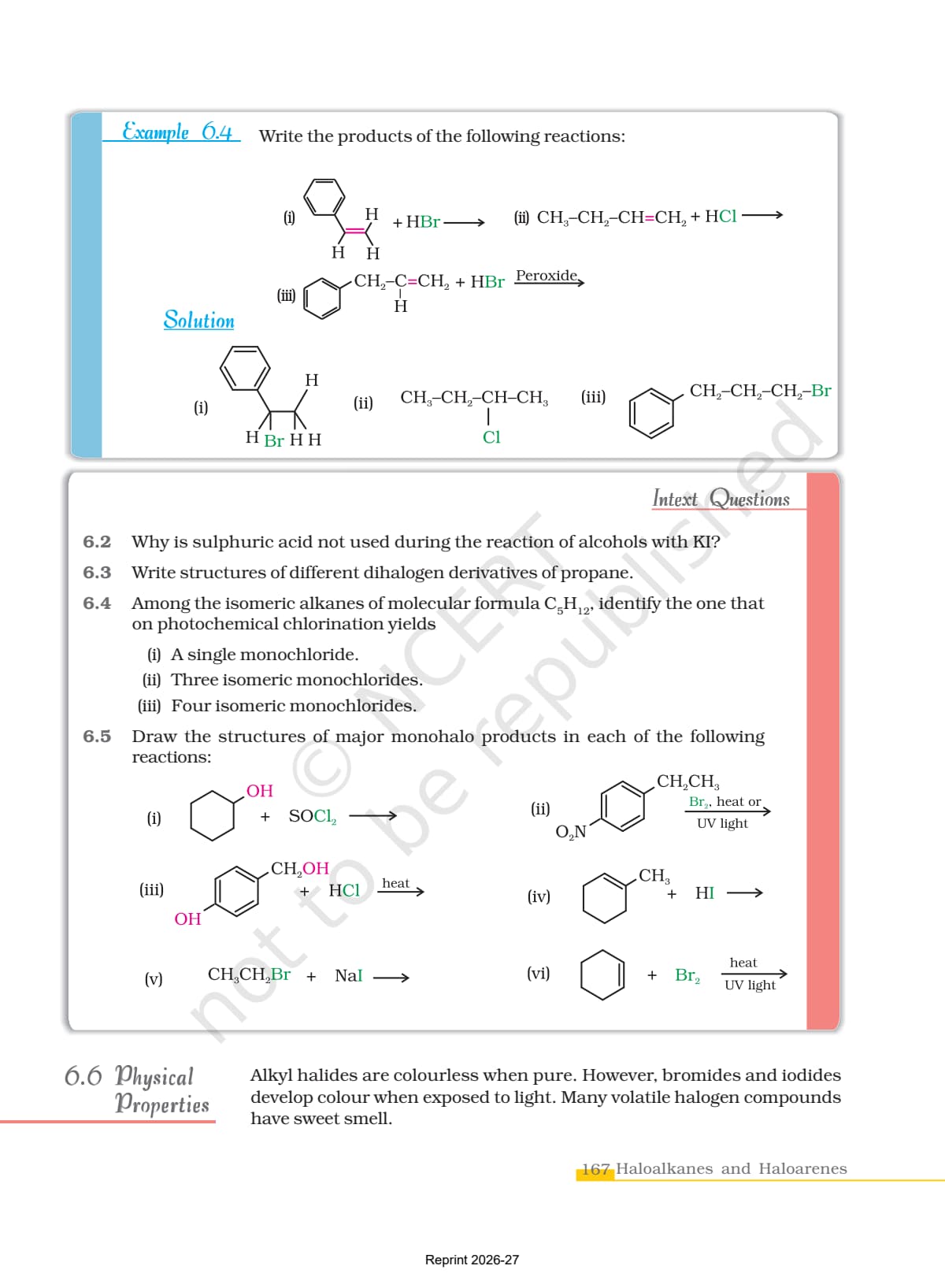
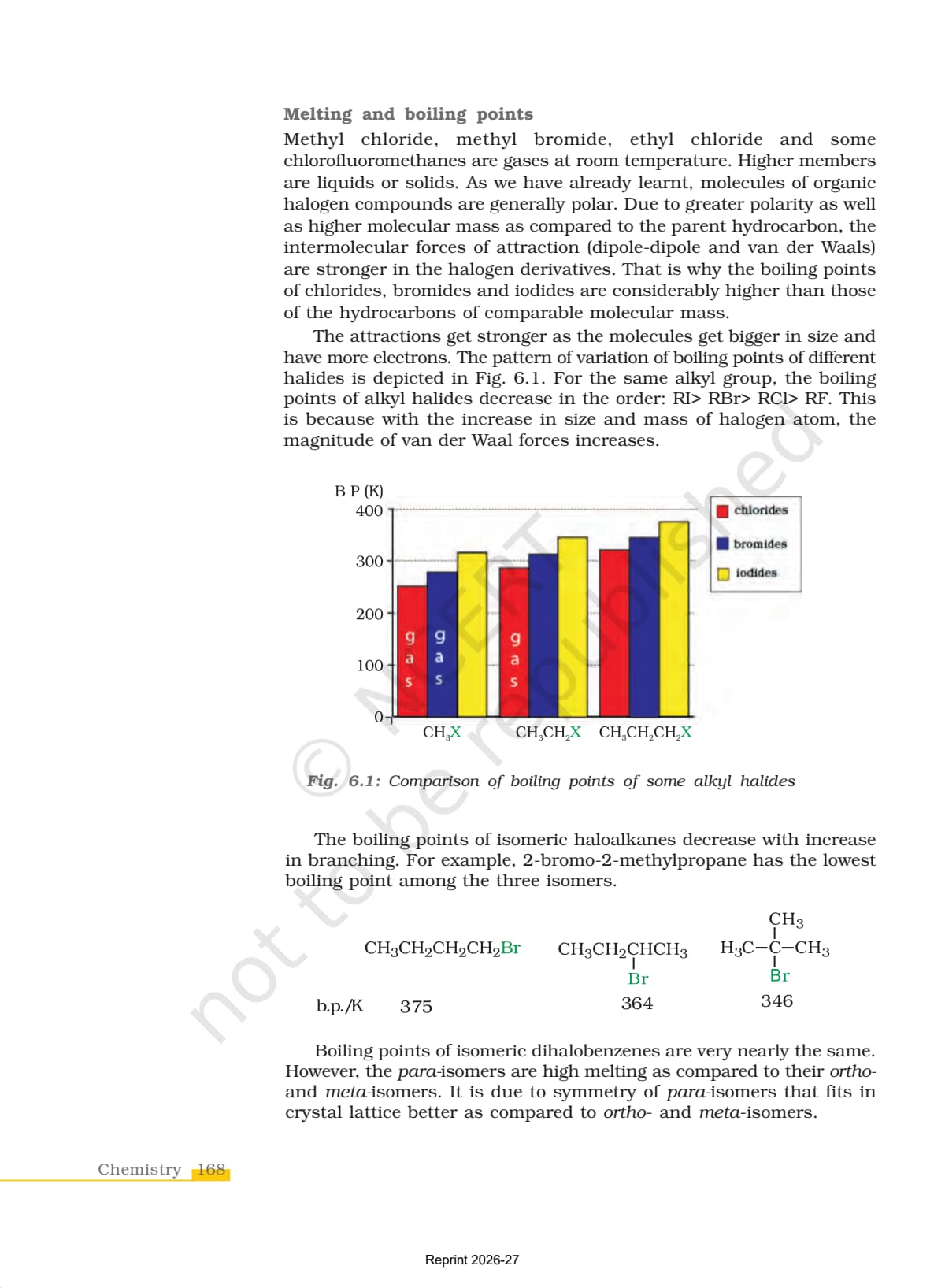



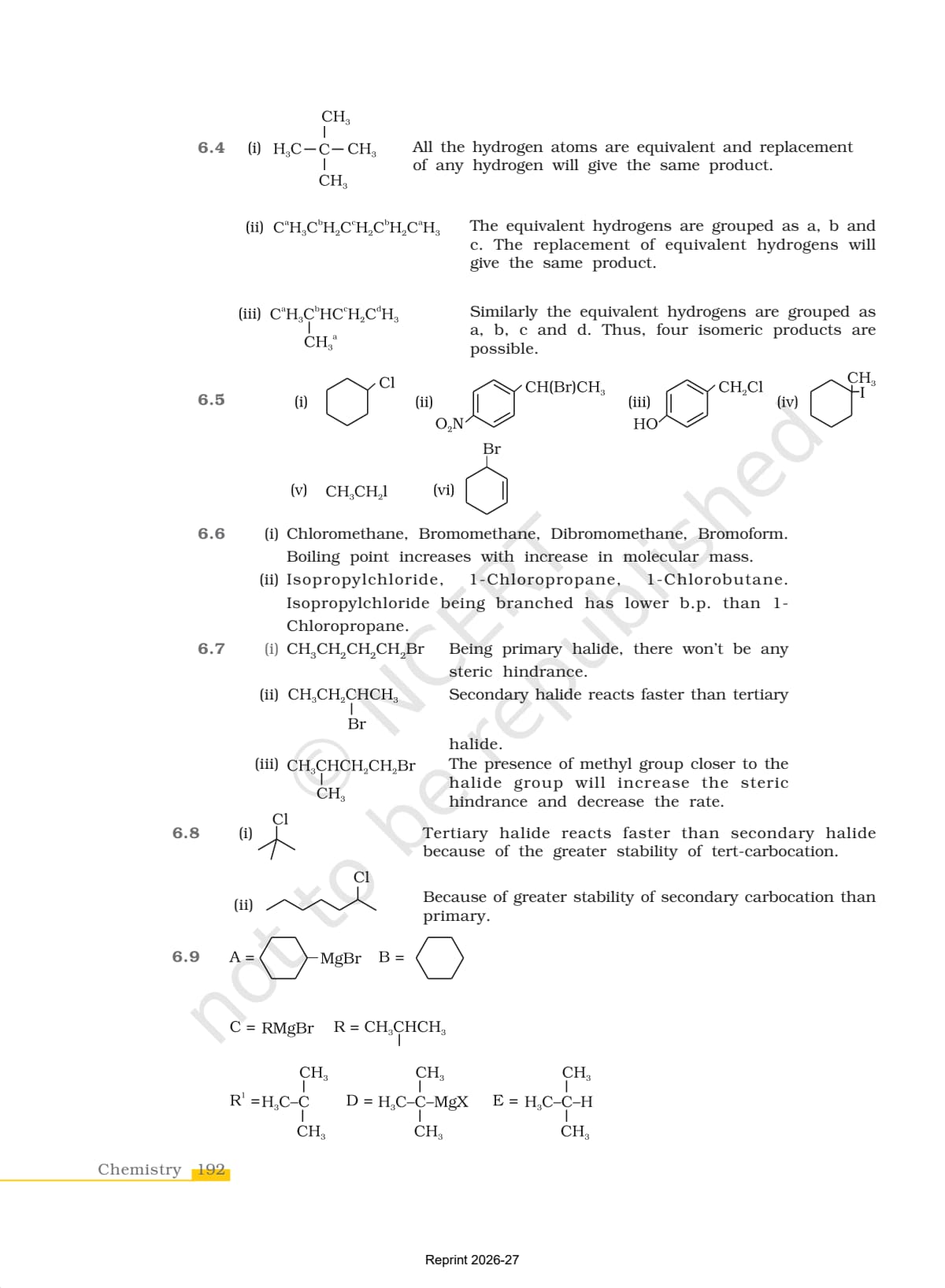
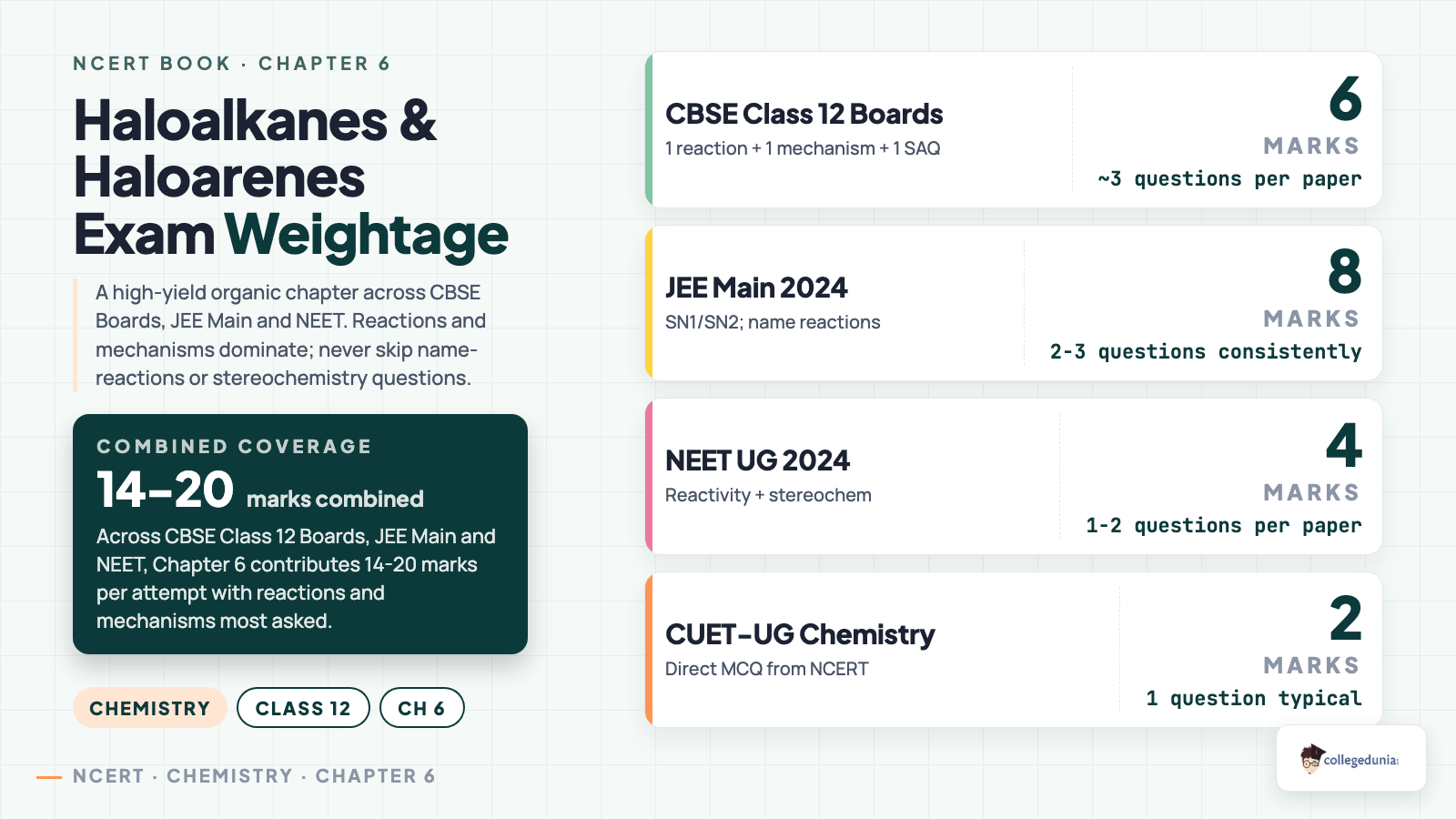
- CBSE Weightage: 3 to 5 marks (typically one 2-mark mechanism question plus one 3-mark name-reaction or distinction item)
- JEE Main Weightage: 2 to 3% (around 1 to 2 questions per shift on SN1/SN2 outcomes, optical activity, and named haloarene reactions)
- NEET Weightage: 2 to 3 question(s) per year, primarily on reactivity order and stereochemistry
The PDF above is the full official NCERT print for Chapter 6 of the Class 12 Chemistry Part-II book. The tables below map it into a board-ready study plan.
This NCERT Book PDF is the official NCERT 2026-27 edition, matched to the CBSE Class 12 Chemistry syllabus.
Also Check:
- Class 12 Chemistry Chapter 5 Coordination Compounds NCERT Book PDF
- Class 12 Chemistry Chapter 7 Alcohols, Phenols and Ethers NCERT Book PDF
- CBSE Class 12 Chemistry Syllabus 2026-27
Why Haloalkanes and Haloarenes Earns Its Slot in Class 12 Chemistry
Chapter 6 is the mechanism foundation of Class 12 Organic Chemistry. Every conversion in Chapters 7, 8 and 9 traces back to an SN1, SN2, E1 or E2 step introduced here.
It is also the only place in Class 12 where stereochemistry appears in a reaction context, so JEE Main often lifts a mechanism stem straight from these pages.
Haloalkanes and Haloarenes Class 12 Chemistry Explained
Source: Magnet Brains on YouTube
How will Collegedunia's NCERT Book PDF Help You with Haloalkanes and Haloarenes?
The official NCERT print is the single source of truth for CBSE Boards, and this page wraps it with the navigation aids that the PDF itself does not carry.
- 2026-27 NCERT Alignment: The PDF here is the latest NCERT print, with every change from the previous 2022 edition flagged in the rationalisation section below.
- Mechanism-by-Mechanism Index: The section breakdown table maps SN1, SN2, E1, E2, and electrophilic-aromatic-substitution discussions to exact page ranges, so you can revise a single mechanism without rereading the chapter.
- Reading Sequence: A skim-then-deep-dive plan tells you which sections to read first (nomenclature, prep) and which to drill (mechanisms, named reactions).
- Cross-Reference to Companion Resources: Every section in the PDF is mapped to the matching Collegedunia Notes, Formula Sheet, and NCERT Solutions for that sub-topic.
Haloalkanes and Haloarenes Class 12th Chemistry NCERT Intext Examples and Their Sub-Topics
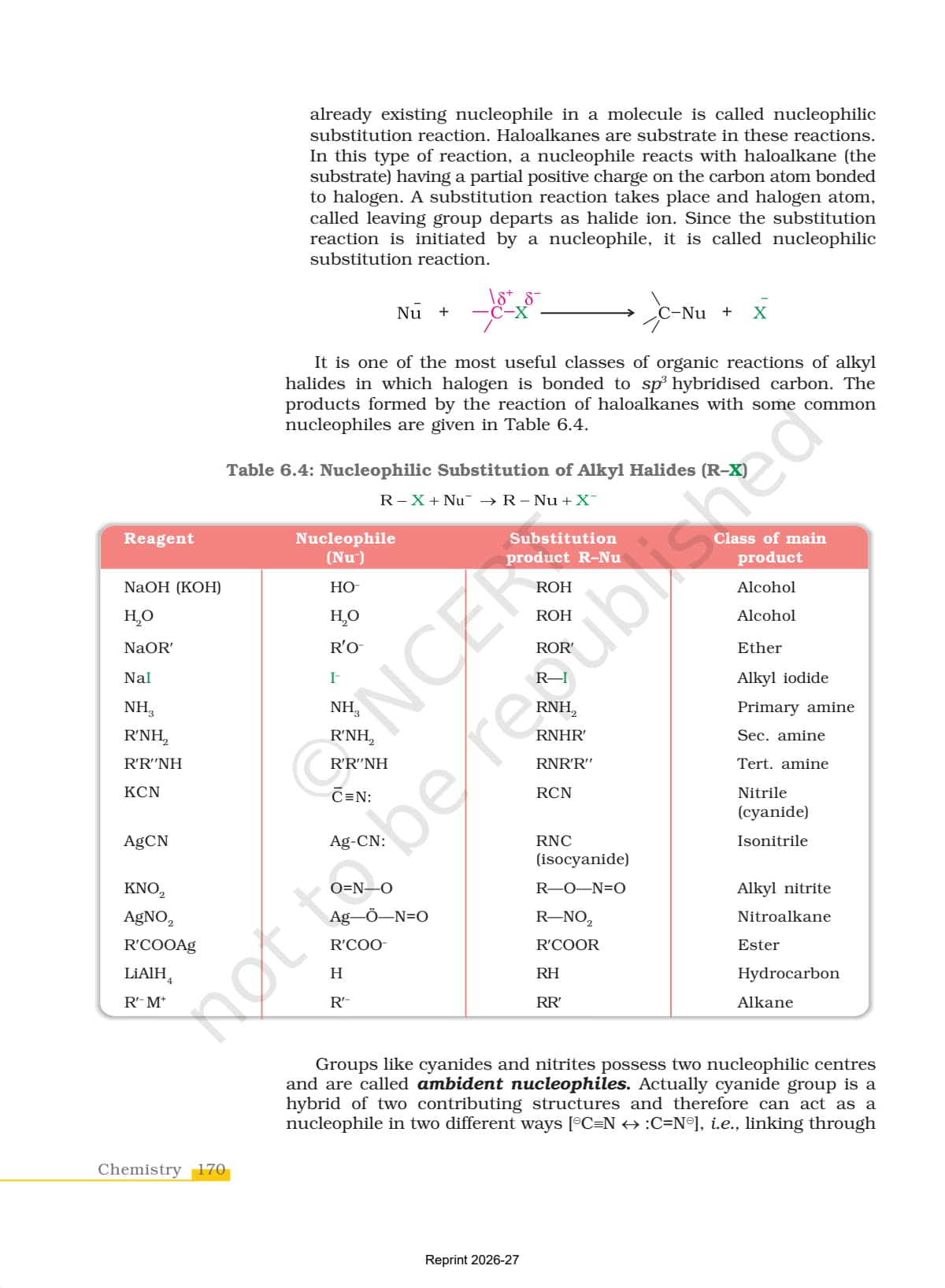
The 2026-27 print of Chapter 6 carries 10 solved intext examples spread across roughly 26 pages of theory. Each example demonstrates a specific reasoning skill that recurs in CBSE conceptual answers and JEE / NEET MCQs. The table below tags every example with the sub-topic it tests.
| Example | Sub-topic | Skill tested |
|---|---|---|
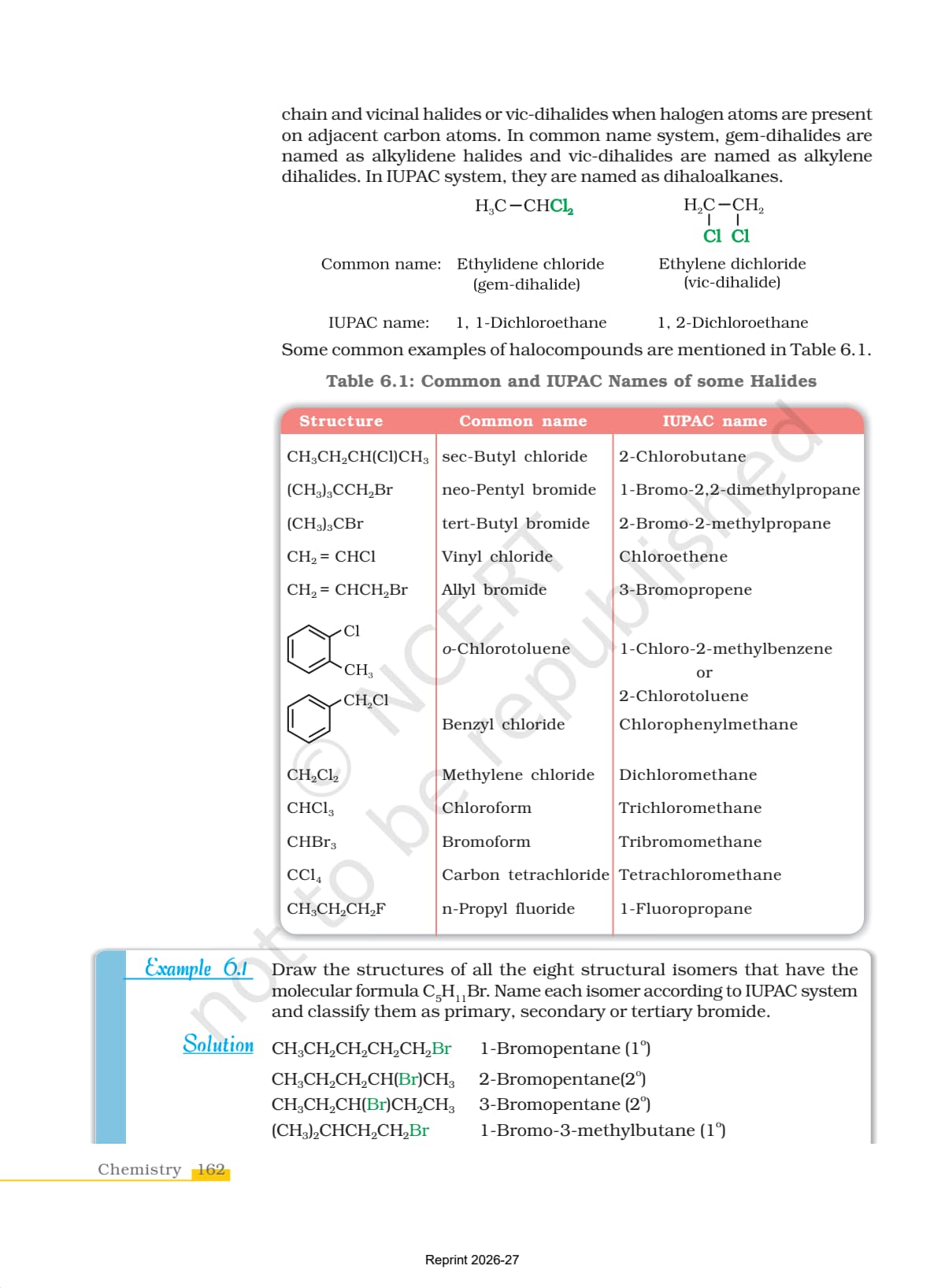
| 6.1 | IUPAC nomenclature of haloalkanes | Lowest-locant rule with halogen substituent |
| 6.2 | Preparation by Finkelstein reaction | Halide exchange in dry acetone |
| 6.3 | Dipole moment comparison | Resultant dipole in chloro vs bromo compound |
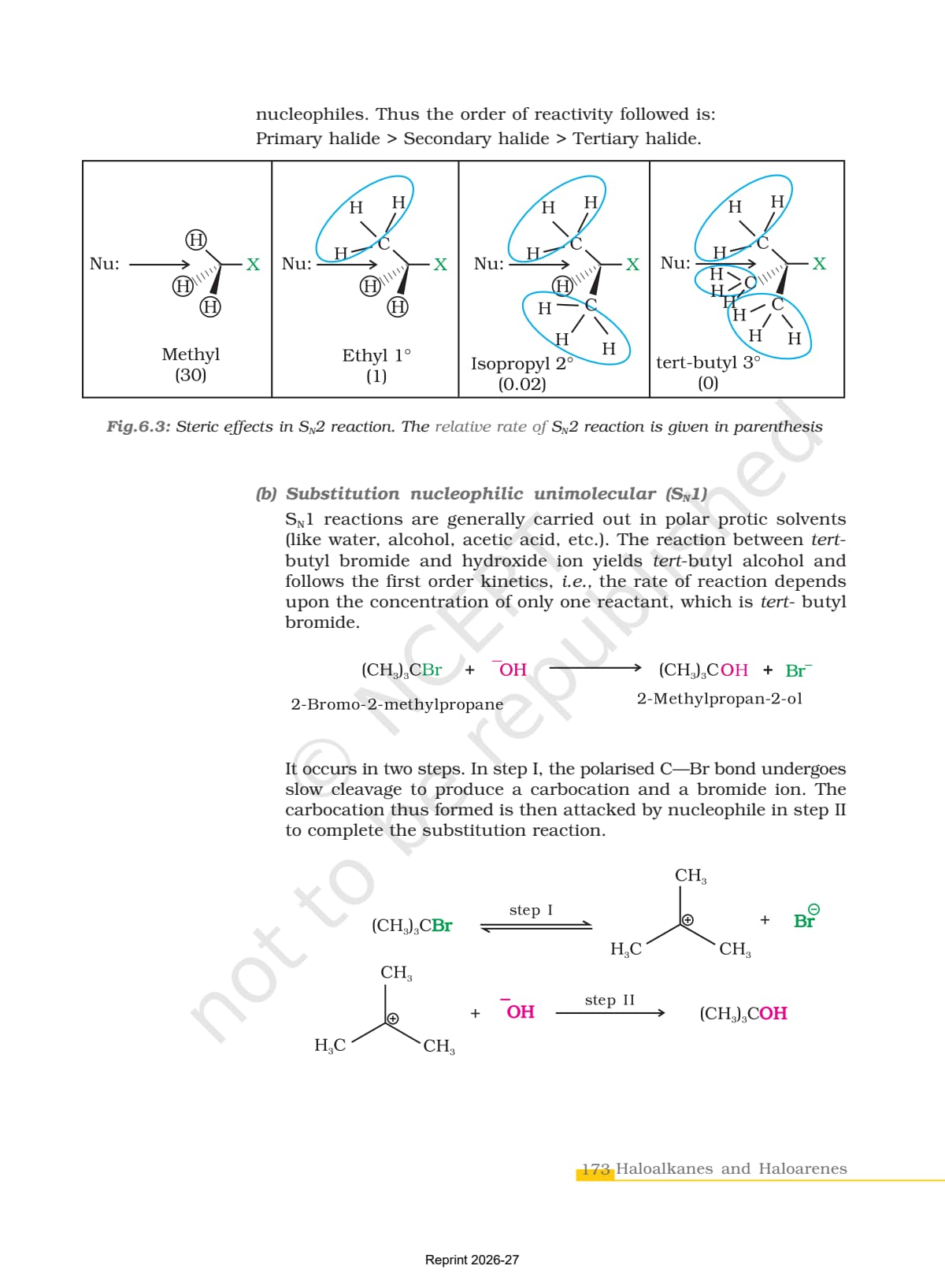
| 6.4 | SN2 reactivity order | Steric and electronic argument for 1° > 2° > 3° |
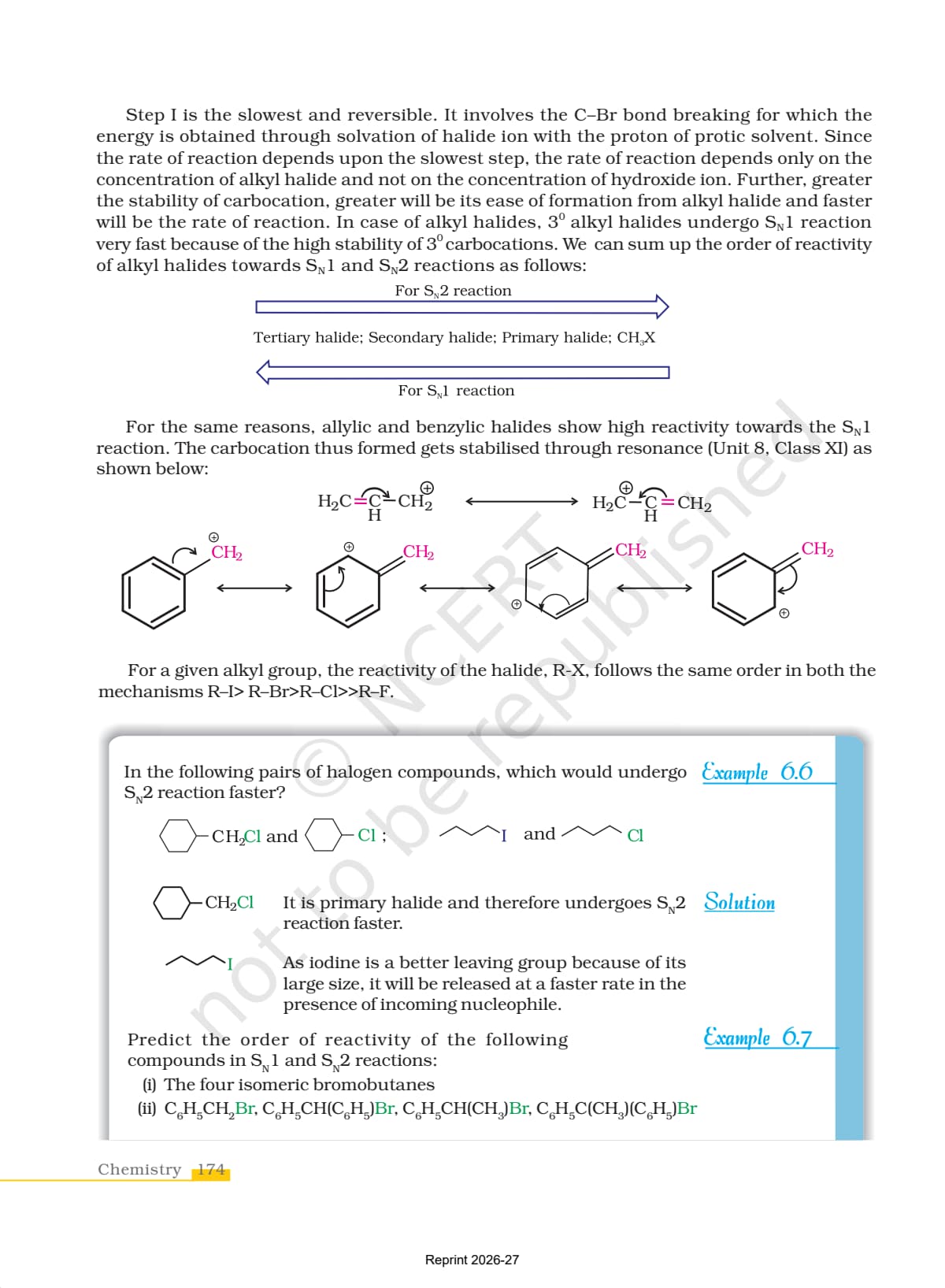
| 6.5 | SN1 reactivity order | Carbocation stability for 3° > 2° > 1° |
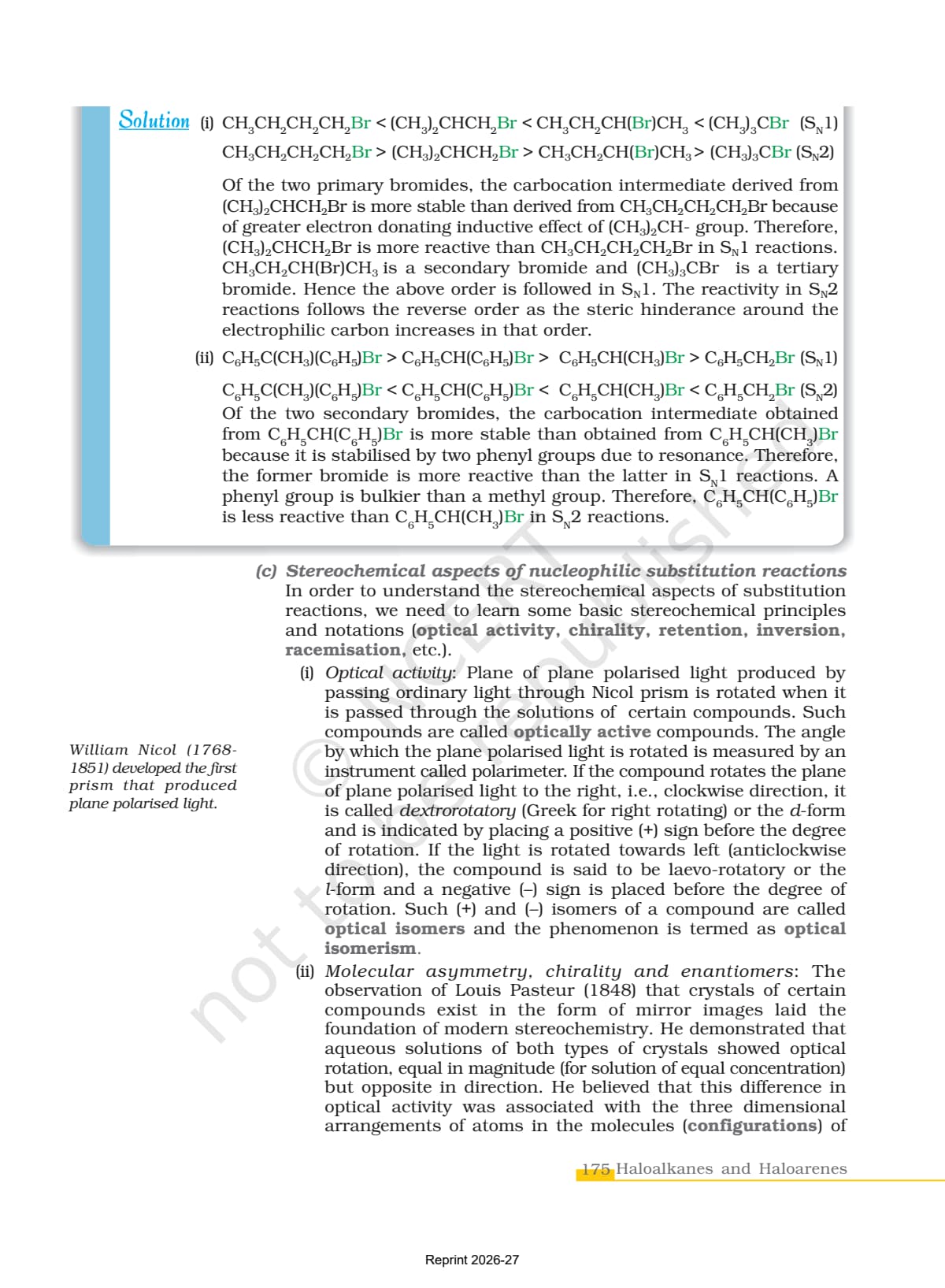
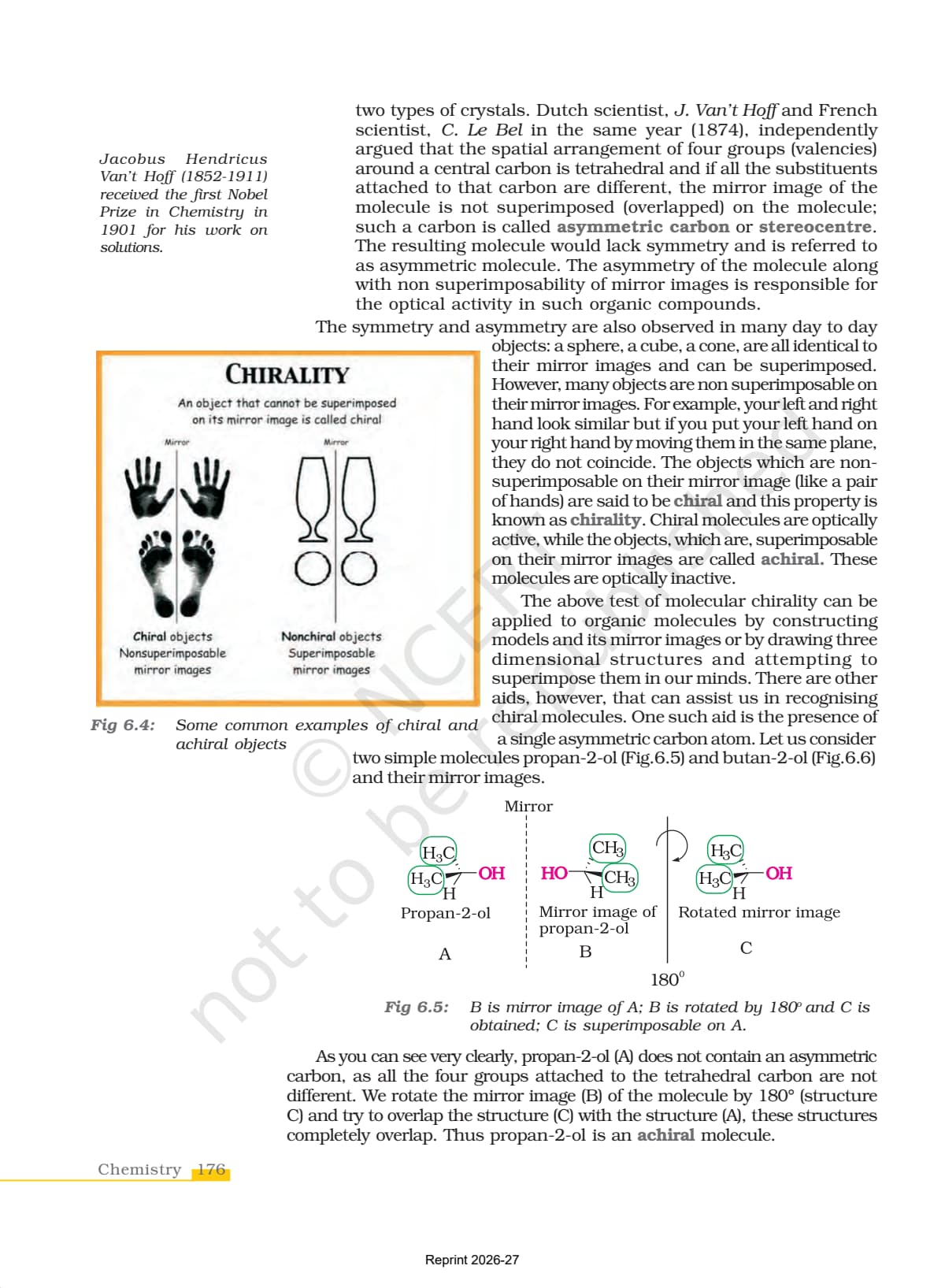
| 6.6 | Optical activity and Walden inversion | Configuration change in SN2 |
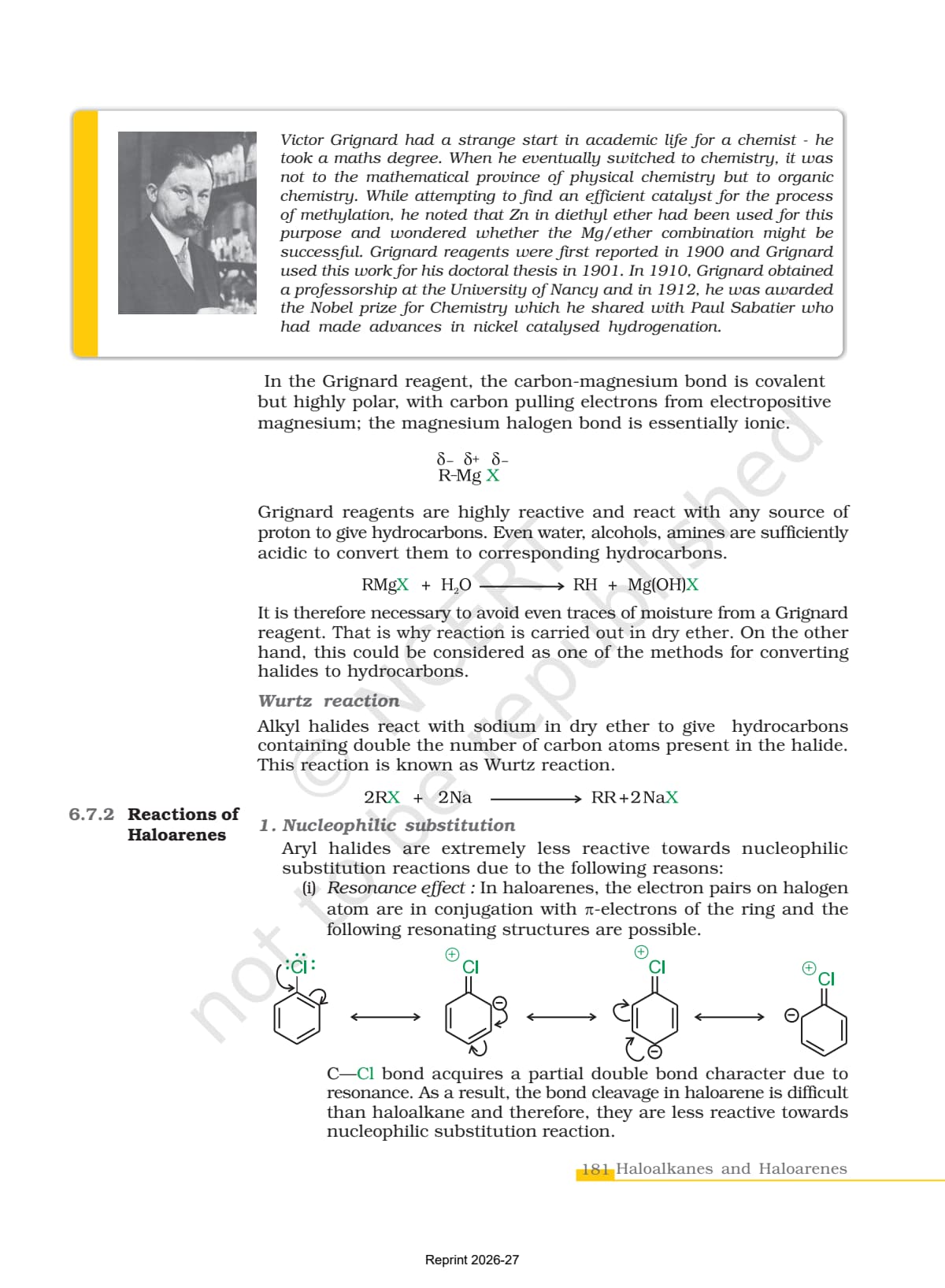
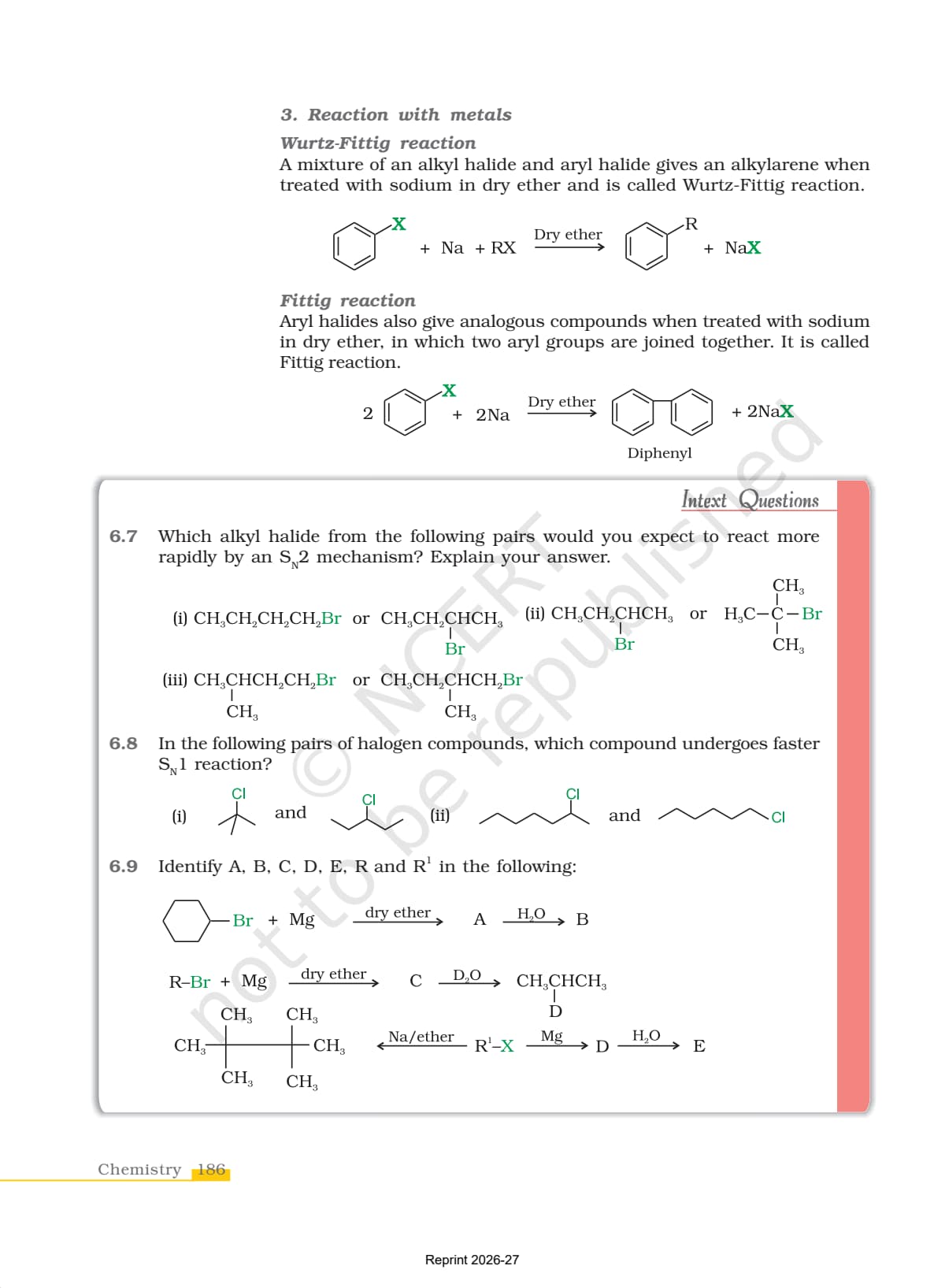
| 6.7 | Wurtz reaction | Alkyl halide + Na in dry ether to a higher alkane |
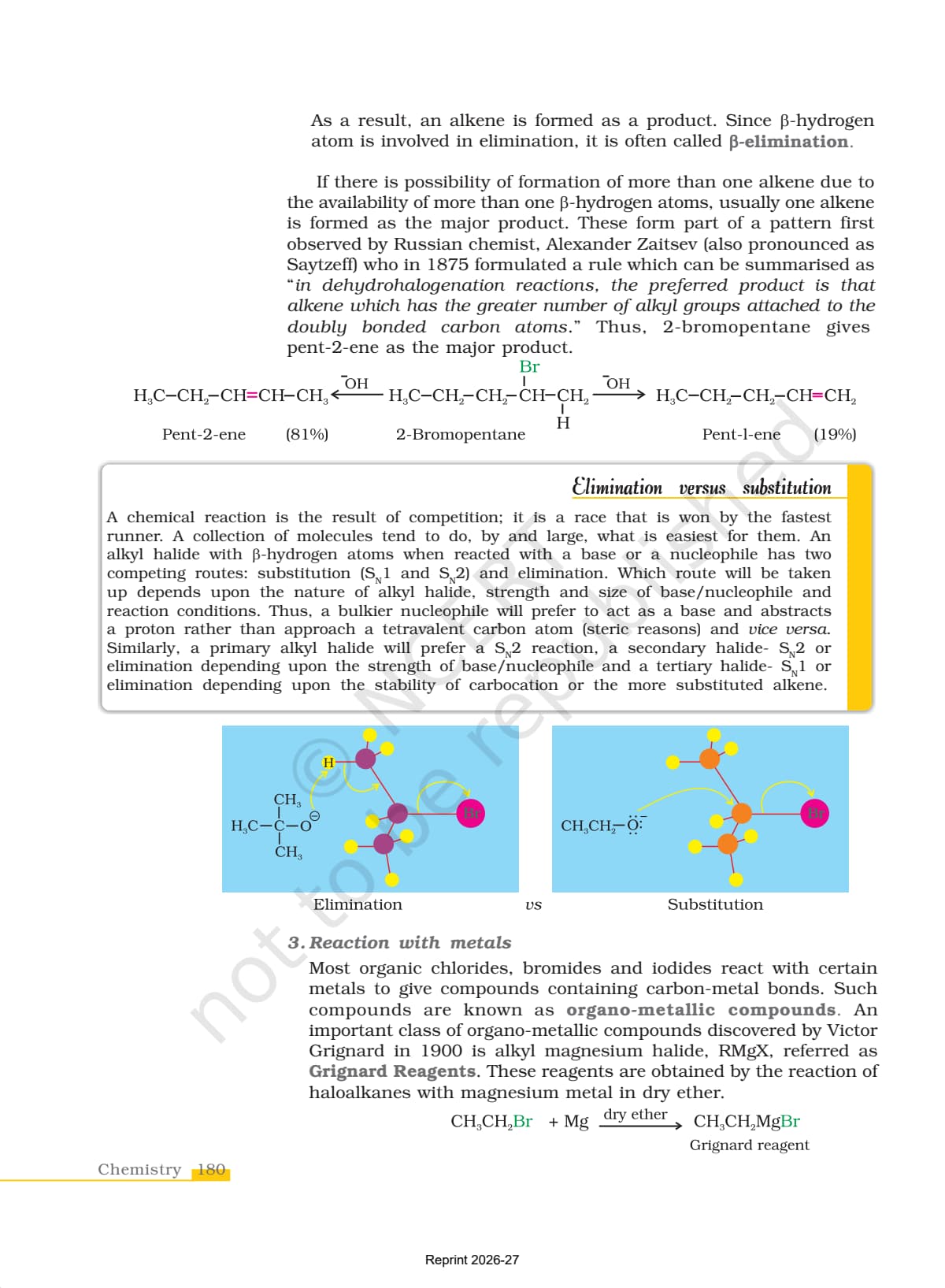
| 6.8 | Saytzeff (Zaitsev) elimination | Pick the more substituted alkene |
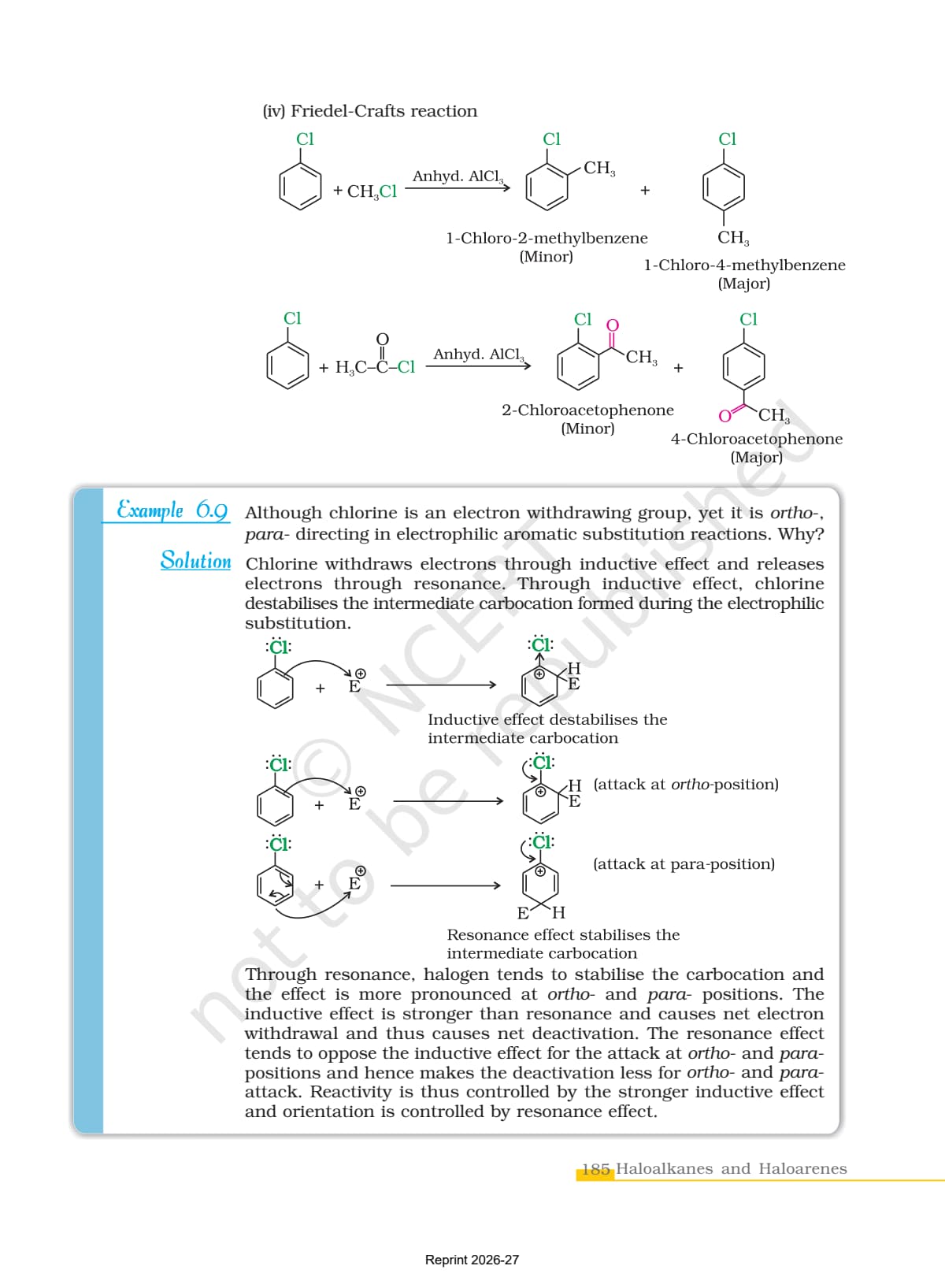
| 6.9 | Electrophilic aromatic substitution in chlorobenzene | ortho/para directing under -I but +R |
| 6.10 | Sandmeyer reaction | Diazonium to haloarene route |
Haloalkanes and Haloarenes NCERT Book: Section-by-Section Breakdown with Page Numbers
The chapter has ten numbered sections plus a summary and exercises, and the table below maps each to its approximate page range and one-line scope. Sections 6.6 (chemical reactions of haloalkanes) and 6.7 (reactions of haloarenes) together account for more than half of all CBSE marks from this chapter.
| Section | Title | Pages | What it covers |
|---|---|---|---|
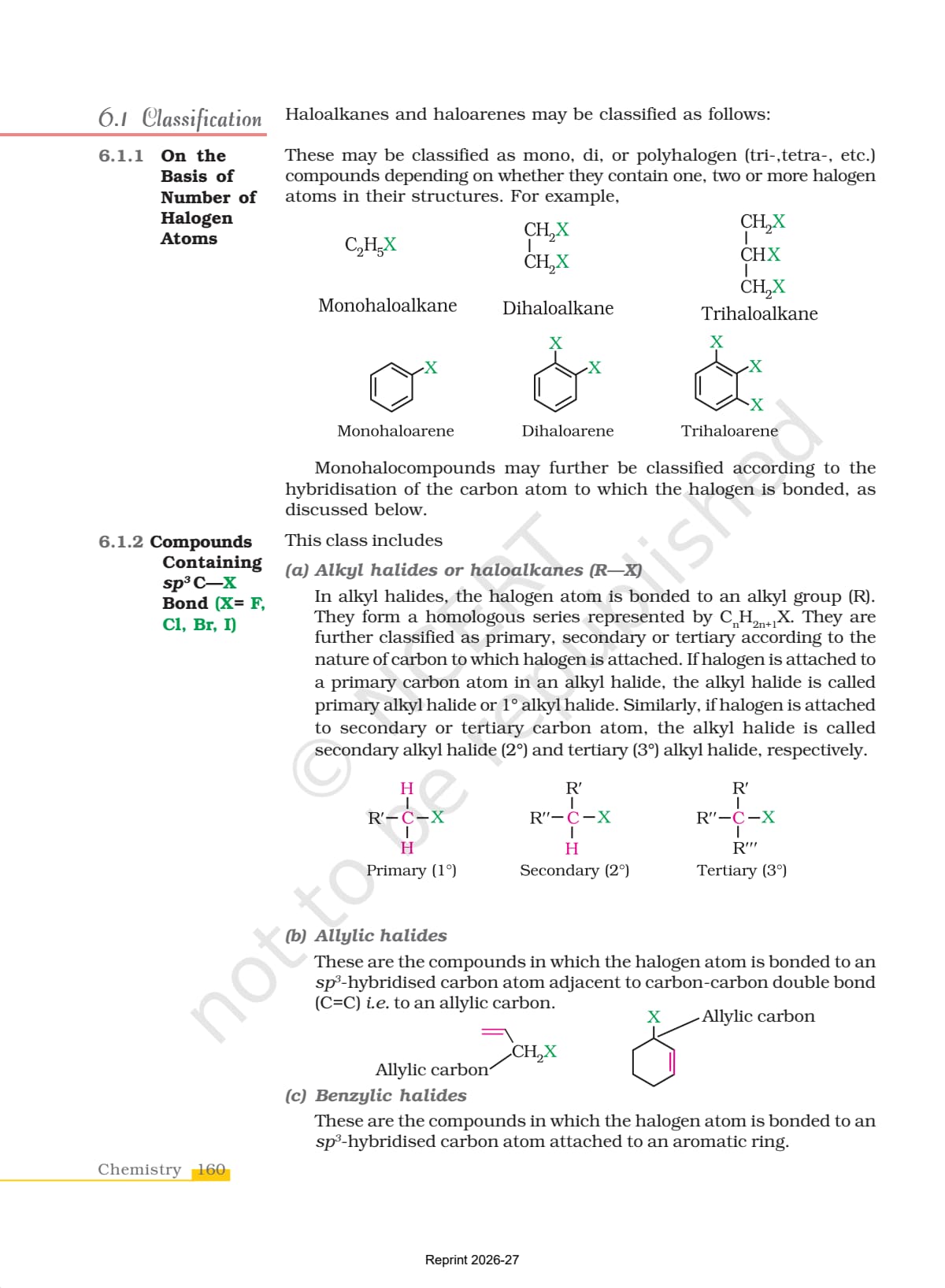
| 6.1 | Classification | 1-3 | Mono / di / poly halides; primary, secondary, tertiary; allylic, benzylic, vinylic, aryl |
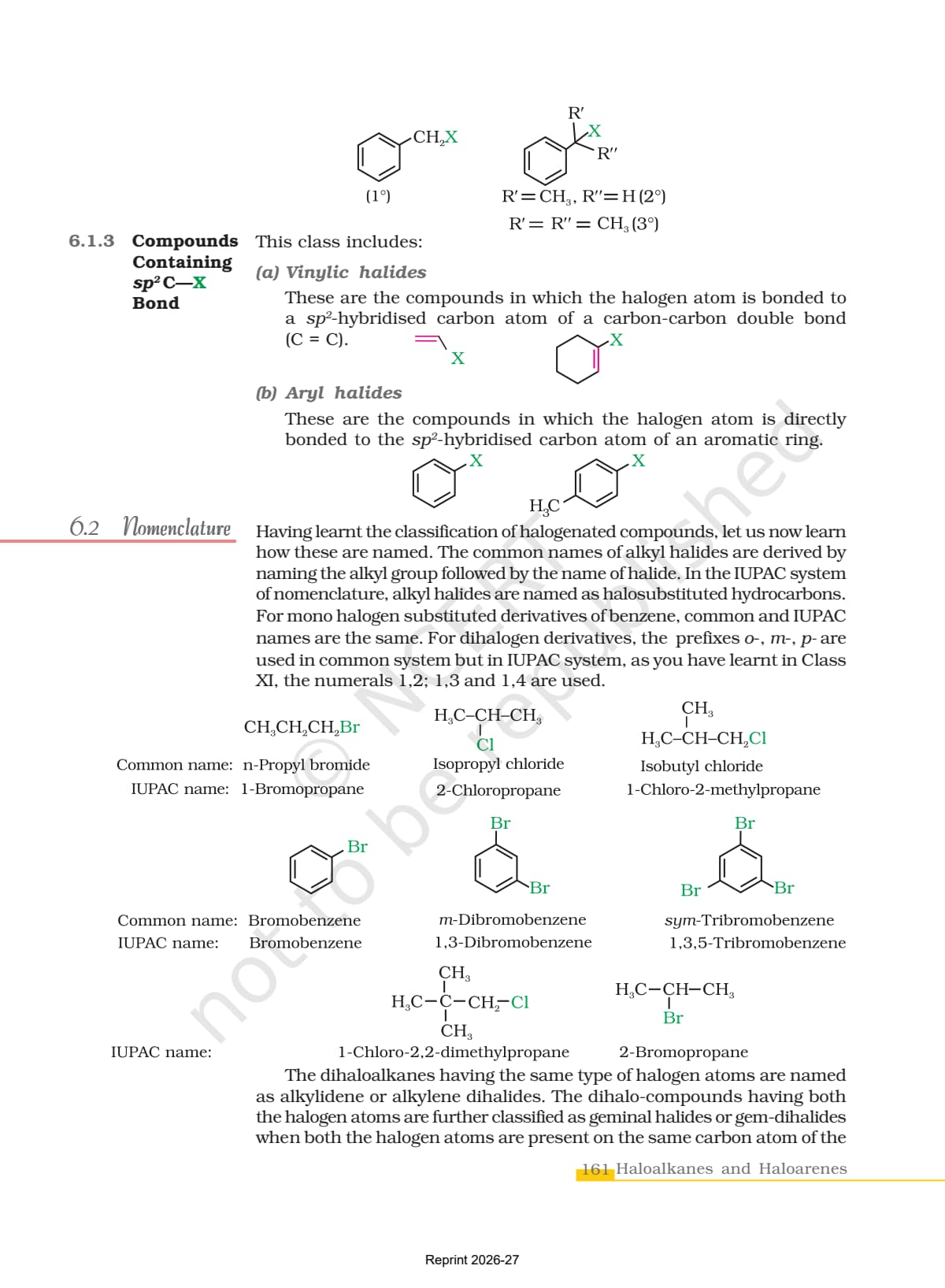
| 6.2 | Nomenclature | 3-5 | Common and IUPAC names of haloalkanes and haloarenes |
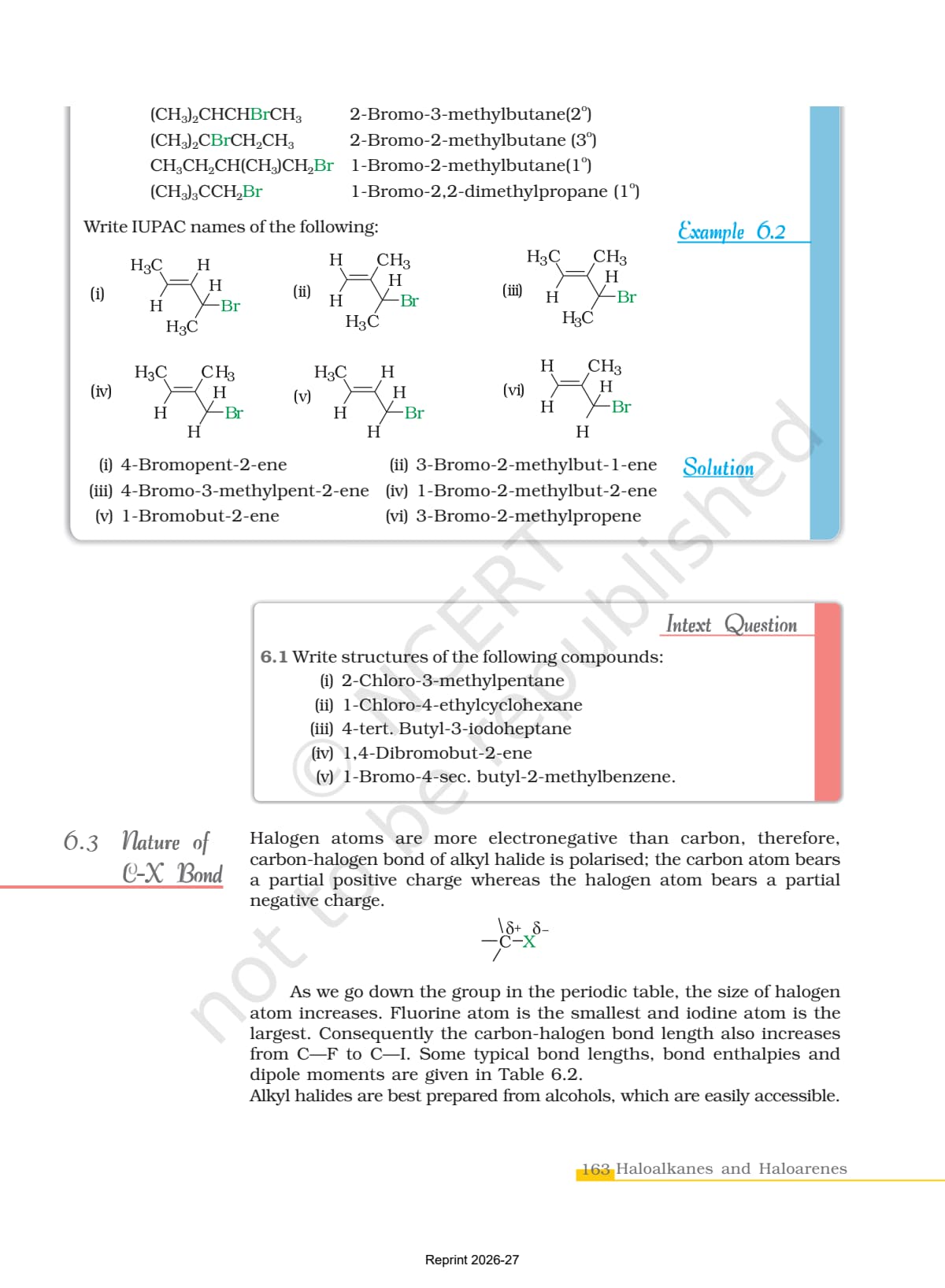
| 6.3 | Nature of C-X Bond | 5-6 | Bond length, polarity, dipole moment, electronegativity differences |
| 6.4 | Methods of Preparation of Haloalkanes | 6-10 | From alcohols, hydrocarbons, alkenes, halide exchange (Finkelstein, Swarts) |
| 6.5 | Preparation of Haloarenes | 10-11 | Halogenation of arenes, Sandmeyer, Gattermann reactions |
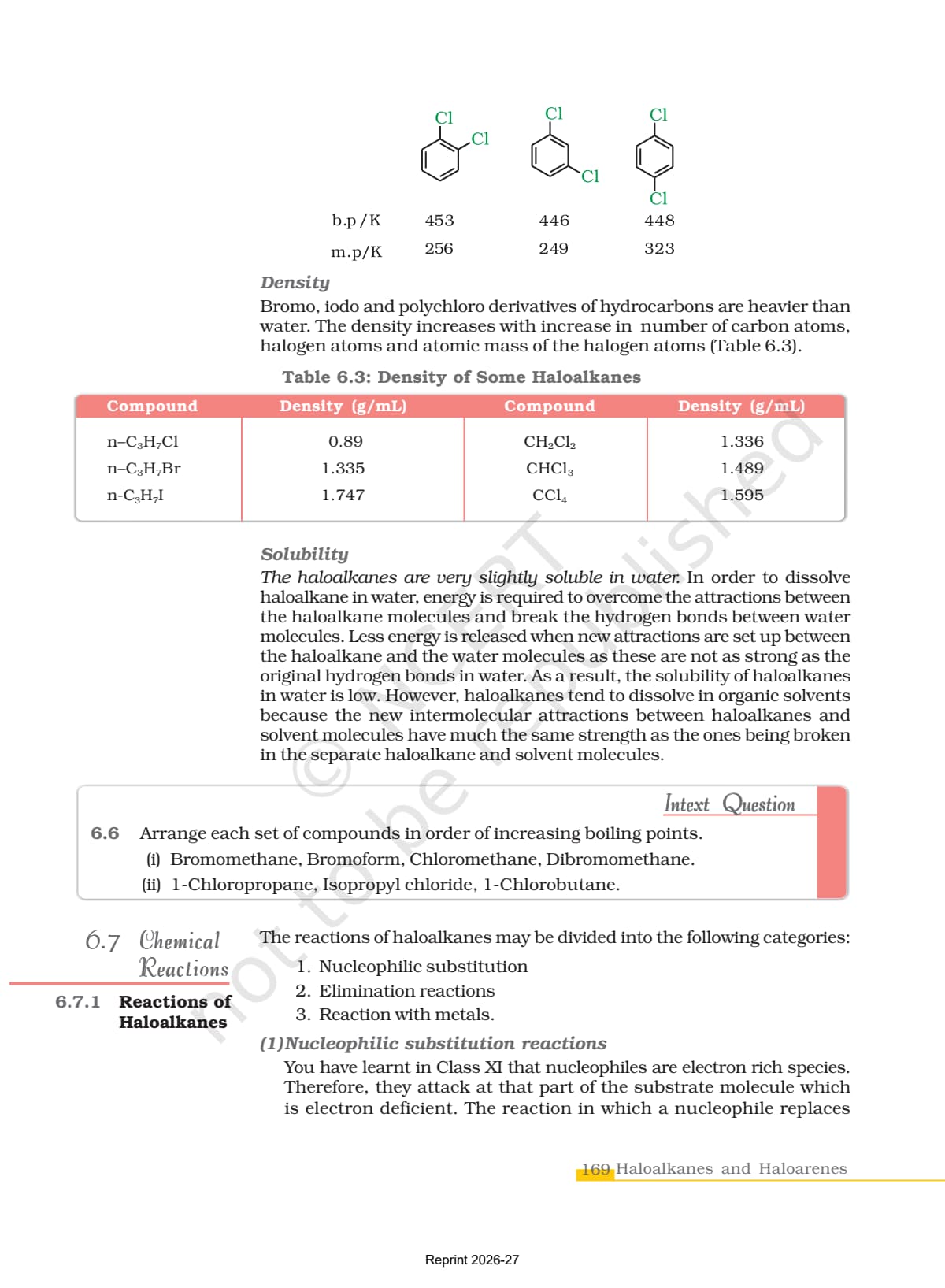
| 6.6 | Physical Properties | 11-13 | Melting/boiling points, solubility, density trends |
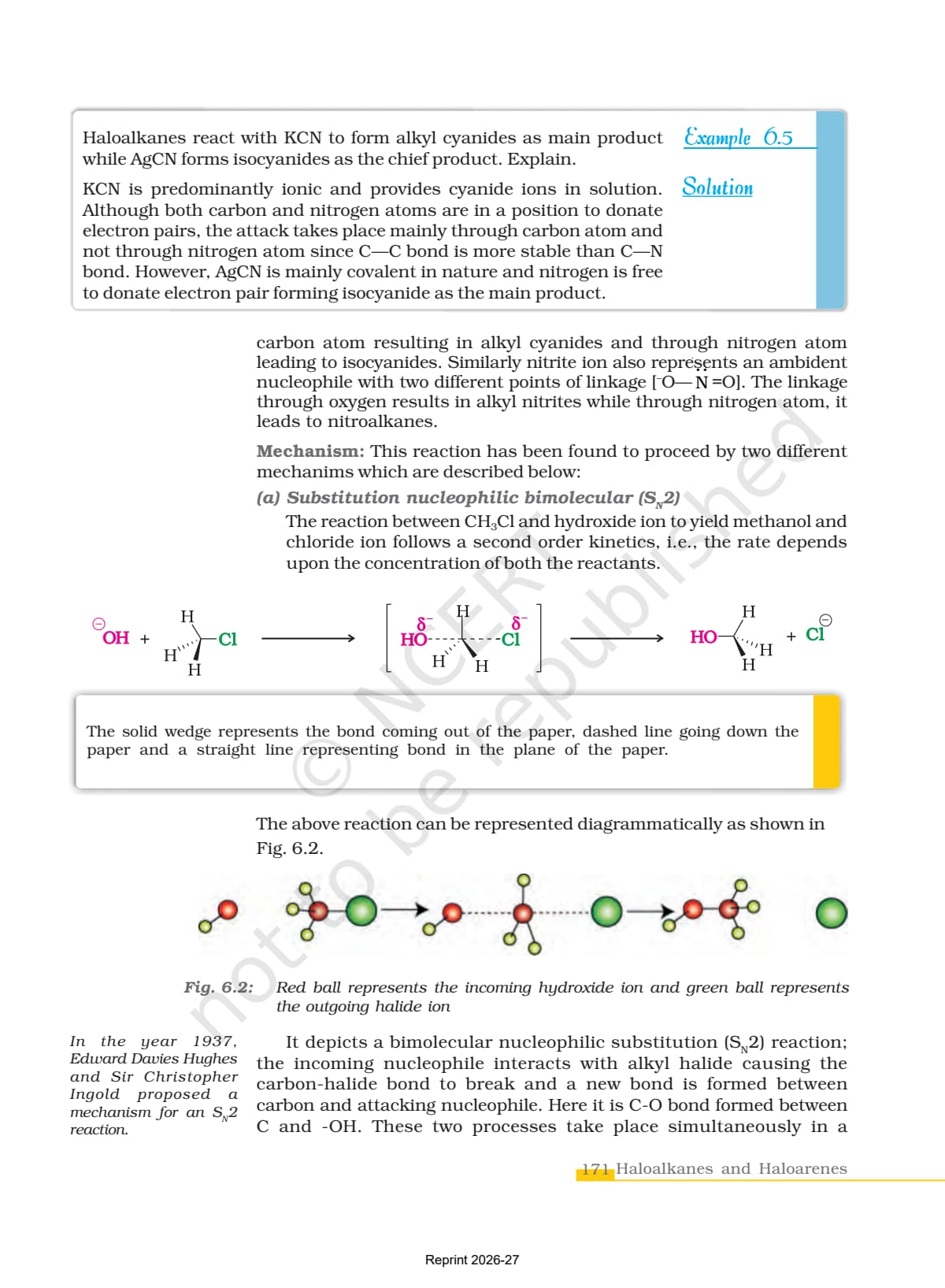
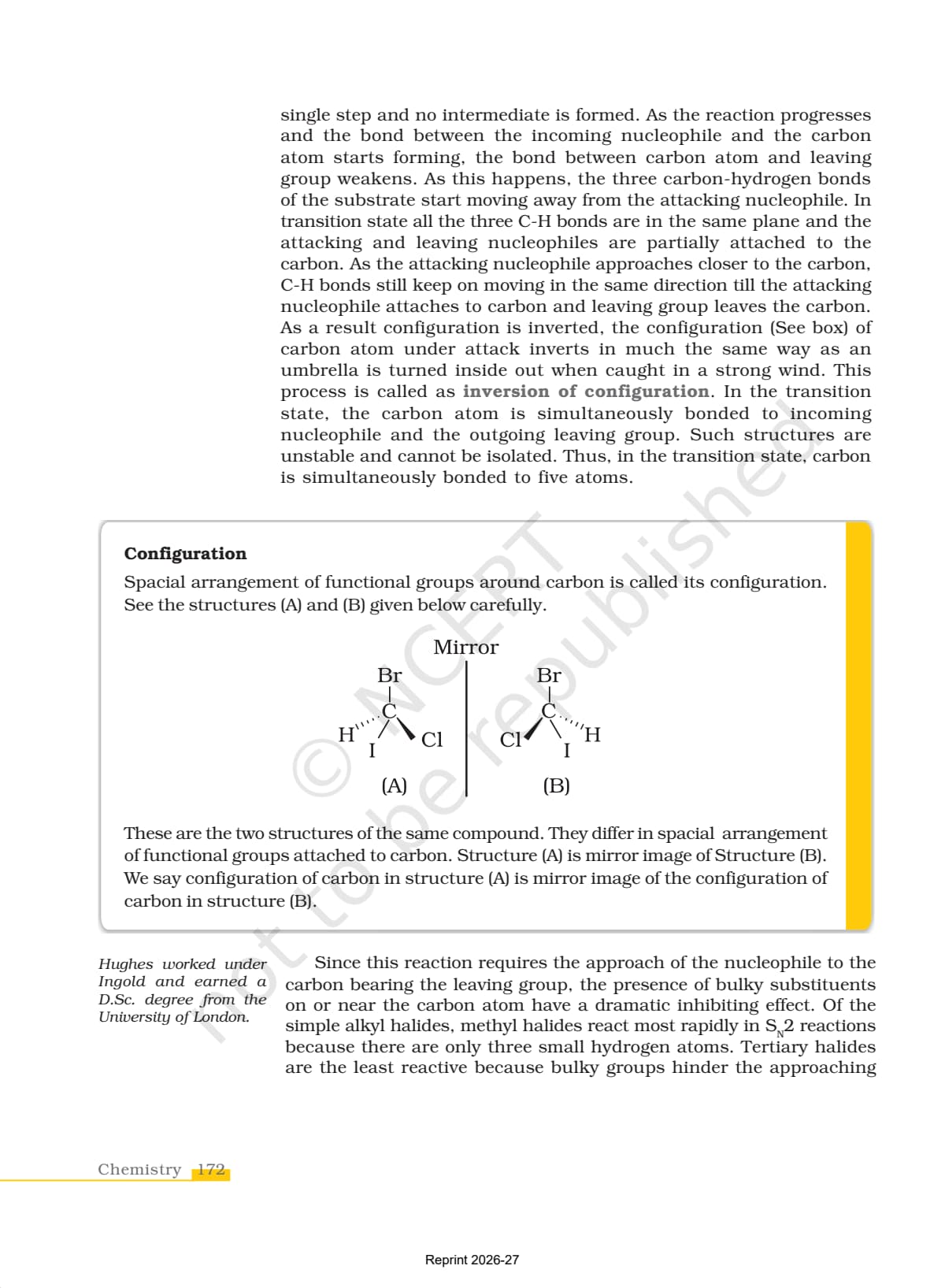
| 6.7 | Chemical Reactions of Haloalkanes | 13-22 | SN1, SN2 mechanism, stereochemistry, elimination, reaction with metals (Wurtz, Grignard) |
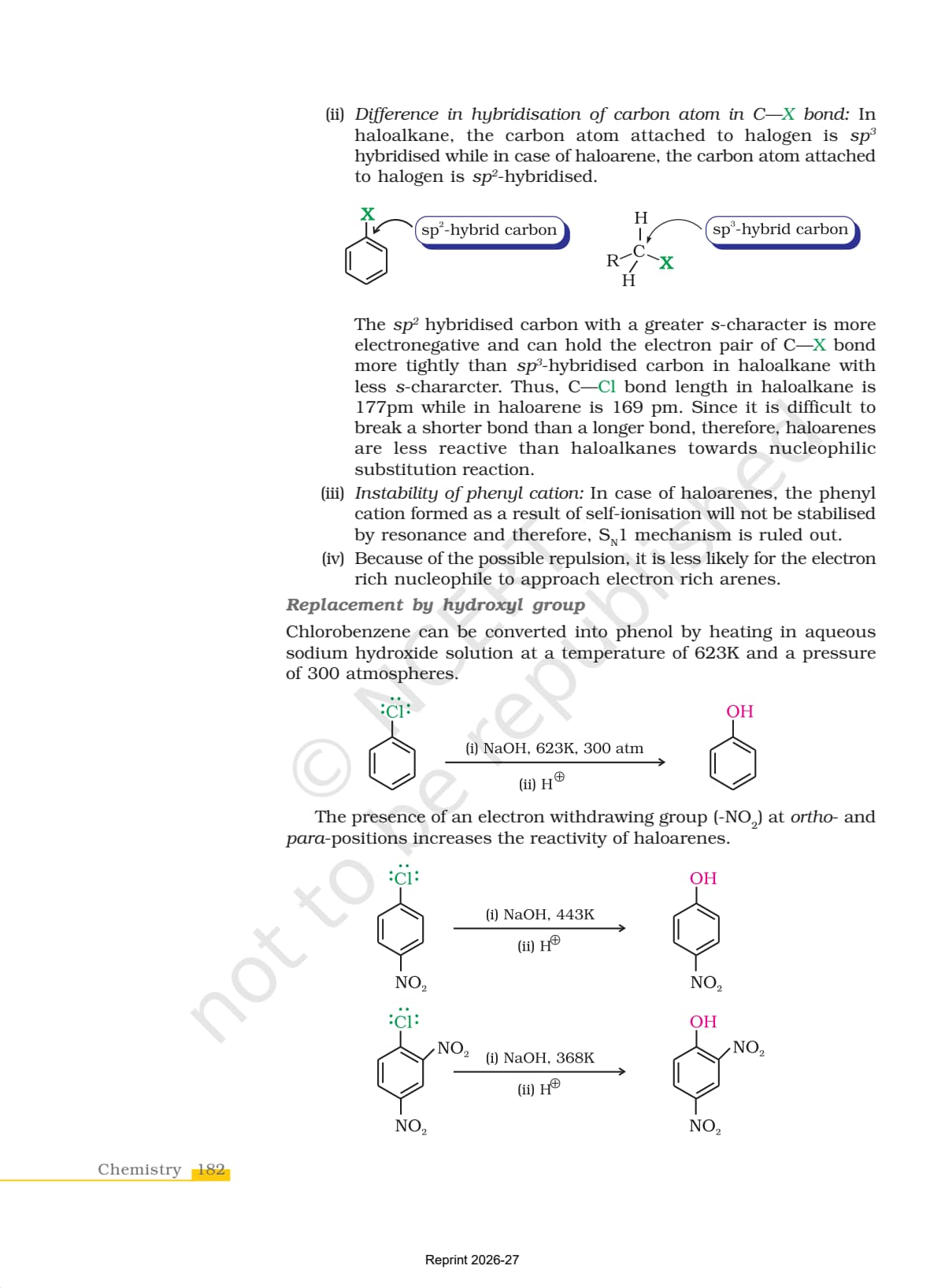
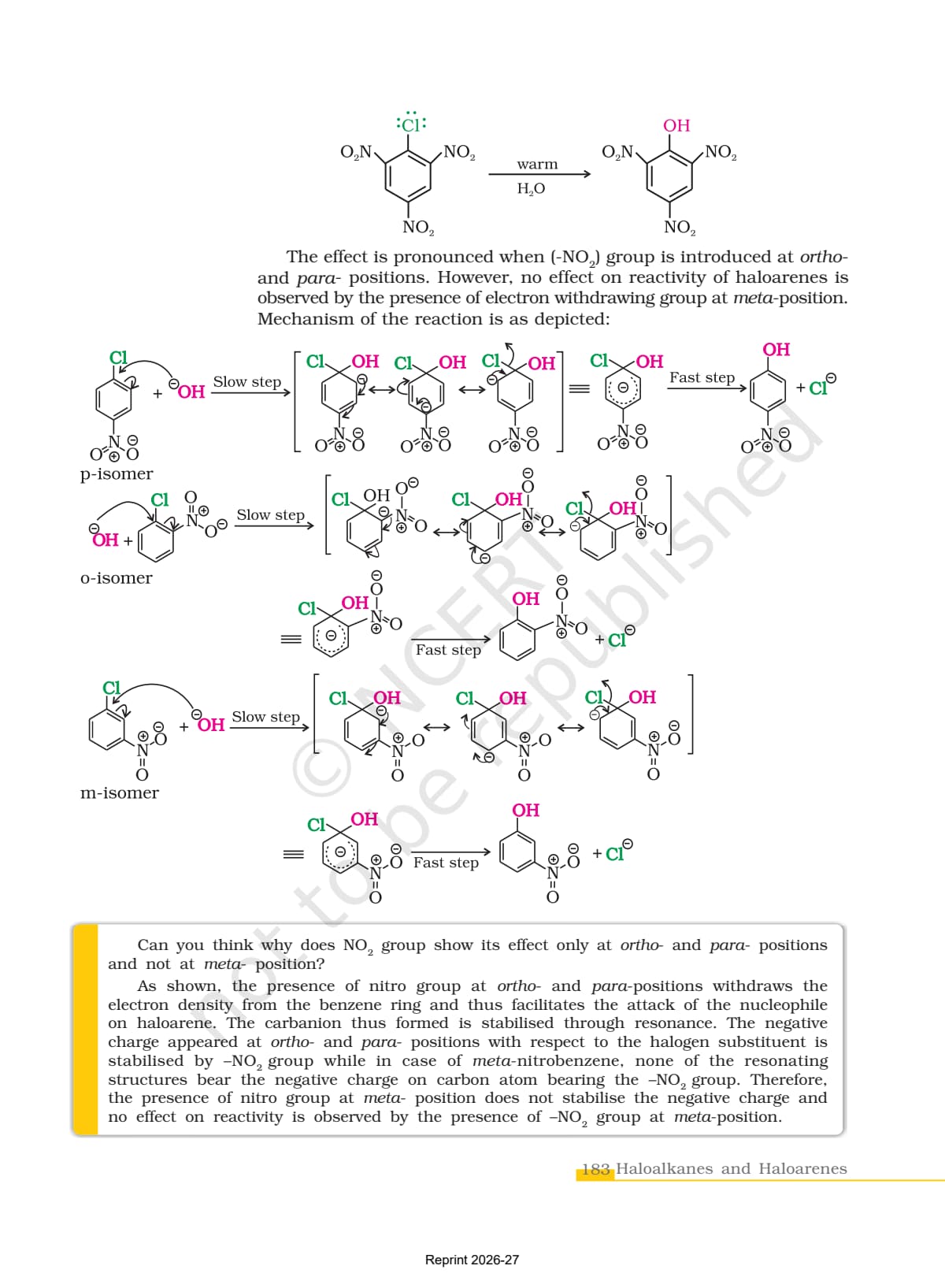
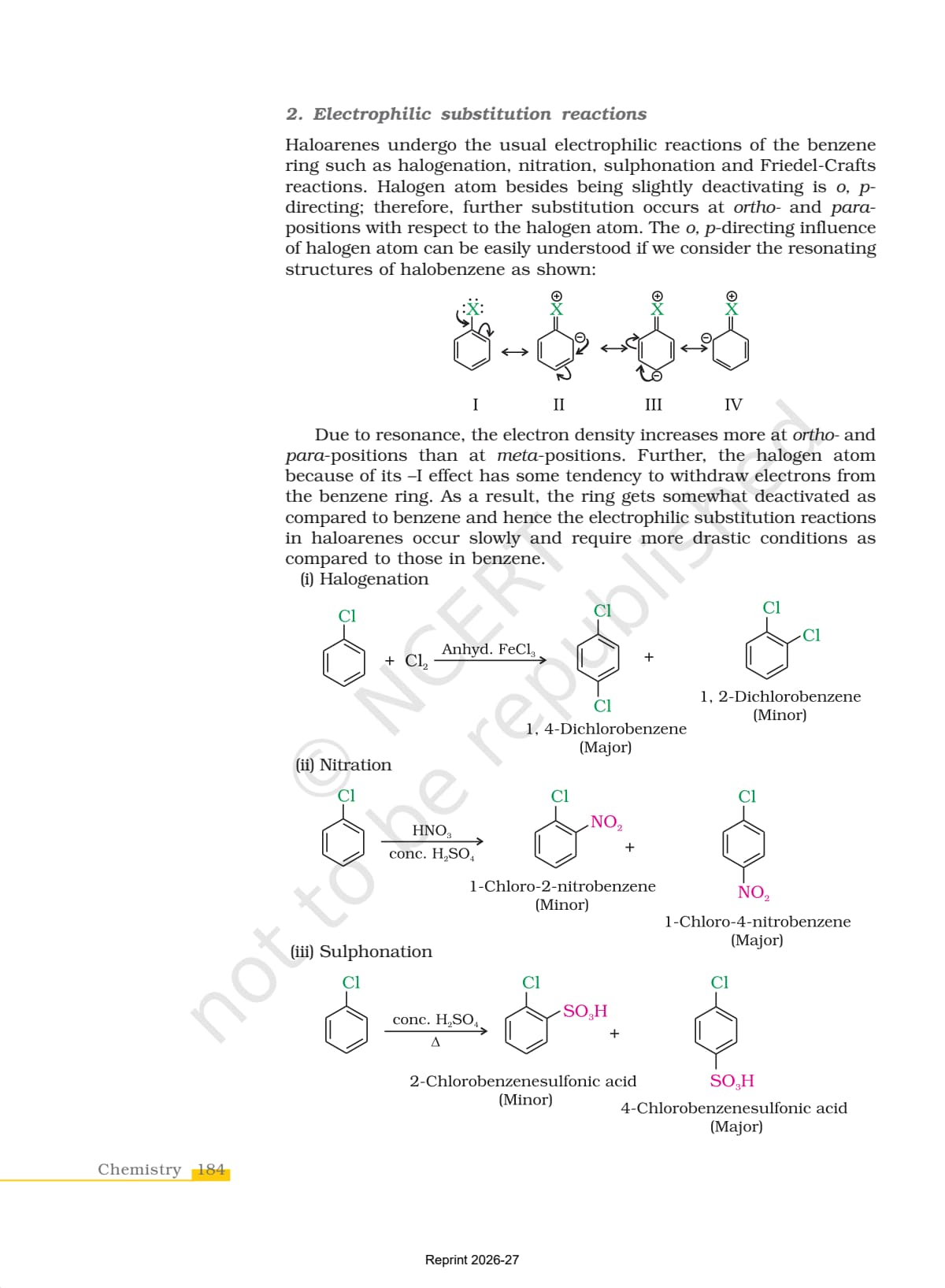
| 6.8 | Chemical Reactions of Haloarenes | 22-26 | Nucleophilic substitution (low reactivity reason), electrophilic substitution, reaction with metals |
| 6.9 | Polyhalogen Compounds | 26-28 | Dichloromethane, chloroform, iodoform, CCl4, freons, DDT |
| - | Summary, Exercises (30 Qs) | 28-34 | End-of-chapter problems for board-level practice |
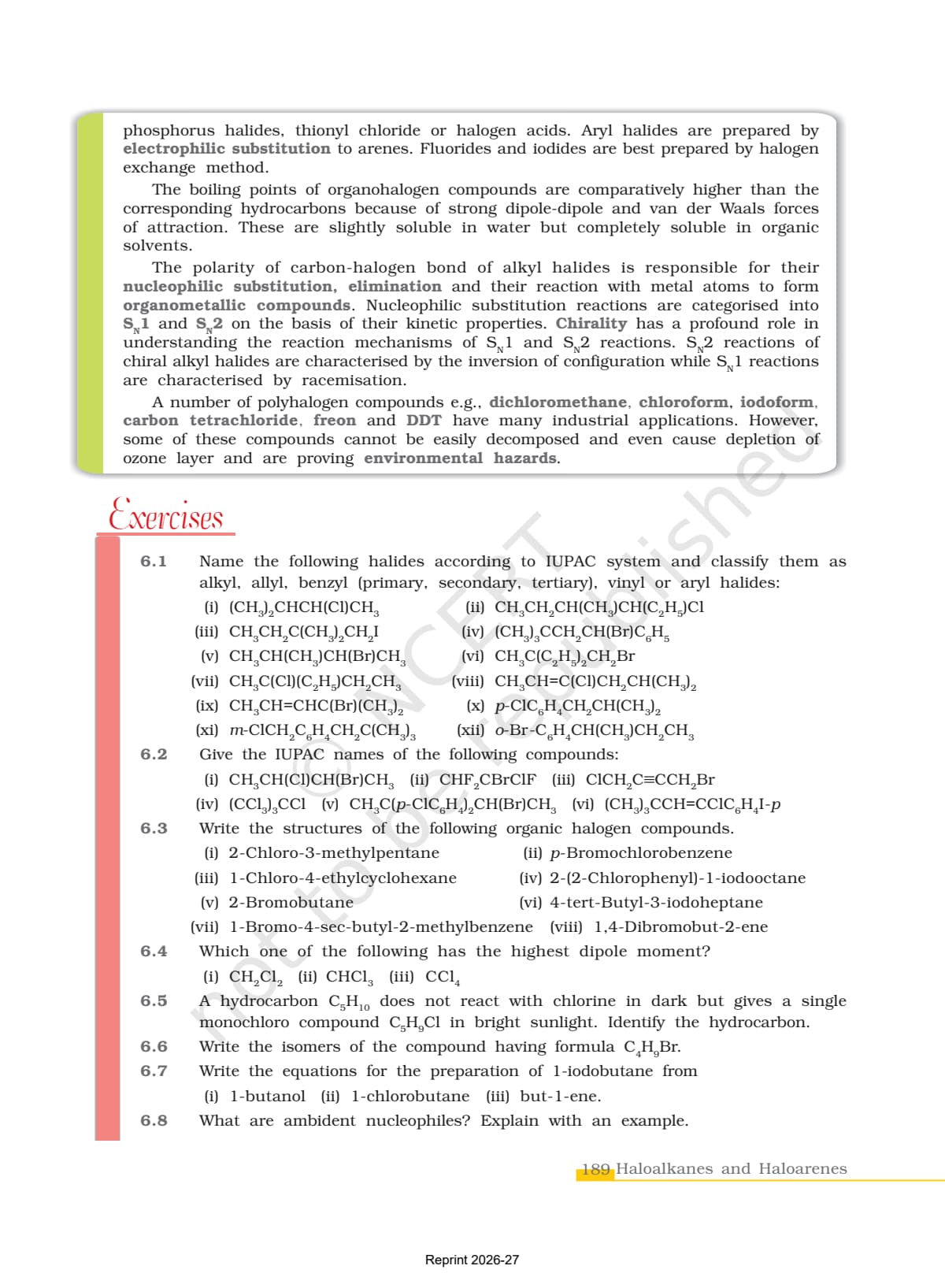
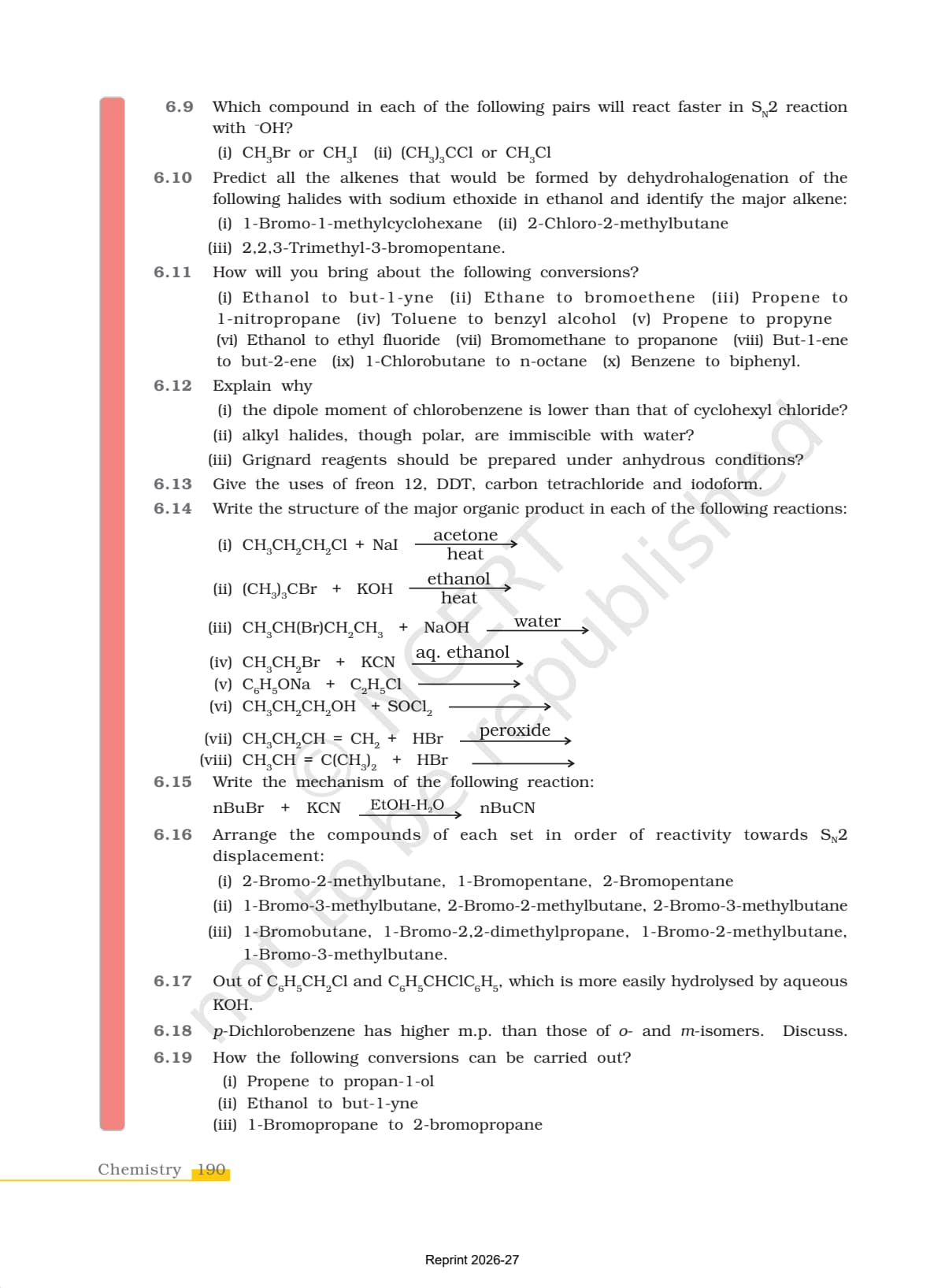
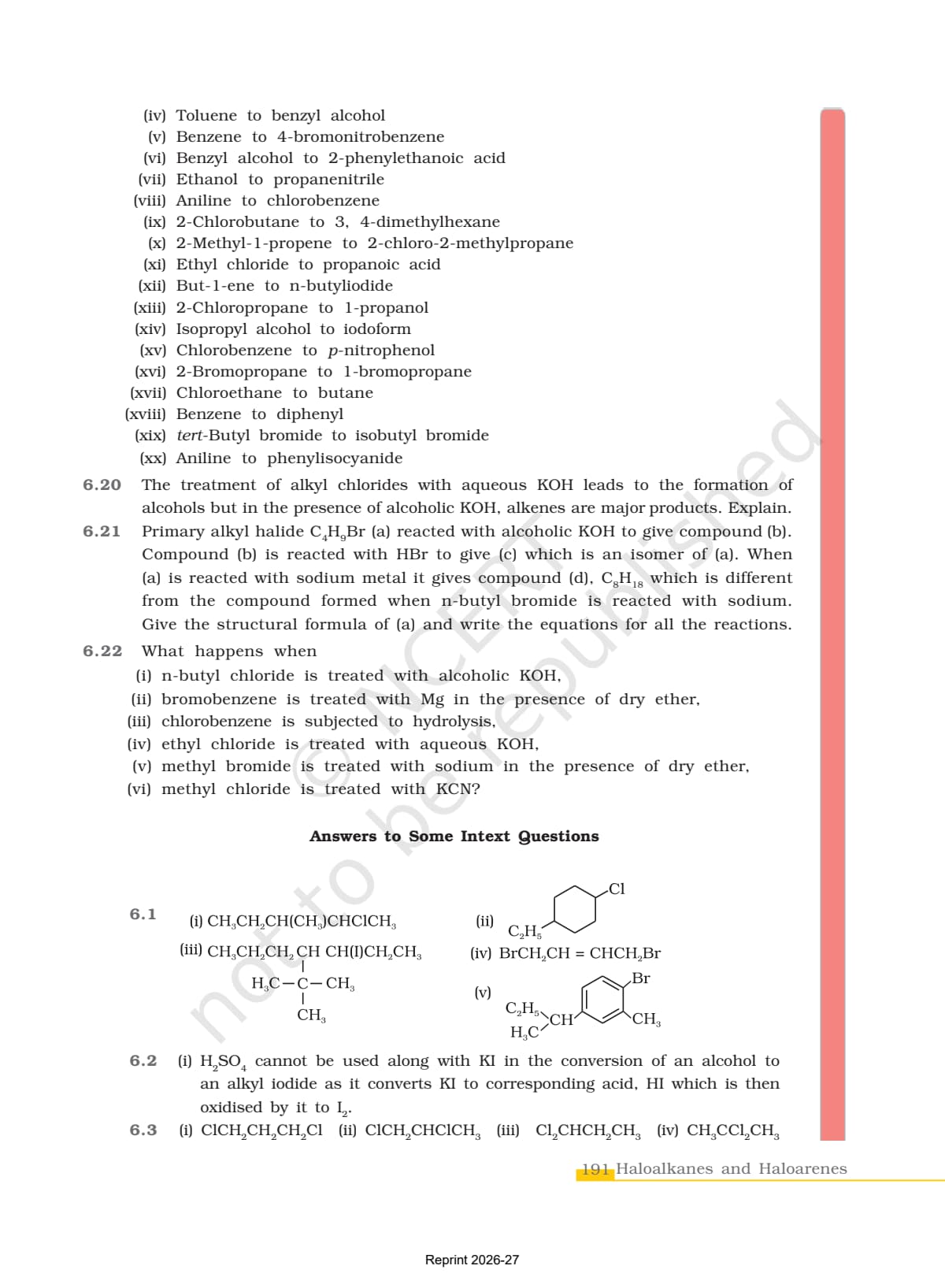
The 30 end-of-chapter exercises split roughly into 10 nomenclature and conversion items, 9 mechanism and reactivity-order questions, 6 named-reaction recall items (Wurtz, Sandmeyer, Friedel-Crafts on chlorobenzene), and 5 distinction / polyhalogen short answers. The mechanism and reactivity-order block is the one most reliably asked in CBSE Boards.
What's New in Haloalkanes and Haloarenes for the 2026-27 NCERT (Rationalisation Note)
The 2026-27 NCERT Class 12 Chemistry Part-II retains the chapter title but renumbered it from legacy Chapter 10 to current Chapter 6, and a small number of sub-topics from the older 2022 print were trimmed when the syllabus was revised.
| Sub-topic | Status in 2026-27 | Notes |
|---|---|---|
| Classification, nomenclature, C-X bond nature | Kept | Core sections, unchanged |
| Preparation of haloalkanes (all routes) | Kept | Finkelstein, Swarts, alcohol routes, addition to alkenes |
| SN1 / SN2 mechanism and stereochemistry | Kept | Core section, all reactivity-order arguments retained |
| Elimination (Saytzeff, E1, E2) | Kept | Core section, unchanged |
| Reaction of haloarenes with metals (Wurtz-Fittig, Fittig) | Kept | Retained as named reactions |
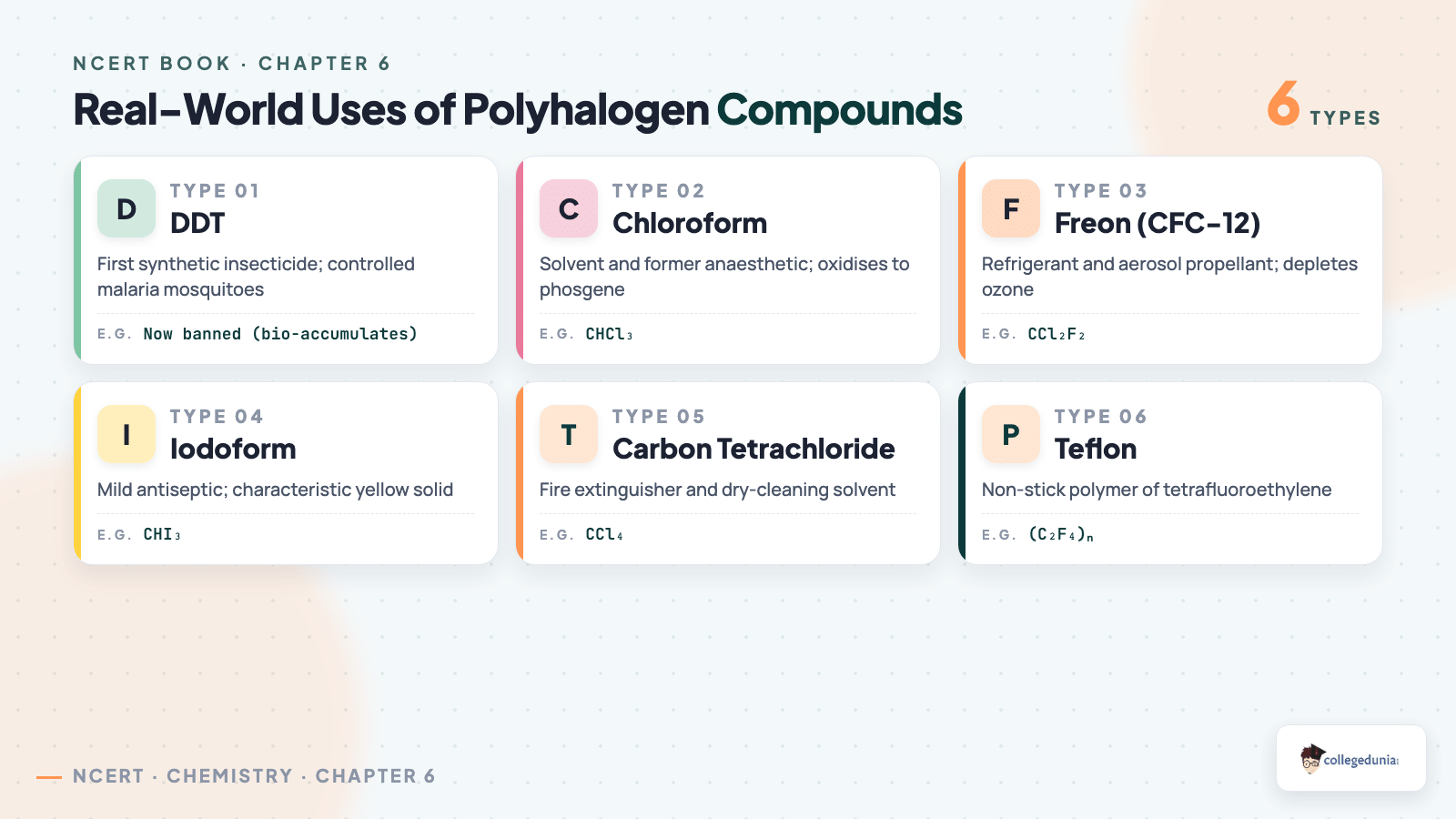
| Polyhalogen compounds (chloroform, freons, DDT) | Trimmed | Industrial uses kept; extended environmental discussion of freons / DDT condensed |
Detailed kept-trimmed-removed table: Haloalkanes and Haloarenes Class 12 Chemistry Notes
Author, Edition and Publisher Information for the Haloalkanes and Haloarenes NCERT PDF
The PDF on this page is the official 2026-27 reprint of the chapter. Citing it correctly matters when you reference it in a project file or a school assignment.
| Title | Chemistry Part-II Textbook for Class XII |
| Chapter | Chapter 6: Haloalkanes and Haloarenes |
| Edition | 2026-27 (Reprint, post-rationalisation) |
| Publisher | National Council of Educational Research and Training (NCERT), New Delhi |
| Pages in chapter | 34 (approx., chapter PDF) |
| ISBN (book) | 81-7450-716-9 (Part-II) |
| Medium | English (Hindi and Urdu editions also published by NCERT) |
Haloalkanes and Haloarenes CBSE Marks Weightage Compared Across Class 12 Chemistry Chapters
The visual below maps the typical CBSE Board marks distribution across all 10 chapters of the current 2026-27 NCERT Class 12 Chemistry book, averaged over the last five board papers. Haloalkanes and Haloarenes sits in the lower-middle band at 5 marks, sharing weight with Amines.
Student Feedback
In a Collegedunia poll of 900 Class 12 students, 78% said reading Section 6.7 straight from this NCERT PDF fixed their SN1 versus SN2 confusion before the board exam.
Other Resources for Haloalkanes and Haloarenes Class 12 Chemistry
| Resource | Link |
|---|---|
| NCERT Book PDF | Haloalkanes and Haloarenes Class 12 Chemistry NCERT Book PDF |
| NCERT Solutions | Haloalkanes and Haloarenes Class 12 Chemistry NCERT Solutions |
| Notes | Haloalkanes and Haloarenes Class 12 Chemistry Notes |
| Formula Sheet | Haloalkanes and Haloarenes Class 12 Chemistry Formula Sheet |
| Exemplar Book PDF | Haloalkanes and Haloarenes Class 12 Chemistry NCERT Exemplar Book PDF |
| Exemplar Solutions | Haloalkanes and Haloarenes Class 12 Chemistry NCERT Exemplar Solutions |
| Handwritten Notes | Haloalkanes and Haloarenes Class 12 Chemistry Handwritten Notes |
NCERT Book PDF for Class 12 Chemistry: All Chapters
| Chapter | NCERT Book PDF |
|---|---|
| Chapter 1 | Solutions NCERT Book PDF |
| Chapter 2 | Electrochemistry NCERT Book PDF |
| Chapter 3 | Chemical Kinetics NCERT Book PDF |
| Chapter 4 | The d- and f-Block Elements NCERT Book PDF |
| Chapter 5 | Coordination Compounds NCERT Book PDF |
| Chapter 7 | Alcohols, Phenols and Ethers NCERT Book PDF |
| Chapter 8 | Aldehydes, Ketones and Carboxylic Acids NCERT Book PDF |
| Chapter 9 | Amines NCERT Book PDF |
| Chapter 10 | Biomolecules NCERT Book PDF |
Haloalkanes and Haloarenes Class 12 Chemistry NCERT Book PDF - FAQs
Q. Is Chapter 6 Haloalkanes and Haloarenes in the 2026-27 NCERT the same as the older Chapter 10?
Yes. The 2026-27 NCERT Class 12 Chemistry Part-II renumbered the older Chapter 10 to current Chapter 6 and kept the title intact. Most sub-topics are unchanged; only the extended environmental discussion of freons and DDT in the polyhalogen-compounds section was condensed.
Q. How many pages and exercises does the Haloalkanes and Haloarenes NCERT chapter PDF contain?
The chapter spans roughly 34 pages, includes 10 solved intext examples, and ends with 30 exercise questions covering nomenclature, mechanisms, named reactions, and polyhalogen compounds.
Q. What is the CBSE weightage of Haloalkanes and Haloarenes in the Class 12 Board exam?
The chapter carries 3 to 5 marks in the CBSE Class 12 Chemistry paper, typically split as one 2-mark mechanism or distinction question plus one 3-mark named-reaction or reactivity-order item.
Q. Which sections of the NCERT chapter are highest-yield for the Boards?
Sections 6.7 (chemical reactions of haloalkanes, especially SN1 and SN2) and 6.8 (chemical reactions of haloarenes, especially named reactions on chlorobenzene) together account for more than half of all CBSE marks from this chapter.
Q. How should I read the Haloalkanes and Haloarenes NCERT chapter for the first time?
Use the three-pass plan on this page: a one-hour skim of section headings and the summary, a four to five-hour deep read with hand-drawn mechanism arrows and intext examples, and a three to four-hour practice session on the 30 end-of-chapter exercises.
Q. Is the Haloalkanes and Haloarenes NCERT chapter PDF enough for JEE Main and NEET?
The chapter PDF is the necessary foundation but not sufficient. JEE and NEET regularly draw mechanism-based MCQs from the Class 12 NCERT Exemplar (legacy Chapter 10, now Chapter 6) for this unit, so pair the NCERT print with the Exemplar PDF available on Collegedunia.
Q. Which named reactions from Haloalkanes and Haloarenes are most often asked in CBSE Boards?
Wurtz, Wurtz-Fittig, Fittig, Sandmeyer, Gattermann, Finkelstein, and Swarts are the recurring names. CBSE has repeated "identify the product" or "write the mechanism" questions on these in four of the last five papers.



Comments