




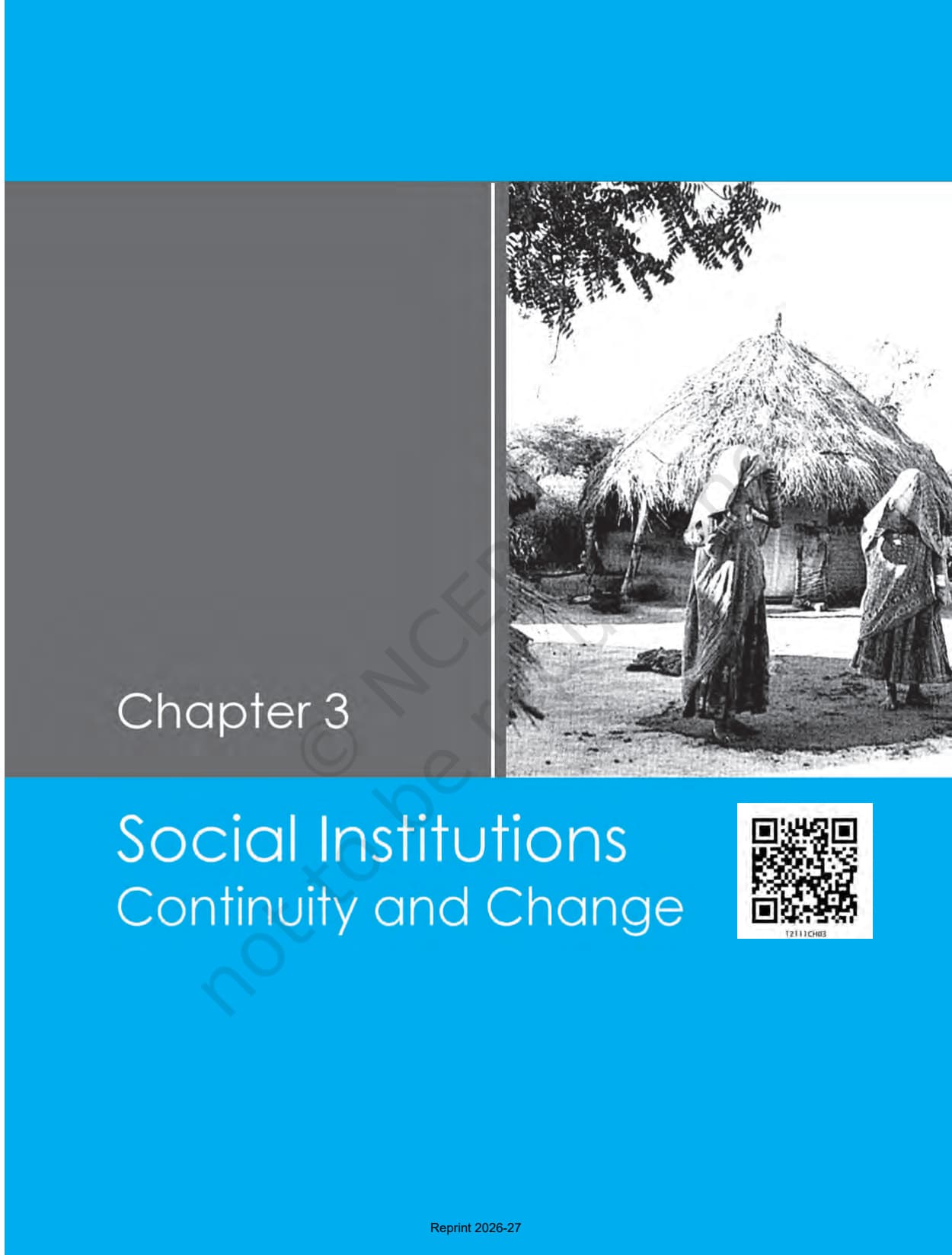
The Class 12 Sociology Chapter 3 Social Institutions Continuity and Change NCERT Book PDF gives the full original chapter from the Indian Society textbook, free to read and download, set to the 2026-27 CBSE syllabus. The chapter studies three core institutions: the caste system, the tribe and the family, each shown through the lens of continuity and change.
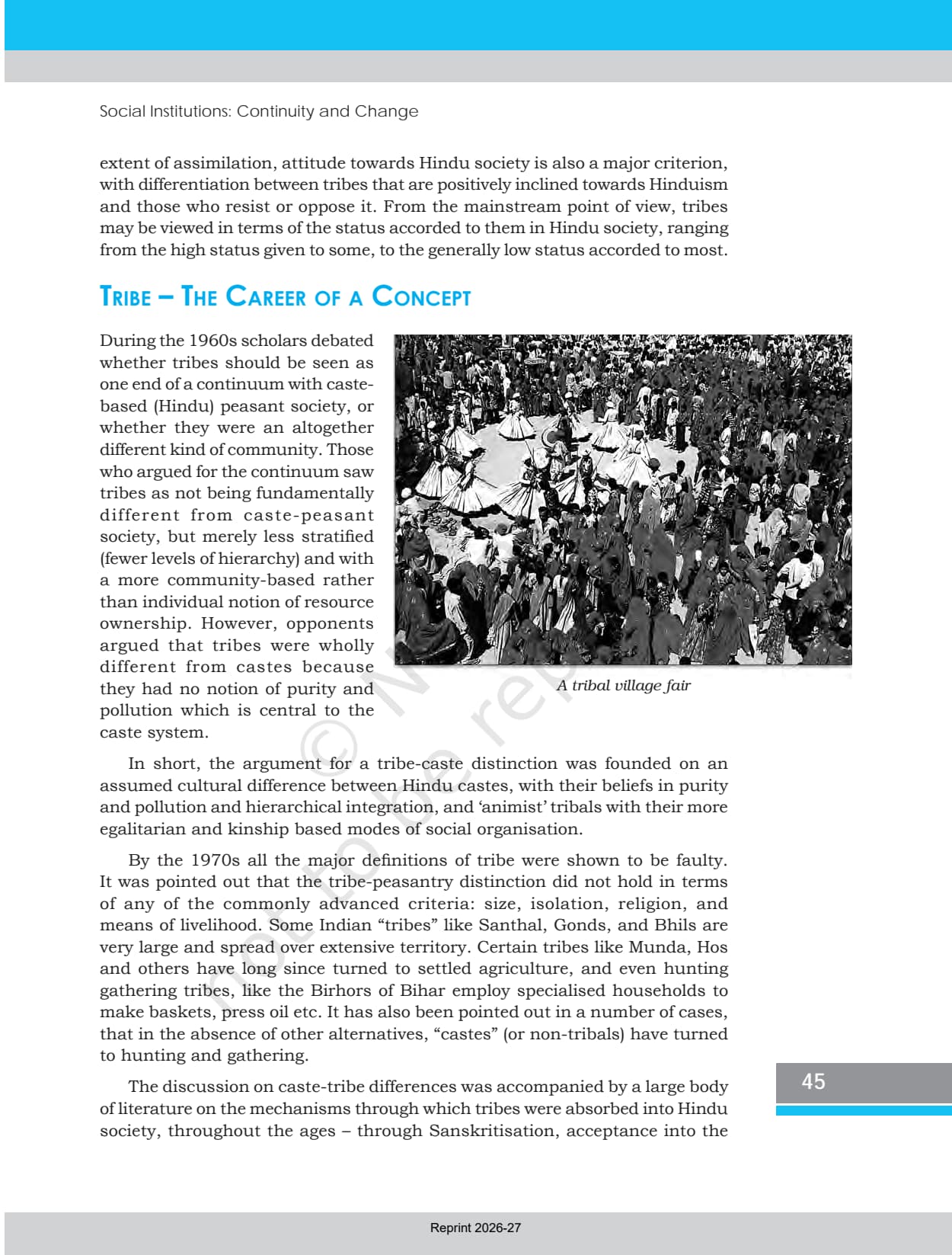
- The complete NCERT Chapter 3 text from the Indian Society book, in a clean, readable PDF.
- This Class 12 Sociology chapter usually carries 5 to 6 marks per board paper.
- Pairs with the NCERT Solutions, Notes and Handwritten Notes linked lower on this page.
This is the official NCERT Indian Society Chapter 3 text, hosted free for Class 12 Sociology students and mapped to the latest 2026-27 syllabus.
Student Feedback: In a Collegedunia poll of 8,140 Class 12 Sociology students, 68% of students said they prefer reading the original NCERT chapter PDF before turning to notes for this chapter. Most students keep the Book PDF open to check the exact wording of caste and tribe definitions.
Source: 2026-27 Class 12 Sociology student poll. Sample of 8,140 students from CBSE schools across 12 states.
What the Social Institutions Continuity and Change Chapter Covers
Chapter 3 of Indian Society looks at how three institutions of Indian life both persist and change. The chapter title says it plainly: it is about continuity and change in caste, tribe and family. Reading the original NCERT text gives students the exact wording examiners expect.
The chapter is built in three clear parts, which the PDF presents in order:
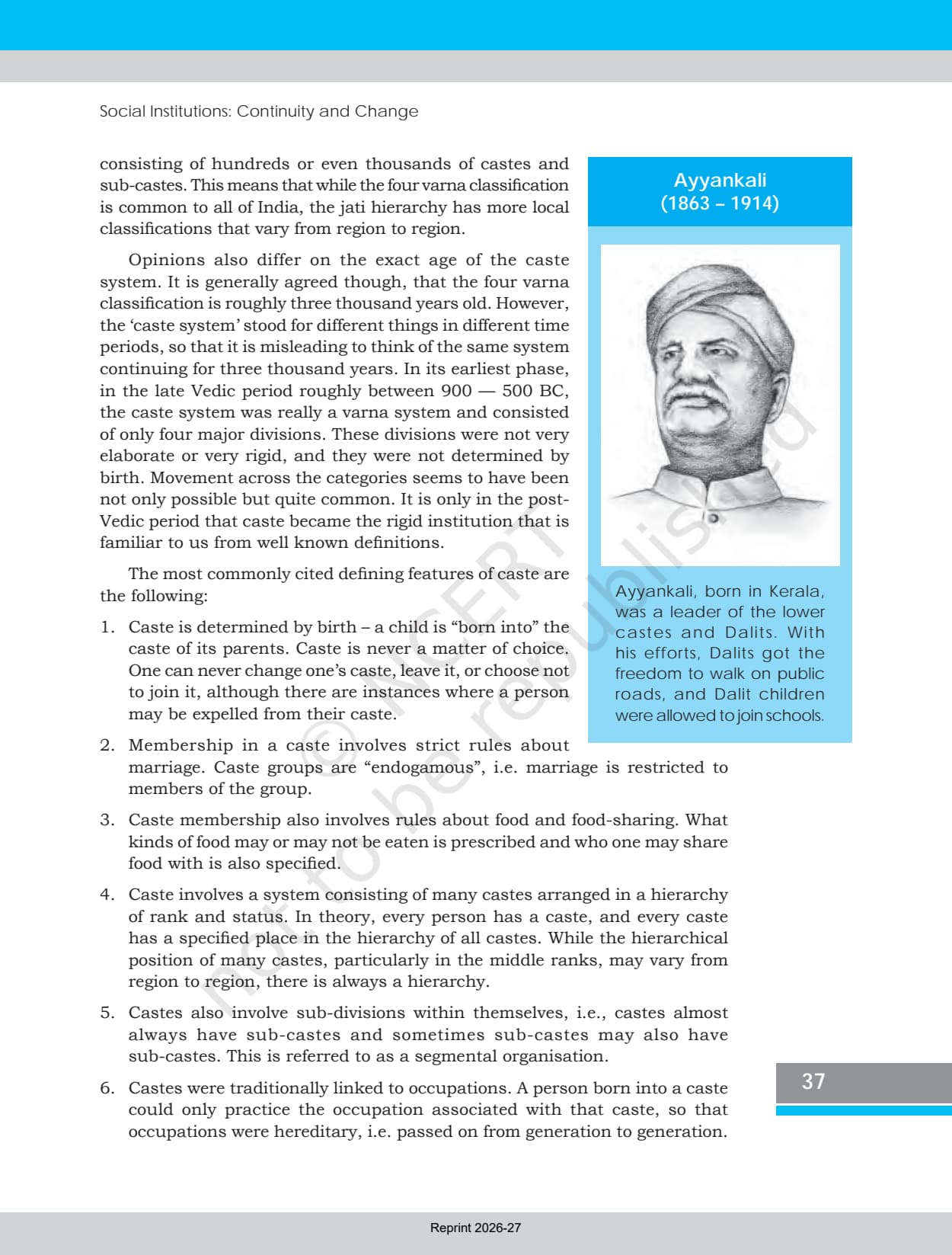
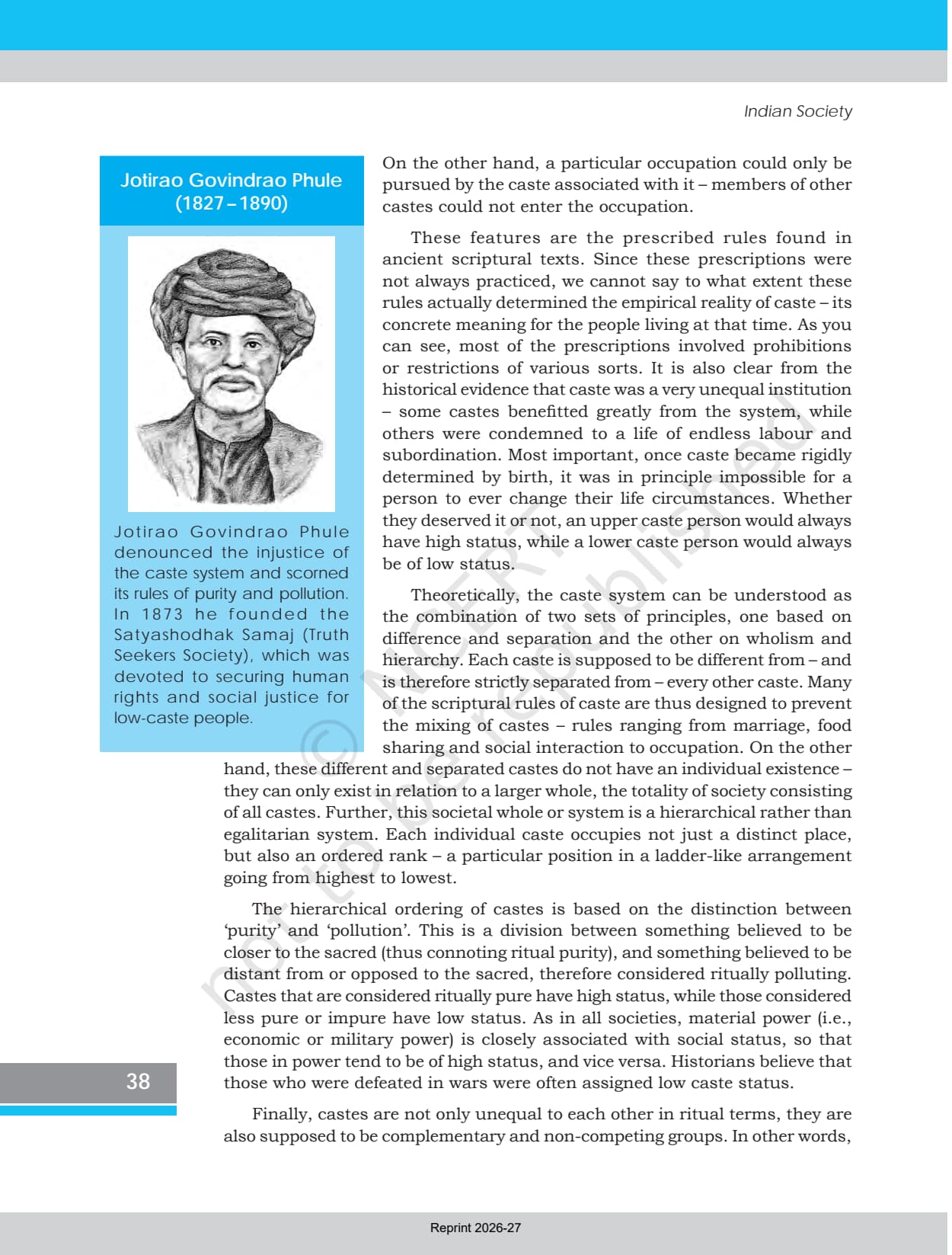
- The caste system: its features, the rules it imposes, and how colonialism and the city changed it.
- The tribe: how tribes are classified and why tribal identity is asserted today.
- The family: the forms the family takes and how it changes with society.
Reading the chapter in this order helps students see the shared theme: each institution keeps a core while slowly shifting. That is the single idea every board answer should return to.
Key Terms to Watch for in the Chapter
The NCERT chapter introduces a handful of terms that carry the marks in the exam. Spot them as you read, and underline each definition in the PDF.
| Term | Where it appears |
|---|---|
| Separation and hierarchy | The caste section, as the two ideas that hold caste together. |
| Endogamy | The caste rules, as marriage within one own caste. |
| Sanskritisation | The discussion of caste change and mobility. |
| Matriliny | The family section, on descent through the mother. |
These terms are the backbone of the chapter. A student who can point to each one in the PDF and recall its meaning is well placed for both the short and the long answers.
How the Chapter Is Organised
The PDF moves from caste to tribe to family, and within each it gives the features first and the changes second. Knowing the layout helps students find any topic fast.
- Caste pages: definition, the rules of separation and hierarchy, colonial change, urban invisibility.
- Tribe pages: classification by region, language and livelihood, then the assertion of identity.
- Family pages: the forms of the family, then the matriliny and matriarchy distinction.
Because the chapter follows this steady pattern, a student can jump straight to the part they need. The exercise questions at the end map onto the same three parts, so the PDF doubles as a revision guide.
How to Read This Chapter for the Board Exam
The NCERT text is the safest source for this chapter, because board answers reward the book exact phrasing. A simple reading plan makes the most of it.
- Read each institution once for the idea, then again to underline the key terms.
- For caste, note both separation and hierarchy; for the family, note the matriliny line carefully.
- Finish each part by attempting the matching exercise question from memory.
Students who read the chapter twice in this way, then move to the Solutions, usually write fuller answers because they use the book own words. The PDF is free, so it can be read on any device.
Download Formats and Languages
The chapter PDF is free and comes in formats that suit different devices and revision styles. The download card at the top of the page carries each option.
- Normal and HD PDF: a normal size for quick downloads and an HD version for clear printing.
- English medium: the full class 12 sociology chapter 3 pdf as it appears in the NCERT Indian Society book.
- Whole-book pack: the chapter sits inside the complete Indian Society PDF, so students can read every chapter in one file.
Many students keep the class 12 sociology chapter 3 PDF on their phone for offline reading before a test. A saved copy means the original text is always to hand, even without internet.
How the Book PDF Pairs with the Other Resources
The Book PDF is the source text. To prepare fully, students should read it alongside the other resources for the same chapter, all linked in the table below.
| Resource | Best used for |
|---|---|
| Social Institutions Continuity and Change NCERT Solutions | Full point-wise answers to all 10 exercise questions |
| Social Institutions Continuity and Change Class 12 Notes | A clear typed summary of caste, tribe and family |
| Social Institutions Continuity and Change Handwritten Notes | Last-minute, one-shot revision in a scanned notebook style |
Tip: read this Book PDF first for the original wording, then use the Notes to summarise and the Solutions to practise the exercise questions.
All NCERT Book PDFs for Class 12 Sociology
The table links the NCERT Book PDF for every chapter in both Class 12 Sociology books, so students can read the whole course in one place. Social Institutions Continuity and Change is highlighted.
| Chapter | NCERT Book PDF |
|---|---|
| Indian Society | |
| Chapter 1 | Introducing Indian Society |
| Chapter 2 | The Demographic Structure of the Indian Society |
| Chapter 3 | Social Institutions - Continuity and Change |
| Chapter 4 | The Market as a Social Institution |
| Chapter 5 | Patterns of Social Inequality and Exclusion |
| Chapter 6 | The Challenges of Cultural Diversity |
| Social Change and Development in India | |
| Chapter 1 | Structural Change |
| Chapter 2 | Cultural Change |
| Chapter 3 | The Constitution and Social Change |
| Chapter 4 | Change and Development in Rural Society |
| Chapter 5 | Change and Development in Industrial Society |
| Chapter 6 | Globalisation and Social Change |
| Chapter 7 | Mass Media and Communications |
| Chapter 8 | Social Movements |
FAQs on Social Institutions Continuity and Change Class 12 NCERT Book PDF
Social Institutions Continuity and Change Class 12 NCERT Book PDF Common Questions
Ques. Where can I download the class 12 sociology chapter 3 NCERT Book PDF?
Ans. You can download the Social Institutions Continuity and Change Class 12 Sociology NCERT Book PDF directly from this page. It is free, follows the 2026-27 NCERT, and carries the full Chapter 3 text from the Indian Society book.
Ques. Which book is Chapter 3 Social Institutions Continuity and Change from?
Ans. It is Chapter 3 of the Indian Society textbook, one of the two Class 12 Sociology books. The other book is Social Change and Development in India. This chapter covers the caste system, tribes and the family.
Ques. What are the three institutions studied in this chapter?
Ans. The chapter studies three social institutions: caste, tribe and family. For each, it shows both continuity, the part that stays the same, and change, the part that shifts under colonial rule, the law and city life.
Ques. Is reading the NCERT Book PDF enough for the board exam?
Ans. The Book PDF is the most reliable source for the exact wording. For full preparation, pair it with the NCERT Solutions for the exercise questions and the Notes for quick revision, all linked on this page.
Ques. What is the main theme of the chapter?
Ans. The main theme is continuity and change. The chapter shows that caste, tribe and family each keep a core across generations while slowly transforming, which is the idea every board answer should return to.



Comments