




The Class 9 Science Chapter 1 Exploration Entering the World of Secondary Science NCERT Book is the opening chapter of the new 2026-27 Exploration textbook. It is a short, reading-only chapter with no exercise, and it sets the tone for the whole year. It explains what science really is, why scientists build simple models, and how ideas are tested, predicted and sometimes revised. Download the free PDF and read it once before you start the full chapters.
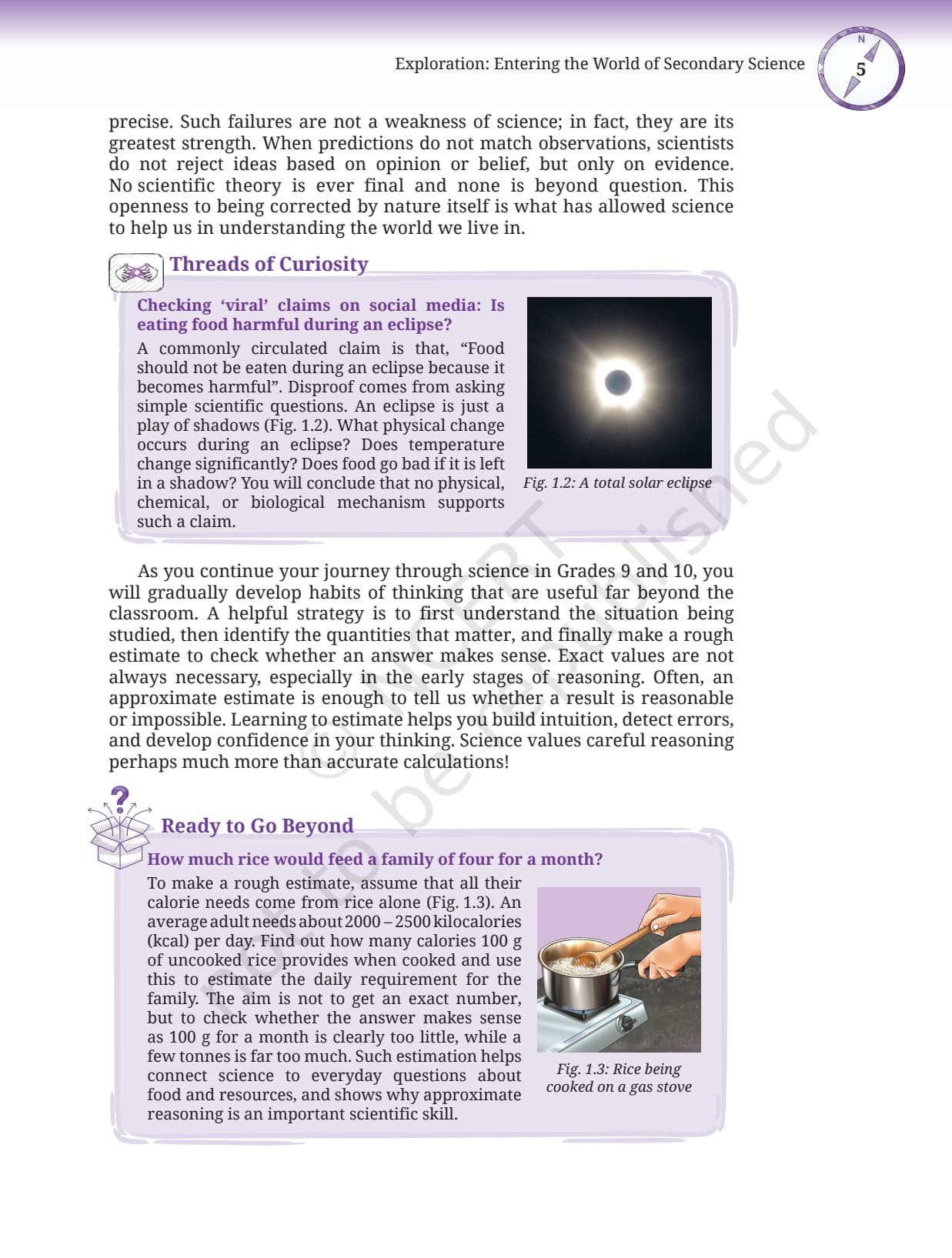
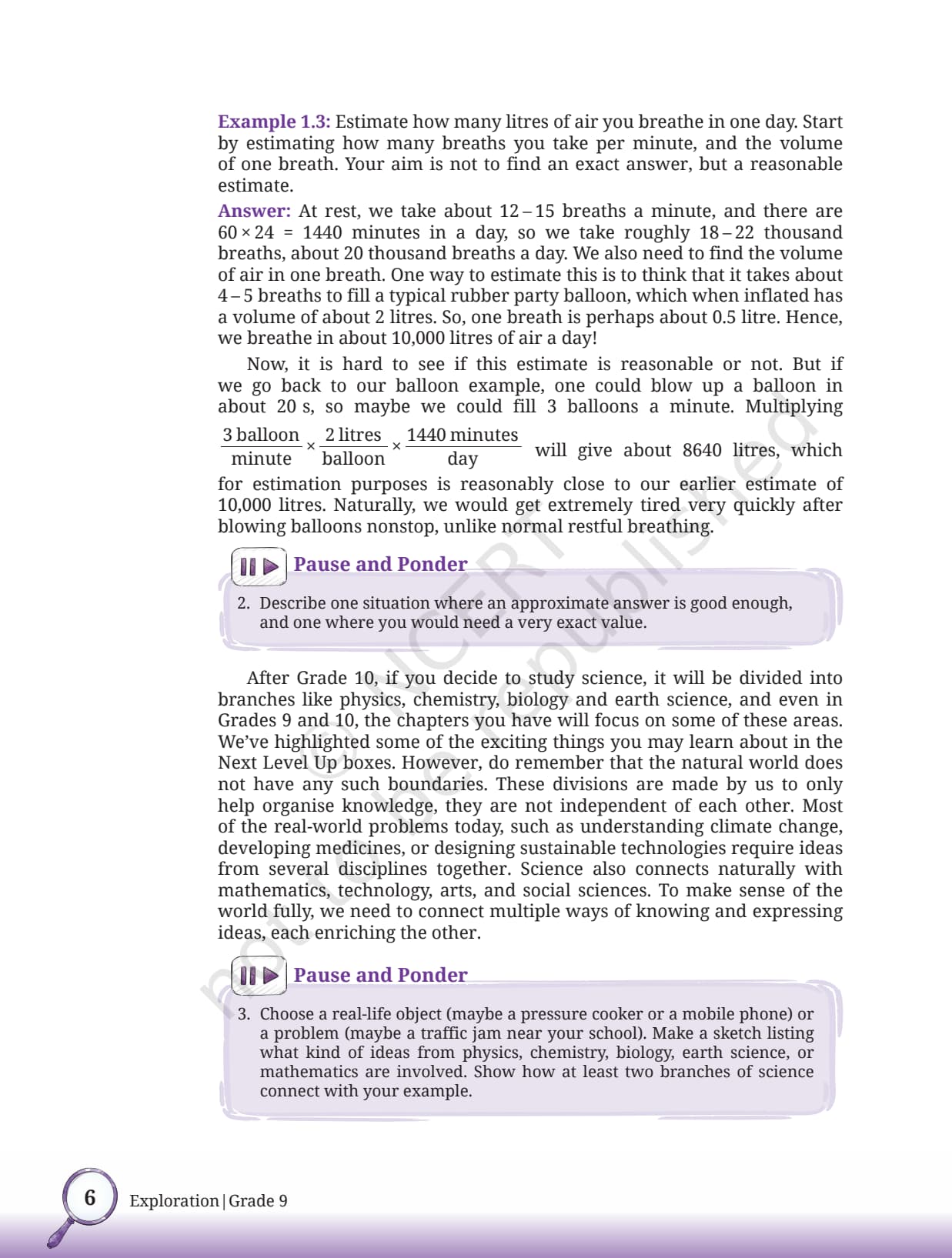
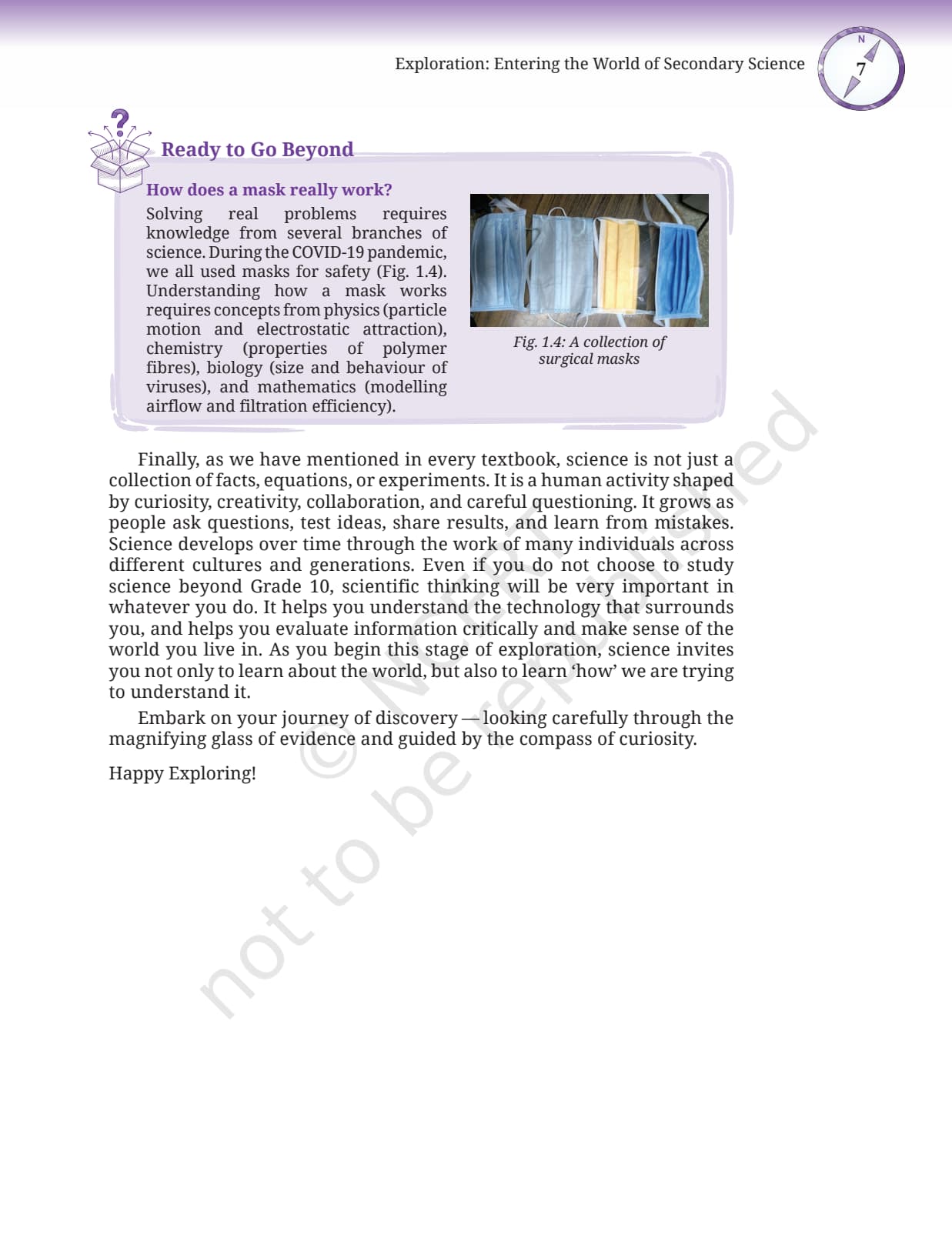
- Intro chapter, no exercise: Chapter 1 has no "Revise, Reflect, Refine" questions, so read it for understanding, not for marks.
- It builds the mindset behind every later chapter: observe, model, predict and test, which the whole 2026-27 Class 9 Science course depends on.
- Free PDF download in Normal and HD, taken straight from the official NCERT Exploration book.
Student Feedback: what 9,400 students told us about reading Chapter 1 before starting Class 9 Science in 2026.
- 71% of students said the "observe, model, predict, test" idea made the later Physics and Chemistry chapters feel less scary.
- 64% of students found the estimation examples (litres of air, rice for a family) the most memorable part of the chapter.
- Most students read this chapter in one sitting at the start of the session rather than close to an exam.
Source: 2026-27 Class 9 Science student poll. Sample of 9,400 students from CBSE schools across 11 states.
|
Table of Contents |
What the Class 9 Science Chapter 1 Exploration Entering the World of Secondary Science NCERT Book Covers
This class 9 science ncert book chapter 1 is unlike any other chapter in the book. It has no numbered exercise and no formulas to learn. Instead, it explains how science is done, so that the Physics, Chemistry and Biology chapters that follow make more sense. Reading it first gives you the "why" behind the whole 2026-27 Exploration course.
- The nature of science: how careful observation, questions and testing turn wonder into reliable knowledge.
- Models and units: why scientists simplify real systems and why the world agrees on standard units like the kilogram.
- Reasoning skills: how laws, theories and rough estimates help you check whether an answer even makes sense.
Class 9 Science Chapter 1 Book Overview and Strategy
Source: Magnet Brains on YouTube
What Entering the World of Secondary Science Means for Class 9 Students
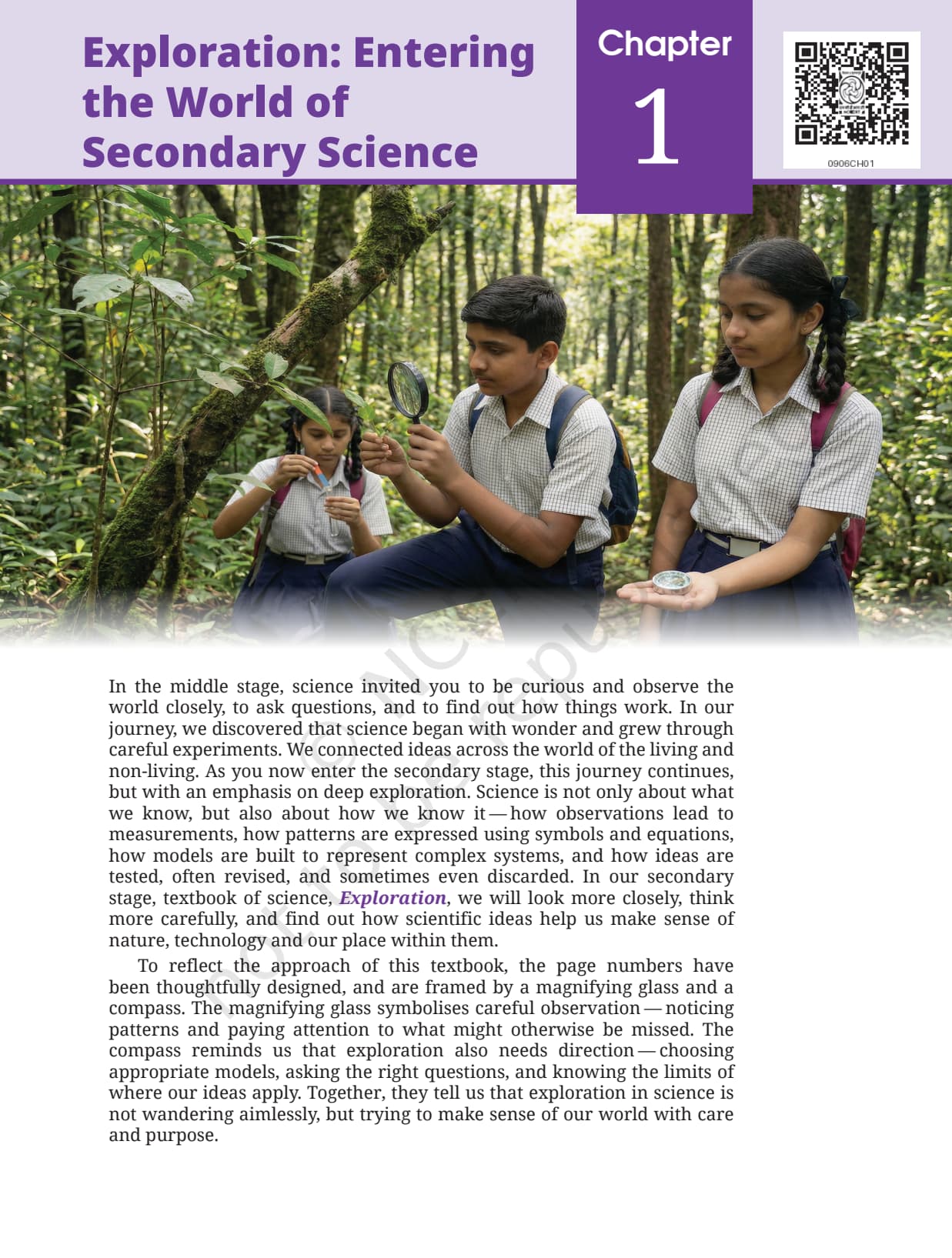
In the middle stage, science invited you to be curious, to observe, and to ask questions. In the secondary stage the same journey continues, but with a stronger focus on deep exploration. Science is no longer only about what we know. It is also about how we know it: how observations lead to measurements, how patterns are written as symbols and equations, and how ideas are tested and, when needed, revised.
The book's page numbers are framed by a magnifying glass and a compass. The magnifying glass stands for careful observation, noticing what others miss. The compass stands for direction, choosing the right questions and knowing the limits of an idea. Together they say that exploration in science is not aimless wandering, but a careful effort to make sense of the world with purpose.
How Science Works in Class 9: Observe, Model, Predict and Test
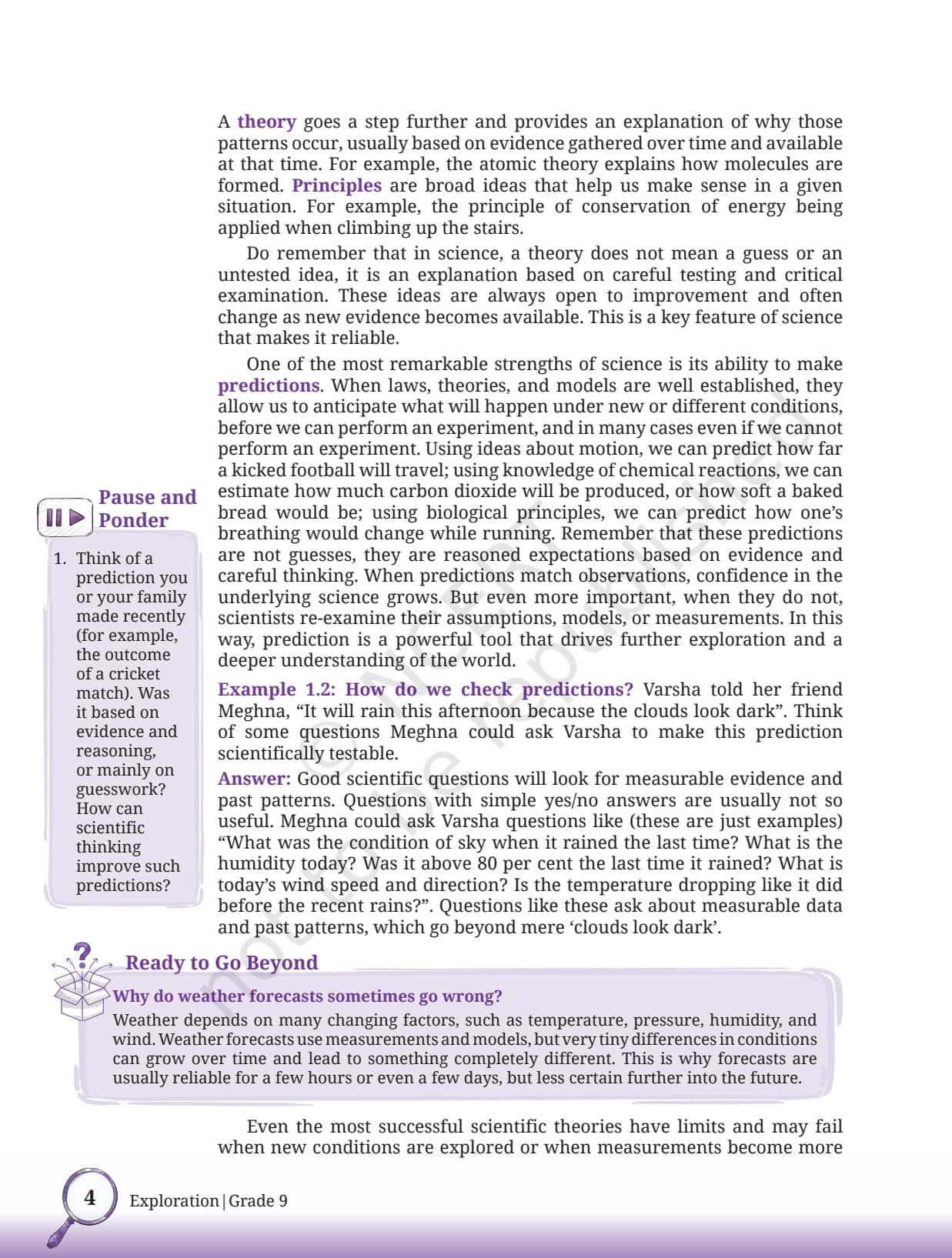
Science follows a steady pattern that you will use again and again this year. You notice something, ask a clear question, build a simple model, predict what should happen, and then test the prediction against evidence. When the test disagrees, scientists do not give up. They re-examine their assumptions, models or measurements, and try again.
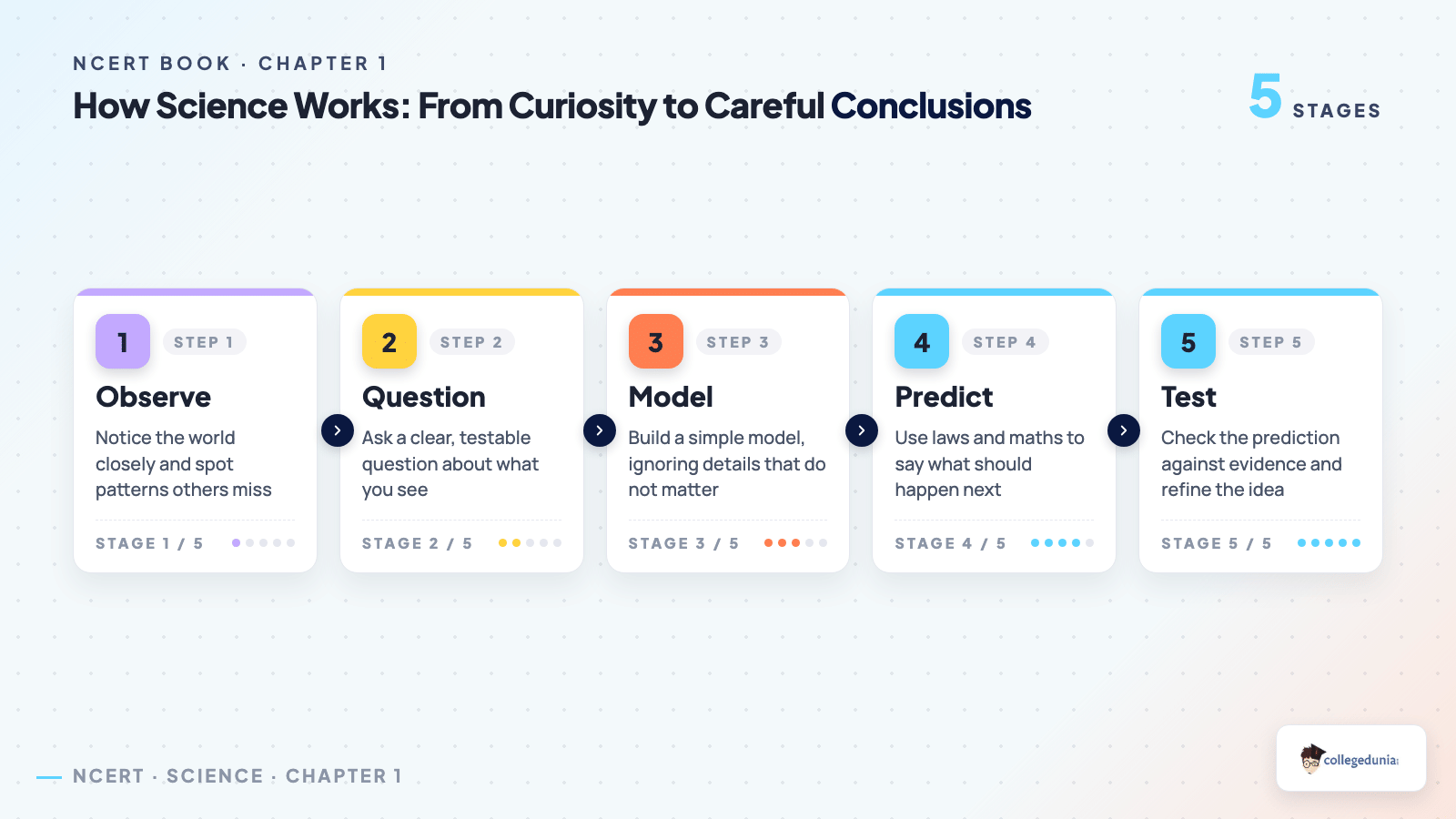
This loop is why a wrong prediction is useful, not a failure. When predictions match observations, confidence in the underlying science grows. When they do not, the mismatch points to what needs fixing. In this way, prediction becomes a tool that drives further exploration.
Why Science Builds Simple Models in the Class 9 NCERT Book
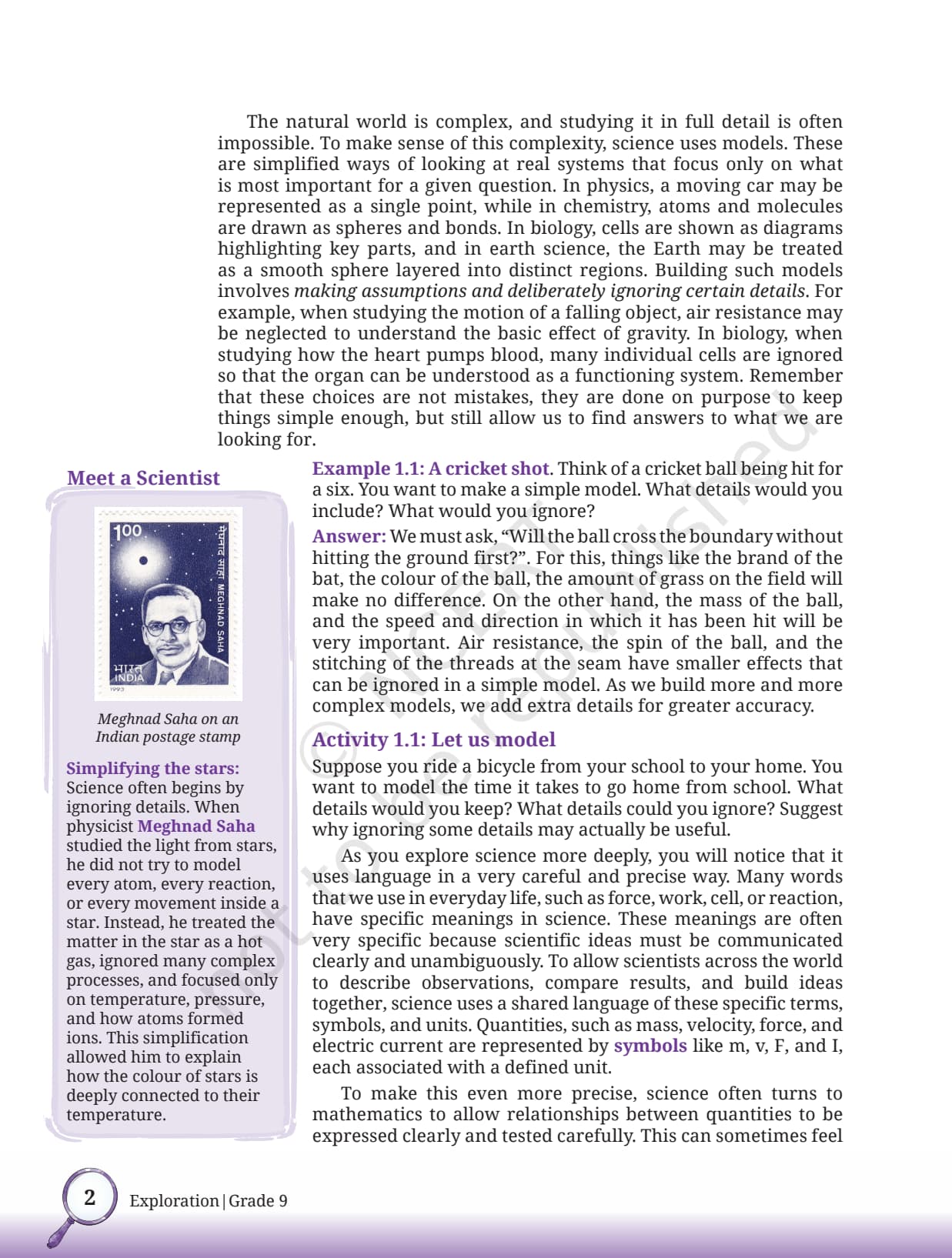
The natural world is complex, and studying it in full detail is often impossible. To manage this, science uses models, which are simplified ways of looking at real systems. A model focuses only on what matters for a given question and deliberately ignores the rest. These choices are made on purpose, and they are not mistakes.
- In physics, a moving car may be treated as a single point.
- In chemistry, atoms and molecules are drawn as spheres and bonds.
- In biology, a cell is shown as a diagram that highlights only its key parts.
The chapter shares how physicist Meghnad Saha studied light from stars. He did not model every atom or reaction inside a star. He treated the matter as a hot gas and focused on temperature, pressure and how ions form. That single simplification let him explain how a star's colour is linked to its temperature.
The Language, Symbols and Mathematics of Science
Many everyday words such as force, work, cell or reaction have very exact meanings in science. Because scientists across the world must share results clearly, science uses a shared set of terms, symbols and units. Quantities like mass, velocity, force and electric current are written with symbols such as m, v, F and I, each tied to a defined unit.
Science also turns to mathematics so that relationships between quantities can be stated clearly and tested. An equation is not just a way to calculate a number. It is a short, exact statement about how quantities are related. Learning to use mathematics in science does not mean memorising equations. It means understanding the situation first, then choosing the quantities that matter, and only then reasoning with the maths.
Why Class 9 Science Uses Standard SI Units
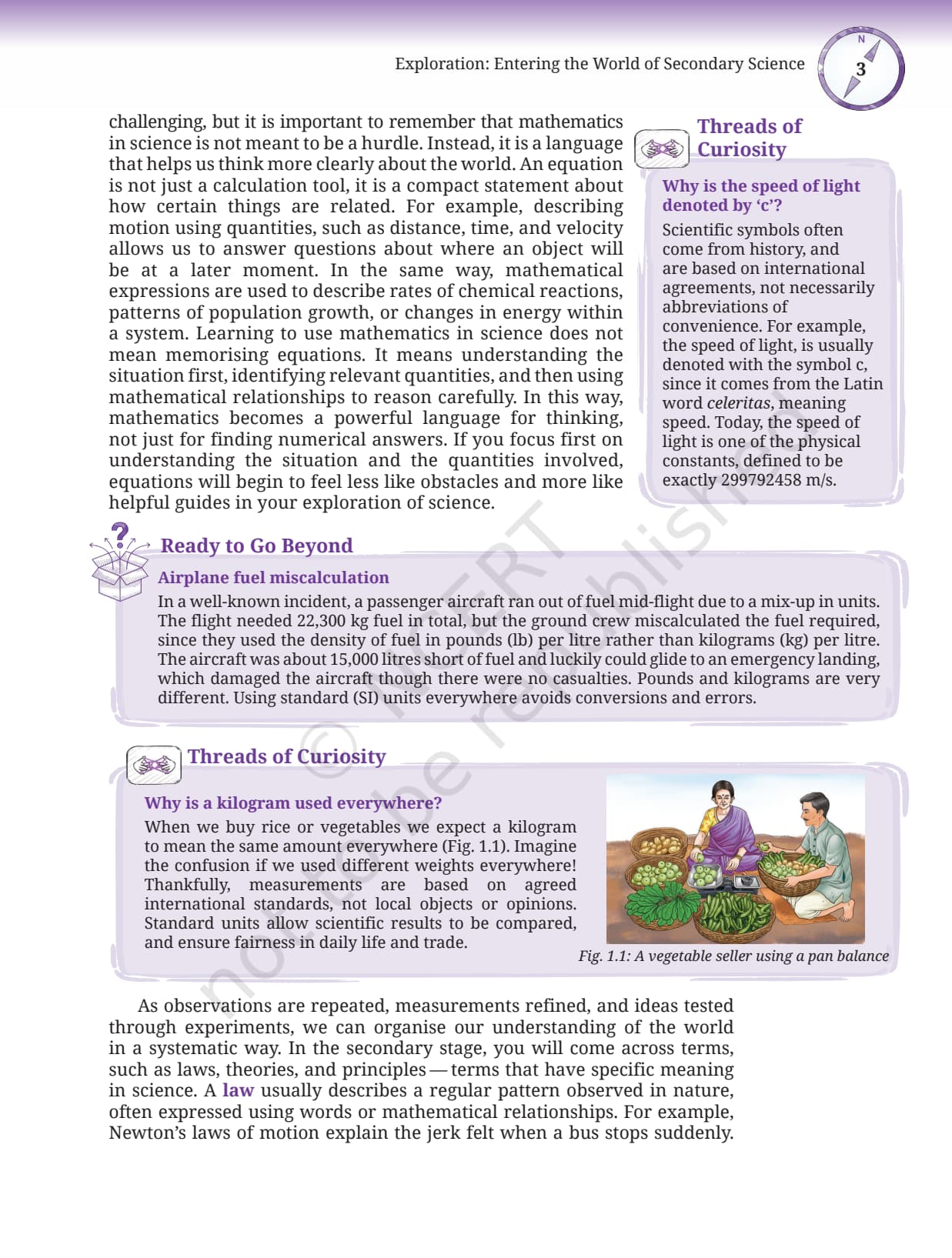
When we buy rice or vegetables, we expect a kilogram to mean the same amount everywhere. Standard units make results fair to compare, both in daily trade and in science. The chapter uses a well-known incident to show why this matters: a passenger aircraft once ran out of fuel mid-flight because the crew mixed up pounds per litre with kilograms per litre and loaded far too little fuel.
The book also explains a neat piece of history. The speed of light is written with the symbol c, which comes from the Latin word celeritas, meaning speed. Its value is fixed at exactly 299792458 metres per second. Using standard SI units everywhere avoids conversion errors and keeps scientific results reliable.
Laws, Theories, Principles and Predictions in Class 9 Science
As observations are repeated and ideas are tested, science organises them into a few clear terms. Getting these right early helps you all year, so the NCERT book defines each one carefully.
| Term | What it means | Example |
|---|---|---|
| Law | A regular pattern seen in nature, often written as a relationship | Newton's laws of motion |
| Theory | An explanation of why a pattern happens, based on careful testing | Atomic theory of matter |
| Principle | A broad idea that helps make sense of many situations | Conservation of energy |
| Prediction | Using established ideas to say what should happen next | How far a kicked ball will travel |
An important point: in science a theory does not mean a guess. It is an explanation built on careful testing and open to improvement as new evidence appears. This openness to being corrected is exactly what makes science reliable.
Estimation: Why Rough Answers Matter in Class 9 Science
One skill the chapter values highly is estimation. Exact values are not always needed, especially in early reasoning. A rough estimate is often enough to tell you whether an answer is sensible or impossible. The book works through friendly examples, such as estimating how many litres of air you breathe in a day.
Taking about 12 to 15 breaths a minute gives roughly 20 thousand breaths a day. If one breath is about 0.5 litre, you breathe close to 10,000 litres of air a day. The aim is not an exact number. It is to check whether the answer makes sense, and 10,000 litres clearly does. Learning to estimate helps you build intuition and catch errors.
Branches of Science Connect Together in the Secondary Stage
After Grade 10, science splits into branches such as physics, chemistry, biology and earth science. Even in Grades 9 and 10, chapters lean towards one of these areas. The chapter reminds you that the natural world has no such neat boundaries, and these divisions only help organise knowledge.
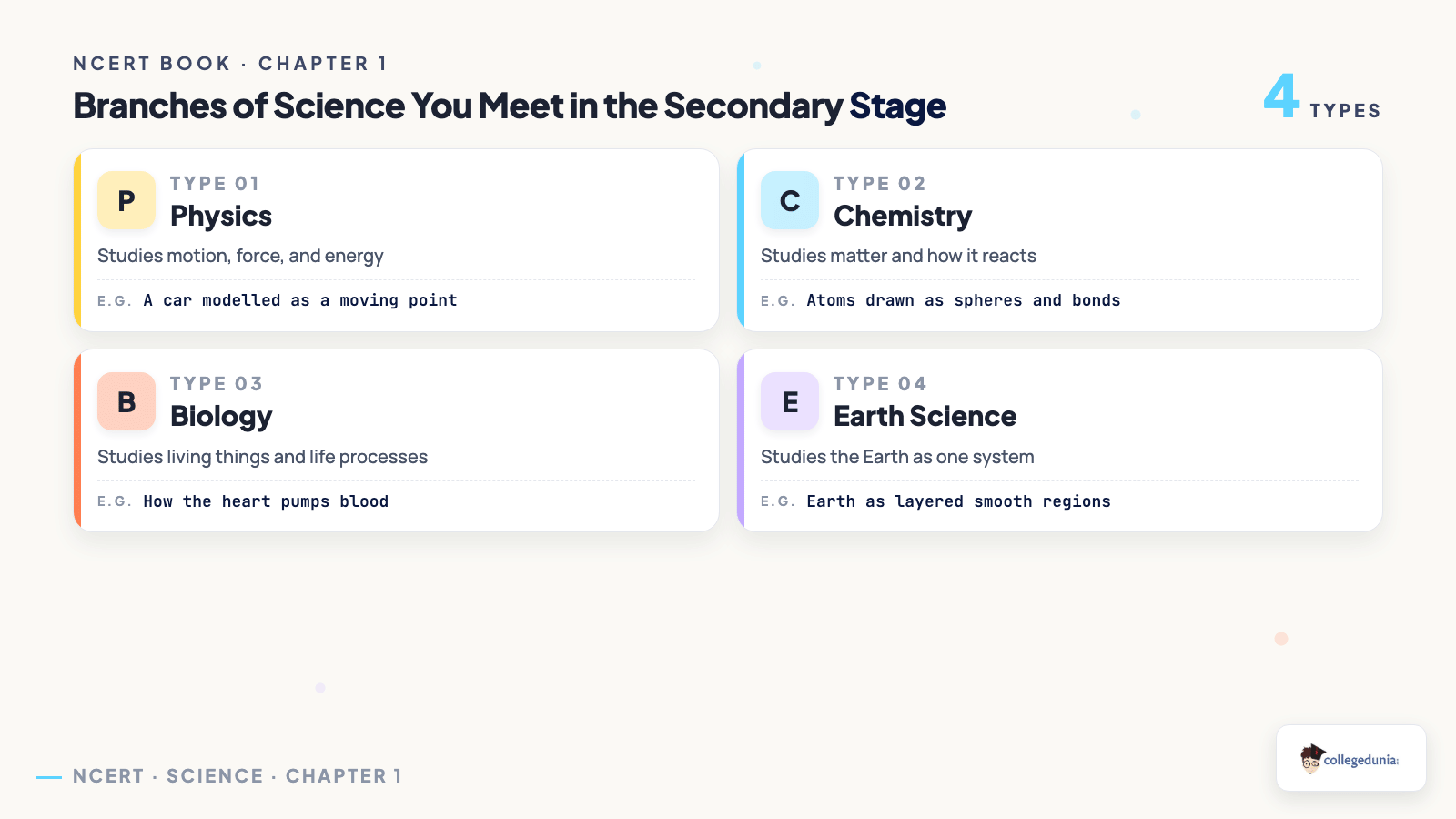
Most real problems, such as understanding climate change or how a mask filters viruses, need ideas from several branches at once. A mask works through physics (particle motion), chemistry (polymer fibres) and biology (the size of viruses). Science also connects with mathematics, technology and the arts, each enriching the other.
How to Use This Class 9 Science Chapter 1 NCERT Book PDF for Revision
Because Chapter 1 has no exercise, the best way to use this class 9 science ncert book pdf is as a reading and mindset chapter. Read it slowly once at the start of the session, and return to it whenever a later chapter feels like a wall of facts.
- Read for the "why": notice how each idea (models, units, estimation) will reappear in Physics, Chemistry and Biology.
- Try the in-text prompts: the "Pause and Ponder", "Think It Over" and "Ready to Go Beyond" boxes are quick thinking exercises, not marked questions.
- Keep the PDF handy: a two-page skim of this chapter is a calm way to reset before you begin a tough topic.
The chapter closes with a simple line that sums up the year ahead: embark on your journey of discovery, looking carefully through the magnifying glass of evidence and guided by the compass of curiosity. Happy exploring.
Other Resources to Begin Class 9 Science for 2026-27
Chapter 1 is a reading-only intro, so there are no solutions or notes for it. The first full chapter is Chapter 2, Cell the Building Block of Life. Start there with the resources below, all built for the 2026-27 session.
| Resource | Best used for |
|---|---|
| Cell the Building Block of Life Class 9 NCERT Solutions | Solving every Revise, Reflect, Refine question step by step |
| Cell the Building Block of Life Class 9 Notes | Reading the full concept notes with tables and diagrams |
| Cell the Building Block of Life Class 9 Handwritten Notes | Quick last-minute revision from colour-coded pages |
All Chapters NCERT Book PDF for Class 9 Science
Download the full set of class 9 science ncert book chapter PDFs for the 2026-27 Exploration textbook, chapter by chapter.
Class 9 Science Chapter 1 Exploration Entering the World of Secondary Science NCERT Book FAQs
Ques. Where can I download the Class 9 Science Chapter 1 Exploration Entering the World of Secondary Science NCERT Book PDF?
Ans. You can download the Chapter 1 NCERT Book PDF directly from this page. Both the Normal and HD versions are free and are taken straight from the official 2026-27 Exploration textbook.
Ques. Does Class 9 Science Chapter 1 have an exercise or solutions?
Ans. No. Chapter 1 is a reading-only introduction and has no "Revise, Reflect, Refine" exercise. There are no solutions or notes for it. The first full chapter with an exercise is Chapter 2, Cell the Building Block of Life.
Ques. What does Chapter 1 Exploration Entering the World of Secondary Science actually teach?
Ans. It explains the nature of science: how scientists observe, build simple models, use standard units and mathematics, and test predictions. It also introduces laws, theories, principles and the value of rough estimation.
Ques. Is this NCERT book aligned with the 2026-27 syllabus?
Ans. Yes. This PDF is from the new 2026-27 NCERT book Exploration, where this is Chapter 1. It is the current first edition for Class 9 Science and replaces the older textbook.
Ques. Why does science use models and standard units in Class 9?
Ans. Models simplify complex systems so scientists can focus on what matters, like treating a moving car as a single point. Standard SI units, such as the kilogram, let results be compared fairly everywhere and avoid conversion errors.
Ques. How should I use the Chapter 1 PDF if there are no questions to solve?
Ans. Read it once at the start of the session to build the right mindset, and try the "Pause and Ponder" and "Ready to Go Beyond" thinking boxes. Return to it whenever a later Physics, Chemistry or Biology chapter feels overwhelming.



Comments