




About 6 to 8 marks in the Class 10 Social Science board paper come from History, and The Age of Industrialisation is one of its most asked chapters.
Chapter4TheAgeofIndustrialisationSolutions.pdf?page=1&dpi=150)
Chapter4TheAgeofIndustrialisationSolutions.pdf?page=2&dpi=150)
Chapter4TheAgeofIndustrialisationSolutions.pdf?page=3&dpi=150)
Chapter4TheAgeofIndustrialisationSolutions.pdf?page=4&dpi=150)
Chapter4TheAgeofIndustrialisationSolutions.pdf?page=5&dpi=150)
Chapter4TheAgeofIndustrialisationSolutions.pdf?page=6&dpi=150)
Chapter4TheAgeofIndustrialisationSolutions.pdf?page=7&dpi=150)
Chapter4TheAgeofIndustrialisationSolutions.pdf?page=8&dpi=150)
Chapter4TheAgeofIndustrialisationSolutions.pdf?page=9&dpi=150)
Chapter4TheAgeofIndustrialisationSolutions.pdf?page=10&dpi=150)
Chapter4TheAgeofIndustrialisationSolutions.pdf?page=11&dpi=150)
Chapter4TheAgeofIndustrialisationSolutions.pdf?page=12&dpi=150)
Chapter4TheAgeofIndustrialisationSolutions.pdf?page=13&dpi=150)
Chapter4TheAgeofIndustrialisationSolutions.pdf?page=14&dpi=150)
Chapter4TheAgeofIndustrialisationSolutions.pdf?page=15&dpi=150)
Chapter4TheAgeofIndustrialisationSolutions.pdf?page=16&dpi=150)
Chapter4TheAgeofIndustrialisationSolutions.pdf?page=17&dpi=150)
Chapter4TheAgeofIndustrialisationSolutions.pdf?page=18&dpi=150)
Chapter4TheAgeofIndustrialisationSolutions.pdf?page=19&dpi=150)
Chapter4TheAgeofIndustrialisationSolutions.pdf?page=20&dpi=150)
The ncert solutions class 10 history chapter 4 The Age of Industrialisation on this page solve every Write in brief and Discuss question, according to the latest 2026-27 CBSE syllabus, keeping each name, date and figure the NCERT text uses.
- 8 NCERT questions solved: 3 Write in brief and 5 Discuss answers, each in a step-by-step format.
- Steady source of 3 and 5 mark questions on proto-industrialisation, gomasthas and the First World War.
- Free PDF download in Normal and HD, plus a Hindi-medium read of every answer.
Every answer in these NCERT Solutions for Class 10 History Chapter 4 is curated by Collegedunia subject experts, checked against the 2026-27 NCERT textbook, and refined using the last five years of CBSE board papers.
What The Age of Industrialisation Chapter Covers for the Boards
This chapter follows the long story of industrialisation, first in Britain and then in colonial India. It begins with proto-industrialisation, the production for the world market that came before the factory, and ends with advertisements and the swadeshi message. The ncert solutions class 10 history chapter 4 The Age of Industrialisation on this page keep every name, year and figure you need for the board answer.
- Before the factory: proto-industrialisation, town guilds, and merchants moving to the countryside.
- Hand labour and steam power: the Spinning Jenny, cheap labour, and why machines spread slowly.
- Industry in the colony: the East India Company, gomasthas, and the control of Indian weavers.
- Manchester comes to India: British cloth flooding the market and the decline of Indian exports.
- The First World War and after: the wartime boom, advertisements, cloth labels and swadeshi.
Learn one date and one outcome per topic. That single line of detail is often worth a mark in the board scheme.
The Age of Industrialisation Crash Course for Class 10 Boards
Source: Magnet Brains on YouTube
History Class 10 Chapter 4 Question Answer: Write in Brief Section
The Write in brief questions in history class 10 chapter 4 test short, factual recall. In the class 10 history chapter 4 question answer set, the board often picks the four-part "explain the following", the True or False set, and the meaning of proto-industrialisation for 3 and 5 mark slots. These class 10 history chapter 4 question answer formats reward one clean fact-line per part.
| Question | What a full-mark answer must include |
|---|---|
| Why women in Britain attacked the Spinning Jenny | Hand spinners feared the Jenny would cut the number of workers needed, so women who lost their work to the spinning engines attacked it out of fear of unemployment. |
| Why the port of Surat declined by the end of the eighteenth century | European companies seized monopoly trade, so Surat's exports collapsed and its gross trade fell from about Rs 16 million to Rs 3 million. |
| True or False on the workforce, Indian textiles, the American Civil War and the fly shuttle | (a) False, under 20 per cent of the workforce was in advanced industry. (b) True. (c) False, the war raised India's cotton exports. (d) True. |
| What is meant by proto-industrialisation | The early, pre-factory phase of industrialisation in which town merchants got peasants and artisans in the countryside to produce goods for the international market. |
Tip: for the four-part "explain" question, name the reason, not the event. In the ncert solutions class 10 history chapter 4 The Age of Industrialisation, "fear of unemployment" scores more than "they did not like the machine".
The Age of Industrialisation Important Question: Discuss Section
The Discuss questions carry the long-answer marks. Each the age of industrialisation important question asks you to explain a process, write an article, or trace a chain of causes, so a plain list of facts is not enough. A well-set answer needs a clear concept line, dated steps, and a one-line conclusion.
- Hand labour over machines: cheap plentiful labour, costly machines, seasonal demand, and the taste for fine handmade goods.
- The East India Company and weavers: the gomastha and the system of advances that tied weavers to the Company.
- Britain and the history of cotton: an encyclopaedia article tracing the rise and fall of British cotton.
- Industry in the First World War: why Indian production boomed when Manchester imports fell.
- Project work: a guided method for studying any one local industry.
Memorise the gomastha-and-advance system and the First World War boom, the two Discuss answers that appear most often.
Why Industrialists in Europe Preferred Hand Labour Over Machines
Why industrialists kept using human hands in the machine age is one of the most asked Discuss questions. The chapter gives four clear reasons, and the board wants each as a separate point: two cost reasons and two demand reasons.
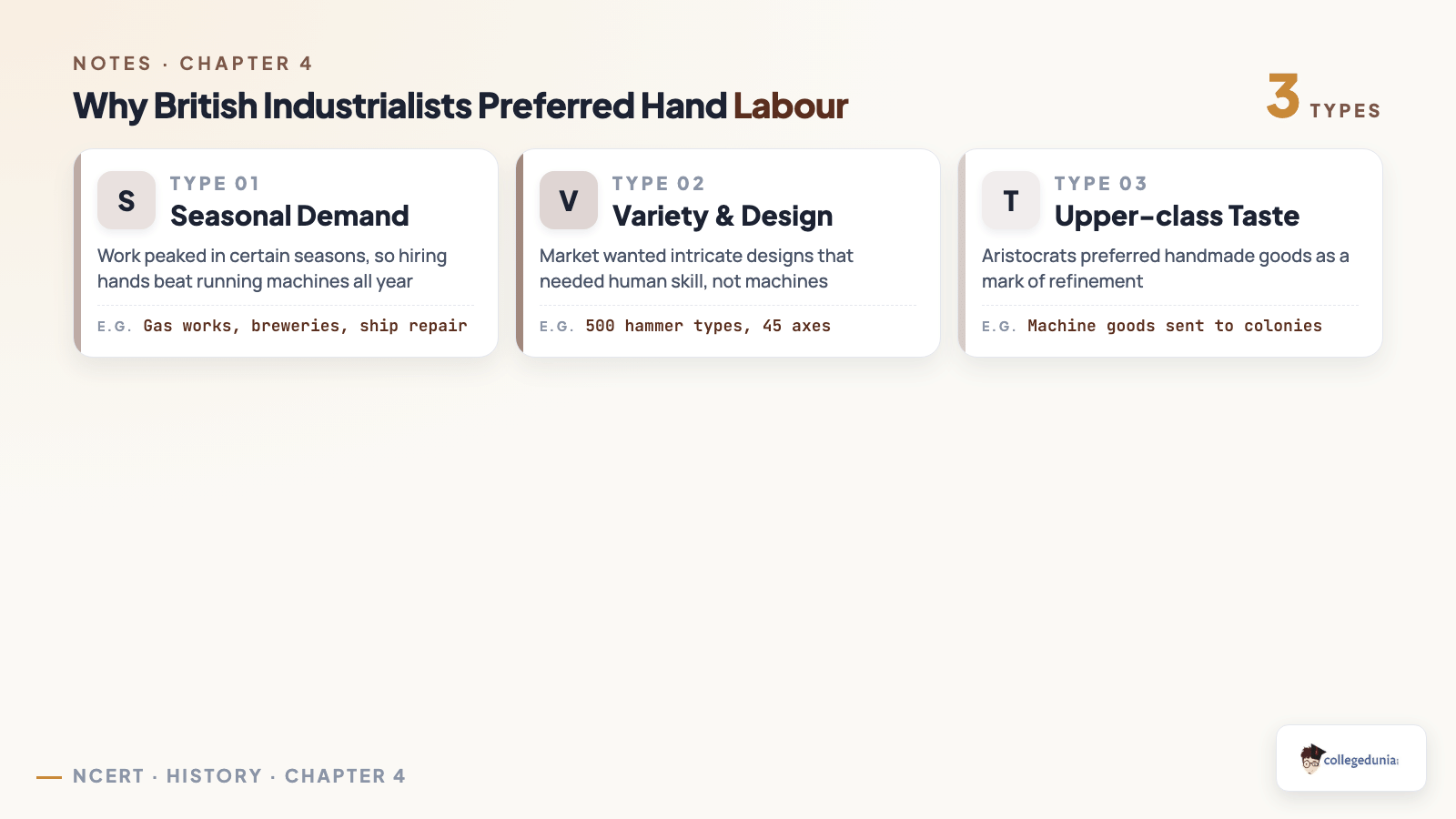
| Reason | Why it favoured hand labour |
|---|---|
| Cheap, plentiful labour | Poor peasants and vagrants flooded the cities, so wages stayed low and there was no labour shortage to solve with machines. |
| Costly, risky machines | Machines needed a large capital investment, broke down often, and were expensive to repair, so owners were cautious. |
| Seasonal demand | In trades like gas works, breweries and book-binding, work rose and fell with the season, so hiring hands beat buying idle machines. |
| Taste for fine goods | The upper classes wanted varied, finely finished handmade goods with intricate designs that machines could not produce. |
Machines did not instantly replace hand labour everywhere. Where labour was cheap and the market wanted variety, hand labour stayed the smarter choice well into the machine age.
How the East India Company Controlled Indian Weavers
How the East India Company secured a regular supply of cotton and silk textiles is a 5-mark favourite. After it gained political power in Bengal and the Carnatic, the Company built a system of management and control that rested on two tools: a person and a trap.
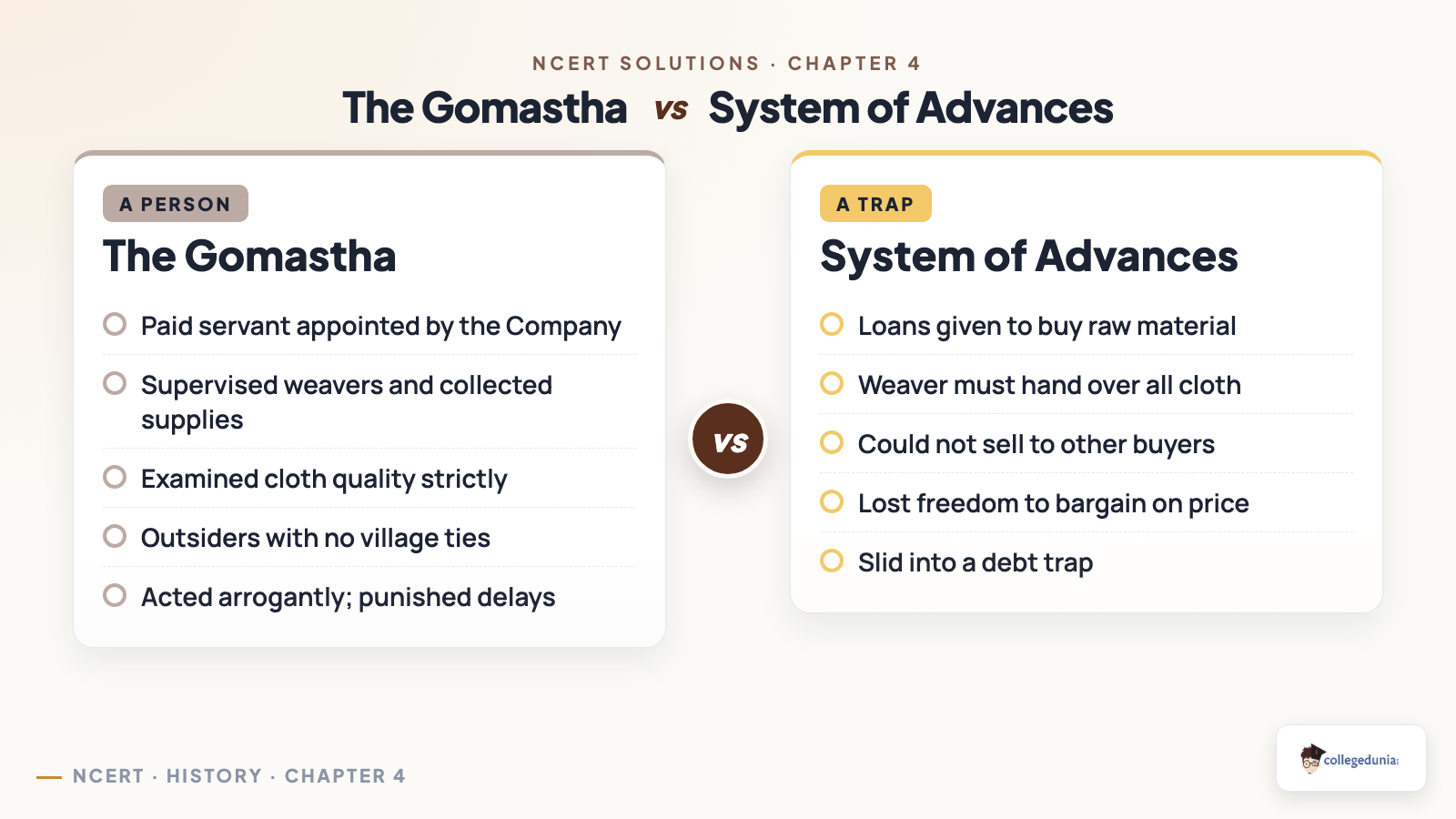
| Tool | What it did |
|---|---|
| The gomastha (the person) | A paid Company servant who supervised the weavers, collected the cloth, and examined its quality, replacing the old supply merchants. |
| The system of advances (the trap) | Loans given to weavers to buy raw material; those who took the loans had to hand all their cloth to the gomastha and could not sell to anyone else. |
Together these tools removed competition and gave the Company a regular, cheap supply. The advances tied weavers to the Company, and the price they got was miserably low. This is how political power was turned into economic control.
Why Indian Industrial Production Increased During the First World War
Why Indian industrial production rose during the First World War (1914 to 1918) is the other big Discuss answer. The war helped Indian industry in two ways at once: it removed a rival and created new demand. Keep both forces in view for full marks.
- Manchester imports fell: British mills turned to war production, so cheap British cloth stopped flooding India.
- A vast home market opened: Indian mills could now sell freely to buyers who had earlier bought Manchester goods.
- War orders poured in: factories supplied jute bags, army uniforms, tents, leather boots and saddles.
- Factories ran at full stretch: new units opened, old ones ran multiple shifts, and workers worked longer hours.
Tip: do not stop at "imports fell". Mention the army war orders and the multiple shifts too. After the war, Manchester never recovered its old place in India.
Student Feedback on The Age of Industrialisation Chapter
What 14,210 students told us about studying this chapter before the 2026 boards.
- 71% of students rated the four-part "explain the following" question as the one they most often answered without giving the reason.
- 64% of students said the gomastha-and-advance system was the hardest set of points to recall under exam pressure.
- Most-skipped topic in revision: the encyclopaedia article on British cotton, left for last by about 44% of students.
Source: 2026-27 Class 10 History student poll. Sample of 14,210 students from CBSE schools across 15 states.
Common Mistakes Students Make in The Age of Industrialisation Chapter
A few slips lose easy marks every year. Fix these before the exam.
- Answering True or False with no reason. In this chapter the reason carries the marks, so add one explaining line each.
- Getting the American Civil War backwards. The war raised India's cotton exports, so that statement is False.
- Forgetting figures: Surat's trade fell from Rs 16 million to Rs 3 million, and India's piece-goods exports fell from 33 per cent in 1811 to 3 per cent by 1850.
- Writing the proto-industrialisation answer without the town-country network, the merchant clothier and the London finishing stage.
How to Use the NCERT Solutions Class 10 History Chapter 4 Page
Use the age of industrialisation ncert solutions in three short blocks so revision stays focused.
- Read and list: read the NCERT chapter and note every name, date, figure and outcome.
- Attempt first: answer all 8 questions on your own before opening the solutions.
- Compare and flag: match your answer with the step-by-step solution and mark the missing fact-lines.
For long-answer practice, write the British-cotton article and the gomastha answer in full at least once. These solutions mirror the board's 5-mark pattern.
Practice All NCERT Solutions for The Age of Industrialisation with Step-by-Step Solutions
Open the question bank below to attempt all 8 solved questions with collapsible Solution and Expert Solution tabs. Every answer in the ncert solutions class 10 history chapter 4 The Age of Industrialisation set is mapped to the NCERT text, so each class 10 history chapter 4 question answer reads exactly the way a board examiner expects.
All Solved Questions for The Age of Industrialisation
Practise every Write in brief and Discuss question with step-by-step solutions and an expert version for board marks.
Class 10 History Other Resources for The Age of Industrialisation
Pair these solutions with the other Class 10 History resources for the same chapter. The notes give a quick recap, the handwritten notes help last-minute revision, and the NCERT book PDF is the source text.
| Resource | Best used for |
|---|---|
| The Age of Industrialisation Class 10 Notes | Quick concept recap before the exam |
| The Age of Industrialisation Class 10 Handwritten Notes | Last-minute scanned revision |
| The Age of Industrialisation Class 10 NCERT Book PDF | Reading the original chapter text |
All Chapters NCERT Solutions for Class 10 History (India and Contemp World II)
Browse the full set of ncert solutions for class 10 history chapter by chapter. Each link opens the solved questions for that chapter.
| Chapter | NCERT Solutions |
|---|---|
| Chapter 1 | The Rise of Nationalism in Europe Class 10 NCERT Solutions |
| Chapter 2 | Nationalism in India Class 10 NCERT Solutions |
| Chapter 3 | The Making of a Global World Class 10 NCERT Solutions |
| Chapter 4 | The Age of Industrialisation Class 10 NCERT Solutions |
| Chapter 5 | Print Culture and the Modern World Class 10 NCERT Solutions |
The Age of Industrialisation Class 10 History NCERT Solutions FAQs
Ques. Where can I download the NCERT Solutions Class 10 History Chapter 4 The Age of Industrialisation PDF?
Ans. You can download the age of industrialisation ncert solutions PDF directly from this page. Both the Normal and HD versions are free, and a Hindi-medium read is available too.
Ques. How many questions are solved in class 10 history chapter 4 question answer?
Ans. All 8 NCERT questions are solved: 3 Write in brief questions and 5 Discuss questions, each with a step-by-step solution and an expert version for the long-answer marks.
Ques. Is this NCERT Solutions page aligned with the 2026-27 syllabus?
Ans. Yes. This page reflects the current 2026-27 syllabus for Class 10 History, and every answer is checked against the latest NCERT edition of India and the Contemporary World II.
Ques. What is meant by proto-industrialisation?
Ans. Proto-industrialisation was the early, pre-factory phase of industrialisation. Town merchants gave money to peasants and artisans in the countryside to produce goods for the international market, in their own homes rather than in factories.
Ques. Who was a gomastha in The Age of Industrialisation chapter?
Ans. A gomastha was a paid servant of the East India Company appointed to supervise weavers, collect the cloth supplies, and examine the quality of the cloth, giving the Company direct control over the weavers.
Ques. Why did women in Britain attack the Spinning Jenny?
Ans. The Spinning Jenny let one worker set many spindles spinning at once, so far fewer hands were needed. Women who survived on hand spinning feared the machine would take away their work, so out of fear of unemployment they attacked it.
Ques. Why did industrial production in India increase during the First World War?
Ans. Manchester imports fell because British mills were busy with war work, so Indian mills gained a vast home market. Indian factories also won army orders for uniforms, tents, boots and jute bags, so new factories opened, old ones ran extra shifts, and production boomed.



Comments