




The NCERT Solutions for Class 10 History Chapter 3 The Making of a Global World cover every Write in brief and Discuss question, according to the latest 2026-27 CBSE syllabus.
Chapter3TheMakingofaGlobalWorldSolutions.pdf?page=1&dpi=150)
Chapter3TheMakingofaGlobalWorldSolutions.pdf?page=2&dpi=150)
Chapter3TheMakingofaGlobalWorldSolutions.pdf?page=3&dpi=150)
Chapter3TheMakingofaGlobalWorldSolutions.pdf?page=4&dpi=150)
Chapter3TheMakingofaGlobalWorldSolutions.pdf?page=5&dpi=150)
Chapter3TheMakingofaGlobalWorldSolutions.pdf?page=6&dpi=150)
Chapter3TheMakingofaGlobalWorldSolutions.pdf?page=7&dpi=150)
Chapter3TheMakingofaGlobalWorldSolutions.pdf?page=8&dpi=150)
Chapter3TheMakingofaGlobalWorldSolutions.pdf?page=9&dpi=150)
Chapter3TheMakingofaGlobalWorldSolutions.pdf?page=10&dpi=150)
Chapter3TheMakingofaGlobalWorldSolutions.pdf?page=11&dpi=150)
Chapter3TheMakingofaGlobalWorldSolutions.pdf?page=12&dpi=150)
Chapter3TheMakingofaGlobalWorldSolutions.pdf?page=13&dpi=150)
Chapter3TheMakingofaGlobalWorldSolutions.pdf?page=14&dpi=150)
Chapter3TheMakingofaGlobalWorldSolutions.pdf?page=15&dpi=150)
Chapter3TheMakingofaGlobalWorldSolutions.pdf?page=16&dpi=150)
Chapter3TheMakingofaGlobalWorldSolutions.pdf?page=17&dpi=150)
Chapter3TheMakingofaGlobalWorldSolutions.pdf?page=18&dpi=150)
Chapter3TheMakingofaGlobalWorldSolutions.pdf?page=19&dpi=150)
Chapter3TheMakingofaGlobalWorldSolutions.pdf?page=20&dpi=150)
Each answer keeps the people, dates and figures the NCERT text uses, from the silk routes to the Bretton Woods Agreement of 1944.
- 9 NCERT questions solved: 5 Write in brief and 4 Discuss answers, each in a step-by-step format.
- History carries about 20 marks in the Class 10 Social Science board paper, and this chapter is a steady source of 3 and 5 mark questions.
- Free PDF download in Normal and HD, plus a Hindi-medium read of every answer.
Every answer here is written by Collegedunia subject experts, checked against the 2026-27 NCERT textbook, and refined using the last five years of CBSE board papers.
What This Class 10 History Chapter Covers for the Boards
This chapter tells how the world became one connected economy, from the ancient silk routes to the post-war Bretton Woods order. Every answer here keeps the names, years and figures you need.
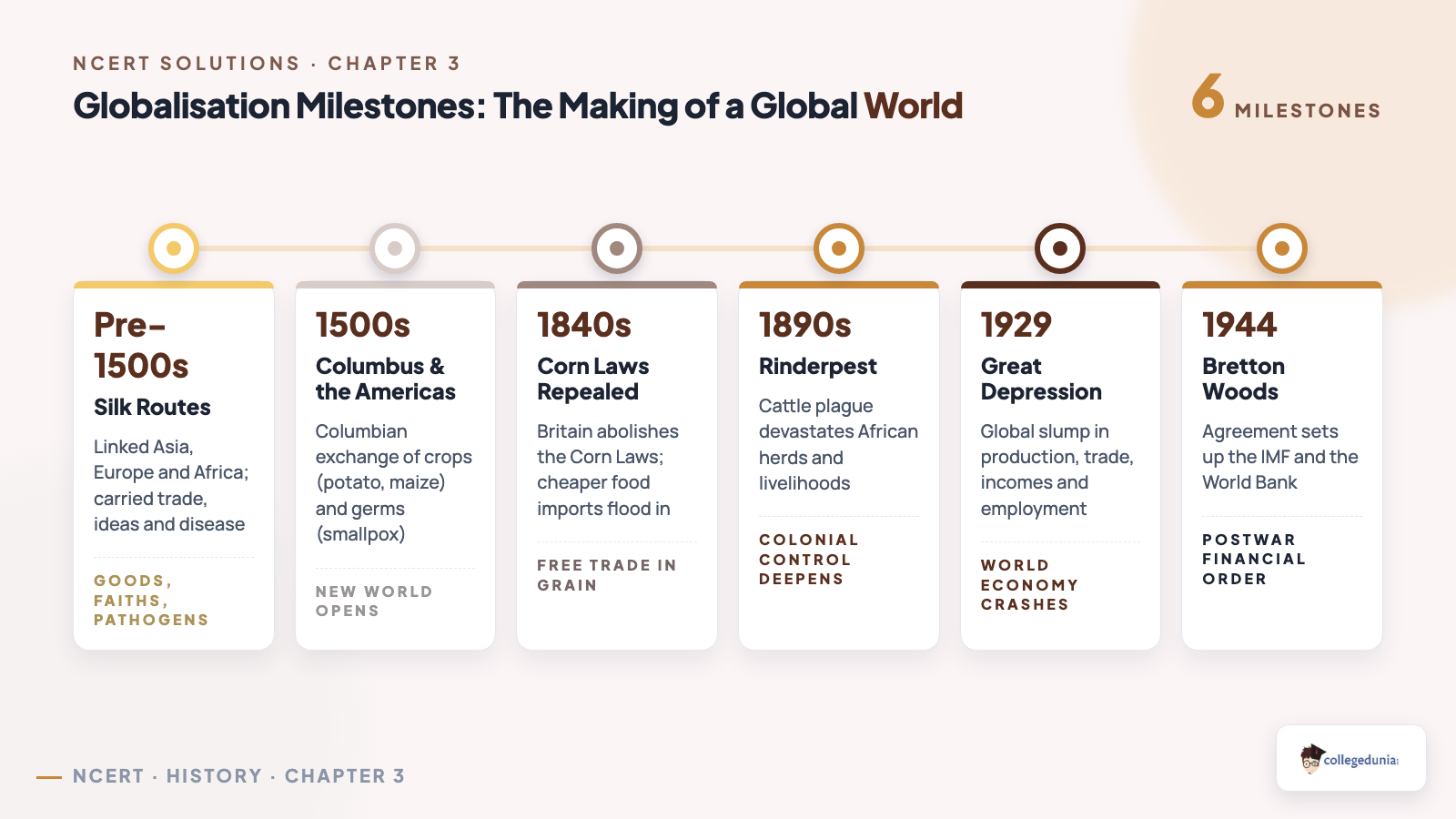
- The pre-modern world: silk routes, American foods, and the global transfer of disease.
- The nineteenth-century economy: the three flows of trade, labour and capital, and the Corn Laws.
- Colonialism and indentured labour: rinderpest in Africa and the Great Depression.
- Rebuilding the world economy: Bretton Woods, the IMF and World Bank, and the G-77.
One-Shot Revision of The Making of a Global World for Class 10 Boards
Source: Magnet Brains on YouTube
History Class 10 Chapter 3 Question Answer: Write in Brief Section
The Write in brief questions in history class 10 chapter 3 test short, factual recall. The board often picks the silk routes example, the five-part effects note and the Bretton Woods question for 3 and 5 marks. Each answer rewards one clean fact-line per part.
| Question | What a full-mark answer must include |
|---|---|
| Two examples of global exchange before the seventeenth century | Asia: the silk routes carried silk, pottery and spices westward, gold and silver eastward. The Americas: foods like the potato, maize and chilli spread after Columbus. |
| How disease helped the colonisation of the Americas | The isolated Americans had no immunity; smallpox became the colonisers' most powerful weapon and wiped out whole communities. |
| Two examples of technology and food availability | Faster railways, lighter wagons and larger ships moved food cheaply; refrigerated ships let meat reach Europe so even the poor could eat it. |
| What is meant by the Bretton Woods Agreement | The 1944 deal that set up the IMF, the World Bank and fixed exchange rates to keep the post-war economy stable. |
Tip: name the technology and the result together, like "refrigerated ships, so the poor could eat meat".
The Making of a Global World Important Question: Discuss Section
The Discuss questions carry the long-answer marks. Each the making of a global world important question asks you to explain a process, write a letter, or trace a cause chain.
- The indentured labourer's letter: deceiving agent, five-year contract, "new system of slavery", the Hosay festival.
- The three flows of exchange: trade, labour and capital, each with one Indian example.
- Causes of the Great Depression: overproduction, withdrawal of US loans, higher import duties, banking collapse.
- The G-77 and the NIEO: developing nations demanding a New International Economic Order from the Bretton Woods twins.
Memorise the three flows and the 1944 Bretton Woods Agreement, since these appear most years.
The Three Flows of International Exchange Explained for Class 10
The three flows of trade, labour and capital are a top topic here. A memory line is "goods, people, money". Keep one Indian example ready for each.
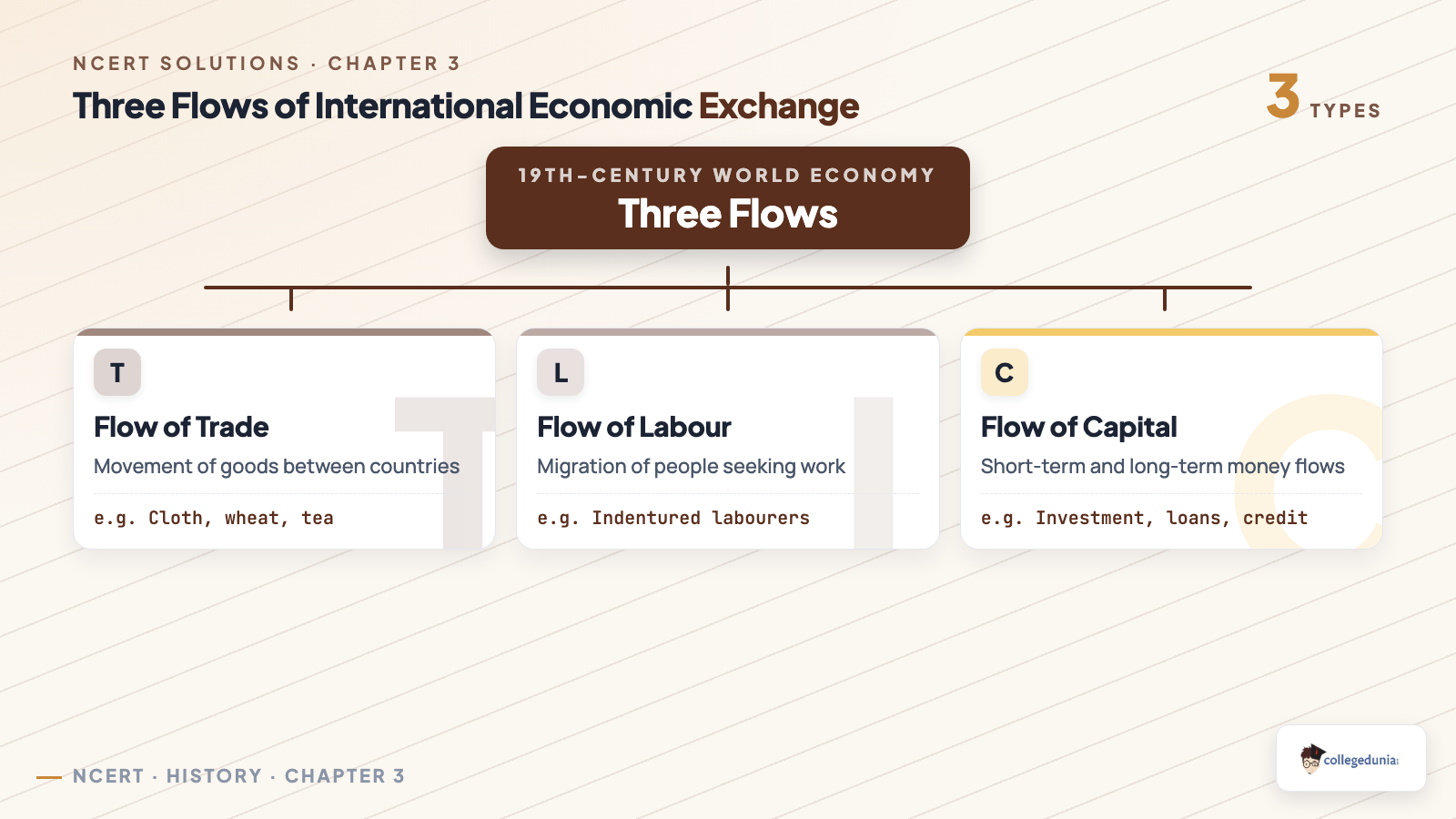
| Flow | What it means | Indian example |
|---|---|---|
| Trade (goods) | Buying and selling goods between countries. | India exported raw cotton and wheat and was flooded with British cloth. |
| Labour (people) | The migration of people for work. | Indian indentured workers sent to the Caribbean, Mauritius and Fiji. |
| Capital (money) | The movement of money for investment. | British investment in Indian railways, and India's surplus used to fund Britain. |
Causes of the Great Depression and Its Effect on India
The Great Depression, which began around 1929, saw a sharp fall in production, jobs, incomes and trade. The board often pairs the causes with the effect on India.
- Agricultural overproduction: farmers grew more as prices fell, crashing them further.
- Heavy dependence on US loans, which fell from over $1 billion in 1928 to a quarter of that within a year.
- The withdrawal of those loans, which toppled banks and currencies abroad.
- The doubling of US import duties, which choked world trade.
- The collapse of the US banking system, with over 4,000 banks closed by 1933.
For India, it halved trade between 1928 and 1934, crashed wheat prices by about 50 per cent, ruined peasants whose revenue stayed high, and made India a gold exporter that helped Britain recover.
Indentured Labour and the Bretton Woods Agreement
Two long-answer favourites here are the indentured labourer's letter and the Bretton Woods Agreement.
- Indentured labour: recruited from eastern UP, Bihar and Tamil districts by a deceiving agent; a five-year contract; harsh work called a "new system of slavery"; the Hosay festival kept spirits alive.
- Bretton Woods (July 1944): the UN Monetary and Financial Conference set up the IMF and World Bank (the "twins") and fixed exchange rates anchored to the US dollar.
Keep the twins straight: the IMF handles a country's money problems, the World Bank lends to rebuild after the war.
Student Feedback on this Class 10 History Chapter
What 13,420 students told us about this chapter before the 2026 boards.
- 69% of students rated the five-part effects note (Corn Laws, rinderpest, war deaths, Depression, MNCs) as the one they most often mixed up.
- 61% of students said the causes of the Great Depression were the hardest points to recall under exam pressure.
- Most-skipped topic: the G-77 and NIEO question, left for last by about 41% of students.
Source: 2026-27 Class 10 History student poll. Sample of 13,420 students from CBSE schools across 14 states.
Common Mistakes Students Make in this Class 10 History Chapter
A few slips lose easy marks every year.
- Writing that guns alone won the Americas. It was disease, especially smallpox, that did most of the damage.
- Merging the five-part effects question into one paragraph instead of answering each part (a) to (e) separately.
- Forgetting figures: rinderpest killed about 90% of African cattle, and India's trade halved between 1928 and 1934.
- Giving "the stock market crashed" as the only cause of the Depression, instead of overproduction, loan withdrawal, import duties and bank failures.
How to Use the NCERT Solutions Class 10 History Chapter 3 Page
Use these solutions in three blocks: read the chapter, attempt the questions, then compare and fix the gaps.
- Read and list every name, date, figure and outcome in the NCERT chapter.
- Attempt all 9 questions on your own first.
- Compare with the step-by-step solution and mark the missing fact-lines.
Write the indentured-labour letter and the three-flows answer in full at least once. These ncert solutions class 10 history chapter 3 mirror the board's 5-mark pattern.
Practice All NCERT Solutions for this Class 10 History Chapter with Step-by-Step Solutions
Open the question bank below to attempt all 9 solved questions with collapsible Solution and Expert Solution tabs. Every class 10 history chapter 3 question answer is mapped to the NCERT text.
All Solved Questions for this Class 10 History Chapter
Practise every question with step-by-step solutions and an expert version.
Class 10 History Other Resources for this Chapter
Pair this with the other Class 10 History resources for this chapter, all linked below.
| Resource | Best used for |
|---|---|
| The Making of a Global World Class 10 Notes | Quick concept recap before the exam |
| The Making of a Global World Class 10 Handwritten Notes | Last-minute scanned revision |
| The Making of a Global World Class 10 NCERT Book PDF | Reading the original chapter text |
All Chapters NCERT Solutions for Class 10 History (India and Contemp World II)
Browse the full set of ncert solutions for class 10 history chapter by chapter.
| Chapter | NCERT Solutions |
|---|---|
| Chapter 1 | The Rise of Nationalism in Europe Class 10 NCERT Solutions |
| Chapter 2 | Nationalism in India Class 10 NCERT Solutions |
| Chapter 3 | The Making of a Global World Class 10 NCERT Solutions |
| Chapter 4 | The Age of Industrialisation Class 10 NCERT Solutions |
| Chapter 5 | Print Culture and the Modern World Class 10 NCERT Solutions |
The Making of a Global World Class 10 History NCERT Solutions FAQs
Ques. Where can I download the NCERT Solutions Class 10 History Chapter 3 The Making of a Global World PDF?
Ans. You can download the making of a global world ncert solutions PDF directly from this page. Both the Normal and HD versions are free, and a Hindi-medium read is available too.
Ques. How many questions are solved in class 10 history chapter 3 question answer?
Ans. All 9 NCERT questions are solved: 5 Write in brief questions and 4 Discuss questions, each with a step-by-step solution and an expert version for the long-answer marks.
Ques. Is this NCERT Solutions page aligned with the 2026-27 syllabus?
Ans. Yes. This page reflects the current 2026-27 syllabus for Class 10 History, and every answer is checked against the latest NCERT edition of India and the Contemporary World II.
Ques. What was the Bretton Woods Agreement in this chapter?
Ans. It was an agreement reached in July 1944 at Bretton Woods, USA, that set up the IMF and the World Bank and a system of fixed exchange rates to keep the post-war world economy stable.
Ques. Why was the abolition of the Corn Laws important?
Ans. After the Corn Laws were abolished, food could be imported into Britain more cheaply than it could be grown. British farming could not compete, land was left uncultivated, and many people lost their jobs or migrated overseas.
Ques. What were the main causes of the Great Depression?
Ans. The main causes were agricultural overproduction with falling prices, the world's dependence on US loans and their sudden withdrawal, the doubling of US import duties, and the collapse of the American banking system.
Ques. What were the G-77 countries and how were they a reaction to the Bretton Woods twins?
Ans. The G-77 was a group of developing nations that demanded a New International Economic Order. It was a reaction to the IMF and the World Bank, which had served the rich Western nations and left the poorer countries out of post-war growth.



Comments