




The NCERT Solutions for Class 10 History Chapter 5 Print Culture and the Modern World cover every Write in brief and Discuss question, according to the latest 2026-27 CBSE syllabus.
Chapter5PrintCultureandtheModernWorldSolutions.pdf?page=1&dpi=150)
Chapter5PrintCultureandtheModernWorldSolutions.pdf?page=2&dpi=150)
Chapter5PrintCultureandtheModernWorldSolutions.pdf?page=3&dpi=150)
Chapter5PrintCultureandtheModernWorldSolutions.pdf?page=4&dpi=150)
Chapter5PrintCultureandtheModernWorldSolutions.pdf?page=5&dpi=150)
Chapter5PrintCultureandtheModernWorldSolutions.pdf?page=6&dpi=150)
Chapter5PrintCultureandtheModernWorldSolutions.pdf?page=7&dpi=150)
Chapter5PrintCultureandtheModernWorldSolutions.pdf?page=8&dpi=150)
Chapter5PrintCultureandtheModernWorldSolutions.pdf?page=9&dpi=150)
Chapter5PrintCultureandtheModernWorldSolutions.pdf?page=10&dpi=150)
Chapter5PrintCultureandtheModernWorldSolutions.pdf?page=11&dpi=150)
Chapter5PrintCultureandtheModernWorldSolutions.pdf?page=12&dpi=150)
Chapter5PrintCultureandtheModernWorldSolutions.pdf?page=13&dpi=150)
Chapter5PrintCultureandtheModernWorldSolutions.pdf?page=14&dpi=150)
Chapter5PrintCultureandtheModernWorldSolutions.pdf?page=15&dpi=150)
Chapter5PrintCultureandtheModernWorldSolutions.pdf?page=16&dpi=150)
Chapter5PrintCultureandtheModernWorldSolutions.pdf?page=17&dpi=150)
Chapter5PrintCultureandtheModernWorldSolutions.pdf?page=18&dpi=150)
Chapter5PrintCultureandtheModernWorldSolutions.pdf?page=19&dpi=150)
Each answer keeps the people, dates and facts the NCERT text uses, from the first woodblock prints in China and the Gutenberg Press of the 1450s to the Vernacular Press Act of 1878 and Gandhi's words on a free press.
- 7 NCERT questions solved: 3 Write in brief and 4 Discuss answers, each in a step-by-step format.
- History carries about 20 marks in the Class 10 Social Science board paper, and this chapter is a steady source of 3 and 5 mark questions.
- Free PDF download in Normal and HD, plus a Hindi-medium read of every answer.
Every answer in these NCERT Solutions for Class 10 History Chapter 5 is written by Collegedunia subject experts, checked against the 2026-27 NCERT textbook, and refined using the last five years of CBSE board papers.
What This Class 10 History Chapter Covers for the Boards
This chapter tells how print changed the world, from the first woodblock printing in China, Japan and Korea, through the Gutenberg Press and the print revolution in Europe, to the printed word fuelling reform and nationalism in India.
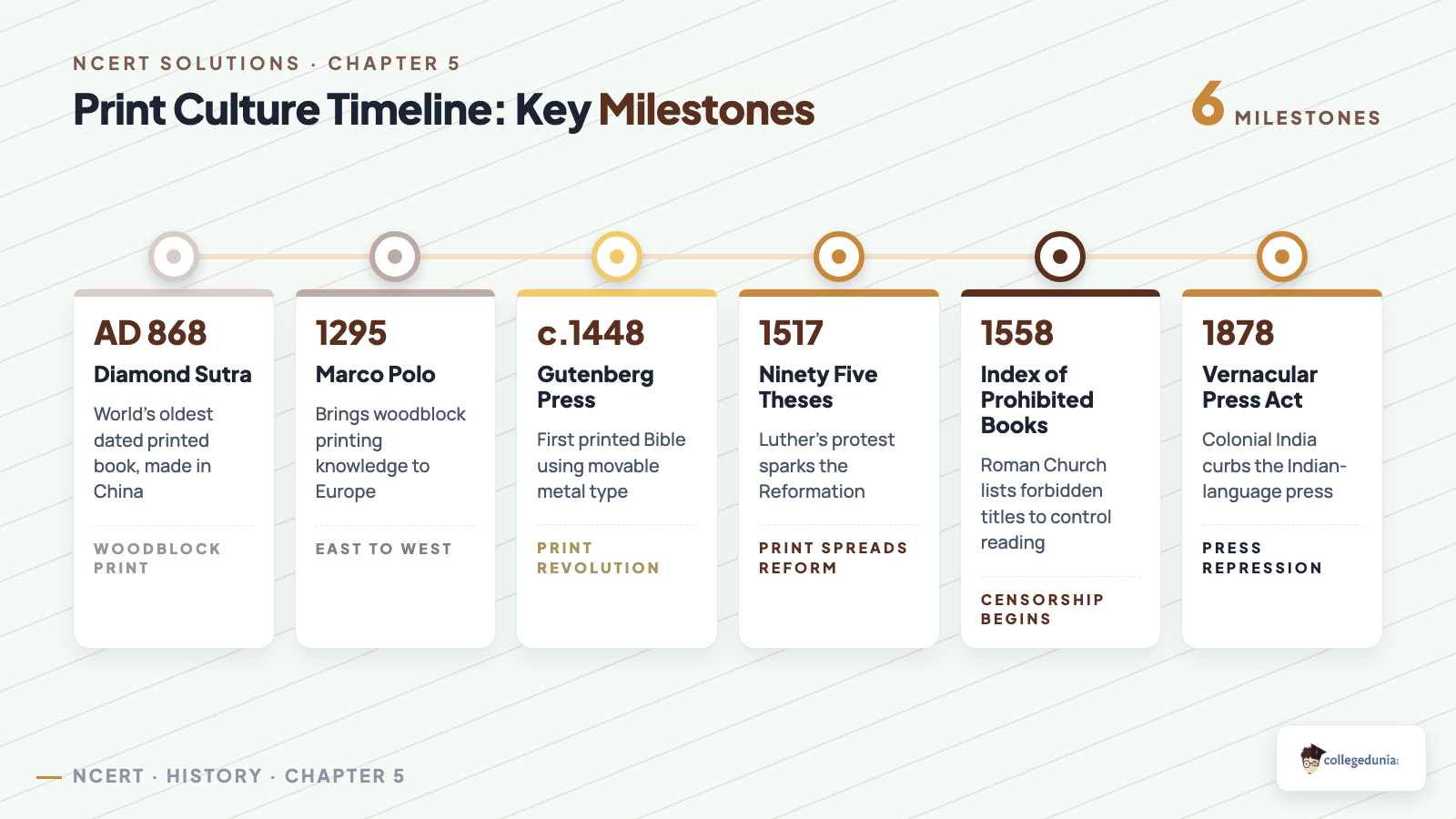
- The first printed books: woodblock print in China, Japan and Korea, and the spread of hand printing across East Asia.
- Print comes to Europe: Marco Polo's return in 1295, the Gutenberg Press, and the print revolution.
- Religious debate: Martin Luther, the Reformation of 1517, and the Church's Index of Prohibited Books.
- Print in India: reform, the voice of women and the poor, and the growth of a reading public.
- Print and nationalism: the Vernacular Press Act of 1878, censorship, and the nationalist newspapers.
Learn one date and one outcome per topic. That single line of detail is often worth one mark in the board scheme.
One-Shot Revision of Print Culture and the Modern World for Class 10 Boards
Source: Magnet Brains on YouTube
History Class 10 Chapter 5 Question Answer: Write in Brief Section
The Write in brief questions test short, factual recall, often the woodblock print reason, the Gutenberg Press note and the Vernacular Press Act. They reward one clean fact-line per part. Below is what each answer should carry.
| Question | What a full-mark answer must include |
|---|---|
| Give reasons: woodblock print reached Europe only after 1295, Luther favoured print, the Church kept an Index, Gandhi praised a free press | Marco Polo brought woodblock knowledge from China back to Italy in 1295; Luther's Ninety Five Theses of 1517 spread fast in print and began the Reformation; the Roman Catholic Church kept an Index of Prohibited Books from 1558; in 1922 Gandhi wrote in Young India that the fight for Swaraj is a fight for the liberty of speech, the press and association. |
| Short notes on the Gutenberg Press, Erasmus's idea of the printed book, and the Vernacular Press Act 1878 | Gutenberg adapted the olive press and metal moulds to make movable metal type; his first printed book was the Bible around 1448, with about 180 copies in three years. Erasmus feared print would spread bad and irreligious books among the foolish. The Vernacular Press Act of 1878, modelled on the Irish Press Laws, gave the government powers to censor and seize vernacular newspapers. |
| What the spread of print culture in nineteenth-century India meant to women, the poor and reformers | Print gave women a voice and access to education; it brought the poor cheap small books, libraries and public reading; it let reformers debate religion and social reform before a wide reading public. |
Tip: name the fact and the result together. "Marco Polo returned in 1295, so woodblock print reached Europe" scores more than a vague "trade brought it".
Print Culture and the Modern World Important Question: Discuss Section
The Discuss questions carry the long-answer marks. Each asks you to explain a process or trace a chain of causes, rewarding a clear concept line, dated steps, and a one-line conclusion.
- Print and enlightenment: cheap print spread the reasoning of Voltaire and Rousseau and built a new public culture of debate.
- Fear of print: Erasmus and the Church in Europe, and the fear of rebellious, irreligious thoughts in India.
- Print and the poor in India: cheap books, public libraries, and the writings of Jyotiba Phule, Kashibaba and factory workers.
- Print and nationalism: nationalist newspapers, the Vernacular Press Act of 1878, the Punjab revolutionaries of 1907, and Bal Gangadhar Tilak.
Memorise the Vernacular Press Act of 1878 and the names of Voltaire, Rousseau, Phule and Tilak, which the Discuss questions lean on most years.
How Print Came to India and Europe Explained for Class 10
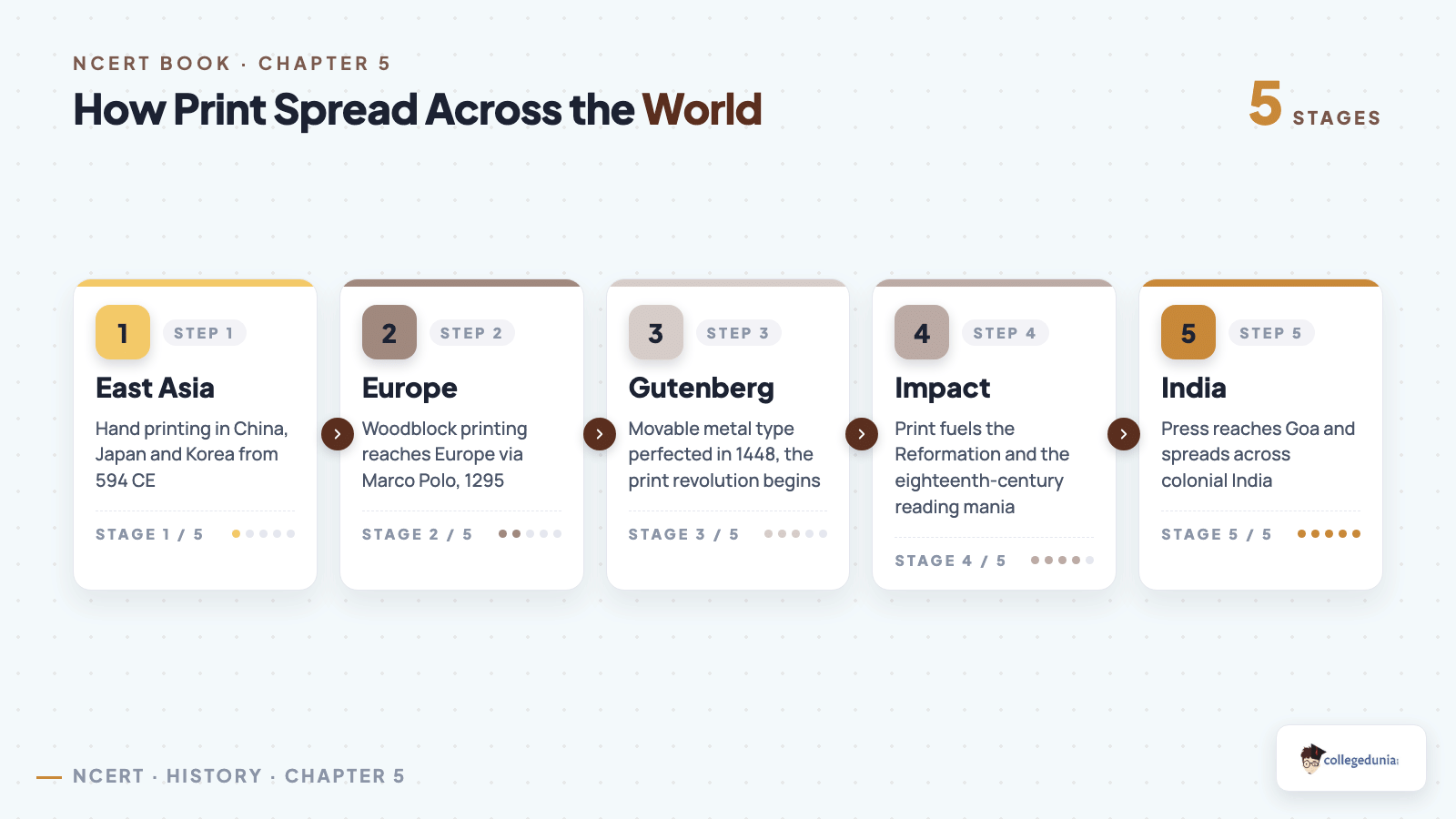
The journey of print from China to Europe to India is one of the most asked topics. A neat memory line is "China first, Gutenberg next, India last". Keep one date and one name ready for each stage.
| Stage | What happened | Key fact |
|---|---|---|
| China and East Asia | The earliest woodblock print, with books rubbed by hand from carved blocks. | China, Japan and Korea printed long before Europe; print was used for the state and for civil-service study. |
| Europe | Print arrived after Marco Polo returned, and Gutenberg built the first printing press. | Marco Polo came back in 1295; Gutenberg printed the Bible around 1448 in about 180 copies. |
| India | Print came with missionaries, then grew into a wide vernacular press. | Print gave women, the poor and reformers a new voice across the nineteenth century. |
Print changed who could read, what they argued about, and how fast new ideas moved, and India was tied into all three by the late nineteenth century.
Print, Reform and the New Voices of Nineteenth-Century India
The spread of print in nineteenth-century India gave new groups a voice. The board often pairs women with the poor and the reformers, so keep all three ready:
- Women gained a voice and access to education, with women writers and a women's reading public growing across the century.
- The poor got cheap small books, public libraries and the chance of public reading near markets and squares.
- Jyotiba Phule and others wrote about caste discrimination so that ordinary people could follow the debate.
- Reformers used print to debate religion and social reform before a wide reading public.
- Factory workers and writers like Kashibaba set down the hardships of working life in cheap print.
For India, print did not only carry the rulers' message; it let women, the poor and reformers answer back.
The Vernacular Press Act and the Growth of Nationalism
Two long-answer favourites from this chapter are the Vernacular Press Act of 1878 and the link between print and nationalism. Both reward real facts over feelings, so anchor every paragraph to a detail from the text.
| Topic | Facts a full-mark answer must carry |
|---|---|
| The Vernacular Press Act 1878 | Modelled on the Irish Press Laws; gave the government powers over vernacular newspapers; a paper got a warning first, and a repeat offence led to the seizure of its press; passed to control criticism of colonial rule. |
| Print and nationalism | Nationalist newspapers defied censorship and spread the demand for self-rule; the Punjab revolutionaries were deported in 1907; the jailing of Bal Gangadhar Tilak in 1908 set off protests across India. |
Keep the cause and effect straight. The Vernacular Press Act of 1878 tried to silence the Indian press, but printed papers kept spreading nationalist ideas, and every act of censorship only sharpened the demand for a free press.
Student Feedback on this Class 10 History Chapter
What 12,840 students told us about studying this chapter before the 2026 boards.
- 68% of students rated the four-part "give reasons" question (Marco Polo, Luther, the Index, Gandhi) as the one they most often mixed up.
- 59% of students said the Vernacular Press Act of 1878 was the hardest single fact to recall under exam pressure.
- Most-skipped topic in revision: the print-and-nationalism Discuss question, left for last by about 43% of students.
Source: 2026-27 Class 10 History student poll. Sample of 12,840 students from CBSE schools across 14 states.
Common Mistakes Students Make in this Class 10 History Chapter
A few slips lose easy marks every year. Fix these before the exam.
- Writing that Gutenberg invented printing. Woodblock print began in China; Gutenberg built the first press with movable metal type.
- Mixing up the years. Marco Polo returned in 1295, the Reformation began in 1517, and the Vernacular Press Act was passed in 1878.
- Forgetting names in the India answers: Jyotiba Phule, Kashibaba and Bal Gangadhar Tilak each carry a mark.
- Treating "give reasons" as one paragraph. Answer each part (a) to (d) under its own label.
Practice All NCERT Solutions for this Class 10 History Chapter with Step-by-Step Solutions
Open the question bank below to attempt all 7 solved questions with collapsible Solution and Expert Solution tabs. Every answer in the ncert solutions class 10 history chapter 5 print culture and the modern world set is mapped to the NCERT text, so each class 10 history chapter 5 question answer reads exactly the way a board examiner expects.
All Solved Questions for this Class 10 History Chapter
Practise every Write in brief and Discuss question with step-by-step solutions and an expert version for board marks.
Class 10 History Other Resources for this Chapter
Pair these solutions with the other Class 10 History resources for the same chapter. The notes give a quick recap, the handwritten notes help last-minute revision, and the NCERT book PDF is the source text.
| Resource | Best used for |
|---|---|
| Print Culture and the Modern World Class 10 Notes | Quick concept recap before the exam |
| Print Culture and the Modern World Class 10 Handwritten Notes | Last-minute scanned revision |
| Print Culture and the Modern World Class 10 NCERT Book PDF | Reading the original chapter text |
All Chapters NCERT Solutions for Class 10 History (India and Contemp World II)
Browse the full set of ncert solutions for class 10 history chapter by chapter. Each link opens the solved questions for that chapter.
| Chapter | NCERT Solutions |
|---|---|
| Chapter 1 | The Rise of Nationalism in Europe Class 10 NCERT Solutions |
| Chapter 2 | Nationalism in India Class 10 NCERT Solutions |
| Chapter 3 | The Making of a Global World Class 10 NCERT Solutions |
| Chapter 4 | The Age of Industrialisation Class 10 NCERT Solutions |
| Chapter 5 | Print Culture and the Modern World Class 10 NCERT Solutions |
Print Culture and the Modern World Class 10 History NCERT Solutions FAQs
Ques. Where can I download the NCERT Solutions Class 10 History Chapter 5 Print Culture and the Modern World PDF?
Ans. You can download the print culture and the modern world ncert solutions PDF directly from this page. Both the Normal and HD versions are free, and a Hindi-medium read is available too.
Ques. How many questions are solved in class 10 history chapter 5 question answer?
Ans. All 7 NCERT questions are solved: 3 Write in brief questions and 4 Discuss questions, each with a step-by-step solution and an expert version for the long-answer marks.
Ques. Is this NCERT Solutions page aligned with the 2026-27 syllabus?
Ans. Yes. This page reflects the current 2026-27 syllabus for Class 10 History, and every answer is checked against the latest NCERT edition of India and the Contemporary World II.
Ques. What was the Vernacular Press Act of 1878?
Ans. It was an act, modelled on the Irish Press Laws, that gave the colonial government powers over vernacular newspapers. A paper was warned first, and a repeat offence led to the seizure of its printing press.
Ques. Why did Martin Luther favour print?
Ans. Luther's Ninety Five Theses of 1517 spread fast in print and began the Reformation. He saw how quickly the printed word carried his ideas and called printing the ultimate gift of God.
Ques. What did the spread of print culture mean for the poor in India?
Ans. The poor got cheap small books, public libraries and the chance of public reading. Writers like Jyotiba Phule and Kashibaba set down accounts of caste discrimination and factory life that ordinary people could follow.
Ques. How did print culture help the growth of nationalism in India?
Ans. Nationalist newspapers defied censorship and spread the demand for self-rule. The Vernacular Press Act of 1878, the deportation of the Punjab revolutionaries in 1907, and the jailing of Bal Gangadhar Tilak all sharpened the national movement.



Comments