



Six to eight marks in the Class 7 Social Science annual exam come from Climates of India. The NCERT Solutions below answer all 7 questions, from matching climate factors to the city-climate map and the Uttarakhand disaster essay, according to the 2026-27 CBSE syllabus.
- Question coverage: All 7 questions and activities, including the five-city climate comparison, the monsoon wind-map drawing and the disaster essay.
- Exam weight: Climate-factor and monsoon questions carry 6 to 8 marks in the Class 7 Social Science paper.
- Also on this page: a five-factor climate chart, a summer-winter monsoon comparison image and links to the Notes and Book PDF.

Every NCERT solution for Class 7 Social Science Chapter 3 Climates of India here is expert-curated, checked against the 2026-27 rationalised NCERT print, and written in plain Class 7 language.
Want the full worked answers, one question at a time? Open the dedicated question bank below for step-by-step solutions to every question and activity in Climates of India, each with a concept explanation, an Expert's Solution and a boxed final answer.
Why Climates of India Matters for Class 7 Social Science
India stretches from the Himalayas to the beaches of Kerala, so it never has just one climate. This chapter opens with weather, the day-to-day condition of the atmosphere, and climate, its average pattern over thirty years, then names five factors that decide how hot, cold, wet or dry a place stays, covers India's six ritus and monsoon system, and closes with climate-linked disasters. NCERT Solutions Class 7 Social Science Chapter 3 Climates of India answers every question below.
Climates of India Explained for Class 7
Source: Magnet Brains on YouTube
Five Factors That Decide India's Climate
Question 1 asks students to match climate factors to their effects. NCERT lists five in the chapter text, and all five return later in the city-comparison question, so learn them as a set.
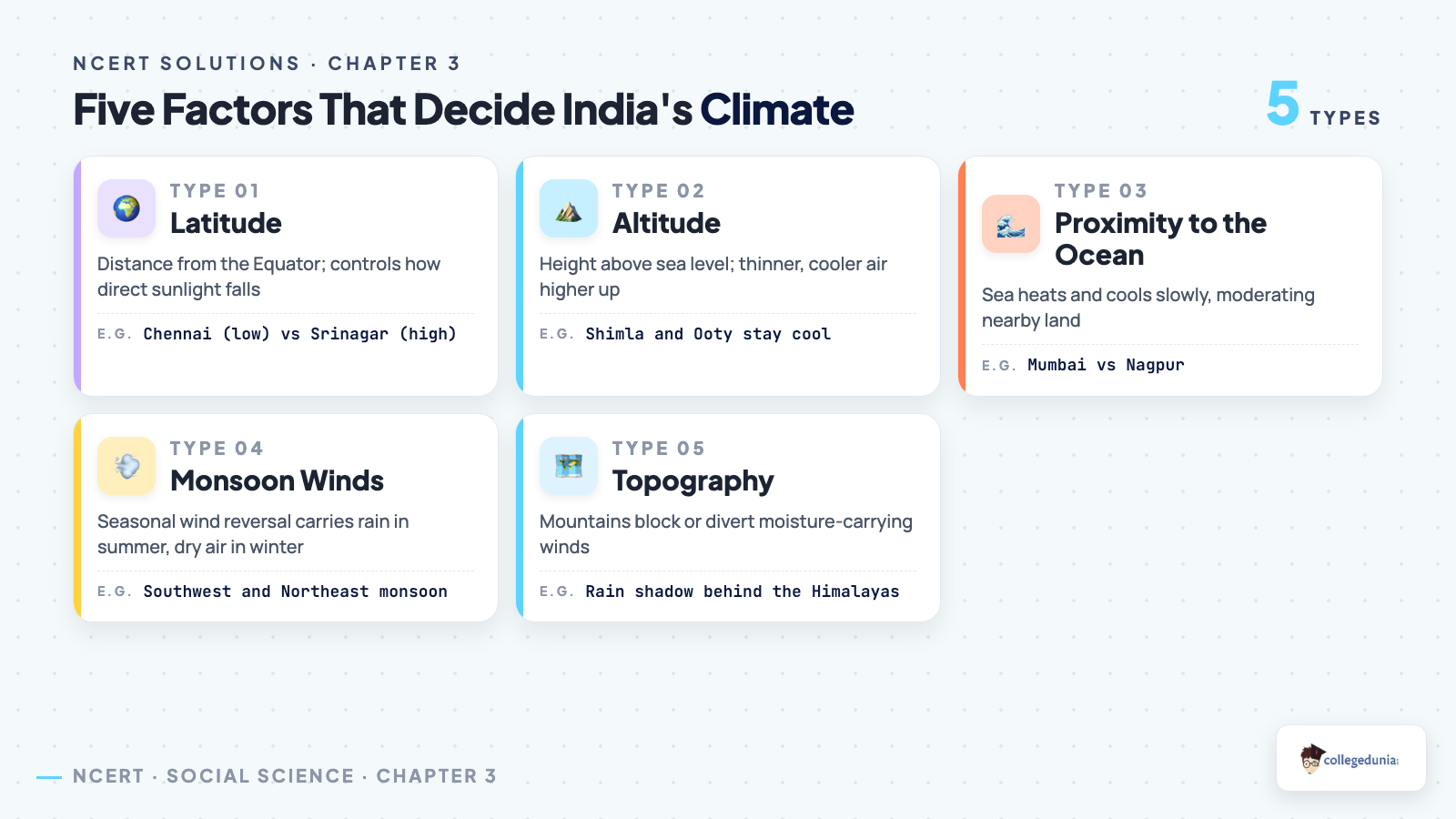
| Factor | Effect on climate |
|---|---|
| Latitude | Creates different climates in the north and south of India |
| Altitude | Keeps higher places cooler, as thin mountain air holds heat poorly |
| Proximity to the ocean | Moderates temperature, since the sea heats and cools slowly |
| Monsoon winds | Bring wet air to India during summer and dry air in winter |
| Topography | Mountains block or divert moisture-carrying winds, creating rain shadows |
Quick trick for Q1: latitude changes with location, altitude changes with height. Sort each effect into "changes with location" or "brings rain and moderates", and the matching becomes automatic.
Climates of India Question and Activity Breakdown
The chapter closes with seven questions and activities; only the first has a fixed matching answer, the rest asking for explanation, a labelled drawing, a poster, a diary entry or an essay.
| Question | What it covers | Answer type |
|---|---|---|
| Q1 | Matching four climate factors to their effects | Fixed matching answer |
| Q2 | Weather vs climate, the sea's effect, monsoon winds, Chennai vs Leh | Four-part explanation |
| Q3 | Identifying the climate of five cities from a map | Map-based reasoning |
| Q4 | Drawing the summer and winter monsoon wind maps | Labelled drawing |
| Q5 | A poster on festivals linked to farming and weather | Creative poster |
| Q6 | A farmer's diary entry preparing for the rainy season | Creative writing |
| Q7 | An essay on a natural disaster, its causes and its fixes | Short essay |
Q2, Q4 and Q7 carry the most marks, since each tests two or three ideas from the chapter at once.
Weather vs Climate and Why the Sea Moderates Coastal Temperature
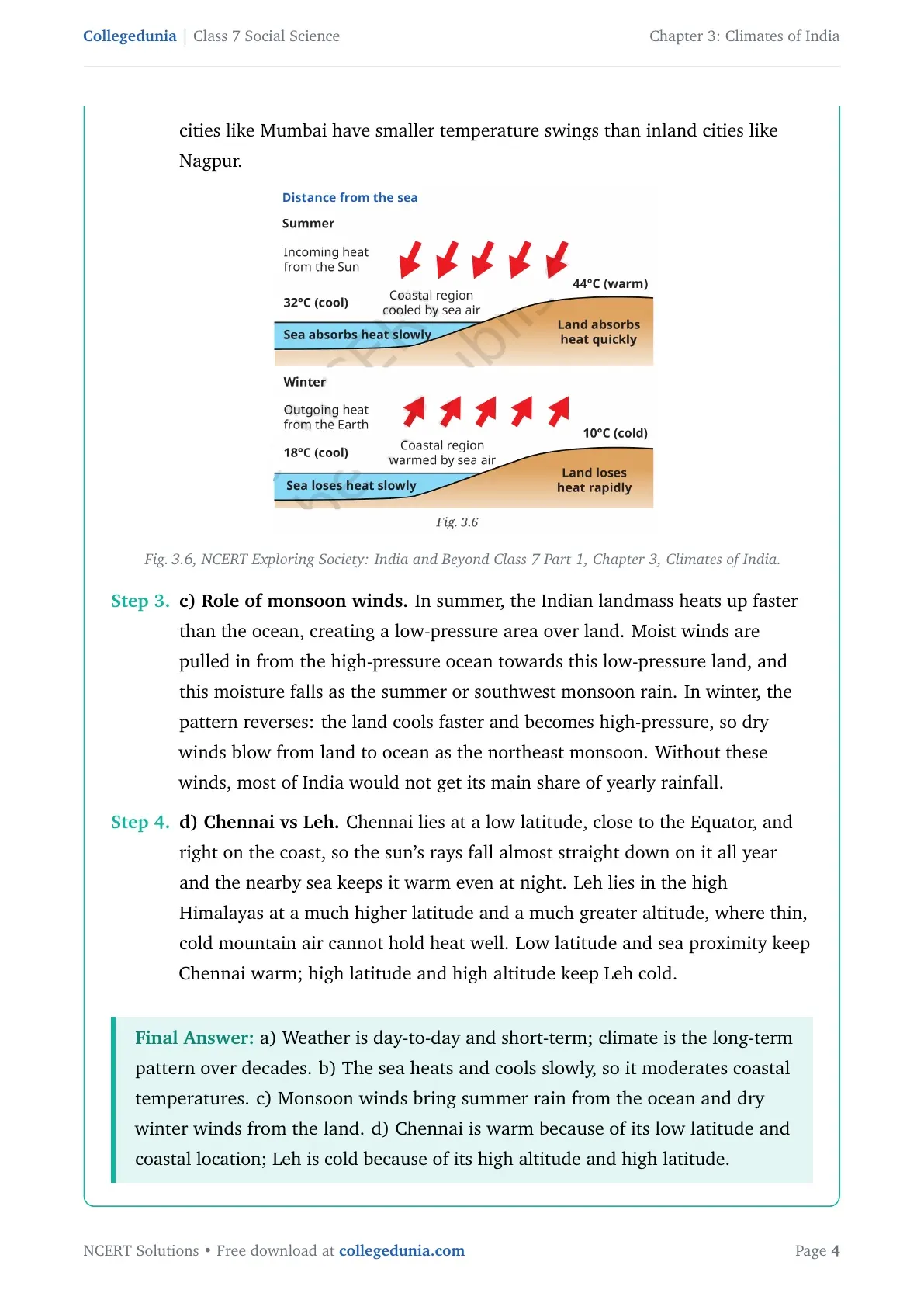
Weather changes hour to hour; climate is the long-term pattern of that weather in a region. Land absorbs and loses heat fast, but the sea does so slowly, staying cooler than land in summer and warmer in winter, so coastal cities like Mumbai see smaller temperature swings than inland cities like Nagpur.
A common mistake is treating "hot climate" and "hot weather" as the same thing: a warm-climate place can still have one unusually cool, rainy day without its climate changing.
Summer and Winter Monsoon Winds Explained
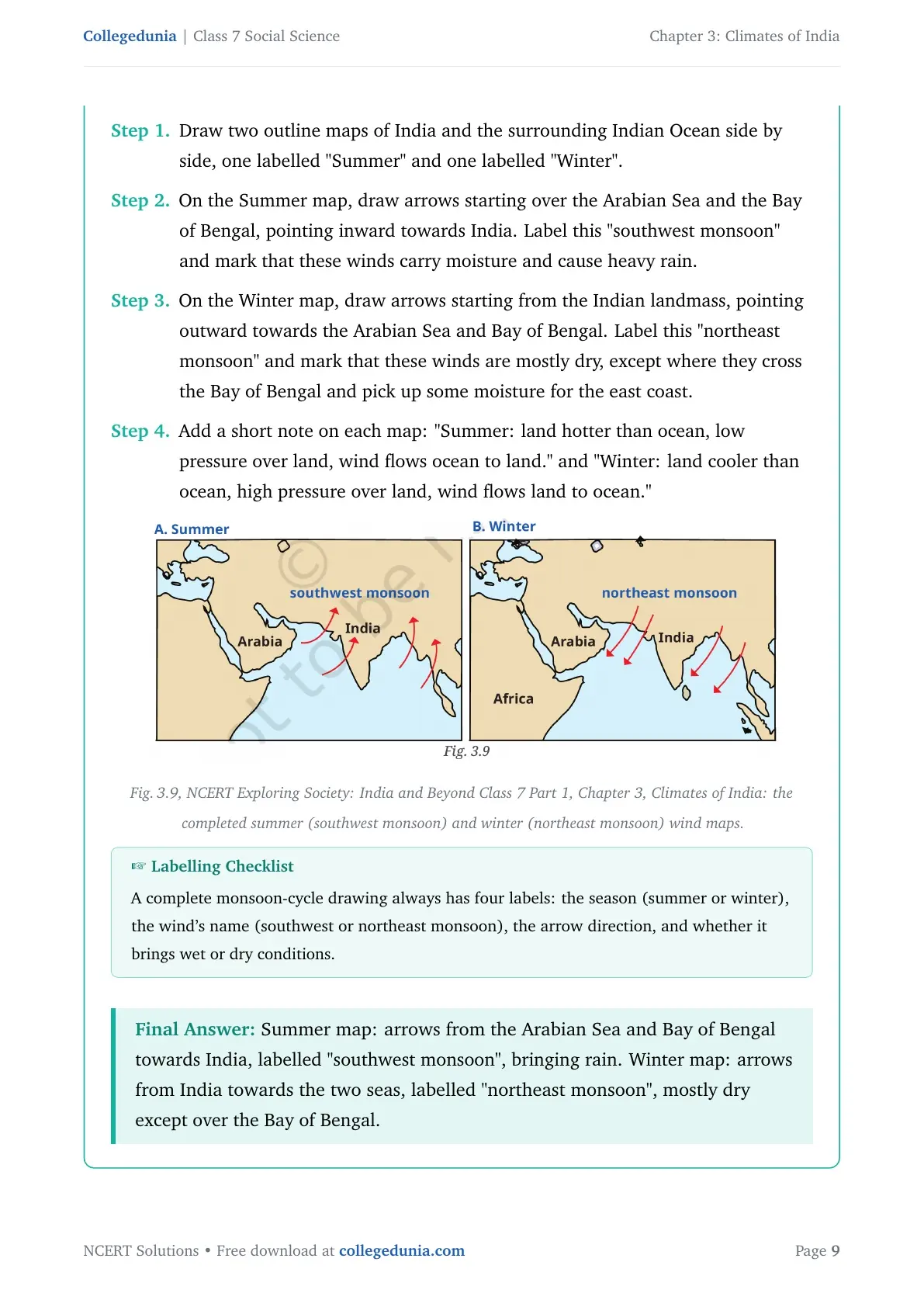
In summer, the Indian landmass heats faster than the ocean, creating a low-pressure area over land. Moist winds are pulled in from the high-pressure ocean and fall as southwest monsoon rain. In winter, the pattern reverses.
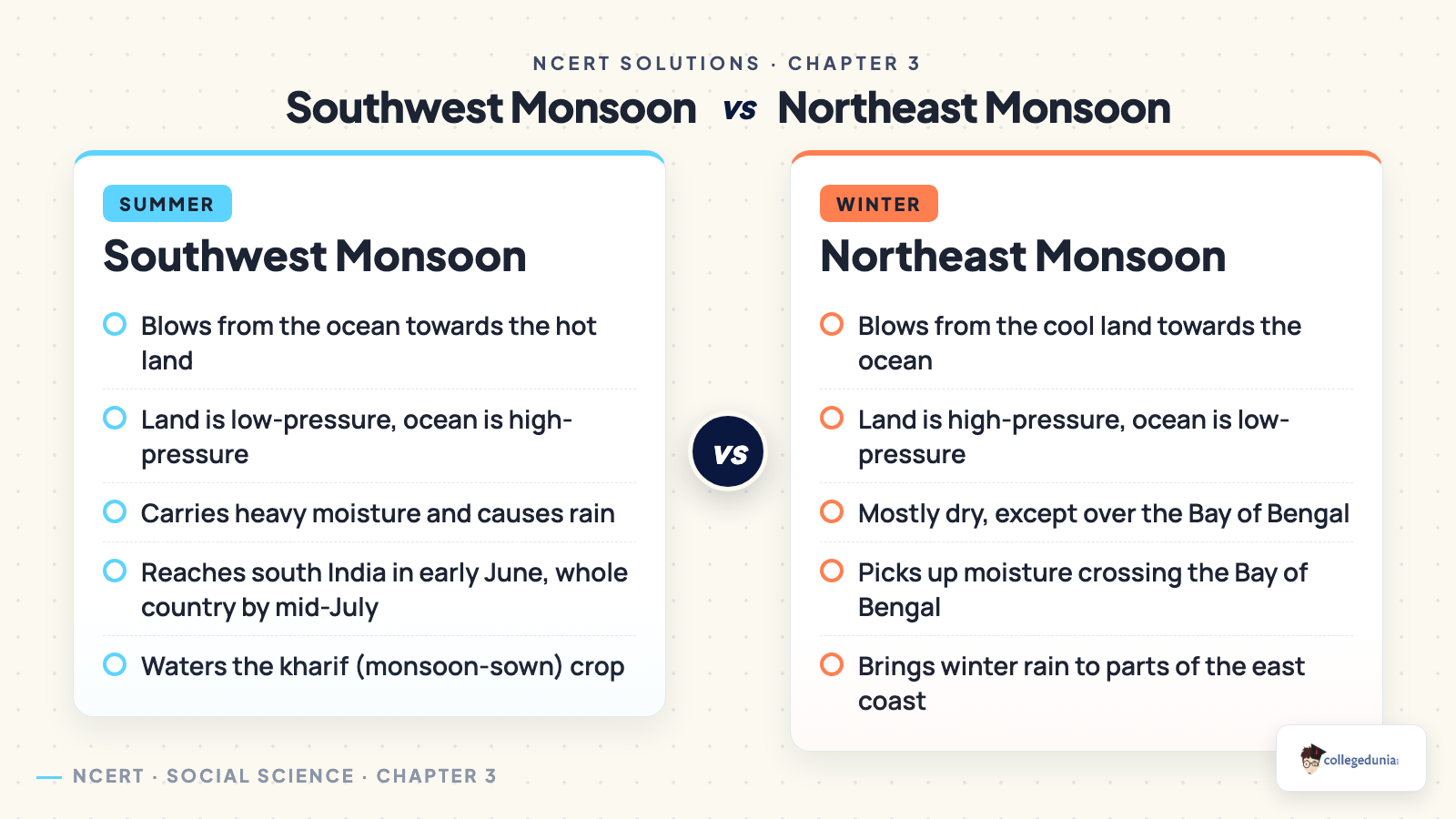
Q4 asks students to draw and label both wind maps. A complete drawing needs four labels: the season, the wind's name, the arrow direction, and whether it brings wet or dry conditions.
The southwest monsoon reaches south India in early June and covers the country by mid-July. Meghalaya's Mawsynram, the wettest place on Earth, gets roughly 11,000 mm of rain a year.
Climate of Five Indian Cities: Leh, Chennai, Delhi, Panaji and Jaipur
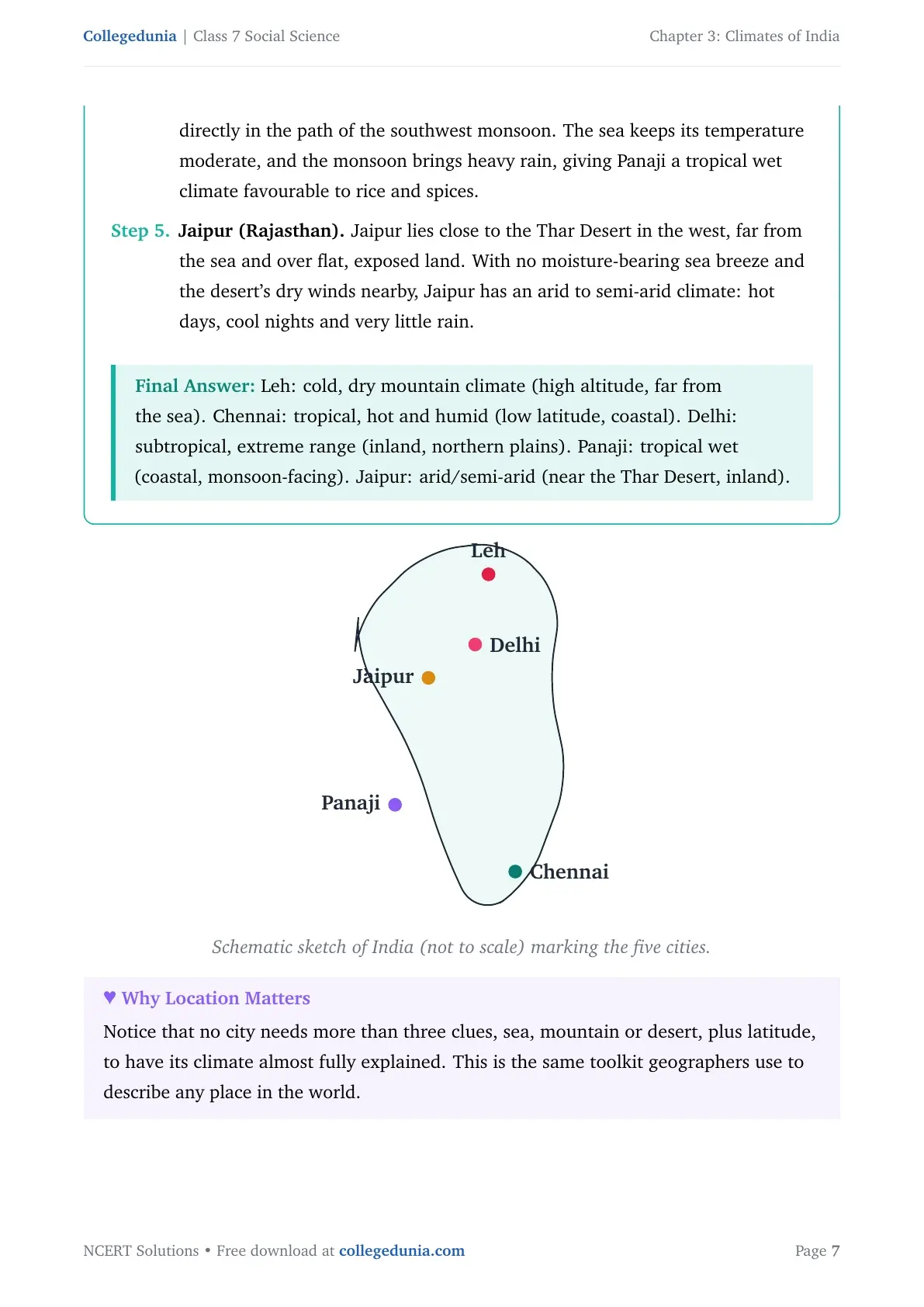
Question 3 asks students to place five cities on a map and explain their climate: sea, mountain or desert proximity, plus latitude. No city needs more than three clues.
| City | Location clue | Climate |
|---|---|---|
| Leh | High Himalayas, over 3,500 m, far from the sea | Cold, dry mountain climate |
| Chennai | Low latitude, coastal, Bay of Bengal | Tropical, hot and humid |
| Delhi | Inland, northern plains, no sea nearby | Subtropical, wide seasonal range |
| Panaji | West coast, faces the Arabian Sea and the monsoon | Tropical wet climate |
| Jaipur | Inland, near the Thar Desert | Arid to semi-arid climate |
Chennai and Panaji sit on opposite coasts, so rainfall differs though both stay warm; Delhi and Jaipur sit inland and miss the sea's moderating effect, but Jaipur's closeness to the desert tips it further towards dry. When two cities share a factor but differ sharply in climate, the factor they don't share is usually doing most of the work.
Festivals, Farming and the Monsoon Calendar
Question 5 asks for a poster on festivals linked to farming and weather; Question 6 asks for a farmer's diary entry before the rainy season, since Indian festivals and farm work follow the seasons.
| Season band | Festivals | Farming link |
|---|---|---|
| Pre-monsoon / summer | Baisakhi, Bihu | Wheat harvest, farming new year |
| Monsoon / rainy season | Onam, Chhath Puja | Monsoon-fed rice crop, river worship after the rains |
| Winter / harvest | Pongal, Makar Sankranti, Lohri, Gudi Padwa | Harvest thanksgiving, start of the harvest season |
For Q6, open with a date in late May or early June, when the monsoon reaches the south. Mention repairing bunds (earthen walls that hold field water), clearing drains, and storing seeds for the kharif crop.
Add one traditional sign from the chapter, fish rising to the surface or where crows nest. A weak monsoon can mean a poor harvest for the year, so a farmer's preparation is never just routine.
Climate Disasters and How India Can Reduce Their Impact
Question 7 asks for a short essay on a natural disaster: its causes, impacts and fixes. The chapter's example is the 2013 Uttarakhand glacial-lake disaster, where days of heavy rain burst an overfull glacial lake through its natural rock-and-ice barrier.
- Natural cause: Heavy, continuous rainfall filled a glacial lake beyond its barrier's limit.
- Human-linked cause: Construction close to the river, including near Kedarnath, worsened the damage.
- Impact: About 6,000 people lost their lives; villages, roads and bridges were destroyed.
Reducing the impact needs individuals learning evacuation routes, communities building early-warning networks, and governments enforcing building codes and keeping forces like the NDRF ready. Nearly every disaster here, floods and forest fires included, has its damage worsened by a human cause.
Common Mistakes Students Make in the Climates of India Chapter
Each mistake below has cost real marks on Class 7 papers.
- Mixing up weather and climate. One rainy day does not change a region's climate.
- Calling a disaster "purely natural". Most disasters here have a human-linked cause too.
- Listing all five factors for every city. Name only the factors that differ.
- Confusing the two monsoons. Southwest brings summer rain; northeast is mostly dry except over the Bay of Bengal.
- Writing a disaster essay without a number. Roughly 6,000 lives lost in Uttarakhand shows the scale examiners want.
Student Feedback: In a Collegedunia survey of 11,860 Class 7 students conducted before the 2026 exams, 58% named the Q3 city-climate question hardest, since it needs three factors, sea, mountain or desert, plus latitude, read together. Students who scored well named the differing factor first.
Source: 2026-27 Class 7 Social Science student survey, 11,860 students across 16 states.
How to Study Climates of India Effectively
This chapter mixes definitions, a drawing, a poster, a diary entry and an essay, so short revision blocks work better than one long sitting.
- Block 1, 20 min. Learn the five climate factors, using the Chennai vs Leh example.
- Block 2, 25 min. Label the summer and winter monsoon maps, marking pressure first.
- Block 3, 20 min. Write the five-city climate answers and the Uttarakhand essay in full.
- Night before, 15 min. Re-read Common Mistakes and redraw one monsoon map from memory.
More Climates of India Class 7 Resources
Also Check: This chapter is available in other formats on Collegedunia. Read the solutions first, then the notes for a deeper walk-through.
| Resource | Best used for | Open it |
|---|---|---|
| NCERT Notes | Topic-by-topic summary of climate factors, monsoons and disasters | Climates of India Class 7 Notes |
| NCERT Book PDF | The official 2026-27 chapter text with all figures | Class 7 Social Science Part 1 Chapter 3 Book PDF |
| Handwritten Notes | Quick one-sitting revision in clear handwriting | Climates of India Class 7 Handwritten Notes |
| Practice Questions | Attempt each question one at a time with Check Solution and Expert Solution tabs | Climates of India Practice Questions |
NCERT Solutions for Class 7 Social Science Part 1: All Chapters
The table below lists NCERT Solutions for every chapter of Part 1, so a student can move on once this one is done.
Sample Solutions from Climates of India Chapter 3
Below are two of the seven questions, answered in full; every question in the complete PDF gets the same concept explanation, step-by-step answer and boxed final answer.
Ques. Match the climatic factors in Column A with their effects in Column B (Latitude, Altitude, Proximity to the ocean, Monsoon winds).
Latitude changes with north-south position, altitude cools higher places as air thins with height, ocean proximity moderates temperature, and monsoon winds bring summer rain.
- Latitude → Creates different climates in the north and south
- Altitude → Keeps higher places cooler
- Proximity to the ocean → Moderates the temperature
- Monsoon winds → Brings wet air to India during summer
Boxed answer: Latitude to different north-south climates, altitude to cooler heights, ocean to moderated temperature, monsoon winds to summer rain.
Ques. Why is Chennai warm or hot throughout the year, while Leh is cold?
Chennai's low latitude and coastal position keep sunlight direct and the sea warm all year. Leh sits over 3,500 m up in the Himalayas, where thin mountain air cannot hold heat.
- Chennai: low latitude, sea level, coastal, warm all year
- Leh: high latitude, over 3,500 m altitude, far inland, cold
Boxed answer: Low latitude and sea proximity keep Chennai warm; high latitude and high altitude keep Leh cold.
Climates of India Class 7 Social Science NCERT Solutions FAQs
Ques. Where can I download the NCERT Solutions for Class 7 Social Science Chapter 3 Climates of India PDF?
Ans. Use the download option at the top of this page. The file is free, covers all 7 questions and activities from the chapter, and is available in both Normal and HD quality.
Ques. What is climate, and how is it different from weather?
Ans. Weather is the day-to-day condition of the atmosphere, sunny, rainy or windy, and it can change from one day to the next. Climate is the average weather pattern of a region built up over thirty years or more, so a single unusual day does not change a region's climate.
Ques. What are the five factors that determine climate in India?
Ans. The five factors are latitude, altitude, proximity to the ocean, monsoon winds and topography. Latitude and altitude control temperature, proximity to the ocean moderates it, monsoon winds control rainfall, and topography can block or divert moisture-carrying winds.
Ques. Why is Chennai warm all year while Leh stays cold?
Ans. Chennai sits at a low latitude on the coast, so it gets almost direct sunlight all year and the nearby sea keeps it warm. Leh sits in the high Himalayas at over 3,500 m altitude, far from the sea, where thin mountain air cannot hold heat well.
Ques. What is the southwest monsoon, and when does it reach India?
Ans. The southwest monsoon is the summer wind that blows from the ocean towards the hot Indian landmass, carrying moisture that falls as rain. It reaches the southern tip of India in early June and covers the whole country by mid-July.
Ques. Why does the northeast monsoon still bring rain to the east coast in winter?
Ans. The northeast monsoon blows from the cool land towards the ocean and is mostly dry, except where it crosses the Bay of Bengal. Crossing the bay lets these winds pick up moisture, which then falls as rain along the east coast.
Ques. What is the wettest place in India, and how much rain does it get?
Ans. Mawsynram in Meghalaya is the wettest place on Earth, receiving about 11,000 mm of rain a year. Its location, facing moisture-laden monsoon winds that are forced upward by the surrounding hills, causes this extremely heavy rainfall.
Ques. What are the six ritus, or traditional Indian seasons, named in this chapter?
Ans. The chapter names six traditional ritus: Vasanta (spring), Grishma (summer), Varsha (monsoon), Sharad (autumn), Hemanta (pre-winter) and Shishir (winter).
Ques. What caused the 2013 Uttarakhand disaster mentioned in the chapter?
Ans. Several days of continuous heavy rainfall caused an already-full glacial lake to overflow and burst through its natural rock-and-ice barrier. Construction close to the river, including near the Kedarnath temple area, worsened the damage, and about 6,000 people lost their lives.
Ques. Is this NCERT Solutions PDF aligned with the 2026-27 syllabus?
Ans. Yes. This page follows the current 2026-27 edition of Exploring Society: India and Beyond, Grade 7 Part 1, and every answer matches the chapter content and question order printed in that edition.
Ques. How many questions are in the Class 7 Social Science Chapter 3 NCERT Solutions PDF?
Ans. The chapter has 7 questions and activities: a matching question, a four-part explanation, a five-city climate comparison, a monsoon map drawing, a festival poster, a farmer's diary entry, and a disaster essay.



Comments