



NCERT Solutions for Class 7 Social Science Chapter 6, The Age of Reorganisation, cover every question and activity below, from Sangam literature to Kanishka's coins, for the 2026-27 session.
- Question coverage: All 6 questions and activities, covering the Shungas, Satavahanas, Sangam literature, Kanishka's coins and the Gandhara-Mathura art schools.
- Exam weight: Ancient-history reasoning answers like these carry 6 to 8 marks in the annual Class 7 paper.
- Also on this page: a post-Maurya kingdoms classification image, a Gandhara-vs-Mathura art comparison image, and links to the Notes and Book PDF.
Every solution here is curated by subject experts, checked against the 2026-27 rationalised NCERT print, and written in plain, Class 7-level language.
Want the full worked answers, one question at a time? Open the dedicated question bank below for step-by-step solutions to every question and activity in The Age of Reorganisation, each with a concept explanation, an Expert's Solution and a boxed final answer.
View All Step-by-Step Solutions for The Age of Reorganisation
Why The Age of Reorganisation Matters for Class 7 Social Science
This chapter carries Class 7 Social Science, Exploring Society: India and Beyond, Part 1, past the Maurya empire's break-up around 185 BCE, when one large empire gave way to many competing kingdoms, exactly why historians call this the age of reorganisation.
NCERT does not test this chapter as a list of dynasty names. It tests whether a student can explain why India's map changed, which these NCERT Solutions walk through for every question.
| Concept | What it means | Why it matters |
|---|---|---|
| Age of reorganisation | Old Maurya territories broke into many new, competing kingdoms after 185 BCE | Explains why this period is a rearrangement of power, not simply a "decline" |
| Sangam Age | The Chera, Chola and Pandya kingdoms in the far south, which produced India's oldest surviving literature | Shows that the south stayed politically independent even during Mauryan power |
| Naming after mothers | Satavahana rulers like Gautamiputra Satakarni carried their mother's name in their title | Reveals that royal women held real political and religious influence |
| Gandhara and Mathura art | Two sculpture schools that flourished side by side under Kushana rule | Shows how Greek and Indian artistic styles blended into a shared heritage |
Most Class 7 papers build at least one long answer around Sangam literature or Kanishka's coins. Naming the exact term, not just describing it in general words, is what earns full marks.
The Age of Reorganisation Explained for Class 7 Boards
Source: Magnet Brains on YouTube
The Age of Reorganisation Question and Activity Breakdown
The chapter closes with six Questions and Activities, each asking for reasoning, a short note or a mapping activity, not a single fixed fact, so marks go for structure and evidence, not a one-line reply.
| Question | What it covers | Answer type |
|---|---|---|
| Q1 | Why the post-Maurya era is called the age of reorganisation | Long reasoning answer |
| Q2 | A 150-word note on Sangam literature | Word-limited note |
| Q3 | Rulers who included their mother's name in their title, and why | Applied, evidence-based reasoning answer |
| Q4 | A 250-word note on one interesting kingdom from the chapter | Personal-choice long note |
| Q5 | Imagining your own kingdom, its emblem, title and values | Creative, open-ended note |
| Q6 | Marking post-Maurya structures on an outline map | Mapping and activity answer |
Six questions, but each one is long-form. Teachers usually pick Q1 or Q3 for a periodic test, so practising both in full sentences first is time well spent.
Kingdoms of the North, Deccan and South After the Mauryas
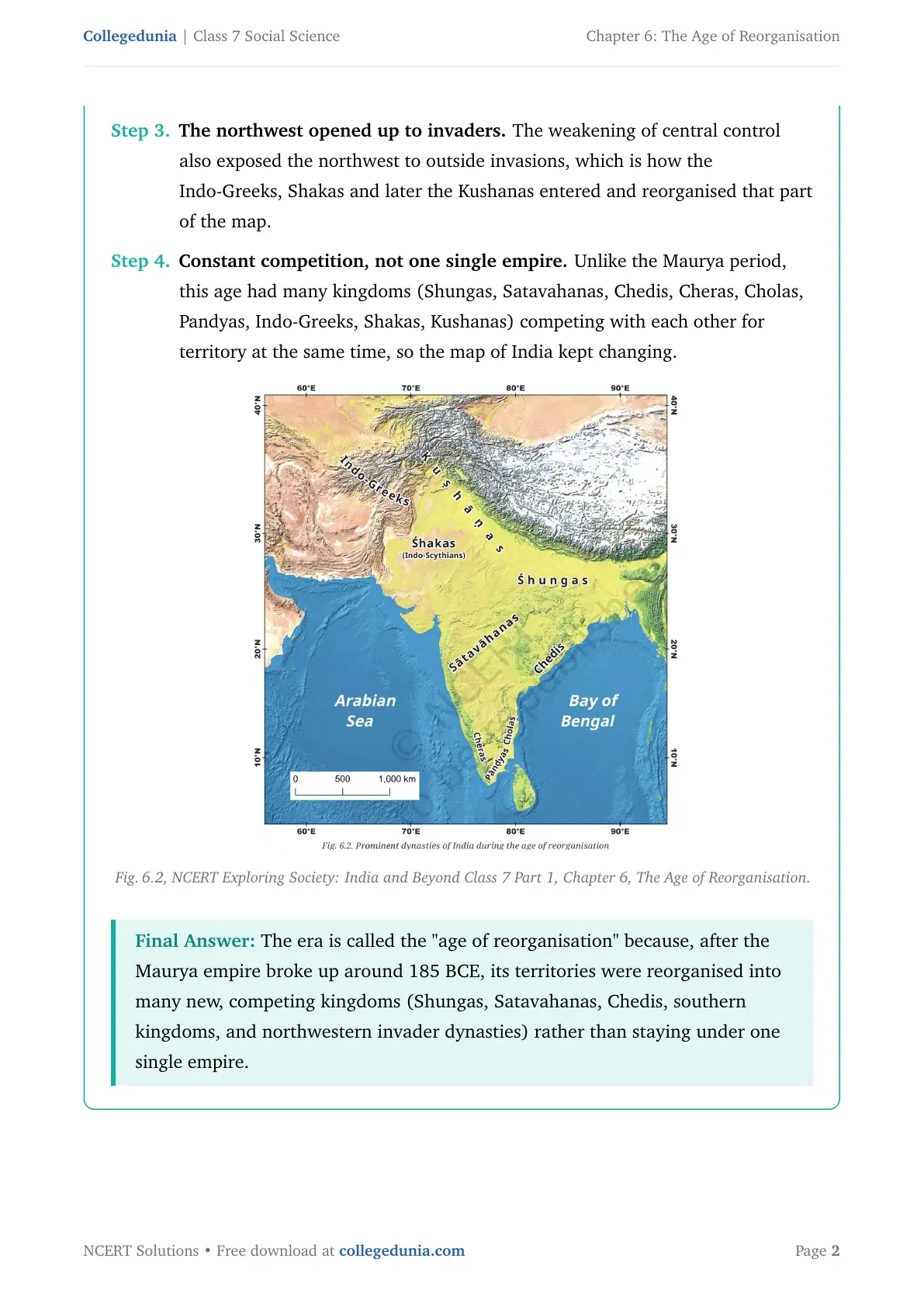
Q1 asks why the post-Maurya era is also called the age of reorganisation. Around 185 BCE, Pushyamitra Shunga, the Maurya commander-in-chief, assassinated the last Maurya emperor. Once the centre fell, its territories reorganised into new, competing kingdoms rather than vanishing.
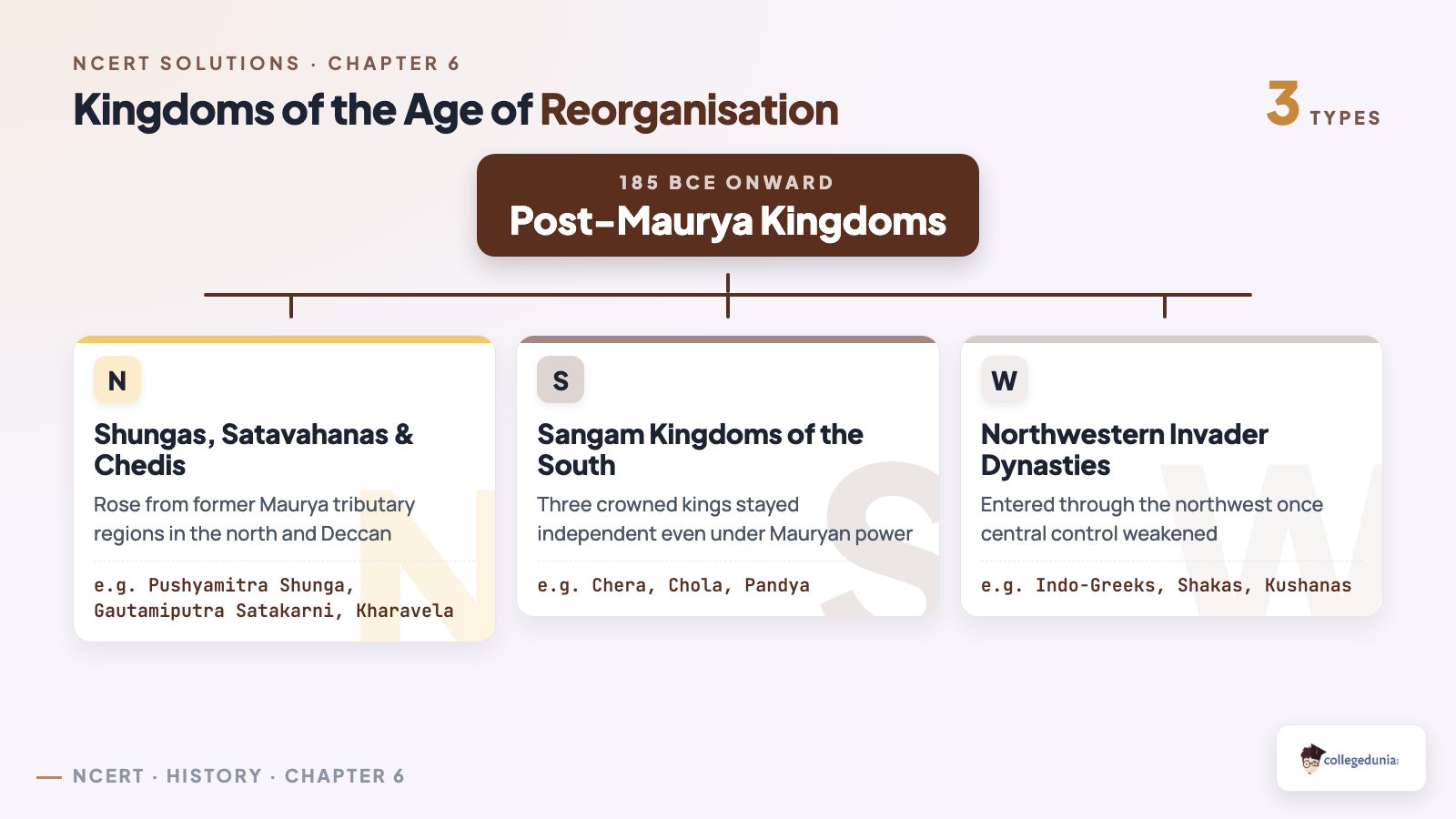
- North and Deccan. The Shungas, Satavahanas and Chedis rose from former Maurya tributary regions.
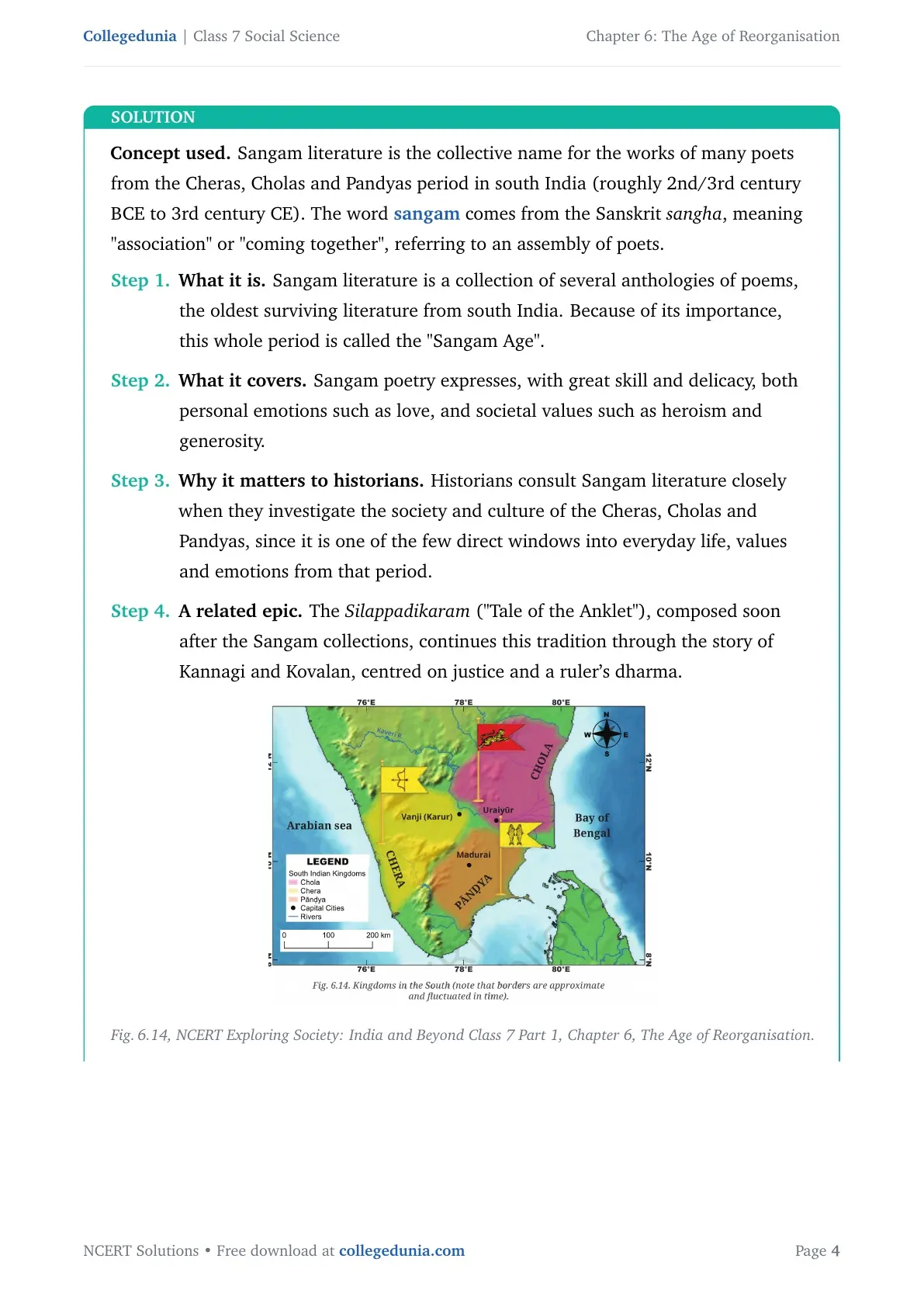
- The far south. The Chera, Chola and Pandya kingdoms stayed independent, three crowned Sangam kings ruling side by side.
- The northwest. A weakened centre exposed this region to the Indo-Greeks, Shakas and later the Kushanas.
Unlike the Maurya period, many kingdoms now competed for territory at once. Calling this a "decline" understates it: new dynasties were rising, fighting and building art and trade networks, so "reorganisation" fits better.
Sangam Literature and the Rise of the Cheras, Cholas and Pandyas
Q2 asks for a 150-word note on Sangam literature, the collective name for the works of many poets from the Chera, Chola and Pandya period, roughly the 2nd or 3rd century BCE to the 3rd century CE in south India. The word sangam comes from the Sanskrit sangha, meaning "association", an assembly of poets.
- What it is. The oldest surviving literature from south India, several anthologies of poems, not a single book.
- What it covers. Personal emotions such as love, and societal values such as heroism and generosity.
- Why it matters. Historians use it to study the society and culture of the Cheras, Cholas and Pandyas.
- A related epic. The Silappadikaram ("Tale of the Anklet") carries the tradition forward through Kannagi and Kovalan's story.
A "150-word note" question is marked partly on staying close to the limit. Cover only definition, content and historical value, and skip extra examples once the word count is already met.
Naming After Mothers: Gautamiputra Satakarni and the Satavahana Queens
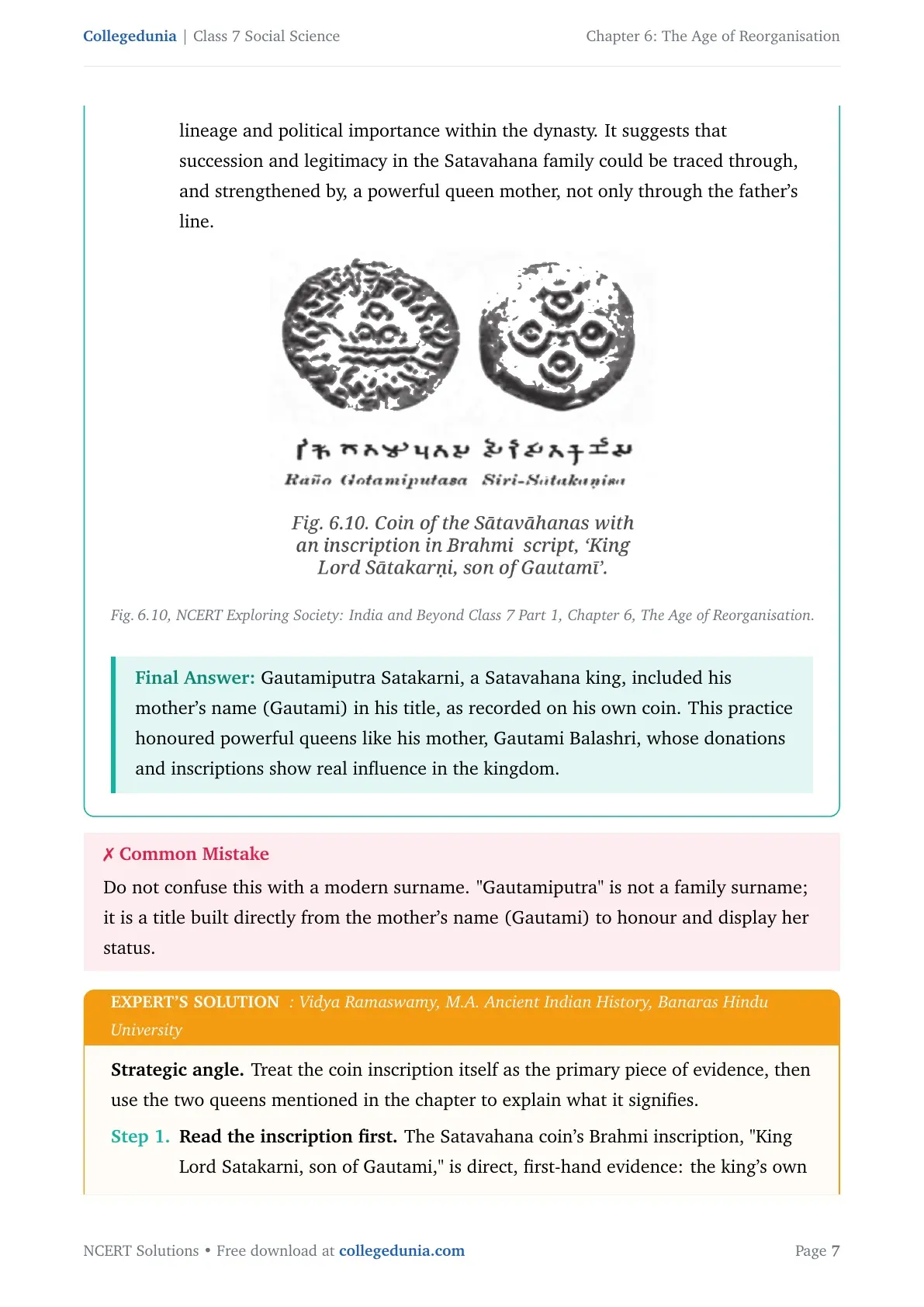
Q3 asks which rulers included their mother's name in their title, and why. The clearest example is Gautamiputra Satakarni, a Satavahana king whose name literally means "son of Gautami". A Satavahana coin carries a Brahmi inscription reading "King Lord Satakarni, son of Gautami," direct evidence of this naming practice.
| Ruler or queen | Evidence | What it shows |
|---|---|---|
| Gautamiputra Satakarni | Coin inscription naming his mother, Gautami | Public honour built directly into the royal title |
| Gautami Balashri | Own inscription at Nashik; land donations to Buddhist monks | A powerful queen with religious patronage of her own |
| Naneghat widow queen | Performed Vedic rituals (ashvamedha yajna); donated land, cattle and silver coins | Royal women held recognised public roles, not just domestic ones |
Do not confuse "Gautamiputra" with a modern surname, it is a title built from the mother's name to honour her status. Naming a king after his mother signals the mother's lineage and political importance, and that succession in the Satavahana family could be strengthened through a powerful queen mother, not only through the father's line.
Kanishka, the Kushanas and the Gandhara-Mathura Art Schools
Q4 asks for a 250-word note on one interesting kingdom. The Kushanas make a strong choice: outsiders from central Asia who entered India, probably in the 2nd century CE, and built an empire woven into Indian art, religion and trade. Their most powerful ruler, Kanishka, is remembered through a 1.85-metre "headless" statue, its Brahmi inscription calling him "maharaja rajadhiraja devaputra Kanishka", the great king, king of kings, son of God.
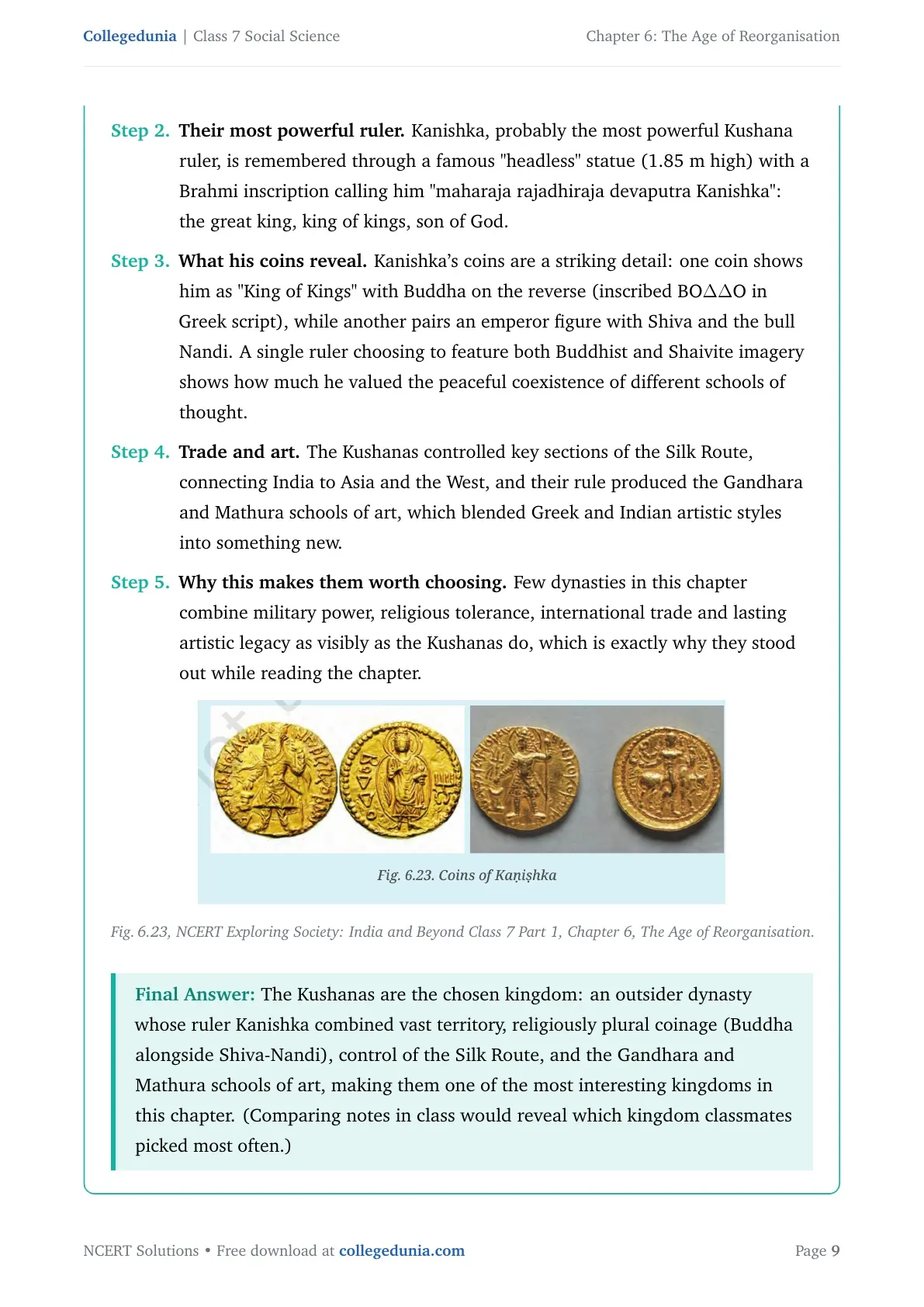
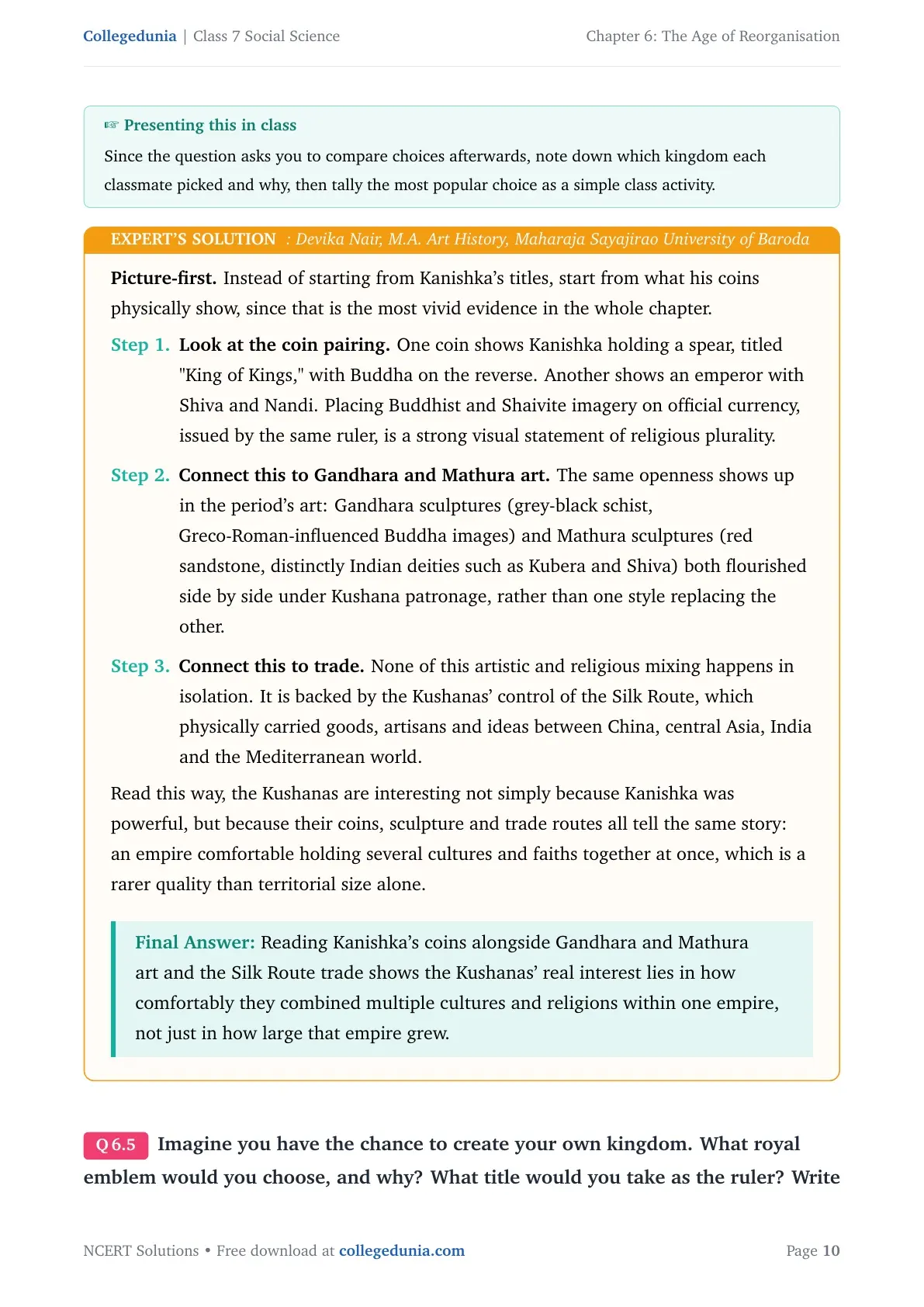
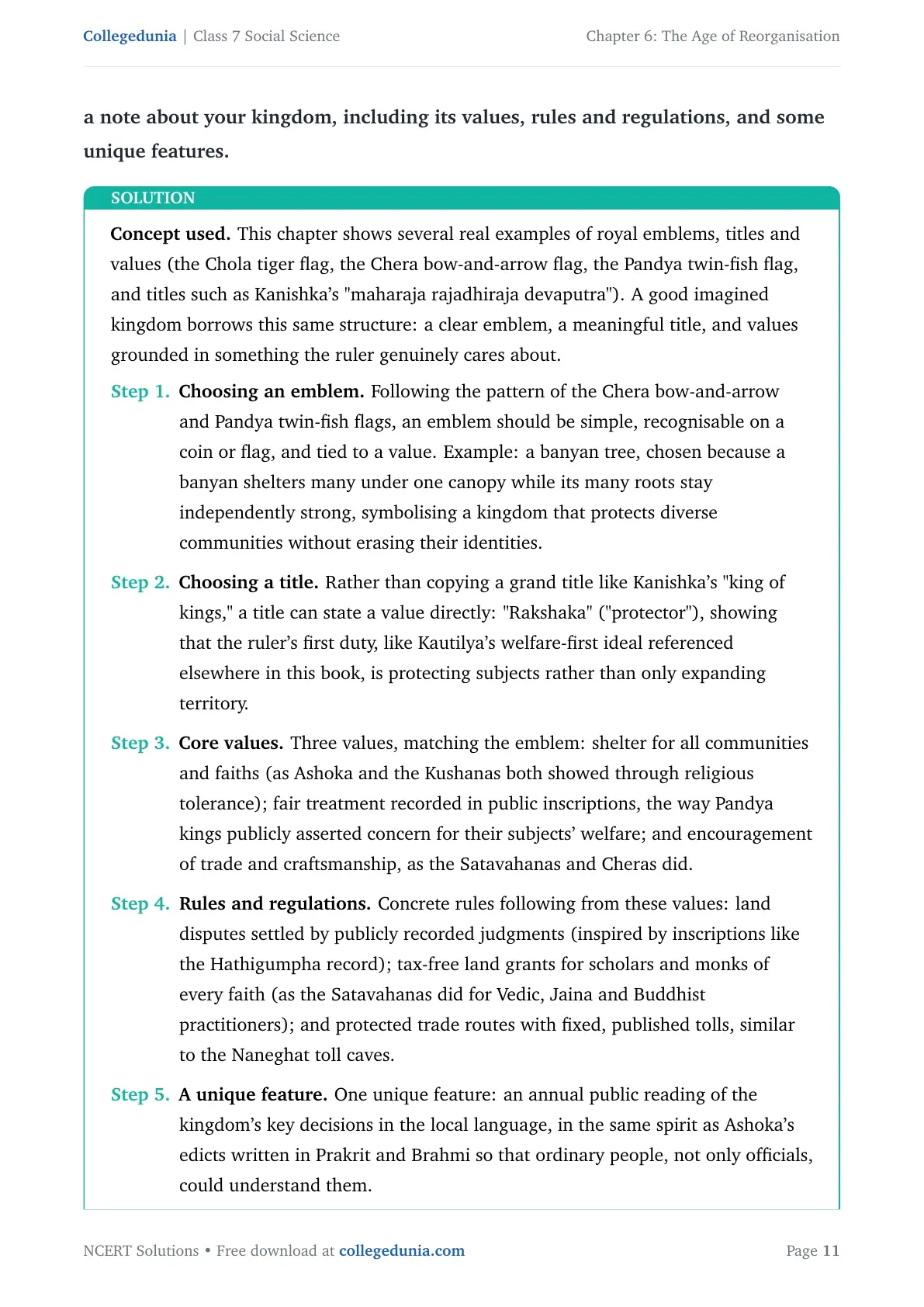
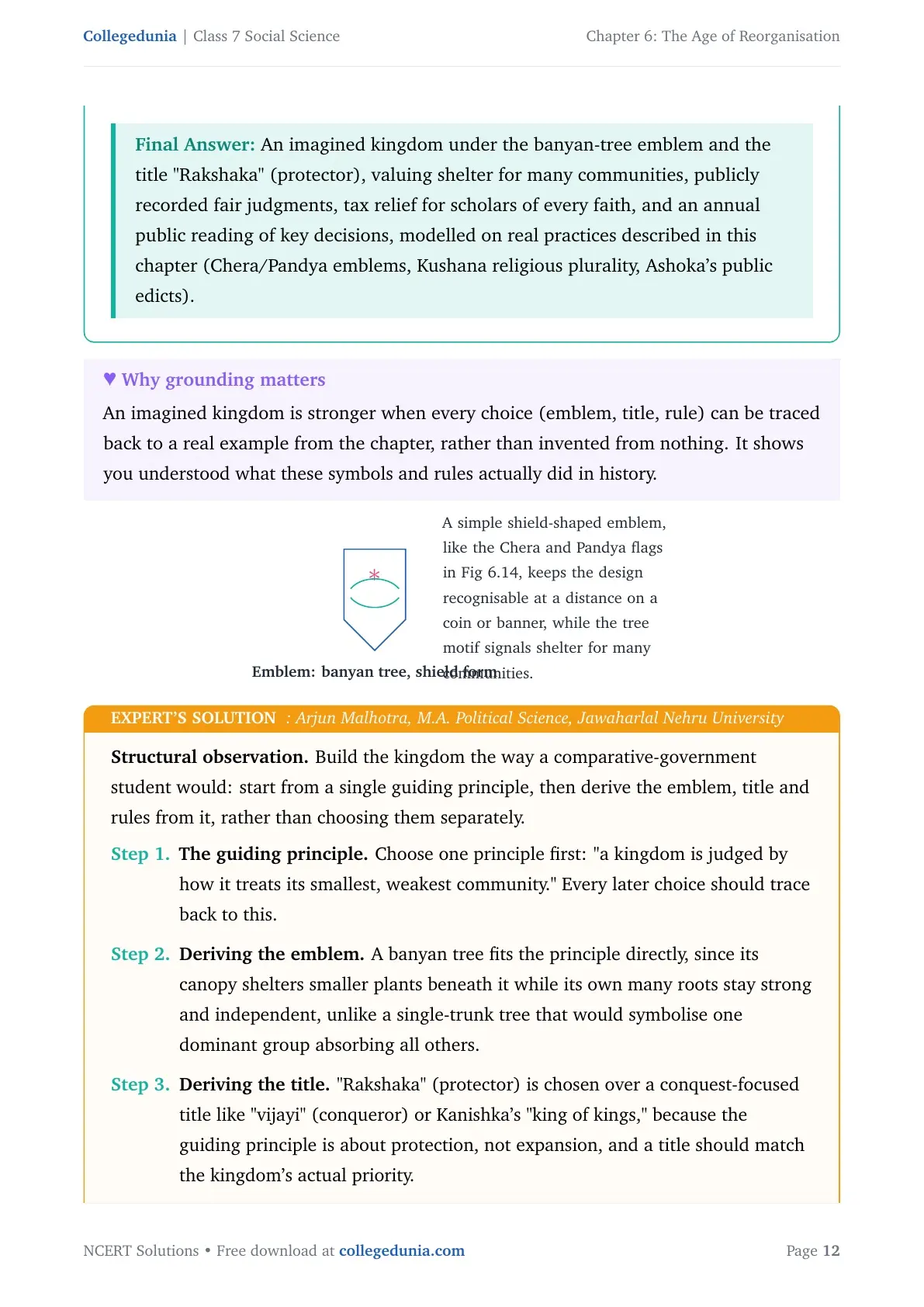
- Religiously plural coins. One Kanishka coin shows Buddha on the reverse; another pairs an emperor figure with Shiva and the bull Nandi.
- The Silk Route. The Kushanas controlled key sections of this trade network, connecting India to Asia and the West.
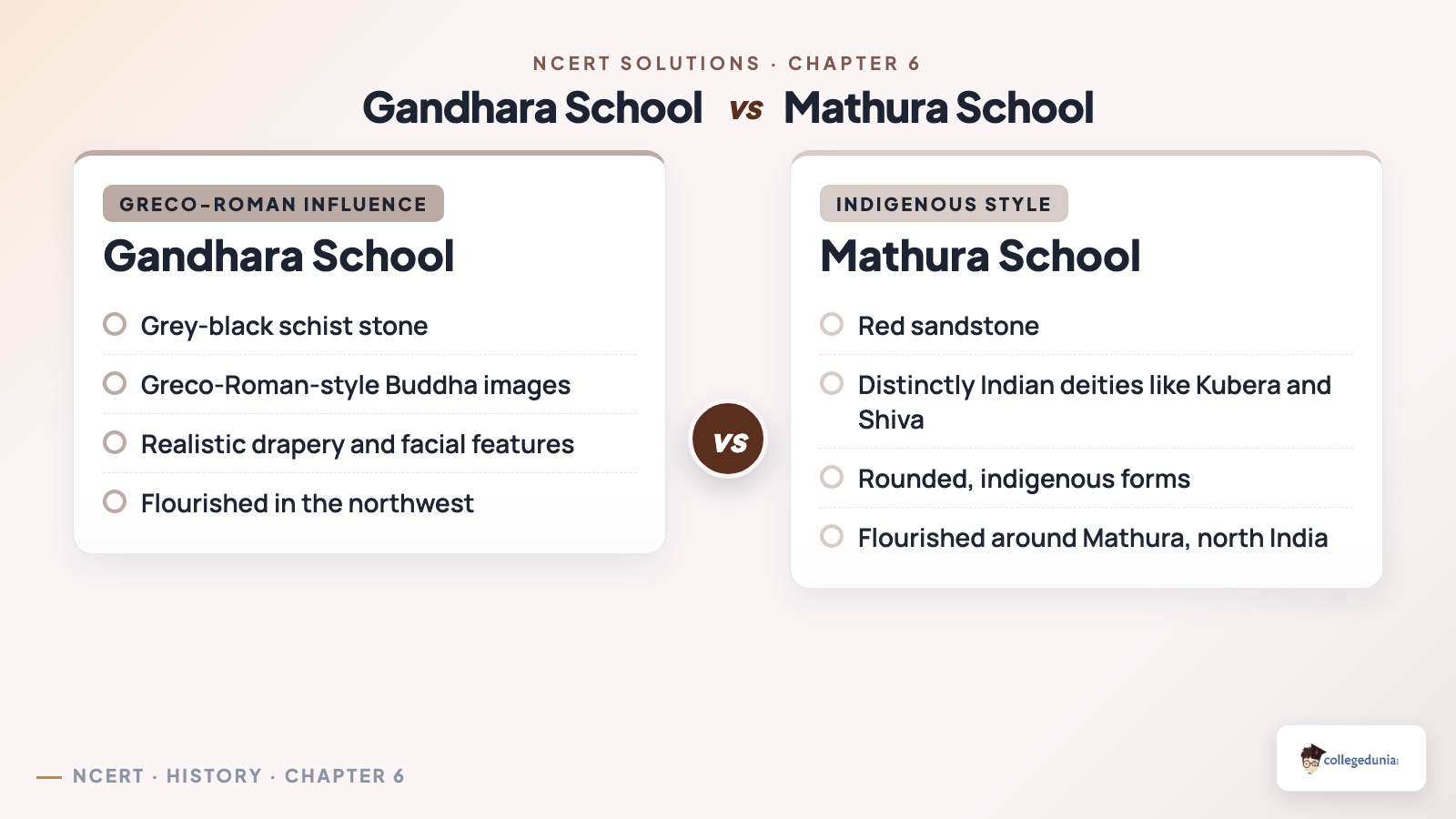
- Gandhara art. Grey-black schist, Greco-Roman-influenced Buddha images, flourishing in the northwest.
- Mathura art. Red sandstone, distinctly Indian deities such as Kubera and Shiva, flourishing around Mathura.
Featuring both Buddhist and Shaivite imagery on his coins signals real religious plurality, an openness that carried into art too, where Gandhara and Mathura styles flourished side by side rather than one replacing the other.
Common Mistakes Students Make in the Age of Reorganisation Chapter
Read this list before your next test. Each mistake below has cost real marks on Class 7 papers.
- Calling this period a "decline". NCERT prefers "reorganisation": kingdoms actively rose, competed and built art and trade, rather than the map simply falling apart.
- Naming only Gautamiputra Satakarni for Q3. A strong answer also cites Gautami Balashri's inscription and the Naneghat widow queen's donations as evidence.
- Mixing up Gandhara and Mathura art. Gandhara is grey-black schist with Greco-Roman Buddha images; Mathura is red sandstone with Indian deities like Kubera and Shiva.
- Forgetting the south stayed independent. The Chera, Chola and Pandya kingdoms were never part of the Maurya reorganisation, they ruled the far south throughout.
- Describing Kanishka's coins without naming both images. Full marks need the Buddha coin and the Shiva-Nandi coin, not just "Buddhist imagery".
Student Feedback: In a Collegedunia survey of 12,140 Class 7 students before the 2026-27 boards, 61% named the Kanishka's-coins-and-titles question the hardest to write in full sentences. Top scorers shared one habit: naming both the Buddha coin and the Shiva-Nandi coin, instead of writing "religious imagery" in general terms.
Source: 2026-27 Class 7 Social Science student survey. Sample of 12,140 students from CBSE schools across 15 states.
How to Study The Age of Reorganisation Effectively
This chapter mixes reasoning, word-limited notes and a mapping activity. Short revision blocks work better than one long sitting.
- Block 1, 20 minutes. Learn why "reorganisation" fits better than "decline", then list the three regional threads: north/Deccan, south, northwest.
- Block 2, 25 minutes. Practise the 150-word Sangam literature note and the 250-word Kushanas note from memory.
- Block 3, 20 minutes. Learn the Gautamiputra Satakarni evidence chain and the Gandhara-vs-Mathura art differences.
- Night before, 15 minutes. Re-read the Common Mistakes list and mark Q6's six structures on a blank outline map.
More The Age of Reorganisation Class 7 Resources
Also Check: This chapter is also available in other formats on Collegedunia. Read the solutions first, then the notes for a deeper topic walk-through.
| Resource | Best used for | Open it |
|---|---|---|
| NCERT Notes | Topic-by-topic summary of the post-Maurya kingdoms, Sangam literature and the Kushanas | The Age of Reorganisation Class 7 Notes |
| NCERT Book PDF | The official 2026-27 chapter text with all figures | Class 7 Social Science Part 1 Chapter 6 Book PDF |
| Handwritten Notes | Quick one-sitting revision in clear handwriting | The Age of Reorganisation Class 7 Handwritten Notes |
NCERT Solutions for Class 7 Social Science Part 1: All Chapters
The table below lists NCERT Solutions for every chapter of Part 1, so you can move to the next chapter once this one is done.
Sample Solutions from The Age of Reorganisation Chapter 6
Below are two of the six questions from NCERT Solutions Class 7 Social Science Chapter 6 The Age of Reorganisation, answered in full. Every question in the complete PDF gets this same level of detail, a concept explanation, a step-by-step answer, and a boxed final answer.
- Concept used: the exact NCERT term or idea the question is testing, named upfront.
- Step-by-step answer: the reasoning broken into short, exam-ready points.
- Boxed answer: a final, one-look summary a student can revise from directly.
Ques. Why was the post-Maurya era also known as the era of reorganisation?
The last Maurya emperor was assassinated around 185 BCE by his own commander-in-chief, Pushyamitra Shunga, barely half a century after Ashoka. This broke up the Maurya empire and let many new kingdoms rise across the subcontinent, several of them former Maurya tributaries. The northwest also opened up to outside invasions, letting the Indo-Greeks, Shakas and later the Kushanas enter and reorganise that part of the map.
Unlike the Maurya period, this age had many kingdoms, Shungas, Satavahanas, Chedis, Cheras, Cholas, Pandyas, Indo-Greeks, Shakas and Kushanas, competing with each other for territory at the same time, so the map of India kept changing.
Boxed answer: The era is called the "age of reorganisation" because, after the Maurya empire broke up around 185 BCE, its territories were reorganised into many new, competing kingdoms rather than staying under one single empire.
Ques. Write a note of 250 words about one kingdom from this chapter that you find interesting. Explain why you chose it.
The Kushanas are interesting because they were outsiders, originally from central Asia, who entered India, probably in the 2nd century CE, and built an empire that reached from central Asia to large parts of northern India, while also becoming deeply woven into Indian art, religion and trade. Kanishka, probably the most powerful Kushana ruler, is remembered through a famous "headless" statue with a Brahmi inscription calling him "maharaja rajadhiraja devaputra Kanishka", the great king, king of kings, son of God.
Kanishka's coins are a striking detail: one shows him as "King of Kings" with Buddha on the reverse, while another pairs an emperor figure with Shiva and the bull Nandi. The Kushanas controlled key sections of the Silk Route and their rule produced the Gandhara and Mathura schools of art, which blended Greek and Indian artistic styles into something new.
Boxed answer: The Kushanas are the chosen kingdom: an outsider dynasty whose ruler Kanishka combined vast territory, religiously plural coinage, control of the Silk Route, and the Gandhara and Mathura schools of art, making them one of the most interesting kingdoms in this chapter.
The Age of Reorganisation Class 7 Social Science NCERT Solutions FAQs
Ques. Where can I download the NCERT Solutions for Class 7 Social Science Chapter 6 The Age of Reorganisation PDF?
Ans. Use the download option at the top of this page. The file is free, covers all 6 questions and activities from the chapter, and is available in both Normal and HD quality.
Ques. What is the age of reorganisation?
Ans. The age of reorganisation is the period after the Maurya empire broke up around 185 BCE, when its territories were reorganised into many new, competing kingdoms, the Shungas, Satavahanas, Chedis, southern Sangam kingdoms and northwestern invader dynasties.
Ques. What is Sangam literature?
Ans. Sangam literature is the oldest surviving south Indian literature, several anthologies of poems by many poets from the Chera, Chola and Pandya period, expressing love, heroism and generosity, and used by historians to study that society.
Ques. Which ruler included his mother's name in his title, and why?
Ans. Gautamiputra Satakarni, a Satavahana king, included his mother Gautami's name in his title, as recorded on his own coin. This practice honoured powerful queens like his mother, Gautami Balashri, whose donations and inscriptions show real influence.
Ques. Who were the Kushanas?
Ans. The Kushanas were an outsider dynasty from central Asia who entered India around the 2nd century CE. Under their most powerful ruler, Kanishka, they controlled the Silk Route and produced the Gandhara and Mathura schools of art.
Ques. What is the difference between the Gandhara and Mathura schools of art?
Ans. Gandhara art uses grey-black schist stone with Greco-Roman-influenced Buddha images and flourished in the northwest. Mathura art uses red sandstone with distinctly Indian deities such as Kubera and Shiva, and flourished around Mathura.
Ques. Why did the Chera, Chola and Pandya kingdoms stay independent?
Ans. The far south was never brought under Maurya control in the way the north was, so the three crowned Sangam kings, Chera, Chola and Pandya, ruled their own kingdoms throughout this period, producing India's oldest surviving literature.
Ques. What structures should I mark for the outline-map activity in Q6?
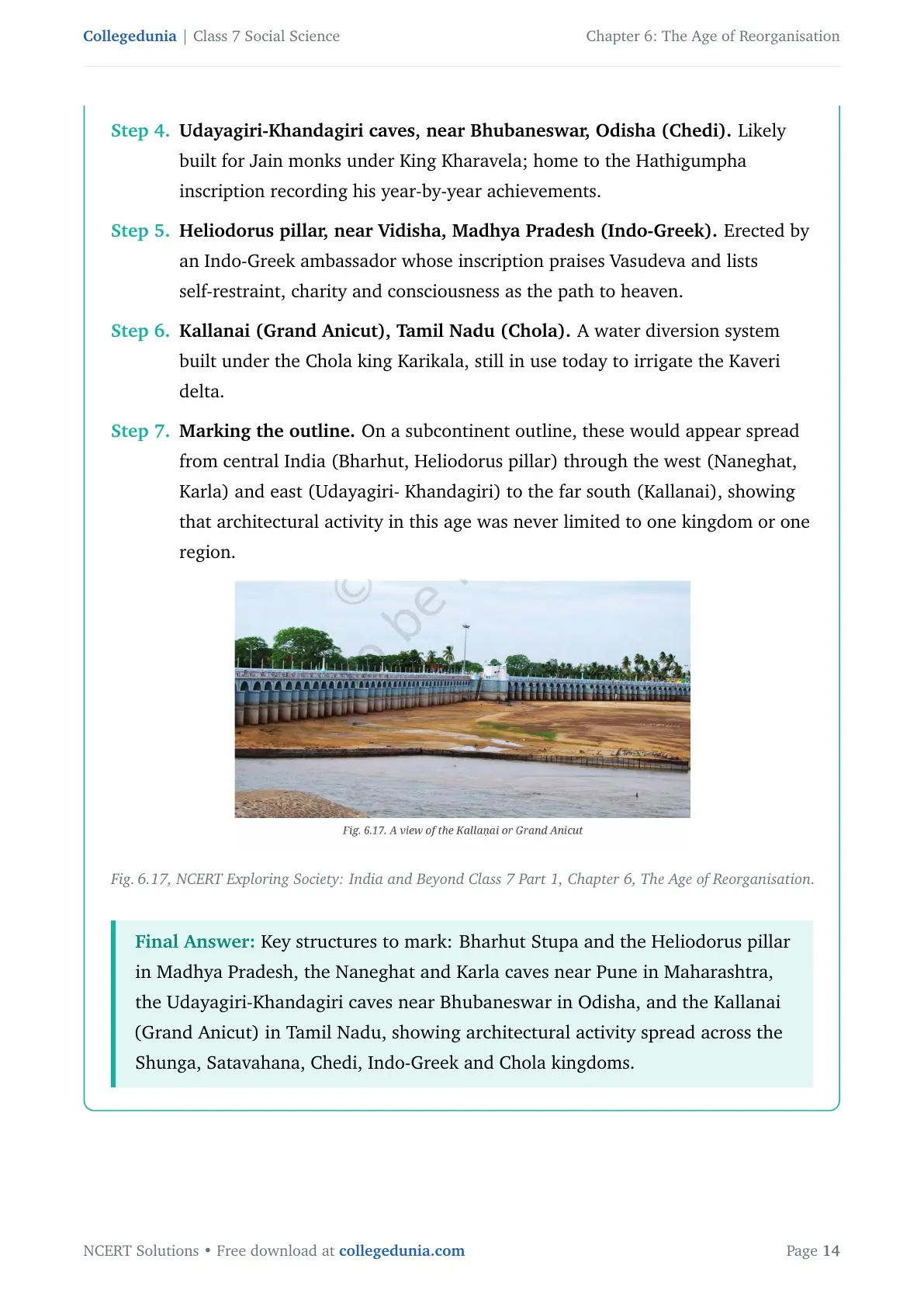
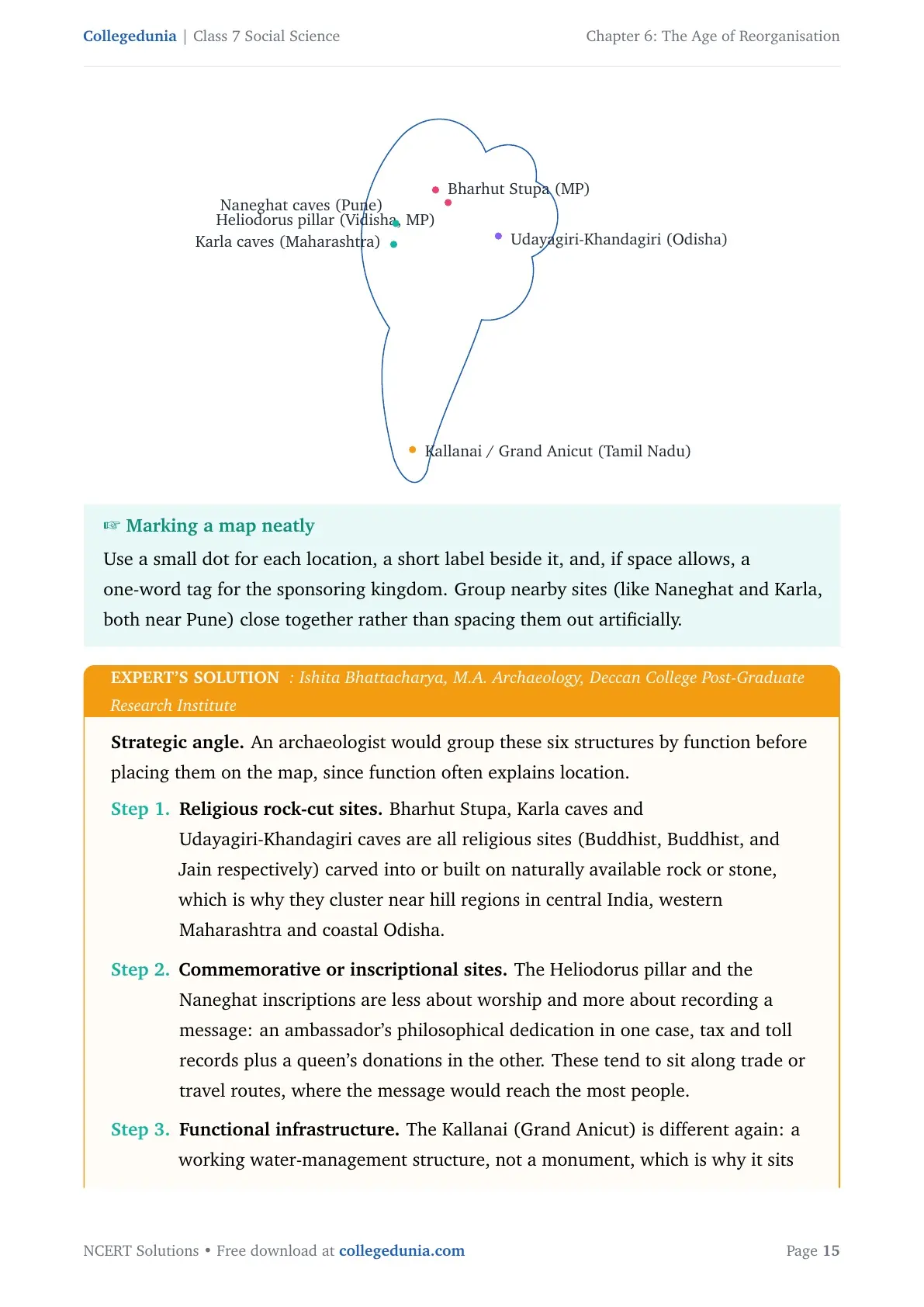
Ans. Mark the Bharhut Stupa and Heliodorus pillar in Madhya Pradesh, the Naneghat and Karla caves near Pune in Maharashtra, the Udayagiri-Khandagiri caves near Bhubaneswar in Odisha, and the Kallanai (Grand Anicut) in Tamil Nadu.
Ques. Is this NCERT Solutions PDF aligned with the 2026-27 syllabus?
Ans. Yes. This page follows the current 2026-27 edition of Exploring Society: India and Beyond, Grade 7 Part 1, and every answer matches the chapter content and question order printed in that edition.
Ques. How many pages is the Class 7 Social Science Chapter 6 NCERT Solutions PDF?
Ans. The Solutions PDF runs to 17 pages and covers all 6 questions and activities from The Age of Reorganisation, with a concept explanation, step-by-step reasoning and a boxed final answer for each one.
Ques. What titles did Kanishka use, and what do they mean?
Ans. A Brahmi inscription calls Kanishka "maharaja rajadhiraja devaputra", meaning the great king, king of kings, son of God, a title recorded alongside a famous 1.85-metre "headless" statue of him.
Ques. What is the Naneghat inscription evidence about?
Ans. The Naneghat caves near Pune carry an inscription describing a Satavahana widow queen who performed Vedic rituals, including the ashvamedha yajna, and made large donations of land, cattle, horses, elephants and silver coins.



Comments