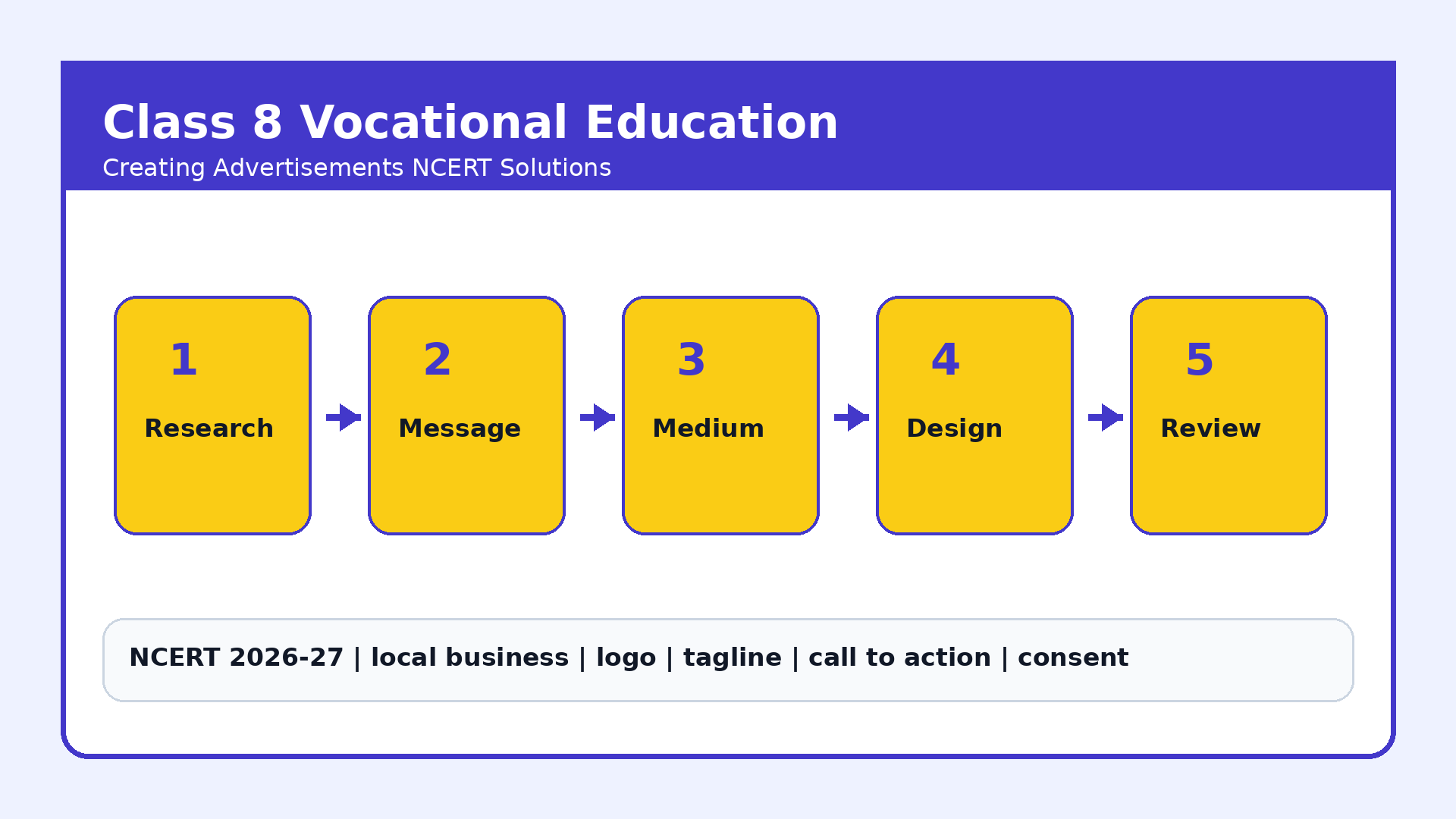
NCERT Solutions for Class 8 Vocational Education Chapter 6 Creating Advertisements help students complete the 2026-27 Kaushal Bodh project file. The PDF covers advertisement types, logo, tagline, visuals, jingles, small-business interviews, ethics and review.
Student Feedback: In a Collegedunia poll of 9,860 middle-school students, 72% said the hardest part of this project was choosing the message and call to action.
Creating Advertisements Solutions Overview
Creating Advertisements connects market learning with real work. Students observe advertisements, meet an expert, choose a local business, collect product and student details, design a message and review it with the owner.
Chapter Part
What Students Write
Skill Practised
Advertisement study
Types, logo, tagline, visuals, sound and call to action.
Media observation
Client research
Business selection, contract, product details and target students.
Interviewing
Design and review
Poster, digital ad, storyboard, feedback and improvements.
Communication design
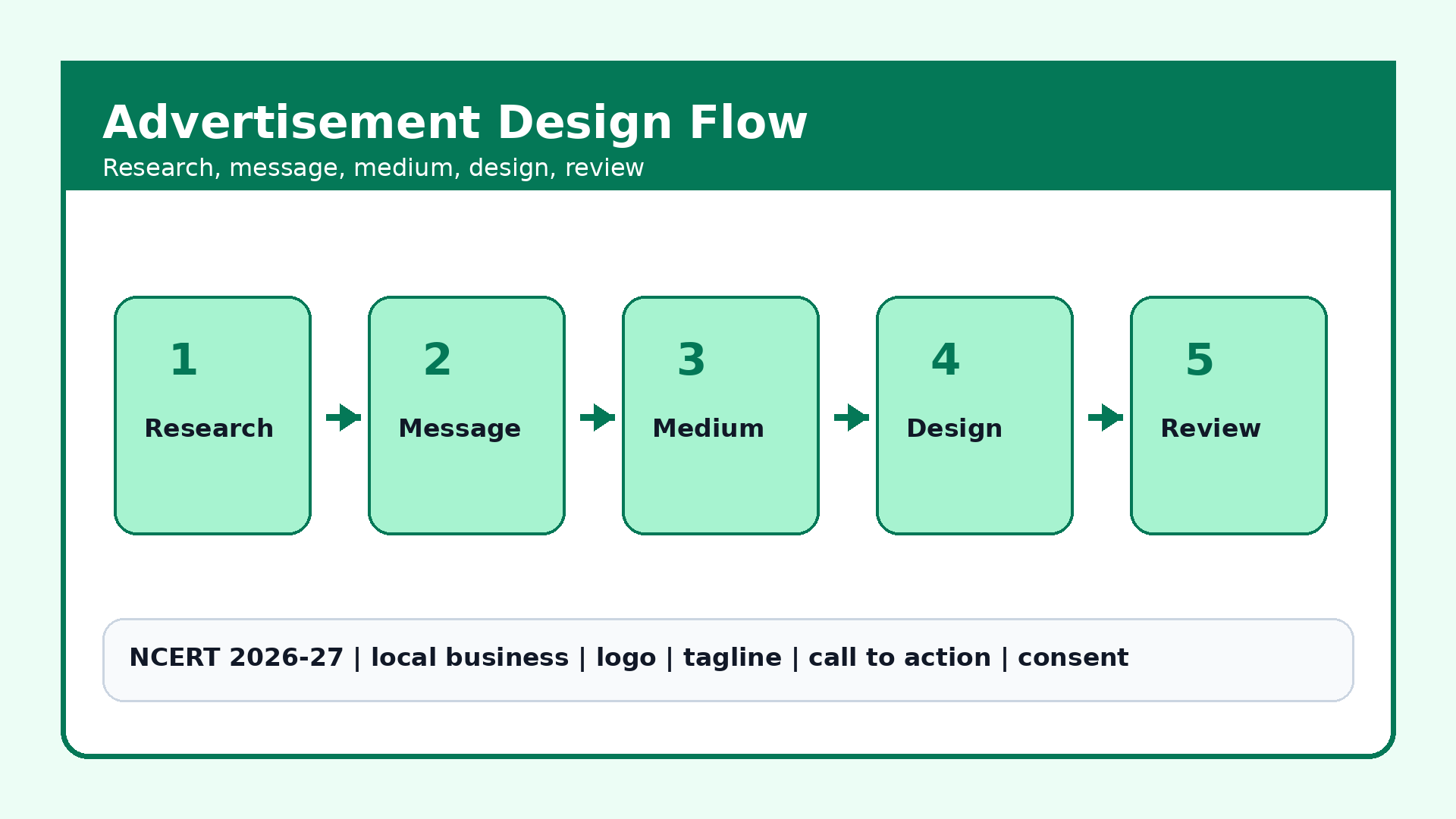
Advertisement Design Flow for a Small Business
The chapter asks students to move step by step. The best advertisement starts with research, not decoration. The group first understands the business, then decides the message, medium, design and review process.
Research: interview the owner and identify the unique selling point.
Message: write a short tagline and clear call to action.
Review: check clarity, visual appeal, honesty and owner feedback.
Ethical Advertising Checklist
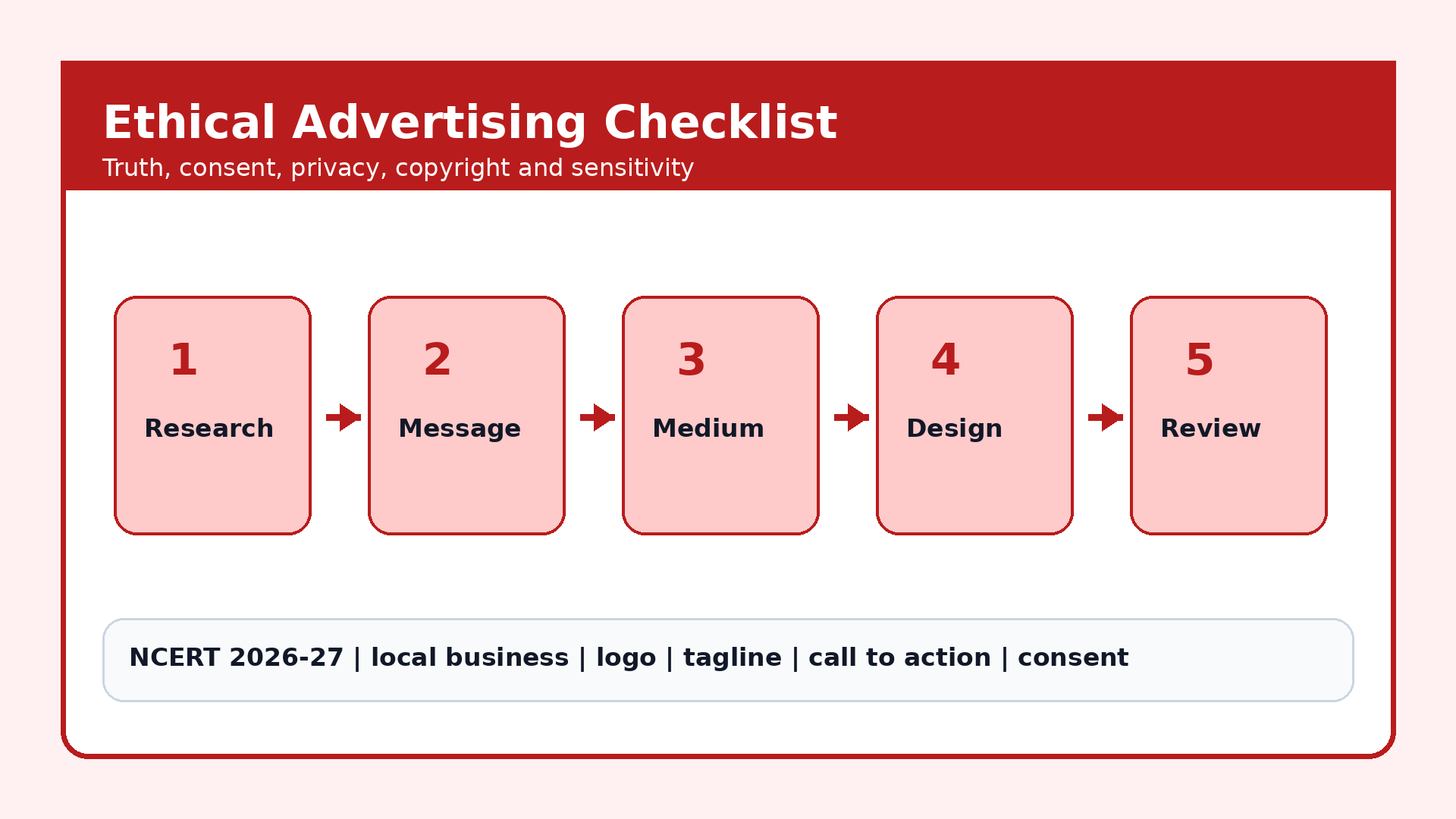
Advertisements are powerful because they persuade people. That power brings responsibility. Students must avoid copying online material, false claims, stereotypes and privacy violations. Truth, consent and sensitivity are part of the final answer.
Rule
Meaning
Project Check
Truthfulness
No fake claims.
Owner confirms every benefit.
Copyright
No copied images, music or text without permission.
Source and permission recorded.
Privacy
No photo or video without consent.
Contract allows approved use.
Sensitivity
No offensive or stereotyped content.
Classmates and owner review the draft.
Creating Advertisements Project Video for Class 8
Source: YouTube educational media tutorial
All NCERT Solutions for Class 8 Vocational Education Chapter 6 Creating Advertisements with Step-by-Step Solutions
The question cards below help students check every Creating Advertisements activity answer quickly.
Q 6.1
How many advertisements could Ruchi identify in one day? Categorise them as print, social media, radio or television, and outdoor advertisements.
Concept used. An advertisement can appear in many media. Classification means sorting each example by the channel through which the message reaches people.
Sorting cue
Ask: where did the student meet the message, on paper, screen, sound, or public space?
Read the comic and list every advertisement Ruchi sees or hears during the day.
Put newspapers, flyers and magazines under print advertisements.
Put posts, reels, stories and online promotional messages under social media.
Put jingles, radio spots, television clips and audio-video clips under radio or television.
Put hoardings, vehicle displays, shop boards and posters under outdoor advertising.
Add one example that you see often in each category so the table becomes personal and complete.
Ruchi's advertisements should be sorted by medium: print, social media, radio or television, and outdoor advertising.
AM
Anika Mehta
MBA Marketing, FMS Delhi
Verified Expert
Project-file angle. Do not count only the colourful posters. The chapter wants students to notice that advertising surrounds daily life. A toothpaste line on television, detergent jingle, grocery discount board, marathon message and shop poster can all be advertisements if they persuade people to act. The correct record is a table with one medium per row and examples in the second column.
Do not count only the colourful posters. The chapter wants students to notice that advertising surrounds daily life. A toothpaste line on television, detergent jingle, grocery discount board, marathon message and shop poster can all be advertisements if they persuade people to act. The correct record is a table with one medium per row and examples in the second column.
Check that the final answer names the advertisement element, the students and the ethical point wherever needed.
Ruchi's advertisements should be sorted by medium: print, social media, radio or television, and outdoor advertising.
Q 6.2
Explain the difference between commercial advertising and social advertising with two examples of each.
Concept used. Commercial advertisements persuade people to buy a product or service. Social advertisements persuade people to support a public message or behaviour.
Purpose cue
If money or sales is the main goal, call it commercial. If behaviour change is the goal, call it social.
Write that commercial advertising is linked to selling or promoting a paid product or service.
Give examples such as a bakery poster, tailor shop banner, hair oil advertisement or discount board.
Write that social advertising spreads a message for public welfare or social action.
Give examples such as vaccination drive, road safety, cleanliness campaign or voter awareness.
Mention that both types use logos, slogans, visuals and calls to action.
End by saying that the purpose decides the type, not only the medium.
Commercial advertising sells products or services, while social advertising promotes public messages such as safety, cleanliness or vaccination.
RD
Rohan Dutta
M.A Mass Communication, Jamia Millia Islamia
Verified Expert
Project-file angle. The cleanest answer compares purpose first. A poster can be commercial if it sells bakery cakes, and the same poster format can be social if it asks people to vote. Medium is secondary. Purpose is primary. This distinction also helps students design their own advertisement for a small business without copying a public campaign style blindly.
The cleanest answer compares purpose first. A poster can be commercial if it sells bakery cakes, and the same poster format can be social if it asks people to vote. Medium is secondary. Purpose is primary. This distinction also helps students design their own advertisement for a small business without copying a public campaign style blindly.
Check that the final answer names the advertisement element, the students and the ethical point wherever needed.
Commercial advertising sells products or services, while social advertising promotes public messages such as safety, cleanliness or vaccination.
Q 6.3
What are logos and taglines? Use the campaign example shown below to explain why campaigns often keep the logo same but change the tagline.
Logo and tagline in a campaign advertisement.
Concept used. A logo is a visual identity. A tagline is a short phrase that carries the message. Together they make the brand or campaign easy to remember.
Branding cue
A good tagline is short enough to remember and clear enough to repeat.
Define logo as a symbol, mark, image or word-image combination used to identify a brand or campaign.
Define tagline as a short memorable phrase that explains the product, service or message.
Explain that a repeated logo creates recognition across different languages or versions.
Explain that a changed tagline can adapt the message for different students.
Use the polio campaign example: the visual identity remains recognisable while the slogan can change.
Write your own example of a product or campaign where a logo and tagline work together.
A logo gives identity, while a tagline gives the message. Keeping the logo same builds recognition, and changing the tagline adapts the message.
MI
Maya Iyer
B.Des Communication Design, NID Ahmedabad
Verified Expert
Project-file angle. Think of the logo as the face and the tagline as the spoken line. The face helps people recognise the campaign quickly. The spoken line can change because the campaign may need different languages, moods or instructions. That is why the NCERT example keeps the identity stable while allowing the message line to adjust.
Think of the logo as the face and the tagline as the spoken line. The face helps people recognise the campaign quickly. The spoken line can change because the campaign may need different languages, moods or instructions. That is why the NCERT example keeps the identity stable while allowing the message line to adjust.
Check that the final answer names the advertisement element, the students and the ethical point wherever needed.
A logo gives identity, while a tagline gives the message. Keeping the logo same builds recognition, and changing the tagline adapts the message.
Q 6.4
Identify the visual elements of the advertisement shown below. Why should text be kept minimum and placed carefully?
Visual elements of an advertisement.
Concept used. Visual design in advertising uses logo, slogan, photographs, colour, layout, important information and contact details to guide attention.
Design cue
Readable text is not decoration. It decides whether the students understands the advertisement.
Identify the logo because it tells the students whose product or service is being advertised.
Identify the slogan because it states the key message in a short phrase.
Identify visuals or photographs because they create interest and show the product, service or mood.
Identify important information such as offer, date, address, phone number or service details.
Identify colour and contrast because text must be readable on the background.
Explain that too much text makes the advertisement crowded and weakens the main message.
Important visual elements include logo, slogan, visuals, legible colours, information and contact details. Text should be short and carefully placed.
KS
Kabir Sethi
B.F.A Applied Art, MSU Baroda
Verified Expert
Project-file angle. A strong advertisement works like a quick map for the eye. The viewer should first notice the image or headline, then understand the message, then find what action to take. If text covers the visuals or blends into the background, the message fails even when the words are correct. Design choices therefore support communication.
A strong advertisement works like a quick map for the eye. The viewer should first notice the image or headline, then understand the message, then find what action to take. If text covers the visuals or blends into the background, the message fails even when the words are correct. Design choices therefore support communication.
Check that the final answer names the advertisement element, the students and the ethical point wherever needed.
Important visual elements include logo, slogan, visuals, legible colours, information and contact details. Text should be short and carefully placed.
Q 6.5
Listen to or watch one advertisement and review its music, jingle, dialogue and duration.
Concept used. Audio and audio-video advertisements use time, sound, dialogue and rhythm to make a message memorable before the students loses interest.
Listening cue
Use a timer. Duration is evidence, not a guess.
Note the start time and end time, then calculate the approximate duration.
Write whether the duration was enough to understand the message.
Describe the music: upbeat, dramatic, emotional, calm, playful or urgent.
Write the jingle or the most memorable phrase if you can remember it.
Mention any dialogue or voiceover and its purpose.
Conclude whether the sound helped you remember the product, service or social message.
A good review records duration, music, jingle, dialogue and whether these helped the message become clear and memorable.
NV
Nisha Verma
M.A Media Studies, University of Hyderabad
Verified Expert
Project-file angle. The best answer does not simply say the music was nice. It explains what the music did. Upbeat music may make a product feel fun. Slow music may build emotion. A short dialogue may explain the problem. A jingle may make the name easy to repeat. Each audio element should be linked to the advertisement's purpose.
The best answer does not simply say the music was nice. It explains what the music did. Upbeat music may make a product feel fun. Slow music may build emotion. A short dialogue may explain the problem. A jingle may make the name easy to repeat. Each audio element should be linked to the advertisement's purpose.
Check that the final answer names the advertisement element, the students and the ethical point wherever needed.
A good review records duration, music, jingle, dialogue and whether these helped the message become clear and memorable.
Q 6.6
How do advertisements connect to emotions and call people to action? Give examples from road safety, voting or army recruitment advertisements.
Concept used. Emotional connect makes people remember a message. A call to action tells them exactly what to do after seeing the advertisement.
CTA cue
A call to action usually starts with an action verb.
Write that emotional connect may use family, pride, safety, hope, fear, celebration or responsibility.
Explain that road safety advertisements often use the value of life and family care.
Explain that army recruitment advertisements may use courage, service and national pride.
Explain that voting advertisements ask citizens to cast their vote.
Identify the call to action: wear a helmet, vote, join, save water, keep clean or buy now.
Mention that a call to action should be clear, honest and easy to follow.
Advertisements connect through feelings and then give a clear action, such as vote, drive safely, join a cause or buy a product.
AM
Arjun Menon
M.A Public Policy, TISS Mumbai
Verified Expert
Project-file angle. Emotion creates attention, but the call to action completes the advertisement. A touching road safety poster is incomplete if the viewer does not know what behaviour is expected. The action line should be short and direct. This is why phrases like 'Vote today' or 'Wear a helmet' work better than long advice.
Emotion creates attention, but the call to action completes the advertisement. A touching road safety poster is incomplete if the viewer does not know what behaviour is expected. The action line should be short and direct. This is why phrases like 'Vote today' or 'Wear a helmet' work better than long advice.
Check that the final answer names the advertisement element, the students and the ethical point wherever needed.
Advertisements connect through feelings and then give a clear action, such as vote, drive safely, join a cause or buy a product.
Q 6.7
Prepare five questions you would ask an advertising or marketing expert during Activity 3.
Concept used. An expert interview helps students learn from real practice. Good questions ask about message, students, medium, cost, impact and ethics.
Interview cue
Begin with easy questions, then move to cost, impact and ethics.
Ask what makes an advertisement interesting and easy to remember.
Ask why money is spent on advertisements and how students are affected.
Ask how the medium is chosen: print, radio, television, outdoor or social media.
Ask what disadvantages or ethical issues advertisements may create.
Add one local question, such as how a small shop can advertise on a low budget.
Keep questions polite, open-ended and suitable for a short interview.
A useful expert interview asks about memorable ads, cost, students effect, medium choice, ethical issues and local low-budget advertising.
TS
Tara Singh
MBA Rural Management, IRMA Anand
Verified Expert
Project-file angle. Good interview questions should invite explanation, not one-word answers. Instead of asking 'Do advertisements work?', ask 'How do you know whether an advertisement worked?' That question may lead to details about sales, enquiries, footfall, social media response or community awareness. Such answers help the project become realistic.
Good interview questions should invite explanation, not one-word answers. Instead of asking 'Do advertisements work?', ask 'How do you know whether an advertisement worked?' That question may lead to details about sales, enquiries, footfall, social media response or community awareness. Such answers help the project become realistic.
Check that the final answer names the advertisement element, the students and the ethical point wherever needed.
A useful expert interview asks about memorable ads, cost, students effect, medium choice, ethical issues and local low-budget advertising.
Q 6.8
How will your group identify a small business client and write a simple contract before making an advertisement?
Concept used. A client is the person or business for whom the advertisement is made. A simple contract records consent, permissions, meeting dates and adult supervision.
Consent cue
Consent is part of ethical advertising, not extra paperwork.
List local small businesses near the school, such as bakers, tailors, toy makers, bamboo workers or vegetable sellers.
Select one business after discussion with classmates, teachers and neighbours.
Visit the business only with a teacher, parent or trusted adult.
Introduce the group and explain the school project clearly.
Ask whether the business accepts the proposal for a marketing campaign.
If accepted, write a simple contract with permission for photographs, meeting dates, progress sharing and adult presence.
The group should choose a nearby small business, request consent politely and record permissions through a simple signed contract.
FA
Farhan Ali
BBA Marketing, Christ University
Verified Expert
Project-file angle. This activity is partly about advertising and partly about trust. Students should not take photos, record videos or promise promotion without permission. A simple contract protects the business owner and the student group. It also makes the project professional because everyone knows what will be shared, when meetings will happen and who will supervise.
This activity is partly about advertising and partly about trust. Students should not take photos, record videos or promise promotion without permission. A simple contract protects the business owner and the student group. It also makes the project professional because everyone knows what will be shared, when meetings will happen and who will supervise.
Check that the final answer names the advertisement element, the students and the ethical point wherever needed.
The group should choose a nearby small business, request consent politely and record permissions through a simple signed contract.
Q 6.9
Prepare an interview plan to understand the small business, product, service and target students.
Concept used. An advertisement works only when it understands the product and the students. The interview should gather facts about features, uniqueness, customers, price and feedback.
USP cue
USP means unique selling point, the reason people should choose this business.
Ask what products or services the business offers.
Ask how long the owner has been doing this work.
Ask what makes the product or service special: price, material, durability, delivery, cleanliness or after-sales service.
Ask which product or service sells the most.
Ask the price range of the product or service.
Ask who usually buys it, including age, location, work and feedback.
Record the answers in simple notes before designing the advertisement.
The interview plan should collect product facts, unique selling points, best-selling items, price range, customer profile and feedback.
MJ
Meera Joshi
M.Ed Work Education, University of Mumbai
Verified Expert
Project-file angle. The target students decides the message. A snack stall near a school may need bright posters and low-price offers. A tailor may need trust, fitting quality and delivery time. A bamboo craft seller may need photographs and a handmade story. The interview converts general advertising ideas into a business-specific message.
The target students decides the message. A snack stall near a school may need bright posters and low-price offers. A tailor may need trust, fitting quality and delivery time. A bamboo craft seller may need photographs and a handmade story. The interview converts general advertising ideas into a business-specific message.
Check that the final answer names the advertisement element, the students and the ethical point wherever needed.
The interview plan should collect product facts, unique selling points, best-selling items, price range, customer profile and feedback.
Q 6.10
How will you choose the form of advertisement for the selected business: poster, video, label, pamphlet or banner?
Concept used. The form of advertisement should match the students, budget, available tools, product type and message.
Medium cue
Always justify the medium. Do not write only 'we chose video' without saying why.
Check who the target students is and where they will see the message.
Choose posters when the students passes through a school, shop, street or community notice area.
Choose labels, pamphlets or banners when product details, price or contact information must be carried away.
Choose a video or reel when movement, process, customer story or demonstration is important.
Compare the cost and resources required for each form.
Pick a form that the group can make honestly with available time and permission.
The group should choose the advertisement form by matching students, message, cost, resources and permission.
DN
Devika Nair
M.Des Visual Communication, IIT Hyderabad
Verified Expert
Project-file angle. A medium is not automatically better because it uses technology. A neat hand-made poster may work well for a local fair. A short video may work better for a craft demonstration. A label may matter most for food packaging. The correct choice is the form that reaches the right people with the clearest message.
A medium is not automatically better because it uses technology. A neat hand-made poster may work well for a local fair. A short video may work better for a craft demonstration. A label may matter most for food packaging. The correct choice is the form that reaches the right people with the clearest message.
Check that the final answer names the advertisement element, the students and the ethical point wherever needed.
The group should choose the advertisement form by matching students, message, cost, resources and permission.
Q 6.11
Fill the design decisions for logo, tagline, call to action, visuals, jingle, emotional connect, target students and medium.
Concept used. Design decisions convert research into an advertisement plan. Each element should have a reason linked to the business and students.
Reason cue
Every creative choice should answer one question: why will this help the students act?
Decide a simple logo that matches the product or service.
Write a short tagline that is easy to remember.
Write a clear call to action, such as visit today, order now or support local artisans.
Choose visuals that show the product, owner, process or customer benefit.
If making audio or video, select a jingle or sound only with permission.
Write the emotional connect, such as trust, family, pride, local craft, health or freshness.
Name the target students and the chosen medium.
Give a reason for each decision.
A complete design table records every advertisement element and explains why each choice suits the business and students.
IM
Ira Mukherjee
PG Diploma Advertising, MICA Ahmedabad
Verified Expert
Project-file angle. The reason column is the most important part of this activity. A tagline may sound good, but the project answer must show why it fits the business. For example, a bakery may use warmth and freshness. A bicycle repair shop may use speed and reliability. The logic behind the design proves that students understood the client.
The reason column is the most important part of this activity. A tagline may sound good, but the project answer must show why it fits the business. For example, a bakery may use warmth and freshness. A bicycle repair shop may use speed and reliability. The logic behind the design proves that students understood the client.
Check that the final answer names the advertisement element, the students and the ethical point wherever needed.
A complete design table records every advertisement element and explains why each choice suits the business and students.
Q 6.12
Plan a poster advertisement and then replicate it digitally. What differences will you notice between hand-made and digital advertisements?
Concept used. A poster communicates at a glance. Digital tools can replicate the same message with easier editing, cleaner alignment and reusable files.
Layout cue
A crowded poster may contain more information but communicate less.
Write a title that grabs attention immediately.
List visual elements such as product photo, owner photo, illustration, colour scheme, logo and font.
Check whether photographs are original or need permission and attribution.
Write how the poster will create emotional connect.
Choose colours and layout so the text remains readable.
Sketch the poster layout first.
Replicate it on a digital tool such as presentation software or Canva with teacher permission.
Compare differences in editing, neatness, speed, alignment and printing or sharing.
The poster plan should include title, visuals, photo permissions, emotion, colours and layout, then compare hand-made and digital work.
AR
Aditi Rao
M.A Film and Media, Jadavpur University
Verified Expert
Project-file angle. Hand-made posters are flexible and personal, but corrections may be difficult. Digital posters are easier to edit, align and reuse. However, digital work still needs the same thinking: title, visual balance, readable text, permission for images and a clear action line. The tool changes the making process, not the core message.
Hand-made posters are flexible and personal, but corrections may be difficult. Digital posters are easier to edit, align and reuse. However, digital work still needs the same thinking: title, visual balance, readable text, permission for images and a clear action line. The tool changes the making process, not the core message.
Check that the final answer names the advertisement element, the students and the ethical point wherever needed.
The poster plan should include title, visuals, photo permissions, emotion, colours and layout, then compare hand-made and digital work.
Q 6.13
Prepare a storyboard for an animated or video advertisement and explain how you will review it before sharing it with the business owner.
Concept used. A storyboard breaks a video advertisement into frames. Review checks creativity, clarity, visual appeal, message accuracy and owner feedback.
Review cue
Do not add claims that the business owner cannot honestly support.
Divide the advertisement into four or more frames.
Write what the viewer will see in each frame.
Add dialogue, voiceover or on-screen text for each frame.
Mention music, sound effects, jingle or silence where needed.
Choose simple transitions such as fade, zoom or slide only when they support the message.
Review the advertisement for creativity, clarity of message and visual appeal.
Share it with the business owner and ask whether they would use it and why.
Record feedback and write what you will change.
A storyboard should show frame-wise action, text, sound and transition, followed by review and business-owner feedback.
PS
Pranav Sharma
MBA Brand Management, NMIMS Mumbai
Verified Expert
Project-file angle. Storyboard planning prevents confusion during shooting or animation. It shows whether the message is too long, whether the product appears clearly and whether the call to action comes at the right time. Review should happen before final sharing so errors, missing permissions and unclear claims can be fixed responsibly.
Storyboard planning prevents confusion during shooting or animation. It shows whether the message is too long, whether the product appears clearly and whether the call to action comes at the right time. Review should happen before final sharing so errors, missing permissions and unclear claims can be fixed responsibly.
Check that the final answer names the advertisement element, the students and the ethical point wherever needed.
A storyboard should show frame-wise action, text, sound and transition, followed by review and business-owner feedback.
Related NCERT Resources for Creating Advertisements
Creating Advertisements Class 8 NCERT Solutions FAQs
Ques. What is covered in NCERT Solutions for Class 8 Vocational Education Chapter 6 Creating Advertisements?
Ans. The solutions cover advertisement types, logo, tagline, visual design, jingles, emotional connect, client interview, poster plan and storyboard review.
Ques. What is the difference between commercial and social advertising?
Ans. Commercial advertising sells a product or service. Social advertising promotes public messages such as cleanliness, vaccination, road safety or voting.
Ques. What should students ask a small business owner before designing an advertisement?
Ans. Students should ask about products, special features, customer profile, best-selling item, price range, feedback, delivery, cleanliness and after-sales service.
Ques. What are the main ethics in advertisement making?
Ans. Students should use truthful claims, get consent for photos or videos, avoid copying content and respect cultural and gender sensitivity.





Chapter6CreatingAdvertisementsSolutions.pdf?page=1&dpi=150)
Chapter6CreatingAdvertisementsSolutions.pdf?page=2&dpi=150)
Chapter6CreatingAdvertisementsSolutions.pdf?page=3&dpi=150)
Chapter6CreatingAdvertisementsSolutions.pdf?page=4&dpi=150)
Chapter6CreatingAdvertisementsSolutions.pdf?page=5&dpi=150)
Chapter6CreatingAdvertisementsSolutions.pdf?page=6&dpi=150)
Chapter6CreatingAdvertisementsSolutions.pdf?page=7&dpi=150)
Chapter6CreatingAdvertisementsSolutions.pdf?page=8&dpi=150)
Chapter6CreatingAdvertisementsSolutions.pdf?page=9&dpi=150)
Chapter6CreatingAdvertisementsSolutions.pdf?page=10&dpi=150)
Chapter6CreatingAdvertisementsSolutions.pdf?page=11&dpi=150)
Chapter6CreatingAdvertisementsSolutions.pdf?page=12&dpi=150)
Chapter6CreatingAdvertisementsSolutions.pdf?page=13&dpi=150)
Chapter6CreatingAdvertisementsSolutions.pdf?page=14&dpi=150)
Chapter6CreatingAdvertisementsSolutions.pdf?page=15&dpi=150)
Chapter6CreatingAdvertisementsSolutions.pdf?page=16&dpi=150)
Chapter6CreatingAdvertisementsSolutions.pdf?page=17&dpi=150)
Chapter6CreatingAdvertisementsSolutions.pdf?page=18&dpi=150)
Chapter6CreatingAdvertisementsSolutions.pdf?page=19&dpi=150)
Chapter6CreatingAdvertisementsSolutions_flat_MobileCard.pdf?page=1&dpi=150)
Chapter6CreatingAdvertisementsSolutions_flat_MobileCard.pdf?page=2&dpi=150)
Chapter6CreatingAdvertisementsSolutions_flat_MobileCard.pdf?page=3&dpi=150)
Chapter6CreatingAdvertisementsSolutions_flat_MobileCard.pdf?page=4&dpi=150)
Chapter6CreatingAdvertisementsSolutions_flat_MobileCard.pdf?page=5&dpi=150)
Chapter6CreatingAdvertisementsSolutions_flat_MobileCard.pdf?page=6&dpi=150)
Chapter6CreatingAdvertisementsSolutions_flat_MobileCard.pdf?page=7&dpi=150)
Chapter6CreatingAdvertisementsSolutions_flat_MobileCard.pdf?page=8&dpi=150)
Chapter6CreatingAdvertisementsSolutions_flat_MobileCard.pdf?page=9&dpi=150)
Chapter6CreatingAdvertisementsSolutions_flat_MobileCard.pdf?page=10&dpi=150)
Chapter6CreatingAdvertisementsSolutions_flat_MobileCard.pdf?page=11&dpi=150)
Chapter6CreatingAdvertisementsSolutions_flat_MobileCard.pdf?page=12&dpi=150)
Chapter6CreatingAdvertisementsSolutions_flat_MobileCard.pdf?page=13&dpi=150)
Chapter6CreatingAdvertisementsSolutions_flat_MobileCard.pdf?page=14&dpi=150)
Chapter6CreatingAdvertisementsSolutions_flat_MobileCard.pdf?page=15&dpi=150)
Chapter6CreatingAdvertisementsSolutions_flat_MobileCard.pdf?page=16&dpi=150)
Chapter6CreatingAdvertisementsSolutions_flat_MobileCard.pdf?page=17&dpi=150)
Chapter6CreatingAdvertisementsSolutions_flat_MobileCard.pdf?page=18&dpi=150)
Chapter6CreatingAdvertisementsSolutions_flat_MobileCard.pdf?page=19&dpi=150)
Chapter6CreatingAdvertisementsSolutions_flat_MobileCard.pdf?page=20&dpi=150)
Chapter6CreatingAdvertisementsSolutions_flat_MobileCard.pdf?page=21&dpi=150)
Chapter6CreatingAdvertisementsSolutions_flat_MobileCard.pdf?page=22&dpi=150)
Chapter6CreatingAdvertisementsSolutions_flat_MobileCard.pdf?page=23&dpi=150)
Chapter6CreatingAdvertisementsSolutions_flat_MobileCard.pdf?page=24&dpi=150)
Chapter6CreatingAdvertisementsSolutions_flat_MobileCard.pdf?page=25&dpi=150)
Chapter6CreatingAdvertisementsSolutions_flat_MobileCard.pdf?page=26&dpi=150)
Chapter6CreatingAdvertisementsSolutions_flat_MobileCard.pdf?page=27&dpi=150)
Chapter6CreatingAdvertisementsSolutions_flat_MobileCard.pdf?page=28&dpi=150)
Chapter6CreatingAdvertisementsSolutions_flat_MobileCard.pdf?page=29&dpi=150)
Chapter6CreatingAdvertisementsSolutions_flat_MobileCard.pdf?page=30&dpi=150)
Chapter6CreatingAdvertisementsSolutions_flat_MobileCard.pdf?page=31&dpi=150)
Chapter6CreatingAdvertisementsSolutions_flat_MobileCard.pdf?page=32&dpi=150)
Chapter6CreatingAdvertisementsSolutions_flat_MobileCard.pdf?page=33&dpi=150)
Chapter6CreatingAdvertisementsSolutions_flat_MobileCard.pdf?page=34&dpi=150)
Chapter6CreatingAdvertisementsSolutions_flat_MobileCard.pdf?page=35&dpi=150)
Chapter6CreatingAdvertisementsSolutions_flat_MobileCard.pdf?page=36&dpi=150)
Chapter6CreatingAdvertisementsSolutions_flat_MobileCard.pdf?page=37&dpi=150)



Comments