AP PGECET 2026 Electrical Engineering Question Paper is available for download here. Andhra University, Visakhapatnam on behalf of APSCHE conducted AP PGECET 2026 Electrical Engineering exam on April 29 in Shift 2. AP PGECET is a state-level entrance exam conducted online for admission into M.Tech./M.Pharm./Pharm.D (PB) courses.
- AP PGECET Question Paper consists of 120 questions divided into two sections- Mathematics and Engineering Domain Specific.
- Each correct answer answer carries 1 mark and there is no negative marking for incorrect answer.
Candidates can download AP PGECET 2026 Electrical Engineering Question Paper with Answer Key and Solution PDF from the links provided below.
AP PGECET 2026 Electrical Engineering Question Paper with Solutions
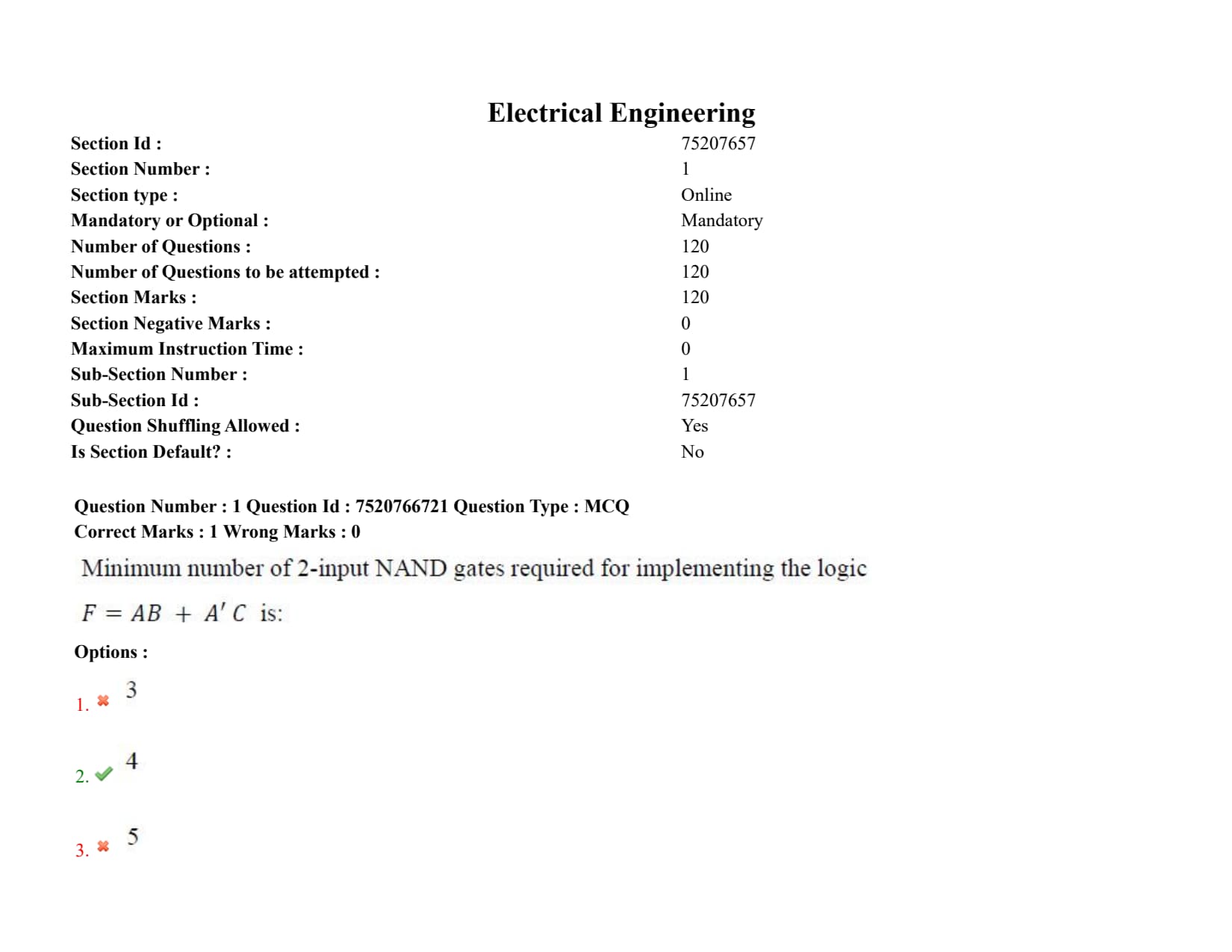
Question 1:
Minimum number of 2-input NAND gates required for implementing the logic \( F = AB + A'C \) is:
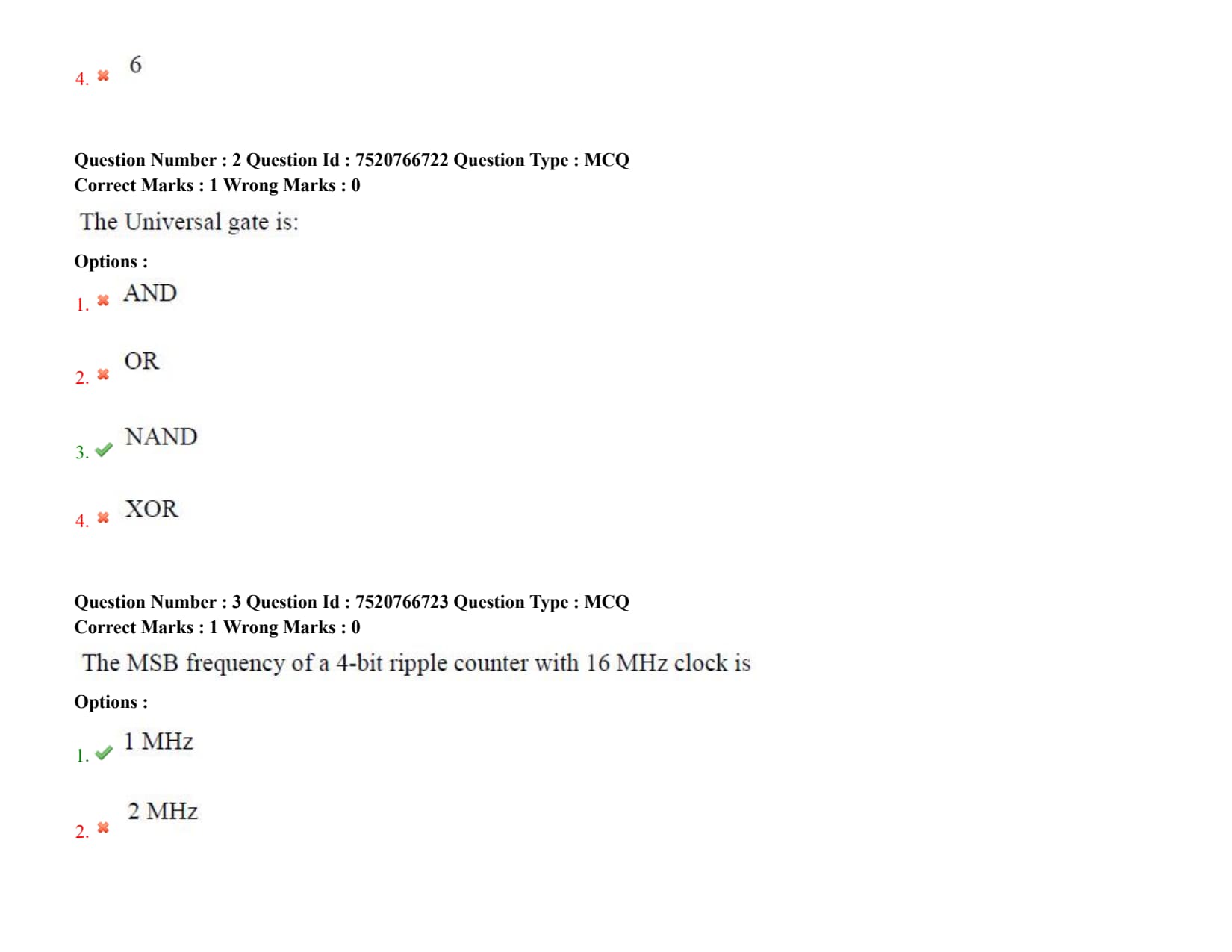
Question 2:
The Universal gate is:
- (A) AND
- (B) OR
- (C) NAND
- (D) XOR
Question 3:
The MSB frequency of a 4-bit ripple counter with 16 MHz clock is
- (A) 1 MHz
- (B) 2 MHz
- (C) 4 MHz
- (D) 8 MHz
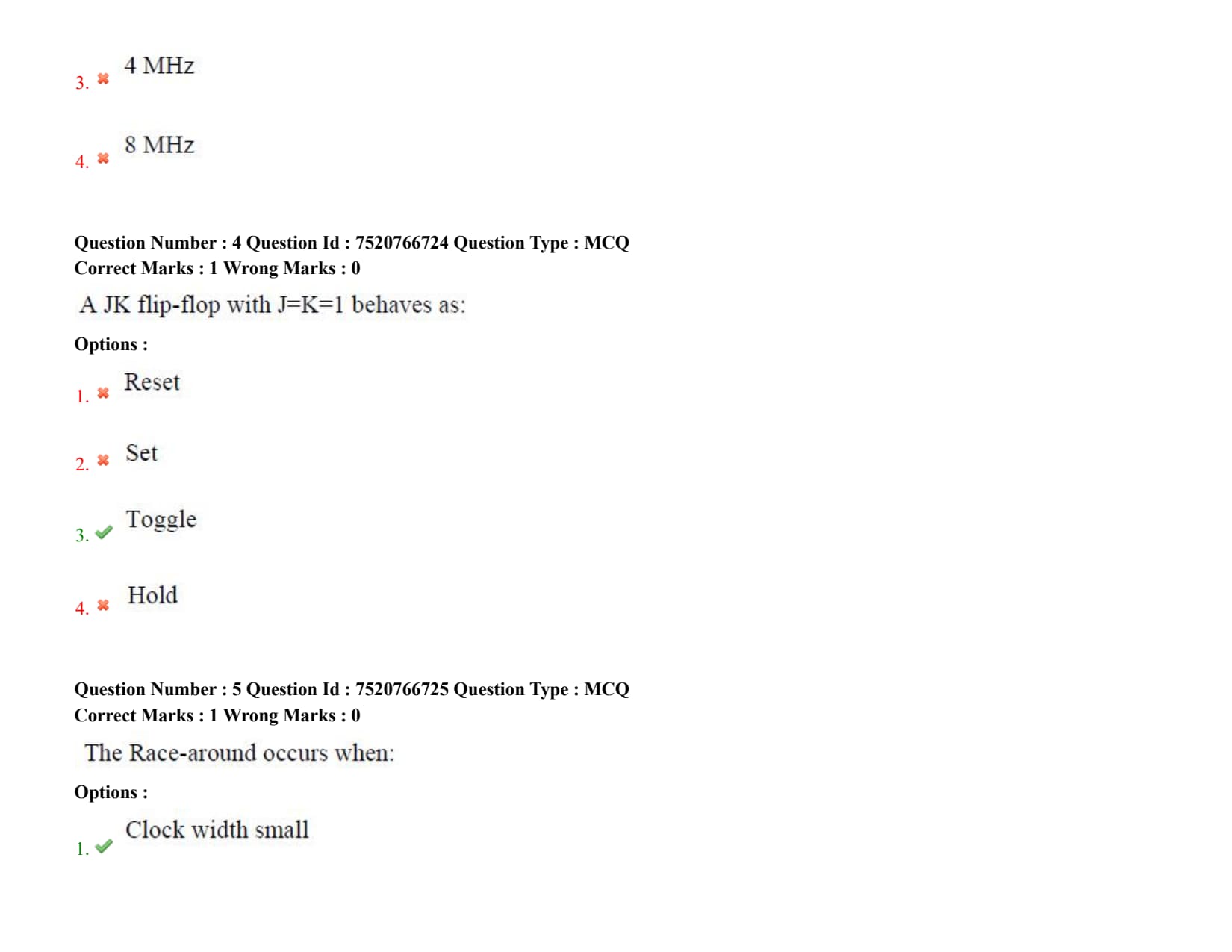
Question 4:
A JK flip-flop with J=K=1 behaves as:
- (A) Reset
- (B) Set
- (C) Toggle
- (D) Hold
Question 5:
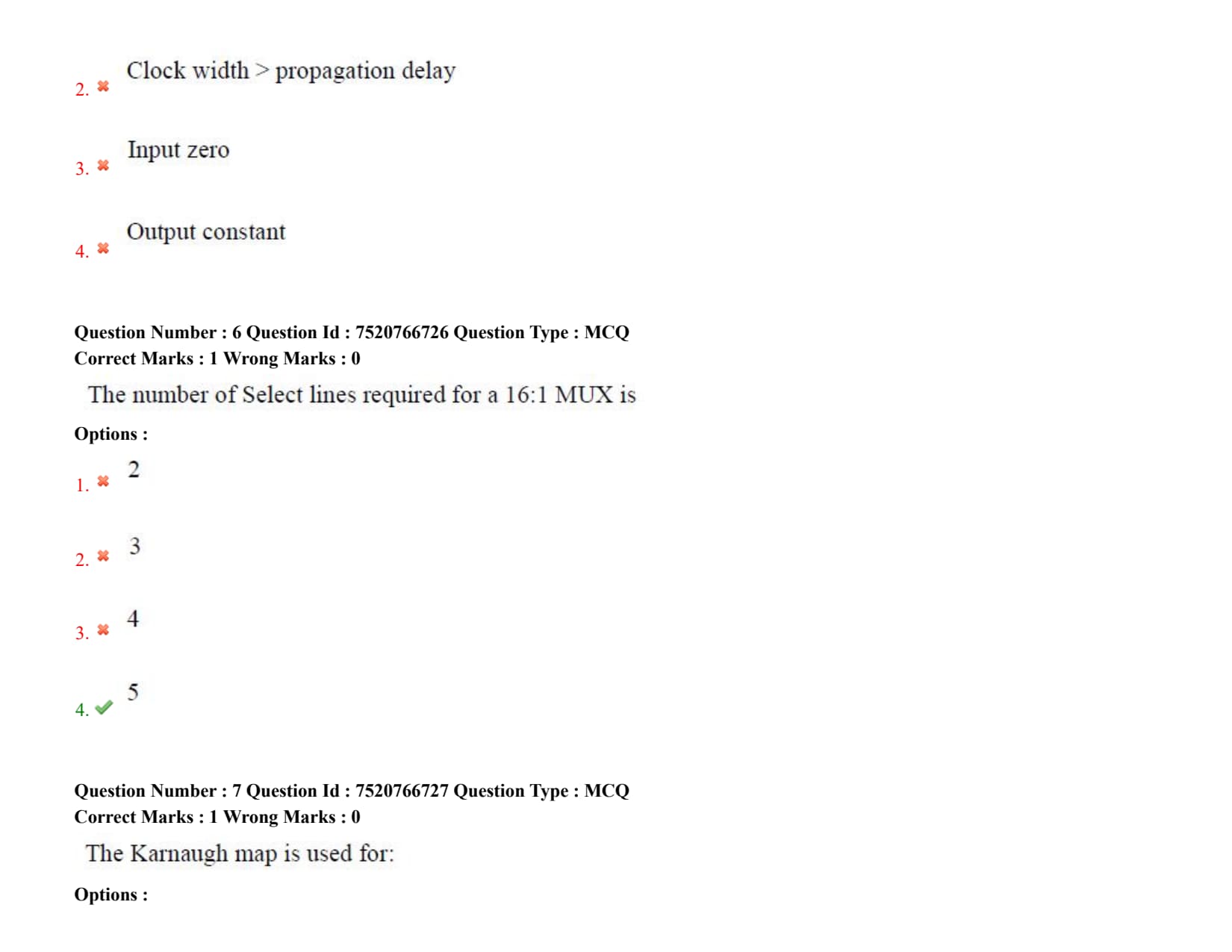
The Race-around occurs when:
- (A) Clock width small
- (B) Clock width \(>\) propagation delay
- (C) Input zero
- (D) Output constant
Question 6:
The number of Select lines required for a 16:1 MUX is
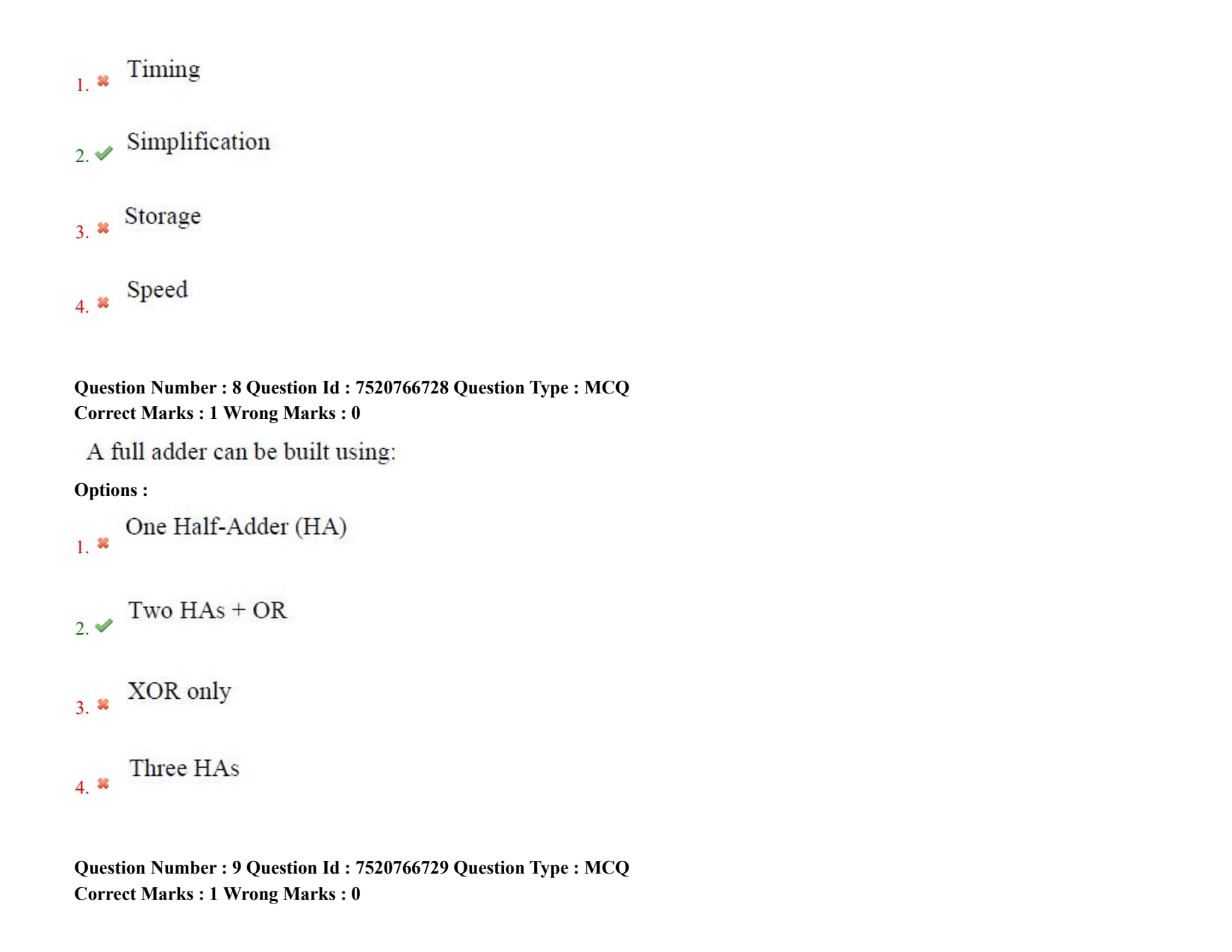
Question 7:
The Karnaugh map is used for:
- (A) Timing
- (B) Simplification
- (C) Storage
- (D) Speed
Question 8:
A full adder can be built using:
- (A) One Half-Adder (HA)
- (B) Two HAs + OR
- (C) XOR only
- (D) Three HAs
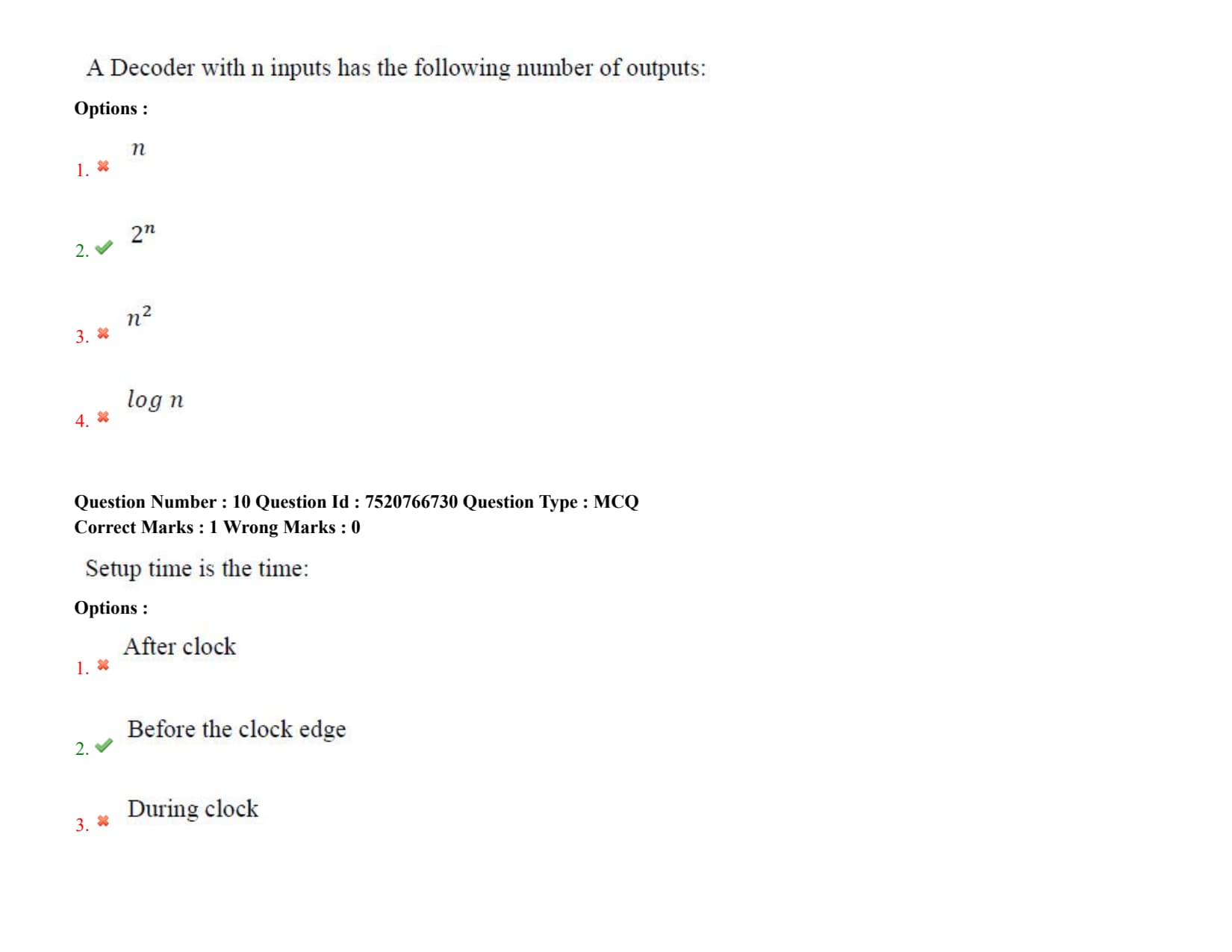
Question 9:
A Decoder with n inputs has the following number of outputs:
- (A) n
- (B) \( 2^n \)
- (C) \( n^2 \)
- (D) \( \log n \)
Question 10:
Setup time is the time:
- (A) After clock
- (B) Before the clock edge
- (C) During clock
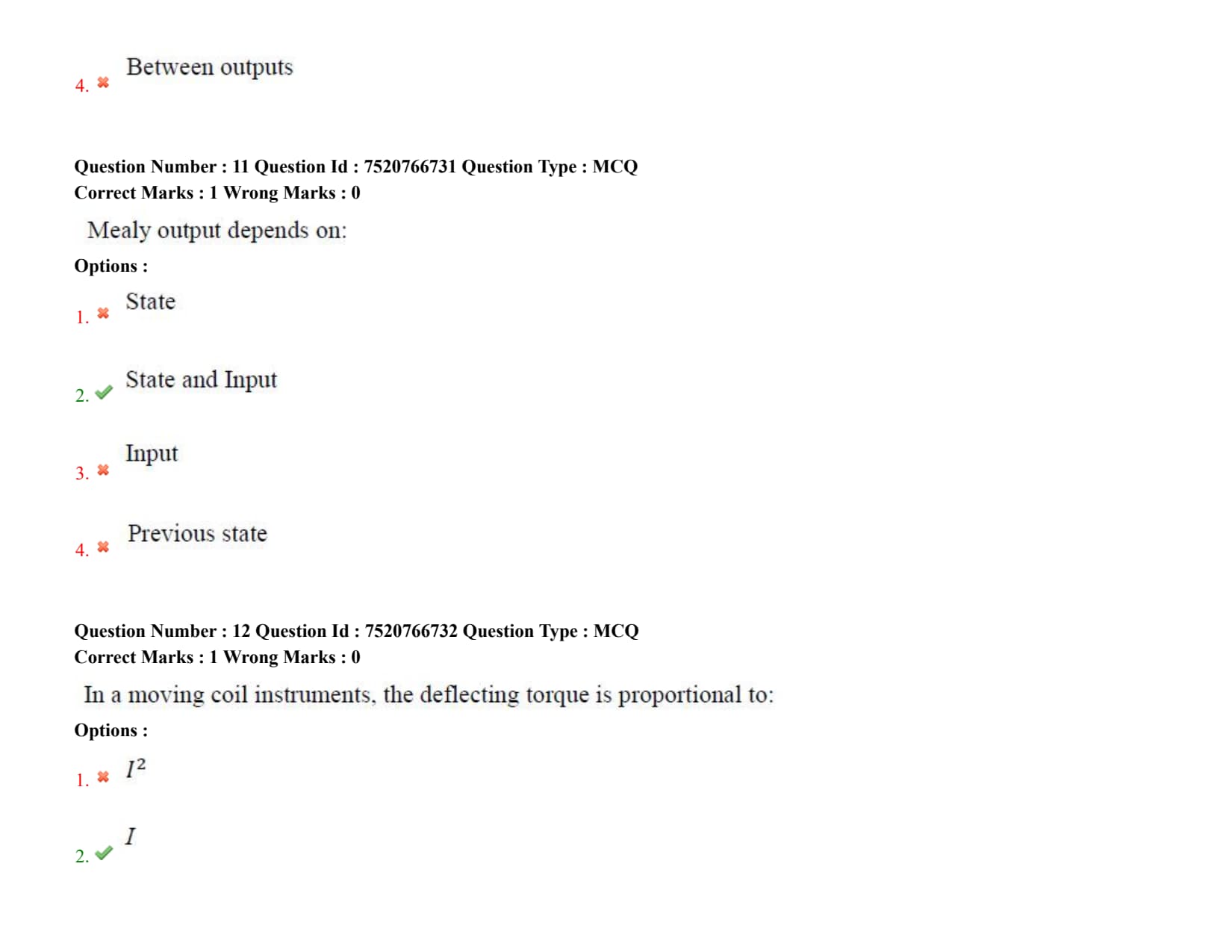
- (D) Between outputs
Question 11:
Mealy output depends on:
- (A) State
- (B) State and Input
- (C) Input
- (D) Previous state
Question 12:
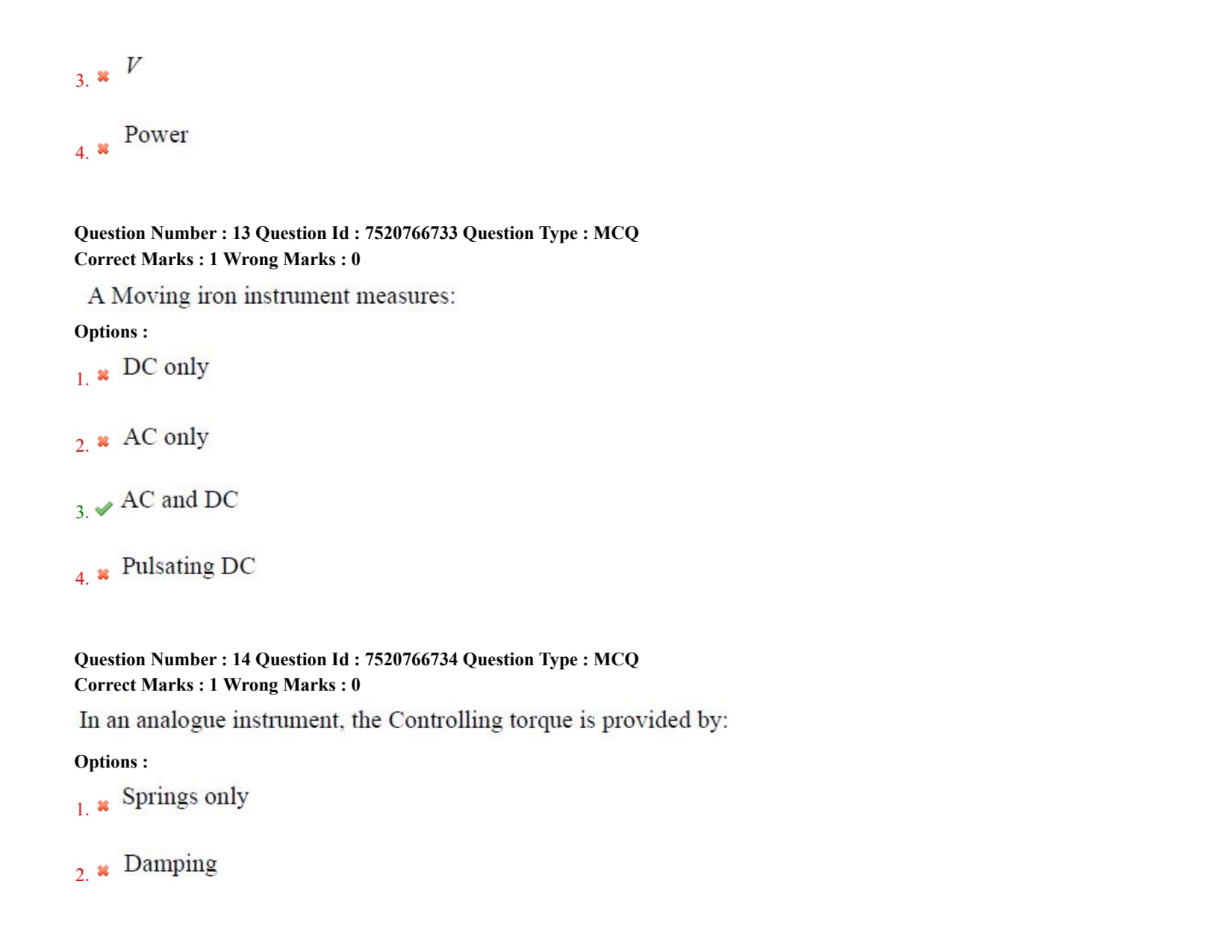
In a moving coil instruments, the deflecting torque is proportional to:
- (A) \( I^2 \)
- (B) \( I \)
- (C) \( V \)
- (D) Power
Question 13:
A Moving iron instrument measures:
- (A) DC only
- (B) AC only
- (C) AC and DC
- (D) Pulsating DC
Question 14:
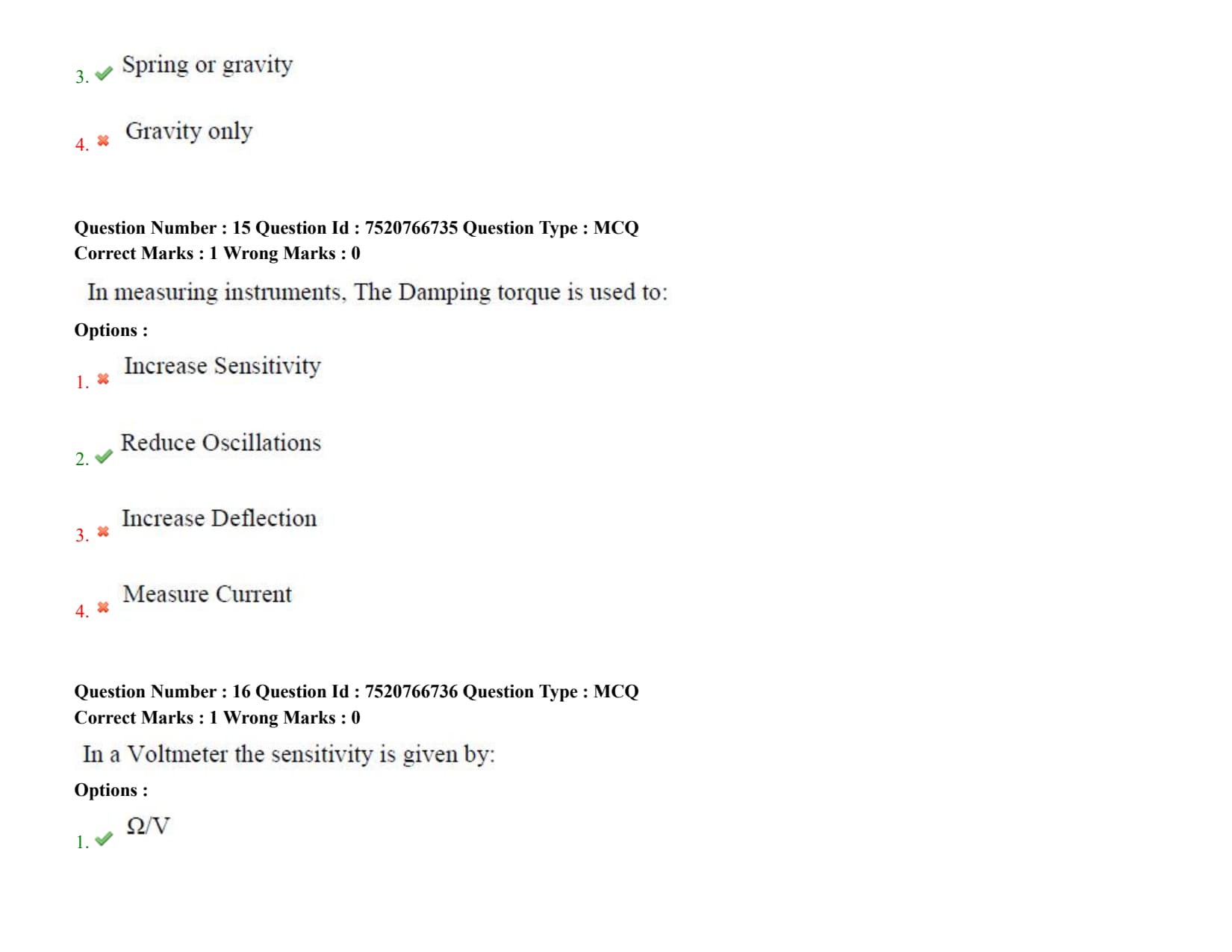
In an analogue instrument, the Controlling torque is provided by:
- (A) Springs only
- (B) Damping
- (C) Spring or gravity
- (D) Gravity only
Question 15:
In measuring instruments, The Damping torque is used to:
- (A) Increase Sensitivity
- (B) Reduce Oscillations
- (C) Increase Deflection
- (D) Measure Current
Question 16:
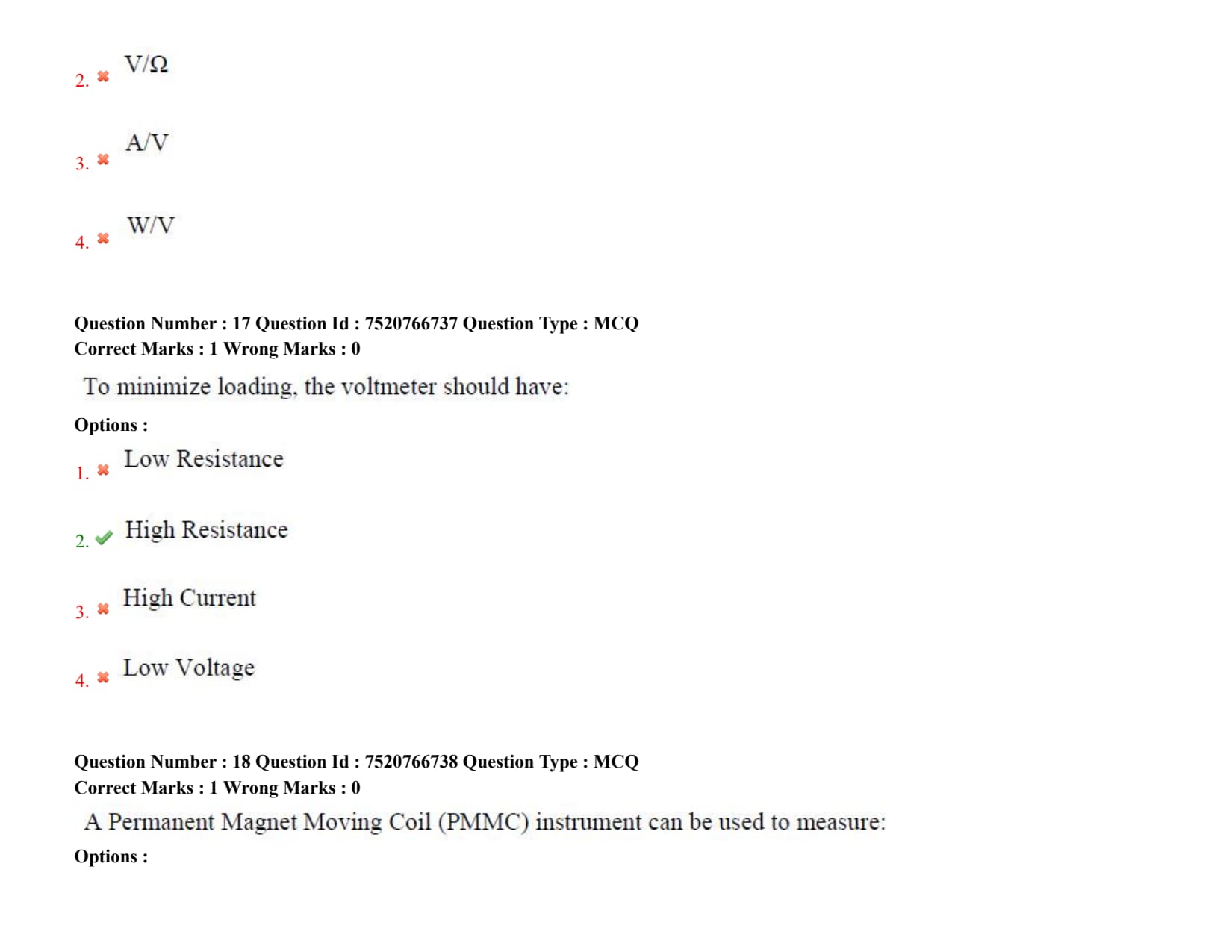
In a Voltmeter the sensitivity is given by:
- (A) \( \Omega/V \)
- (B) \( V/\Omega \)
- (C) \( A/V \)
- (D) \( W/V \)
Question 17:
To minimize loading, the voltmeter should have:
- (A) Low Resistance
- (B) High Resistance
- (C) High Current
- (D) Low Voltage
Question 18:
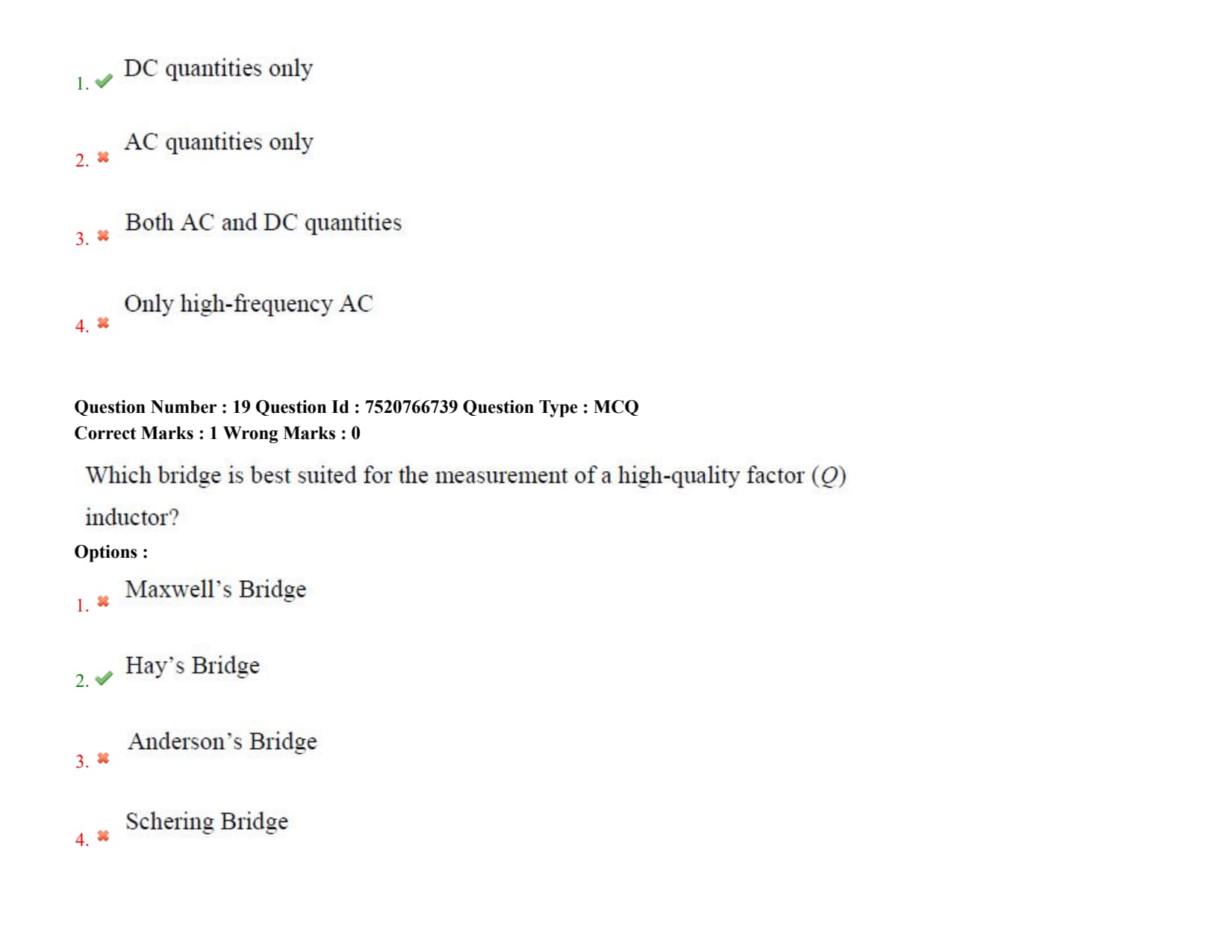
A Permanent Magnet Moving Coil (PMMC) instrument can be used to measure:
- (A) DC quantities only
- (B) AC quantities only
- (C) Both AC and DC quantities
- (D) Only high-frequency AC
Question 19:
Which bridge is best suited for the measurement of a high-quality factor (Q) inductor?
- (A) Maxwell's Bridge
- (B) Hay's Bridge
- (C) Anderson's Bridge
- (D) Schering Bridge
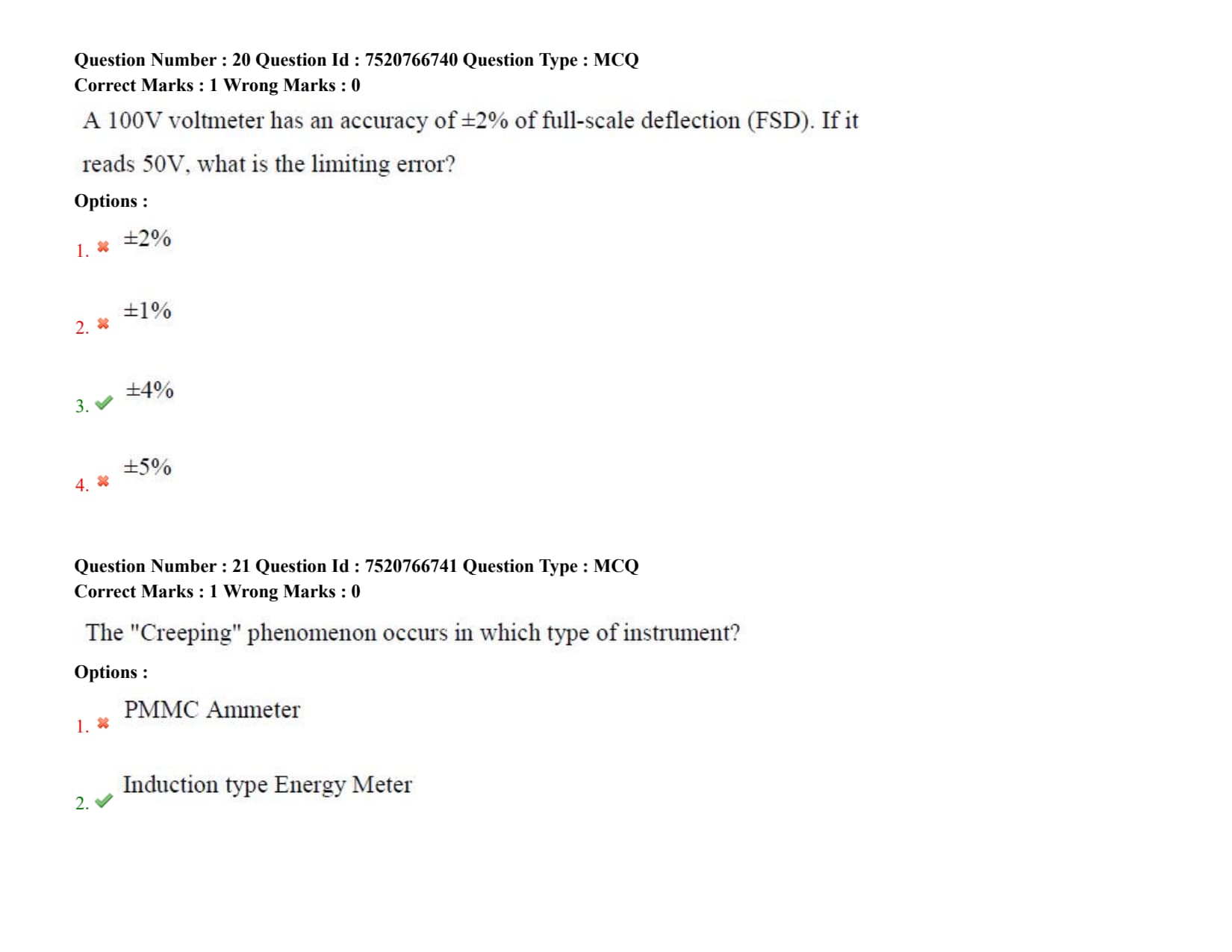
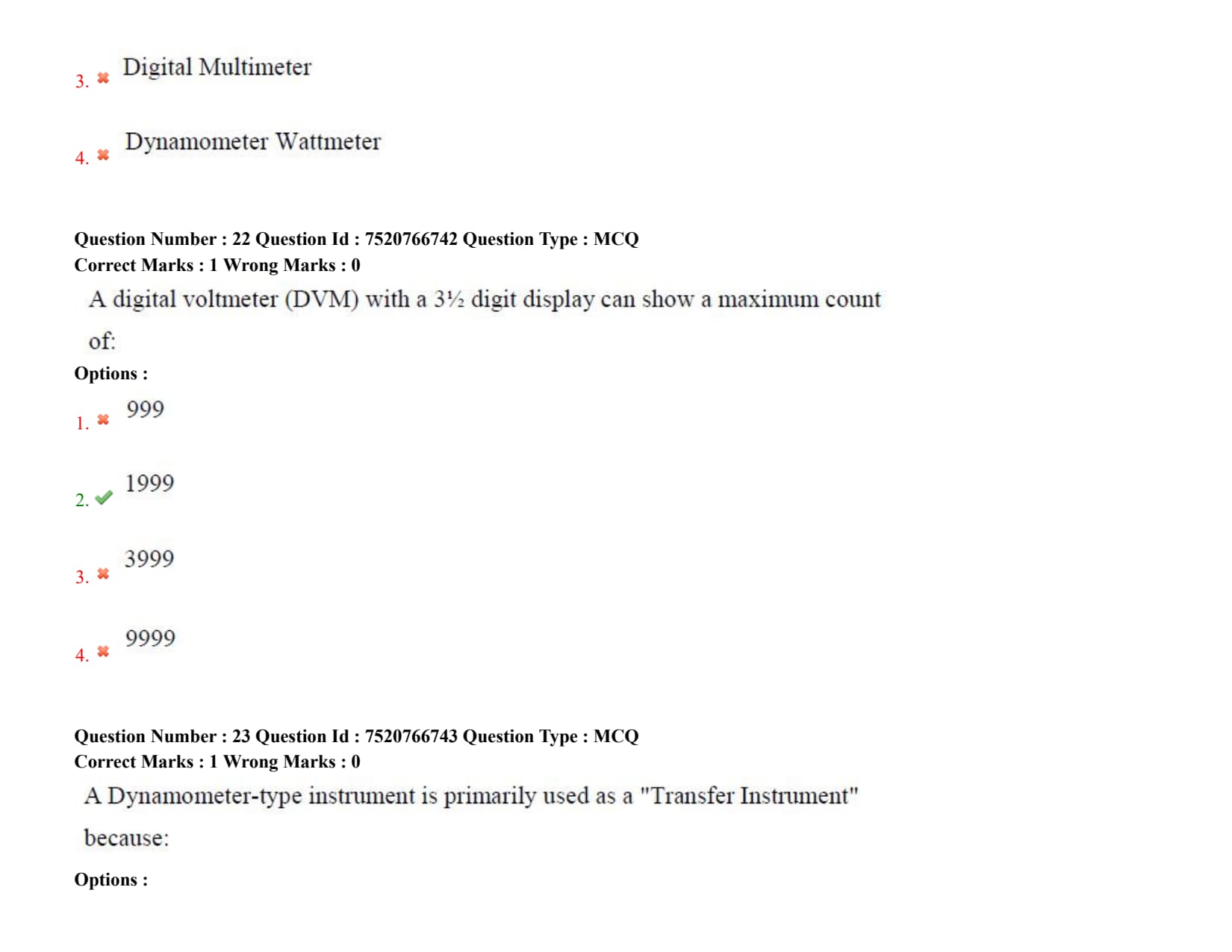
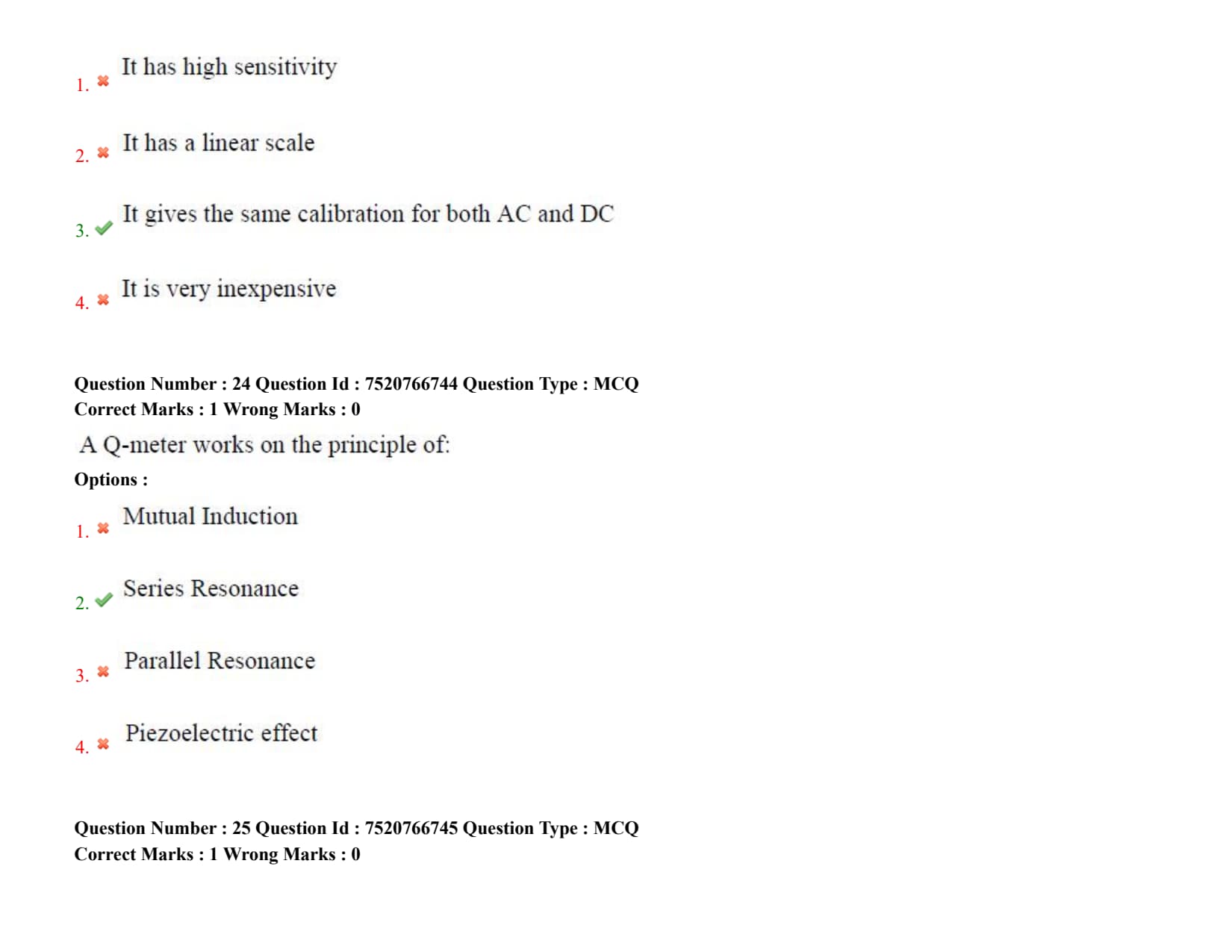
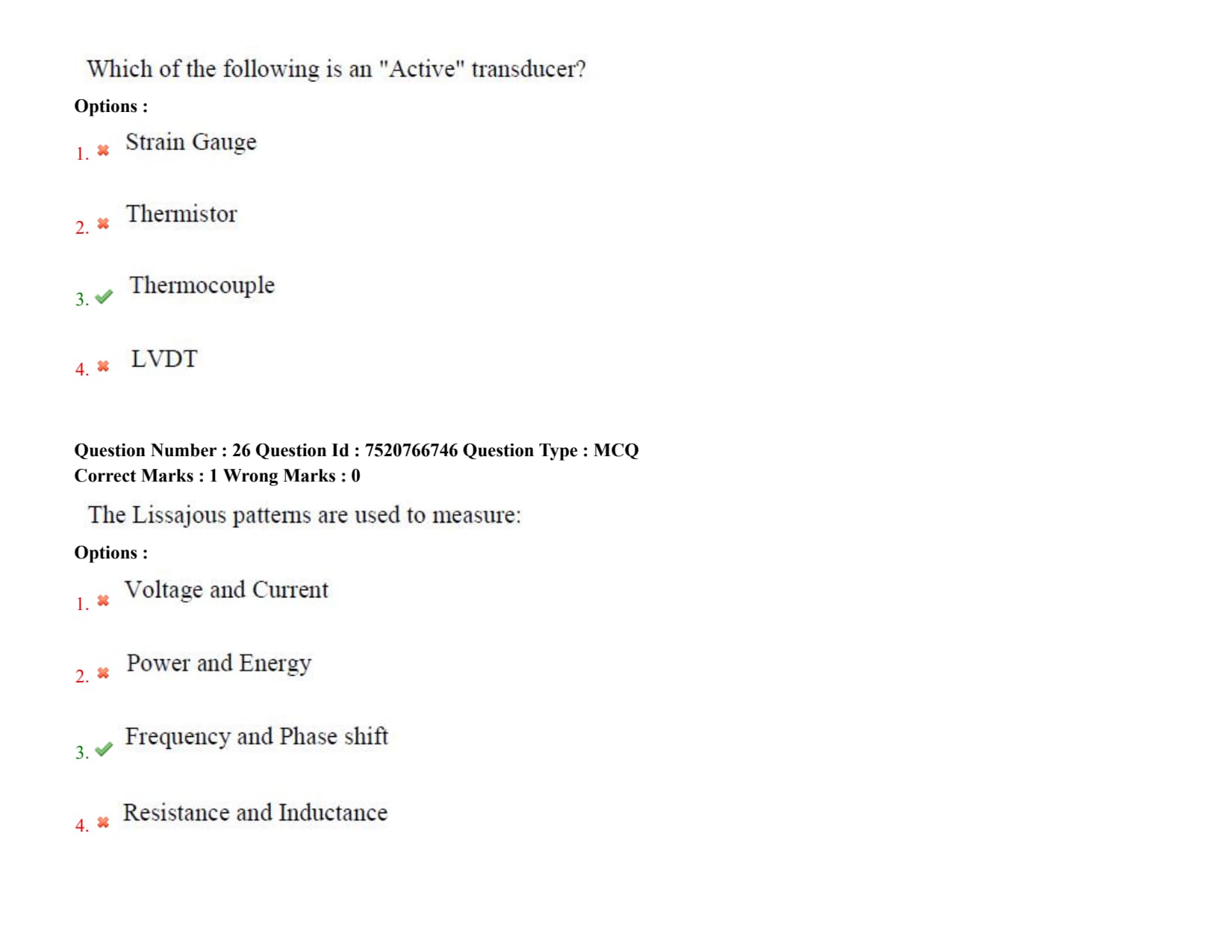
Question 20:
A 100V voltmeter has an accuracy of \( \pm \)2% of full-scale deflection (FSD). If it reads 50V, what is the limiting error?
- (A) \( \pm \)2%
- (B) \( \pm \)1%
- (C) \( \pm \)4%
- (D) \( \pm \)5%
Question 21:
The "Creeping" phenomenon occurs in which type of instrument?
- (A) PMMC Ammeter
- (B) Induction type Energy Meter
- (C) Digital Multimeter
- (D) Dynamometer Wattmeter
Question 22:
A digital voltmeter (DVM) with a \( 3 \frac{1}{2} \) digit display can show a maximum count of:
- (A) 999
- (B) 1999
- (C) 3999
- (D) 9999
Question 23:
A Dynamometer-type instrument is primarily used as a "Transfer Instrument" because:
- (A) It has high sensitivity
- (B) It has a linear scale
- (C) It gives the same calibration for both AC and DC
- (D) It is very inexpensive
Question 24:
A Q-meter works on the principle of:
- (A) Mutual Induction
- (B) Series Resonance
- (C) Parallel Resonance
- (D) Piezoelectric effect
Question 25:
Which of the following is an "Active" transducer?
- (A) Strain Gauge
- (B) Thermistor
- (C) Thermocouple
- (D) LVDT
Question 26:
The Lissajous patterns are used to measure:
- (A) Voltage and Current
- (B) Power and Energy
- (C) Frequency and Phase shift
- (D) Resistance and Inductance
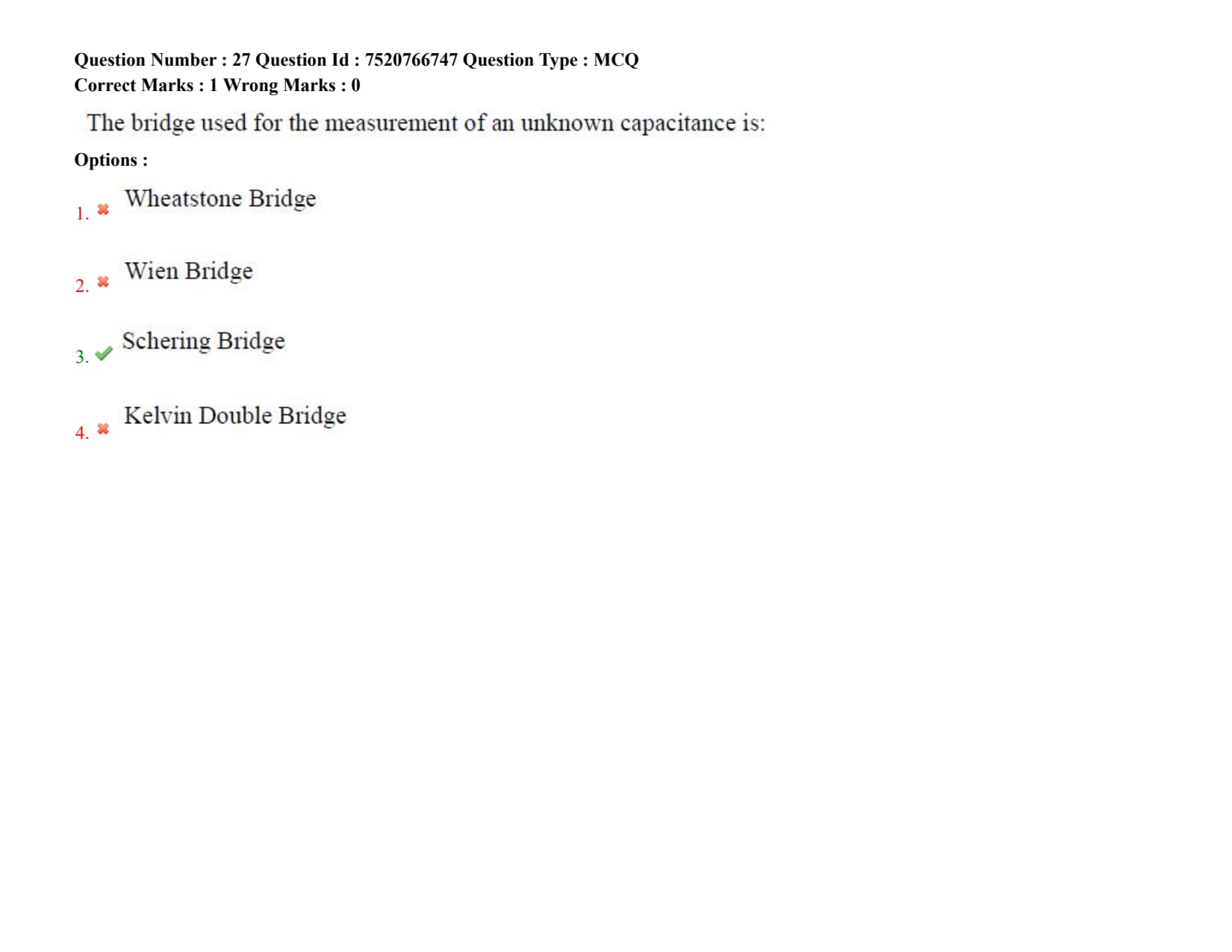
Question 27:
The bridge used for the measurement of an unknown capacitance is:
- (A) Wheatstone Bridge
- (B) Wien Bridge
- (C) Schering Bridge
- (D) Kelvin Double Bridge
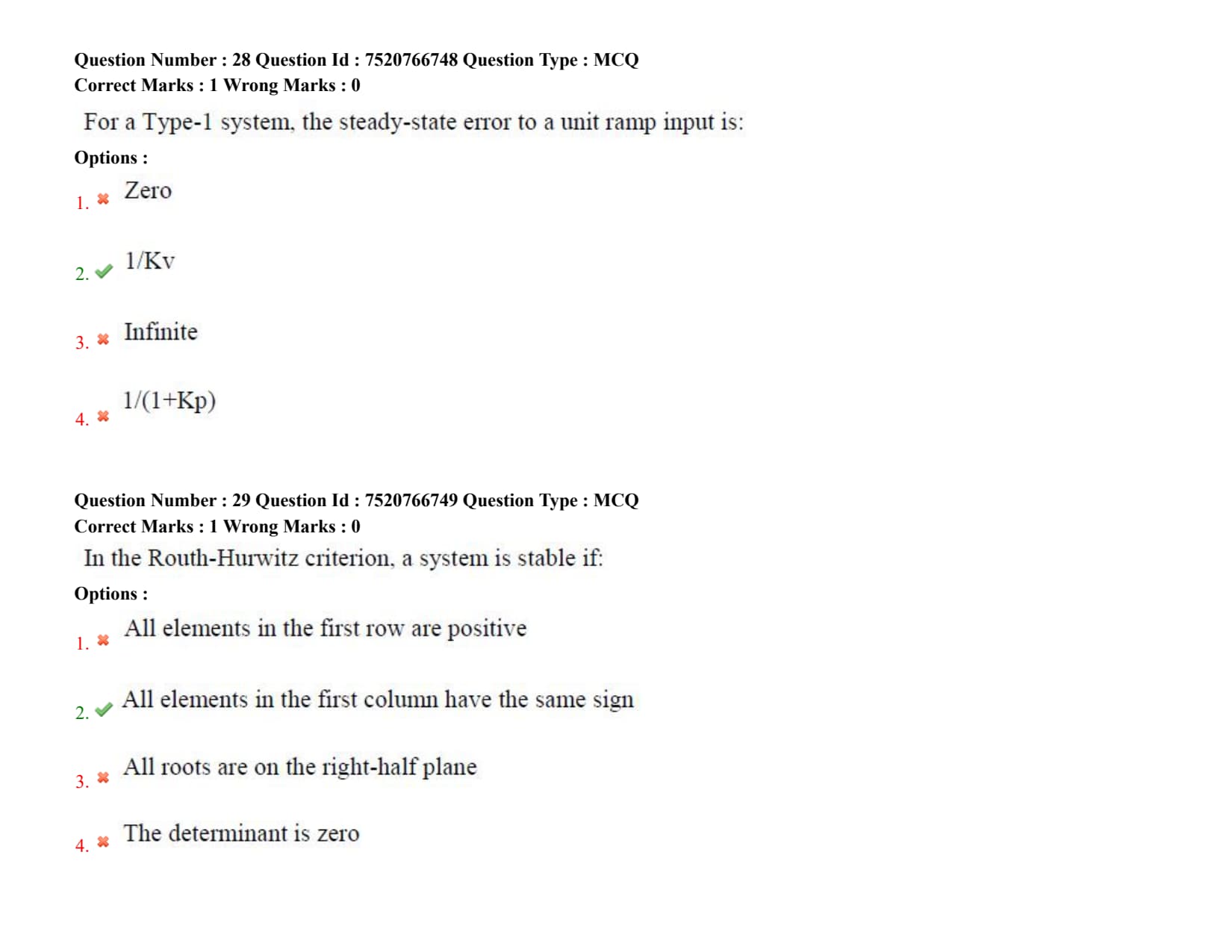
Question 28:
For a Type-1 system, the steady-state error to a unit ramp input is:
- (A) Zero
- (B) 1/Kv
- (C) Infinite
- (D) 1/(1+Kp)
Question 29:
In the Routh-Hurwitz criterion, a system is stable if:
- (A) All elements in the first row are positive
- (B) All elements in the first column have the same sign
- (C) All roots are on the right-half plane
- (D) The determinant is zero
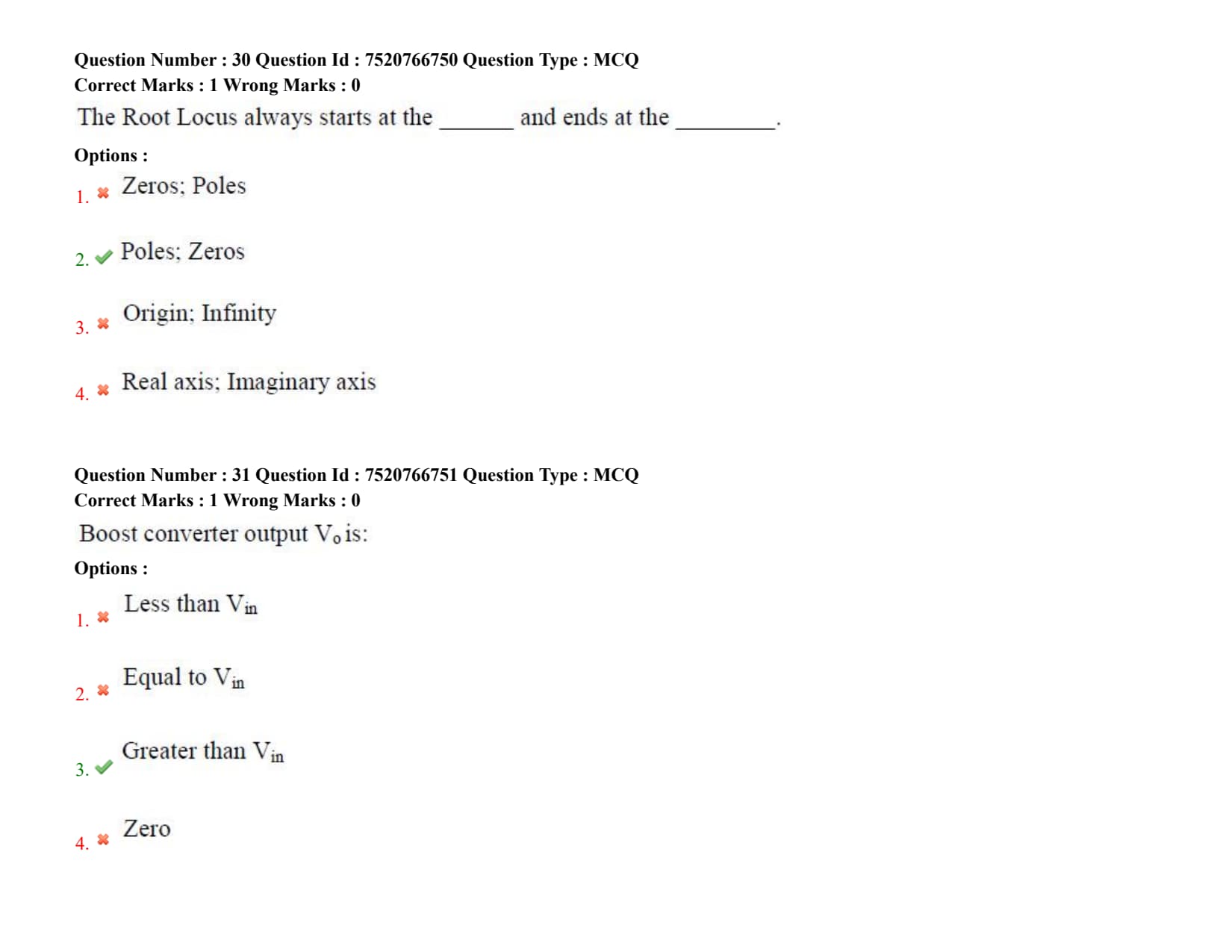
Question 30:
The Root Locus always starts at the _______ and ends at the _______.
- (A) Zeros; Poles
- (B) Poles; Zeros
- (C) Origin; Infinity
- (D) Real axis; Imaginary axis
Question 31:
Boost converter output \( V_o \) is:
- (A) Less than \( V_{in} \)
- (B) Equal to \( V_{in} \)
- (C) Greater than \( V_{in} \)
- (D) Zero
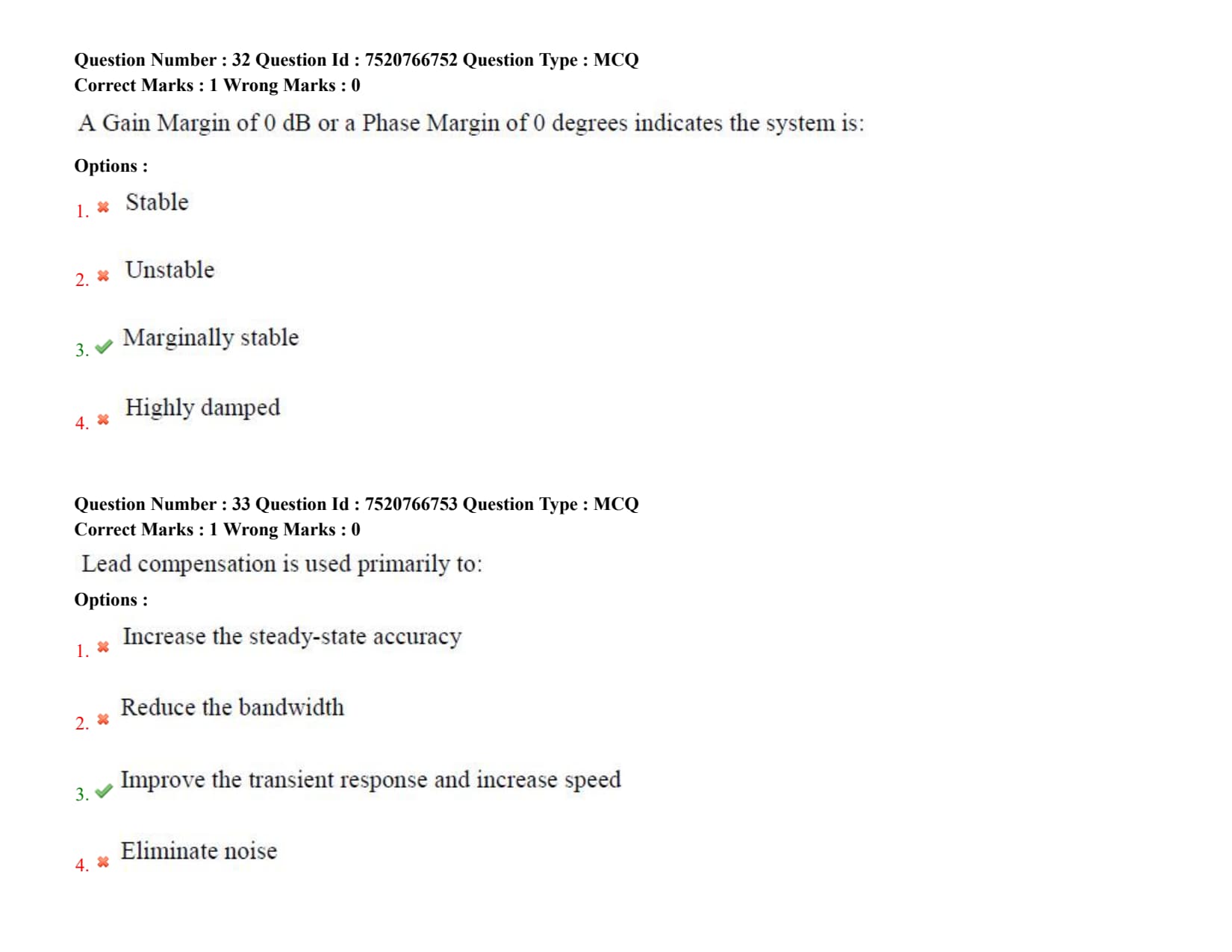
Question 32:
A Gain Margin of 0 dB or a Phase Margin of 0 degrees indicates the system is:
- (A) Stable
- (B) Unstable
- (C) Marginally stable
- (D) Highly damped
Question 33:
Lead compensation is used primarily to:
- (A) Increase the steady-state accuracy
- (B) Reduce the bandwidth
- (C) Improve the transient response and increase speed
- (D) Eliminate noise
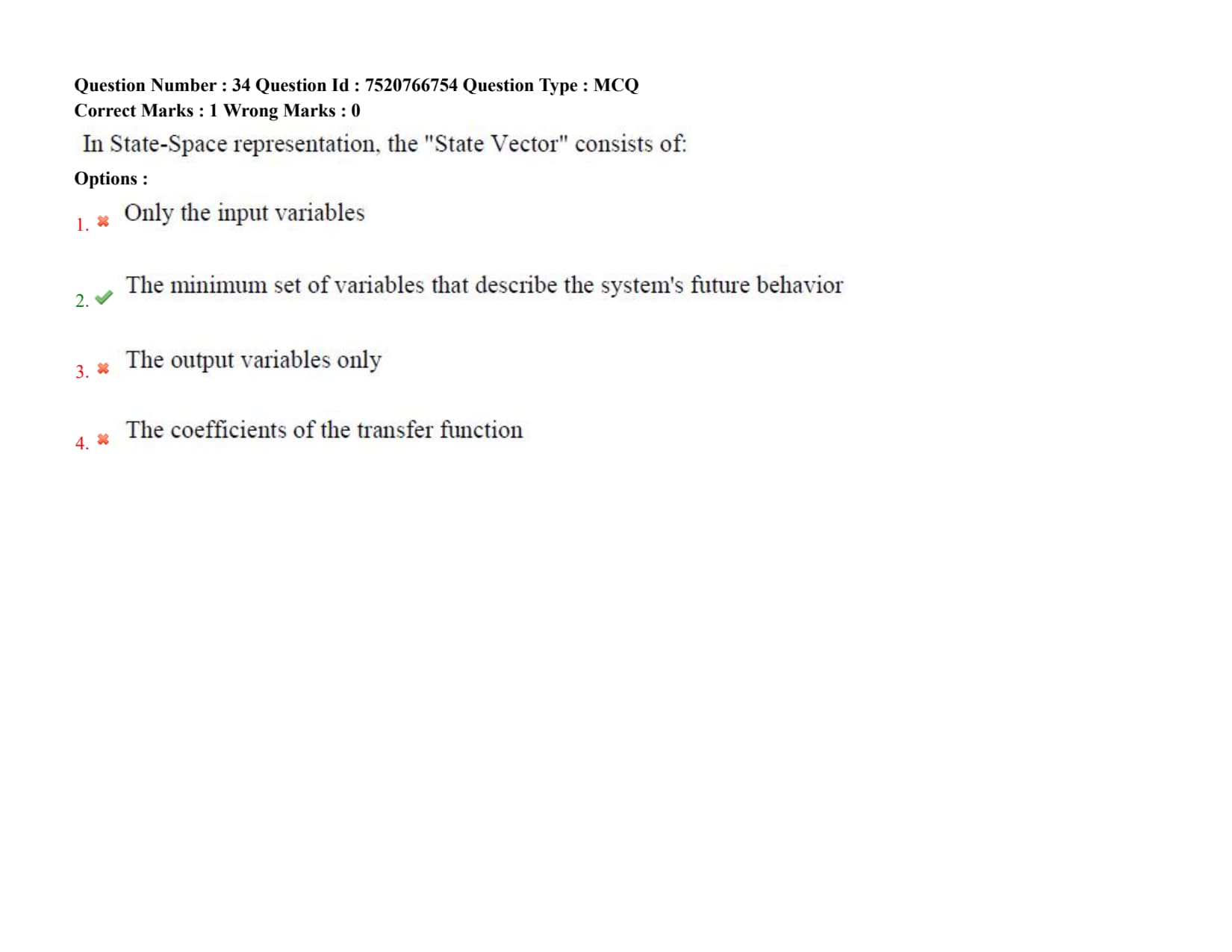
Question 34:
In State-Space representation, the "State Vector" consists of:
- (A) Only the input variables
- (B) The minimum set of variables that describe the system's future behavior
- (C) The output variables only
- (D) The coefficients of the transfer function
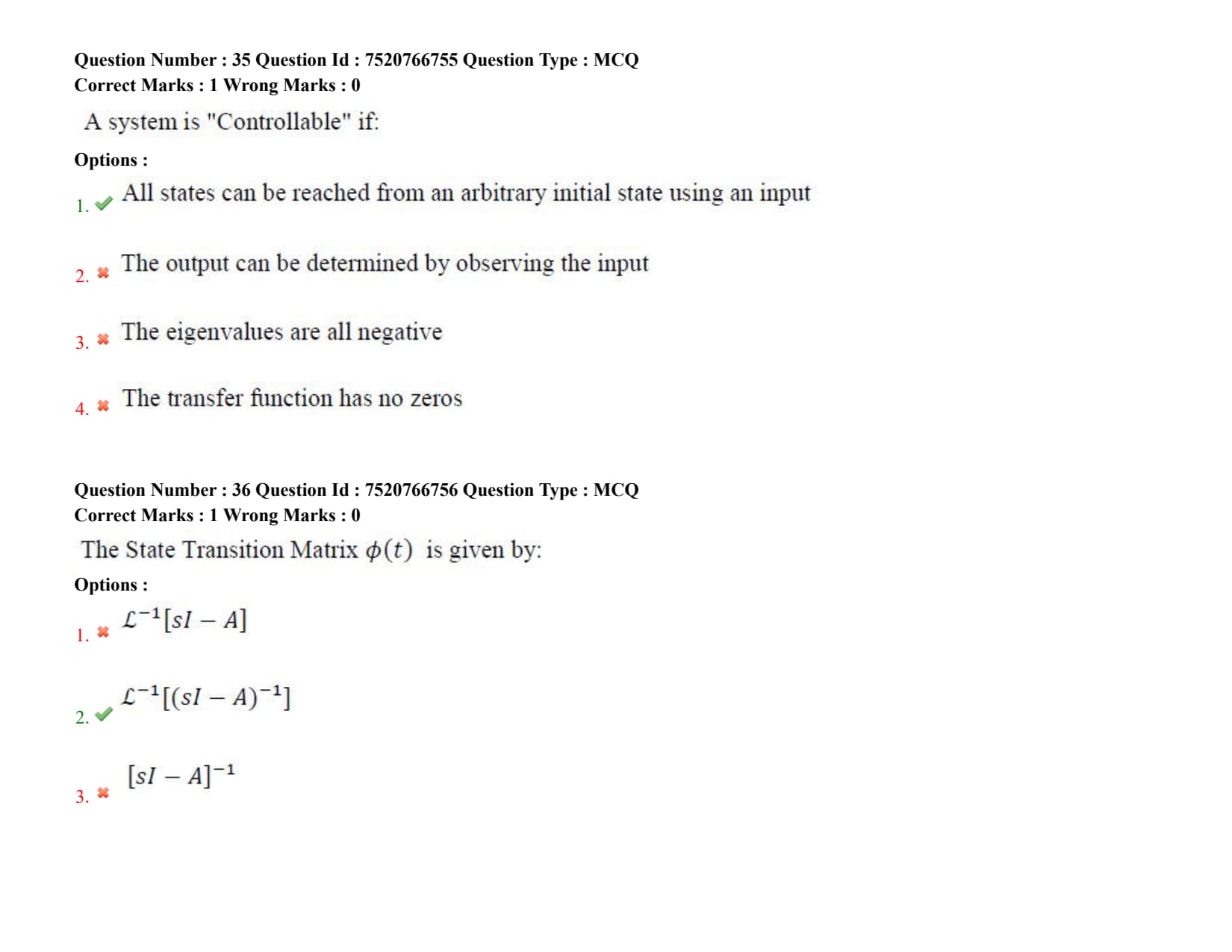
Question 35:
A system is "Controllable" if:
- (A) All states can be reached from an arbitrary initial state using an input
- (B) The output can be determined by observing the input
- (C) The eigenvalues are all negative
- (D) The transfer function has no zeros
Question 36:
The State Transition Matrix \( \phi(t) \) is given by:
- (A) \( \mathcal{L}^{-1}[sI - A] \)
- (B) \( \mathcal{L}^{-1}[(sI - A)^{-1}] \)
- (C) \( [sI - A]^{-1} \)
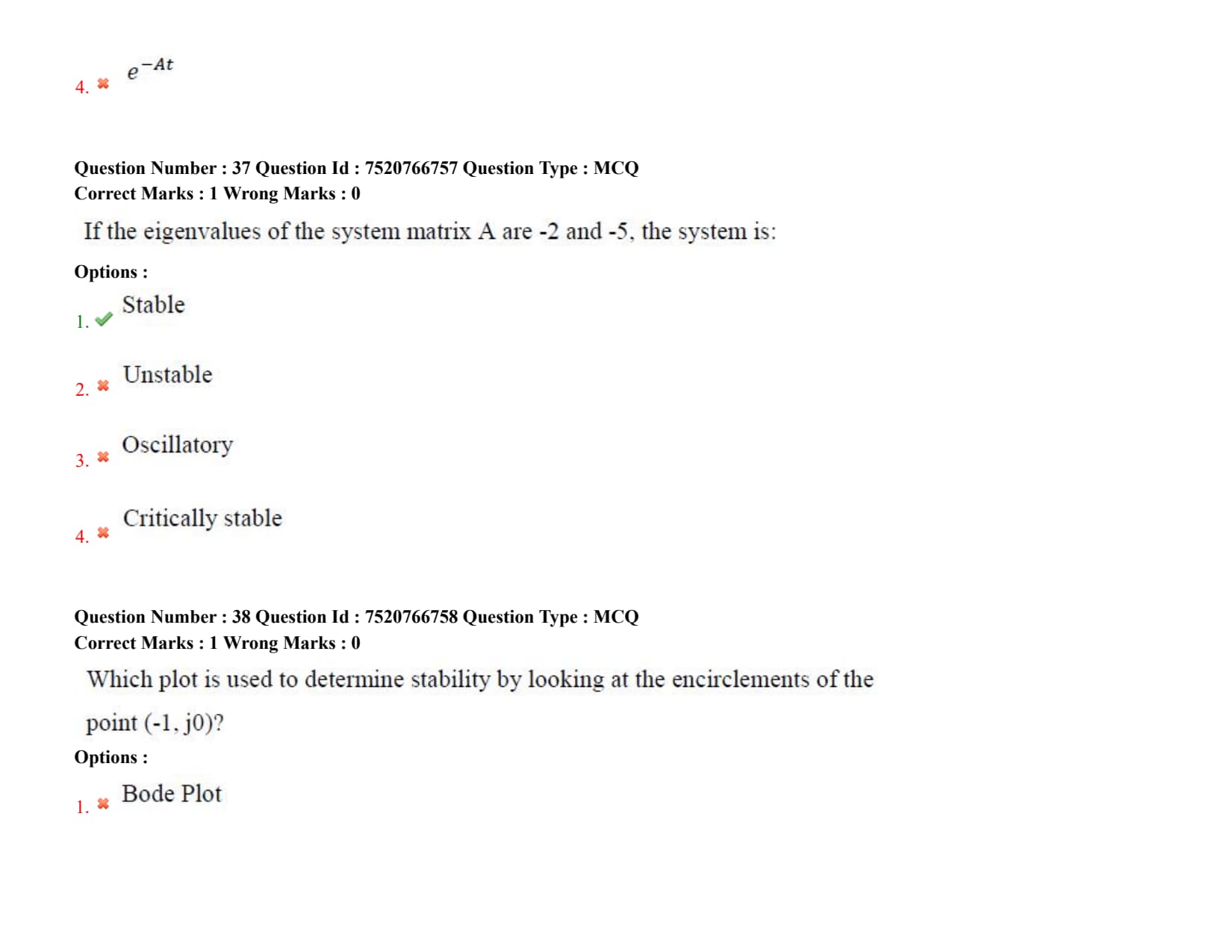
- (D) \( e^{-At} \)
Question 37:
If the eigenvalues of the system matrix A are -2 and -5, the system is:
- (A) Stable
- (B) Unstable
- (C) Oscillatory
- (D) Critically stable
Question 38:
Which plot is used to determine stability by looking at the encirclements of the point (-1, j0)?
- (A) Bode Plot
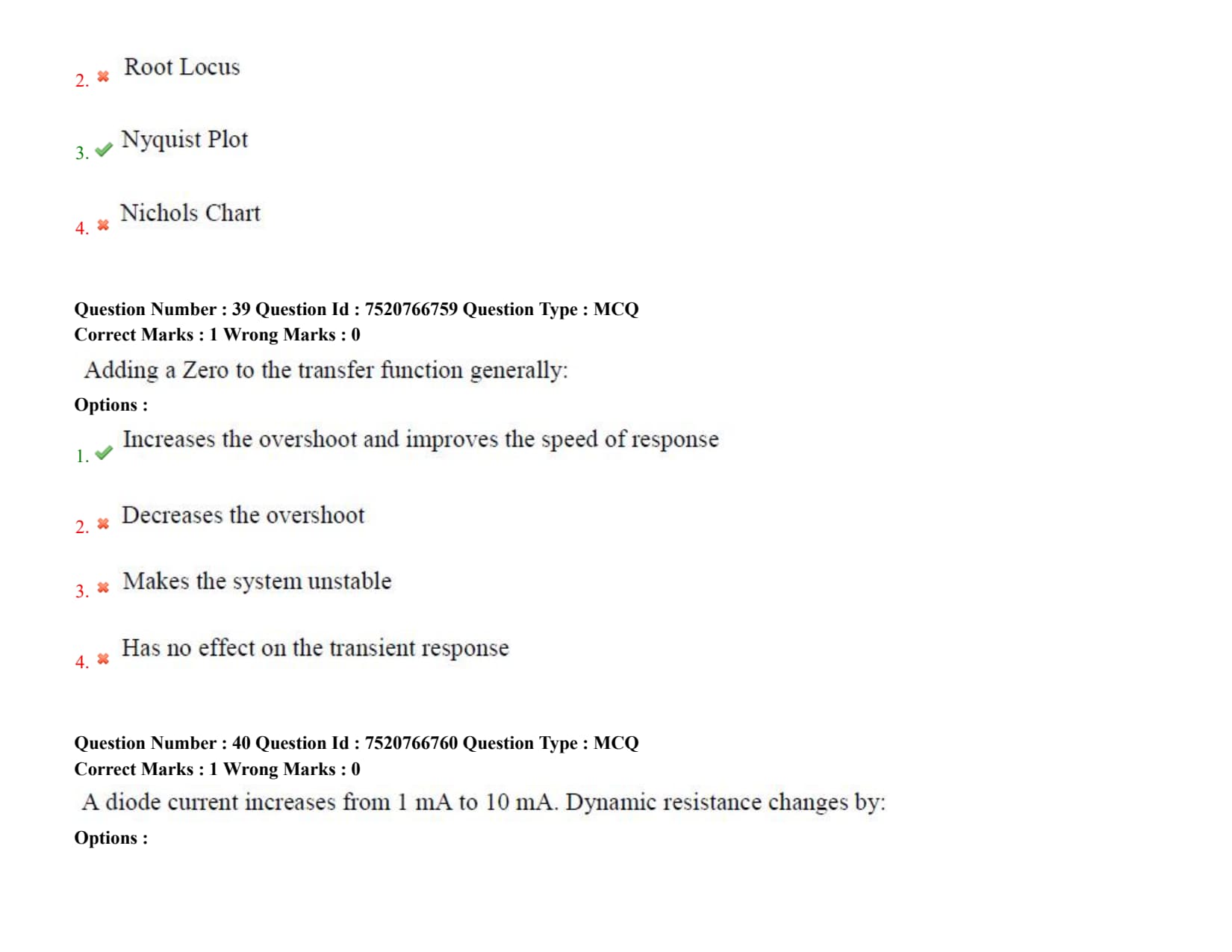
- (B) Root Locus
- (C) Nyquist Plot
- (D) Nichols Chart
Question 39:
Adding a Zero to the transfer function generally:
- (A) Increases the overshoot and improves the speed of response
- (B) Decreases the overshoot
- (C) Makes the system unstable
- (D) Has no effect on the transient response
Question 40:
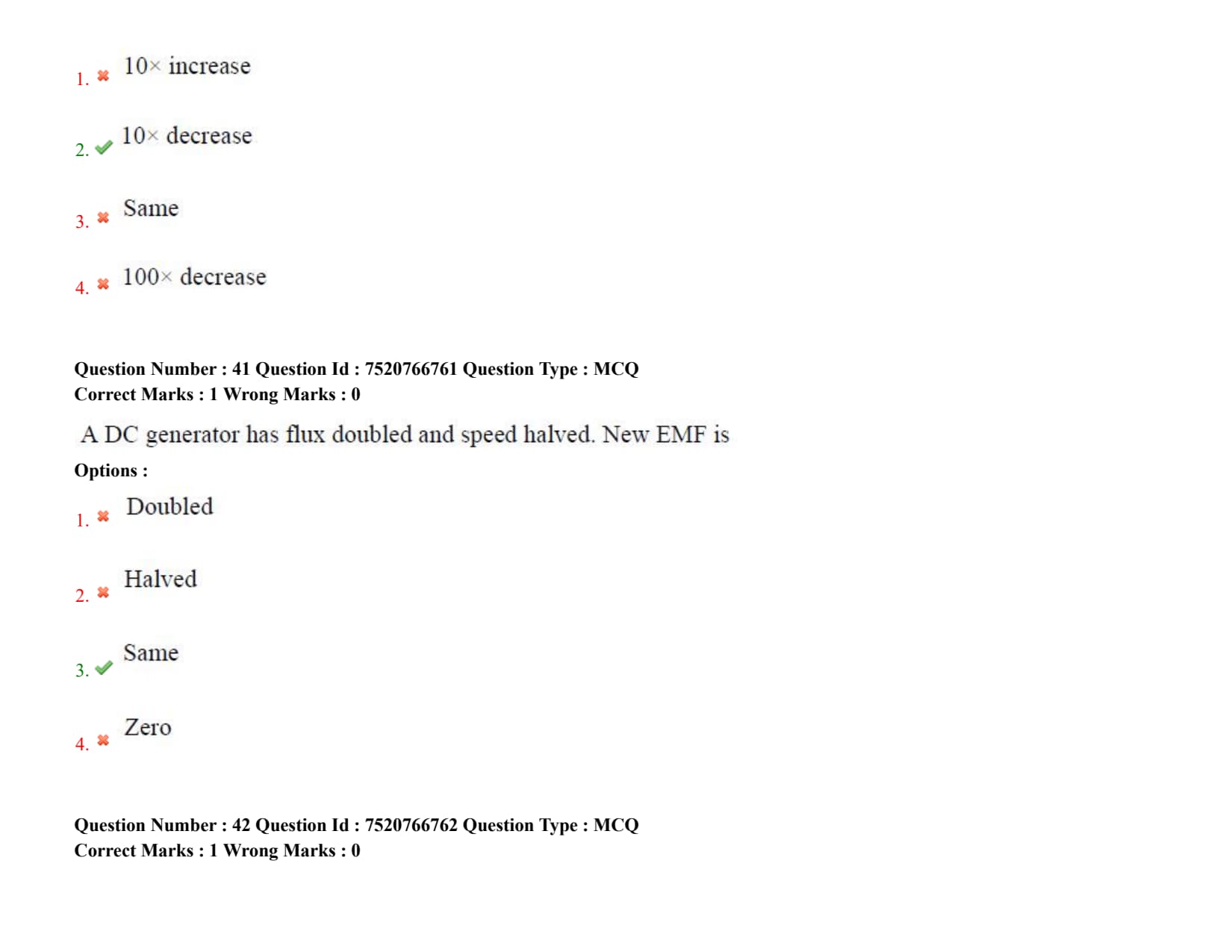
A diode current increases from 1 mA to 10 mA. Dynamic resistance changes by:
- (A) 10\( \times \) increase
- (B) 10\( \times \) decrease
- (C) Same
- (D) 100\( \times \) decrease
Question 41:
A DC generator has flux doubled and speed halved. New EMF is
- (A) Doubled
- (B) Halved
- (C) Same
- (D) Zero
Question 42:
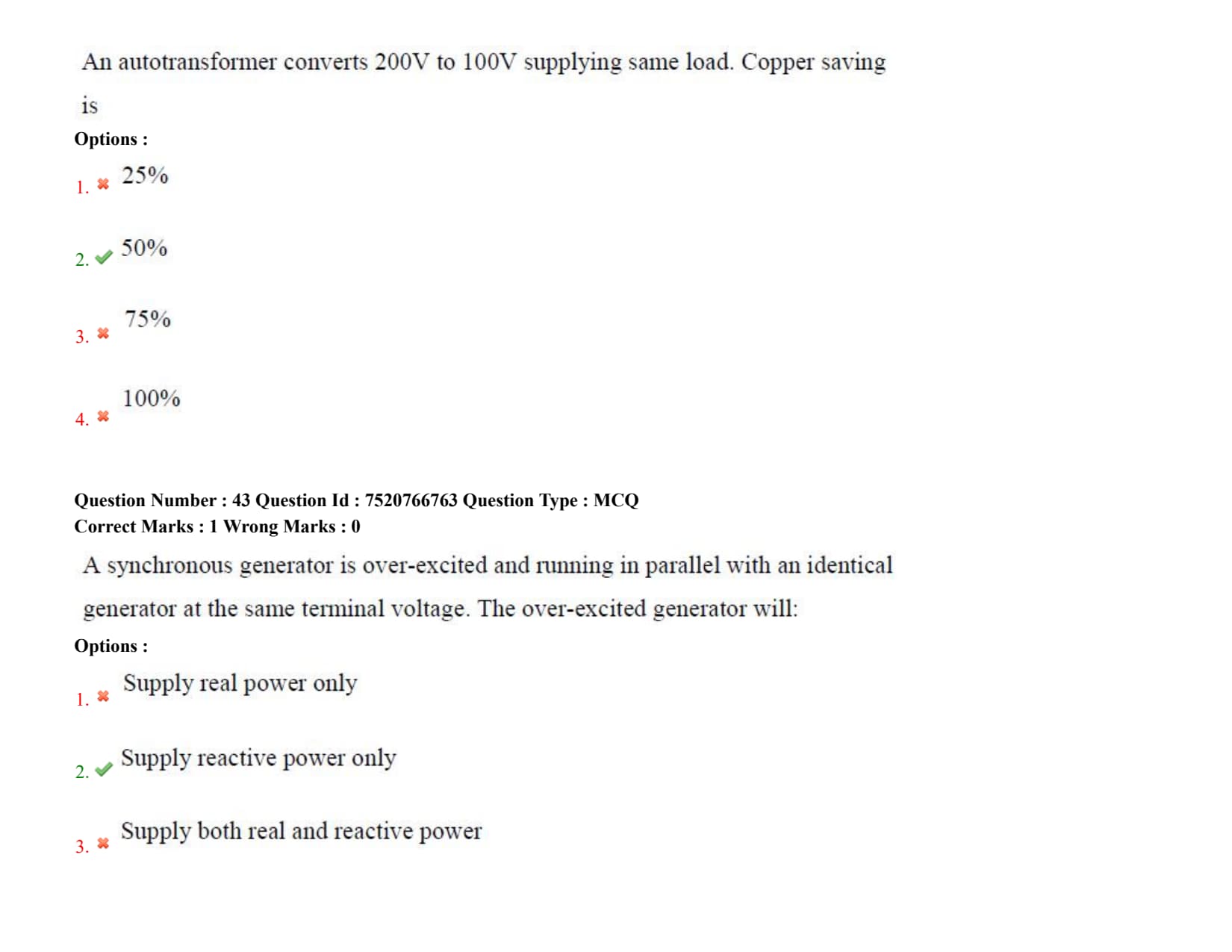
An autotransformer converts 200V to 100V supplying same load. Copper saving is
- (A) 25%
- (B) 50%
- (C) 75%
- (D) 100%
Question 43:
A synchronous generator is over-excited and running in parallel with an identical generator at the same terminal voltage. The over-excited generator will:
- (A) Supply real power only
- (B) Supply reactive power only
- (C) Supply both real and reactive power
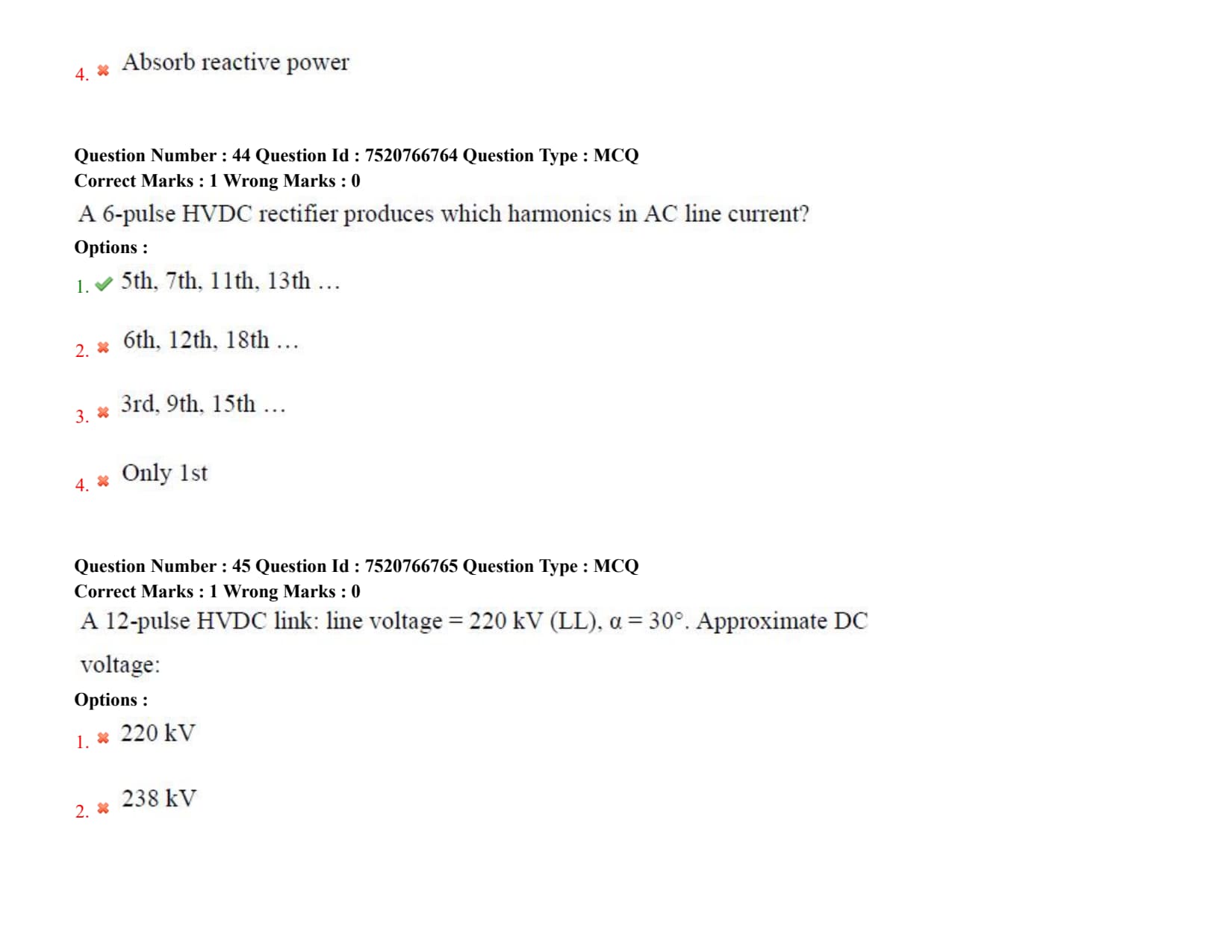
- (D) Absorb reactive power
Question 44:
A 6-pulse HVDC rectifier produces which harmonics in AC line current?
- (A) 5th, 7th, 11th, 13th ...
- (B) 6th, 12th, 18th ...
- (C) 3rd, 9th, 15th ...
- (D) Only 1st
Question 45:
A 12-pulse HVDC link: line voltage = 220 kV (LL), \(\alpha = 30^\circ\). Approximate DC voltage:
- (A) 220 kV
- (B) 238 kV
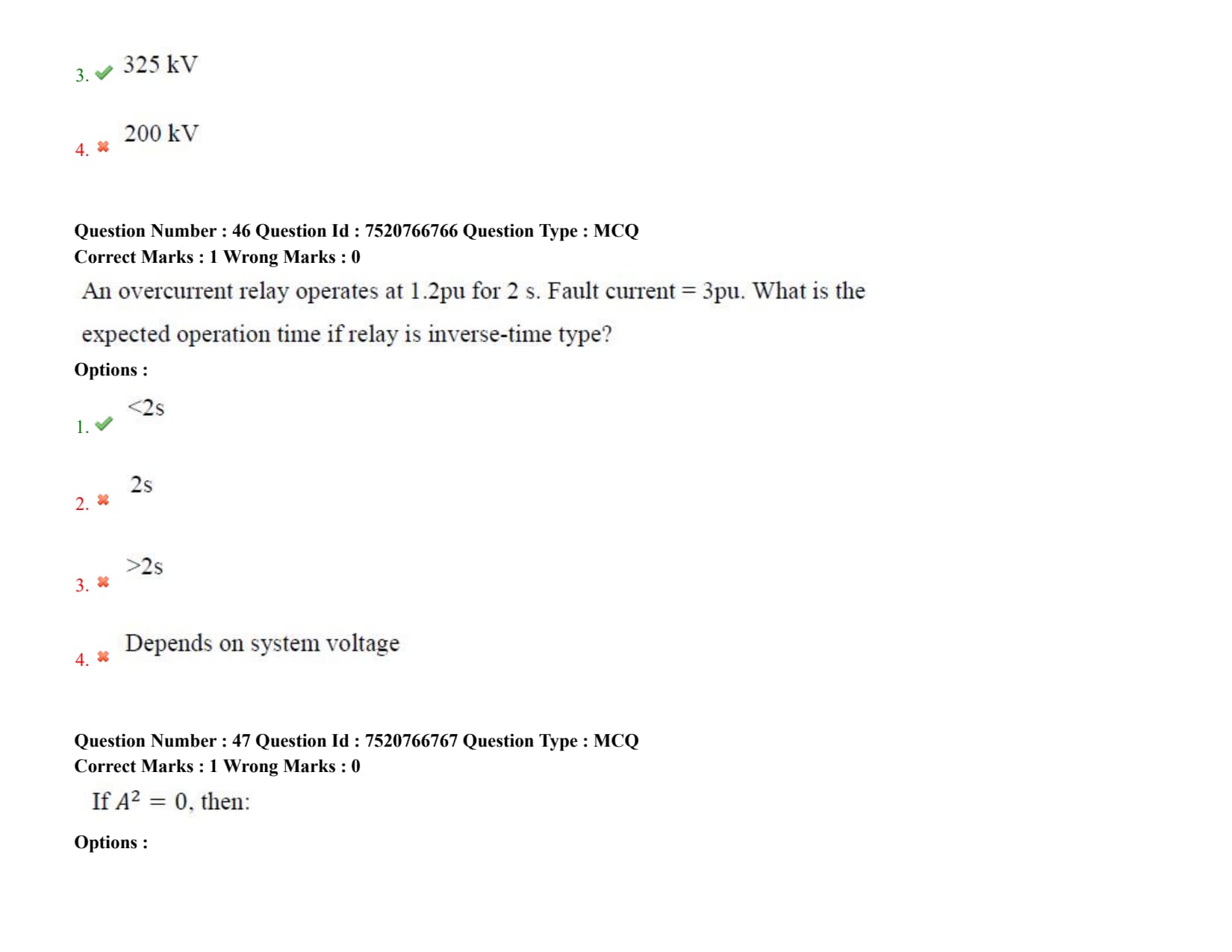
- (C) 325 kV
- (D) 200 kV
Question 46:
An overcurrent relay operates at 1.2pu for 2 s. Fault current = 3pu. What is the expected operation time if relay is inverse-time type?
- (A) \(<\)2s
- (B) 2s
- (C) \(>\)2s
- (D) Depends on system voltage
Question 47:
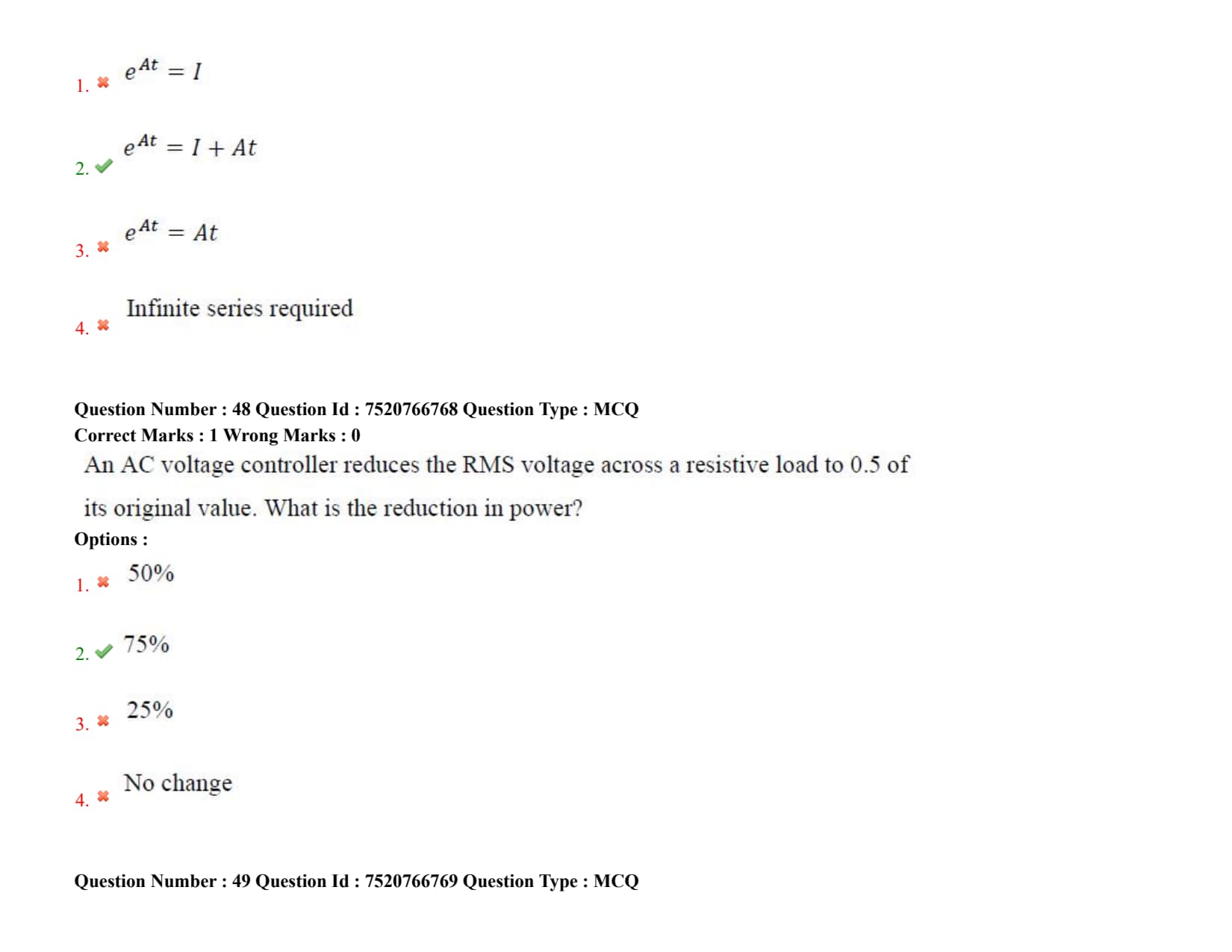
If \(A^2 = 0\), then:
- (A) \(e^{At} = I\)
- (B) \(e^{At} = I + At\)
- (C) \(e^{At} = At\)
- (D) Infinite series required
Question 48:
An AC voltage controller reduces the RMS voltage across a resistive load to 0.5 of its original value. What is the reduction in power?
- (A) 50%
- (B) 75%
- (C) 25%
- (D) No change
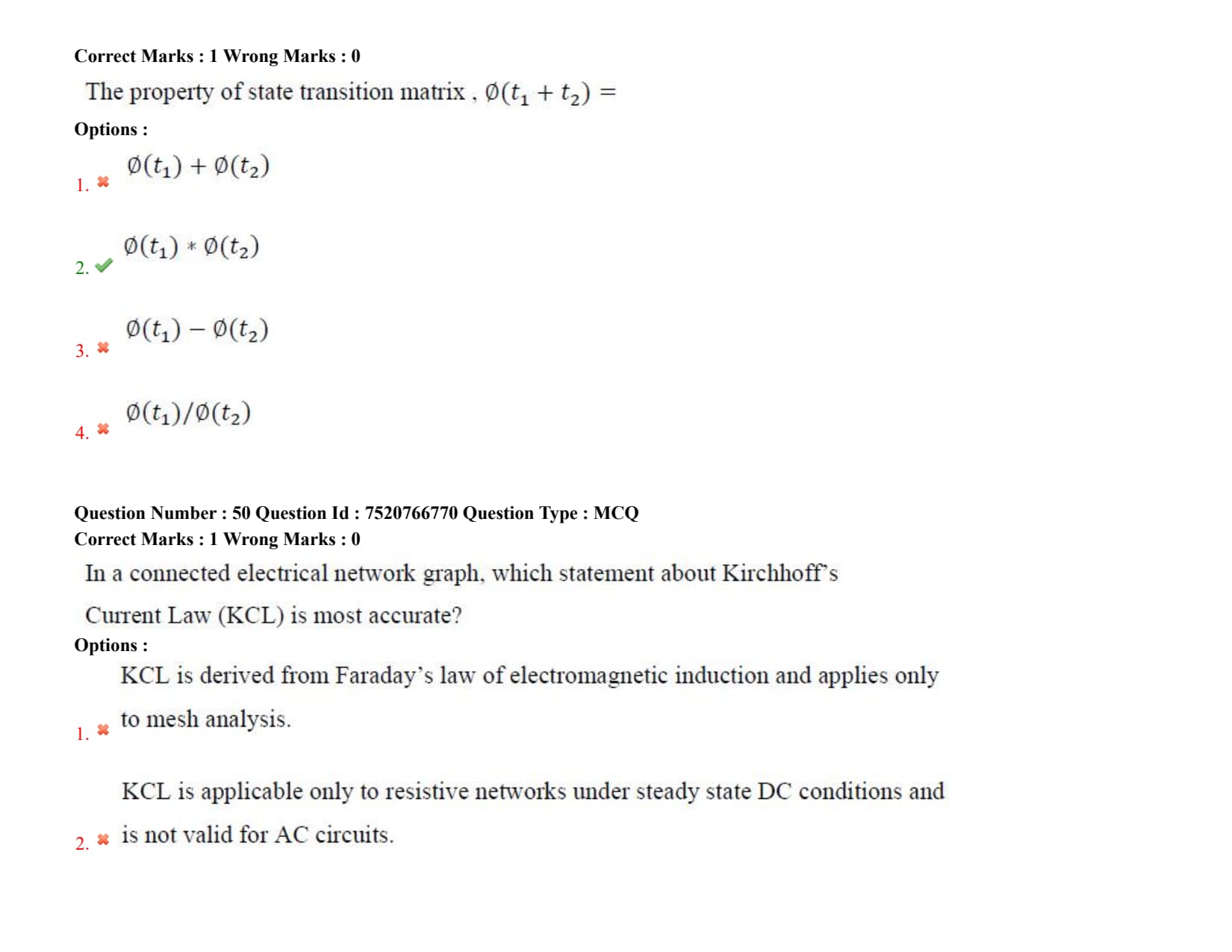
Question 49:
The property of state transition matrix, \(\Phi(t_1 + t_2) =\)
- (A) \(\Phi(t_1) + \Phi(t_2)\)
- (B) \(\Phi(t_1) \cdot \Phi(t_2)\)
- (C) \(\Phi(t_1) - \Phi(t_2)\)
- (D) \(\Phi(t_1) / \Phi(t_2)\)
Question 50:
In a connected electrical network graph, which statement about Kirchhoff's Current Law (KCL) is most accurate?
- (A) KCL is derived from Faraday's law of electromagnetic induction and applies only to mesh analysis.
- (B) KCL is applicable only to resistive networks under steady state DC conditions and is not valid for AC circuits.
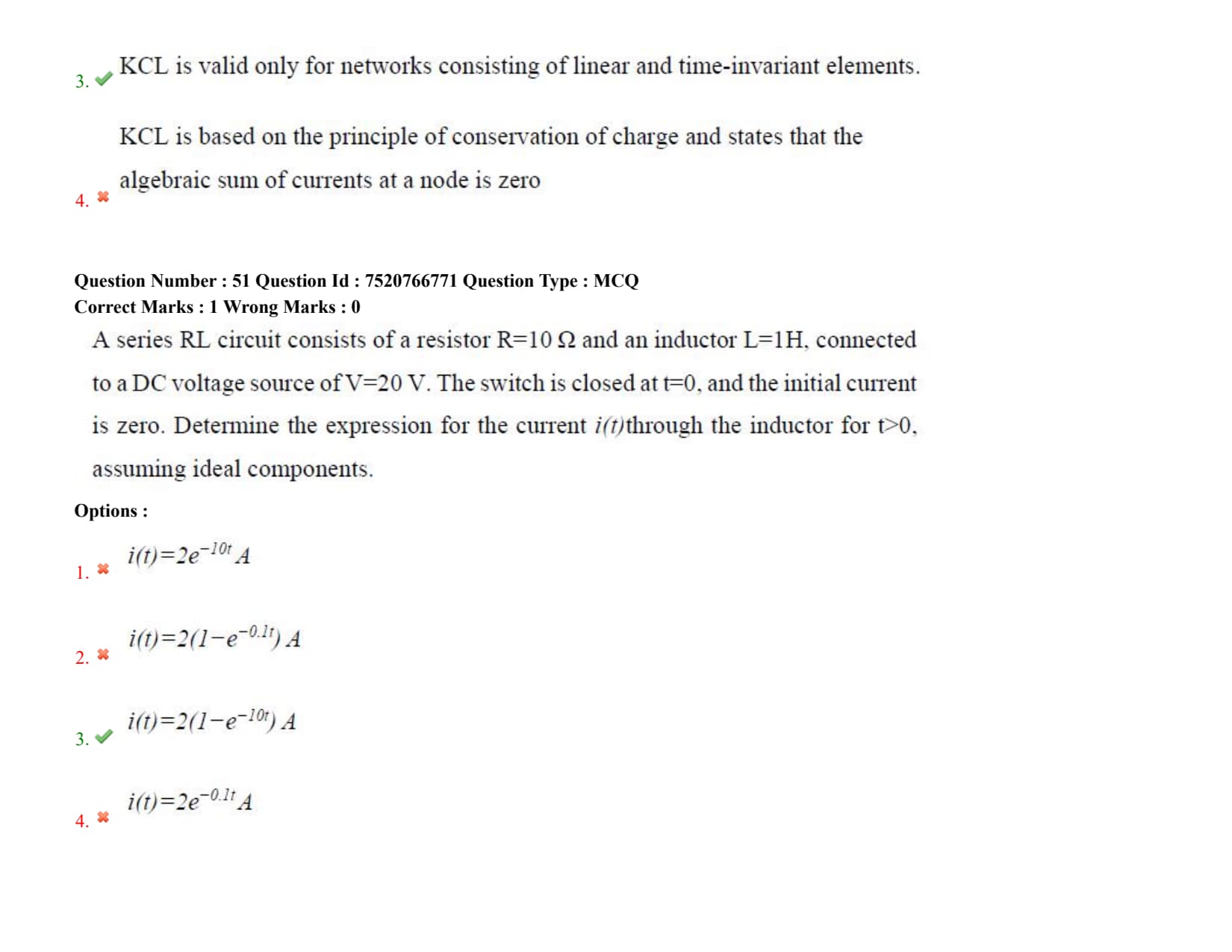
- (C) KCL is valid only for networks consisting of linear and time-invariant elements.
- (D) KCL is based on the principle of conservation of charge and states that the algebraic sum of currents at a node is zero
Question 51:
A series RL circuit consists of a resistor \(R=10 \ \Omega\) and an inductor \(L=1 H\), connected to a DC voltage source of \(V=20 V\). The switch is closed at \(t=0\), and the initial current is zero. Determine the expression for the current \(i(t)\) through the inductor for \(t>0\), assuming ideal components.
- (A) \(i(t)=2e^{-10t} A\)
- (B) \(i(t)=2(1-e^{-0.1t}) A\)
- (C) \(i(t)=2(1-e^{-10t}) A\)
- (D) \(i(t)=2e^{-0.1t} A\)
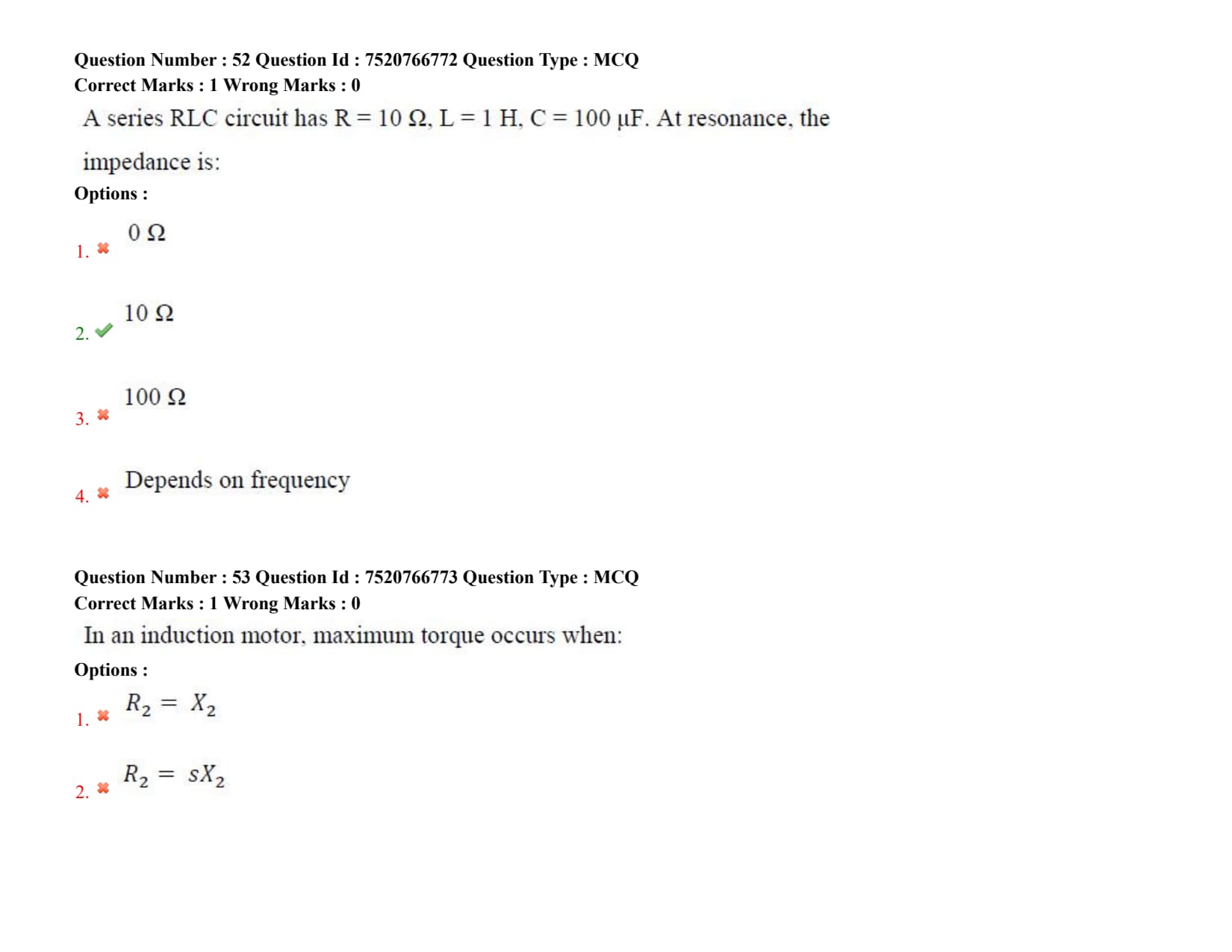
Question 52:
A series RLC circuit has \(R = 10 \ \Omega\), \(L = 1 H\), \(C = 100 \ \mu F\). At resonance, the impedance is:
- (A) \(0 \ \Omega\)
- (B) \(10 \ \Omega\)
- (C) \(100 \ \Omega\)
- (D) Depends on frequency
Question 53:
In an induction motor, maximum torque occurs when:
- (A) \(R_2 = X_2\)
- (B) \(R_2 = s X_2\)
- (C) \(\frac{R_2}{s} = X_2\)
- (D) \(\frac{R_2}{X_2} = s_m\)
Question 54:
A balanced three-phase, star-connected source with a line-to-line RMS voltage of \(400 V\) supplies a balanced star-connected load. Each phase of the load has a resistance of \(20 \ \Omega\). Neglect the line impedance. Calculate the total active power consumed by the load.
- (A) \(6 kW\)
- (B) \(4 kW\)
- (C) \(12 kW\)
- (D) \(8 kW\)
Question 55:
In a Capacitor-start motor, main winding current is \(2.0 pu\), auxiliary winding current is \(2.0 pu\) and the phase difference is \(90^\circ\). Then the starting torque is:
- (A) \(2.0 pu\)
- (B) \(4.0 pu\)
- (C) \(6.0 pu\)
- (D) \(8.0 pu\)
Question 56:
A stepper motor with a step angle \(1.8^\circ\) requires ______ steps per one revolution.
- (A) 180
- (B) 200
- (C) 360
- (D) 100
Question 57:
Which of the following is true about hunting in synchronous machines?
- (A) Occurs at low speed only
- (B) Occurs when mechanical load fluctuates
- (C) Is due to sudden change in field current
- (D) Is due to interaction between rotor inertia and synchronizing torque
Question 58:
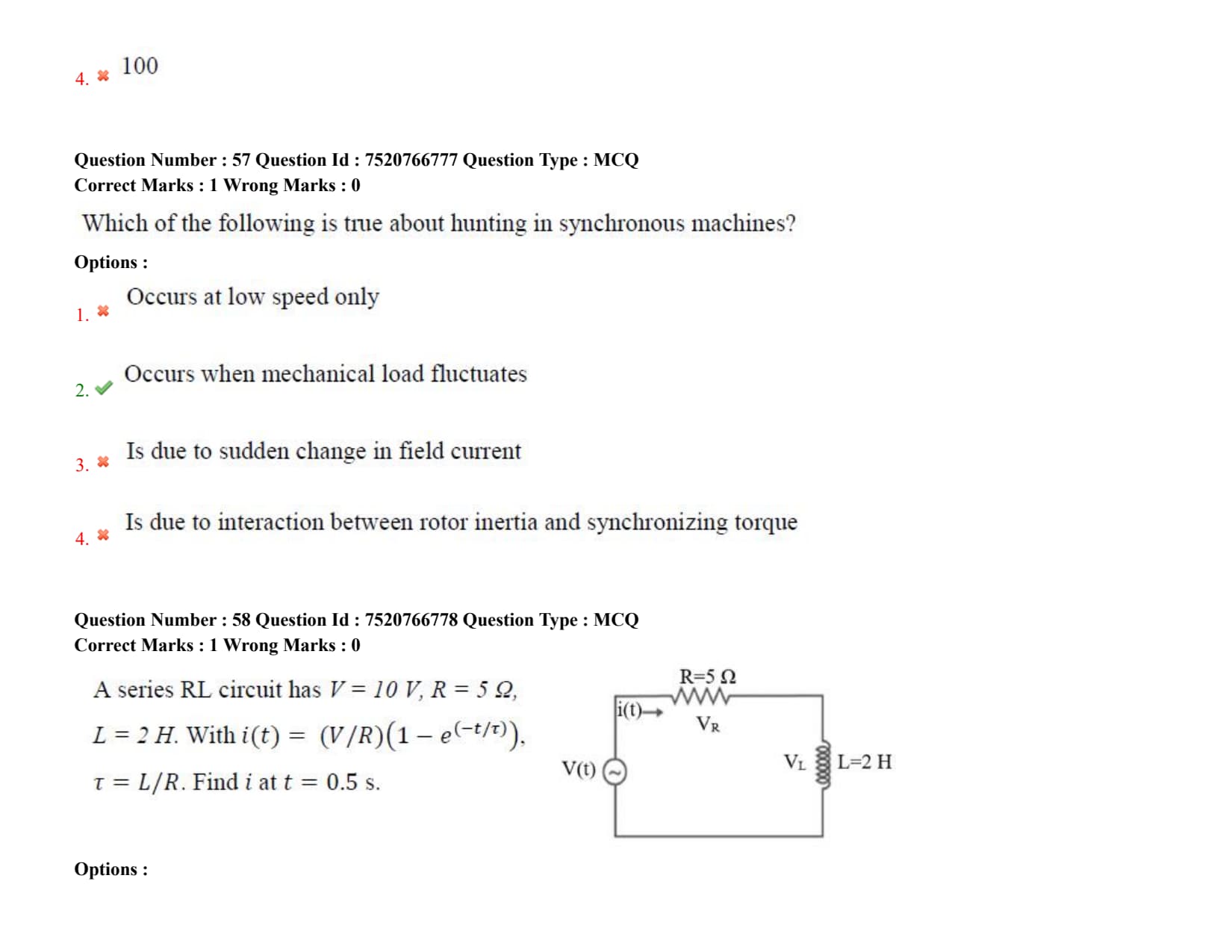
A series RL circuit has \(V = 10 V\), \(R = 5 \ \Omega\), \(L = 2 H\). With \(i(t) = (V/R)(1 - e^{-t/\tau})\), \(\tau = L/R\). Find \(i\) at \(t = 0.5 s\).
![]()
- (A) \(1.26 A\)
- (B) \(1.428 A\)
- (C) \(2.00 A\)
- (D) \(0.95 A\)
Question 59:
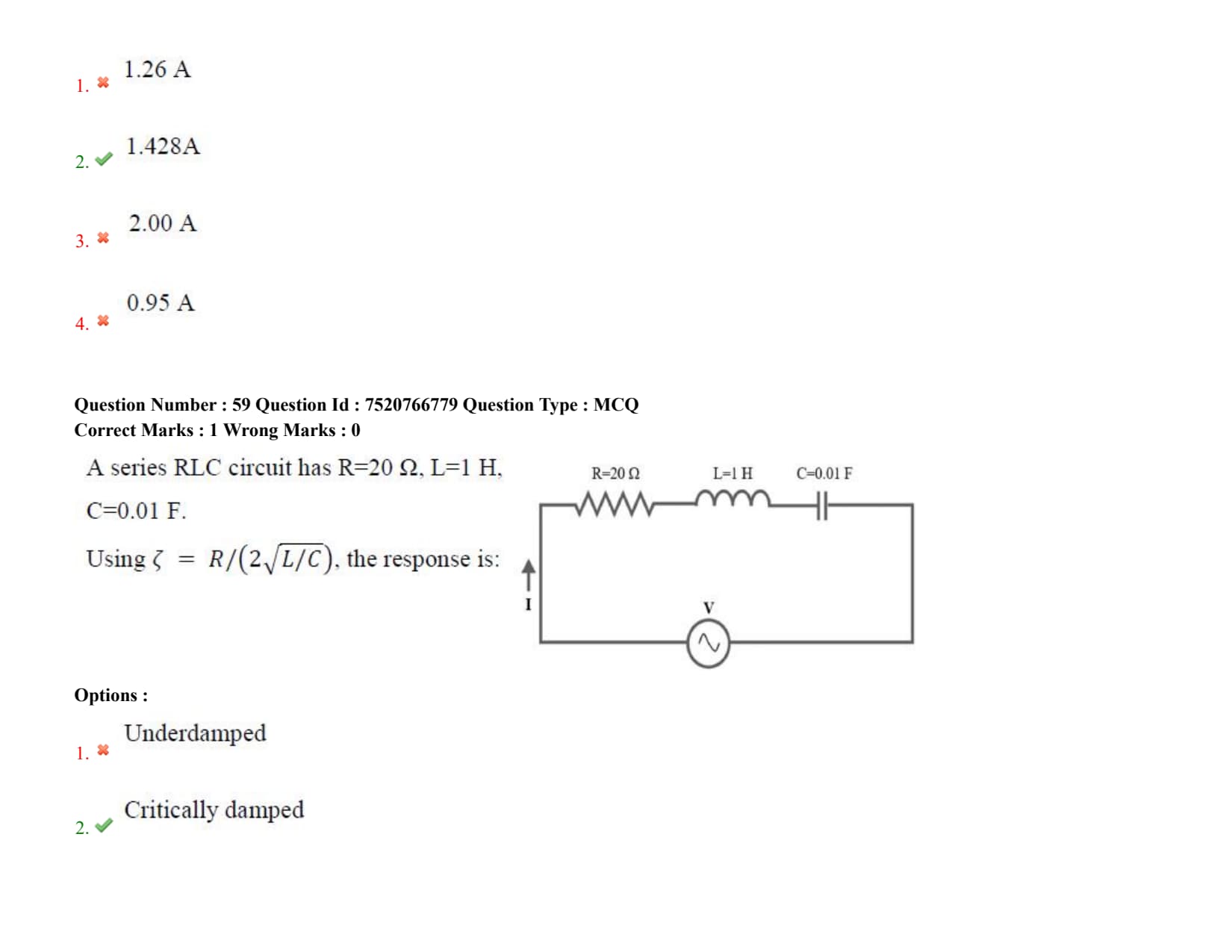
A series RLC circuit has \(R=20 \ \Omega\), \(L=1 H\), \(C=0.01 F\). Using \(\zeta = R / (2\sqrt{L/C})\), the response is:
![]()
- (A) Underdamped
- (B) Critically damped
- (C) Overdamped
- (D) Sustained oscillations
Question 60:
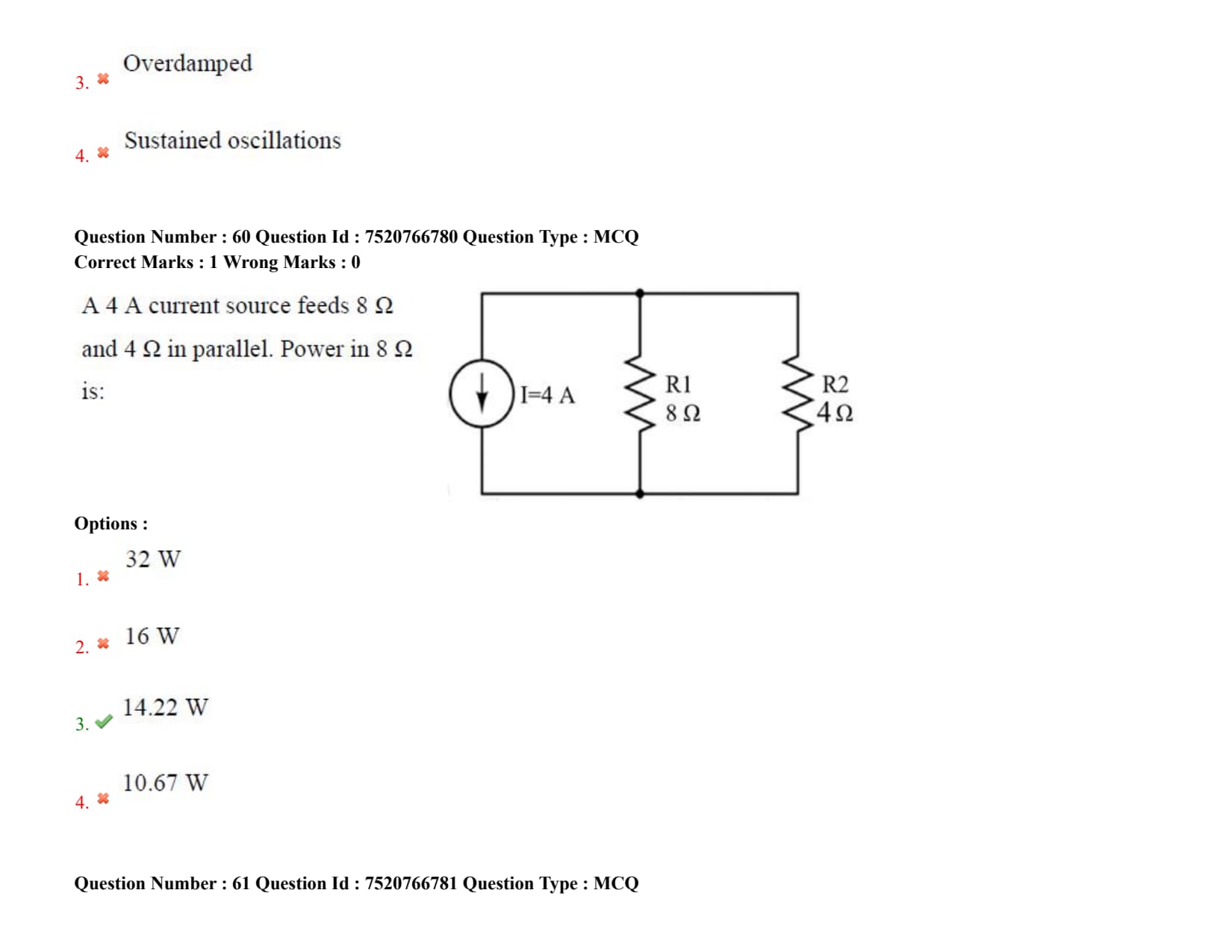
A \(4 A\) current source feeds \(8 \ \Omega\) and \(4 \ \Omega\) in parallel. Power in \(8 \ \Omega\) is:
![]()
- (A) \(32 W\)
- (B) \(16 W\)
- (C) \(14.22 W\)
- (D) \(10.67 W\)
Question 61:
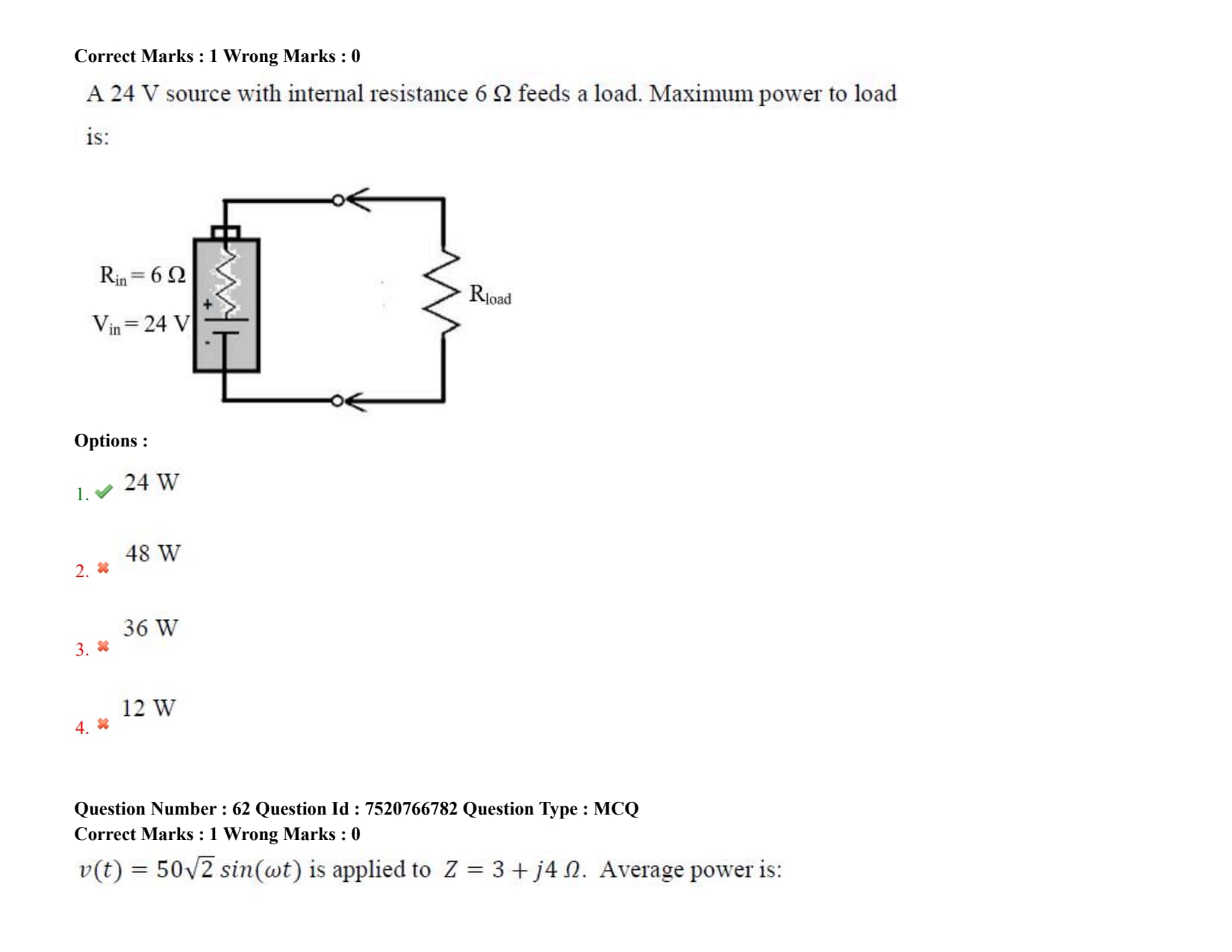
A 24 V source with internal resistance 6 \(\Omega\) feeds a load. Maximum power to load is:
![]()
- (A) 24 W
- (B) 48 W
- (C) 36 W
- (D) 12 W
Question 62:
\(v(t) = 50\sqrt{2} \sin(\omega t)\) is applied to \(Z = 3 + j4 \ \Omega\). Average power is:
- (A) 200 W
- (B) 250 W
- (C) 300 W
- (D) 400 W
Question 63:
With dependent sources, Thevenin's resistance is found by:
- (A) Open-circuit method
- (B) Short-circuit method
- (C) Applying a test source (V/I)
- (D) Ignoring sources
Question 64:
The Maximum power transfer in an AC network occurs when:
- (A) \(RL = RS\)
- (B) \(ZL = ZS^*\)
- (C) \(ZL = ZS\)
- (D) \(RL = 0\)
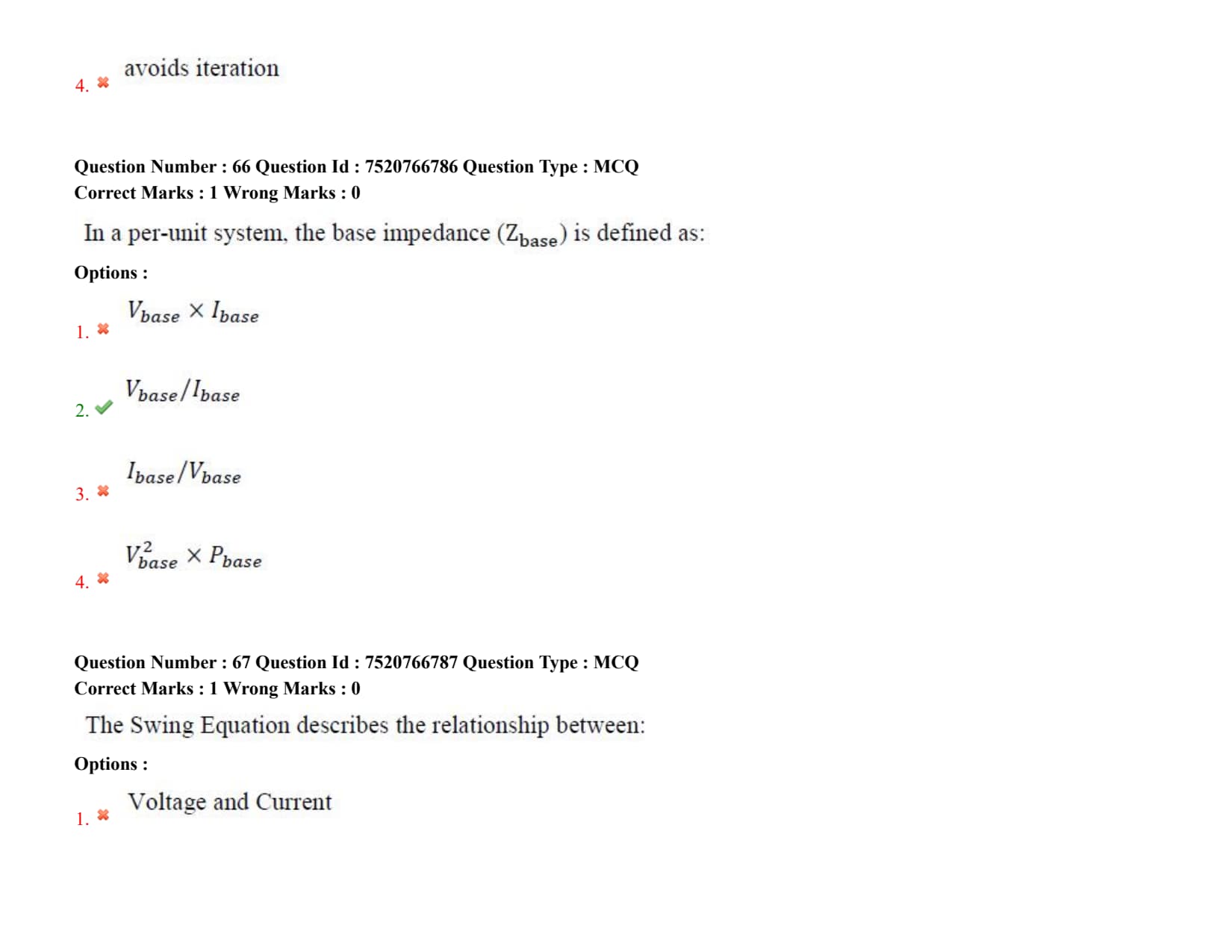
Question 65:
The Newton–Raphson method is preferred because it,
- (A) is simplest
- (B) has Quadratic Convergence
- (C) uses fewer equations
- (D) avoids iteration
Question 66:
In a per-unit system, the base impedance (\(Z_{base}\)) is defined as:
- (A) \(V_{base} \times I_{base}\)
- (B) \(V_{base} / I_{base}\)
- (C) \(I_{base} / V_{base}\)
- (D) \(V_{base}^2 \times P_{base}\)
Question 67:
The Swing Equation describes the relationship between:
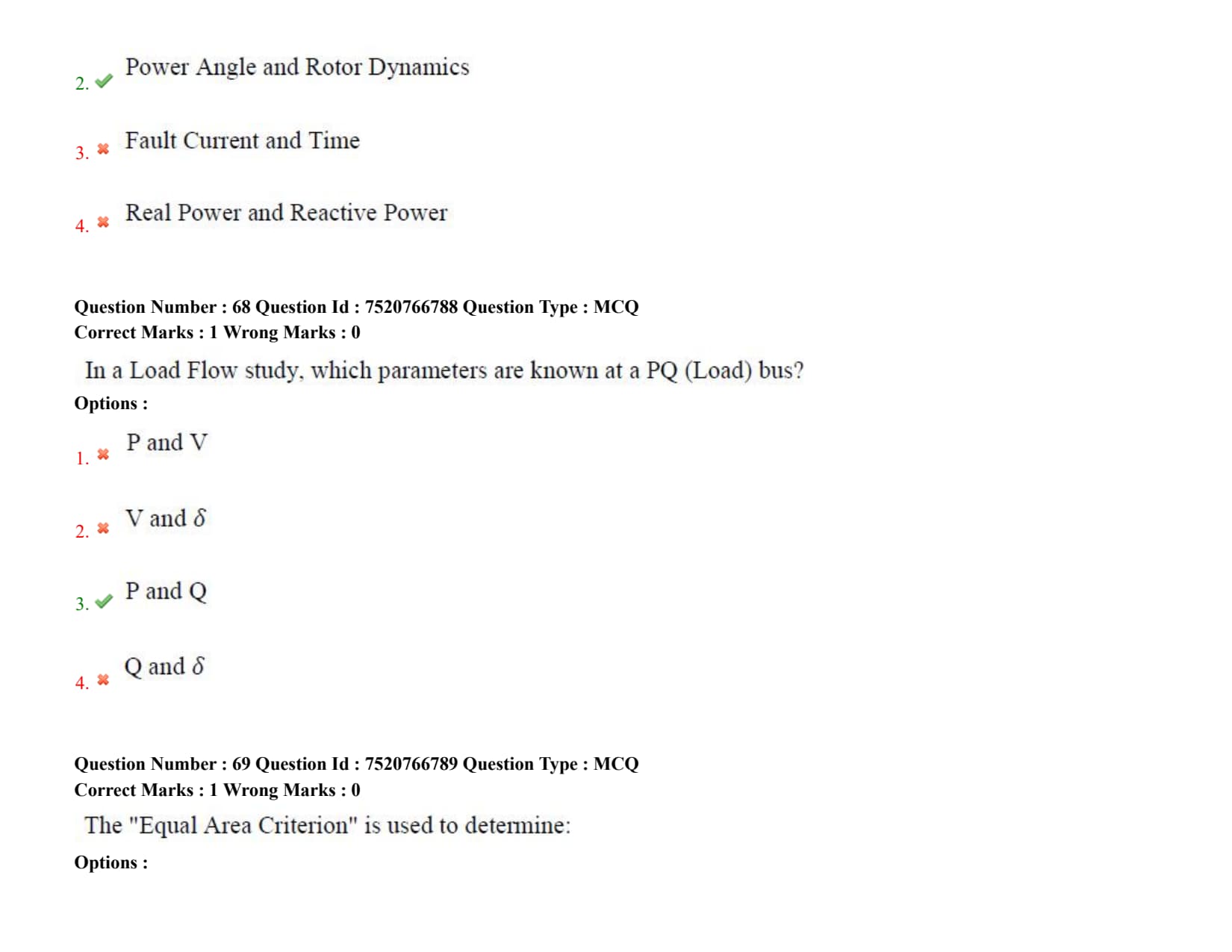
- (A) Voltage and Current
- (B) Power Angle and Rotor Dynamics
- (C) Fault Current and Time
- (D) Real Power and Reactive Power
Question 68:
In a Load Flow study, which parameters are known at a PQ (Load) bus?
- (A) P and V
- (B) V and \(\delta\)
- (C) P and Q
- (D) Q and \(\delta\)
Question 69:
The "Equal Area Criterion" is used to determine:
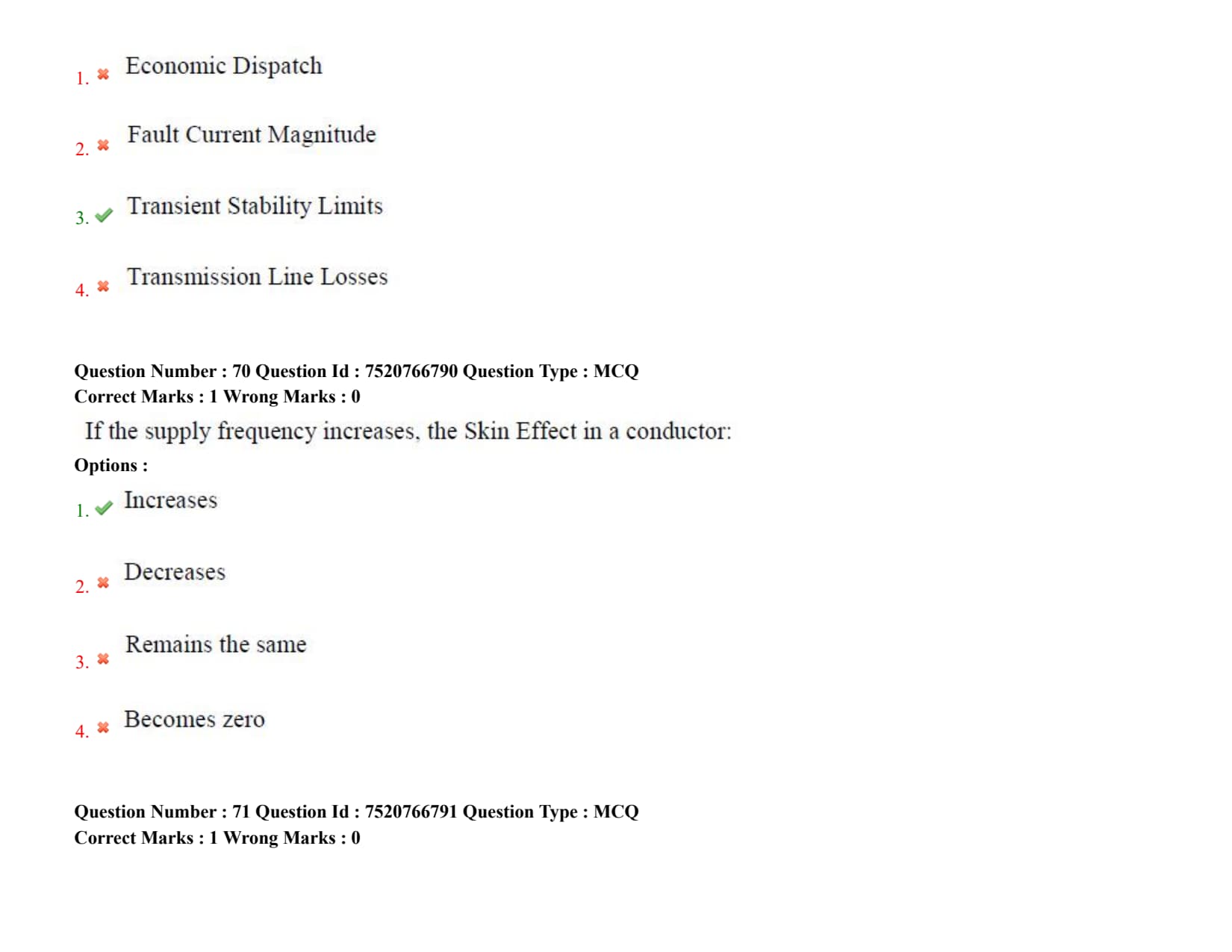
- (A) Economic Dispatch
- (B) Fault Current Magnitude
- (C) Transient Stability Limits
- (D) Transmission Line Losses
Question 70:
If the supply frequency increases, the Skin Effect in a conductor:
- (A) Increases
- (B) Decreases
- (C) Remains the same
- (D) Becomes zero
Question 71:
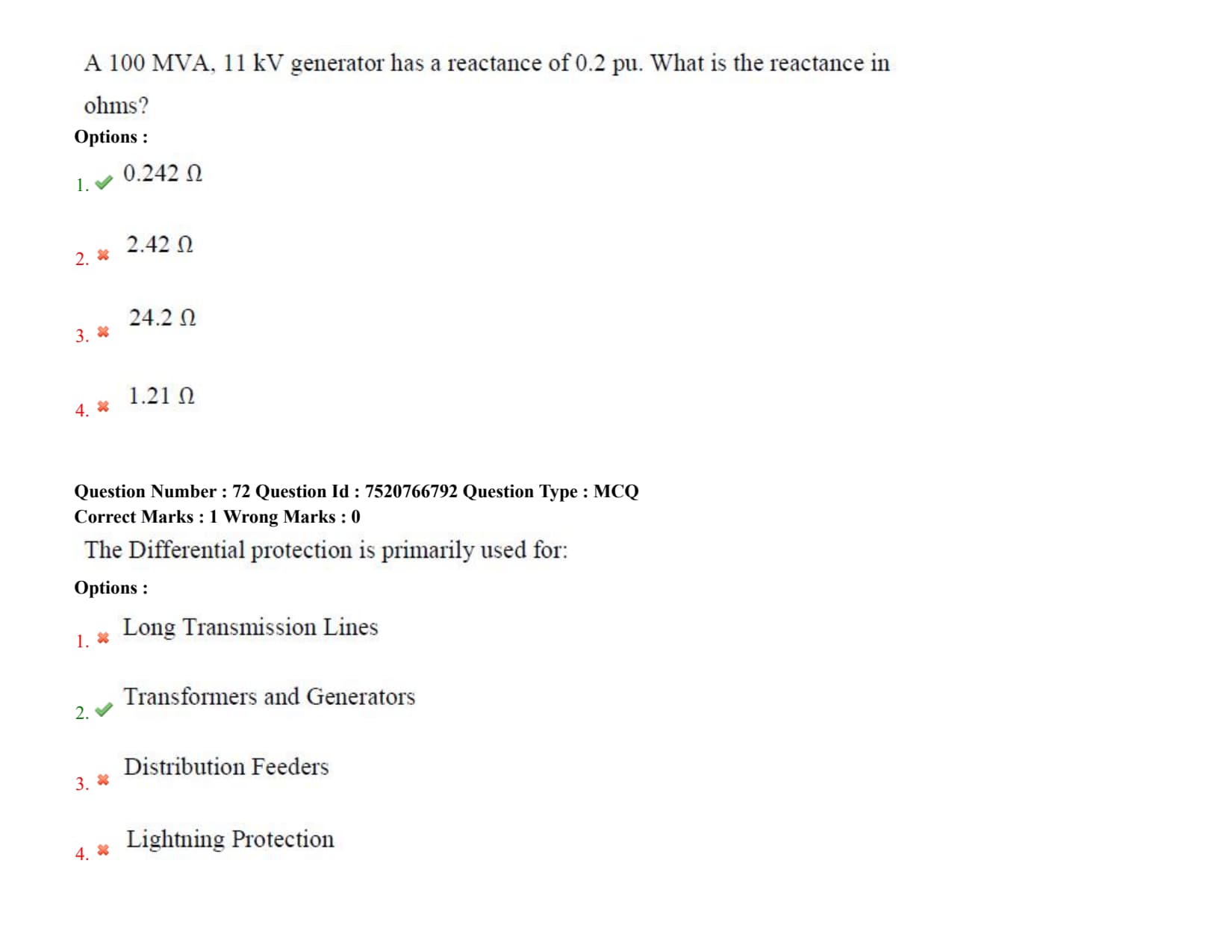
A 100 MVA, 11 kV generator has a reactance of 0.2 pu. What is the reactance in ohms?
- (A) \(0.242 \ \Omega\)
- (B) \(2.42 \ \Omega\)
- (C) \(24.2 \ \Omega\)
- (D) \(1.21 \ \Omega\)
Question 72:
The Differential protection is primarily used for:
- (A) Long Transmission Lines
- (B) Transformers and Generators
- (C) Distribution Feeders
- (D) Lightning Protection
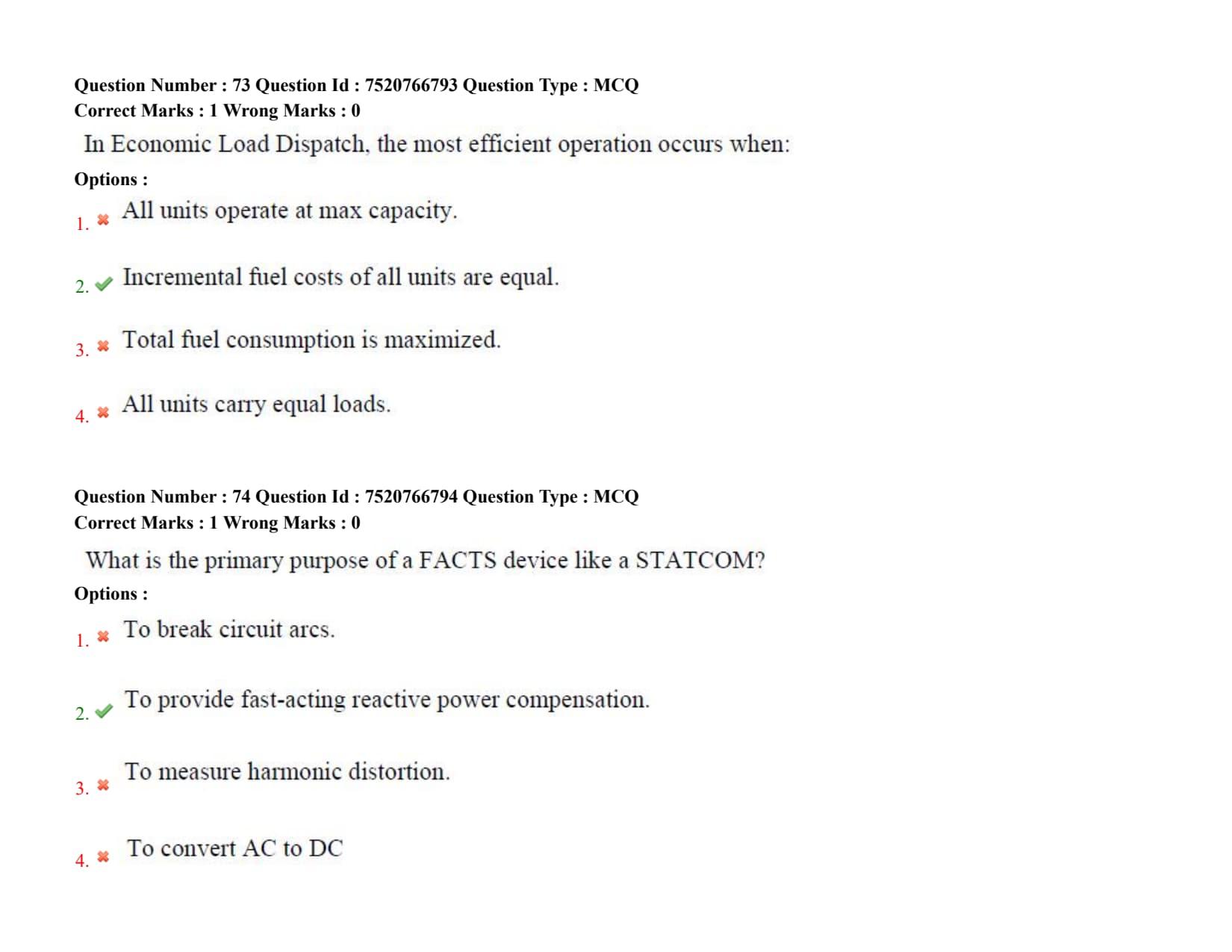
Question 73:
In Economic Load Dispatch, the most efficient operation occurs when:
- (A) All units operate at max capacity.
- (B) Incremental fuel costs of all units are equal.
- (C) Total fuel consumption is maximized.
- (D) All units carry equal loads.
Question 74:
What is the primary purpose of a FACTS device like a STATCOM?
- (A) To break circuit arcs.
- (B) To provide fast-acting reactive power compensation.
- (C) To measure harmonic distortion.
- (D) To convert AC to DC
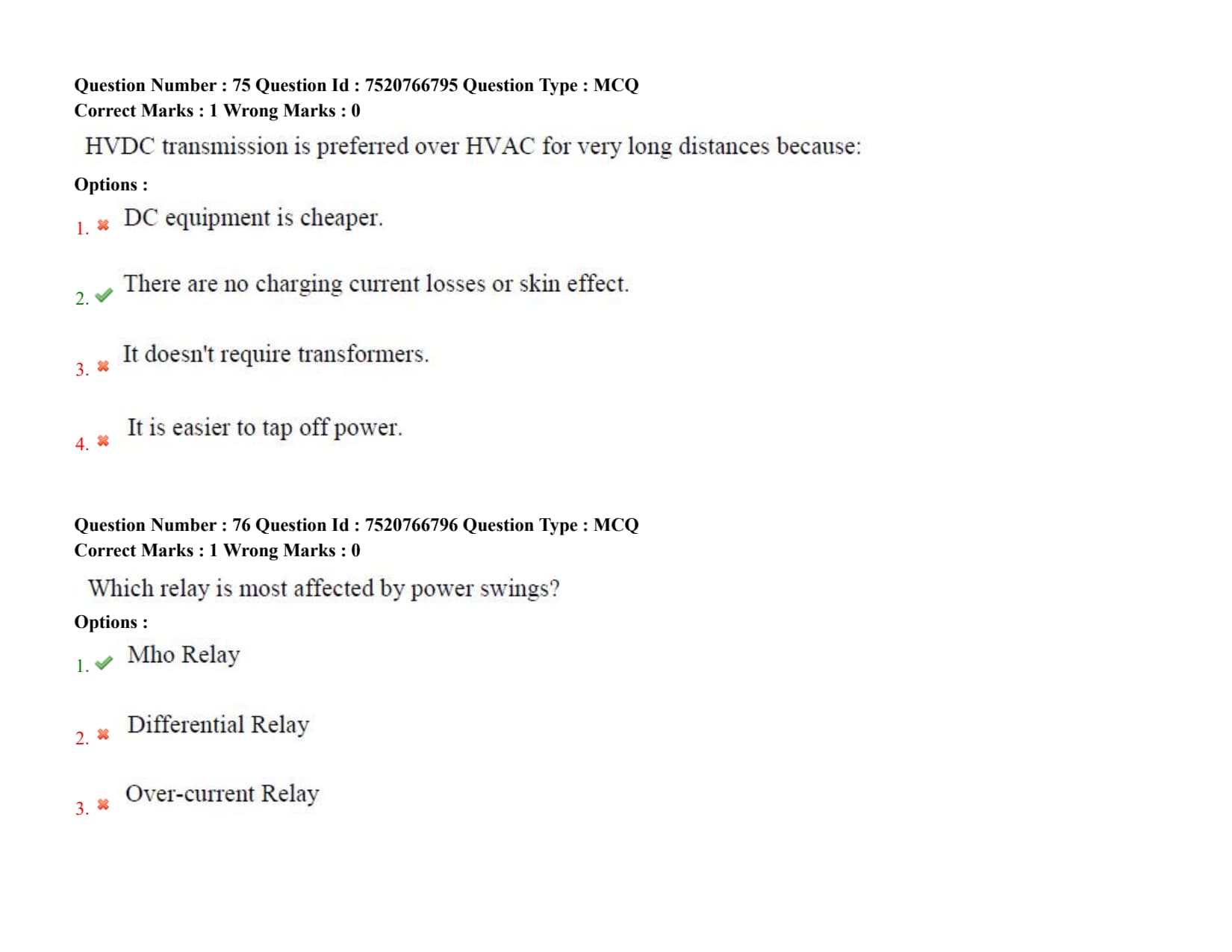
Question 75:
HVDC transmission is preferred over HVAC for very long distances because:
- (A) DC equipment is cheaper.
- (B) There are no charging current losses or skin effect.
- (C) It doesn't require transformers.
- (D) It is easier to tap off power.
Question 76:
Which relay is most affected by power swings?
- (A) Mho Relay
- (B) Differential Relay
- (C) Over-current Relay
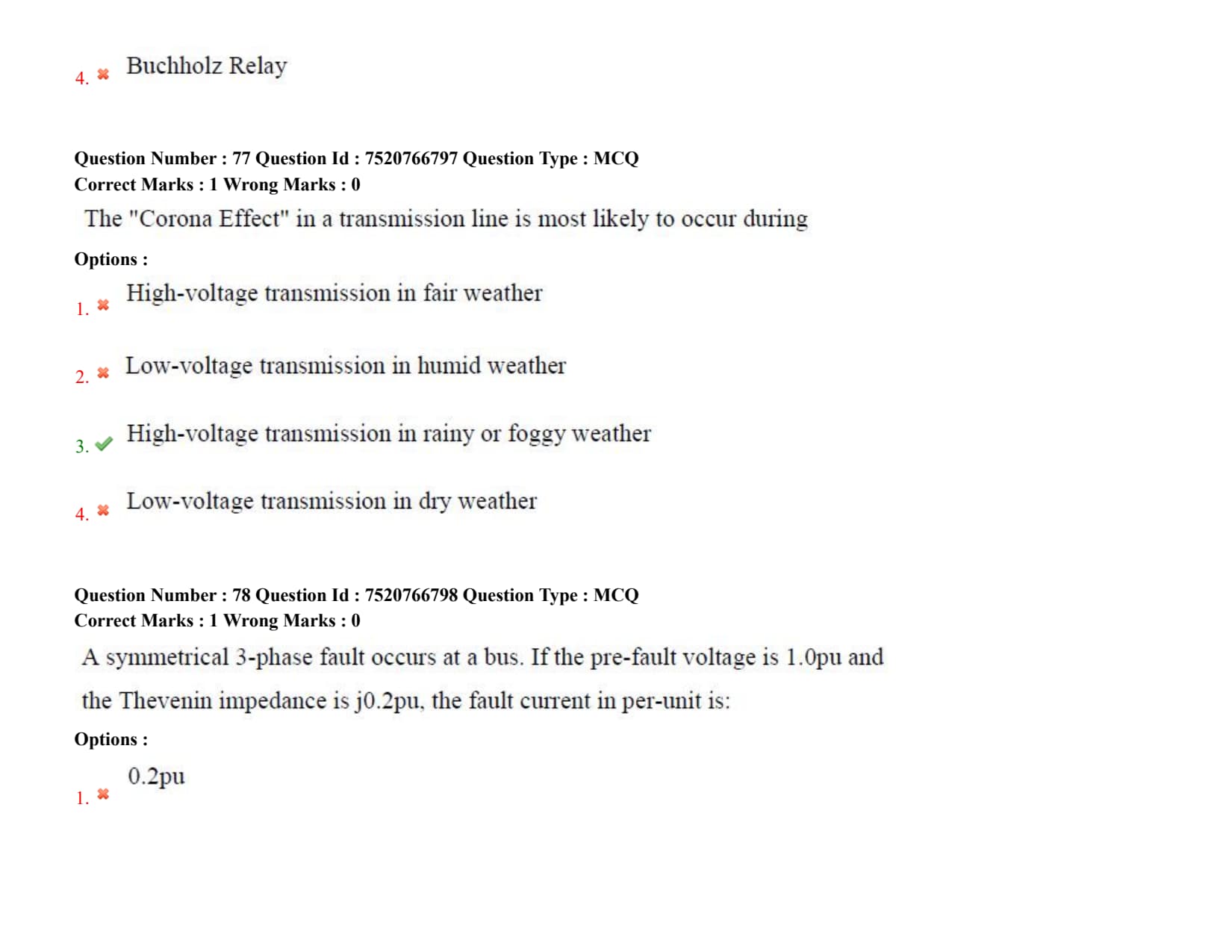
- (D) Buchholz Relay
Question 77:
The "Corona Effect" in a transmission line is most likely to occur during
- (A) High-voltage transmission in fair weather
- (B) Low-voltage transmission in humid weather
- (C) High-voltage transmission in rainy or foggy weather
- (D) Low-voltage transmission in dry weather
Question 78:
A symmetrical 3-phase fault occurs at a bus. If the pre-fault voltage is 1.0pu and the Thevenin impedance is j0.2pu, the fault current in per-unit is:
- (A) 0.2pu
- (B) 2.0pu
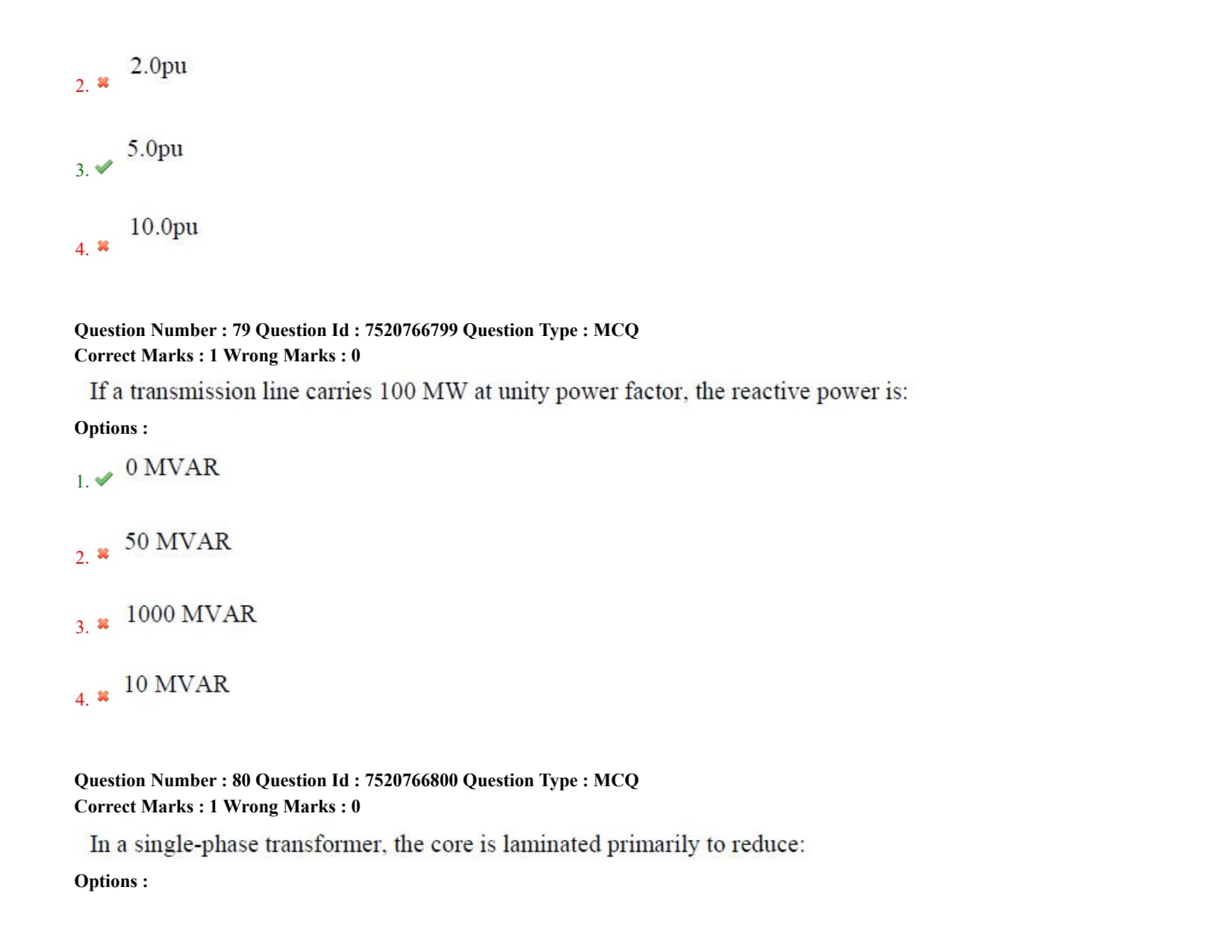
- (C) 5.0pu
- (D) 10.0pu
Question 79:
If a transmission line carries 100 MW at unity power factor, the reactive power is:
- (A) 0 MVAR
- (B) 50 MVAR
- (C) 1000 MVAR
- (D) 10 MVAR
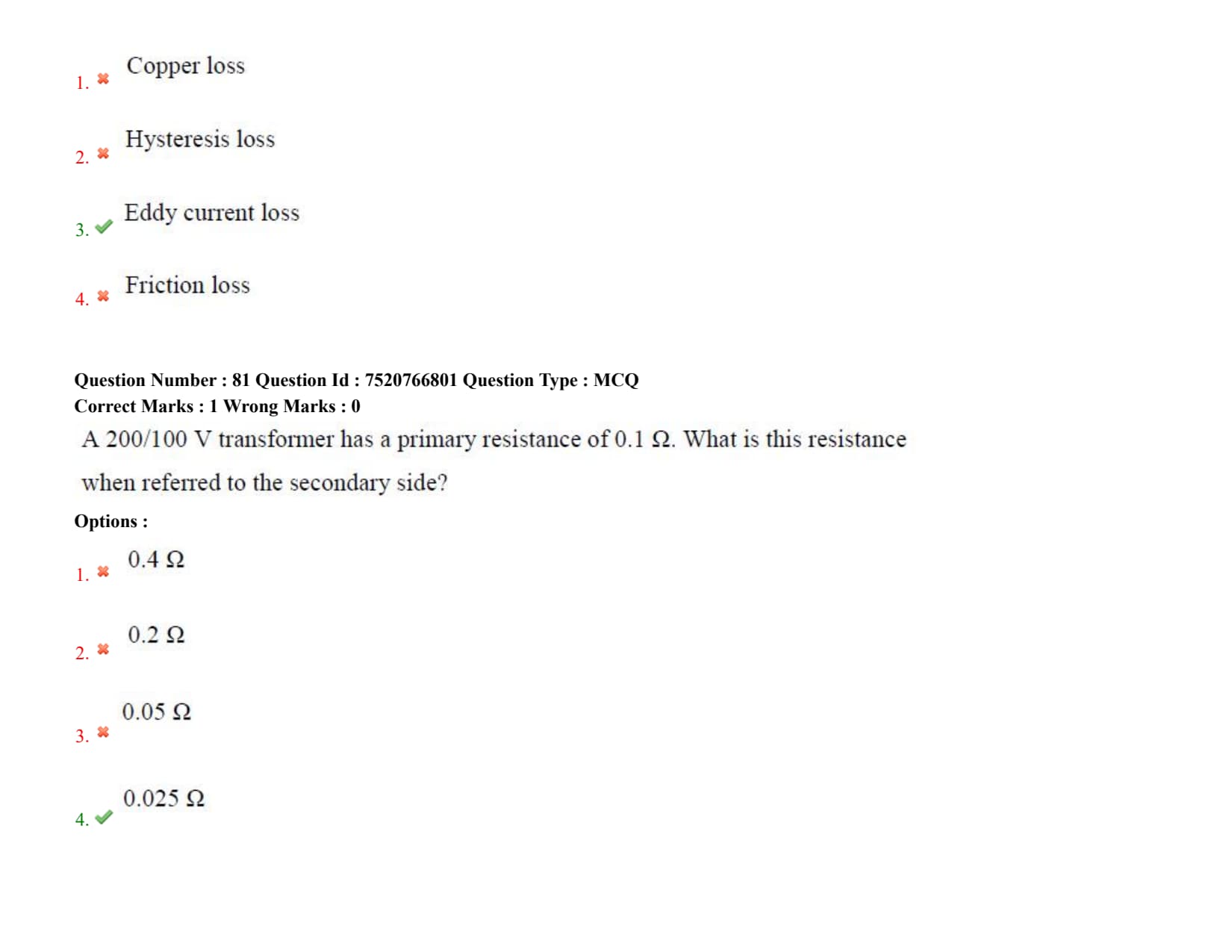
Question 80:
In a single-phase transformer, the core is laminated primarily to reduce:
- (A) Copper loss
- (B) Hysteresis loss
- (C) Eddy current loss
- (D) Friction loss
Question 81:
A 200/100 V transformer has a primary resistance of 0.1 \(\Omega\). What is this resistance when referred to the secondary side?
- (A) 0.4 \(\Omega\)
- (B) 0.2 \(\Omega\)
- (C) 0.05 \(\Omega\)
- (D) 0.025 \(\Omega\)
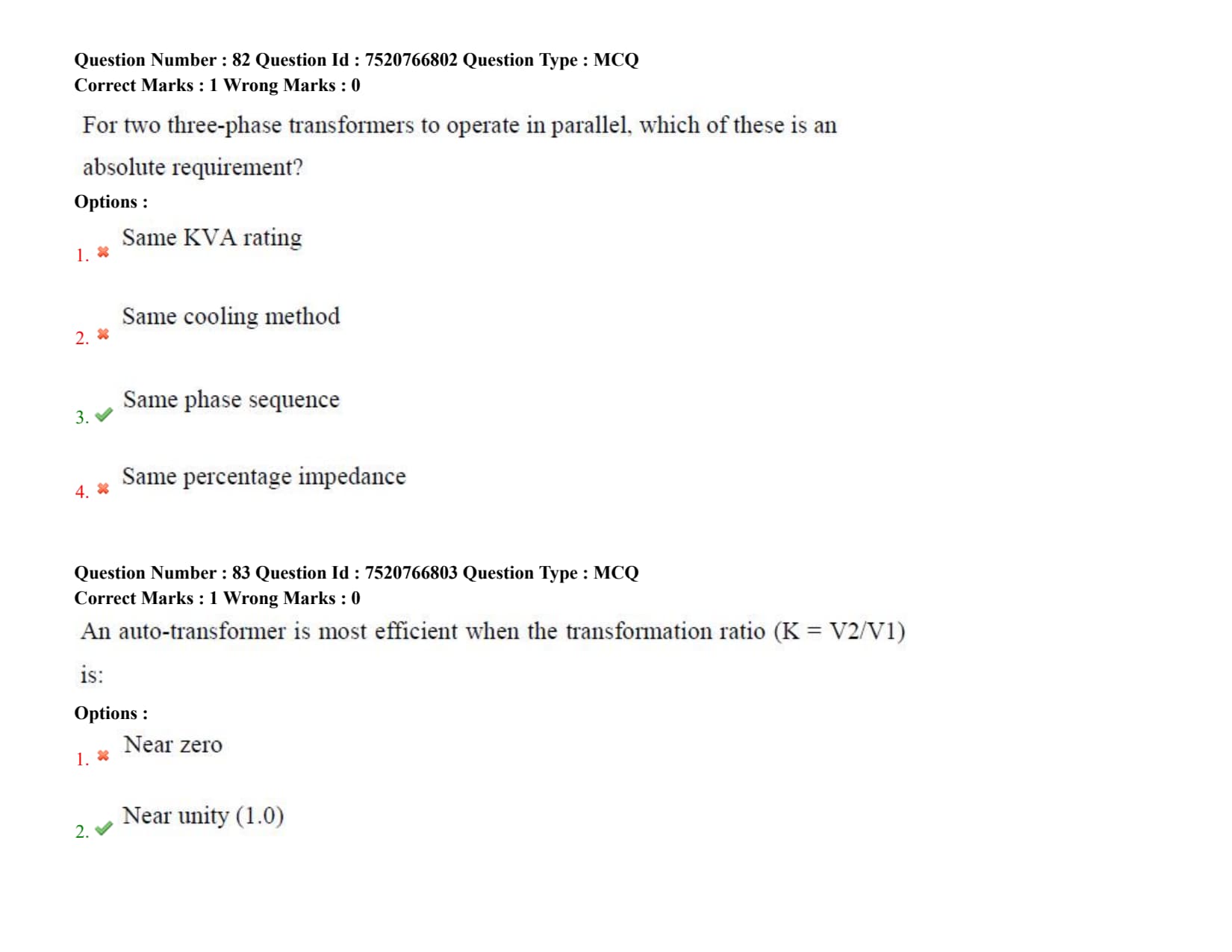
Question 82:
For two three-phase transformers to operate in parallel, which of these is an absolute requirement?
- (A) Same KVA rating
- (B) Same cooling method
- (C) Same phase sequence
- (D) Same percentage impedance
Question 83:
An auto-transformer is most efficient when the transformation ratio (\(K = V_2/V_1\)) is:
- (A) Near zero
- (B) Near unity (1.0)
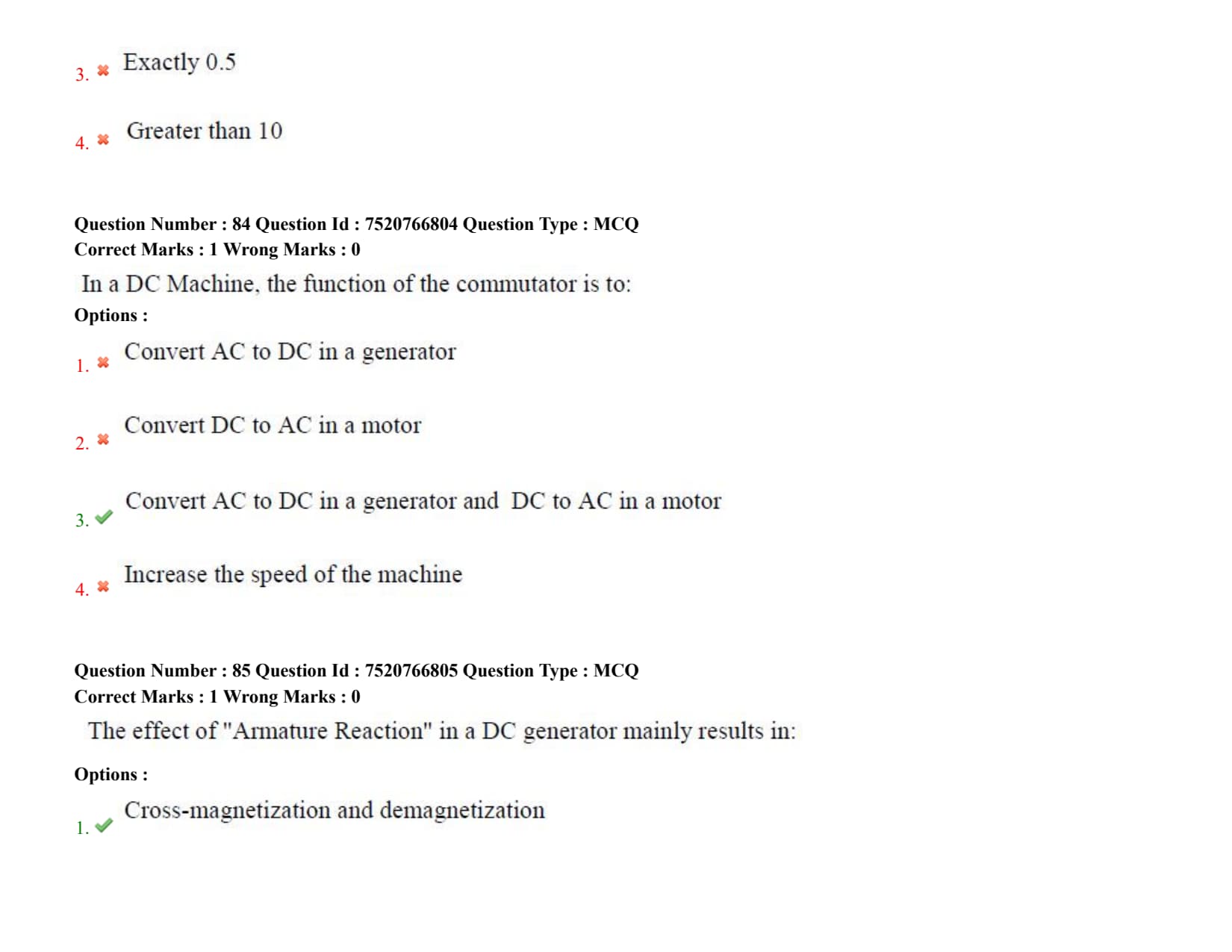
- (C) Exactly 0.5
- (D) Greater than 10
Question 84:
In a DC Machine, the function of the commutator is to:
- (A) Convert AC to DC in a generator
- (B) Convert DC to AC in a motor
- (C) Convert AC to DC in a generator and DC to AC in a motor
- (D) Increase the speed of the machine
Question 85:
The effect of "Armature Reaction" in a DC generator mainly results in:
- (A) Cross-magnetization and demagnetization
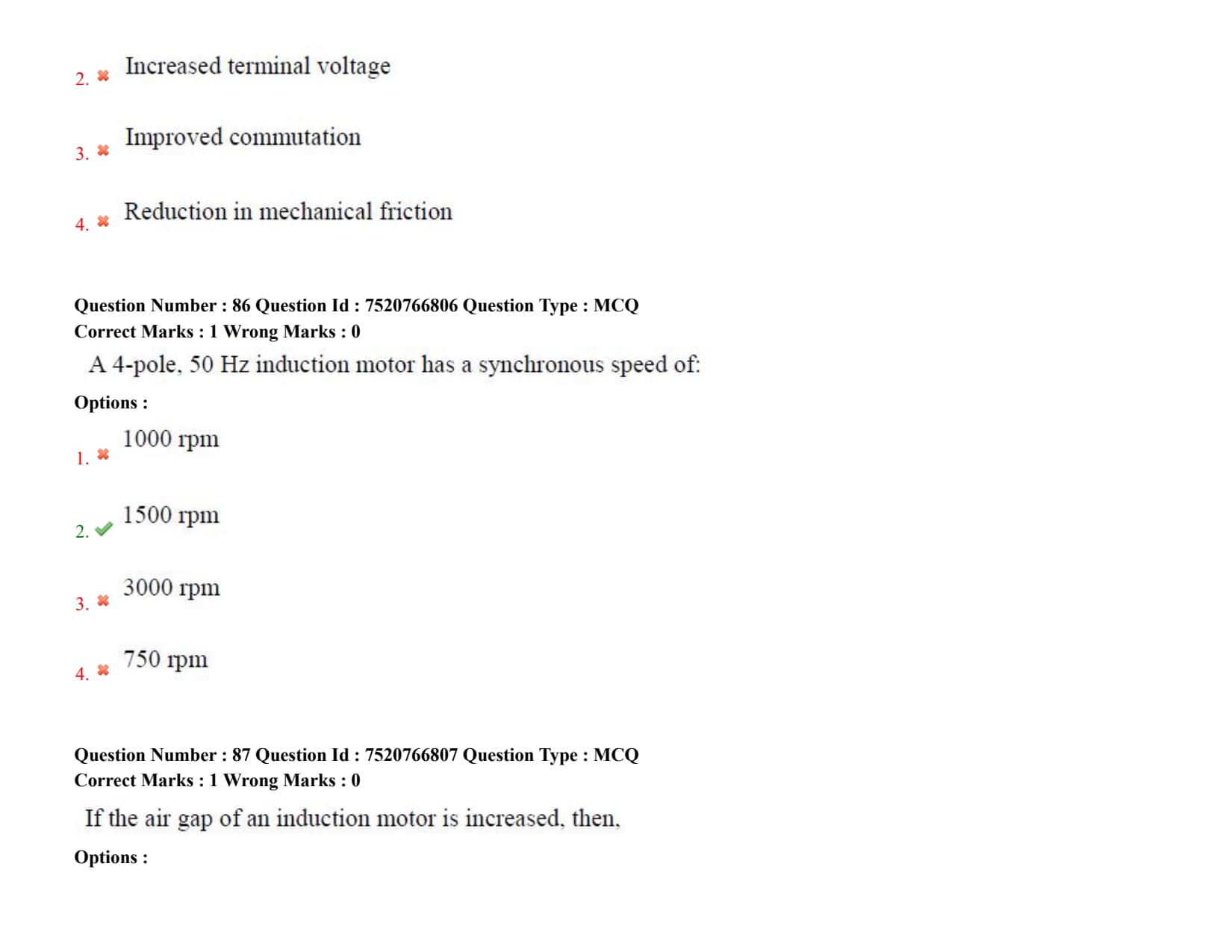
- (B) Increased terminal voltage
- (C) Improved commutation
- (D) Reduction in mechanical friction
Question 86:
A 4-pole, 50 Hz induction motor has a synchronous speed of:
- (A) 1000 rpm
- (B) 1500 rpm
- (C) 3000 rpm
- (D) 750 rpm
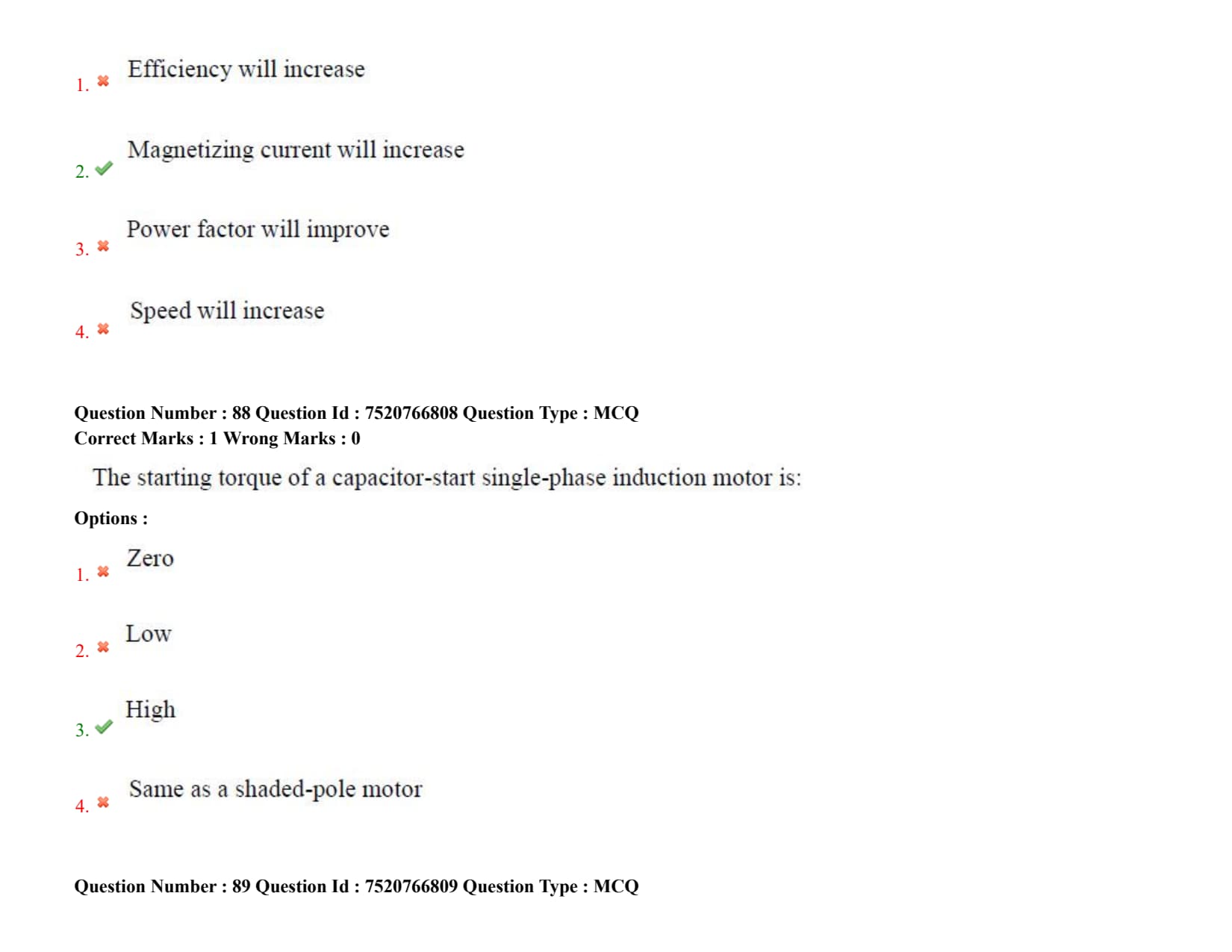
Question 87:
If the air gap of an induction motor is increased, then,
- (A) Efficiency will increase
- (B) Magnetizing current will increase
- (C) Power factor will improve
- (D) Speed will increase
Question 88:
The starting torque of a capacitor-start single-phase induction motor is:
- (A) Zero
- (B) Low
- (C) High
- (D) Same as a shaded-pole motor
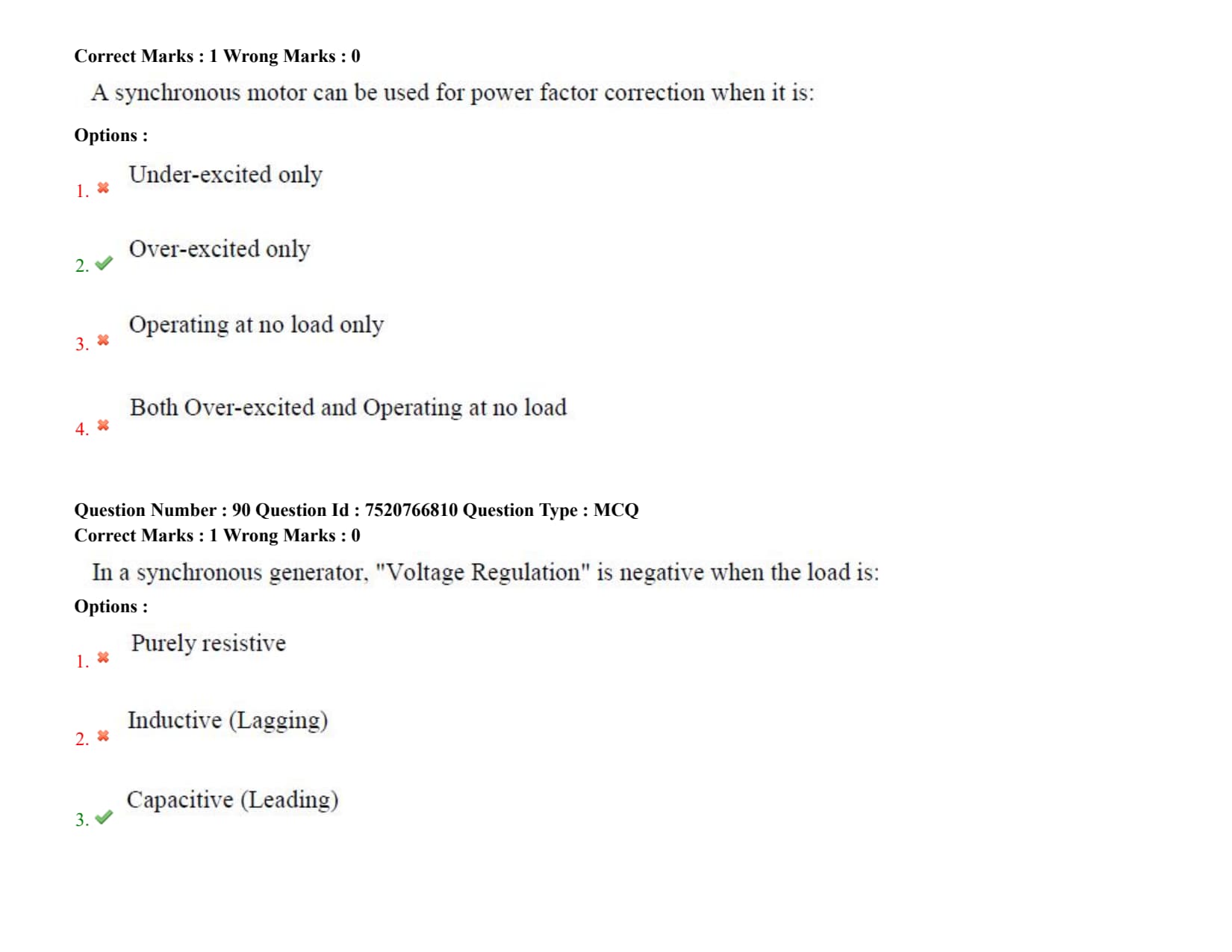
Question 89:
A synchronous motor can be used for power factor correction when it is:
- (A) Under-excited only
- (B) Over-excited only
- (C) Operating at no load only
- (D) Both Over-excited and Operating at no load
Question 90:
In a synchronous generator, "Voltage Regulation" is negative when the load is:
- (A) Purely resistive
- (B) Inductive (Lagging)
- (C) Capacitive (Leading)
- (D) Unity power factor
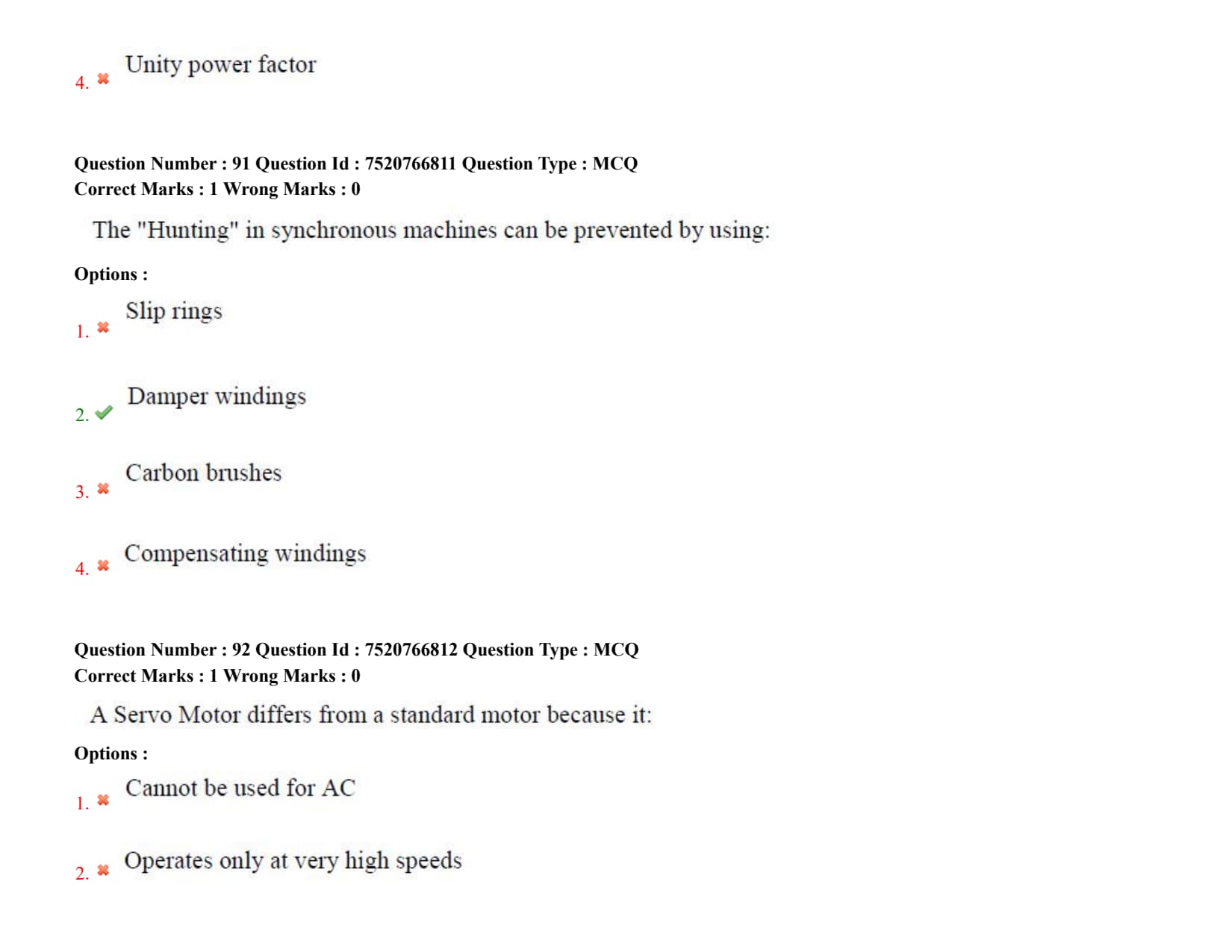
Question 91:
The "Hunting" in synchronous machines can be prevented by using:
- (A) Slip rings
- (B) Damper windings
- (C) Carbon brushes
- (D) Compensating windings
Question 92:
A Servo Motor differs from a standard motor because it:
- (A) Cannot be used for AC
- (B) Operates only at very high speeds
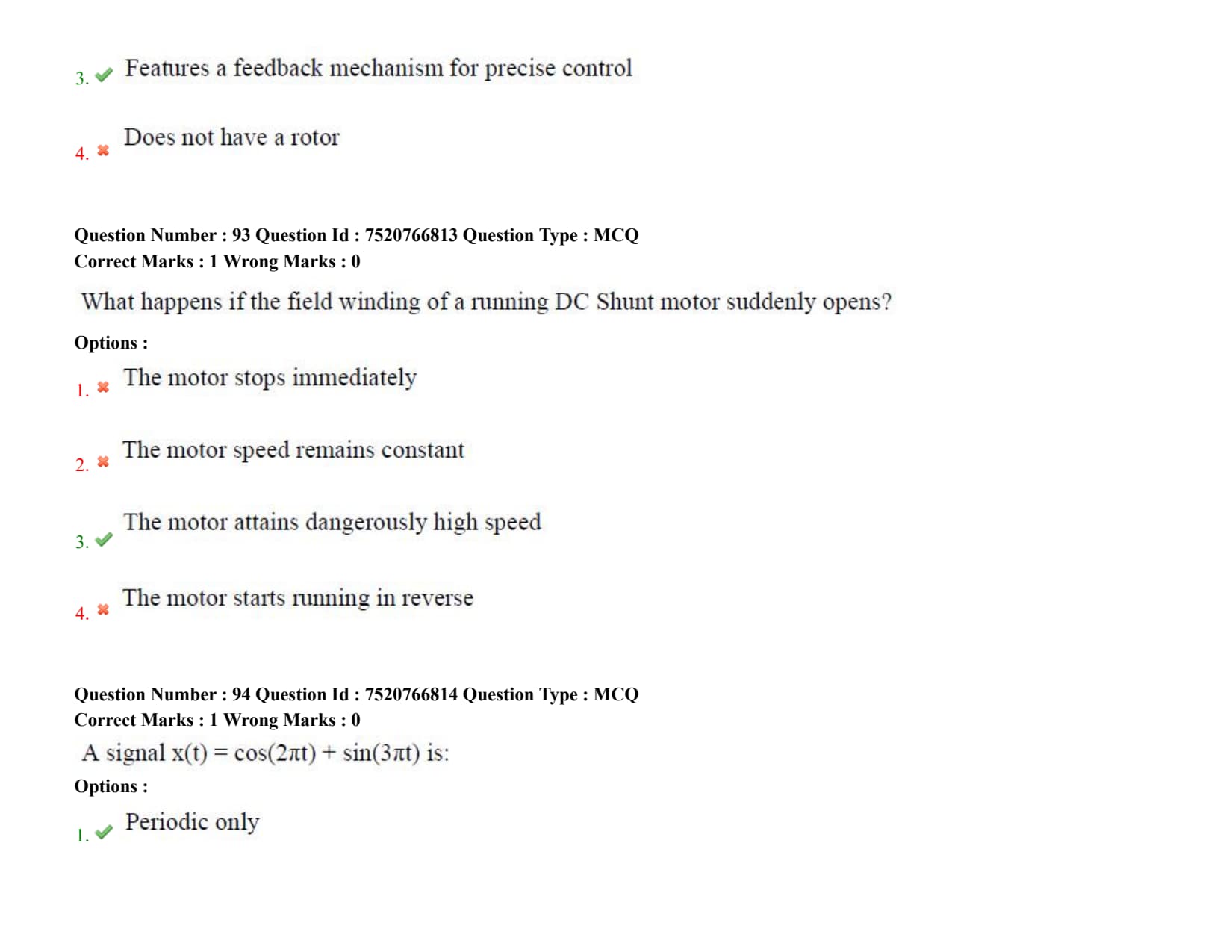
- (C) Features a feedback mechanism for precise control
- (D) Does not have a rotor
Question 93:
What happens if the field winding of a running DC Shunt motor suddenly opens?
- (A) The motor stops immediately
- (B) The motor speed remains constant
- (C) The motor attains dangerously high speed
- (D) The motor starts running in reverse
Question 94:
A signal x(t) = cos(2\(\pi\)t) + sin(3\(\pi\)t) is:
- (A) Periodic only
- (B) Aperiodic only
- (C) Both periodic and even
- (D) Neither periodic nor odd
Question 95:
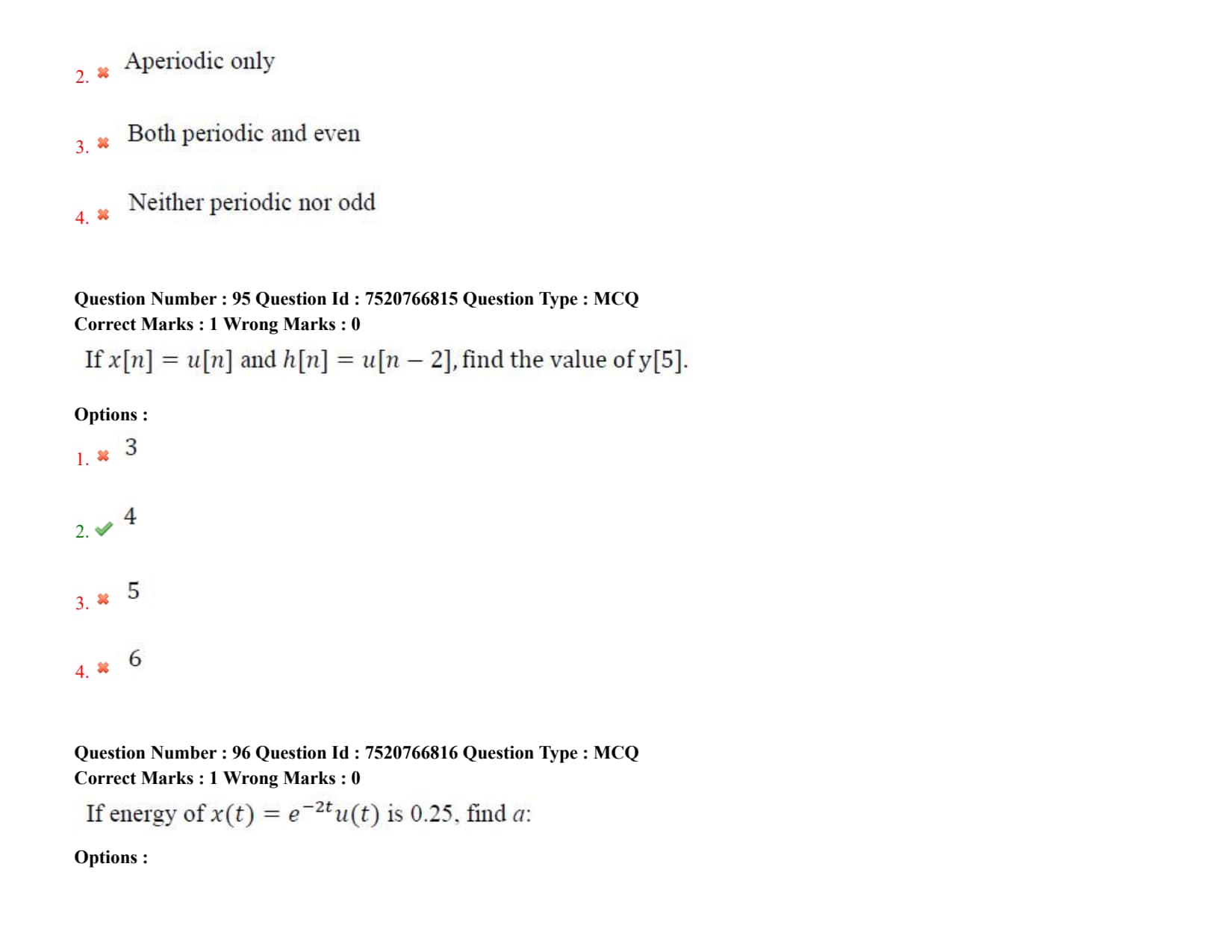
If x[n] = u[n] and h[n] = u[n - 2], find the value of y[5].
Question 96:
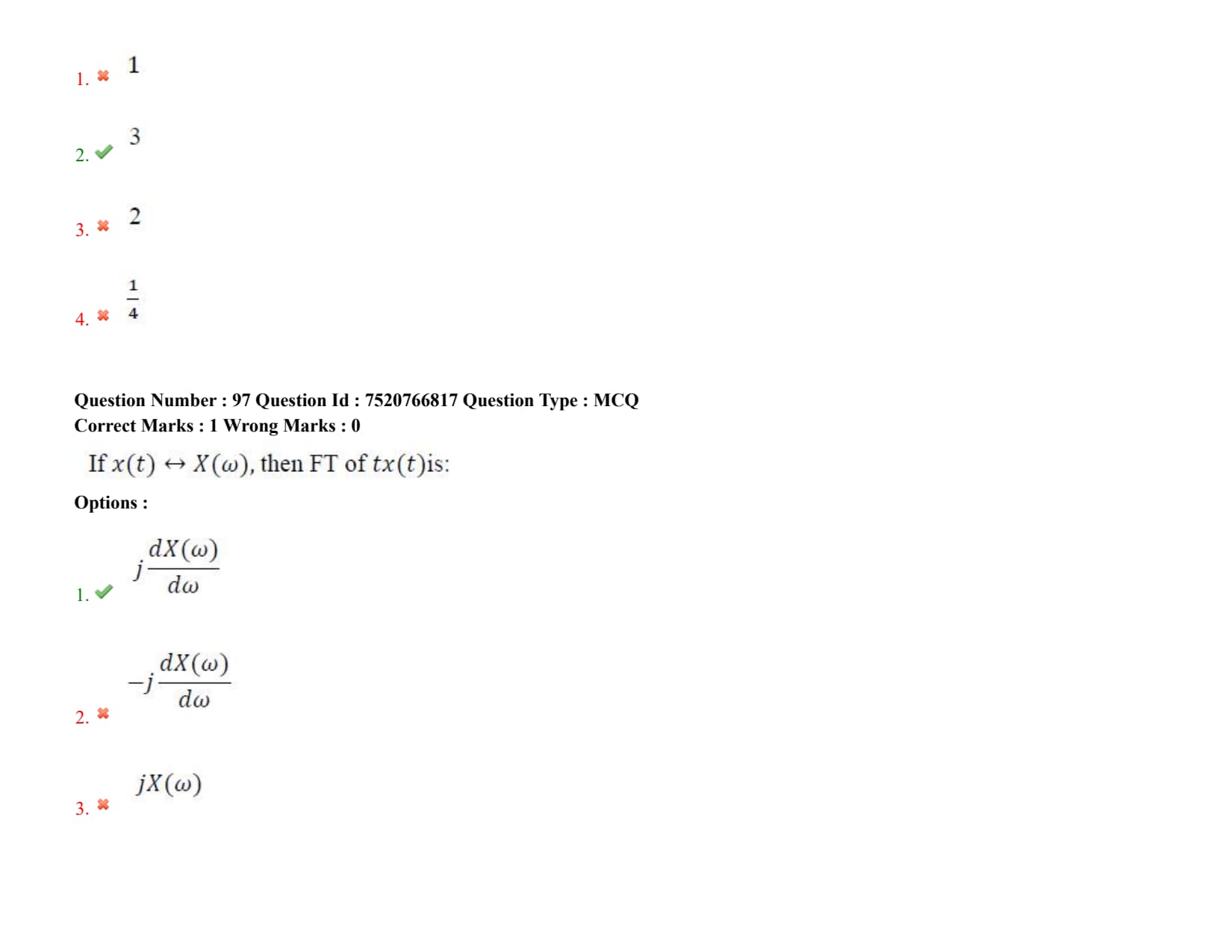
If energy of x(t) = e\(^{-2t}\)u(t) is 0.25, find a:
- (A) 1
- (B) 3
- (C) 2
- (D) 1/4
Question 97:
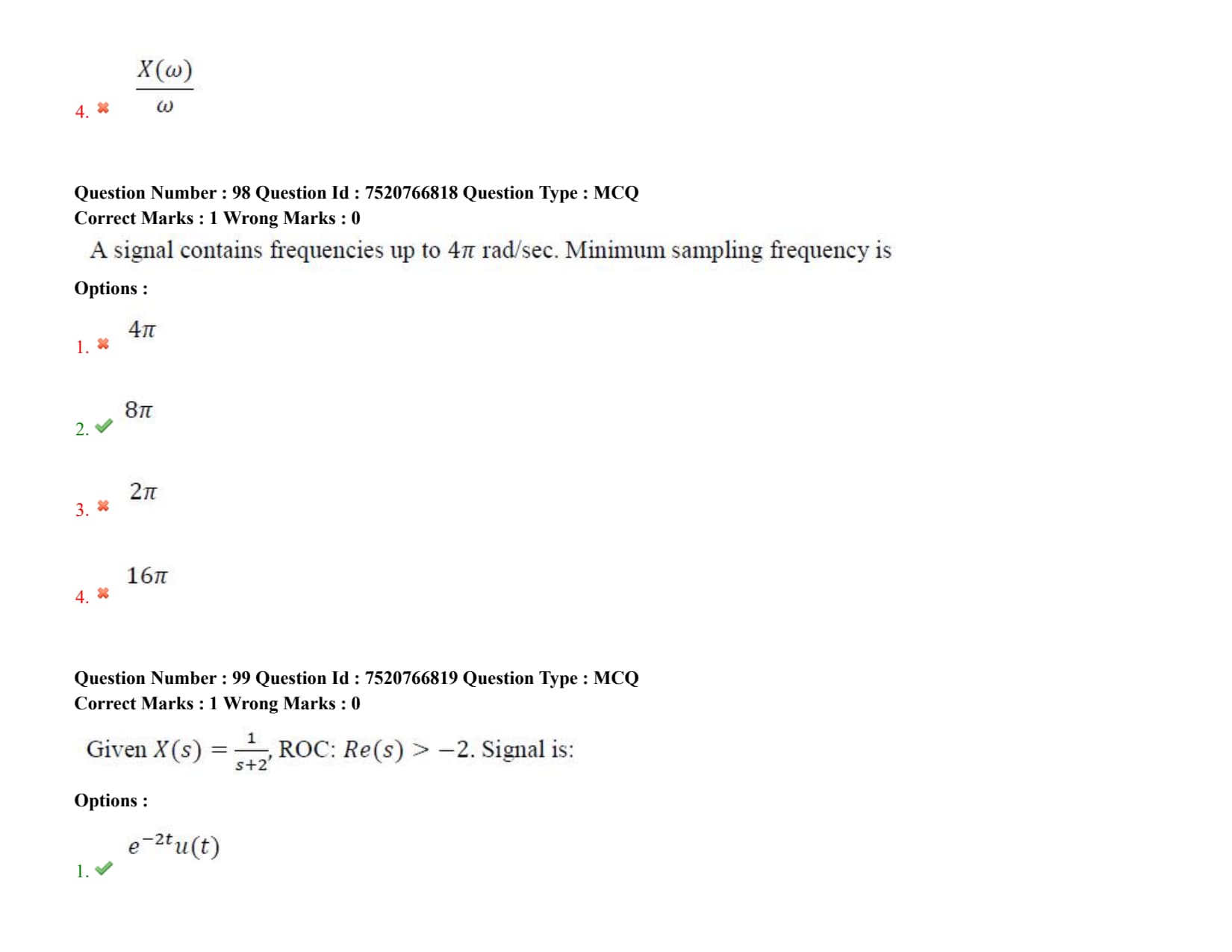
If x(t) \(\leftrightarrow\) X(\(\omega\)), then FT of tx(t) is:
- (A) j \(\frac{dX(\omega)}{d\omega}\)
- (B) -j \(\frac{dX(\omega)}{d\omega}\)
- (C) jX(\(\omega\))
- (D) \(\frac{X(\omega)}{\omega}\)
Question 98:
A signal contains frequencies up to 4\(\pi\) rad/sec. Minimum sampling frequency is:
- (A) 4\(\pi\)
- (B) 8\(\pi\)
- (C) 2\(\pi\)
- (D) 16\(\pi\)
Question 99:
Given X(s) = \(\frac{1}{s+2}\), ROC: Re(s) \(>\) -2. Signal is:
- (A) e\(^{-2t}\)u(t)
- (B) -e\(^{-2t}\)u(-t)
- (C) e\(^{2t}\)u(t)
- (D) e\(^{-2t}\)u(-t)
Question 100:
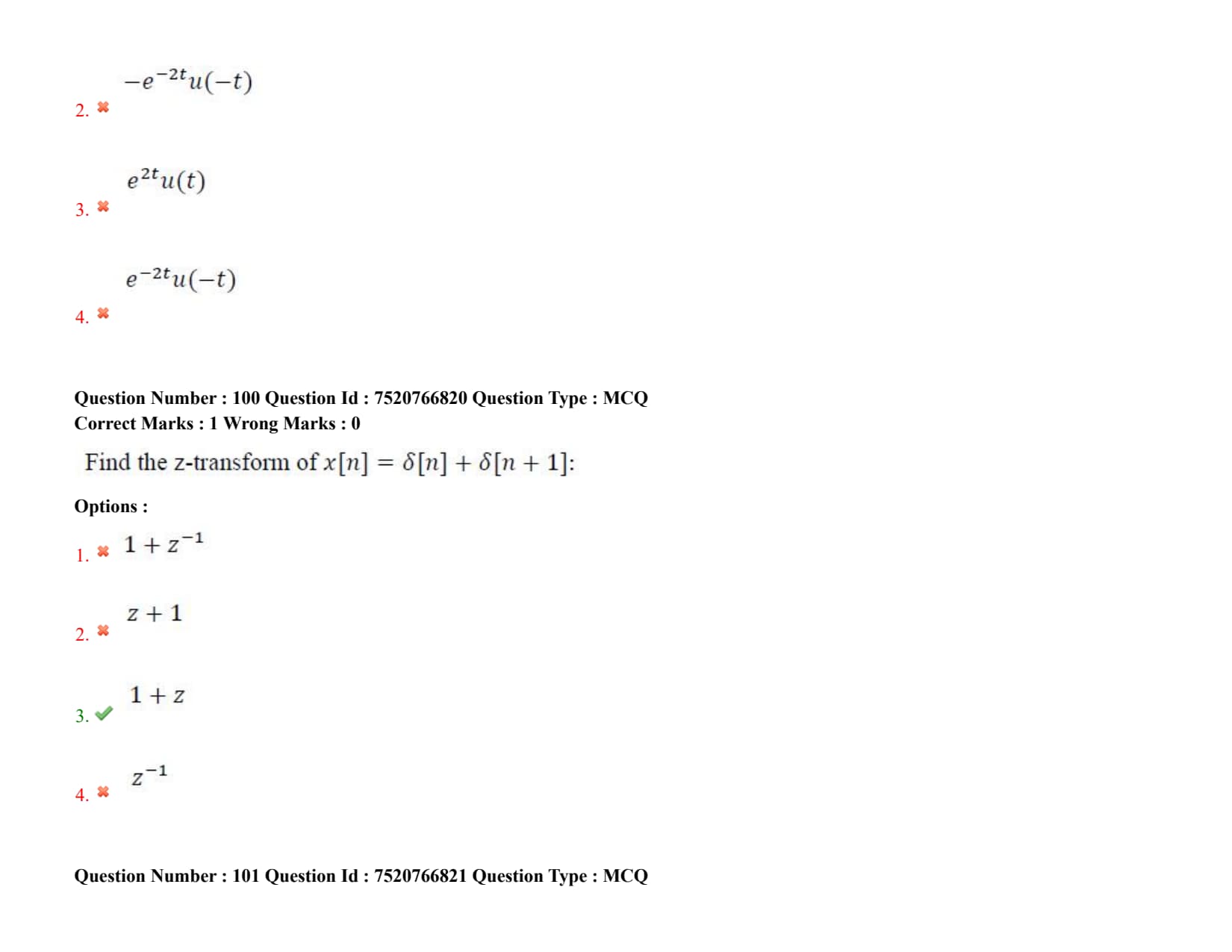
Find the z-transform of x[n] = \(\delta\)[n] + \(\delta\)[n + 1]:
- (A) 1 + z\(^{-1}\)
- (B) z + 1
- (C) 1 + z
- (D) z\(^{-1}\)
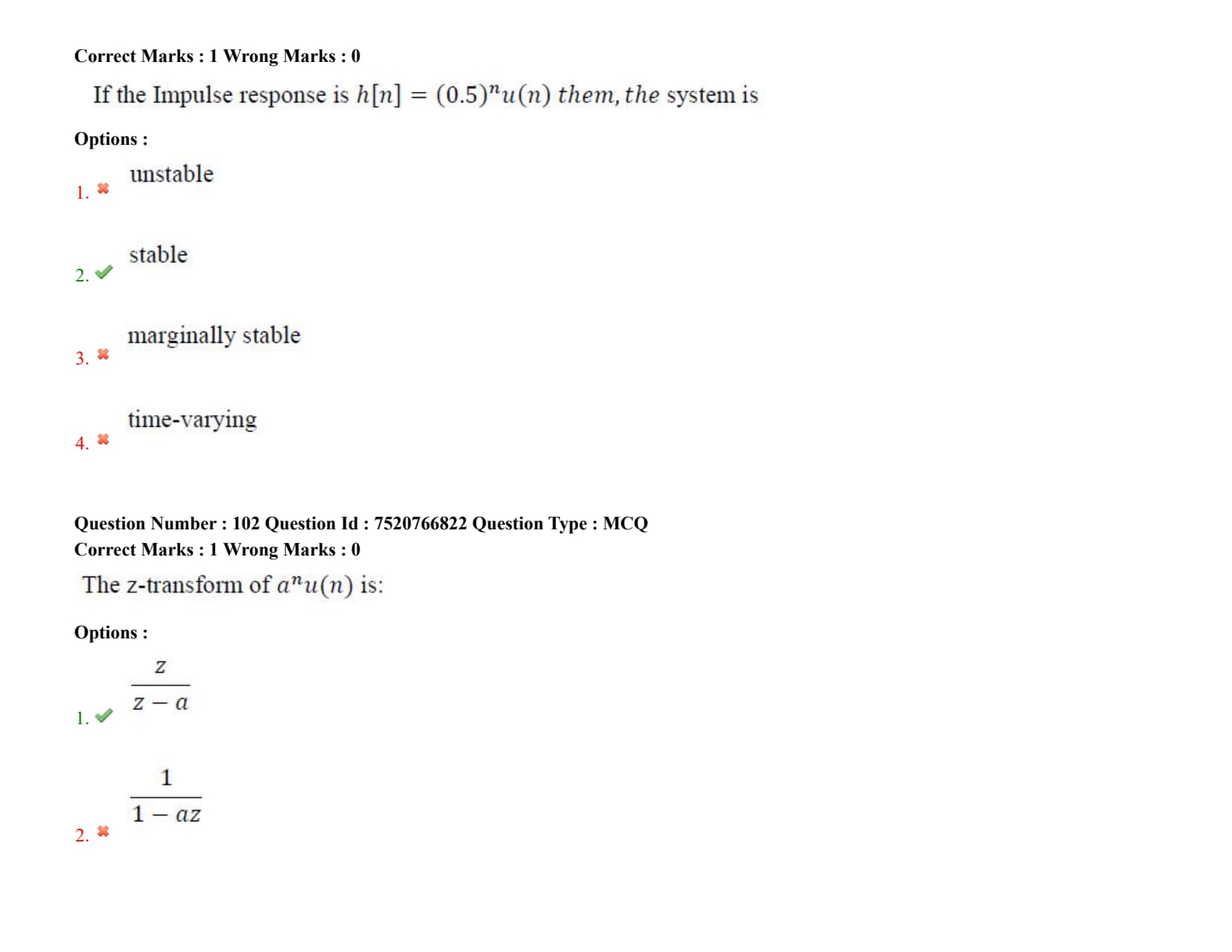
Question 101:
If the Impulse response is \(h[n] = (0.5)^n u(n)\) then, the system is
- (A) unstable
- (B) stable
- (C) marginally stable
- (D) time-varying
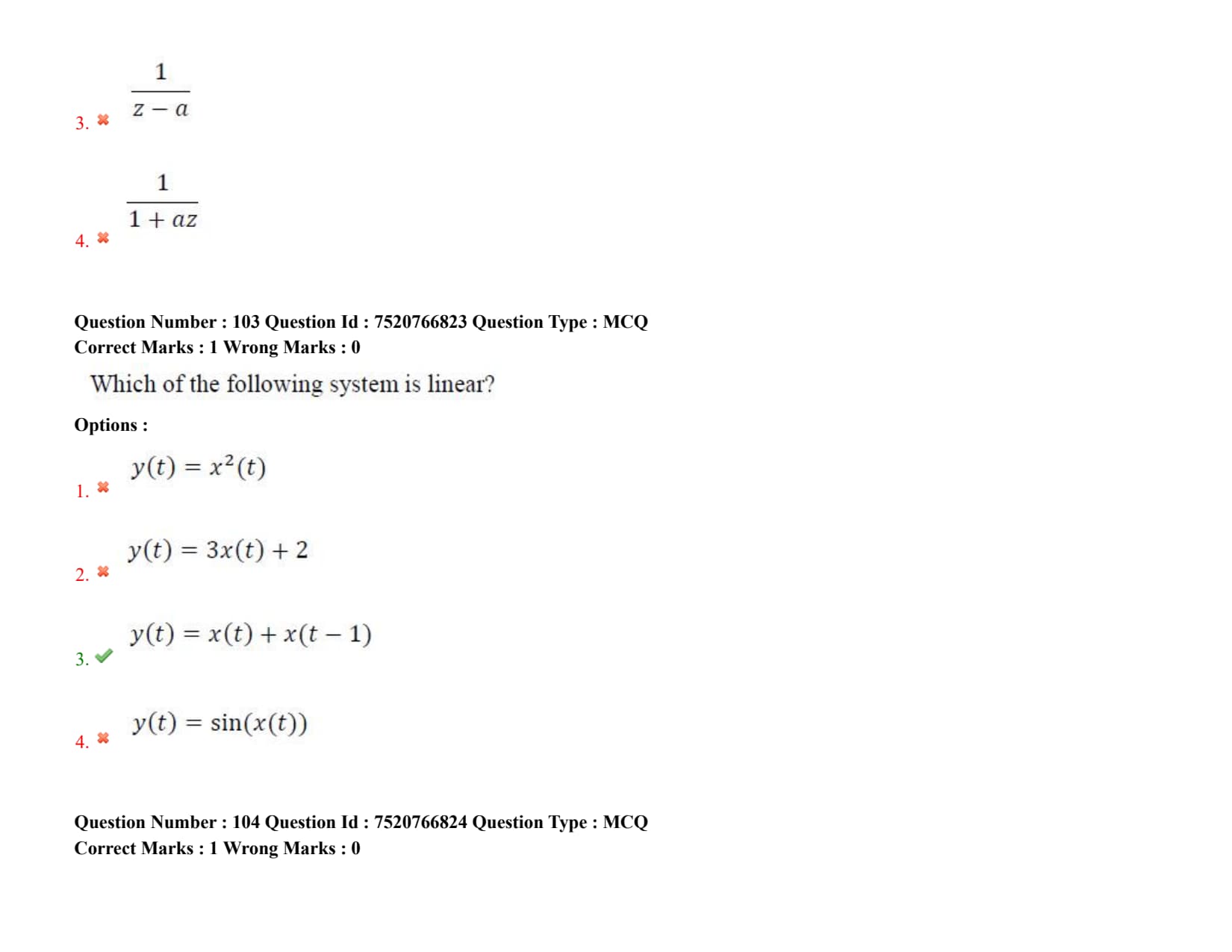
Question 102:
The z-transform of \(a^n u(n)\) is:
- (A) \(\frac{z}{z-a}\)
- (B) \(\frac{1}{1-az}\)
- (C) \(\frac{1}{z-a}\)
- (D) \(\frac{1}{1+az}\)
Question 103:
Which of the following system is linear?
- (A) \(y(t) = x^2(t)\)
- (B) \(y(t) = 3x(t) + 2\)
- (C) \(y(t) = x(t) + x(t - 1)\)
- (D) \(y(t) = \sin(x(t))\)
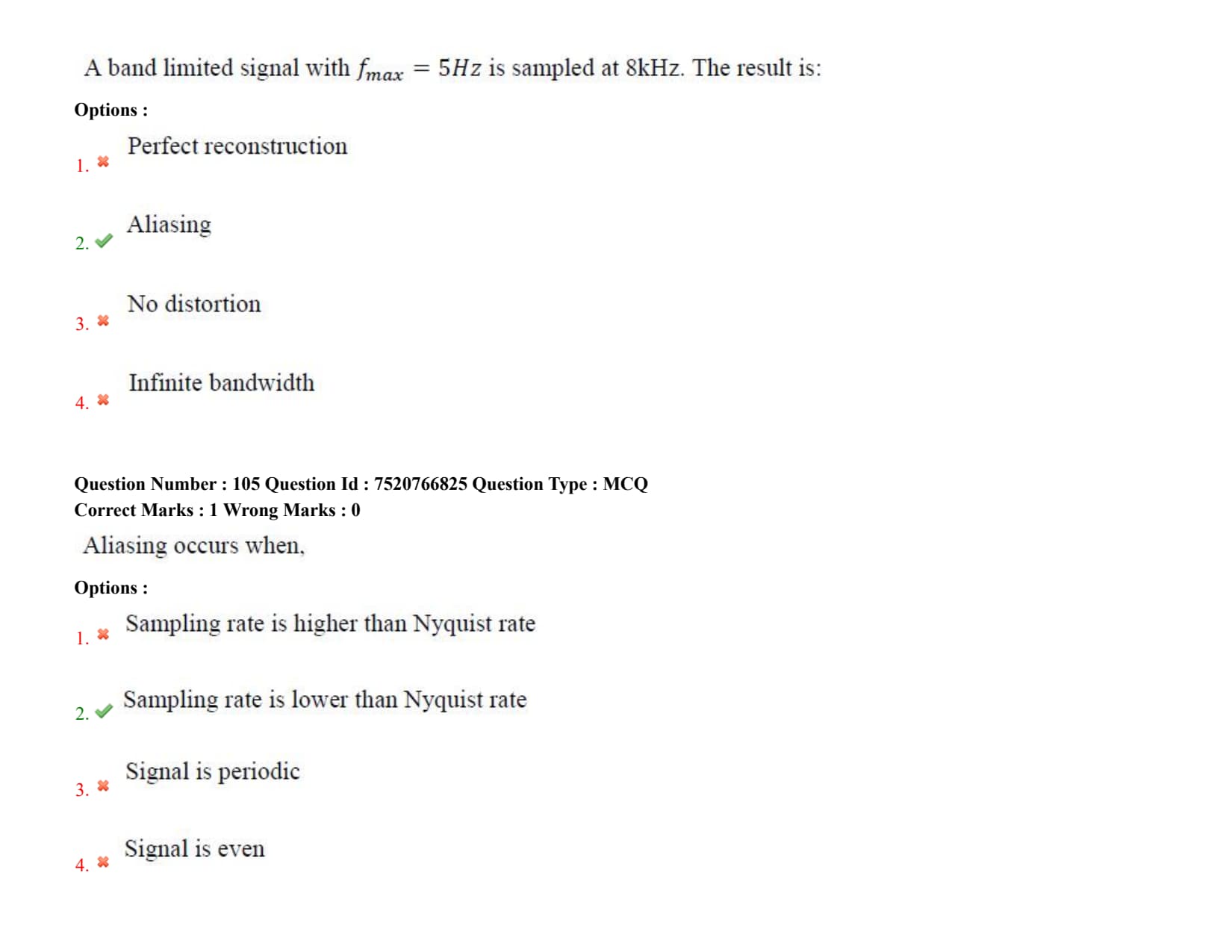
Question 104:
A band limited signal with \(f_{max} = 5Hz\) is sampled at 8kHz. The result is:
- (A) Perfect reconstruction
- (B) Aliasing
- (C) No distortion
- (D) Infinite bandwidth
Question 105:
Aliasing occurs when,
- (A) Sampling rate is higher than Nyquist rate
- (B) Sampling rate is lower than Nyquist rate
- (C) Signal is periodic
- (D) Signal is even
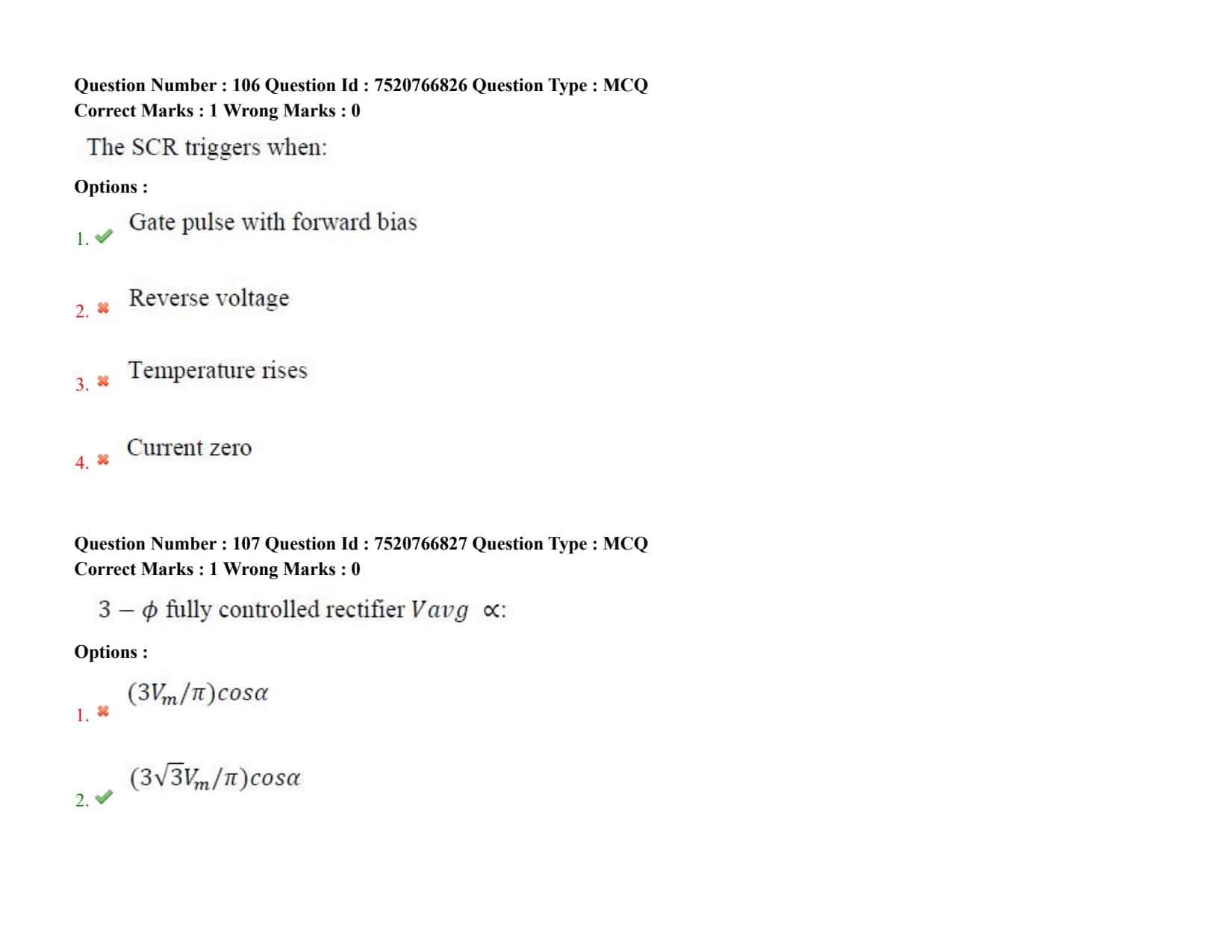
Question 106:
The SCR triggers when:
- (A) Gate pulse with forward bias
- (B) Reverse voltage
- (C) Temperature rises
- (D) Current zero
Question 107:
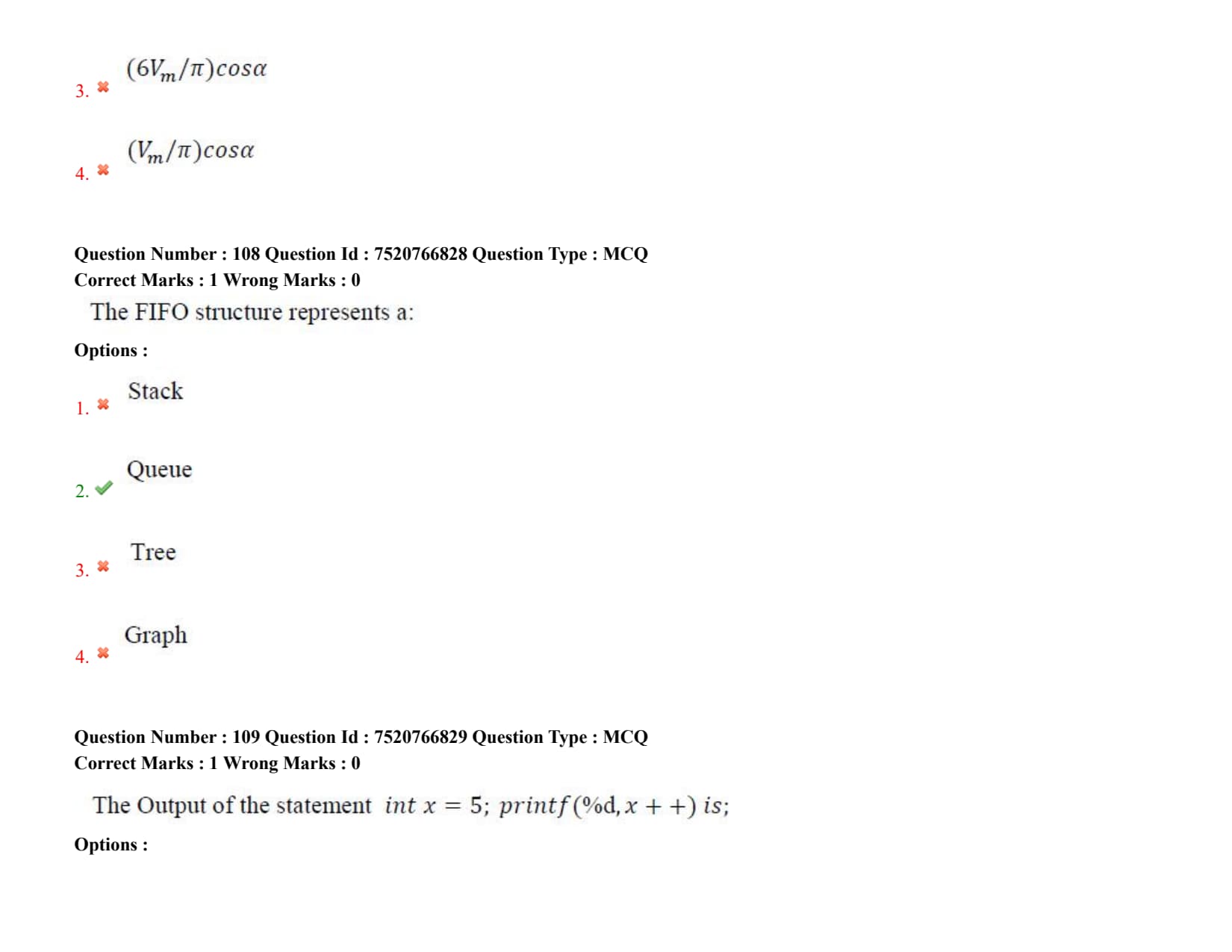
3 - \(\phi\) fully controlled rectifier \(V_{avg} \propto\):
- (A) \((3V_m/\pi)\cos\alpha\)
- (B) \((3\sqrt{3}V_m/\pi)\cos\alpha\)
- (C) \((6V_m/\pi)\cos\alpha\)
- (D) \((V_m/\pi)\cos\alpha\)
Question 108:
The FIFO structure represents a:
- (A) Stack
- (B) Queue
- (C) Tree
- (D) Graph
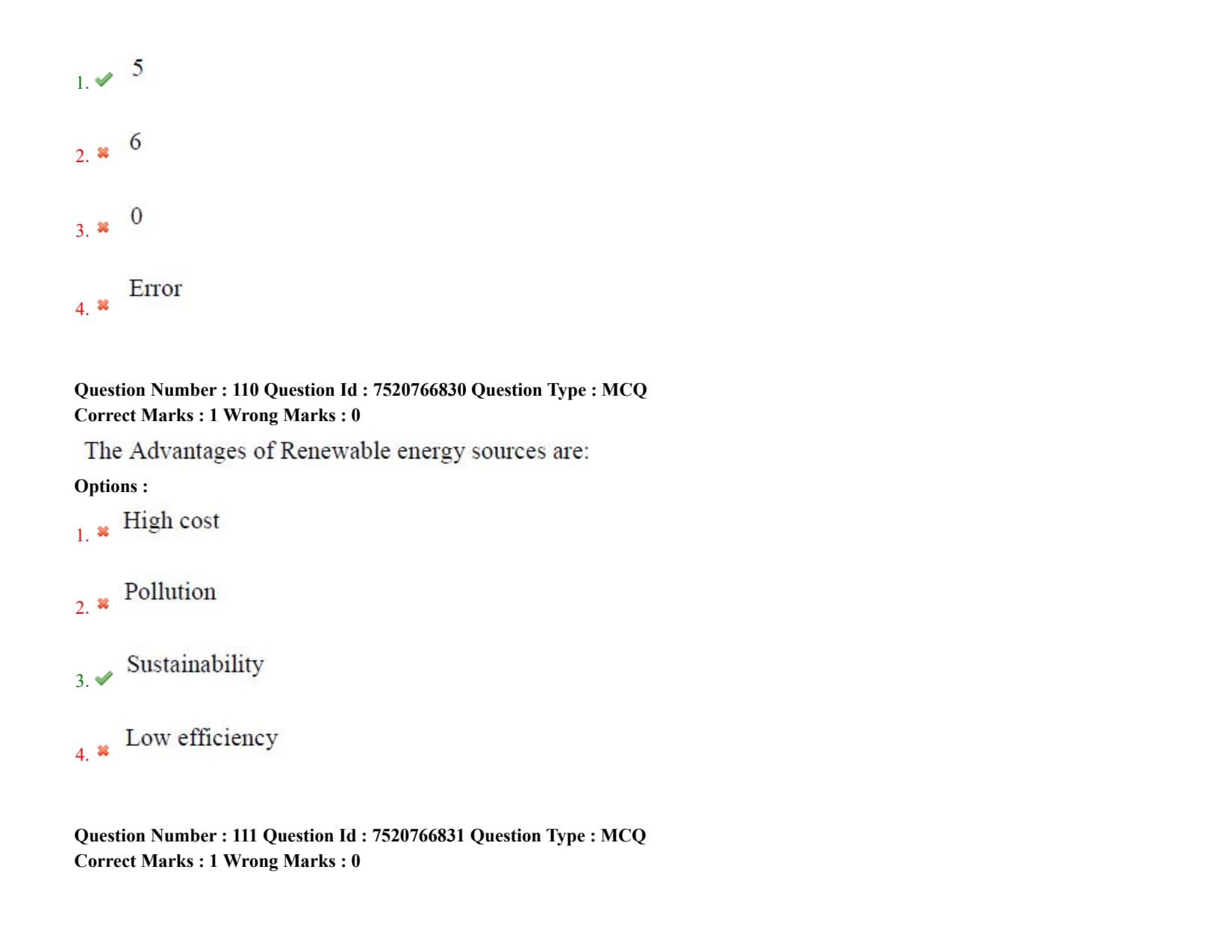
Question 109:
The Output of the statement \(int\ x = 5;\ printf("%d, x++");\) is:
- (A) 5
- (B) 6
- (C) 0
- (D) Error
Question 110:
The Advantages of Renewable energy sources are:
- (A) High cost
- (B) Pollution
- (C) Sustainability
- (D) Low efficiency
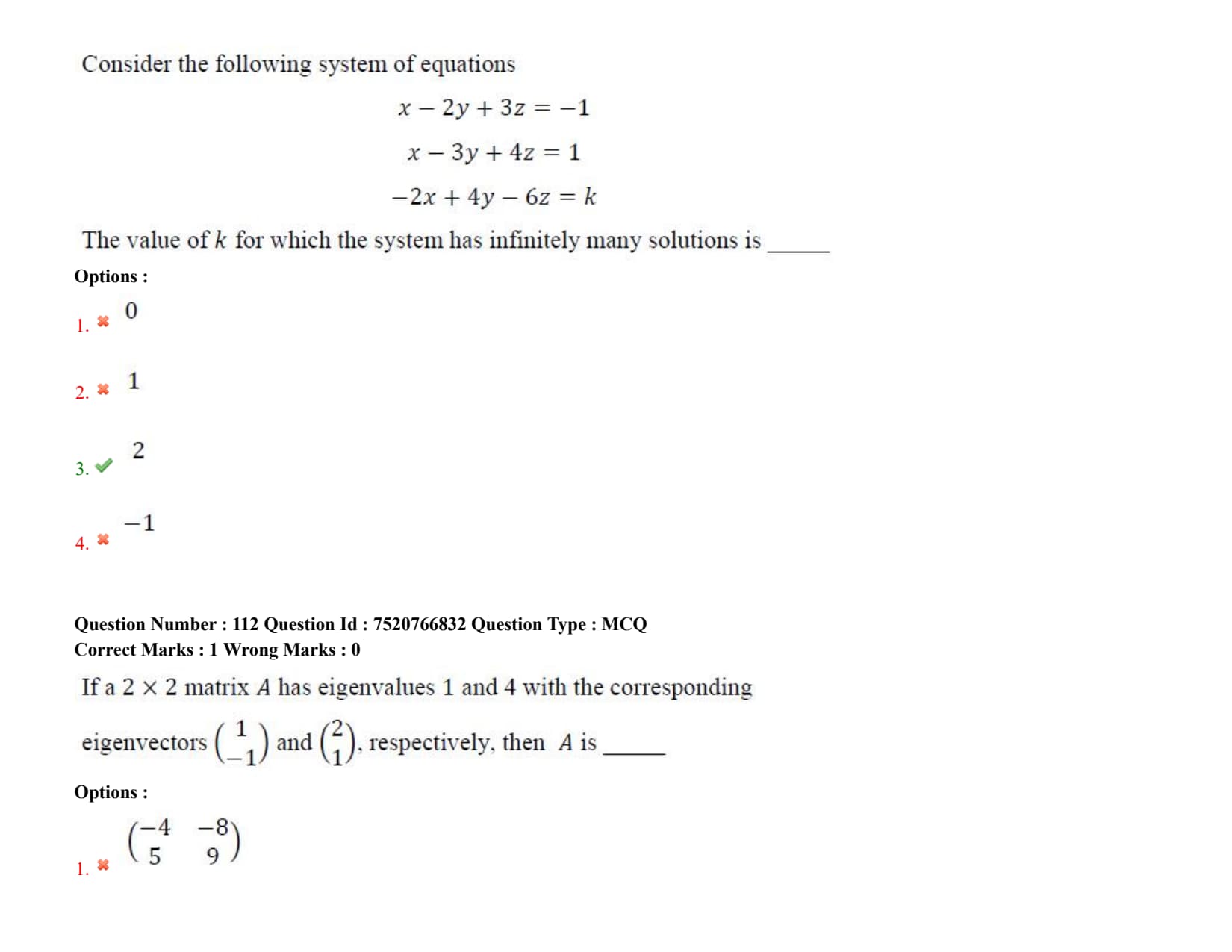
Question 111:
Consider the following system of equations:
\(x - 2y + 3z = -1\)
\(x - 3y + 4z = 1\)
\(-2x + 4y - 6z = k\)
The value of \(k\) for which the system has infinitely many solutions is _______
Question 112:
If a \(2 \times 2\) matrix \(A\) has eigenvalues 1 and 4 with the corresponding eigenvectors \(\begin{pmatrix} 1
-1 \end{pmatrix}\) and \(\begin{pmatrix} 2
1 \end{pmatrix}\), respectively, then \(A\) is _______
- (A) \(\begin{pmatrix} -4 & -8
5 & 9 \end{pmatrix}\)
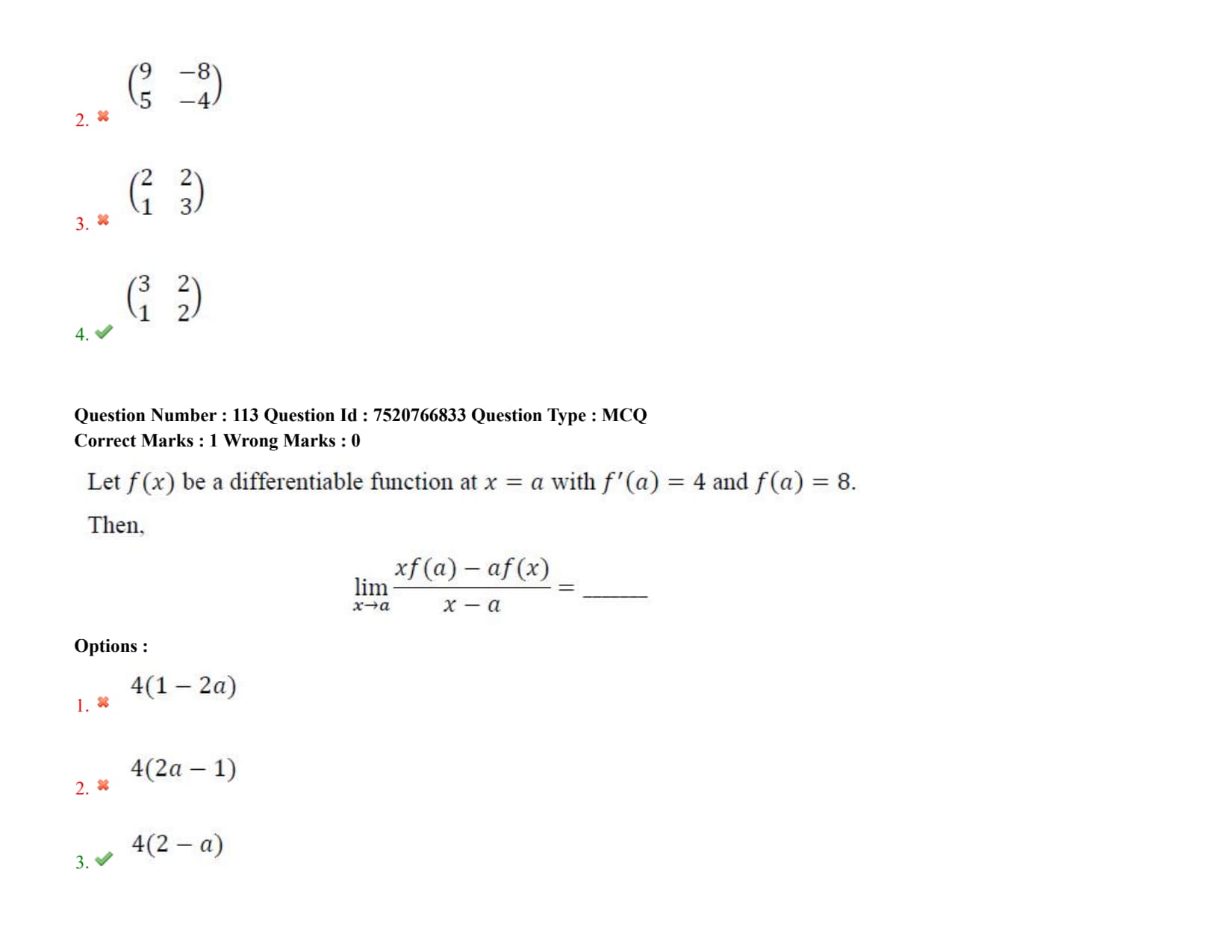
- (B) \(\begin{pmatrix} 9 & -8
5 & -4 \end{pmatrix}\)
- (C) \(\begin{pmatrix} 2 & 2
1 & 3 \end{pmatrix}\)
- (D) \(\begin{pmatrix} 3 & 2
1 & 2 \end{pmatrix}\)
Question 113:
Let \(f(x)\) be a differentiable function at \(x = a\) with \(f'(a) = 4\) and \(f(a) = 8\). Then, \(\lim_{x\to a} \frac{xf(a) - af(x)}{x - a} = \)_______
- (A) \(4(1 - 2a)\)
- (B) \(4(2a - 1)\)
- (C) \(4(2 - a)\)
- (D) \(4(a - 2)\)
Question 114:
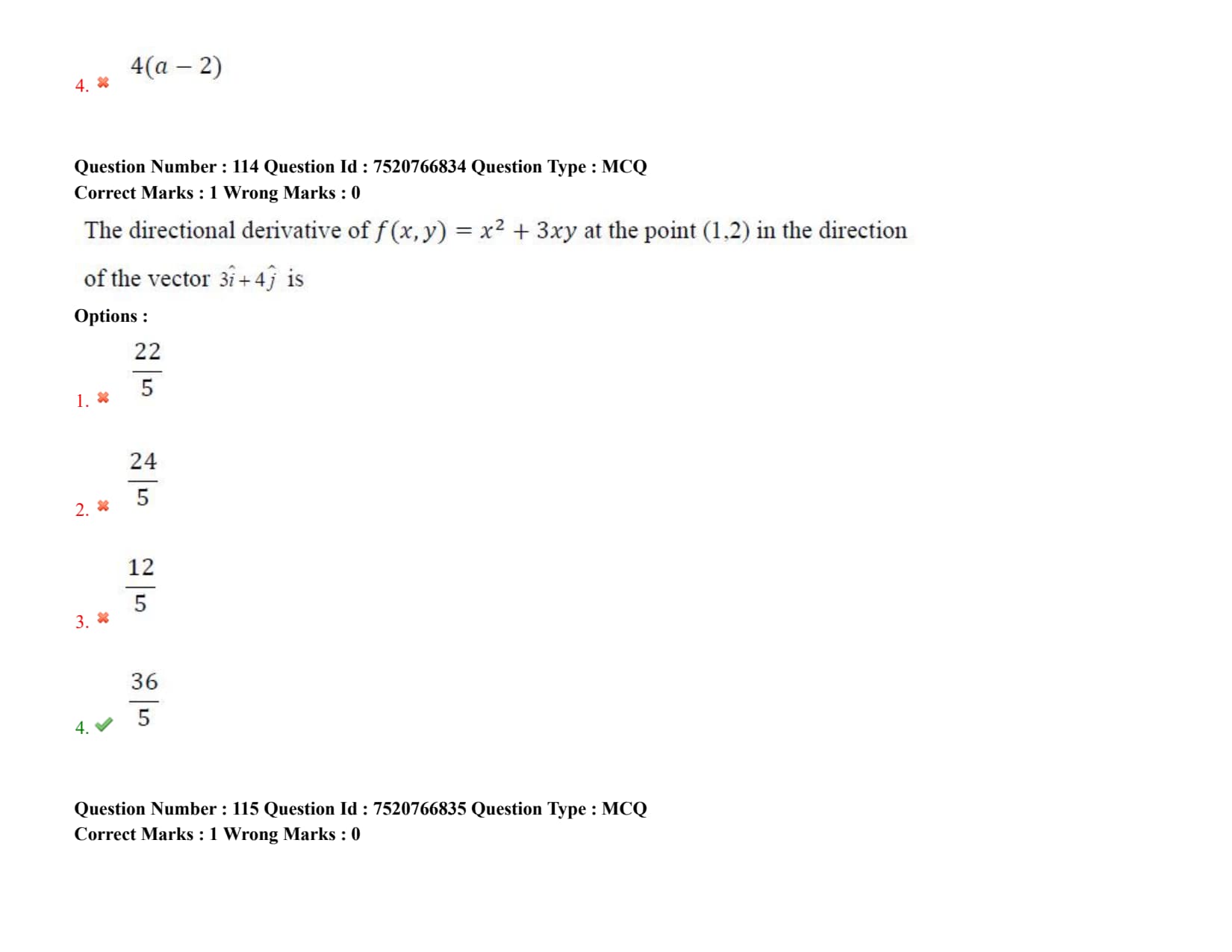
The directional derivative of \(f(x,y) = x^2 + 3xy\) at the point (1,2) in the direction of the vector \(3\hat{i} + 4\hat{j}\) is
- (A) \(\frac{22}{5}\)
- (B) \(\frac{24}{5}\)
- (C) \(\frac{12}{5}\)
- (D) \(\frac{36}{5}\)
Question 115:
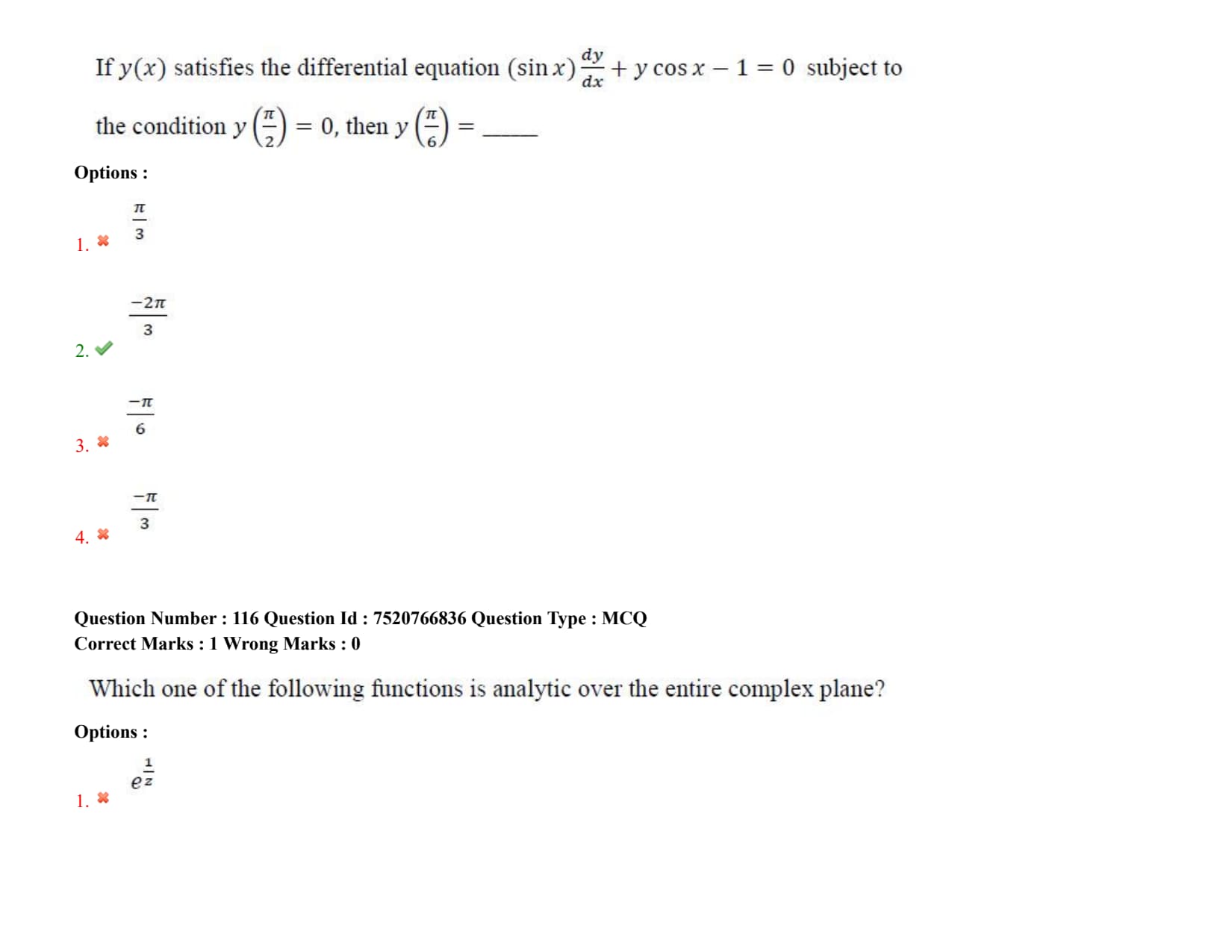
If \(y(x)\) satisfies the differential equation \((\sin x)\frac{dy}{dx} + y \cos x - 1 = 0\) subject to the condition \(y\left(\frac{\pi}{2}\right) = 0\), then \(y\left(\frac{\pi}{6}\right) = \)_______
- (A) \(\frac{\pi}{3}\)
- (B) \(\frac{-2\pi}{3}\)
- (C) \(\frac{-\pi}{6}\)
- (D) \(\frac{-\pi}{3}\)
Question 116:
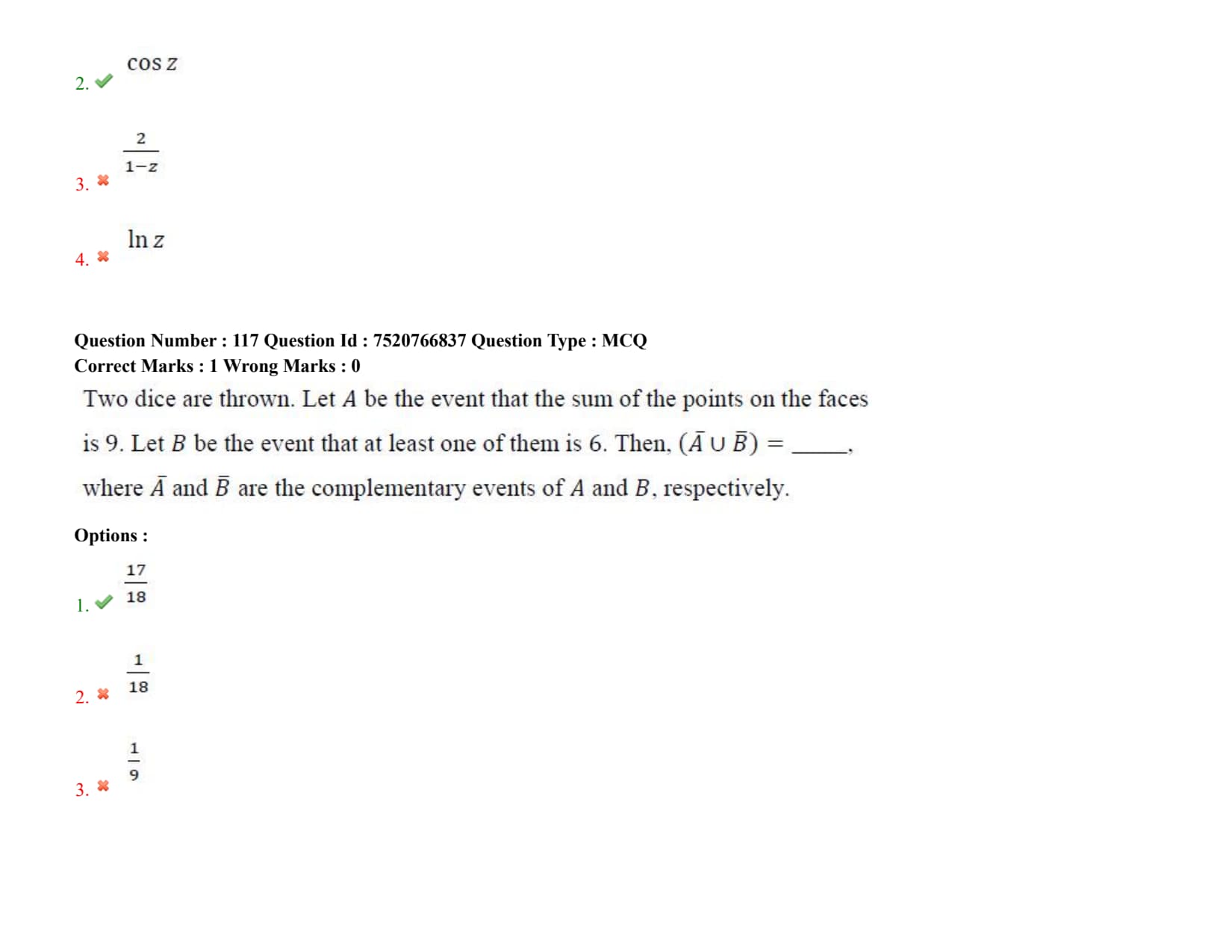
Which one of the following functions is analytic over the entire complex plane?
- (A) \(e^{\frac{1}{z}}\)
- (B) \(\cos z\)
- (C) \(\frac{2}{1-z}\)
- (D) \(\ln z\)
Question 117:
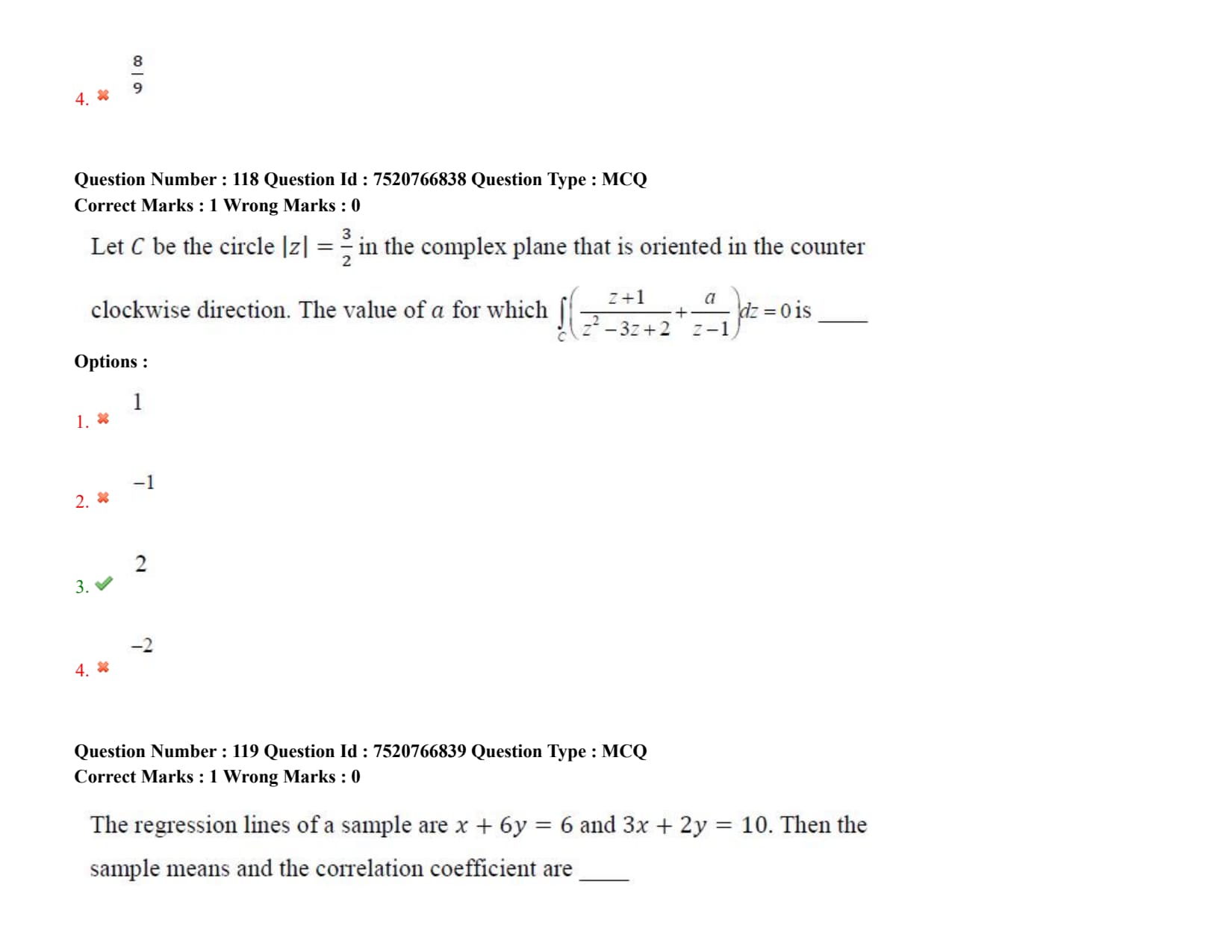
Two dice are thrown. Let \(A\) be the event that the sum of the points on the faces is 9. Let \(B\) be the event that at least one of them is 6. Then, \((\bar{A} \cup \bar{B}) = \)_______
- (A) \(\frac{17}{18}\)
- (B) \(\frac{1}{18}\)
- (C) \(\frac{1}{9}\)
- (D) \(\frac{8}{9}\)
Question 118:
Let \(C\) be the circle \(|z| = \frac{3}{2}\) in the complex plane that is oriented in the counter-clockwise direction. The value of \(a\) for which \(\int_C \left(\frac{z+1}{z^2 - 3z + 2} + \frac{a}{z-1}\right) dz = 0\) is _______
- (A) 1
- (B) -1
- (C) 2
- (D) -2
Question 119:
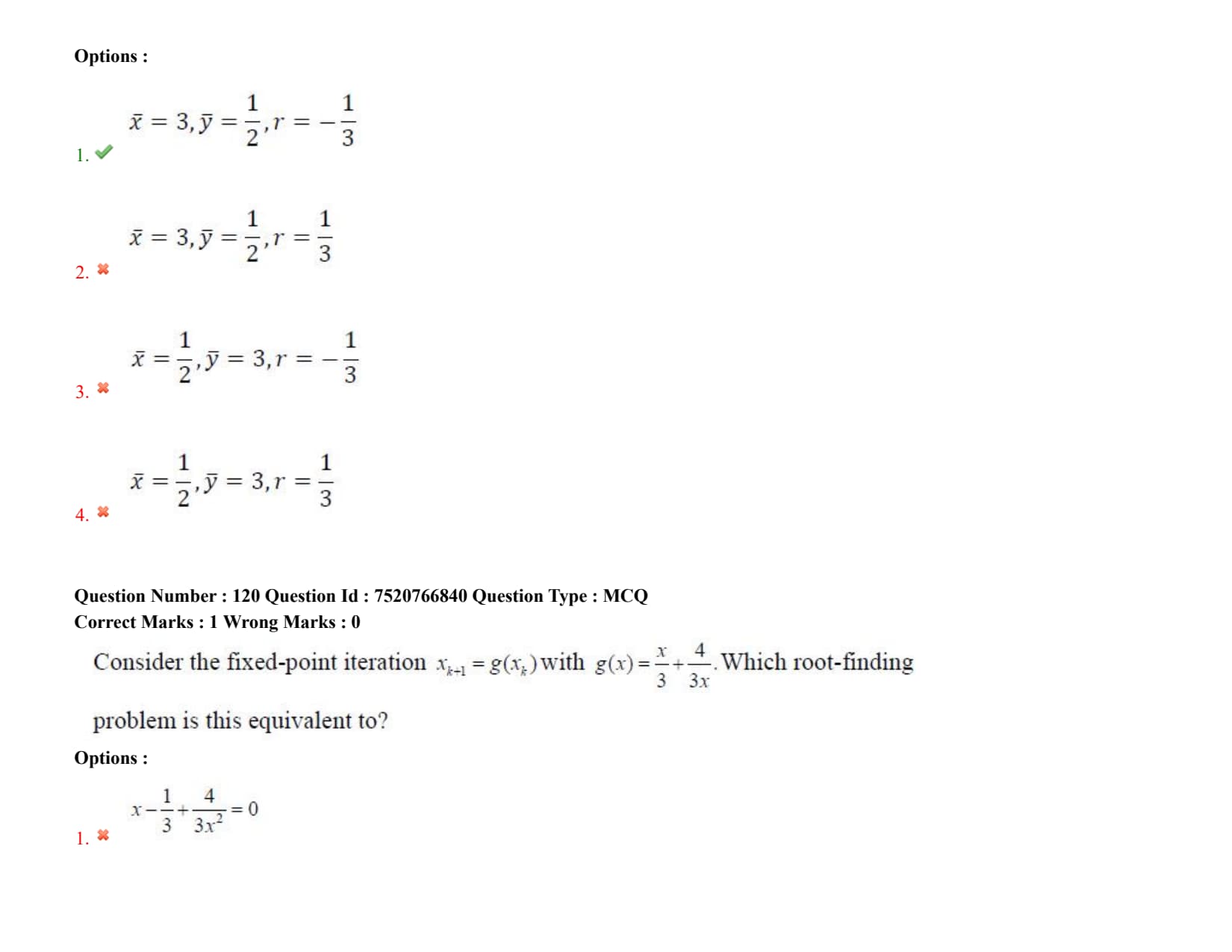
The regression lines of a sample are \(x + 6y = 6\) and \(3x + 2y = 10\). Then the sample means and the correlation coefficient are
- (A) \(\bar{x} = 3, \bar{y} = \frac{1}{2}, r = -\frac{1}{3}\)
- (B) \(\bar{x} = 3, \bar{y} = \frac{1}{2}, r = \frac{1}{3}\)
- (C) \(\bar{x} = \frac{1}{2}, \bar{y} = 3, r = -\frac{1}{3}\)
- (D) \(\bar{x} = \frac{1}{2}, \bar{y} = 3, r = \frac{1}{3}\)
Question 120:
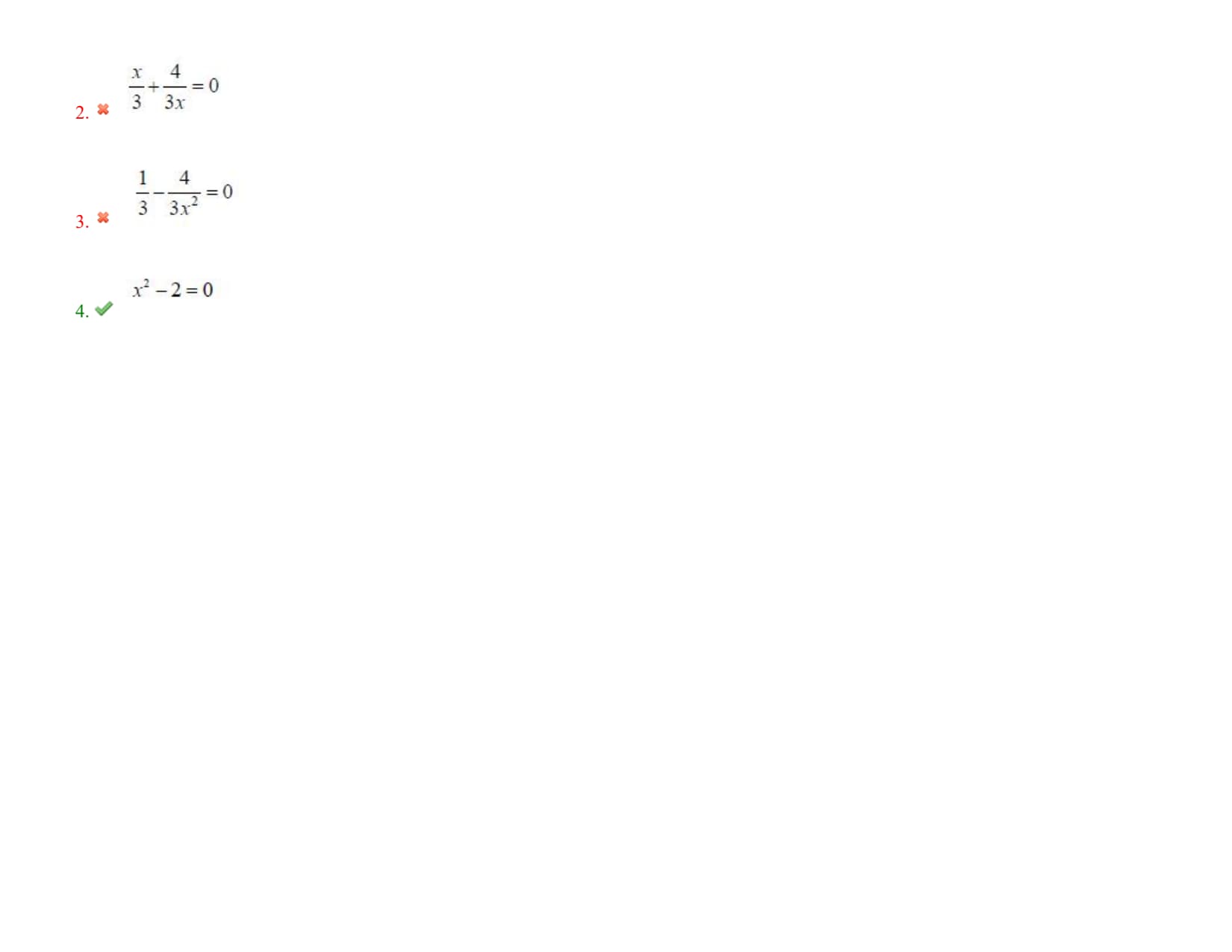
Consider the fixed-point iteration \(x_{k+1} = g(x_k)\) with \(g(x) = \frac{x}{3} + \frac{4}{3x}\). Which root-finding problem is this equivalent to?
- (A) \(x - \frac{1}{3} + \frac{4}{3x^2} = 0\)
- (B) \(\frac{x}{3} + \frac{4}{3x} = 0\)
- (C) \(\frac{1}{3} - \frac{4}{3x^2} = 0\)
- (D) \(x^2 - 2 = 0\)
AP PGECET 2026 Electrical Engineering Topic-wise weightage
| Major Subject |
Approx. Number of Questions |
Expected % (Approx.) |
| Engineering Mathematics |
12–18 |
10–15% |
| Electric Circuits |
14–18 |
12–15% |
| Power Systems |
14–18 |
12–15% |
| Control Systems |
12–16 |
10–13% |
| Electrical Machines |
12–16 |
10–13% |
| Power Electronics |
10–14 |
8–12% |
| Signals & Systems |
8–12 |
7–10% |
| Measurements & Instrumentation |
8–12 |
7–10% |
AP PGECET 2026 Preparation Strategy








Comments