




UCEED 2027 syllabus covers visual reasoning, logical thinking, observation, design awareness, creativity, drawing, and design aptitude. Conducted by IIT Bombay, the Undergraduate Common Entrance Examination for Design (UCEED) is used for admission to Bachelor of Design (B.Des.) programmes at participating institutes.
UCEED 2027 consists of Part A and Part B, which assess different but complementary design skills. Candidates preparing for UCEED 2027 should understand the complete syllabus, analyse previous-year question papers, and practise both objective questions and design-based problems.
- UCEED 2027 Part A syllabus includes topics like Visualization & spatial reasoning, practical & scientific knowledge, observation & design sensitivity, environment and society, analytical & logical reasoning, language, and creativity.
- UCEED 2027 Part B syllabus includes drawing and design aptitude topics.
- Drawing and design aptitude in UCEED have traditionally been assessed through two questions carrying 50 marks each under the recent exam pattern.
- UCEED 2027 Important topics include Visual reasoning, pattern recognition, analytical reasoning, everyday observation, design awareness, perspective drawing, and problem-solving.
- UCEED 2027 preparation strategy must focus on practising PYQs, building a topic-wise error log, and developing drawing and design-thinking skills through regular timed exercises.
Related Articles:
Ques. What is the Difference Between UCEED Part A and Part B?
Ans. Part A evaluates a candidate's ability to interpret visual information, solve problems, reason logically, and understand design-related concepts. Part B assesses the ability to communicate ideas visually and develop appropriate solutions to design problems.
Both parts are important for preparation. Candidates should not treat Part B as merely a sketching test because design aptitude also requires practical thinking, creativity, and empathy.
Ques. Is the UCEED 2027 syllabus officially released?
Ans. Yes. IIT Bombay has published the UCEED 2027 syllabus on its official website. You can download the UCEED 2027 syllabus at uceed.iitb.ac.in.
Ques. Is UCEED Part A more important than Part B?
Ans. Part A is important because it determines shortlisting for Part B evaluation. However, Part B also contributes substantially to the final score under the recent examination pattern.
UCEED 2027 Previous Years’ Question Papers
| UCEED Exam Year | UCEED 2027 Question Paper PDF |
|---|---|
| UCEED 2026 | Download PDF |
| UCEED 2025 | Download PDF |
| UCEED 2024 | Download PDF |
| UCEED 2023 | Download PDF |
| UCEED 2022 | Download PDF |
| UCEED 2021 | Download PDF |
| UCEED 2020 | Download PDF |
| UCEED 2019 | Download PDF |
| UCEED 2018 | Download PDF |
| UCEED 2017 | Download PDF |
| UCEED 2016 | Download PDF |
| UCEED 2015 | Download PDF |
UCEED 2027 Part A Syllabus: Topic-Wise Details
The UCEED Part A syllabus contains seven broad areas. Rather than studying each area in isolation, candidates should group related skills together to improve their preparation efficiency.
| Part A Topic | What It Tests | Suggested Practice Areas |
|---|---|---|
| Visualization and spatial reasoning | Understanding spatial relationships | 2D-to-3D visualization, rotations, folding, object views |
| Practical and scientific knowledge | Applying everyday and scientific principles | Mechanisms, materials, object functions, physical principles |
| Observation and design sensitivity | Detecting details and interpreting visual information | Visual differences, classification, inference, usability |
| Environment and society | Understanding design in social and environmental contexts | Sustainability, cultural practices, public spaces |
| Analytical and logical reasoning | Solving qualitative and quantitative problems | Patterns, sequences, logic puzzles, data interpretation |
| Language | Reading and understanding Standard English | Comprehension, contextual meaning, verbal relationships |
| Creativity | Understanding relationships between ideas and symbols | Analogies, metaphors, signs, symbols |
UCEED 2027 Syllabus for Visualization and Spatial Reasoning
This topic in the UCEED 2027 syllabus assesses how effectively candidates can imagine, rotate, transform, and interpret two-dimensional shapes and three-dimensional objects.
Topics to practise:
- 2D and 3D shape relationships
- Mental rotation and spatial orientation
- Paper folding and cutting
- Cube and object visualization
- Front, side, and top views
- Counting and interpreting visual figures
Preparation tip: Solve visual reasoning questions without immediately relying on diagrams or explanations. Practise identifying how an object changes when rotated, folded, or viewed from another angle.
UCEED 2027 Syllabus for Practical and Scientific Knowledge
This area in the UCEED syllabus 2027 tests whether candidates can apply scientific principles and everyday knowledge to unfamiliar situations.
Topics to practise:
- Functions of everyday objects
- Basic physical principles
- Materials and their properties
- Simple mechanisms and moving parts
- Practical problem-solving
- Relationships between form and function
Preparation tip: Observe how everyday products work. Ask why a particular material, shape, handle, hinge, or arrangement is suitable for its intended use.
UCEED 2027 Syllabus for Observation and Design Sensitivity
Observation and design sensitivity in the UCEED syllabus 2027 measure the ability to notice details, identify hidden properties, compare alternatives, and make logical inferences.
Topics to practise:
- Visual comparison and classification
- Identifying differences and inconsistencies
- Interpreting visual clues
- Analysing product usability
- Understanding user needs
- Predicting outcomes from available information
Preparation tip: Study everyday products and public spaces. Identify usability problems, confusing layouts, uncomfortable features, or design choices that affect accessibility.
UCEED 2027 Syllabus for Environment and Society
Environment and Society in UCEED syllabus 2027 examines awareness of environmental, cultural, and social relationships relevant to design.
Topics to practise:
- Sustainable design and resource use
- Everyday environmental issues
- Indian culture and traditional practices
- Public spaces and community needs
- Accessibility and inclusive design
- The relationship between society and products
Preparation tip: Develop design awareness through observation and reading. Focus on understanding why a design choice matters rather than memorising isolated facts.
UCEED 2027 Syllabus for Analytical and Logical Reasoning
Analytical and logical reasoning in UCEED syllabus evaluates the ability to interpret information, recognise relationships, and arrive at defensible conclusions.
Topics to practise:
- Pattern and sequence recognition
- Logical deductions
- Quantitative reasoning
- Classification and relationships
- Data interpretation
- Multi-step problem-solving
Preparation tip: Maintain an error log showing whether mistakes result from incorrect assumptions, missed information, slow calculations, or poor time management.
UCEED 2027 Syllabus for Language
The language component in the UCEED syllabus 2027 assesses proficiency in reading and comprehending Standard English.
Topics to practise:
- Reading comprehension
- Contextual vocabulary
- Interpreting statements
- Understanding relationships between words
- Identifying the central idea of a passage
Preparation tip: Read short passages regularly and summarise their central argument in one or two sentences. This improves comprehension without making preparation dependent on rote vocabulary learning.
UCEED 2027 Syllabus for Creativity
UCEED Creativity syllabus assesses the ability to recognise and interpret relationships between words, images, signs, symbols, and concepts.
Topics to practise:
- Verbal and non-verbal analogies
- Metaphors and symbolic meaning
- Visual associations
- Signs and symbols
- Alternative interpretations
- Connections between unrelated ideas
Preparation tip: Practise explaining why two apparently different ideas are connected. This develops flexible thinking and helps candidates interpret unfamiliar visual and verbal problems.
How Should Candidates Cluster the UCEED Part A Syllabus?
For preparation, the seven official areas can be grouped into four connected skill clusters. These clusters are an editorial study framework, not official UCEED sections.
| Study Cluster | Related Topics | Main Objective |
|---|---|---|
| Visual thinking | Visualization, observation, creativity | Interpret shapes, images, patterns, and symbols |
| Reasoning and problem-solving | Analytical reasoning, practical knowledge | Apply logic and solve unfamiliar problems |
| Design and contextual awareness | Environment and society, design sensitivity | Understand people, products, culture, and surroundings |
| Language and interpretation | Language, creativity, observation | Understand meaning, relationships, and context |
This approach reduces repetitive practice. For example, a product-analysis exercise may improve observation, practical knowledge, and design sensitivity simultaneously.
Ques. Which topics are included in UCEED Part A?
Ans. Part A covers visualization and spatial reasoning, practical and scientific knowledge, observation and design sensitivity, environment and society, analytical and logical reasoning, language, and creativity.
Ques. Is mathematics included in the UCEED Part A syllabus?
Ans. Quantitative and analytical problem-solving may be relevant to Part A. Candidates should practise numerical reasoning and mathematical concepts that support problem-solving, while using official syllabus descriptions and previous-year papers to guide preparation.
Ques. Does UCEED Part A include general knowledge?
Ans. Environment, society, culture, and design-related awareness are explicitly included. Candidates should prioritise these syllabus-linked areas rather than relying entirely on broad, unrelated general knowledge.
UCEED 2027 Part A Topic-Wise Weightage
IIT Bombay does not publish a fixed marks distribution for each of the seven syllabus topics. Therefore, the exact topic-wise weightage for UCEED 2027 cannot be confirmed in advance.
A more reliable approach is to distinguish between the official weightage of question types and the estimated topic frequency derived from previous-year papers.
UCEED Part A Question-Type Weightage
The recent pattern used in 2024–2026 provides the following reference distribution:
| Question Type | Questions | Marks | Share of Part A Marks |
|---|---|---|---|
| Numerical Answer Type (NAT) | 14 | 56 | 28% |
| Multiple Select Questions (MSQ) | 15 | 60 | 30% |
| Multiple Choice Questions (MCQ) | 28 | 84 | 42% |
| Total | 57 | 200 | 100% |
UCEED 2027 Part A Topic-Wise Weightage
| UCEED Part A Topic | Approx. Weightage | Priority | Important Topics to Prepare |
|---|---|---|---|
| Visualization and Spatial Reasoning | 20–35% | Very High | 2D–3D conversion, rotation, reflection, paper folding, object views |
| Observation and Design Sensitivity | 18–25% | High | Visual observation, pattern recognition, product usability, design judgement |
| Analytical and Logical Reasoning | 15–25% | High | Logical puzzles, sequences, analogies, figure counting, data interpretation |
| Practical and Scientific Knowledge | 10–15%* | High | Everyday mechanisms, materials, physical principles, product functions |
| Environment and Society | 10–20%* | Moderate–High | Sustainability, Indian culture, social context, environmental awareness |
| Creativity and Design Thinking | 10–15%* | High | Visual associations, symbols, analogies, creative problem-solving |
| Language and English | 5–10%* | Moderate | Reading comprehension, contextual meaning, verbal reasoning |
Ques. Which UCEED Part A topics should be prioritised?
Ans. Use previous-year papers to identify recurring question formats, difficulty levels, and personal weaknesses. The following table is a practical prioritisation framework, not a claim about guaranteed marks.
| Priority | Topic Cluster | Why It Deserves Attention |
|---|---|---|
| High | Visualization and spatial reasoning | Develops core visual interpretation skills |
| High | Analytical and logical reasoning | Builds structured problem-solving ability |
| High | Observation and design sensitivity | Connects visual details with inference |
| High | Practical and scientific knowledge | Tests application to real-world situations |
| Regular revision | Environment and society | Supports contextual and design awareness |
| Regular revision | Creativity | Develops flexible interpretation of concepts |
| Regular revision | Language | Strengthens comprehension and verbal interpretation |
Important: Do not skip a topic solely because it appeared less frequently in one previous paper. UCEED questions can vary considerably from year to year.
UCEED 2027 Part B Syllabus: Drawing and Design Aptitude
Part B evaluates the candidate's ability to communicate ideas visually and respond appropriately to design problems. Under the recent exam pattern, it consists of two questions carrying 50 marks each.
| Part B Topic | Skills Tested | What to Practise |
|---|---|---|
| Drawing | Proportion, composition, perspective, shading, line quality | Objects, people, scenes, spatial arrangement |
| Design aptitude | Creativity, empathy, practical problem-solving | User-centred solutions, product improvements, design scenarios |
UCEED 2027 Syllabus for Drawing
Drawing is not simply about making an attractive picture. Candidates need to communicate the intended scene or object clearly and accurately.
Key areas to practise:
- Proportion and scale
- Perspective and depth
- Composition and visual hierarchy
- Line quality and clarity
- Shading and tonal contrast
- Drawing people, products, and scenes
Preparation tip: Complete timed sketches using everyday objects and familiar environments. Review whether the drawing communicates the idea clearly, rather than judging it only on artistic style.
UCEED 2027 Syllabus for Design Aptitude
Design aptitude evaluates how candidates respond to a problem or situation with ingenuity and empathy.
Key areas to practise:
- Identifying the user's actual problem
- Generating practical design solutions
- Improving everyday products
- Considering usability and accessibility
- Communicating a concept through sketches
- Balancing creativity with feasibility
Preparation tip: For each practice problem, identify the target user, define the problem, develop alternative solutions, and sketch the most appropriate concept. Explain how the solution addresses the user's needs.
How can candidates improve their Part B performance?
- Practise drawing under time limits.
- Use previous-year questions to understand the expected level of detail.
- Focus on communicating ideas instead of adding unnecessary decoration.
- Develop a consistent process for interpreting design problems.
- Review every drawing for proportion, composition, perspective, and clarity.
- Test whether each proposed solution is practical for its intended user.
Ques. How many questions are asked in UCEED Part B?
Under the recent pattern, Part B contains two questions: one drawing-based and one design aptitude-based.
Ques. Is drawing the only skill tested in UCEED Part B?
No. Part B also assesses the ability to develop practical, appropriate, and creative responses to design problems.
Ques. Does UCEED Part B require shading and perspective?
Yes. The official syllabus explicitly mentions line quality, composition, proportion, perspective, and shading as elements of drawing ability.
UCEED 2027 Topic-Wise Weightage: What Previous-Year Trends Suggest
| Topic | Marks under Recent Pattern | Preparation Focus |
|---|---|---|
| Drawing | 50 | Perspective, proportion, composition, shading |
| Design Aptitude | 50 | User needs, creativity, functionality, problem-solving |
| Total | 100 | Both skills require regular practice |
UCEED 2027 Key Preparation Strategy From Past-Paper Discussions
- Avoid single-topic preparation: Strong performance in spatial reasoning alone may not compensate for weaknesses in other areas.
- Build design awareness: Everyday objects, visual communication, cultural context, and user needs can inform design-related questions.
- Practise unfamiliar problems: UCEED can test how candidates apply concepts, not simply whether they memorise familiar examples.
- Use recent papers: Recent papers help candidates understand current question styles, while older papers remain useful for broader practice.
- Track topic-level accuracy: Record the topics attempted, correct answers, time taken, and recurring errors.
DDM Classes shared a Video discussing a step-by-step guide to prepare for UCEED 2027. You can watch the Video below and follow the preparation guide to score higher in the examination.
Ques. Can previous-year papers predict the UCEED 2027 topic-wise weightage?
Ans. They can help identify patterns and recurring skills, but they cannot establish the exact future distribution of questions.
Ques. Should candidates focus only on high-frequency topics?
Ans. No. Candidates should prioritise weak areas and important recurring skills while maintaining coverage of the entire official syllabus.
Ques. Are YouTube and Reddit useful for UCEED preparation?
Ans. They can provide preparation strategies, peer experiences, and interpretations of past papers. Verify the syllabus and examination details against official IIT Bombay information.
UCEED 2027 Preparation Strategy: How to Cover the Syllabus
A balanced preparation plan should develop Part A problem-solving skills and Part B visual communication together. Candidates can adjust the schedule according to their starting level and available study time.
| Preparation Stage | Main Focus | Recommended Practice |
|---|---|---|
| Stage 1 | Understand the syllabus | Map the seven Part A areas and two Part B skills |
| Stage 2 | Build fundamentals | Practise visual reasoning, logic, observation, and drawing |
| Stage 3 | Strengthen application | Solve mixed-topic questions and design scenarios |
| Stage 4 | Analyse previous-year papers | Track accuracy, timing, and recurring mistakes |
| Stage 5 | Take timed mocks | Simulate exam conditions and review performance |
| Stage 6 | Revise weak areas | Reattempt incorrect questions and repeat drawing exercises |
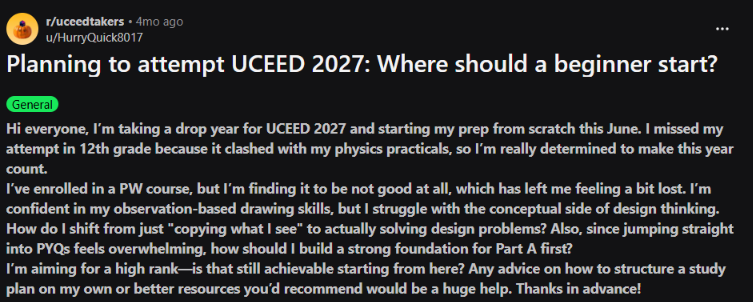
In a Reddit post, a user asked where a beginner should start to attempt the UCEED 2027 examination. In response to the query, another user suggested not joining a coaching institute for UCEED preparation; instead, the user suggested finding some online resources to prepare for the exam. Some other users in the comment section suggested solving PYQs to prepare for the UCEED 2027 examination.
How to Use Previous-Year UCEED Question Papers
- Attempt a paper under timed conditions.
- Classify mistakes by syllabus topic and question format.
- Identify whether each error arose from a concept gap, misinterpretation, or time pressure.
- Practise the weakest areas using topic-specific questions.
- Reattempt difficult questions after a gap to check whether the concept has improved.
What should candidates avoid while preparing for UCEED 2027?
- Treating predicted topic weightage as a guarantee.
- Ignoring Part B until the final weeks.
- Memorising design facts without understanding their application.
- Practising only familiar question types.
- Repeating mock tests without analysing mistakes.
- Spending excessive time perfecting artwork at the expense of clear communication.
Also Check:
UCEED 2027 Syllabus FAQs
Ques. Is the UCEED 2027 syllabus different from UCEED 2026?
Ans. No, as of now, there are no changes in the UCEED syllabus 2027. The syllabus for UCEED 2027 is the same as last year's syllabus for the exam.
Ques. Which books or resources should I use for UCEED preparation?
Ans. Begin with the UCEED 2027 official syllabus, previous-year question papers, and the examination interface or sample resources provided by IIT Bombay. Supplement these with targeted practice material for visual reasoning, analytical reasoning, drawing, and design aptitude.
Ques. Is UCEED 2027 topic-wise weightage officially available?
Ans. No fixed topic-wise mark distribution is specified in the official syllabus. Previous-year question papers can help estimate topic frequency, but such estimates must be clearly labelled as analysis rather than official weightage.
Ques. When should I start preparing for UCEED 2027?
Ans. Start as early as possible. A longer preparation period allows candidates to build reasoning skills, develop drawing confidence, and practise full-length papers without rushing.
Ques. How many mock tests should I solve for UCEED 2027?
Ans. There is no universal required number. Prioritise a manageable set of full-length mocks, topic-wise practice, and detailed review of mistakes rather than taking tests without analysing the results.
Ques. Can I prepare for UCEED Part A and Part B simultaneously?
Ans. Yes. Combining objective aptitude practice with regular drawing and design exercises helps candidates maintain progress in both parts.



Comments