




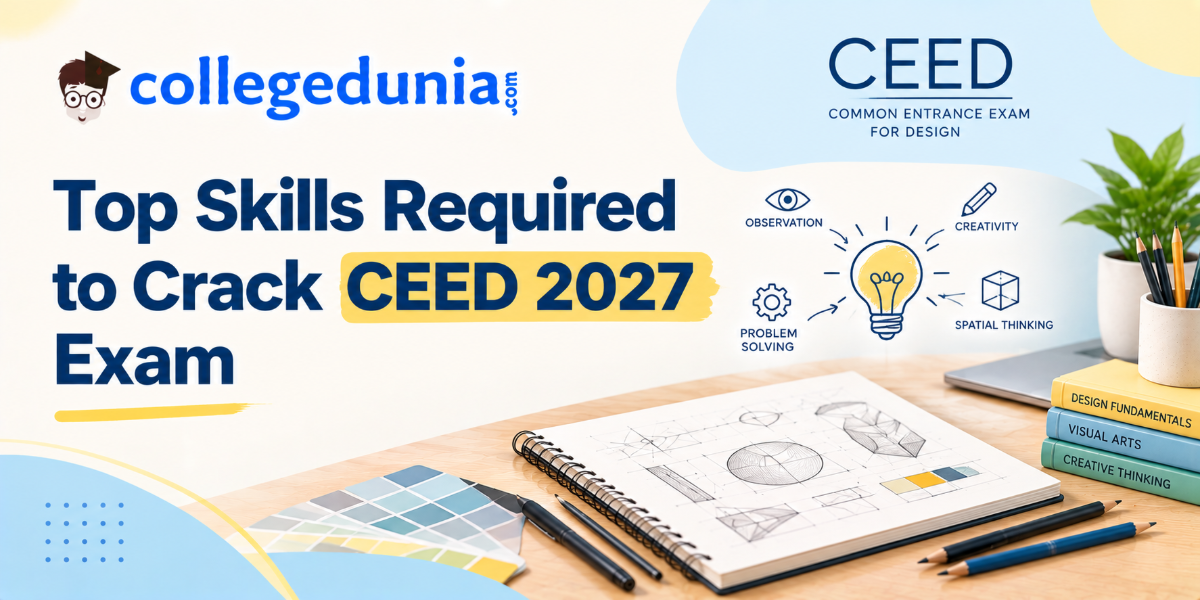
The top skills required to crack CEED 2027 are drawing, sketching, visualisation, creative ideation and clear visual communication. Focus equally on CEED Syllabus 2027 for Part A and B. CEED Part B carries 75% of the final score.
- Candidates need to clear CEED Part A because Part B is considered only when you qualify for Part A.
- CEED Part A is a computer-based objective paper. Part B consists of five questions to test design, drawing and writing skills, written/drawn in the answer booklet.
- CEED 2027 tests creativity, logical reasoning, and design aptitude. So focus on strong observation, visualisation, and problem-solving skills.
- Drawing and visual communication skills are important for design-based questions.
- Understand design principles and concepts and express ideas clearly through drawings and visuals.
- Regular practice of previous year question papers improves speed and accuracy and helps you understand the questions asked.
- Attempt mock tests, as time management helps candidates solve questions within the exam duration.
- Analyse PYQs and mocks after attempting them to know your strengths and weaknesses and topics that require improvement.
- CEED final score calculation is 0.25 × Part A marks + 0.75 × Part B marks. So drawing, ideation, and communication carry three times the weight of Part A.
Related Articles:
- CEED Exam Pattern 2027: Part A and Part B Paper Pattern, Marking Scheme, Total Marks and Duration
- CEED Syllabus 2027: Part A, Part B, Subject-Wise Topics and PDF Download
Key Summary
- CEED Part A consists of a total of 150 marks that need to be solved in 1 hour. CEED Part B comprises a total of 100 marks for 2 hours paper.
- Qualifying CEED does not guarantee admission, since each institute may add its own test, portfolio and interview.
- CEED Part-B answer books will be manually evaluated only for candidates shortlisted from Part-A.
CEED 2027 Skills Needed for Part A and Part B
Part A tests how you think and observe, and Part B tests how you draw and communicate, so the two parts need different kinds of practice.
| Part | Mode | Skills Tested | Share of Final Score |
|---|---|---|---|
| Part A | Computer-based, objective (NAT, MCQ and MSQ) | Visual and spatial ability, environmental and social awareness, analytical and logical reasoning, language, observation and design sensitivity | 25% |
| Part B | Answers written and drawn in an answer book | Design, drawing and writing skills across 5 questions | 75% |

Source: ceed.iitb.ac.in
Related Link: CEED Design Drawing & Writing Skills Sample Paper- Download PDF
On discussion forums such as Quora, a user shared skills to crack CEED 2027 exam.
- Familiarize yourself with the CEED exam pattern and CEED syllabus
- Practice sketching a variety of objects and scenes to improve your freehand drawing skills. Work on accuracy, proportion, and creativity.
- Improve your spatial and visualisation skills by practising problems related to 2D and 3D objects to improve your ability to visualise complex shapes.
- Work on practice papers and previous years' questions to enhance your analytical and logical reasoning skills
- Stay informed about current affairs, design trends, and cultural developments. Regularly read newspapers, magazines, and online articles related to art and design to enhance your general awareness.
- Understanding the history of design and influential designers can provide context and insights for the exam.
- Regularly take CEED mock tests. This will help you manage your time effectively and become accustomed to the pressure of the actual exam.
- After each mock test, review your performance to identify strengths and weaknesses.
Source: Quora
Ques. What is the weightage of Part A and Part B in CEED 2027?
Ans. The CEED final score is 0.25 × Part A marks + 0.75 × Part B marks. Part B therefore carries 75% of the final score, and Part A carries 25%.
Top Skills Required for CEED 2027 Part B
CEED 2027 Part B has 5 questions and rewards clear ideas shown through simple, well-proportioned drawings, not heavy artwork.
- Always focus on creativity and develop original and innovative ideas through practice.
- Stay updated on art, design, and current trends.
- Practice sketching and visual representation by properly understanding shapes, objects, and spatial relationships.
| Skill | What It Means | How to Build It |
|---|---|---|
| Freehand sketching | Drawing with correct proportion, perspective and line quality | Sketch everyday objects, people and spaces daily, and practise without relying on an eraser |
| Creative ideation | Coming up with original ideas for a given situation | Observe common objects closely and draw several ideas for one prompt |
| Storyboarding | Showing a sequence or user journey in frames | Study comic strips, which are a good everyday example of a storyboard |
| Form and visual sensitivity | Showing shape, texture and material | Practise rendering different surfaces with simple pencil work |
| Problem identification | Spotting a user problem and proposing a visual solution | Pick a product, name one problem with it and sketch a fix |
| Visual communication | Explaining an idea through sketches and short text | Add labels and one or two lines of explanation to every sketch |
Expert Tips
- A simple pencil sketch is recommended, and heavy shading can wait until the rest of the paper is done.
- Give higher-mark questions more detailed work, and finish every question in the time available.
Related Link: CEED Previous Year Question Papers (Available)- Download PDF with Solutions [2026-2010]
Ques. Do you need drawing skills to crack CEED?
Ans. Yes, to crack CEED 2027, drawing matters because Part B carries 75% of the final score. The aim is clear, simple sketches that communicate an idea, not polished art, so regular daily practice is more useful than advanced techniques.
Top Skills Required for CEED 2027 Part A
Part A is a screening paper, and not meeting the qualifying cutoff for CEED Part A stop your Part B answers from being evaluated.
| Skill | Topics Students Commonly Practise |
|---|---|
| Visual and spatial ability | 3D shapes, mirror images, paper folding, geometry, isometric and perspective views |
| Analytical and logical reasoning | Number series, patterns, syllogisms, coding-decoding, puzzles |
| Observation and design sensitivity | Details in everyday objects, logos, typography, colour theory |
| Environmental and social awareness | Current affairs, environment, society and design in the news |
| Language | Reading comprehension and grammar in standard English |
| Art and design knowledge | Design movements, famous designers, Indian art, crafts and architecture |
Related Link: CEED 2027 Exam Dates: Registration Open till October 31, Exam Schedule and Admit Card Date
Ques. Can students without a design background crack CEED?
Ans. Students with a bachelor's degree, diploma or postgraduate degree of at least 3 years in any stream can apply. Students from non-design backgrounds should spend extra time on sketching practice and design awareness.
Preparation Tips to crack CEED 2027
CEED 2027 exam will be held on January 17, 2027. With about 3 months left, spend at least 3- 4 hours daily as structured below.
- Solve CEED previous year papers in the computer-based format for Part A, and time yourself on sample Part B questions.
- Attempt and analyse CEED mock tests to understand your strengths and weaknesses and target the weakest area first
| Activity | Suggested Time |
|---|---|
| Part A aptitude and reasoning questions | 60 minutes |
| Sketching and design exercises | 90 minutes |
| Reading design case studies or news | 30 minutes |
| Full-length timed mock test | Once every weekend |
Related Link: CEED Mock Test (Available), Free Online Mock test, Sectional Tests, PDFs
Ques. How many months are needed to prepare for CEED?
Ans. Candidates require at least 3 to 4 months, depending on their drawing practice and background. For CEED 2027, the exam is on 17 January 2027, so students should plan a daily routine for the time that is left.
Common Mistakes to Avoid in CEED Part B
Most Part B mistakes come from time management and presentation. So the common mistakes to avoid in CEED Part B are listed below:
- Spending too long on one question and leaving other answers incomplete.
- Over-detailing drawings instead of communicating the idea.
- Skipping problem definition and jumping straight to a solution.
- Treating Part B as secondary and giving most of the preparation time to Part A.
- Leaving portfolio and interview preparation to the last moment, since many institutes ask for both after the result.
Related Link: CEED Application Process 2027: Registration Date (Out), Last Date to Apply, Direct Link & Documents Required
CEED vs UCEED: Which Skills Differ?
CEED is for M.Des admissions, and UCEED is for B.Des admissions. CEED expects a higher level of drawing and visual communication compared to UCEED.
| Aspect | CEED | UCEED |
|---|---|---|
| Programme | M.Des (Master of Design) | B.Des (Bachelor of Design) |
| Qualification | Bachelor's, diploma or postgraduate degree of 3 years after 10+2 | 10+2 or equivalent in any stream |
| Age limit and attempts | No age limit, no attempt limit | Age limit applies, two attempts in consecutive years |
| Skills emphasised | Advanced drawing, design thinking and visual communication | Basic sketching with good line quality and proportion |
| Admission | Each institute runs its own test and interview | Central counselling |
Also Check: CEED Admit Card 2027: Release Date, Download Link, Exam Day Guidelines & Documents Required
Ques. Is there an attempt limit or age limit for CEED?
Ans. No, CEED has no age limit and no cap on attempts, as per the official brochure.
CEED 2027 Exam Day Tips
- Carry documents: Bring the admit card, a colour printout and a valid original photo ID, and reach the centre on time for biometric recording.
- Carry drawing materials: Bring your own pencils, colours and sketch pens, and do not carry drawing sheets.
- Avoid unfair means: Mobile phones, calculators and electronic gadgets are not allowed, and can lead to cancellation.
- Read each question twice and answer only what is asked.
Related Link: Tips for Organising Portfolio for CEED Interviews 2027
CEED 2027 Important Dates
| Event | Date |
|---|---|
| Registration with regular fee | October 1- 31, 2026 |
| Registration with late fee | November 1- 6, 2026 |
| Admit card download begins | January 1, 2027 |
| CEED 2027 exam | January 17, 2027 (9:00 AM to 12:00 noon) |
| Draft Part A answer key | January 19, 2027 |
| Final Part A answer key | January 26, 2027 |
| Part A cutoff marks | February 4, 2027 |
| Result | March 3, 2027 |
| Scorecard available | March 10, 2027 |
CEED 2027 Skills and Preparation: More FAQs
Ques. Is CEED Part B drawing paper checked for every student?
Ans. No, CEED Part B is evaluated only if you clear the Part A cutoff. The Part A cutoff marks are scheduled to be announced on February 4, 2027.
Ques. Is there central counselling after CEED 2027?
Ans. No, qualifying CEED does not guarantee admission. Students apply to each participating institute separately, and an institute may ask for its own test, portfolio and interview.
Ques. Is a portfolio required for the CEED exam?
Ans. No portfolio is submitted for the CEED exam itself. Individual institutes may ask for a portfolio at the admission stage, so students should read each institute's brochure.
Ques. What should you sketch to improve for CEED Part B?
Ans. For CEED Part B, sketch everyday objects, people and spaces daily, and practise drawing from memory after observing an object for a minute. Add short labels to each sketch so the idea is clear.
Ques. How can you build creativity and observation skills to crack CEED 2027?
Ans. To crack CEED 2027, look closely at everyday products, read about the work of designers you admire, and study comic strips, which are a good everyday example of a storyboard. Try to name one problem in each product you study.
Ques. How should you prepare for the CEED environmental and social awareness section?
Ans. Read newspapers and magazines regularly and follow news on the environment, society and design. Note how design affects people and the environment, since this section has its own place in CEED Part A.
Ques. Can final-year students apply for CEED 2027?
Ans. Final-year students can apply to CEED 2027, but they must complete the degree before the deadline set by the institute, which is typically around July 2027. Students should check the brochure of each institute.



Comments