




The CEED Syllabus 2027 covers design aptitude, visualisation, spatial and analytical reasoning, creativity, art and design knowledge. The exam is divided into Part A and Part B, with a total of 250 marks. Part A carries 150 marks and includes objective questions, while Part B carries 100 marks and includes subjective design, drawing and writing questions.
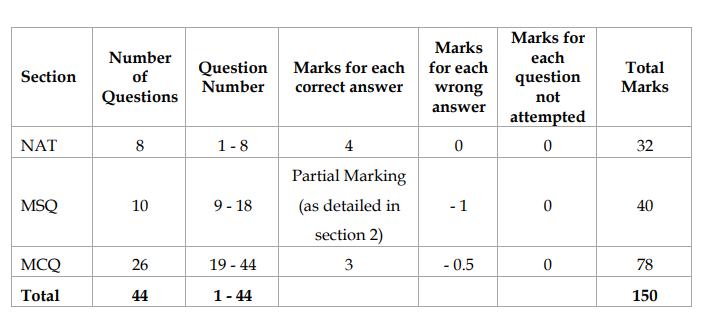
- CEED Part A carries 150 marks and consists of 44 objective questions - 8 NAT, 10 MSQ and 26 MCQ.
- NAT questions carry 4 marks each, while MCQs carry 3 marks for a correct answer with -0.5 marks for an incorrect answer. MSQs have partial marking and carry 40 marks in total.
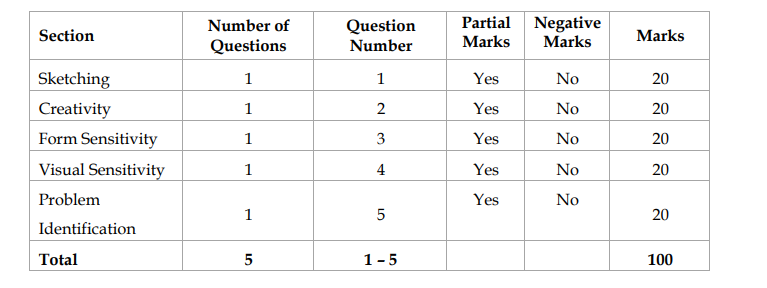
- CEED Part B carries 100 marks and consists of 5 subjective questions. It tests design, drawing and writing skills, with each question carrying 20 marks.
- Part A evaluates visual and spatial ability, general awareness, reasoning, language, observation and design sensitivity.
- Part B assesses sketching, creativity, form sensitivity, visual sensitivity and problem identification. Candidates required to write their answers in the provided answer booklet.
- The final CEED score is calculated using 25% of Part A marks and 75% of Part B marks, making Part B an important component of the final score.
Related Articles:
Key Summary
- In CEED syllabus Part A includes 9 syllabus areas, covering both design aptitude and general design awareness.
- Part B includes 2 major areas, namely Drawing and Creativity in CEEB Syllabus.
- The latest CEED structure has 44 questions in Part A for 150 marks and 5 questions in Part B for 100 marks.
- The final CEED score is calculated using 25% of Part A marks and 75% of Part B marks.
What is CEED Syllabus 2027?
The CEED Syllabus 2027 covers the core concepts and skills tested in both parts of the examination. Part A focuses on objective questions related to design aptitude, while Part B assesses practical drawing and creative abilities.
- Part A includes Visualization and Spatial Ability, Practical and Scientific Knowledge, Observation and Design Sensitivity, Environment and Society, Analytical and Logical Reasoning, Language, Creativity, Art and Design Knowledge, and Design Methods and Practices.
- Visualization and Spatial Ability covers the understanding and manipulation of 2D and 3D forms, while Practical and Scientific Knowledge focuses on the working principles of everyday objects.
- Observation and Design Sensitivity, Environment and Society, and Analytical and Logical Reasoning test observation, design awareness, environmental understanding and logical analysis.
- Language, Creativity, Art and Design Knowledge, and Design Methods and Practices cover comprehension, creative thinking, art and design awareness, materials, production processes and ergonomics.
- Part B focuses on Drawing and Creativity, requiring candidates to demonstrate visual representation, proportion, composition, perspective, shading and original design ideas.
CEED Syllabus 2027 PDF
The CEED 2027 Information Brochure contains the official examination details, including the syllabus, question paper structure, important dates, eligibility, registration process and examination requirements. The brochure can be downloaded from the official CEED 2027 website.
- Candidates can download the CEED 2027 Information Brochure from the official IIT Bombay CEED website.
- The official brochure should be referred to for the latest syllabus and examination instructions.
- The CEED 2027 syllabus is divided into Part A and Part B.
- The official website also provides previous-year CEED question papers and answer keys.
Source: CEED 2027 Official Website
CEED Syllabus 2027: Part A
The CEED Syllabus 2027 Part A covers objective design aptitude areas that evaluate candidates' visual and spatial ability, environmental and social awareness, analytical and logical reasoning, language, observation and design sensitivity.
CEED Part A Syllabus: Visualization and Spatial Reasoning
Visualization and Spatial Reasoning tests the ability to understand, manipulate and mentally transform two-dimensional and three-dimensional forms.
- Candidates should practise visualising 2D shapes and 3D objects from different perspectives.
- Questions can involve spatial relationships, transformations, mental rotation and visual representation.
- Paper folding, unfolding and isometric or orthographic views can also be practised.
CEED Part A Syllabus: Practical and Scientific Knowledge
Practical and Scientific Knowledge covers the understanding of scientific principles and their applications in everyday objects.
- Candidates should understand how commonly used objects work.
- Preparation should include basic principles related to materials, mechanics and practical applications.
- Questions may test the relationship between scientific concepts and everyday products.
CEED Part A Syllabus: Observation and Design Sensitivity
Observation and Design Sensitivity assesses attention to detail, classification, analysis, inference and prediction.
- Candidates should practise identifying differences, patterns and important visual details.
- Preparation should focus on understanding how visual information relates to design.
- Questions can test observation skills and sensitivity towards design elements.
CEED Part A Syllabus: Environment and Society
Environment and Society covers the relationship between design, environmental conditions and society.
- Candidates should understand environmental and social connections with design.
- Preparation can include sustainability, natural resources and environmental issues.
- Cultural and social influences on products and design should also be studied.
CEED Part A Syllabus: Analytical and Logical Reasoning
Analytical and Logical Reasoning tests the ability to analyse qualitative and quantitative information and arrive at logical conclusions.
- Candidates should practise pattern recognition and logical deduction.
- Preparation should include qualitative and quantitative analysis.
- Data interpretation and reasoning-based questions should also be practised.
CEED Part A Syllabus: Language
The Language section tests candidates' understanding of Standard English and their ability to comprehend written information.
- Candidates should practise reading comprehension and understanding passages.
- Preparation should focus on identifying the meaning and implications of written information.
- Candidates should also practise drawing logical inferences from passages.
CEED Part A Syllabus: Creativity
Creativity assesses the ability to understand and generate ideas through verbal and non-verbal relationships.
- Candidates should practise verbal and non-verbal analogies.
- Preparation can include metaphors, signs and symbols.
- Creative thinking should be developed through visual and conceptual problem-solving exercises.
CEED Part A Syllabus: Art and Design Knowledge
Art and Design Knowledge covers awareness of art, artefacts, products, artists, designers, art history, design history and design trends.
- Candidates should revise important artists and designers.
- Preparation should include major developments in art and design history.
- Candidates should also develop awareness of products, artefacts and contemporary design trends.
CEED Part A Syllabus: Design Methods and Practices
Design Methods and Practices covers media, materials, production processes and ergonomics used in design.
- Candidates should understand different media and materials used in design.
- Preparation should include basic production processes and prototyping concepts.
- Ergonomics and practical design practices should also be covered.
| CEED Syllabus Part A | Major Topics Covered |
|---|---|
| Visualization and Spatial Reasoning | 2D and 3D Visualisation, Transformation of Shapes and Objects, Spatial Relationships, Mental Rotation, Paper Folding and Unfolding, Isometric and Orthographic Views |
| Practical and Scientific Knowledge | Scientific Principles, Everyday Objects, Practical Applications, Materials, Mechanics and Working Principles |
| Observation and Design Sensitivity | Attention to Detail, Classification, Analysis, Inference, Prediction, Visual Patterns and Design Sensitivity |
| Environment and Society | Environmental Awareness, Social Connections with Design, Cultural Connections with Design, Sustainability, Natural Resources and Environmental Issues |
| Analytical and Logical Reasoning | Qualitative Information, Quantitative Information, Logical Analysis, Pattern Recognition, Data Interpretation and Logical Deduction |
| Language | Standard English, Reading Comprehension, Understanding Passages and Drawing Inferences |
| Creativity | Verbal Analogies, Non-Verbal Analogies, Metaphors, Signs and Symbols and Creative Thinking |
| Art and Design Knowledge | Art, Artifacts, Products, Artists, Designers, Art History, Design History and Trends |
| Design Methods and Practices | Media, Materials, Production Processes, Ergonomics, Prototyping and Design Practices |
Also Check: CEED 2027 Exam Dates: Registration Open till October 31, Exam Schedule and Admit Card Date
CEED Syllabus 2027: Part B
The CEED Syllabus 2027 Part B focuses on design, drawing and writing skills. Part B contains five questions, with the questions displayed on the computer and answers written in the answer booklet provided at the examination centre.
CEED Part B Syllabus: Drawing
Drawing assesses the ability to visually represent products, people and scenes using appropriate composition, proportion, perspective and shading.
- Candidates should practise freehand drawing of everyday objects and scenes.
- Preparation should focus on line quality, proportion, composition and perspective.
- Shading should be practised to represent form, depth and visual structure.
CEED Part B Syllabus : Creativity
Creativity assesses the ability to develop original and diverse solutions to design problems.
- Candidates should practise generating multiple ideas for a single design problem.
- Preparation should focus on originality and visual communication.
- Timed creative exercises can help improve ideation speed.
CEED Part B Syllabus: Form Sensitivity
Form Sensitivity assesses the ability to understand and represent the visual characteristics and relationships of forms.
- Candidates should practise understanding shape, structure and proportion.
- Preparation should focus on identifying visual relationships between forms.
- Regular observation of objects can improve form sensitivity.
CEED Part B Syllabus: Visual Sensitivity
Visual Sensitivity evaluates the ability to understand visual elements and communicate them effectively.
- Candidates should practise composition and visual balance.
- Preparation should include observation of shapes, proportions and spatial relationships.
- Candidates should focus on presenting ideas clearly through visual representation.
CEED Part B Syllabus: Problem Identification
Problem Identification assesses the ability to recognise design problems and respond to them appropriately.
- Candidates should practise identifying the main requirements of a design problem.
- Preparation should focus on understanding users, situations and functional requirements.
- Candidates should practise developing appropriate visual solutions within time limits.
| CEED Part B Area | Major Skills Covered |
|---|---|
| Drawing | Product Drawing, People and Scenes, Line Quality, Composition, Proportion, Perspective and Shading |
| Creativity | Original Ideas, Diverse Solutions and Creative Problem-Solving |
| Form Sensitivity | Understanding Form, Shape, Structure, Proportion and Visual Relationships |
| Visual Sensitivity | Visual Composition, Balance, Observation and Visual Communication |
| Problem Identification | Identifying Design Problems, Understanding Requirements and Developing Solutions |
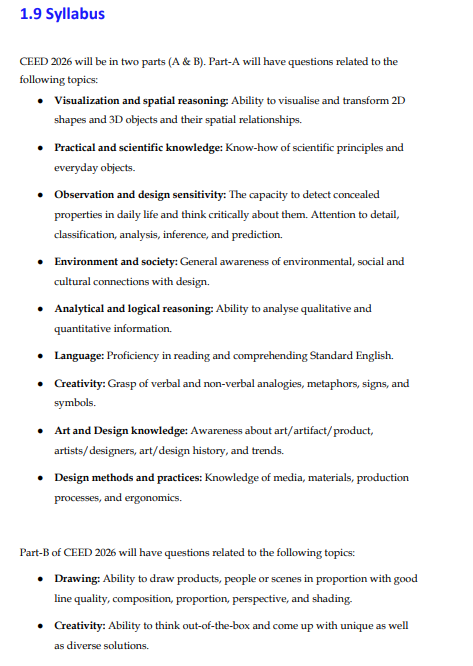
Source: CEED Information Brochure, IIT Bombay.
Also Read:
CEED 2027 Syllabus: Part-Wise Weightage
The official CEED structure assigns 150 marks to Part A and 100 marks to Part B. IIT Bombay does not specify fixed marks for each individual syllabus topic in the official CEED syllabus. Therefore, topic-wise percentages should be treated as indicative estimates based on previous-paper analysis rather than an official 2027 distribution.
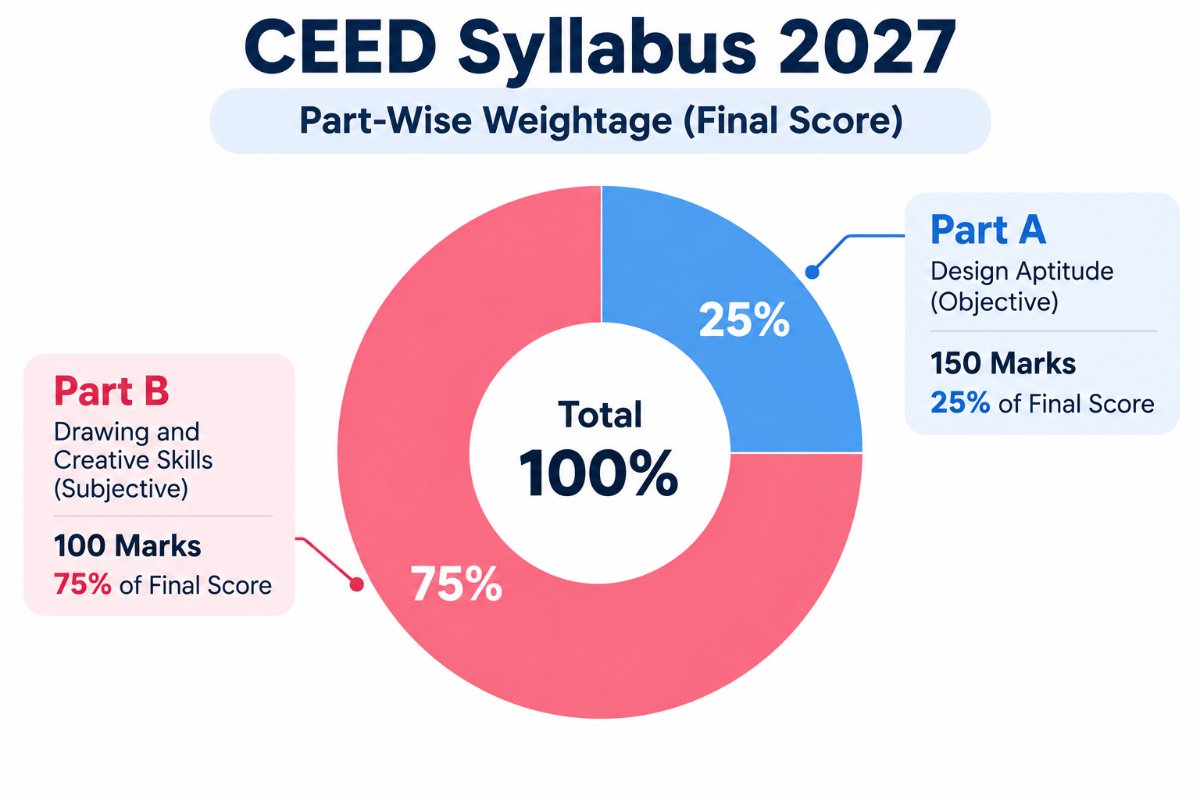
The official structure confirms that Part A carries 150 marks and Part B carries 100 marks, with the final score using 25% of Part A and 75% of Part B.
| Part | Marks | Final Score Weightage |
|---|---|---|
| Part A | 150 | 25% |
| Part B | 100 | 75% |
| Total | 250 | 100% |
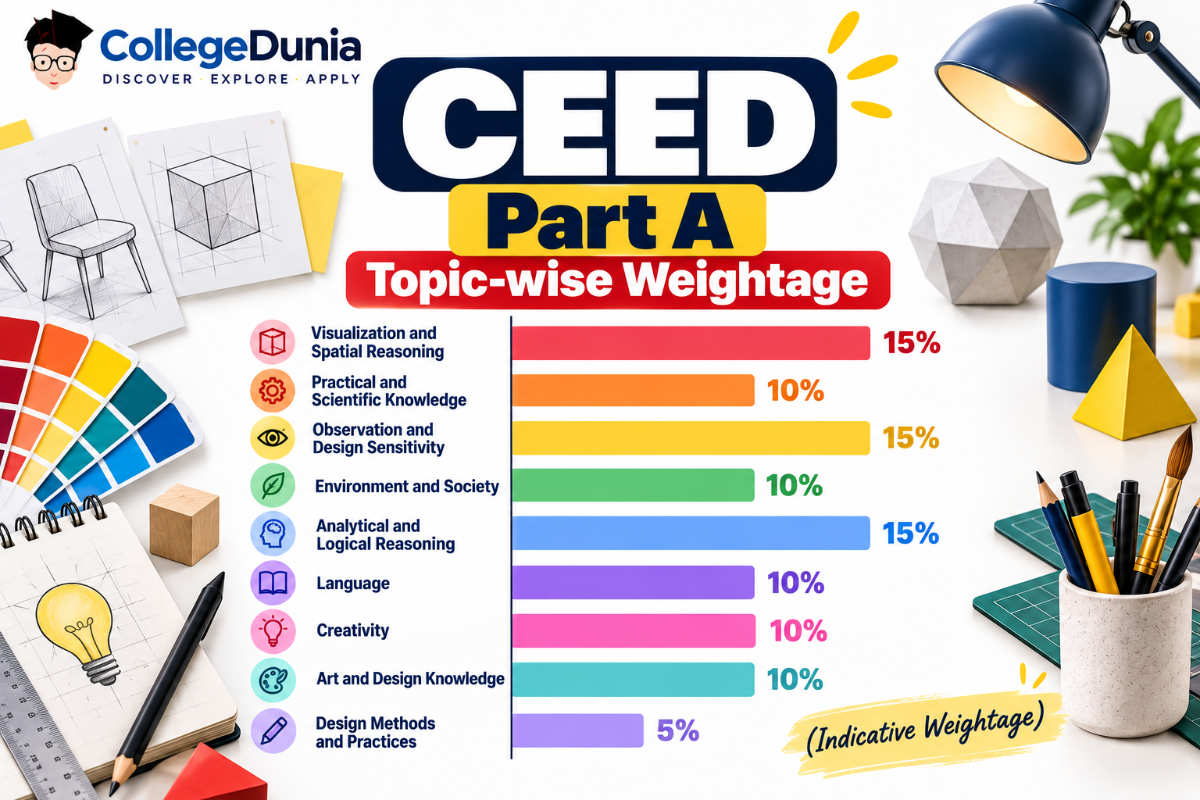
CEED Part A Topic-wise Weightage
The following distribution can be used as an indicative topic-wise weightage based on the syllabus areas and previous-paper analysis.
- Visualization and Spatial Reasoning carries 15% of the indicative weightage.
- Practical and Scientific Knowledge carries 10% of the indicative weightage.
- Observation and Design Sensitivity carries 15% of the indicative weightage.
- Environment and Society carries 10% of the indicative weightage.
- Analytical and Logical Reasoning carries 15% of the indicative weightage.
- Language carries 10% of the indicative weightage.
- Creativity carries 10% of the indicative weightage.
- Art and Design Knowledge carries 10% of the indicative weightage.
- Design Methods and Practices carries 5% of the indicative weightage.
| CEED Part A Area | Indicative Weightage |
|---|---|
| Visualization and Spatial Reasoning | 15% |
| Practical and Scientific Knowledge | 10% |
| Observation and Design Sensitivity | 15% |
| Environment and Society | 10% |
| Analytical and Logical Reasoning | 15% |
| Language | 10% |
| Creativity | 10% |
| Art and Design Knowledge | 10% |
| Design Methods and Practices | 5% |
CEED Part B Topic-wise Weightage
The CEED Part B topic-wise distribution can be understood from the major skills assessed through the five subjective questions.
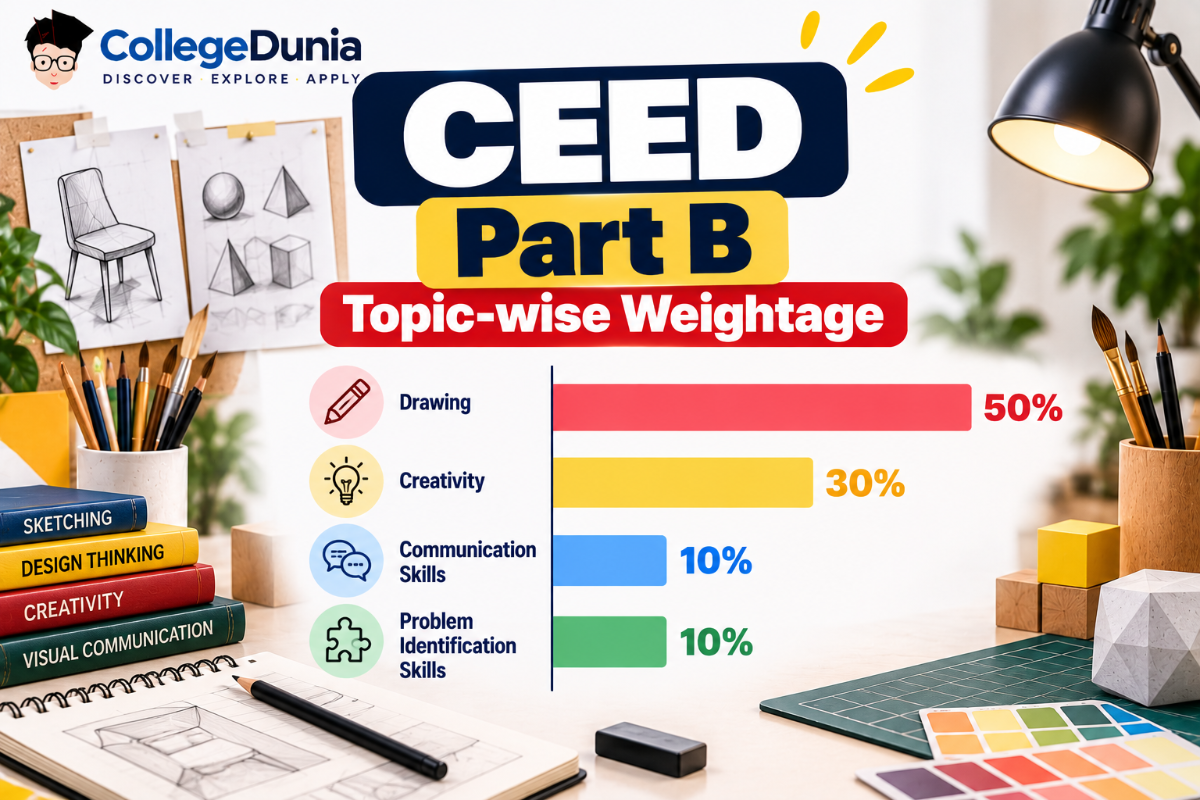
- Drawing carries 50% of the indicative weightage.
- Creativity carries 30% of the indicative weightage.
- Communication Skills carries 10% of the indicative weightage.
- Problem Identification Skills carries 10% of the indicative weightage.
| CEED Part B Area | Indicative Weightage |
|---|---|
| Drawing | 50% |
| Creativity | 30% |
| Communication Skills | 10% |
| Problem Identification Skills | 10% |
CEED Part A Question Pattern 2027
The CEED Part A question paper contains three types of objective questions, namely Numerical Answer Type (NAT), Multiple Select Questions (MSQ) and Multiple Choice Questions (MCQ). The answers to Part A are entered on the computer.
- NAT questions require candidates to enter a numerical answer.
- MSQ questions may have more than one correct option and are subject to partial marking.
- MCQ questions contain one correct option.
- Part A contains 44 questions carrying a total of 150 marks.
| Question Type | Number of Questions | Total Marks |
|---|---|---|
| NAT | 8 | 32 |
| MSQ | 10 | 40 |
| MCQ | 26 | 78 |
| Total | 44 | 150 |
Source: CEED Information Brochure, IIT Bombay.
Also Read:
CEED Part B Question Pattern 2027
CEED Part B contains 5 subjective questions carrying 100 marks, with each question carrying 20 marks. Candidates view the questions on the computer screen and write their responses in the answer booklet provided at the examination centre.
- The Part B paper contains five questions worth 20 marks each.
- The questions assess drawing, creativity, form sensitivity, visual sensitivity and problem identification.
- Part B responses are evaluated with partial marking.
- There is no negative marking for Part B responses.
| Section | Number of Questions | Question Number | Marks |
|---|---|---|---|
| Sketching | 1 | 1 | 20 |
| Creativity | 1 | 2 | 20 |
| Form Sensitivity | 1 | 3 | 20 |
| Visual Sensitivity | 1 | 4 | 20 |
| Problem Identification | 1 | 5 | 20 |
| Total | 5 | 1–5 | 100 |
Source: CEED Information Brochure, IIT Bombay.
Also Read:
CEED 2027 Preparation Tips Based on Syllabus
CEED preparation requires candidates to practise both objective design aptitude and practical drawing and creativity. Candidates should use the official syllabus and previous-year papers to understand the skills assessed in both parts.
- Candidates should divide the syllabus into individual topics and prepare a regular study schedule.
- Candidates should practise visualisation and spatial reasoning using 2D shapes and 3D objects.
- Candidates should solve previous-year CEED papers to understand the question formats.
- Candidates should revise important artists, designers, products, art history and design history.
- Candidates should practise freehand drawing with attention to proportion, perspective, composition and shading.
- Candidates should work on creative ideation through timed design problems.
- Candidates should practise Part B questions within a fixed time limit.
- Candidates should review completed sketches to improve line quality and visual communication.
- Candidates should attempt mock tests to improve speed and familiarity with the examination format.
Related Link: Tips for Organising Portfolio for CEED Interviews 2027
CEED 2027 Important Books
The CEED 2027 Important Books cover drawing, perspective, observation, design principles and previous-year question practice. These books can help candidates develop the skills required for both objective and drawing-based sections of the examination.
- Design Drawing by Francis D.K. Ching focuses on drawing techniques and visual representation.
- Perspective Drawing Handbook by Joseph D'Amelio helps candidates practise perspective and spatial drawing.
- Drawing on the Right Side of the Brain by Betty Edwards supports drawing and observation skills.
- The Design of Everyday Things by Don Norman covers design principles and user-centred thinking.
- Universal Principles of Design by William Lidwell, Kritina Holden and Jill Butler provides concepts and principles related to design.
- CEED Previous Year Question Papers from IIT Bombay help candidates understand actual question formats and practise previous questions.
| Book Name | Author / Publisher | Best Use |
|---|---|---|
| Design Drawing | Francis D.K. Ching | Drawing and visual representation |
| Perspective Drawing Handbook | Joseph D'Amelio | Perspective and spatial drawing |
| Drawing on the Right Side of the Brain | Betty Edwards | Drawing and observation |
| The Design of Everyday Things | Don Norman | Design principles and user-centred thinking |
| Universal Principles of Design | William Lidwell, Kritina Holden and Jill Butler | Design concepts and principles |
| CEED Previous Year Question Papers | IIT Bombay | Understanding actual question formats |
Also Read:
CEED 2027 Previous Year Question Papers
Previous-year CEED question papers help candidates understand the actual question formats and difficulty level. IIT Bombay provides question papers and answer keys on the official CEED website. The official website currently lists papers from 2026, 2025, 2024, 2023 and 2022, along with older papers.
| Year | Question Paper |
|---|---|
| CEED 2026 | Download CEED 2026 Question Paper |
| CEED 2025 | Download CEED 2025 Question Paper |
| CEED 2024 | Download CEED 2024 Question Paper |
| CEED 2023 | Download CEED 2023 Question Paper |
| CEED 2022 | Download CEED 2022 Question Paper |
Also Read:
CEED 2027 Preparation Reddit Insights
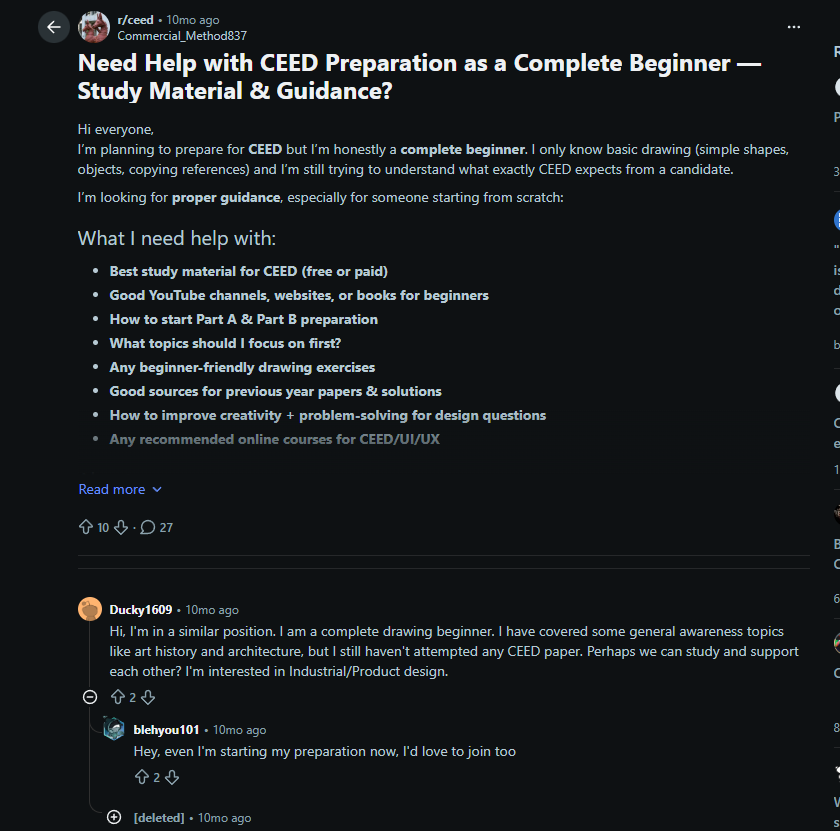
As per the user asked this - A CEED beginner on Reddit asked for guidance on study material, books, Part A and Part B preparation, drawing exercises, previous-year papers and ways to improve creativity and problem-solving.
To this another user answered this - One respondent suggested completing previous-year questions and using drawing resources, while another beginner mentioned that Drawabox was helpful for building basic sketching skills.
Source: Reddit
CEED Syllabus 2027 FAQs
Ques. What is the CEED 2027 syllabus?
Ans. The CEED syllabus covers design aptitude, visualisation, spatial reasoning, observation, reasoning, creativity, design awareness, drawing and problem-solving skills across Part A and Part B.
- Part A focuses on objective design aptitude areas.
- Part B assesses design, drawing and writing skills.
Ques. What are the topics in CEED Part A?
Ans. CEED Part A covers Visualization and Spatial Reasoning, Practical and Scientific Knowledge, Observation and Design Sensitivity, Environment and Society, Analytical and Logical Reasoning, Language, Creativity, Art and Design Knowledge, and Design Methods and Practices.
- Candidates should prepare both design concepts and reasoning-based topics.
- Visual observation and design awareness are also important areas.
Ques. What is included in CEED Part B?
Ans. CEED Part B consists of five questions that assess design, drawing and writing skills through responses written in the answer booklet.
- The major skills include drawing, creativity, form sensitivity, visual sensitivity and problem identification.
- Candidates should practise proportion, perspective, composition, shading and creative problem-solving.
Ques. Is there fixed topic-wise weightage in CEED?
Ans. IIT Bombay does not specify fixed marks or percentage-wise weightage for individual syllabus topics in the official CEED structure.
- The topic-wise percentages presented in preparation resources should therefore be treated as indicative.
- The official final score uses 25% of Part A marks and 75% of Part B marks.
Ques. How many marks are assigned to Part A and Part B?
Ans. Part A carries 150 marks, while Part B carries 100 marks, making the total examination structure 250 marks.
- Part A contributes 25% to the final CEED score.
- Part B contributes 75% to the final CEED score.
Ques. Is there negative marking in CEED?
Ans. Negative marking applies to certain objective question types in Part A, while Part B does not have negative marking.
- MCQs carry -0.5 marks for an incorrect answer.
- Part B questions are evaluated with partial marking and no negative marking.
Ques. Where can I download the CEED 2027 syllabus PDF?
Ans. Candidates can download the CEED 2027 Information Brochure from the official IIT Bombay CEED website, which contains the examination syllabus and other important details.
- The official website also provides CEED 2026 and previous-year question papers.
- Candidates should refer to the official brochure for the latest examination instructions.



Comments