



Education Journalist | Study Abroad Lead | Updated On - Jun 15, 2026
Three Canadian provinces have scaled back dedicated graduate permanent residence routes in 2026. Manitoba, British Columbia and Ontario each closed or restructured a student-to-PR pathway this year. The shift directly affects Indian graduates planning Canada PR through a provincial nominee program. Ontario revoked all nine streams on May 30, 2026, the largest single change. Each province now favours work experience, employer job offers or targeted sectors over open graduate streams.
- Ontario revoked all nine OINP streams under Regulation 47/26, ending the standalone Master's and PhD graduate categories.
- British Columbia confirmed on April 23, 2026 that it will not launch its planned Bachelor's, Master's and Doctorate streams.
- Manitoba closed the Career Employment Pathway on June 11, 2026, rerouting graduates into a work-first Skilled Worker pathway.
India is Canada's largest student source market. A provincial nomination has long been the most predictable study-to-PR route. That route now looks different in three major destination provinces. Indian graduates targeting these provinces must rethink the sequence to PR.
Also Read: Canada PR Requirements for Indian Students
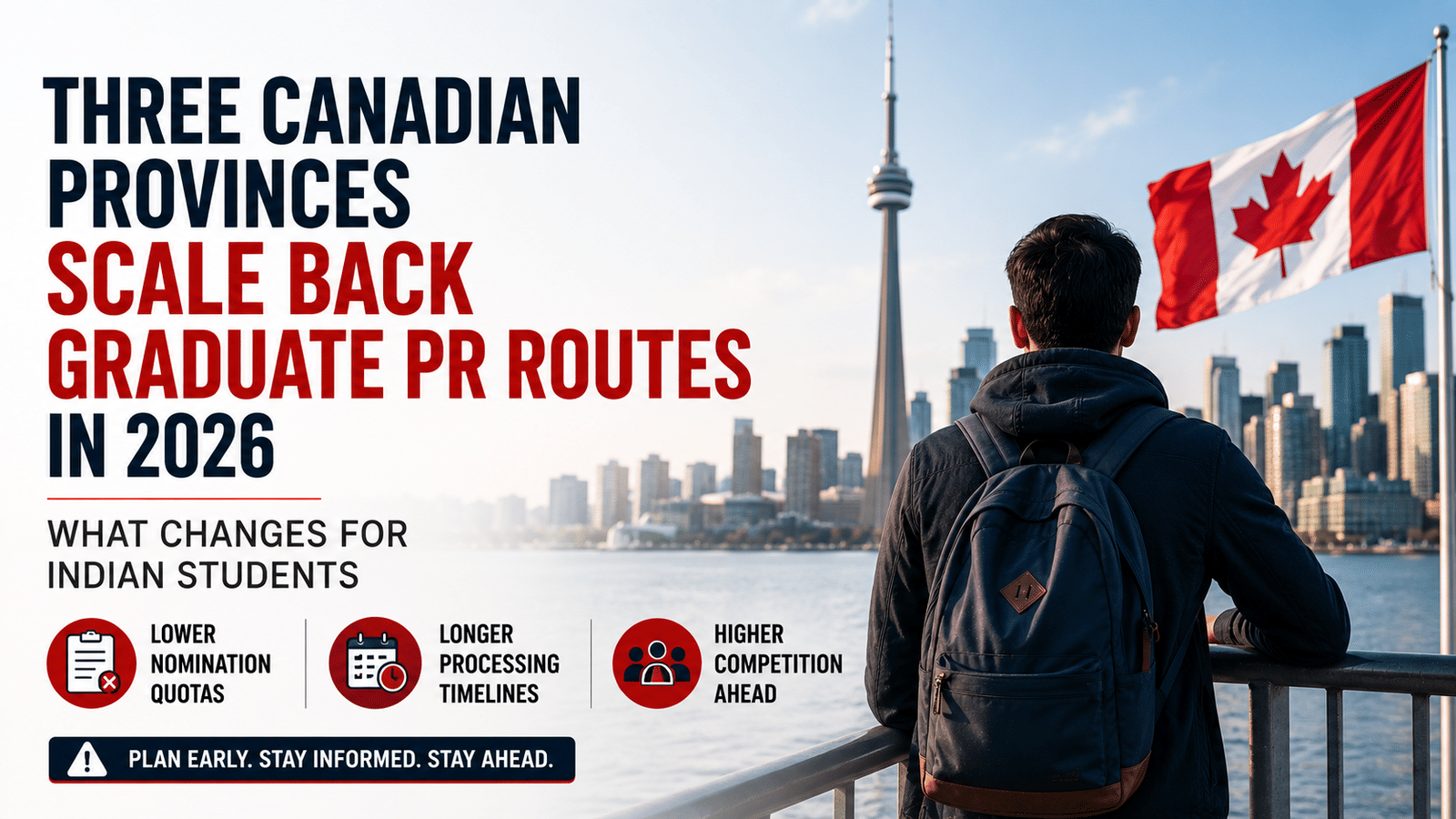
Three Provinces, Three Different Graduate PR Changes in 2026
The three changes are not identical. Each province altered its graduate route differently. The table below sets out what changed and when.
| Province | Effective Date | What Changed | What Replaces It |
|---|---|---|---|
| Ontario | May 30, 2026 | All nine OINP streams revoked, including Master's and PhD Graduate | Employer-driven EOI framework, rolling out in stages |
| British Columbia | April 23, 2026 | Planned graduate replacement streams cancelled | Focus on healthcare, trades and high-impact talent |
| Manitoba | June 11, 2026 | Career Employment Pathway closed | Skilled Worker in Manitoba, needing 6 months work |
OINP is the Ontario Immigrant Nominee Program, the province's PR selection system. EOI means Expression of Interest, the profile a candidate files before any invitation. Each province now screens graduates more tightly than before.
Ontario Revokes All Nine OINP Streams on May 30
Ontario made the broadest change of the three. The province revoked all nine OINP streams on May 30, 2026. The change came under Regulation 47/26, an amendment to the Ontario Immigration Act.
The revoked streams include the Master's Graduate and PhD Graduate categories. They also cover Foreign Worker and International Student with a Job Offer. A new employer-driven system will replace them through the second half of 2026.
Ontario ran a final Master's and PhD draw on April 22, 2026. It issued 918 invitations, with the Master's cutoff jumping 31 points in one cycle. Applications fully submitted before May 30 are processed under the old rules.
Key Caveat: Ontario did not pause its graduate streams. It revoked them with no grace period. Candidates still in the EOI pool without an invitation face real uncertainty until the replacement framework launches.
British Columbia Cancels Planned Graduate Replacement Streams
British Columbia's change began earlier and finished in April. The province closed its International Graduate stream in late 2024. It closed the International Post-Graduate stream in January 2025.
BC had promised three replacement streams: Bachelor's, Master's and Doctorate. On April 23, 2026, the province confirmed it will not launch them. The cancellation is permanent, not deferred.
BC is shifting nominations toward healthcare and certified trades. Its 2026 allocation stands at 5,254 nominations, well below the 9,000 it requested. Tech, business and engineering graduates lose their dedicated provincial route.
Also Check: British Columbia Closes PR Pathways for Indian Students
Manitoba Reroutes Graduates Through a Work-First Pathway
Manitoba's change is the most recent and the narrowest. The province closed the Career Employment Pathway on June 11, 2026. The closure took effect immediately.
Graduates are not shut out of Manitoba PR. They now route through the Skilled Worker in Manitoba pathway instead. That pathway needs 6 months of in-province work before a qualifying job offer.
The province says Manitoba-educated graduates stay strongly positioned in targeted draws. The Graduate Internship Pathway also remains open for master's and doctoral graduates. Manitoba has held 11 Skilled Worker draws so far in 2026.
Also Check: Manitoba Closes Career Employment Pathway Ending a Key Graduate PR Route
What the 2026 Rollback Means for Indian Students
The common thread is a move away from open graduate streams. Provinces now prioritise work experience, employer offers and specific sectors. For Indian students, the field of study and the job now matter more than the degree alone.
- Healthcare students remain well placed, especially in British Columbia's priority occupations.
- Tech and business graduates in BC and Ontario lose their clearest provincial routes for now.
- Manitoba graduates must build six months of provincial work before counting on a nomination.
- Federal Express Entry becomes the fallback where a provincial stream no longer exists.
The wider context sharpens the impact. Canada issued only 94,605 study permits to Indians in 2025, down 49.7% from 2024 (ICEF Monitor). Fewer permits and tighter PR routes together raise the planning bar.
What This Means for Indian Students: Pick the province by your PR pathway, not just university ranking. A healthcare profile fits BC. A work-experience plan fits Manitoba. A tech or business graduate should check Express Entry CRS and Alberta or Atlantic options too.
The academic strength of these provinces has not changed. What changed is the route from graduation to permanent residence. Indian families weighing a Canadian degree should map the PR pathway before accepting an offer. In 2026, the province you choose shapes your settlement plan as much as your course does.



Comments