



Content Curator
Baker's Ammonia Formula, often known as diammonium salt formula, is an ammonium carbonate formula. It's a chemical compound made up of the ions ammonium and carbonate. (NH4)2CO3 is the chemical formula for ammonium carbonate. It has a sharp ammoniacal taste and is a colorless crystalline solid or white powder with a strong ammonia odor. It is non-combustible and water-soluble. It produces ammonium salt and carbon dioxide when it combines with acids. It creates ammonia gas when it interacts with bases. Carbon dioxide and aqueous ammonia are mixed to make ammonium carbonate.
| Table of Content |
Key Takeaways: Molecule, Electron, Acidity, Basicity, Alkaline, Aqueous
Molecular Formula of Ammonium Carbonate
[Click Here for Sample Questions]
(NH4)2CO3 is the chemical formula for ammonium carbonate. When heated to a higher temperature, it breaks down into gaseous ammonia and carbon dioxide. It's mostly used as a leavening salt and a smelling salt. Baker's salt is another name for it. It served as a forerunner to a modern leavening agent such as baking soda and baking powder. It has a molar mass of 96.06 grams per mole.
N2=14*2=28
H4=1*4*2=8
C=12*1=12
O=16*3=48
Molar mass = 28+8+12+48=96(hence proved).
Structural Formula Of Ammonium Carbonate
[Click Here for Sample Questions]
The structural Formula of ammonium carbonate
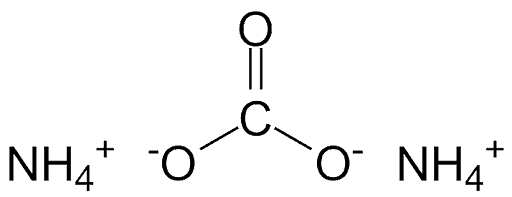
Structural Formula Of Ammonium Carbonate
Properties Of Ammonium Carbonate (Baker’s Ammonia)
[Click Here for Sample Questions]
Some basic properties of ammonium carbonate are mentioned in the table below.
| The chemical formula of Ammonium Carbonate | (NH4)2CO3 |
| Molecular weight | 96.09 g/mol |
| Density | 1.50 g/cm3 |
| Melting point | 58 °C |
| Boiling point | Decomposes |
Production Of Ammonium Carbonate
[Click Here for Sample Questions]
Carbon dioxide and aqueous ammonia are used to produce ammonium carbonate. However, as of 1997, roughly 80000 tonnes were produced per year. Carbon dioxide can be used to make ammonium carbonate. This involves injecting carbon dioxide and ammonia gas with purity levels of 99-99.99 percent into two buffer gas vats at a pressure of 0.2 to 2 MPa.
Open the valves in the vats to release the gas flow into a sealed PVC synthesis reaction bag and create the product using the Rotameter. The flow rates for carbon dioxide and ammonia gas are (0.6-2) X 106L/h and (0.1-0.6) X 106L/h, respectively.
Decomposition of Ammonium Carbonate
[Click Here for Sample Questions]
With ordinary temperature and pressure, ammonium carbonate decomposes slowly through two mechanisms. As a result, every sample of ammonium carbonate that is originally pure will quickly break down into a variety of by-products. On its own, ammonium carbonate can decompose into ammonium bicarbonate and ammonia.
(NH4)2CO3 → NH4HCO3 + NH3
Which later decomposes into carbon dioxide, water, and other ammonia molecules.
NH4HCO3 → H2O + CO2 + NH3
Uses of Ammonium Carbonate
[Click Here for Sample Questions]
- Ammonium carbonate is used as a leavening agent in some traditional recipes, particularly those from northern Europe and Scandinavia, such as Speculoos, Tunnbröd, and Lebkuchen. It was the predecessor to the widely used baking powder of today.
- The major component of smelling salts is ammonium carbonate. Their production procedure is, however, on a lower commercial scale. Buckley's cough syrup, which is still made in Canada today, contains ammonium carbonate as an active ingredient that helps to relieve bronchitis symptoms.
- It can be used as an emetic. It can also be found in smokeless tobacco, such as Skoal, which is a chewing tobacco product. It's also used as a lens cleaning agent in aqueous solutions.
Properties of Ammonium Carbonate
[Click Here for Sample Questions]
- Ammonium Carbonate has the chemical formula (NH4)2CO3.
- It also has a molecular weight of 96.09 g/mol. 1.50 g/cm3 is the density.
- It has a melting point of 58 °C but decomposes at its boiling point.
- When exposed to air, ammonium carbonate decomposes, releasing ammonia and carbon dioxide, turning white and powdery before eventually converting to ammonium bicarbonate.
- A teaspoon of baking powder or a teaspoon of baking soda can be substituted for a teaspoon of baker's ammonia.
Things To Remember
[Click Here for Sample Questions]
- In ammonium carbonate, Nitrogen forms a covalent bond with hydrogen.
- In a furnace, ammonium sulphate, ammonium chloride, and calcium carbonate are combined to produce ammonium carbonate.
- In traditional recipes, especially those from northern Europe and Scandinavia, ammonium carbonate can be employed as a leavening agent.
- Ammonium Carbonate is also used as an acidity regulator.
- Ammonium can not be used in baked goods; it gets trapped in it and smells bad.
- When heated over 36°C, AMMONIUM BICARBONATE decomposes, releasing ammonia and carbon dioxide gases.
- Ammonium Bicarbonate stabilizing characteristic enables the preservation of a food's desirable physicochemical features.
Read More:
| Ammonium Sulfate | Ammonium Oxalate |
| Ammonium Bicarbonate | Difference between baking soda and baking powder |
| Bicarbonates | Sodium Carbonate (Na2CO3) |
Sample Questions
Ques. Which Type of Bonding is Present in the Ammonium Hydrogen Bond? (3 Marks)
Ans. The ionic bond that exists between ammonium and carbonate ion is called a covalent bond. The covalent bond exists within the polyatomic ion. The covalent link (dative covalent) is present in the ammonium ion. Both electrons are provided by nitrogen itself in this case. As a result, ammonium carbonate has all of the linkages. Ionic, covalent, and coordinate bonds are the three types of bonding. An ionic bond is the complete transfer of valence electrons between atoms. A covalent bond is defined as the sharing of electron pairs between two atoms. Shared pairs or bonding pairs are other names for these electron pairs. A coordinate bond occurs when both electrons originate from the same atom. As a result, (NH4)2CO3 contains all three bonds.
Ques. Why is Aqueous Solution For Ammonium Carbonate Basic? (3 Marks)
Ans. The ka and kb values of the base and the acid-forming it determines the salt of a weak acid and the weak solution of an acid that is acidic or basic. An acid is a hydrogen-containing substance capable of transferring a proton to another chemical. It is called a base when it can accept a hydrogen ion from an acid. Acids can be distinguished by their sour flavor. Acids can also cause blue litmus to turn red. Bases can convert red litmus blue. The bases have a harsh taste and a slick feel. As a result, ammonium carbonate is water-soluble.
Ques. What does ammonium carbonate do? (3 Marks)
Ans. Smelling salts, baking powder, fire extinguishers, ammonium casein glue, ceramics, and textile dyes all contain ammonium carbonate. It's also utilized in the paper industry as an aqueous neutralization/alkalization agent (AIC Book and Paper catalog). It's also used to attract apple maggots in Washington State, as well as to track the spread of the infestation and change the Apple Maggot Quarantine Area's borders.
Ques. Can you eat ammonium carbonate? (3 Marks)
Ans. It creates ammonia gas (the smell of liquid ammonia) when dissolved in water, which dissolves in the water to form ammonium hydroxide, a strong base. Strong bases cause serious damage to delicate tissues like the lining of your nose and mouth when used in concentrated form. As a result, ingesting ammonium carbonate is dangerous. The skin, eyes, and respiratory system are all irritated by ammonium bicarbonate. Short-term health impacts from ammonium bicarbonate exposure might develop immediately or shortly after exposure.
Ques. What happens if you smell ammonium carbonate? (3 Marks)
Ans. And Furthermore, inhaling large amounts of ammonium carbonate can induce breathing difficulties and severe lung damage. Ammonia fumes can be harmful, and toxicity from ammonia can build up in the body. As a result, smelling salts should only be used in limited amounts in a well-ventilated or outdoor environment. High levels of ammonia in the air induce acute burning of the eyes, nose, throat, and respiratory tract, which can lead to blindness, lung damage, or death. Lower quantities might induce coughing and discomfort of the nose and throat when inhaled.
Ques. What ions are present in ammonium carbonate? (3 Marks)
Ans. Ammonium carbonate has the following chemical formula: The cation is ammonium, and the anion is carbonate. Interchange the number of positive and negative charges now. The ammonium ion's subscript becomes (NH4)2, and the carbonate ion's subscript becomes CO3.
Ques. Is ammonium carbonate the same as baking soda? (3 Marks)
Ans. And You can use baking soda instead of baking powder or ammonium carbonate if you don't have either. Before we go any further, it's important to remember that ammonium carbonate has a stronger formula than baking soda. As a result, you can increase the amount of baking soda by 25% when substituting it with ammonium carbonate.
Ques. Why is ammonium bicarbonate used in food? (3 Marks)
Ans. In the food sector, ammonium bicarbonate is used as a leavening agent for flat baked goods like cookies and crackers, releasing CO2 without the use of an acid. Although there is a small ammonia scent while baking, it rapidly evaporates and leaves no aftertaste. His ingredient is typically employed in extra crisp cookies, rather than big volume cakes. It doesn't have the alkaline flavor of baking powder or soda.
READ MORE:



Comments