



Content Curator
A pentagon is a two-dimensional figure having 5 sides and 5 angles. The interesting aspect of the name of any polygon is that it highlights the number of sides the polygon possesses
There are various types of pentagons classified based on their properties. Some of the commonly visible examples of pentagons are pencils, school crossing signs, diamonds and many more. The shape can also be spotted in the cross-sections of flowers and okra. Pentagons consist of interior, exterior and central angles that are formed at the common endpoint of the sides.
Read more: Polygon Curve Angle
| Table of Content |
KeyTerms: Pentagon, Interior angles, Exterior angles, Polygons, Properties of Pentagon, Vertex, Regular Pentagon.
What is a Pentagon?
[Click Here for Sample Questions]
In geometry, a polygon can be defined as any two dimensional shape that is formed with five straight lines all connected to each other. The word of the shape is derived from the Greek word as “Penta” denotes five, and “gon” denotes angle. If all the five sides of the shape are not connected, or if the shape has a curved side, then it is not considered as a pentagon.
Types of pentagon
[Click Here for Sample Questions]
Pentagons are classified into different types based on their properties. The types of pentagon include:
- Regular Pentagon: A pentagon having all of its sides and interior angles equal
- Irregular Pentagon: All the sides of the pentagon and interior angles are not of the same measurement.
- Convex Pentagon: A regular pentagon is a convex pentagon with one of the interior angles.
- Concave Pentagon: A concave pentagon has one of the interior angles greater than 108ο and one of the vertices pointed inward.

Convex and Concave Pentagon
Properties of Regular Pentagon
[Click Here for Sample Questions]
A regular pentagon has the following properties:
- Interior angles measures 108ο
- Exterior angles measures 72ο
- Area of approximately 1.7204774 x s2
- Sum of interior angles 540ο
- Number of diagonal is five
Angles in a Pentagon
[Click Here for Sample Questions]
A Pentagon is the polygon with five angles. An angle is formed when two sides of the pentagon meet at the common terminal, called the vertex of the angle. It includes interior angles, exterior angles, and central angles.
Interior Angles
The inner angles of a pentagon are those formed by two adjacent pairs of sides.
| Number of sides = Number of vertices = Number of interior angles = 5 |
Adjacent interior angles or adjacent angles are two internal angles that have a similar side.
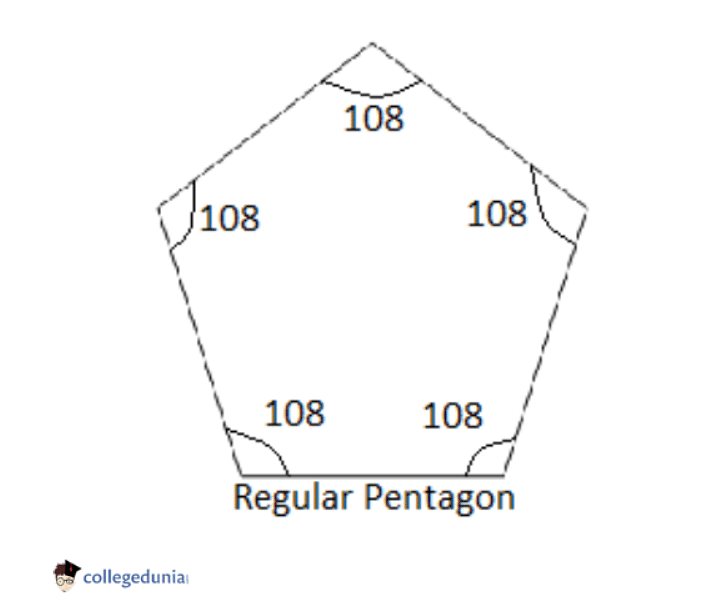
Interior angles of Pentagon
A regular pentagon has all its five sides equal and all five angles are also equal.
Hence, measure of each interior angle = [(n – 2) × 180°]/n = 540°/5 = 108°.
Here, n = Number of sides
Exterior Angles
The angles that are created when the sides of a pentagon are extended outside of the pentagon are known as the exterior angles. A pentagon's exterior angles are all equal to 72°.
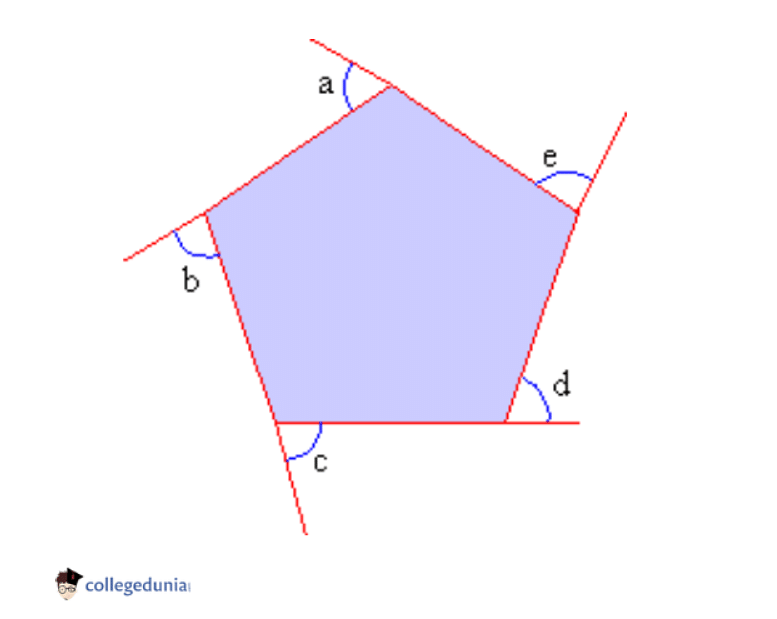
Exterior angles of Pentagon
Since a regular pentagon's exterior angles add up to 360 degrees, the following formula can be used to determine each exterior angle of a regular pentagon:
The measure of each exterior angle of a pentagon = 360°/n = 360°/5 = 72°.
Read more:
| Relevant Concepts | ||
|---|---|---|
| Types of Polygon | Rectangle | Regular Hexagon |
| Convex Polygon | Heptagon | Properties of Hexagon |
Central Angle
A regular pentagon's center angle has a measurement that is equal to a circle, 360° or overall. The angle at one of the pentagon's five congruent triangles' vertices will be 72° (360°/5 = 72°).
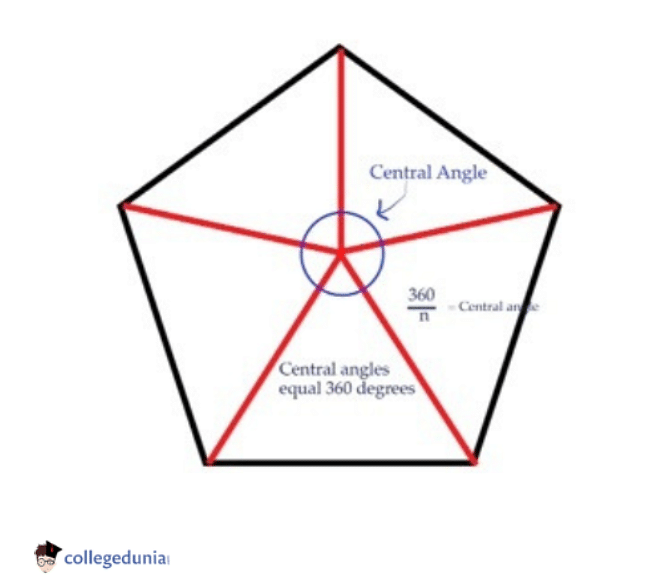
Central angle of Pentagon
Sum of Angles in a Pentagon
[Click Here for Sample Questions]
The sum of all the five angles in a pentagon is the sum of the pentagon. The sum of angles in pentagon is as follows:
Sum of Interior Angles in a Pentagon
Pentagon is formed from three angles, hence
the sum of angles in a pentagon = 3 x 180ο = 540ο
The alternative method to calculate the sum of angles using sides of pentagon
The sum of interior angles of a polygon of n sides = (n - 2) x 180ο
Since pentagon has 5 sides, n = 5, hence (5 - 2) x 180ο = 540ο
Hence, the sum of the interior angles of the pentagon is 540ο.
Sum of Exterior Angles in a Pentagon
Formula to calculate the sum of interior angles of a polygon is (n - 2) x 180ο.
Hence, each interior angle = [(n - 2) x 180ο] /n.
Each exterior angle is supplementary to the interior angle.
Thus, from above formula, each angle is derived = [180°n -180°n + 360°]/n = 360°/n
Therefore, the sum of exterior angles of a polygon = n(360°/n).
As, the number of sides in a pentagon is 5, n = 5.
Thus, the sum of exterior angles of a pentagon = 5(360°/5) = 360°.
Things to remember
- A pentagon is a two-dimensional polygon with five angles and five sides.
- The sum of all the interior angles of any regular pentagon equals 540° and the sum of all the exterior angles of any regular pentagon equals 360°.
- Each exterior angle of a regular pentagon is equal to 72° and each interior angle of a regular pentagon is equal to 108°.
- In a pentagon, an angle is formed when the two sides of the pentagon share a common point.
- A regular pentagon has equal sides and angles,
- A regular pentagon is a convex pentagon.
- The types of pentagon are categorized based on their properties.
Sample Questions
Ques. Three angles of a pentagon are 80°, 70° and 100°, then the other two angles can be 145° and 145° or 120° and 180°? (3 marks)
Ans. Given three angles are 80°, 70° and 100°.
Sum of three angles = 80° + 70° + 100° = 250°
We know that the sum of all the five angles of a pentagon is 540°.
Sum of the other two angles = 540° – 250° = 290°
Now,
145° + 145° = 290°
120° + 180° = 300°
Hence, the other two angles of a pentagon are 145° and 145°.
Ques. The angles at 4 vertices of a pentagon measure 80°, 100°, 90°, and 60°. What is the measure of the remaining angle? (2 marks)
Ans. the sum of all the interior angles of equals 540°. Here, the first four angles add up to = 60° + 80° + 90° + 100° = 330°
So, the remaining 5th angle will be 540°−330° = 210°.
Ques. If the interior angle of a regular pentagon is 12y. Then, what is the value of y? (2 marks)
Ans. We know that each interior angle of a regular pentagon is 108°. Hence, 12 y = 108°; y = 9.
Ques. Peter found the perimeter of his pentagonal ground to be 120 units. How will he find the area of the ground? (3 marks)
Ans. Given, Perimeter (P) = 120 units and Side = 120 ÷ 5 = 24 units
Apothem = side/2 ÷ tan 36° units
= 24/2 ÷ tan 36° units
= 16.6 units
Area = 1/2 × P × A sq units
= 1/2 × 120 ×16.6
= 60 × 16.6
= 996 sq units
Ques. What are the Properties of the Pentagon? (3 marks)
Ans. Here are few properties of the pentagon:
- In the pentagon, the sum of interior angles = 540ο
- Regular pentagon has equal measures of sides and angles. Otherwise, it is known as an irregular pentagon.
- The interior angles = 108ο and the exterior angles = 72ο.
- An equilateral pentagon has 5 sides that are equal to each other.
- The sum of interior angles of a rectangular pentagon = 540ο.
Ques. Mention the different types of Pentagon. (3 marks)
Ans. The types of pentagon are as follows:
- Regular Pentagon
- Irregular Pentagon
- Concave Pentagon
- Convex Pentagon
Ques. What is the measurement of the central angle of a regular pentagon? (1 mark)
Ans. The measurement of the central angle of a regular pentagon is 72ο.
Ques. What is the measurement of each interior angle? (1 mark)
Ans. The measurement of each interior angle is 108ο.
Ques. What is the measurement of each exterior angle? (1 mark)
Ans. The measurement of each exterior angle is 72ο.
Ques. What is the total sum of interior and exterior angles? (1 mark)
Ans. The sum of interior angles = 540ο, and the exterior angles = 360ο.
Check Out:



Comments