



Content Curator
A pentagon is a closed 2D shape that consists of 5 vertices and 5 straight lines or sides. The different shapes and figures in geometry are called polygons.
- A polygon can have two, three, or four sides.
- A polygon can be a rectangle, square, quadrilateral or even a pentagon.
- It forms five interior angles.
According to that, different shapes have got different names. The word pentagon is made from two words: “penta”, which means five, and the other word is “gonia”, which means angle. The total of all the internal angles of the pentagon is equal to 5400. These five sides of a pentagon can be pointed inwards or outwards, and depending upon that, pentagons are classified with different names. They are:
- Regular and Irregular pentagon
- Convex and Concave pentagon
| Table of Content |
Key Terms: Polygon, Pentagon, Concave Pentagon, Irregular Pentagon, Regular Pentagon, Convex Pentagon, Apothem
What is a Pentagon?
[Click Here for Sample Questions]
A pentagon has 5 sides and 5 angles. It falls in the family of Polygon. The total of the internal angles of a pentagon equals 5400. The different sides of the pentagon thus decide the type of pentagon shapes
- Regular and Irregular pentagon
- Convex and Concave pentagon
Pentagons are either simple or self-intersecting. A simple pentagon (5-gon) has five straight sides which typically meet to form five vertices. However, they do not intersect with one another. A self-intersecting regular pentagon is known as a Pentagram.
Line of Symmetry of a Pentagon
In case of line symmetry, every polygon has a distinct number of lines of symmetry. For instance, a square has 4 lines of symmetry. In a similar manner, a regular pentagon has 5 lines of symmetry.
Read Also:
| Topic-Related Concepts | ||
|---|---|---|
| Quadrilateral Angle Sum Property | Types of Polygon | Area of Polygon |
| Angle Formula | Volume of Pyramid | Volume of a Prism |
Types of Pentagon
[Click Here for Sample Questions]
The several types of Pentagon are:
Regular Pentagon
Regular pentagons have five sides, and all five sides are equal in length and equal in exterior and interior angles. i.e., all exterior angles have a measurement of 72 degrees and the interior angle measures 108 degrees.
Irregular Pentagon
These pentagons do not have all sides equal in length, and all angles are not of equal measure. i.e. all exterior angles have different measurements and interior angles have different measures.
Concave Pentagon
If any one of the vertices of a pentagon points towards the inside, then it is called a concave pentagon. i.e., the interior angle of the pentagon is greater than 180 degrees.
Convex Pentagon
In a convex pentagon, if a pentagon the vertices point outside and none of its interior angles are greater than 180 degrees.
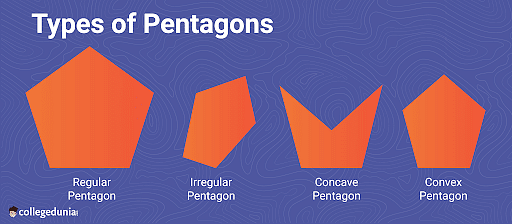
Types of Pentagons
Some other types of Pentagons include:
Equilateral Pentagon
A polygon with equal 5 length sides is known as an Equilateral pentagon. All the five internal angles found in a pentagon can possess a range of value sets. Thus, it forms a family of pentagons.
Cyclic Pentagon
In case the vertices of a pentagon fall on the circumference of a circle, it is then referred to as a Cyclic Pentagon. The regular pentagon is one of the best examples of the same. The area of a cyclic pentagon can be shown as one-fourth the square root of a septic equation.
Area of a Pentagon
[Click Here for Sample Questions]
The area of a pentagon is the closed surface enclosed within the pentagon. It can be calculated by different methods depending upon the dimensions that are known.
For a regular pentagon area, can be calculated by using one single formula. But for some irregular pentagons, we need to split them into different polygons and add their areas to get the result.
Area of a Regular Pentagon
The area of a Regular Pentagon formula is:
| ½ x Perimeter x Apothem |
Here, the Apothem is the line from the centre of the pentagon to a side, intersecting the side at a right angle.
- In a regular pentagon with side and the apothem length, the formula to determine the area of the pentagon is: Area of a Pentagon, A = (5/2) × Side Length × Apothem square units
- Considering the side length of a pentagon is given: Area = 5s2 / (4 tan 36°) Square units
- Considering the radius of a pentagon is given: Area = (5/2)r2 sin 72° Square units
Area of an Irregular Pentagon
The area of an irregular pentagon can be calculated by dividing the pentagon into several other polygons and then calculating the individual areas of these polygons and adding them together to get the result of an irregular pentagon.
Perimeter of Pentagon
[Click Here for Sample Questions]
Perimeter of a pentagon is defined as the total measure of its boundary.
- It is calculated by adding the length of all its sides.
- Since a pentagon has five sides, then its perimeter can be calculated by adding the length of all its five sides.
- In a regular pentagon, all of its sides are of equal measurement.
- Therefore, if a pentagon has a side of a unit, then its perimeter is 5a units.
However, in Irregular Pentagons, all the sides are of different lengths. Therefore, we need to add each side length separately. Thus, it can be shown using the following example
Example 1. Find the perimeter of a pentagon whose each side is of length 8 cm.
Solution: The side length of a given pentagon is 8 cm.
Using the pentagon formula, perimeter = 5a = 5 x 8 = 40 cm.
Example 2: Find the perimeter of a pentagon in which the length of the sides is 6 units, 5 units, 4 units, 3 units, and 2 units.
Solution: In order to find the perimeter of the irregular pentagon, we will add all five sides.
Thus, Perimeter = 6 + 5 + 4 + 3 + 2 = 20 units.
Therefore, the perimeter of the pentagon is 20 units.
Properties of a Pentagon
[Click Here for Sample Questions]
Some of the properties of a pentagon are:
- Pentagons have five straight lines, and these lines never intersect.
- Pentagons consist of five interior angles which add up to 540 degrees.
- Irregular pentagons have five sides of different lengths.
- Regular pentagons have all five sides of equal length.
- In a convex pentagon, no internal angle can be greater than 180 degrees.
- In a concave pentagon, there is always one interior angle which is greater than 180 degrees.
- Regular pentagons have five congruent sides, i.e., sides of equal length, five congruent interior angles each of 108 degrees and five congruent exterior angles each of 72 degrees.

Types of Polygons
Read Also:
Pentagon Examples
Examples of a pentagon in real life:
A pentagon is made with five edges and five points, that is, five sides and five corners that exist in two dimensions. Here are some real-world examples of pentagons, which are very common geometrical shapes used by architects to design structures and buildings. Thus,
- Section on a soccer ball: In football or soccer balls, more pentagons and hexagons are stitched together to make a football.
- Toy house: If you take a look at a toy house, its outer boundary consists of five sides, five corners, and five angles.
- Diamond:- Diamond is clearly a real-life example of a pentagon shape.
- One of the best-known pentagon structure examples in the real world is the headquarters of the United State Department.
Things to Remember
- A pentagon is a closed 2D shape of 5 vertices and 5 straight lines or sides.
- Area of a Pentagon, A = (5/2) × Side Length × Apothem square units
- Pentagons have five straight lines, and these lines do not intersect.
- Pentagons contain five interior angles adding up to 540 degrees.
Sample Questions
Ques. What is a Pentagon? (1 mark)
Ans. A pentagon can be defined as a closed 2D shape with 5 vertices and 5 straight lines or sides. The different shapes and figures in geometry are called polygons. Pentagon is considered a polygon.
Ques. What is a Polygon? (1 mark)
Ans. A Polygon is a plane figure that has at least three straight sides and angles. Triangles, Rectangles, Petangons are all examples of a Polygon.
Ques. A girl measures a pentagon drawn on the ground. Each side is 6 feet, and the apothem is 4 feet in length. How is she going to find the area of the grass patch she is going to grow? (2 marks)
Ans. As per the given question,
Apothem = 4 feet
Side = 6 feet
Thus,
Area = 1/2 × perimeter × apothem
= 1/2 × 5 × 6 × 4
= 1/2 × 120
= 60 sq inches
Thus, the area of grass patch = 60 inches2.
Ques. The perimeter of a pentagonal ground is 120 units. Determine the area of the ground. (2 marks)
Ans. As per the equation
Perimeter (P) = 120 units
Side = 120 ÷ 5 = 24 units
Apothem = side/2 ÷ tan36° units
= 24/2 ÷ tan36° units
= 16.6 units
Thus, the area can be determined by,
Area = 1/2 × P × A sq units
= 1/2 × 120 ×16.6
= 60 × 16.6
= 996 sq units
Hence, the area of the field = 996 sq units
Ques. Sara makes a pentagon shape embroidery on her frock. How much thread is needed to construct a 4-inch-sided regular pentagon? (2 marks)
Ans. As per the given question,
Side = 4 inches
Thus, the length of the thread needed is going to be its perimeter.
Perimeter = 5 × 4 = 20 inches
Hence, Sara would require 20 in the thread.
Ques. Determine the apothem of a pentagon with sides of 16 yards. (2 marks)
Ans. Apothem can be calculated in case the side is known.
Thus, Apothem = side/2 ÷ tan36° units
= 16/2 ÷ tan36° yards
= 8 ÷ 0.72 yards
= 11.12 yards
Hence, Apothem = 11.12 yards
Ques. Determine the area and perimeter of a regular pentagon with a side 5 cm and an apothem length of 6 cm. (3 marks)
Ans. As per the given question
Side of a pentagon, a = 5 cm
Apothem Length = 6 cm
Since we ae aware that,
The area of a pentagon, A = (5/2) ×Side Length ×Apothem square units
Thus, upon substitution, side = 5 cm, Apothem = 6 cm in the formula,
A = (5/2) × 5 × 6
= 5 × 5 × 3
= 75
Therefore, the area of a pentagon is 75 cm2
The perimeter of a pentagon, P = 5a units
P = 5 (5)
P = 25 cm
Hence, the perimeter of a pentagon is 25 cm.
Ques. Determine the area of the pentagon calculation with the help of the given image. (5 marks)

Ans. In the given triangle POQ, the following can be seen:
OA = apothem and OA perpendicular to PQ.
Now, consider the length of the side is 6 inches.
Thus, also consider the right triangle POA.
Then,
OP = hypotenuse
And, AP = 1/2 of the pentagon's side = 3 inches
Hence,
∠AOP = 36° (∵ 72° ÷ 2)
∠OPA = 54° (∵ 108° ÷ 2)
Tangent of an angle
tan 36° = opposite/adjacent
= opposite/apothem
= 3/apothem
Thus, it can be said,
Apothem = 3/tan 36°
= 3/0.72
= 4.16 inches
As per the pentagon formula,
Area = 1/2 × 5 × side × apothem
= 1/2 × perimeter × apothem
= 1/2 × 30 × 4.16
= 15 × 4.16
= 62.4 sq in
Check-Out:



Comments