



Content Curator
Geometry is one of the major segments of mathematics that especially deals with study of shapes and sizes of different figures. It is widely classified into Plane geometry and Solid Geometry. Plane and Solid geometry varies from one another. When plane geometry deals particularly with flat structures, like polygons, curves, and lines and circles – solid geometry talks vividly about three-dimensional shapes, likespheres, cubes, cones, and more.
Read Also: Coordinate Geometry
| Table of Content |
Key Takeaways: Polygon, Curve, Angle, Obtuse angle, Acute angle, Reflex angle, Right angle, Regular polygon, Convex polygon, Concave polygon, Simple curve
What is a Polygon?
[Click Here for Sample Questions]
A polygon simply is an enclosed geometric figure that has three or more straight line segments. Typically, the straight line segments that enclose the figure are collectively known as the sides of the polygon.

Polygon
In the above figure, AB is a side. While A, B, C, D and E are all vertices of the polygon shape. A and E make adjacent vertices, while A and C make non-adjacent vertices. Moreover, AC is a diagonal.
- Besides, the point at which two straight line segments gradually meet is otherwise known as the vertex.
- Moreover, the pair of sides which eventually meet exactly at the same vertex are known as adjacent sides and the touchpoints of either side are widely also called adjacent vertices.
- The diagonal of a polygon is its non-adjacent vertices.
- A regular polygon can be determined if the sides of it are equal in length. For instance, a square is a perfect epitome of the same. A rectangle is an irregular polygon.
- The minimum number of sides a polygon should have is three. And a perfect example of the same is a triangle.
- The nomenclature each polygon has is based on the number of sides it has. For example, a pentagon typically has five sides, while a square has four.
Check Important Notes for Centroid of a Triangle
Types of Polygon
[Click Here for Sample Questions]
There are four major types of Polygons:
- Regular Polygon: A Polygon with equal sides and angles is known as Regular Polygon.
- Irregular Polygon: A Polygon with unequal sides and angles is known as an Irregular Polygon.
- Convex Polygon: A polygon that has the boundary of a convex set is known as Convex Polygon.
- Concave Polygon: A polygon that does not have the boundary of a convex set is known as Convex Polygon.
What is a Curve?
[Click Here for Sample Questions]
A curve, if simply defined, can be anything but straight in shape. A curve is a non-straight line that bends or changes its direction at least about once.
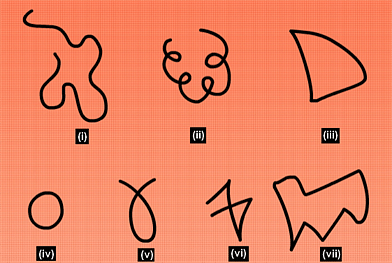
Curve Shapes
It is usually a continuous, especially endless, line that changes directions. For example, mountainous roads are a prime instance of a curve. Many random lines that you have probably drawn until now fall under the category of a curve.
Check Also: Properties of Parallel Lines
Types of Curve
[Click Here for Sample Questions]
There are several kinds of curves, like simple curves, open curves, and closed curves, upward curve, downward curve and non-simple curve.
- Open Curve: An open curve is typically a curve whose endpoints apparently do not meet. Closed curves, however, encloses a full area and does not have any endpoints.
- Upward Curve: An upward curve usually faces upwards in direction, and is also otherwise known as a concave curve. A downward curve, on the other hand, faces downwards in direction, and is usually also known as convex curve.
- Simple Curve: A simple curve doesn’t usually intersect itself at any particular point. A non-simple curve, however, is seen to intersect its own line of direction during movement.
What is an Angle?
[Click Here for Sample Questions]
When two lines intersect very close to the point of meeting, it typically then creates a space (measured generally in degrees) which is known as an angle.

Angles
There are several parts of an angle, much like the vertex, interior angle, exterior angle and its arms. Two lines that usually intersect at a specific point causes the formation of four angles simultaneously during intersection. The symbol of an angle is ∠.
Check Also: Alternate Angles
Types of Angles
[Click Here for Sample Questions]
Angles can be classified in many parts like, acute angle, obtuse angle, reflex angle and right angle. They are named and determined as per their shape and size.
- Acute Angle: An acute angle is formed when the measurement between the two main arms is less than 90 degrees.
- Obtuse Angle: An obtuse angle is typically formed when the measurement between the two main arms is more than 90 degrees.
- Reflex Angle: A reflex angle is formed when the measurement between the two main arms is usually more than 180 degrees, but less than 360 degrees.
- Right Angle: A right angle is formed when the measurement between the two main arms is exactly 90 degrees.
Points to Remember
[Click Here for Sample Questions]
Following are some important points:
- A polygon is an enclosed geometric shape that has three or more straight line segments. One major example of a polygon is a triangle, which is also a figure that has the least number of sides a polygon is supposed to have.
- Regular Polygon, Irregular Polygon, Convex Polygon and Concave polygon are all types of polygon.
- A curve can be anything but straight in shape. A curve is a non-straight line that changes its direction at least about once.
- Simple curves, open curves, and closed curves, upward curve, downward curves, and non-simple curves are the major types of curves.
- Angles are categorized into four parts, like acute angle, obtuse angle, reflex angle and right angle.
Read More: Linear Pair Axiom
Sample Questions
Ques: Assuming that the sum of angles of a particular polygon is 2160 degrees. Determine the sum of angles of this polygon if there is an additional side. (3 Marks)
Ans: As per the question, the sum of angles of the polygon is = 2160 degrees
Considering the sum of angles of the respective polygon with n number of sides, which is = (n - 2) * 180 degrees.
= therefore, (n - 2) * 180 degrees = 2160 degrees
=> n −2 = 2160/180
=> n-2 = 12
=> n = 14
Thus, the total number of sides of the polygon is 14.
Which also means, the second polygon will have = 14 + 1 = 15 sides
Therefore, the sum of the angles of the polygon with 15 sides is
= (n - 2) * 180 degrees
now, after substituting the values, we get
= (15 − 2) * 180 degrees
= 13 * 180 degrees = 2340 degrees
Hence, the sum of angles of the polygon, assuming it has 15 sides is 2340°.
Ques: Determine the measurement of x in the given figure. (3 Marks)

Ans: The given figure shows the following measurements: 50 degrees, 90 degrees, 110 degrees, and x.
To determine the value of x, we need to add the following measurements.
Therefore, x + 90 degrees + 50 degrees + 110 degrees = 360 degrees
Moreover, x + 250 degrees = 360 degrees
X = 110 degrees.
The measurement of x in the following figure is 110 degrees.
Ques: Determine the total number of sides of a regular polygon which typically has an exterior angle measuring about 45 degrees. (3 Marks)
Ans: As per the given equation, it can be said that the measurement of the exterior angles in total is = 360 degrees
Now, it is also mentioned that each exterior angle measures = 45 degreesHence, the total number of sides can be determined after we divide the values with one another, which is = \(\frac{360}{45}\) = 8
Therefore, the total number of sides of the regular polygon is 8.
Ques: Consider the given figure, and determine the values of x, y, and z. (3 Marks)

Ans: As per the given figure shown above, it can be said,
The parallelogram shows angle TBE = 100 degrees
Now, since we are already aware that the opposite angles of every parallelogram are equal.
Hence, x = 100 degrees
Now, we are also aware that the adjacent angles of any parallelogram is known to be supplementary,
Thus, 100 degree + z = 180 degree
Ques: Determine the value of x as per shown in the following image below. (3 Marks)

Ans: As per the given question, we are already aware that the three exterior angles of the polygon are 125 degrees, 125 degrees and x.
We also simultaneously know that the sum of exterior angles is = 360 degrees.
Thus,
125 + 125 + x = 360
250 + x = 360
x = 360 - 250
x = 110
Therefore, the value of x is 110 degrees.
Ques: Assume the following rectangle in the given picture. The diagonals, in the given figure, meet at O. Determine the value of x, if OR = 2x + 4, alongside OT = 3x + 1. (3 Marks)

Ans: As we already know from the given figure, OT is basically half of TE (which is the diagonal of the rectangle).
At the same time, OR is basically half of RN (which is also the diagonal of the rectangle).
It is clear that OR = OT, since diagonals usually bisect one another and still remain equal in a rectangle.
Therefore, after considering the following equation, we get, 2x + 4 = 3x + 1
Ques: Consider that the diagonals of the rectangle ABCD intersect one another through the point O. Now, if ∠AOD is about 30o, then determine the angle of∠OCD. (3 Marks)

Ans: In the following triangle angle OBC it can be said that∠AOD = ∠BOC = 30 degrees, which are apparently opposite angles.
Now, since we already know that diagonals of a rectangle are supposed to equal and also simultaneously should bisect one another, it can be said, OB = OC
Now, in the isosceles triangle \(\angle\)BOC, ∠OBC = ∠OCB = x
Therefore, after applying angle sum property of a triangle, it can be shown,
30 + x + x = 180
2x = 180 - 30
2x = 150
x = 75
Therefore, it can be said that∠OCB=75º
Now, we also know that every vertex angle of any rectangle is supposed to be 90 degrees, thus,
OCD + OCB = 90
OCD + 75 = 90
OCD = 15
Therefore, the angle OCD is 15 degrees.



Comments