



Education Journalist | Study Abroad Lead
Arteries are blood vessels that carry blood from the heart and pump it to all the tissues of the body. Arteries hold a special feature in human physiology of giving oxygenated blood and nutrients to all parts of the body. They hold a tree-like structure that gets branched out into small parts known as arterioles and again arterioles are branched further to form capillaries, which are the core point of exchange of nutrients and other materials.
Read More: What are Blood Vessels?
Key Terms: Arteries, Arterioles, Capillaries, Veins, Heart, Blood, Blood Vessels, Circulatory System, Pulmonary Artery, Oxygenated Blood, Deoxygenated Blood.
Human Circulatory System
[Click Here for Sample Questions]
The human body is made up of complex structures which function in coordination to maintain the smooth functioning and proper transportation of needful materials which are enacted by the human circulatory system also known as the blood vascular system. The human circulatory system is responsible for the transportation of blood, crucial nutrients, and minerals throughout the body. It is also responsible for removing the discarded aspects away from the body.
The Human Circulatory System is made up of the heart, blood and blood vessels. Among them, blood vessels are the network of a number of arteries, veins and capillaries. They are responsible for the transportation of nutrients and minerals from the heart and towards the heart. They also hold the responsibility to eradicate the waste materials of the cells and tissues.

Human Circulatory System
What are Blood Vessels?
[Click Here for Sample Questions]
Blood vessels act as a crucial aspect of the human circulatory system. They are the network of hollow tubes in a pipe-like structure which are responsible for the transportation of blood, nutrients and minerals all over the body. There are three types of blood vessels, namely.
- Arteries
- Veins
- Capillaries

Types of Blood Vessels
Arteries
[Click Here for Sample Questions]
Arteries are types of blood vessels that are responsible to carry oxygenated blood and nutrients from the heart to all the tissues of the body. Though it has one exception of the pulmonary artery which carries deoxygenated blood from the left heart to the lungs. Arteries hold pumped blood from the heart which flows in high pressure and to bear this, they are muscular, rigid and elastic in structure.

Arteries
Structure of Arteries
[Click Here for Sample Questions]
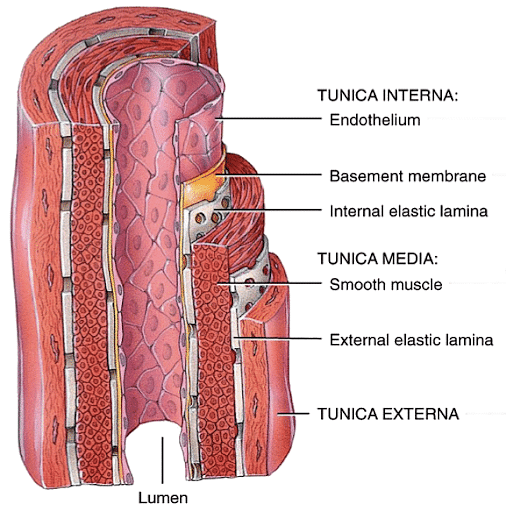
Arteries hold high pressure-resistant power and have a muscular tubular structure. It is lined by smooth tissues and has three layers, namely,
- Tunica Intima: The innermost layer is known as tunica intima which is lined by a smooth tissue known as the endothelium.
- Tunica Media: The middle layer is called tunica media, it is a muscular layer that is responsible for bearing high pressure from the heart.
- Tunica Adventitia: The outermost part is called adventitia, it is made up of connective tissues which guide arteries to the outer part of the body.

Structure of Arteries
Note: The largest artery is known as Aorta. It is the main tube that is connected to the left ventricle of the heart. It further gets branched into numerous networks of smaller arteries. These smaller branches of arteries are known as arterioles and capillaries.

Aorta
Types of Arteries
[Click Here for Sample Questions]
There are three types of arteries, namely,
- Elastic arteries
- Muscular arteries
- Arterioles
Elastic Arteries: Elastic arteries are made up of thick muscular layers which get stretched by every heartbeat. It is also known as conducting arteries.
Structure of Elastic Arteries
Muscular Arteries: Muscular arteries are responsible to take blood and other nutrients from elastic arteries and further branch them into smaller arteries and arterioles. They are made up of smooth muscles that are responsible for expansion and contraction. It is also known as distributing arteries.
Arterioles: Arterioles are blood vessels that emerge from the artery and move towards capillaries. They are made up of muscular walls and are responsible for the transportation of blood and other nutrients.

Arterioles in Human Circulatory System
Function of Arteries
[Click Here for Sample Questions]
Below mentioned is the function of arteries in our body:
- The primary function of the artery is to carry oxygenated blood from the heart to all the parts of the body.
- Pulmonary arteries carry blood to lungs from the left side of the heart, i.e, they carry deoxygenated blood.
Difference between Arteries and Veins
[Click Here for Sample Questions]
[Click Here for Sample Questions]
Arteries and Veins are blood vessels that are responsible for the proper functioning of the human circulatory system. Let us understand the major difference between both of them.
| Arteries | Veins |
|---|---|
| Arteries carry oxygenated blood from the heart to all tissues, except the pulmonary artery which carries deoxygenated blood to the lungs. | Veins carry deoxygenated blood from the tissues to the heart, except pulmonary veins which carry oxygenated blood to the heart. |
| Arteries are made up of three layers, which are highly resistant to high pressure. They are muscular and rigid in structure. | Veins are made up of three layers, which are less muscular and thinner than arteries and so do not hold high-pressure resistive power. |
| Arteries are positioned deep inside a human body. | Veins are positioned on the periphery of the human body. |
| Arteries are capable of upholding high pressure. | Veins are capable of upholding low pressure. |
| In arteries carbon dioxide content is minimum | In veins carbon dioxide content is maximum. |
| In arteries, valves are not present. | In veins valves are present. |
| There are three types of arteries: Elastic Artery, Muscular Artery and Arterioles. | There are three types of veins: Deep Veins, Superficial Veins and Pulmonary Veins |
Things to Remember
- The human circulatory system is made up of the heart, blood ,and blood vessels.
- Blood vessels are of three types, namely, Arteries, Veins and Capillaries which perform the function of transportation in our body.
- Arteries are blood vessels that carry oxygenated blood from the heart to the body tissues, but there is an exception of the pulmonary artery which carry deoxygenated blood.
- Arteries transport blood from heart to other tissues and organs since they are capable of holding high pressure of pumped blood.
- Veins carry deoxygenated blood from the tissues to the heart except the pulmonary veins which carry oxygenated blood.
- Pulmonary artery carries deoxygenated blood from heart to lungs.
Sample Questions
Ques. Define the human circulatory system. (2 marks)
Ans. Human body is a complex structure of numerous tissues and organs. The body runs with the circulation of blood and nutrients which flow throughout the body continuously without a stop. This is maintained by the human circulatory system, which has its reach to all the tissues of the body. The human circulatory system consists of the heart, blood, and blood vessels. The human circulatory system is responsible for the transportation of blood and other nutrients from the heart and away from the heart.
Ques. What are arteries? Mention the types of arteries (3 marks)
Ans. Arteries are types of blood vessels. Arteries are tube-like structured pipes that carry oxygenated blood from the heart to all the tissues of the body. But it has an exception of the pulmonary artery which carries deoxygenated blood from the left heart to the lungs. It is thick, rigid, and elastic in structure and is capable of holding high pressure of pumping blood, which comes from the heart. There are three types of arteries, namely, Elastic artery, Muscular artery and Arterioles.
- Elastic arteries are also known as conducting arteries. They are muscular, thick , and stretchable in structure.
- Muscular arteries are also known as distributary arteries. They take blood and other nutrients from the elastic arteries and transport them to arterioles.
- Arterioles come out from arteries and move towards capillaries. Arterioles are made up of muscular walls. They are responsible for the movement of blood and other nutrients.
Ques. Explain the reason behind the deep presence of arteries in the skin.(2 marks)
Ans. Arteries uphold the responsibility for the transportation of oxygenated blood from the heart to the rest of body parts. Since arteries carry blood from the heart which gets pumped out in heavy pressure. This heavy pressure makes the blood flow heavily. To uphold this high pressure arteries are situated deep inside the skin, else the presence of arteries in the periphery of the skin would have increased the risk of blood loss due to rupture.
Ques. Why are arteries made up of thick muscles? (2 Marks)
Ans. Human circulatory system in itself is a bizarre system. It is made up of blood, blood vessels, and the heart. Among them, blood vessels act as a transport which helps in the transportation of blood from the heart to body parts and vice versa. There are three types of blood vessels – arteries, veins, and capillaries. Among them, arteries are responsible for the transportation of blood from the heart to all the body parts of the body. Since the heart beats with its pace in continuation, it pumps out blood at a faster rate making high pressure within. To tackle this arteries are made up of thick and rigid tissues which are resistive to high pressure.
Ques. Veins are not capable of holding high pressure. Give a reason.(2 marks)
Ans. Veins are one of the types of blood vessels. Veins are responsible for the transportation of deoxygenated blood from the body parts to the heart. Though it has an exception of pulmonary vein which carry oxygenated blood. Veins are located in the periphery of the entire human body due to its function of transportation from all the parts. So, due to its location on the periphery veins are highly subjective to the outside world and so hold a high risk of getting ruptured. Veins are made up of less muscular tissues by structure. So, due to the location and structure of veins, veins are subjected to uphold low pressure and not high pressure.
Ques. How are arteries and veins different from each other? Give three reasons (5 marks)
Ans. Blood vessels are a network of hollow tube-like structures which act as a transporting agent between the heart and different body parts. There are three types of blood vessels, namely – Arteries, Capillaries, and Veins. Among them, arteries and veins act as transporting sites of blood and other nutrients.
- Where arteries carry oxygenated blood from the heart to different body parts except the pulmonary artery which carries deoxygenated blood from the heart to the lungs. Veins are responsible for the transportation of deoxygenated blood from different body parts to the heart with an exception of pulmonary veins which carry oxygenated blood.
- Arteries are made up of thick and rigid muscles and are capable of bearing high pressure whereas veins are made up of soft muscles and can take low pressure.
- The concentration level of CO2 in arterial blood is low whereas blood carried by veins has a high CO2 level.
- Arterial blood has a high oxygen level whereas blood carried by veins has low oxygen level.
- Arteries have a narrow lumen whereas veins have a wide lumen.
- Diseases related to arteries are renal vascular disease, atherosclerosis, pectoris etc whereas diseases related to veins are varicose veins.
- The blood vessels of arteries are red in colour whereas the blood vessels of veins are blue in colour.
Ques. Explain the difference between arteries and capillaries by giving three reasons.(5 marks)
Ans. Human body is a complex structure. For its proper functioning, the human circulatory system works which passes proper nutrition and food of tissues which is blood, minerals, and other nutrients. For this transportation, blood vessels are present. There are three types of blood vessels namely – arteries, veins, and capillaries. The major difference between arteries and capillaries are:
| Arteries | Capillaries |
|---|---|
| Arteries are blood vessels that are responsible for the transportation of oxygenated blood from the heart to the other body parts with an exception of the pulmonary artery which carries deoxygenated blood. | Capillaries are vessels that act as a linkage between arteries and veins. |
| Arteries are responsible for the transportation of blood. | Capillaries are responsible for the exchange of materials between blood and tissues. |
| Arteries are capable of holding high pressure. | Capillaries are capable of holding low pressure. |
| Arteries have thick walls. | Capillaries have thin walls. |
Ques. How many types of veins are present in our body? (2 marks)
Ans. Veins are broadly categorised into three types namely,
- Deep Veins: These are located deep within our body
- Superficial Veins: These veins are easily visible as these are positioned closer to skin.
- Pulmonary Veins: These veins are distributed along the entire body and are four types.
Read More:



Comments