



Education Journalist | Study Abroad Lead
Aves refers to the class in Biology which mainly comprises birds. In simple words, birds belong to the taxonomic class Aves which is a part of the kingdom Animalia. Simultaneously, Aves are associated with the phylum Chordata and the subphylum Vertebrata. They are endothermic in nature and possess some unique features such as toothless jaws with beak, hard shell eggs, colourful features, ability to fly, double circulation, oviparous reproduction, courtship, parental care, nest building etc.
In this article, we will read about the evolution history of aves, their characteristics and features along with a few examples and various other associated concepts.
| Table of Contents |
Key Terms: Vertebrates, Terrestrial, Evolution, Birds, Life Cycle, Cretaceous Period, Oviparous Reproduction, Double Circulation, Species, Animalia
Aves: Scientific Classification
[Click Here for Sample Questions]
The scientific classification of Aves is mentioned below:
- Kingdom: Animalia
- Phylum: Chordata
- Clade: Sauropsida, Avemetatarsalia, Ornithurae
- Class: Aves

Classification of Kingdom Animalia
Read More: Classification of Animal Kingdom
Evolutionary History
[Click Here for Sample Questions]
In India, we have multiple organisations like Bombay Natural History Society, Salim Ali Centre for Ornithology and Natural History, which have worked for decades to understand the origin and the evolution of the Aves. It has been found that the earlier instances of this species were recognised in the Jurassic period, which is also characterised as the age of dinosaurs. The evolution of Aves began almost 160 million years ago with the gradual development of a lighter and smaller body along with the formation of wings and feather that facilitated the adaptability to flight. However, the Triassic and the Cretaceous periods are known for extreme volcanism, leading to the extinction of both birds and dinosaurs. Following the extinction, a completely evolved form of new species of birds emerged all over the world.
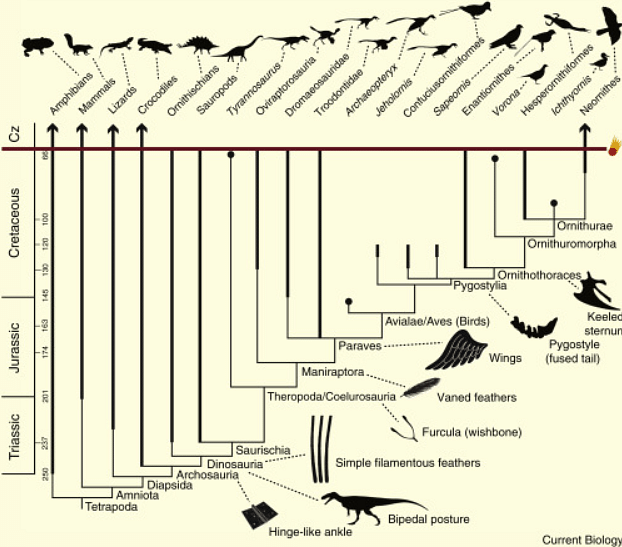
Evolution of Aves
Read More: Origin of Life
Classification of Aves
[Click Here for Sample Questions]
The taxonomic class of Aves is classified into two sub-classes, as mentioned below.
- Archaeornithes: This sub-class of Aves include the birds which have toothed beaks, elongated body, small brain and eyes and long tails. They are mainly considered as extinct species of the Jurassic era. Archaeopterygiformes is the only order under Archaeornithes. For example, Archaeopteryx lithographica
- Neornithes: It is another subclass under the taxonomic class of Aves. They are characterised by shorter tails and toothless jaws. The contemporary species are mainly of this sub – class and have multiple orders like, Struthioniformes, Casuariiformes, Apterygiformes, etc.
Read More: Phylum Chordata Classification
Characteristics of Aves
[Click Here for Sample Questions]
Let us understand some of the important characteristics of Aves which shall help in their identification and differentiation.
- Aves are known for having feathers all around their body. Feather helps them in maintaining their body temperature, supports flight and helps in camouflaging.
- Toothless jaws of the Aves are modified into beak which helps them in collecting and gathering food, safeguarding themselves from predators. However, shape and size of beaks vary as per different types of Aves. Such as, some birds have longer beaks than their head, while others have shorter beaks, almost half of their body and so on.
- The species' evolution and adaptation have resulted in the modification of the forelimbs of the Aves into their wings. It helps them to walk, wade, perch, hop, grasp and sometimes also help in swimming. However, wings of different types of Aves vary greatly in shape and size.
- Aves have a streamline shaped body structure. This helps them in flying easily by resisting the air.
- Their sharp eyes, well-developed flight muscles, small and elastic lungs are some other features which help them in flight and catching their prey and hiding from predators.
- The presence of hollow and long bones, known as pneumatic and ossified bones in the endoskeleton helps the Aves in constant flight.
- Aves have loose skin, wider jaws, flat or lifting fingers along with hallux and scaled lower limbs.
- Aves do not have any urinary bladder, rather use the kidney as the excretory organ.
- Internal fertilisation is also one of their important characteristics. Laying eggs is their main way of reproducing.
Read More:
Things to Remember
- Aves belong to a specific class of endothermic vertebrates, hence, characterised by their most prominent advantage of adaptation to flight.
- Passeriformes constitute the largest order under the class Aves. Birds like Chaffinch are classified in this order.
- The extinct species of Aves has toothed jaws whereas the present species majorly do not have teeth, rather the toothless jaw with beaks.
- Archaeornithes and Neornithes are two main sub – classes of the main class Aves which have multiple orders within it like Struthioniformes, etc.
- Aves are mainly known to have evolved in the Jurassic and the Cretaceous periods.
Sample Questions
Ques. What are Aves? Give examples. (2 marks)
Ans. Aves majorly are a type of birds which are adaptable to flight, these birds have wings and feathers and come under the class of Aves. Aves belong to the Kingdom animalia and remain a part of the phylum Chordata. These categories of birds have their origin in the specific class of endothermic vertebrates. Generally, Aves are characterised by their most prominent advantage of adaptation to flight. Moreover, the earth is vastly covered with more than ten thousand species of Aves, such as Ostrich, Hummingbirds, Pigeon, Waders and so on.
Ques. Illustrate the main characteristics of the Aves. (3 marks)
Ans. Some of the distinguishing characteristics of Aves are:
- Scientifically, the class, Aves, are a part of the wider group, called endothermic vertebrates.
- They belong to the Kingdom animalia and the phylum Chordata which itself combines to form a unique characteristic of Aves.
- While some other characteristics of Aves are mostly known in terms of their adaptability and habitat.
- Such as Aves have feathers all around their body which accompany them in moderating their body temperature and they also evolved to have a toothless jaw and a beak which makes it different from other kinds of birds.
- Their oviparous nature and the streamlined body are some other additional features for which the Aves are known.
Ques. What are the differences between the two subclasses of the main class Aves? (3 marks)
Ans. The taxonomic class of Aves is classified into two subclasses such as, Archaeornithes and Neornithes. The former sub – class of Aves consists of the birds which have toothed beaks, whereas the latter is the more recent one, having toothless jaws. Archaeornithes are known for having the elongated body, small brain and eyes and long tails. Whereas, Neornithes have comparatively shorter tails as a difference. Archaeopterygiformes is an order of the Archaeornithes. For example, Archaeopteryx lithographica. Simultaneously, Struthioniformes, Casuariiformes Apterygiformes, etc. are a few of the orders of Neornithes, for example Albatrosses.
Ques. Which branches of science is concerned with the study of Aves or birds? (2 marks)
Ans. Since Aves are nothing but just a taxonomic class of birds. However not all birds are Aves but all Aves are birds. Usually, the birds with feathers and wings are classified under Aves and simultaneously play an important role within the environment and mainly in terms of maintaining biodiversity. Therefore, there exists a branch of science, called as Ornithology which deals with their studies into multiple aspects. Some larger organisations like that of Bombay Natural History Society and so many others are also attached with the task of research and development on Aves or birds as a whole.
Ques. Which features of Aves help them in Flight? (2 marks)
Ans. Aves have evolved in a way that their body structure contributes a lot in the exercise of flight. Their streamline - shaped body contributes by cross – cutting the air pressure. They have feathers all around their body which stabilises their body heat and supports camouflaging and easy flight. Strong and robust muscles and sharp eyes are some other significant features which help them in flight and catching their prey and hiding from predators.
Ques. How are birds and reptiles linked to one another? Explain briefly. (2 marks)
Ans. Archaeopteryx serves as a connecting link between the birds and the reptiles. It is believed that the Archaeopteryx has both the types of traits, that is of reptiles as well as of birds. Thus, it also suggests that birds have evolved over a period of time from the actual and the earlier reptiles. And it could be said that both reptiles and birds earlier shared the same origin, however, their survival transformed gradually, maybe due to the climatic or other habitat related changes.
Ques. What is the role of birds in the ecosystem? (2 marks)
Ans. Birds constitute an important part of the entire ecosystem, become a significant element of the food chain and food web, provide meat and eggs to humans and serve the duty of balancing the environment. As a result, there are more than ten thousand species of Aves which are found on the earth, not so evenly distributed but are found in different habitats as per their nature of adaptability. Some of the examples of Aves are Ostrich, Hummingbirds, Chicken, Pigeon, Duck, Flamingo, Parrots, Kingfishers, Falcons, Woodpeckers, Hawks, Vultures etc.
Read More:



Comments