



Education Journalist | Study Abroad Lead
Reptilia are a class of vertebrates that belong to phylum chordata. The name ‘Reptile’ comes from a latin phrase that means ‘Creeping Creatures’. Snakes, lizards, crocodiles, caimans, alligators, turtles, geckos and chameleons are among these creatures, with lizards and snakes accounting for the bulk of reptile species. Reptiles are cold-blooded creatures, meaning they can't control their own body temperature. Also, such species are known to have evolved from amphibians. About 320 million years ago, sophisticated four-limbed vertebrates known as reptiliomorpha developed into the first reptiles. These early reptiles developed adaptations to living on land. Biting, hissing, camouflaging, and avoidance are some of the ways reptiles defend themselves against danger.
| Table of Contents |
Key Terms: Vertebrates, Terrestrial, Evolution, Life Cycle, Internal Fertilisation, Tetrapods, Species, Animalia
Reptilia: Scientific Classification
[Click Here for Sample Questions]
The scientific classification of Reptilia is as mentioned below:
- Kingdom: Animalia
- Phylum: Chordata
- Clade: Sauropsida
- Class: Reptilia
- Sub-classes: Anapsida, Parapsida, Diapsida
Read More: Classification of Animal Kingdom

Classification of Kingdom Animalia
Evolutionary History
[Click Here for Sample Questions]
Reptilians are the first species to adapt to life on land. Millions of years ago, they are thought to have evolved from amphibians. On the planet, reptiles number in the tens of thousands. They are cold-blooded creatures that belong to the Animal Kingdom's phylum Chordata.
The reptiles' skulls have been changed to give them a more efficient and strong jaw motion. The cranium has also been lightened as a result of the change. Turtles (Testudines), snakes and lizards (Lepidosauria), crocodiles and their cousins (Crocodilia), and birds (Aves), as well as a number of extinct taxa, make up the Reptilia Class in our taxonomy.
Read More: Origin of Life
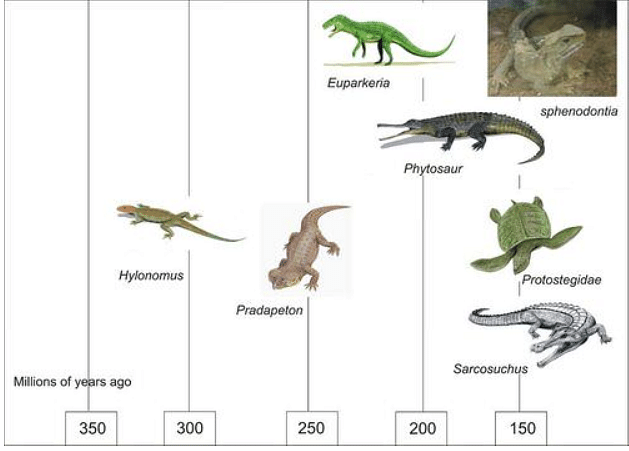
Evolution History of Reptiles
Characteristics of Reptilia
[Click Here for Sample Questions]
Mentioned below are the characteristics of Reptiles:
- They are basically Tetrapods: Snakes and other squamates have vestigial organs such as limbs and are categorised as tetrapods, like caecilians, since they are descended from four-limbed ancestors. Reptiles deposit eggs encased in shells on land. Even reptiles that live in the water come ashore to lay their eggs. Internal fertilisation is the most common method of reproduction for them. Some species are ovoviviparous, meaning the eggs stay in the mother's body until the time comes for them to hatch. Other species are viviparous, meaning they give birth to live offspring.

Circulatory System of Reptilia
- Reptiles have Oviparous Characteristics: The majority of reptiles reproduce sexually, however others can reproduce asexually. The cloaca, which is located at the base of the tail, is used for reproduction. Most reptiles have copulatory organs, which are generally hidden inside their bodies. A penis is seen in male turtles and crocodiles, whereas a pair of hemipenes is found in lizards and snakes. Because some species, such as the tuatara, lack copulatory organs, mating is accomplished by forcing the cloaca together.
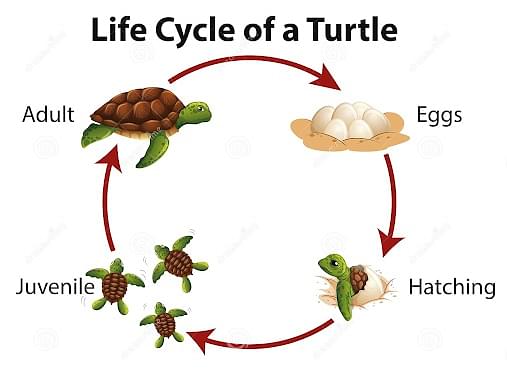
Life Cycle of Reptiles
- Reptiles have scales: The creation of reptiles' scaly skin, which includes the protein keratin and waxy lipids to reduce water loss from the skin, was one of the important adaptations that allowed them to survive on land. Because reptiles and amphibians have occlusive skin, they can't breathe through their skin and must rely on their lungs.
- Reptiles are Ectotherms: Ectotherms are animals whose primary source of body heat is derived from their surroundings. Endotherms, on the other hand, control body temperature using heat produced by metabolism. Reptiles are classified as poikilotherms, or creatures whose body temperatures fluctuate rather than remain constant, in addition to being ectothermic. Reptiles have behavioural adaptations to assist control body temperature, such as warming up by basking in the sun and cooling down by choosing shaded regions or burrowing underground.
- Lungs are used by reptiles to breathe: Lungs are used by reptiles to breathe. The breathing process can only be completed through the lungs, despite the fact that turtles have porous skin through which gaseous exchange occurs, and certain species improve the pace of gaseous exchange through the cloaca. Distinct reptile species have different ways of breathing through their lungs. The lungs of lizards and snakes are ventilated by axial musculature, which is also utilised to move. As a result of these factors, the majority of animals are obliged to hold their breath during strenuous activity. Some lizards, on the other hand, use buccal pumping to help them breathe. Crocodiles have muscular diaphragms, which pull the pubis backwards to provide room for the lungs to expand. Because certain reptiles lack secondary palates, they must hold their breath while swallowing.
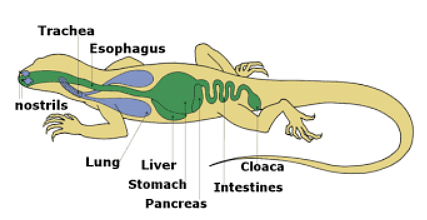
Respiratory System of Reptiles
- Reptiles have characteristics of a Vertebrate: Reptiles have traits that are comparable to those of mammals, birds, and certain amphibians. The spinal cords that span the length of their bodies are housed in their backbones. From the tail to the skull, reptiles contain a chain of bone parts. The cranium or skull, appendages, and limb girdles make up the bone endoskeleton. The inner tissue is protected by the endoskeleton, which also assists in bodily mobility.
Read More: Difference between Vertebrates and Invertebrates
Classification of Reptilia
[Click Here for Sample Questions]
There are three significant sub-classes within the Reptilia class as mentioned below:
- Anapsida
- Parapsida
- Diapsida
Anapsida:
The characteristics of Anapsida are mentioned below:
- With no temporal fossae, the dermal bones create a full roof over the skull.
- Cotylosauria and Chelonia are two subgroups of these.
- The way of retraction of the head in the shell is used to classify modern chelonians.
- This category includes turtles, tortoises, and terrapins.
Parapsida:
The characteristics of Parapsida are mentioned below:
- One temporal fossa is located high up on the skull of these reptiles.
- This form of skull was seen in Protosaurs, Nothosaurs, and Placodonts.
- Ichthyosaurs and Plesiosaurs were the two biggest groups among them. Other reptiles, including dinosaurs, perished at the end of the Cretaceous epoch and became extinct.
Diapsida:
The characteristics of Diapsida are mentioned below:
- In the skull, there are two temporal vacuities.
- They are the most diversified reptiles on the planet.
- This category includes dinosaurs and pterosaurs.
- Archosauria and Lepidosauria are the two primary groups of dinosaurs. Crocodiles and chameleons are other examples.

Classification of Reptilia
Read More: Difference between Reptiles and Amphibians
Order of Reptilia
[Click Here for Sample Questions]
Chelonia, Rhynchocephalia, Squamata, and Crocodilia are the four orders of class Reptilia. The following are the features of reptiles belonging to various orders:
Crocodilia
Crocodiles, alligators, caimans and gharials are all members of the order Crocodilia.
Some of the characteristics of this order are:?
- They renew their teeth throughout their lives.
- They have four spreading legs that can gallop.
- They have strong jaws and a forceful bite.
- They have a more evolved intellect.
- They have a four-chambered heart and are smarter than other reptiles.
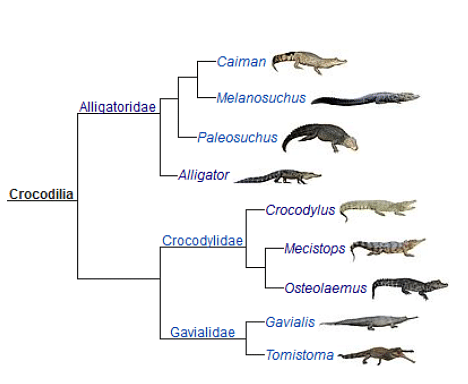
Examples of Crocodilian animals
Sphenodontia
This order includes Tuataras that are the least specialised of all extant reptiles, with a brain that is extremely similar to an amphibian's and a three-chambered heart that is more basic than other reptiles.
Squamata
It includes lizards and snakes. Lizards have four legs for sprinting and climbing, as well as the ability to swim; many change colour when threatened; and their hearts contain three chambers. Snakes lack legs, although deriving from a tetrapod ancestor; they have a highly flexible jaw that allows them to swallow huge animals whole; some inject poison into their food through fangs; and they have a three-chambered heart.
Testudines
Turtles, tortoises, and terrapins are examples of testudines. They move on four legs, have a hard shell that covers most of their body, and a three-chambered heart.
Read More:
Things to Remember
- Reptiles are classified into four orders, namely, Crocodilia, which contains crocodiles and alligators; Sphenodontia, which includes tuataras; Squamata, which includes lizards and snakes; and Testudines, which includes turtles and tortoises.
- Reptiles are the first animals to be fully adapted to living in arid environments on land.
- They don't have any distinguishing traits that readily distinguish them from other vertebrate groups.
- Reptiles have a variety of characteristics that may be found in fish and amphibians on the one hand, and birds and mammals on the other.
- Herpetology is the study of reptiles, and the class name alludes to the way of movement reptum, which means to creep or crawl.
- Most reptiles have a continuous layer of epidermal scales on their skin.
- Reptile scales contain beta keratin, which is also found in other vertebrates' scales and interscalar skin, as well as alpha keratin, which is also found in other vertebrates' scales and interscalar skin.
- The major component of reptile scales is keratin.
Read More: Taxonomic Hierarchy of Plants and Animals
Sample Questions
Ques. Describe the role of reptiles in the environment. (5 marks)
- In the agriculture industry as a whole, reptiles have a lower commercial value than fowl and hoofed mammals, but they have a significant economic value for food and ecological services (such as insect control) at the local level, and they are valued nationally and internationally for food, medicinal products, leather goods, and the pet trade.
- In many tropical places, turtles, crocodiles, snakes, and lizards are routinely collected as food for indigenous use. When this practise becomes commercialised, the pressures placed on local reptile populations frequently exceed the species' ability to replenish itself through natural reproduction.
- Reptiles have made substantial contributions to a wide range of biomedical and fundamental biological research projects. Snake venom research aided in the treatment of heart attack victims in the 1960s and 1970s, and it is still being explored in the creation of pain-relieving medications today.
Ques. What distinguishes reptiles from other animals? (5 marks)
- The skin of most reptiles is covered in a continuous layer of epidermal scales. Beta keratin, which is present in other vertebrates' scales and interscalar skin, is found in reptile scales, as well as alpha keratin, which is found in other vertebrates' scales and interscalar skin.
- The occipital condyle is a single protuberance that connects the skull to the first vertebra.
- Internal sexual reproduction occurs when sperm is deposited by copulation or the apposition of cloacae. In certain populations, asexual reproduction via parthenogenesis is also possible.
- Reptiles are usually terrestrial and cold-blooded, often known as Ectothermic.
- Reptiles have epidermal scales on their bodies.
- A single occipital condyle makes up their skull.
- The heart of a reptile normally consists of two auricles separated by a ventricle. A crocodile with a four-chambered heart is an exception.
- The majority of reptiles are oviparous. It lays eggs rather than giving birth to children.
Ques. How do reptiles such as a lizard or a snake smell? (2 marks)
Ans. Lizards and snakes use their tongues to lick the air for scent. Scents are picked up by the tongue as airborne molecules, which the animal then pulls back into its mouth. The tongue's forked tips are placed into two apertures in a specific organ called Jacobson's organ, which recognises chemicals and sends them to the brain. Lizards and snakes have a high sense of smell, which they use to track prey and discover possible mates, thanks to this unusual organ.
Ques. What are the differences between a lizard and a salamander? (3 marks)
Ans. Although lizards and salamanders have similar appearances, they are totally distinct animals. Reptiles and amphibians both are cold-blooded animals that rely on their surroundings to keep their body temperatures in check. Salamanders can be found in a forest under leaves or in a stream under rocks. Lizards have scaly skin, extended toes for climbing, and dwell in a dry, hot climate. They can go without water for lengthy periods of time. Salamanders must lay their eggs in a damp environment and without shells. Many salamander eggs must be placed fully underwater since the larvae develop gills quickly and are completely reliant on water after they emerge. Young lizards do not alter or morph after hatching.
Ques. Why do reptiles such as lizards and crocodiles need to acquire energy by lying in the sun? (3 marks)
Ans. The lizard is a reptile, which means it is a cold-blooded animal that can't regulate its own body temperature. They migrate to different sections of their habitat to warm up or chill down. If a lizard begins to feel the heat of the tropical sun, it may seek refuge in the shade or take a bath in the water. In the heat of the day, frilled and collared lizards gallop on their rear legs, creating an artificial wind to keep cool. On sweltering days, another reptile, the crocodile, keeps its mouth open to keep cool. Its mouth has blood arteries that are near to the skin's surface and aid in heat transmission. Another method the crocodile employs to keep its body warm and aid digestion is to lie quietly. Reptiles can subsist on far less food than warm-blooded small mammals and birds, which must burn a large portion of their diet to stay warm.
Ques. How many species are there in the Reptilia class? Is it true that alligators and crocodiles are lizards? (2 marks)
Ans. Crocodilia (crocodiles and alligators), Sphenodontia (tuataras), Squamata (lizards and snakes), and Testudines (testudines) are the four surviving clades of Reptilia (turtles). Crocodilia has 25 species, Sphenodontia has two species, Squamata has roughly 9,200 species, and Testudines has about 325 species.
Crocodiles, alligators, caimans, and gharials are all crocodiles. They're classified as reptiles, just like lizards. They are, however, not closely related to lizards in terms of reptiles. Lizards are more closely related to snakes; snakes and lizards are referred to as squamates jointly (clade Squamata).
Ques. Name some extinct groups of class Reptilia. (4 marks)
Ans. The extinct groups of class Reptilia include:
- Ichthyopterygia: The members of this group had one temporal fossa placed high up on the skull. Ichthyosaurs and Plesiosaurs are the two largest sub classes of this group.
- Lepidosauria: The members of this group had two temporal vacuities in the skull. Youngina is an example.
- Archosauria: The members of this group are believed to give rise to dinosaurs. Brontosaurus is an example.
- Synapsida: The members of this group had one temporal fossa on the lower side of the skull. Plesiosaurus is an example.
Read More:



Comments