



Education Journalist | Study Abroad Lead
Insects have the ability to walk on water due to a phenomenon known as surface tension. Surface Tension is a property of any liquid that enables it to resist an external force. Insects known as water striders display this phenomenon effectively. Across the insect world, there are many different species of insects that lift heavier objects, leap over hundreds of meters, and walk on water. Insects have a total of six legs that are located on the meso-, pro-, and metathorax, such as a pair of mid, hind, and fore legs. Each leg is further divided into 6 segments known as coxa, femur, trochanter, tarsus, tibia, and post-tarsus. All these different segments are connected through the same muscles.
| Table of Contents |
Key Terms: Insects, Water striders, Surface Tension, Water Molecules, Cohesion, Forelegs, Force, Air Molecules
What is surface tension?
[Click Here for Sample Questions]
Insects walk on water due to surface tension. Without the surface tension phenomenon, they would also sink in the water like us. The molecules of water are strongly attracted to one another than they are attracted to the molecules of air. Hence, they tightly cling together in a water body as a result of cohesion. The molecules present at the surface of water do not have the molecules of water on all their sides. Therefore, as a result of this, they are strongly attracted to the molecules of water that are present between them. This produces an inward force at the water surface that creates a film and causes the water to behave like it is covered with a thin film or a membrane. This phenomenon is referred to as the surface tension of water.
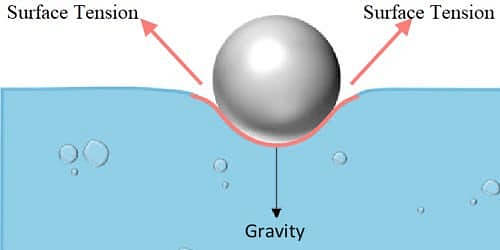
Surface Tension
How do insects walk?
[Click Here for Sample Questions]
Insects are able to walk through the contraction and relaxation of thoracic muscles that are attached to the base of the cuticle and the leg. Firstly, the muscles act on the base of the legs. The contraction is transmitted through the internal leg muscles which cause the legs to flex or stretch. Insects often use two gait forms:
- During the tripod gait, three legs of the insects, including the hind legs and forelegs on one side and the mid-leg on the other side, are in contact with the ground at each time. The stable legs help to drive the body ahead to provide protection, the remaining legs swing forward.
- During the wave gait, only one leg moves at a time. It is slower than tripod gait but is comparatively more stable.
Insects have multiple options that allow them to walk at greater speeds, as they are able to:
- Raise the leg movements’ frequency
- Lift either 2 or 4 legs above the substrate to move to bipedality of hind leg.
- Enhance the length of their strides
How do insects use surface tension to walk on water?
[Click Here for Sample Questions]
Certain species of spiders and insects use surface tension to walk on water. Their weight is really less and so they are not able to overcome the surface tension force, hence they do not break the water surface when they are standing on it. Instead, their feet produce indentations and dimples on the surface of the water, which helps to spring them back to make them move forward.
This further allows the insects to quickly scoot over the lakes, rivers, and ponds’ surfaces. However, apart from surface tension, insects that walk on water also have other important adaptations, in the absence of which they would not be able to walk on water.

Insects Walk on Water due to Surface Tension
Insects are really small, so much that even when they fall from a 10 storey building, they do not encounter any risk of injury. However, insects have to face many other dangers such as being eaten, crushed, or predated. Surface tension can also lead to fatal situations for insects. For the insects, water tends to behave as quicksand. Therefore, insects get trapped within the water bubble and hence die due to drowning. Even if an insect manages to swim to the surface, its bodies are not strong enough to push itself out of the bubble. To overcome this, some insects have a keratin coating that allows the water to slide off.
Adaptations insects need to walk on water
[Click Here for Sample Questions]
The other adaptations needed by insects to walk on water are:
-
Water striders have hairy bodies
Fishing spiders and water striders have both bodies and legs covered with thick layers of hair. This hair traps the air, repel the water, and help in keeping the insects afloat.
The secret weapon of any insect that walks on water is in its body hair. Water striders and fishing spiders both have legs and bodies that are covered in a thick layer of tiny hairs. These hairs trap air in between them, repelling water and helping them keep the bugs afloat. If the insect were to get wet though, it wouldn’t be able to walk on the surface of the water anymore.
-
Water striders have long legs too
Another important adaptation adopted by the insects to walk on water is long legs. They have six legs whereas the mid and the hind legs are longer than the front two legs. These are used to propel the insect over the surface of the water. Their legs are also covered with hair and this layer repels the water. This creates a tiny cushion of air between the feet of the insects and the surface of the water, that allows them to glide over its surface.

Adaptations Insects need to Walk on Water
Things to Remember
- Surface tension refers to the tendency of the liquid surfaces due to which they can shrink into minimum surface areas.
- Insects are the largest group under the phylum Arthropod.
- The small insects that adapt themselves to life on the top of still water are known as water striders.
- Insects walk on water due to surface tension. They are not able to break through the strong attractive forces between the water molecules.
- Insects often use two gait forms, tripod gait and wave gait.
- In addition to surface tension, insects also need to have key adaptations such as long legs and hairy bodies in order to walk on water.
Sample Questions
Ques. Explain the phenomenon of surface tension. (3 marks)
Ans. Surface tension is the tendency of liquid at rest to get shrunk in the minimum possible area.
- The liquid surface acts like a stretched elastic membrane.
- Surface tension can be measured in dynes/cm.
- The molecules of the liquid are drawn together by intermolecular forces like Van der Waals force.
Ques. Mention three applications of surface tension. (3 marks)
Ans. Some of the examples of surface tension identified in nature are:
- Insects are able to walk on water due to surface tension.
- Due to surface tension, water bridges the pores in the rainproof materials of the tent.
- The phenomenon of surface tension is responsible for the shape of a liquid droplet.
Ques. State a few characteristics of insects. (5 marks)
Ans. Some of the characteristics of insects are:
- They have a joint foot.
- Their abdomen is divided into 11 segments.
- They have a hard shell-like covering on the outside of their body.
- They have 3 main body parts, the thorax, head, and abdomen.
- On the top of their heads, insects have antennae.
Ques. What is the structure of insects? (5 marks)
Ans. The structure of insects is as given below:
- The exoskeleton of insects is formed of a hard material known as chitin.
- The head of the insects contain the eyes, antennae, and mouthparts.
- The middle body part known as the thorax has wings and legs attached to it.
- The abdomen has reproductive and digestive organs internally.
- The sides of the abdomen and thorax are lined with spiracles through which insects obtain oxygen.
Ques. What are water striders? (3 marks)
Ans. Water striders are small insects that are well adapted to life on top of still water.
- They use surface tension to their advantage.
- They have a thin body and three pairs of legs.
- Their legs have tiny hair that repels water.
Ques. Why an insect can walk on ordinary water but sink in the soapy water? (2 marks)
Ans. The weight of the insect, their structure, and the surface tension allows insects to walk on water. However, soapy water reduces the surface tension, therefore insects are not able to walk and instead sink in the water.
Ques. What are the two types of gait the insects have? (3 marks)
Ans. The two types of gait the insects have are:
- Tripod Gait: It involves that at any given time, an insect should at least have three legs on the ground.
- Metachronal or Wave Gait: It involves moving only one leg at a time.
Ques. How can surface tension prove to be fatal for insects? (3 marks)
Ans. Surface tension can also prove to be fatal for insects as:
- They can also get trapped within the water bubble and hence die due to drowning.
- Even if an insect manages to swim to the surface, its bodies are not strong enough to push itself out of the bubble.
Check-Out:



Comments