



Education Journalist | Study Abroad Lead
Closing Stock is defined as the amount of the unsold stock that is left after all the sales done by the business, waiting to be sold. Closing Stock refers to the inventory that is left after all the sales done by the business. This can happen due to various reasons, mostly which can be the demand of the product in the market, quality of the product or availability of competitors in the market. Thus, sometimes some goods may remain unsold at the end of a particular period. Various methods can be used to determine the closing stock value, depending on the business’s requirement and the nature of the stock. These are commonly referred to as inventory valuation methods. Such methods are used in a variety of companies for a range of factors.
| Table of Content |
Key Terms: Closing Stock, Stock, Inventory, Sales, Demand, Supply, Inventory Valuation Methods, Profit, Loss, Balance Sheet, Raw Material, Financial Year
What is Closing Stock?
[Click Here for Sample Questions]
The amount of unsold stock which is lying idle at the end of the accounting period is known as the closing stock. Closing stock is the stock that is still in the hands of the business, in any form be it unprocessed or semi-processed, or in the form of raw materials or work-in-progress. The financial statements such as Profit and Loss A/c and Balance Sheet are normally prepared for the reporting period for a closing stock.
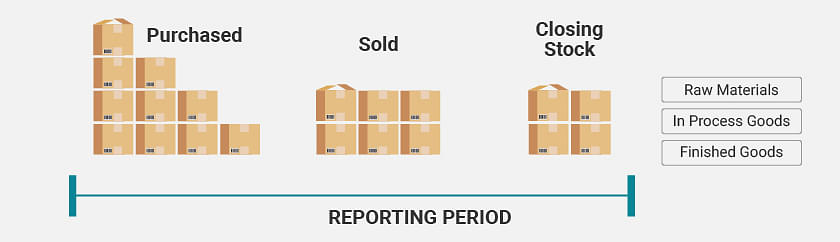
Closing Stock
Closing Stock Formula
[Click Here for Sample Questions]
The formula for calculating Closing stock is given below:
Closing Stock = Opening Stock + Purchases – Cost of Goods Sold
Where
- Opening stock = Unsold products from the prior accounting period are moved forward.
- Purchases = New Purchases or Goods produced
- Cost of Goods Sold = Sale or cost of goods that are produced
The next step in determining the closing stock using the above formula is to determine the closing stock's value. The closing value is calculated in order to represent it in the Profit and Loss A/C and the Balance Sheet. It is important for assessing a business's closing stock at the end of a financial year.
Methods of Calculating Closing Stock
[Click Here for Sample Questions]
There are 4 methods to calculate Closing stock:
- First-in, first-out (FIFO): The first-in, first-out method assumes that the goods acquired first will be sold first and that the most recent and freshest inventory will be retained unsold. It indicates that the cost of older inventory is allocated to the cost of goods sold, while the cost of newer inventory is allocated to ending inventory. Cost layers are used to store the costs of all independently acquired goods.
- Last in, first out (LIFO): The last in, first out method assumes that the most recent purchase will be sold first. This method can be utilized for non-perishable goods, and the costs of all independently acquired goods are stored in cost layers.
- Retail Inventory Method: The retail inventory method implies that the link between the price of goods and their selling price is used by retailers to determine their closing inventory balances. It is a precise procedure and is insufficient for financial statements, that require a greater level of accuracy of inventory record.
- Weighted Average Method: The weighted average method implies that the prices of all independently acquired goods are added together to form a weighted-average price. Since it produces an average cost, it tends to produce an acceptable cost of goods sold and revenue.
The methods used to calculate the closing stock vary from one another. The calculation is then adjusted to another method known as the lower cost or market (LCM), where it specifies that inventory items should be recorded at their lowest cost or current market value.
Closing Stock in Balance Sheet
[Click Here for Sample Questions]
On the asset side of the balance sheet, the closing stock is shown. The previous year's closing stock becomes the new year's opening stock, which is reflected in the following year's trial balance. The trial balance does not reflect any opening stock once the opening and closing stocks are modified by purchases. In this situation, the trial balance must show the closing stock and the purchases.
It must be remembered that because the closing stock has already been changed through the purchases account, it will not be presented on the credit side of the trading and profit and loss. The trading and profit and loss accounts will be debited with the modified purchases.
Valuation of Closing Stock
[Click Here for Sample Questions]
Valuation methods can be used to determine the closing stock value, depending on the business’s requirement and the nature of the stock. These are commonly referred to as inventory valuation methods. Such methods are used in a variety of companies for a range of factors.
Here are some of the methods:
- Average Costing Method
- Weighted Average Costing Method
- Moving Average Costing Method
- Fifo Costing Method
- Lifo Costing Method
- Last Purchase Cost
- Costing Method
- At Zero Cost
This has a significant impact on the company's financial performance. As a result, businesses must select a method that is more appropriate for the products they deal with.

Inventory Valuation
Things to Remember
[Click Here for Sample Questions]
- The cost of unsold products in stores at the end of the accounting period is known as the closing stock and it is shown on the asset side of the balance sheet.
- There are four methods to calculate Closing stock and the methods used to calculate the closing stock vary from one another. The LCM rule is particular is followed once a year to ensure compliance with Generally Accepted Accounting Principles (GAAP) during the audits.
- The approach by which a business decides to price its inflation has an impact on its financial standing.
- If the business chooses to implement LIFO, the cost of items sold will rise. In contrast to FIFO, the amount of closing stock on the balance sheet will be greater when utilizing FIFO. It is one of the primary reasons why businesses prefer LIFO accounting over FIFO accounting.
Solved Questions
Ques. What is meant by Closing Stock? (3 Marks)
Ans. The amount of unsold stock at the end of an accounting period is referred to as closing stock. At the end of a financial year, the inventory that has been lying with the business is known as the Closing Stock or the Closing Inventory.
Closing stocks include those products that are not sold but then already processed by the company. It can be due to various factors such as demand of the product in the market, quality of the product or availability of competitors in the market.
Ques. Calculate Closing Stock from the following given,
Opening stock = Rs. 5,000
Sales = Rs. 16,000
Carriage Inwards = Rs. 1,000
Sales Return = Rs. 1,000
Gross Profit = Rs. 6,000
Purchases = Rs. 10,000
Purchases Return = Rs. 900 (3 Marks)
Ans. Cost of Goods Sold = Net Sales (Sales - Sales Return) - Gross Profit
= Rs. 15,000 - Rs. 6,000
= Rs. 9,000.
Closing Stock = Opening Stock + Net Purchases (Purchases - Purchases Return) + Carriage Inwards - Cost of Goods Sold
= Rs. 5,000 + Rs. 9,100 + Rs. 1,000 - Rs. 9,000
= Rs. 6,100
Ques. Show treatment of closing stock at the time of preparation of final account: (a) When given inside the trial balance? (b) When given in the adjustment? (3 Marks)
Ans. (a) Closing stock when given inside the trial balance, only a single posting will be there in the balance sheet as assets.
(b) In case the closing stock is given in the adjustment, there will be two postings mainly. First, the amount of closing stock will be shown in the credit side of the Trading Account and the same figure of closing stock will be shown in the assets side of the balance sheet.
Ques. Calculate the cost goods sold with the information given below:
Opening stock= Rs 40,000
Net purchases= Rs 50,000
Sales= Rs 1,90,000
Rent paid= Rs 15,000
Closing stock= Rs 15,000 (3 Marks)
Ans. Cost of goods sold = Opening Stock + Purchase + direct expense – Closing Stock
= 40,000 + 50,000 + 10,000 – 15,000
= Rs 85,000
Hence, cost of goods sold are of Rs 85,000
Ques. Find the value of closing stock from the following:
Opening stock= Rs 1,20,000
Purchases during the year= Rs 9,20,000
Sales during the year= Rs 15,60,000
Rate of gross profit= 40% on sale (5 Marks)
Ans. Gross profit = 40% of sales
= 15,60,000 x 40%
Gross profit = Rs 9,24,000
Cost of goods sold = Net sales – Gross profit = 15,60,000 – 9,24,000
Cost of goods sold = Rs 9,36,000
Closing Stock = Opening Stock + Purchase – Cost of goods sold
Closing Stock = 1,20,000 + 9,20,000 – 9,36,000
Hence, Closing Stock = 1,14,000
Ques. Find the value of closing stock from the following:
Opening stock= Rs 4,80,000
Purchases during the year= Rs 13,60,000
Sales = Rs 19,50,000
Rate gross profit= 30% on cost (5 Marks)
Ans. Let the cost of goods sold be X
Gross profit = Cost * 30%
= X * 30/100
Cost of goods sold = sales – Gross profit
X = 19,50,000 – X* 30/100
100X – 30X = 19,50,000 * 100
70X = 19,50,00,000
X = Rs 15,00,000
Closing Stock = Opening Stock + Purchase – Cost of goods sold
= 4,80,000 + 13,60,000 – 15,00,000
Hence, Closing Stock = Rs 3,40,000
Ques. From the following balances, calculate the amount of: Cost of goods sold during the year
Opening stock = Rs 25,000
Credit purchases = Rs 7,50,000
Cash purchases = Rs 3,00,000
Purchases return = Rs 10,000
Wages = Rs 1,00,000
Closing stock = Rs 30,000 (3 Marks)
Ans. Cost of goods sold = Opening Stock + Purchase + direct expense – Closing Stock
= 25,000 + 10,40,000 + 1,00,000 – 30,000
Hence, the Cost of goods sold during the year = Rs 11,35,000
Ques. Find the value of closing stock from the following:
Opening stock= Rs 38,000
Purchases = Rs 50,000
Sales = Rs 3,60,000
Gross loss= Rs 20,000
Return inwards = Rs 5,000
Return outwards = Rs 4,000
Freight inwards = Rs 26,000 (3 Marks)
Ans. Net purchases = Purchases – Purchase return
= 3,40,000 – 4,000
Net purchases = Rs 3,36,000
Cost of goods sold = Net sales + Gross profit
= 3,60,000 – 5,000 + 20,000
Cost of goods sold = Rs 3,75,000
Closing Stock = Opening Stock + Purchase + direct purchase – Cost of goods sold
= 38,000 + 3,36,000 + 26,000 – 3,75,000
Hence, closing Stock = Rs 25,000
Ques. Calculate the value of the closing stock as per the information given below:
Opening stock: Rs. 70,000
Purchases: Rs. 4,16,000
Sales: Rs. 5,22,000
Gross profit earned: 25% of cost (5 Marks)
Ans. We know that,
Cost of Goods sold = Opening stock + Purchases - Closing Stock
Gross Profit = 25% on cost.
Let us assume cost as Rs. 100
Thus, Gross Profit is Rs.25
Thus, sales will be cost of goods sold + Profit
That is, Rs.100 + Rs.25= Rs.125
Therefore, Gross Profit on sales = Gross Profit / Sales * 100
Profit on Sales Will be Rs.25 / Rs.125 * 100 = 20% on Sales
Sales = Rs. 5,22,000
Gross Profit will be 20% of Rs.522000 which will be Rs.1,04,400
Cost of Goods Sold = Rs. 5,2,2000 - Rs.1,04,400
Cost of goods sold = Rs. 4,17,600
Therefore,
Rs.4,17,600 = Rs.70,000 + Rs.4,16,000 - Closing stock
Closing stock = Rs. 4,86,000 - Rs. 4,17,600
Closing Stock = Rs. 68,400
Ques. Calculate the Net Sales and Gross Profit from given information:
Cost of Goods Sold = Rs. 4,50,000
Gross Profit = 25% on Sales (3 Marks)
Ans. Gross Profit = 25% on Sales = 1/4 on Sales
1/4 on Sales = 1/3rd on Cost
Gross Profit = 13 × 4,50,000 = Rs 1,50,000
Cost of Good Sold = Sales − Gross Profit
4,50,000 = Sales − 1,50,000
Sales = Rs 6,00,000
For Latest Updates on Upcoming Board Exams, Click Here: https://t.me/class_10_12_board_updates
Read More:



Comments