



Content Curator
Calcium Sulphate is an inorganic compound best known as gypsum and plaster of Paris in its hydrated forms.
- CaSO4 is the chemical formula for calcium sulphate.
- Calcium is an essential metal for all living things
- A variety of calcium compounds are also important in a variety of sectors and are manufactured on a massive scale.
- Such compounds are calcium carbonate, calcium hydroxide, calcium oxide, calcium sulphate, calcium chloride, and others.
- Calcium sulphate is a very valuable compound in both its anhydrous and hydrated forms.
- It is also known as drierite.
- It is poorly soluble in water and causes permanent hardness in water.
- In alloy manufacturing, calcium sulphate is used as a deoxidizer, decarbonizer and desulfurizer due to its chemical characteristics.
| Table of Content |
Key Terms: Calcium Sulphate, Chemical formula, Melting point, Atoms, Ions, Gypsum, Plaster of Paris, Ionic compound, Oxygen, IUPAC name, Hydration states
What is Calcium Sulphate?
[Click Here for Sample Questions]
Calcium sulphate (Calcium sulfate) is a naturally occurring calcium salt.
- The chemical formula of calcium sulphate is CaSO4.
- It is most commonly known in its dihydrate form, CaSO4.2H2O, as gypsum, a white or colourless powder.
- As uncalcined gypsum, the sulfate is used as a soil conditioner.
- Calcined gypsum is used in the production of tile, wallboard, lath, and a variety of plasters.
- When gypsum is heated to around 120 °C (250 °F), it loses three-quarters of its water and transforms into the hemihydrate CaSO4.1/2H2O, i.e. plaster of Paris.
- Plaster of Paris, when combined with water, can be sculpted into shapes before hardening by recrystallizing to dihydrate form.
- Groundwater may include calcium sulfate, which causes hardness that cannot be eliminated by boiling.

Also check:
| Related Concepts | ||
|---|---|---|
| Barium Carbonate | Californium | Hard Water and Soft Water |
| Calcium Sulphate | PbO2 | Classification of Colloids |
Structure of Calcium Sulphate
[Click Here for Sample Questions]
One atom of calcium, one atom of sulphur, and four atoms of oxygen make up calcium sulphate.
- It's an ionic compound made up of one calcium cation and one sulphate anion (polyatomic ion).
- The valency of the calcium ion is +2, while the valency of the sulphate polyatomic ion is -2.
- As a result, when they combine, they generate the neutral molecule calcium sulphate (CaSO4).
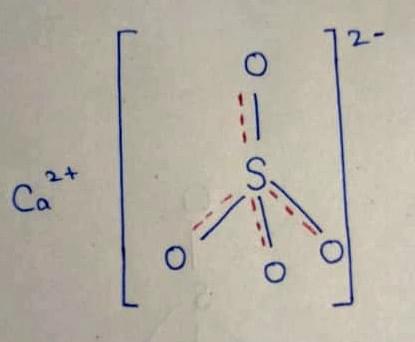
Calcium Sulphate Structure
Extraction of Calcium Sulphate
[Click Here for Sample Questions]
Aside from natural resources, calcium sulphate can be produced as a byproduct in the following processes:
- Exhaust gases from fossil power plants and other procedures (such as cement manufacture) are desulfurized by blowing in lime or finely crushed limestone.
- Hence, contaminated calcium sulfite is formed, which is then oxidized to calcium sulphate during storage.
- Calcium phosphate is treated with sulfuric acid and calcium sulfate precipitates during the production of phosphoric acid from phosphate rock.
- Calcium fluoride is treated with sulfuric acid in the production of hydrogen fluoride, resulting in the precipitation of calcium sulfate.
- In the zinc refining process, zinc sulfate solutions are treated with hydrated lime to co-precipitate heavy metals and barium.
- Calcium sulphate can also be collected and reused from waste drywall at manufacturing plants.
Properties of Calcium Sulphate
[Click Here for Sample Questions]
The following are the properties of Calcium Sulphate
| Properties | Value |
|---|---|
| Chemical Formula | CaSO4 |
| IUPAC name | Calcium Sulphate |
| Molar mass | 136.14 g/mol (anhydrous) 145.15 g/mol (hemihydrate) 172.172 g/mol (dihydrate) |
| Odour | Odourless |
| Appearance | White solid |
| Melting point | 1,460 °C (anhydrous ) |
| Density | 2.96 g/cm3 (anhydrous), 2.32 g/cm3 (dihydrate) |
| Crystal structure | Orthorhombic |
| Solubility | Partially soluble in water and in glycerol |
| Acidity (pKa) | 10.4 (anhydrous), 7.3 (dihydrate) |
| Synonyms | Anhydrous Calcium Sulphate, Anhydrous Gypsum, Calcium Sulphate, and Sulfuric Acid Calcium Salt |
| Other names | Plaster of Paris (POP), gypsum, drierite. |
Hydration States of Calcium Sulphate
[Click Here for Sample Questions]
Calcium sulphate has three different hydration states.
- CaSO4 (anhydrite): Anhydrous state.
- CaSO4·2H2O (gypsum): Dihydrate.
- CaSO4·1/2H2O (bassanite): Hemihydrate state, also known as plaster of Paris.
Specific hemihydrates are sometimes distinguished:
- Alpha-hemihydrate
- Beta-hemihydrate.
Plaster of Paris and Gypsum
[Click Here for Sample Questions]
Plaster of Paris and gypsum are hydrated calcium sulphate compounds. These two hydrated forms of calcium sulphate are well recognized because they are commonly used in a variety of sectors, including medicine and construction.
Plaster of Paris
Plaster of Paris is a white powder made of hydrated calcium sulphate salt, which when mixed with water turns into gypsum.
- Calcium sulphate hemihydrate is its chemical name.
- POP (an abbreviated form of Plaster of Paris) is another name for it.
- Doctors use it as a plaster to keep broken bones in the proper place.
- It is made by heating gypsum to 373 Kelvin.
The following is the reaction:
\(CaSO_4.2H_2O \:(Gypsum)\:\:\: \underrightarrow{373K}\:\:\: CaSO_4. \frac{1}{2}H_2O\:(Plaster \:of \: Paris)+\frac{3}{2}H_2O\)
Gypsum
The chemical name of Gypsum is calcium sulphate dihydrate.
- CaSO4.2H2O is its chemical formula.
- It is used to preserve and decorate walls, ceilings, and ornamental things.
- It cannot be shaped into various forms.
- Plaster of Paris is a man-made substance, whereas gypsum exists naturally.
- Plaster of Paris can also be used to make gypsum.
- When water is combined with Plaster of Paris, it hardens and becomes gypsum.
The following is the reaction:
\(CaSO_4.\frac{1}{2}H_2O \: (Plaster \: of \: Paris)+1 \frac {1}{2}H_2O \:\:\: \rightarrow \:\:\:CaSO_4.2H_2O \: (Gypsum)\)
Uses of Calcium Sulphate
[Click Here for Sample Questions]
Following is the list of applications of calcium sulphate:
- Its main application is in the production of Plaster of Paris.
- Tofu contains calcium sulphate, which is used as a coagulant.
- It is widely used in the dental field.
- It is used to increase the hardness of brewing water.
- Before the 1970s, the compound was used to produce sulphuric acid.
- It's an ingredient in Portland cement.
- It is used as a moisture indicator.
- It is found in a variety of ornamental materials.
- It is used to make mortar.
Also check:
| Other Concepts | ||
|---|---|---|
| Catalysis | Surface Chemistry | Micelle |
| Colloids | Emulsions | Adsorption |
Things to Remember
- Calcium sulphate (Calcium sulfate) is a naturally occurring calcium salt.
- The chemical formula of calcium sulphate is CaSO4.
- It is best known as gypsum and plaster of Paris in its hydrated forms.
- Plaster of Paris is made by heating gypsum to 373 degrees Celsius
- The formula of Plaster of Paris is CaSO4.1/2H2O
- The chemical name of Gypsum is calcium sulphate dihydrate.
- Plaster of Paris can be used in art, architecture, decorations, burial services, medical uses, fireproofing and 3D printing.
Sample Questions
Ques. What is plaster of Paris? (2 Marks)
Ans. Plaster of Paris is a white powdered chemical product that is made up of hydrated calcium sulphate and is made by calcining gypsum. Plaster of Paris is made by heating gypsum to 373 Kelvin.
Ques. What is the gypsum formula? (1 Mark)
Ans. The chemical formula of gypsum is CaSO4.2H2O.
Ques. What is the second name of the plaster of Paris? (1 Mark)
Ans. Plaster of Paris is also referred to as gypsum plaster.
Ques. What are the uses of Plaster of Paris? (3 Marks)
Ans. Following are the uses of Plaster of Paris:
- Plaster of Paris can be used for a variety of purposes, some of which are described here.
- Plaster of Paris is used to create excellent artwork for the monument and building decoration and beautification.
- Plaster of Paris is still widely used as a mould and cast in the medical industry.
- Several morticians and funeral home administrators utilise plaster to repair injured tissue, reattach cut-off sections of deceased bodies, and fill wounds that have developed.
Ques. What are the common names for Calcium sulphate? (2 Marks)
Ans. Calcium sulphate, or CaSO4, is a calcium salt that occurs naturally. CaSO4.2H2O, the dihydrate form, is generally known as gypsum, a white or colourless powder. The sulphate is used as a soil conditioner since it is uncalcined gypsum.
Ques. What is the procedure for making plaster of Paris? What is the chemical formula and name of the substance? (3 Marks)
Ans. Plaster of Paris is calcium sulphate with half a molecule of water per molecule of salt (hemihydrate) (plaster of Paris). It is made by partly dehydrating gypsum (CaSO4.2H2O) by heating it at 120°C in rotating kilns.
Plaster of Paris is a white powder that, when combined with water, hardens into a hard mass as gypsum crystals with time. As a result, it is employed in the setting of plaster for the repair of damaged bones. It's also used to make a variety of ornamental things, as well as toys and chemical plugs.
Ques. What is the reaction of calcium sulphate? (2 Marks)
Ans. Calcium sulphate is a non-flammable substance. Only at very high temperatures (>1500°C) does it decompose into hazardous sulphur oxides. Incompatible with diazomethane, aluminium, and phosphorus; has a moderate reactivity but can act as an oxidising agent. Some calcium sulphate forms react with water, whereas others do not.
Ques. When calcium sulphate reacts with water, what happens? ((2 Marks)
Ans. Calcium sulphate dihydrate is formed when calcium sulphate hemihydrate combines with water. The pace of this reaction varies greatly from sample to sample, with the differences in reactivity attributable, at least in part, to the conditions that existed during the dehydration of the parent dihydrate.
Ques. Calcium sulphate is either a metal or a non-metal? (2 Marks)
Ans. Calcium sulphate (CaSO4) is a substance having the chemical formula CaSO4. A calcium cation (Ca²?) and a sulphate anion (SO4²?) make up this ion. Ionic compounds are those that have a metal cation and a polyatomic anion.
Ques. Who discovered Calcium? (2 Marks)
Ans. Sir Humphry Davy, a chemist, inventor, and Britain's greatest scientist at the time, was the first to isolate calcium in 1808. He tried several times to reduce moist lime by electrolysis, similar to how sodium and potassium are produced, with varying degrees of success.
For Latest Updates on Upcoming Board Exams, Click Here: https://t.me/class_10_12_board_updates
Also Read:



Comments