



Content Curator
Critical velocity is the velocity when the fluid flows up to a break-even point after which it becomes turbulent. In terms of air, critical velocity can be defined as the speed of the object when the air resistance and gravitational pull of a free-falling object are both the same.
When a fluid passes through a tube, it can either flow in a streamlined or turbulent manner. Streamline flow is when the flow of water is parallel to the pipe without any zig-zag patterns or disruptions. But, as the velocity increases, the flow of water gets irregular, which is called a turbulent flow.
| Table of Content |
Key Takeaways: Critical Velocity, Critical Velocity Formula, Reynolds Number, Lower Critical Velocity, Upper critical Velocity
What is Critical Velocity?
[Click Here for Sample Questions]
Critical Velocity is the velocity at which a liquid can pass through the tube or passage without being turbulent. It is the breakeven velocity below which the flow is considered streamlined or laminar and above it is termed turbulent.
It can be understood in a way that when in instances of normal velocity the flow of water in parallel. But when external factors like velocity and viscosity are altered, change in flow is witnessed. For example, a less viscous liquid is more likely to get turbulent even with low velocity and similarly a more viscous liquid is more likely to be streamlined even at significantly higher velocity.
So, the critical velocity of each liquid is different as they have different viscosities.
Read More: Relative Velocity
Critical Velocity Formula
[Click Here for Sample Questions]
The formula for finding the Critical Velocity of a liquid is:
\(\color{red}{V_{\mathrm{critical}} = \frac{R \eta}{2 \rho r}}\)
Here,
R = Reynolds Number
Vcritical = Critical Velocity
η = Coefficient of Viscosity
r = Radius of the tube or passage through which the liquid is flowing
ρ = Density of the fluid
The dimensions of the above variables present in the formula are:
Reynolds number (R) = M0L0T0
Coefficient of Viscosity (η) = M1L-1T-1
Radius (r) = M0L1T0
Density of the fluid (⍴) = M1L-3T0
The dimensional formula of Critical Velocity will look as
Vcritical = M0L1T-1
The SI unit of Critical Velocity is called meter/sec.
Read More: Escape Velocity
Reynolds Number
[Click Here for Sample Questions]
In a fluid, mostly two forces work together, the inertial force and the viscous force. The ratio of inertial forces to the viscous force gives us Reynolds Number. As it is a ratio, it has no unit and also no dimensions.
The Reynolds Number of fluid is given by the formula:
\(\color{red}{Re = \frac{\rho u L}{\mu}}\)
Re = Reynolds Number
ρ = Density of the fluid
u = flow speed
L = characteristic linear dimension
μ = dynamic viscosity of the fliud
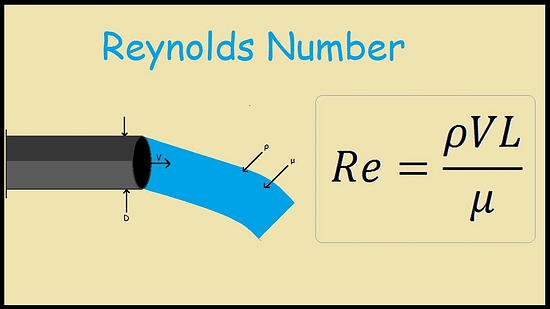
Factors Affecting Reynolds Number
The Reynolds Number obtained from the formula is then used to determine whether the flow of the liquid is laminar or turbulent in nature.
There are three cases of Reynolds Number or Re:
- Re greater than 0 and less than 2000 is said to be streamlined or laminar flow.
- Re greater between 2000 and 3000 is said to be unstable or turbulent flow.
- Re above 3000 is said to be a highly turbulent and dangerous flow.
Explanation of Reynolds Number
When Reynolds Number is low it means the viscous forces overpower the inertial forces resulting in a smooth flow.
When Reynolds Number is high it indicates that the inertial forces overpower the viscous forces and the liquid flows in high turbulence.

Representation of Laminar and Turbulent Flow
Read More: Mach Number
Types of Critical Velocity
[Click Here for Sample Questions]
The flow from laminar to turbulent does not occur abruptly. There is a small transition period between this change in the flow pattern. This transition can be classified as:
Lower Critical Velocity
Lower Critical Velocity is the speed at which the flow of liquid shifts from streamlined/laminar to a transition phase. The flow of liquid does not change directly from streamlined to turbulent, instead, it first enters a transition phase. This was proved by Prof. Reynolds Osborne in 1883.
Upper Critical Velocity
Upper Critical Velocity is the speed at which the flow of liquid shifts from the transition period to turbulence. It is the speed at which turbulence of a flow begins or ends as the liquid enters into the transition from turbulent or from turbulent to the transition phase.
Read More: Force and Motion
Things to Remember
- Critical velocity is the velocity at which a fluid passes through a tube or a flow passage without being turbulent.
- Escape velocity is the speed with which an object must travel to break the gravitational pull of the earth and enter space.
- Critical velocity is dependent on Reynolds Number, the coefficient of viscosity of the fluid, the density of the fluid, and the radius of the pipe through which the fluid passes.
- Reynolds Number is a dimensionless quantity that is evaluated by using the density of the fluid, dynamic viscosity of the fluid, length of the pipe through which the fluid flows, and the speed of flow.
- Estimation of the Reynolds number facilitates in differentiating the nature of the flow as laminar or turbulent.
- Reynolds number less than 2000 is termed as laminar flow.
- Reynolds number between 2000-3000 is termed as turbulent.
- Reynolds number greater than 3000 is termed a highly turbulent flow.
- Lower critical and upper critical velocities help quantify the transition from laminar to turbulent flow.
Sample Questions
Ques. Explain with a schematic and plot the regions showing the Critical Velocity, Turbulent Flow, and Laminar Flow. (3 Marks)
Ans. The flow schematic and the various flow regions are as follows:

Flow Schematic with Flow Regions
Ques. What will be the critical velocity of water in a tube of radius 1m, if the coefficient of viscosity of water is 1793 poise and Reynolds number is 1000? (3 Marks)
Ans.
Given, Coefficient of Viscosity of Water (ηwater) = 1793 poise
Radius, r = 1 meter
Reynolds Number, Re = 1000
Density of Water, ρ = 1000 kg m-3
As, per the critical velocity formula:
\(\color{red}{V_{\mathrm{critical}} = \frac{R \eta}{2 \rho r}}\)
Vcritical = (1000 × 1793)/(2 × 1000 × 1)
= 17.9 × 10⁻³ cm-1.
Therefore, the Critical Velocity of the water passing through a tube of radius 1 meter is 17.9 × 10⁻³ cm-1.
Ques. Define the significance of Reynolds Number and what it helps in determining. (3 Marks)
Ans. Reynolds Number helps us in determining whether the flow of fluid is streamlined/laminar or turbulent. It is a ratio of inertial forces to viscous forces, hence it is a dimensionless quantity with no unit. The formula for Reynolds Formula is:
\(\color{red}{Re = \frac{\rho u L}{\mu}}\)
Re = Reynolds Number
ρ = Density of the fluid
u = flow speed
L = characteristic linear dimension
μ = dynamic viscosity of the fliud
The flow conditions are as follows:
- Re greater than 0 and less than 2000 is said to be streamlined or laminar.
- Re greater between 2000 and 3000 is said to be unstable or turbulent.
- Re above 3000 is said to be highly turbulent and dangerous.
Ques. List the characteristics of Turbulent Flow. (5 Marks)
Ans. One cannot just name any flow of fluid as turbulent. There are some characteristics and parameters that make a flow turbulent. Turbulent flows of water are categorized with low viscosity and high velocity and the passage being narrow. One of the parameters is that turbulent flow has Reynolds Number, Re greater than 3000. Other important characteristics of Turbulent Flow are:
- Irregularity
One of the most striking differences between turbulent and streamlined flow is its irregular and zig-zag manner of flow. Its flow does not occur in a single line or pattern like in laminar flow.
- Diffusivity
Constant Velocity Dispersal occurs at some sections of the pipe or passage. This results in all the flow getting concentrated in a single point known as valves.
- Rotationality
Turbulent flow of fluids is categorized by a 3-D vortex production process. The common name for this process is Vortex Stretching. A vortex is a rotating region of a fluid or liquid such as a tornado, cyclone, or whirlpool.
- Dissipation
In a turbulent flow the dissipation is highly evident. The viscous shear stress converts the kinetic energy due to the flow of water into potential or inertial energy.
Ques. Define Viscosity and how it affects the flow of liquid? (3 Marks)
Ans. Viscosity is the property or characteristic of a fluid by virtue of which the internal forces in a fluid resist its movement or relative motion. This means that a liquid with high viscosity will have relatively less velocity than one with low viscosity. A common example is that of oil and water.
The SI unit of viscosity is Pa.s The dimensional formula of viscosity is [ML-1T-1].
The formula for finding viscosity is :
\(\color{red}{viscosity\ \eta\ (eta)=\frac{2 \Delta \rho g r^{2}}{9v}}\)
where Δρ = difference in density between the sphere and the fluid,
g = acceleration due to gravity,
r = radius of sphere
and v = terminal velocity.
A graph of v (y axis) against r2 is therefore a straight line through the origin having a gradient of \(\frac{2 \Delta \rho g}{9 \eta}\)
Ques. If dimensions of critical velocity VC of a liquid flowing through a tube are expressed as [ηxρyrz], where η, ρ, and r, are the coefficient of viscosity of the liquid, the density of the liquid, and radius of the tube respectively, then the values of x, y and z are given by? (5 Marks)
Ans. Solving the problems requires balancing the dimensions of each side.
We know that,
Unit of coefficient of viscosity = kg s-1 m-1 and dimension = [M1L-1T-1]
Unit of Density = kg/m3 and dimension = [M1L-3T0]
Unit of radius = meter and dimension = [L1]
Unit of Critical Velocity = meter per second and dimension = [M0L1T-1]
Given, that Critical Velocity VC = [ηxρyrz]
So, [M0L1T-1] = [M1L-1T-1]x × [M1L-3T0]y × [L1]z
⇒ [M0L1T-1] = [Mx+y L-x-3y+z T-x]
⇒ Comparing the values of M, L and T on both sides we get,
x + y = 0 ……(i)
-x-3y+z = 1 …..(ii)
-x = -1 …..(iii)
From (iii), x = 1
Putting x = 1 in (i) we get,
y = -1
Putting x = -1 and y = -1 in (ii) we get,
1 + 1 + z = 1
z = -1
Therefore, the values of x, y, and z are 1, -1 and -1.
Ques. Find the critical velocity for air that passes through a tube of diameter 2 cm. Given, density of air, ρ = 1.3 × 10⁻³ g cm-3 and coefficient of viscosity of air, η = 181 × 10-6 Poise. (2 Marks)
Ans. We know that for air, Re (Reynolds Number) = 2000
Re = (ρVD)/η
2000 = (ρVD)/η
V = (2000 × 181 × 10-6)/1.3 × 10-3 × 2
V = 140 cm s-1
Therefore, the critical velocity is 140 cm s-1.
Ques. Calculate the critical velocity of water in a tube of diameter 0.25m. Given Reynolds Number = 2500, ρw = 103 kg/m3 & ηw = 10-3 Ns/m2. (2 Marks)
Ans. Given,
Re = 2500
ρw = 103 kg/m3
ηw = 10-3 Ns/m2
We know that,
Vc = (Re × ηw)/ρw * D
= (2500 × 10-3)/103 × 0.25
= 0.01 m/s.
Therefore, the critical velocity of water in a tube of diameter 0.25 m is 0.01 m/s.
Also Read:



Comments