



Content Curator
Fungi is any eukaryotic organism that includes microbes like yeasts, moulds and mushrooms. Whereas Lichens are complex organisms that form when algae and fungus form a symbiotic connection. Fungi and lichens are part of our natural ecosystem, which is made up of countless organisms. Autotrophs, which produce their own food, and heterotrophs, who rely on others for nourishment, make up an ecosystem. Organisms do, nevertheless, occasionally exist in close proximity to one another. The nature of this relationship can be parasitic, symbiotic, or mutualistic.
| Table of Content |
Key Takeaways: Fungi, lichens, parasitism, ecosystem, symbiosis, mutualism, nitrogen cycle, eukaryotes.
Fungi
[Click Here for Sample Questions]
Fungi is any eukaryotic organism that includes microbes like yeasts and moulds, as well as the more well-known mushrooms. These organisms are classed as a kingdom, distinct from the other eukaryotic kingdoms, which also include Plantae, Animalia, Protozoa, and Chromista in one traditional classification.

Plant Cell Vs Fungal Cell
The presence of chitin in fungi's cell walls distinguishes them from plants, bacteria, and a few protists. Fungi, like animals, are heterotrophs, meaning they get their nourishment by absorbing dissolved molecules, which they usually do by secreting digestive enzymes into the environment. Photosynthetic fungi do not exist. Except for spores (some of which are flagellated), which can travel through the air or water, their only means of mobility is through growth. In ecological systems, fungi are the main decomposers. Mycology is the branch of biology concerned with fungi.
Read More:
Lichens
[Click Here for Sample Questions]
Lichens are complex organisms that form when algae and fungus form a symbiotic connection. Fungus, as the dominant partner, is responsible for most of the properties of lichens. Lichens can contain any combination of green and blue-green algae. The fungal component protects the algae by collecting moisture and nutrients, allowing it to photosynthesize and produce food for the fungus to develop. Lichens can be found in a wide range of environments. Lichens can be found on tree bark, rocks, gravestones, and walls, among other places. Lichen is frequently mistaken for moss. Only mosses are plants, despite the fact that lichen and moss are non-vascular plants. Lichens cover approximately 6-8 percent of the landmass, according to estimations.
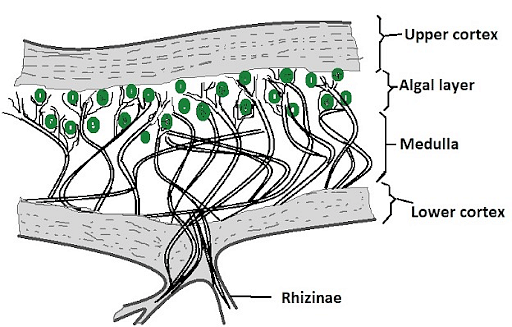
Lichens Structure
Lichens may grow on practically any surface and can grow from sea level to high alpine heights under a variety of climatic situations. In rainforests and temperate woodland, they can be seen growing on bark, leaves, mosses, or other lichens, as well as hanging from branches "dwelling on thin air" (epiphytes). They can be found on rock, walls, gravestones, roofs, exposed soil surfaces, rubber, bones, and biological soil crusts in the soil. Lichens have evolved to thrive in some of the world's harshest settings, including polar tundra, scorching deserts, rocky beaches, and poisonous slag heaps. They can even grow between the grains of solid rock to survive.
Read More:
Symbiosis
[Click Here for Sample Questions]
Symbiosis is any sort of mutualistic, commensalistic, or parasitic biological relationship between two separate biological species. Each symbiont, or group of organisms, must be of a different species. Symbiosis can be either obligatory (when one or more symbionts are dependent on one another for survival) or facultative (when they can survive independently).

Symbiosis
Difference between Fungi and Lichens
[Click Here for Sample Questions]
| Fungi | Lichens |
|---|---|
| Non-chlorophyllous thallophytes | Composite form of Algae and fungi |
| Mycelia is the thallus, which is made up of thread-like hyphae. | With root-like rhizines and upper, medulla, and lower cortex, Thallus organisation is a complicated form. |
| Heterotrophs, saprophytes, and parasites are all examples | The partners are a unique pairing, demonstrating mutualism or symbiosis. |
| Fungi do not have such a structure. | The presence of specific structures for vegetative reproduction, such as soredia and isidia. |
| They thrive best in warm tropical and subtropical climates around the world. | They thrive best in the world's moderate and cooler climates. |
| Dark locations, shady, wet, and vitiated towns are preferred. | Towns provide more light and air, as well as a cleaner atmosphere. |
| They can feed on both dead and living things and require a lot of moisture to grow. | During drought and starvation circumstances, it can grow on a bare substratum. |
| Colourless. | Due to the inclusion of numerous organic acids, it is brightly coloured. |
| Mold, Mushrooms, Yeast, etc. | Iceland moss, beard lichens, dog lichens, oakmoss, and other lichens can be found on the island. |
Read More:
Things to Remember
- Fungi is any eukaryotic organism that includes microbes like yeasts and moulds, as well mushrooms.
- Fungi are classed as a kingdom, distinct from the other eukaryotic kingdoms.
- Lichens are complex organisms that form when algae and fungus form a symbiotic connection.
- Fungus, as the dominant partner, is responsible for most of the properties of lichens.
- Lichens can contain any combination of green and blue-green algae.
- The fungal component protects the algae by collecting moisture and nutrients, allowing it to photosynthesize and produce food for the fungus to develop.
- Lichens can be found in a wide range of environments.
- Symbiosis is any sort of mutualistic, commensalistic, or parasitic biological relationship between two separate biological species.
Read More:
Sample Questions
Ques. What is ergotism? (2 marks)
Ans: Long-term ergot poisoning is caused by ingestion of the alkaloids formed by the Claviceps purpurea fungus—from the Latin noun clava meaning "club" and the suffix -ceps meaning "head," i.e. the purple club-headed fungus that infects rye and other cereals—and, more recently, by the action of a number of ergoline-based drugs. Ergotoxicosis, ergot poisoning, and Saint Anthony's fire are all names for the same condition.
Ques. What is Basidiomycota? (3 marks)
Ans: Basidiomycota is one of two great divisions that make up the subkingdom Dikarya (commonly referred to as the "upper fungi") within the kingdom Fungi, along with Ascomycota. Basidiomycetes are the members of this fungus. Mushrooms, puffballs, stinkhorns, bracket fungus, other polypores, jelly fungi, boletes, chanterelles, earth stars, smuts, bunts, rusts, mirror yeasts, and Cryptococcus, the human pathogenic yeast, are all classified as Basidiomycota. Except for basidiomycota-yeast, basidiomycota are filamentous fungi that reproduce sexually by forming specialised club-shaped end cells called basidia, which ordinarily bear external meiospores (usually four).
Ques. What is Saprotrophic nutrition? (3 marks)
Ans: Saprotrophic nutrition, also known as lysotrophic nutrition, is a chemoheterotrophic extracellular digestion process that involves the breakdown of decaying (dead or waste) organic matter. It is found in saprotrophs and is frequently linked to fungi (such as Mucor) and soil bacteria. Saprobes refer to saprotrophic microscopic fungus, whereas saprophytes refer to saprotrophic plants or bacterial flora (sapro- 'rotten stuff' + -phyte 'plant'), albeit it is currently thought that all plants traditionally thought to be saprotrophic are actually parasites of tiny fungi or other plants. The process is typically aided by the active transport of such elements throughout the internal mycelium and its constituent hyphae via endocytosis.
Ques. Do any potentially harmful fungi? (3 marks)
Ans: When fungi create major health problems in humans, they become toxic. Infections, allergies, and poisoning are the most common symptoms of these dangerous fungus. Although many mushrooms are considered edible, they are not all edible. People frequently make the mistake of eating both healthy and dangerous foods. As a result, the ones listed below are some of the most dangerous to avoid.
- Webcaps
- Death cap
- Autumn skullcap
- Conocybe filaris
Ques. What are edible fungi? (3 marks)
Ans: Commercially grown and wild-harvested mushrooms are both edible mushrooms. The most frequently farmed species in the West, Agaricus bisporus, is used in salads, soups, and a variety of other foods when sold as button mushrooms when young or Portobello mushrooms when larger. Many Asian fungus are farmed commercially, and their popularity has grown in the West. Straw mushrooms (Volvariella volvacea), oyster mushrooms (Pleurotus ostreatus), shiitakes (Lentinula edodes), and enokitakes (Lentinula edodes) are all frequently available fresh in grocery shops and markets (Flammulina spp.).
Ques. What is a fruticose lichen? (2 marks)
Ans: A fruticose lichen is a type of lichen fungus with a shrubby or bushy growth structure that resembles coral. A thallus and a holdfast make up this structure. A photobiont, such as green algae or, less typically, cyanobacteria, and one, two, or more mycobionts create a symbiotic association. Fruticose lichens are found in a variety of classes and are not monophyletic or holophyletic.
Ques. What are areolate lichens? (2 marks)
Ans: Areolate lichens are crustose lichens (those that grow like a paint crust) that appear to be broken up into polygonal pieces, similar to old cracked paint. The pieces are referred to as aereolas (areaeolae). It resembles the island-like fragments of dried-cracked mud found in a dry lakebed. An underlying prothallus connects the areaolae "islands" to form a single lichen organism. The prothallus is typically dark and unnoticeable, with the aereolae appearing to be detached. Squamulose means that the aereolae curl up at the edges and continue to grow at the edges, causing them to overlap.
Ques. What are the effects of air pollution on lichens? (3 marks)
Ans: If lichens are constantly exposed to contaminants and have no deciduous sections, they are unable to escape pollution accumulation. Lichens, which lack stomata and a cuticle, can absorb aerosols and gases throughout the entire thallus surface, allowing them to diffuse easily to the photobiont layer. Because lichens lack roots, the air is their principal supply of most elements, hence elemental levels in lichens generally reflect the ambient air's accumulated composition. Fog and dew, gaseous absorption, and dry deposition are all examples of atmospheric deposition processes. As a result, several environmental studies involving lichens highlight their potential as excellent biomonitors of air quality.
Ques. What are epiphytes? (2 marks)
Ans: An epiphyte is a plant-like organism that gets its moisture and nutrients from the air, rain, water (in marine habitats), or detritus accumulating around it. Like any other creature, epiphytes participate in nutrient cycles and contribute to the ecosystem's diversity and biomass. For many species, they are a valuable source of food. More epiphytes typically grow on the oldest sections of a plant. Epiphytes are different from parasites in that they cling to other plants for physical support and do not always harm the host. Epibionts are organisms that grow on non-plant organisms.
Ques. What is commensalism? (3 marks)
Ans: Commensalism is a long-term biologic association (symbiosis) wherein the members of one species profit while those of the other species do not. This is in contrast to mutualism, that both organisms benefit from each other; amensalism, in which one is harmed while the other is unaffected; parasitism, in which one is harmed while the other benefits; and parasitoidism, which is close to parasitism but the parasitoid has a free-living state and, rather than simply harming its host, eventually kills it. The commensal (beneficial species) may acquire nourishment, shelter, support, or movement from the host species, which is largely unaffected.
Ques. What are the advantages and disadvantages of Lichens? (3 marks)
Ans:
Advantages
- Source of food
- They are natural habitats for various birds and animals.
- Provides birds with nesting materials.
- It aids in the preservation of plants and rocks.
Disadvantages
- Toxic lichens exist.
- They can be toxic at times.
- They are inedible in their natural state.
Read More:



Comments