



Content Writer-SME
Autotrophic and heterotrophic nutrition are two main types of nutrition of living organisms that are classified based on their ability to produce food. In the food chain, autotrophs are producers and heterotrophs are consumers or decomposers. This difference forms the basis of how ecosystems work.
- Organisms who prepare their own food by the process of photosynthesis are called autrotrophs.
- Those who depend on plants or other animals for their food are considered as heterotrophs.
- Both autrophs and heterotrophs play significant role in maintaining ecological balance.
In this article we will discuss in detail the difference between autotrophic and heterotrophic nutrition.
Difference between Heterotrophic And Autotrophic Nutrition
[Click Here for Sample Questions]
Energy source utilization, food chain and oxygen production are the main parameters of difference between autotrophic and heterotrophic nutrition. Furthermore, some more differences are listed below in tabular form:
| Basis of Comparison | Heterotrophic Nutrition | Autotrophic Nutrition |
|---|---|---|
| Definition | Heterotrophs are the organisms who are not able to prepare food on their own and depend on others for it. | Autotrophs are the organisms that make their food on their own with the help of sunlight, air and water. |
| Presence of Chloroplast | Chloroplast absent | Autotrophs contain chloroplast. |
| Energy Source | Heterotrophs derive their food directly or indirectly from other organisms. | They derive food from inorganic sources like- sunlight, water etc. |
| Types of organisms | Photoheterotroph and Chemoheterotroph | Photoautotroph and Chemoautotroph |
| Energy Storage | They are not able to store energy. Not capable of storing energy | They store chemical energy. |
| Dependency | Rely on other organisms for food | Independent |
| Role | Consumers | Producers |
| Food chain level | Secondary or tertiary level | Primary producer |
| Movement | They are capable to move from one place to another for food | Cannot move from one place to another |
| Example | Animals such as elephants, cats, horses, cats, cows, dogs, etc. | Green plants, algae and some bacteria |
Also check: Food Chain: Components, Types & Food Web
Definition of Autotrophic and Heterotrophic Nutrition
[Click Here for Sample Questions]
Food is an essential need of all living organisms whether plants or animals. Plants are the basic source of food on the planet. The main difference between heterotrophic and autotrophic nutrition is the way in which organisms obtain their nutrients. The method of nutrition used by autotrophs is called autotrophic nutrition, while heterotrophs follow the heterotrophic mode of nutrition.
Now let us first understand the definition of both autotroph and heterotroph in detail.
What are Autotrophs?
Autotrophs are organisms that can prepare their own food with the help of inorganic substances like carbon dioxide, sunlight and water. These organisms have an autotrophic mode of nutrition and prepare their food by the process of photosynthesis.
- All green plants come under autotrophs.
- These organisms occupy the primary level in the food chain or food web.
- They prepare their food via a photosynthetic process or chemosynthetic process.
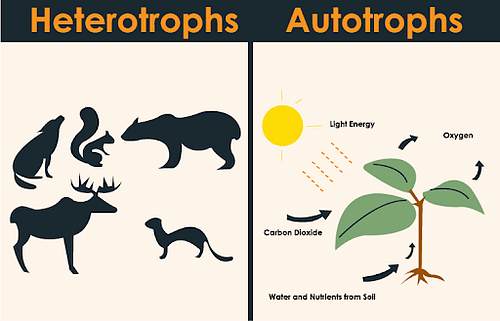
Autotrophs and Heterotrophs
Photosynthesis Process
It is the process by which green plants or autotrophs transform light energy into chemical energy. During photosynthesis, plants capture sunlight via leaves and use it to convert water, carbon dioxide and minerals into oxygen and energy-rich compounds(starch). Green plants have a special type of pigment found in the chloroplast named chlorophyll that helps in the synthesis of food by absorbing water through roots in the presence of sunlight.

Process of Photosynthesis
Chemosynthesis
Organisms that synthesize their food through chemosynthesis are known as chemoautotrophs. These organisms involve chemical energy to produce carbohydrates and utilize inorganic compounds such as sulphur, hydrogen sulphide etc. in the process of chemosynthesis. Examples are Green sulphur bacteria, purple sulphur bacteria etc.
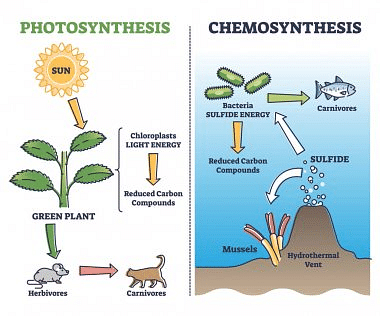
Photosynthesis Vs Chemosynthesis
What are Heterotrophs?
Heterotrophs are organisms that depend on other animals or plants for their food because they cannot prepare their own food. This type of mode of nutrition is known as the Heterotrophic mode of nutrition. Some insectivorous plants like the pitcher plant, venus flytrap and non-green plants and animals including human beings are examples of Heterotrophs because they rely on others for their food.

Heterotrophs
- These organisms consume organic food materials and rely on autotrophs for their continuous supply of food.
- They are considered consumers and occupy the 2nd or 3rd trophic level in the food chain at the secondary and tertiary positions.
How does photosynthesis affect Heterotrophs?
Herbivores are heterotrophs that directly consume their food from plants and photosynthesis is the essential process of preparation of food in plants. Heterotrophs use oxygen for their cellular respiration which is recycled by the process of photosynthesis.

Insectivorous plant
Also check: Photosynthesis: Definition, Formula, Diagram, Steps & Importance
How Autotrophs and Heterotrophs Affect Ecosystems?
[Click Here for Sample Questions]
Autotrophs are important component of the ecosystem as they convert complex compounds into simpler molecules that are released in the environment for their uses. For example, oxygen is released after using carbon dioxide molecules in the carbon cycle.
Heterotrophs play an important role in energy flow from one level to another and maintaining energy cycles. They consume plants and other animals and their faecal wastes help in regaining the inorganic material for plants consumption.

Position of Autotrophs and Heterotrophs in Food Chain
When we talk about the position of autotrophs and heterotrophs in the food chain, plants and algae occupies 1st trophic level and are primary producer in the food chain, whereas animals or organism depend on plants and other animals for their food occupies 2nd and 3rd trophic level and also known as primary consumer or secondary consumer or tertiary consumer.
Things to Remember
- Autotrophs and Heterotrophs are the two classes of living organisms that are classified based on the organism’s ability to produce food.
- The mode of nutrition through which autotrophs prepare their own food with the help of sunlight and water is called autotrophic nutrition.
- The mode of nutrition in heterotrophs are dependent on other animals or plants for their food.
- Most Autotrophs prepare their food by the process of photosynthesis and some prepare by the process of chemosynthesis.
- Autotrophs are important nutrient cyclers of the ecosystem as they convert compounds into simpler molecules.
- Heterotrophs play an important role in energy flow from one level to another and maintaining energy cycles.
Sample Questions
Ques. Is it possible to remove autotrophs from the food chain? (2 marks)
Ans. No, every organism whether they are autotrophs or heterotrophs, both are beneficial in their position and to maintain energy flow in the ecosystem that’s why they are dependent on each other.
Ques. What are the differences between autotrophic nutrition and heterotrophic nutrition? (2 marks)
Ans. Following are some important difference between autotrophic and heterotrophic nutrition:
| Autotrophic nutrition | Heterotrophic nutrition |
|---|---|
| In this mode of nutrition, an organism makes or synthesizes its own food. | In this mode of nutrition, an organism cannot make or synthesize its own food |
| Organisms use simple inorganic materials like carbon dioxide and water and synthesise their food in the presence of sunlight. | Organisms cannot make their own food from simple inorganic matter and depend on other organisms for their food. |
| All green plants and some algae undergo this mode of nutrition. | All the animals, most bacteria and fungi undergo this mode of nutrition. |
Ques. Can heterotrophs occupy more than one trophic level? (2 marks)
Ans. Yes, Heterotrophs may be primary consumers also known as herbivores or may be they are secondary or tertiary consumers.
Ques. Why are heterotrophs not able to perform photosynthesis? (2 marks)
Ans. Photosynthesis requires the major pigment found in autotrophs only which is known as chlorophyll, absent in the case of heterotrophs.
Ques. How many types of organisms are classified on the basis of nutrition? (2 marks)
Ans. Organisms are of two types which are classified on the basis of nutrition they are- Heterotrophs and Autotrophs.
Ques. Where do plants get each of the raw materials required for photosynthesis? (3 marks)
Ans. (i) Carbon dioxide: Plants get carbon dioxide from the environment/atmosphere through stomata.
(ii) Water: Plants absorb water from the soil through roots and transport to leaves.
(iii) Sunlight: Plants get sunlight from the sun.
(iv) Chlorophyll: It is present in chloroplast found in green leaves and green parts of plants.
Ques. What are the examples of Autotrophs? (2 marks)
Ans. Examples of Autotrophs are- land plants ( such as- Bryophytes, Ferns, Gymnosperms, Grass, Dicots etc.), Bacteria ( such as- cyanobacteria, planktons, etc.). Protists and Algae ( Diatoms, Dinoflagellates, Chlorophytes, Charophytes Etc.)
Ques. What are the examples of Heterotrophs? (2 marks)
Ans. All the organisms except plants and one who have chloroplasts are heterotrophs such as- Animals, Humans, Fungi, Some bacteria and all primary,secondary and tertiary consumers.
Ques. Are all humans heterotrophs? (2 marks)
Ans. Yes, We all get our food either from plants or other organisms we haven't capability to produce food by their own.
Ques. What advantage over an aquatic organism does a terrestrial organism have with regard to obtaining oxygen for respiration? (2 marks)
Ans. Aquatic organisms use oxygen dissolved in the surrounding water. Since air dissolved in water has a fairly low concentration of oxygen, the aquatic organisms have a much faster rate of breathing. Terrestrial organisms take oxygen from the oxygen-rich atmosphere through respiratory organs. Hence, they have a much less breathing rate than aquatic organisms.
Ques. How are animals categorised in various categories as heterotrophs? (2 marks)
Ans. Animals are heterotrophs and they are categorised on the basis of which type of food they consumed These animals are- Herbivores, Carnivores, Omnivores.
Ques. In which category do we put decomposers? (2 marks)
Ans. Decomposers are organisms which depend on dead and decaying matter for their food, so they come under Heterotrophs.
Ques. How is oxygen and carbon dioxide transported in human beings? (2 marks)
Ans. (i) Transport of oxygen: Haemoglobin present in the blood takes up the oxygen from the air in the lungs. It carries the oxygen to tissues which are deficient in oxygen before releasing it.
(ii) Transport of carbon dioxide: Carbon dioxide is more soluble in water. Therefore, it is mostly transported from body tissues in the dissolved form in our blood plasma to lungs. Here it diffuses from blood to air in the lungs.
Ques. How do autotrophs depend on heterotrophs? (2 marks)
Ans. Autotrophs use minerals from the soil for their food preparation which get recycled by the activities of Heterotrophs who help in recycling of nutrients.
Ques. How are water and minerals transported in plants? [CBSE 2015] (4 marks)
Ans. The roots of a plant have hair called root hair.

The root hairs are directly in contact with the film of water in between the soil particles. Water and dissolved minerals get into the root hair by the process of diffusion. The water and minerals absorbed by the root hair from the soil pass from cell to cell by osmosis through the epidermis, root cortex, endodermis and reach the root xylem.
The xylem vessels of the root of the plant are connected to the xylem vessels of its stem.
Therefore the water containing dissolved minerals enters the root xylem vessels into stem xylem vessels. The xylem vessels of the stem branch into the leaves of the plants. So, the water and minerals carried by the xylem vessels in the stem reach the leaves through the branched xylem vessels which enter from the petiole (stalk of the leaf) into each and every part of the leaf. Thus the water and minerals from the soil reach through the root and stem to the leaves of the plants. Evaporation of water molecules from the cells of a leaf creates a suction which pulls water from the xylem cells of roots. The loss of water in the form of vapour from the aerial parts of the plant is known as transpiration.



Comments