



Education Journalist | Study Abroad Lead
Nitrate and nitrite are inorganic compounds that consist of nitrogen as an integral element. They have several uses like preservation of foodstuff, a component of fertilizers, ammunition, explosives, etc. They are produced naturally by nitrogen-fixing bacteria. However, if taken in excess amount can cause several diseases of the gastrointestinal tract and especially affect babies and cause the blue baby syndrome. Both nitrate and nitrite are often confused, but they have differences in their number of oxygen atoms. Nitrate has one nitrogen and three oxygen atoms whereas nitrite has one nitrogen and two oxygen atoms. The chemical formula of nitrate is NO3- whereas the chemical formula of nitrite is NO2-. The bacteria in the soil convert nitrite into nitrate because nitrate is more stable. Other characteristics which differentiate them includes geometry shape, the oxidation number of nitrogen, the strength of acids formed, oxidation and reduction, etc.
| Table of Content |
Key Terms: Nitrite, Nitrate, Sodium Nitrite, Structural Formula, Chemical Formula, Oxidation, Reduction, Stability, Blue Baby Syndrome, Atoms, Nitrogen
What is Nitrate?
[Click Here for Sample Questions]
Nitrate is an inorganic compound that has the chemical formula NO3-. It is a common component of chemical fertilizers and explosives. Most of them are soluble in water and only a few of them are insoluble. For example, bismuth oxynitrate. They are produced naturally by nitrifying bacteria. They are produced industrially from nitric acid. It can be obtained through diet from leafy green foods like lettuce, red beetroot, spinach, etc. High consumption can cause methemoglobinemia (blue baby syndrome) and is more prominent in babies.
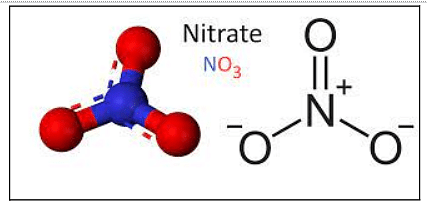
Nitrate
Read More: Nitrogen Fixation
What is Nitrite?
[Click Here for Sample Questions]
Nitrate is an inorganic compound with the chemical formula NO2-. Basically, Nitrite is produced by the oxidation of nitric oxide and reduction of nitrate by bacteria present in the mouth and gastrointestinal tract. They can be changed into nitric oxide (beneficial to the human body) and nitrosamines (harmful to the human body).
They are added to food to preserve by hindering the growth of harmful microorganisms like Clostridium botulinum, which can cause botulism. They are added to meat to preserve them. For example, they react with proteins in the meat, change its colour to pink or red, and thus preserve it. If it is not added, the meat can turn brown quickly.

Nitrite
Differences Between Nitrite and Nitrate
[Click Here for Sample Questions]
Although both nitrate and nitrite spells alike and are often confused with each other, they have differences. The main distinctions are tabulated below:
| Characteristics | Nitrate | Nitrite |
|---|---|---|
| Chemical Structure | Has three oxygen atoms and one nitrogen atom. | Has two oxygen atoms and one nitrogen atom. |
| Geometry Shape | Possesses a Trigonal planar geometry shape | Possesses a bent molecular geometry shape |
| Oxidation And Reduction | They are reduced to form nitrites | They are oxidized to form nitrites |
| Strength Of Acid | They form nitric acid, which is a strong acid. | They form nitrous acid, which is a weak acid. |
| Oxidation Number Of Nitrogen | The oxidation number of nitrogen is +5 | The oxidation number of nitrogen is +3 |
| Stability | More stable because of an additional oxygen atom | Less stable because of one less oxygen atom |
| Uses | Fertilizers and explosives | Used in Food preservatives, for example, in meat. |

Nitrate and Nitrite
Read More: Oxides of Nitrogen
Things to Remember
[Click Here for Sample Questions]
- Nitrate and nitrite are inorganic compounds that differ in the number of oxygen atoms.
- Nitrate hold one nitrogen atom and three oxygen atoms whereas nitrite have one nitrogen atom and two oxygen atoms.
- The chemical formula of nitrate and nitrite is NO3- and NO2- respectively.
- They are produced naturally by nitrifying bacteria and can be found naturally in the body. They are used in the manufacturing of explosives, ammunition, firecrackers, and preservation of food materials like meat etc.
- They are taken in form of dietary food like spinach and lettuces etc. However, if taken in excess amount can affect the gastrointestinal tract and can cause blue baby syndrome.
- Both nitrite and nitrate differ on the basis of geometry shape, the oxidation number of nitrogen, the strength of acids formed, oxidation and reduction, etc.
Sample Questions
Ques. Which is more harmful nitrite or nitrate? (3 Marks)
Ans. Nitrite is more harmful than nitrate. This is because they react with amines present in stomach food to form nitrosamines. These nitrosamines are carcinogenic in nature and can cause cancer. However, nitrates are stable and unlikely to change and cause harm. Therefore, nitrate is less toxic and is used as a food source by live plants
Ques. What can be done to remove nitrates from the aquarium? (3 Marks)
Ans. Nitrates can be removed from the aquarium by adding live plants to the aquarium. This is because plants utilize nitrate as a nutrient for their growth and development. In addition to this, decrease the number because excreta of fish increase nitrate levels in the water. Use nitrate remover such as Algone. It clear cloudy aquarium and make it crystal clear.
Ques. How nitrates can affect the plants? (3 Marks)
Ans. Nitrate is a common component of plant fertilizers. It is required essentially for the growth and development of plants. If plants are deficient in nitrates, then the amount of chlorophyll in leaves reduces. This may turn the leaves pale green or yellow colour. Chlorophyll is the main component of photosynthesis, if it gets reduced then it will reduce the plant’s ability to photosynthesize and grow properly. This ultimately reduces the crop yield.
Ques. How nitrates can affect aquatic organisms? (3 Marks)
Ans. Nitrates can affect the environment as well as organisms severely. Often, fertilizers are added to the soil for the growth and development of plants. This makes the soil rich in nitrate and in heavy rains of flood this nitrate enters the water bodies and encourages the growth of microorganisms. These microorganisms make the water oxygen-deficient which can cause the death of aquatic organisms.
Ques. What are the harmful effects of sodium nitrite? (3 Marks)
Ans. Sodium nitrite is present in bacon, hotdogs, and processed meat. They can cause nausea, headache, diarrhoea, vomiting, and abdominal pain. The excessive intake of sodium nitrite can lead to leukaemia, pancreatic, bladder, thyroid cancer, etc. It can damage blood vessels by making arteries hard and narrow which in the future can lead to heart diseases.
Ques. Are nitrites present in urine? (3 Marks)
Ans. Urine consists of nitrates, not nitrites. In case of urinary infection (UTI), may enter the urine and change nitrate into nitrite. This can be detected by a urine test. Nitrituria is a positive test for nitrites in the urine. Thus, the presence of Nitrites in urine may be a sign of a urinary tract infection.
Ques. Are nitrate and nitrites cancerous? [ 3 Marks]
Ans. Nitrite and nitrate are taken through a diet like spinach and lettuces, etc. When they are ingested, they react with amides and amines present in the gut and form N-nitroso compounds (NOC), which are responsible for causing in animals and in humans. For example- sodium nitrite in presence of extreme heat or a high acidic environment can transform into nitrosamine, a carcinogen. It can cause gastric cancer.
Ques. What is the permissible limit of nitrate in drinking water? (3 Marks)
Ans. Permissible limit is the range by which a substance is non-toxic. Above this limit, the specific drug or toxin can be lethal. According to the Indian Institute of Technology of Kanpur, the permissible limit of nitrate in drinking water is 45 milligrams of nitrate per litre of drinking water (mg/L). This means if nitrate is less than 45 per litre then water is safe for drinking. A value greater than 45 milligrams of nitrate per litre can make water unsafe for drinking.
Ques. Why nitrites are nucleophiles? (3 Marks)
Ans. A nucleophile is a donor of electrons that bonds to an atom other than hydrogen. However, ambident nucleophiles have two for attacking. For example- nitrite ion. The nitrite ion attack through nitrogen to form nitroalkanes and it can also attack through oxygen to form alkyl nitrites. Therefore, nitrites are ambident nucleophiles.
Read More:



Comments