



Content Writer
Gastrointestinal Tract is the path from where the food enters the body, and the waste is excreted. It includes all major digestive system organs, including the esophagus, stomach, intestines, liver and pancreas.
- The gastrointestinal tract is a muscular tube that extends from the mouth to the anus.
- It is also known as the digestive tract or alimentary canal.
- Chemicals that are harmful to internal organs enter the body through the gastrointestinal (GI) tract.
- The mucosa is a delicate barrier that keeps germs out while allowing nutrients to enter and maintain equilibrium.
- The gastrointestinal tract is also the only internal organ that contains bio-transforming and toxigenic microorganisms.
- It also contains drug-binding compounds that are inert.
As a result, when a substance is introduced into the gastrointestinal system, its ultimate toxicity is dictated by interactions with bacterial and mammalian enzymes and the level of detoxification and activation processes.
Read More: Immune System
| Table of Content |
Key Terms: Gastrointestinal Tract, Oesophagus, Intestine, Ileum, Ischium, Chyme, Mucous, Pancreas, Liver, Rectum, Digestive System
Gastrointestinal Tract: Definition
[Click Here for Sample Questions]
The gastrointestinal tract is an organ system in humans and other animals that takes in food, digest it, absorb nutrients and expel it out in the form of faeces. It passes through the pharynx, esophagus, stomach, and intestines.
- The length of the gastrointestinal tract is approximately 9 metres.
- It consists of gut microbiota that are responsible for maintaining the immunity and metabolism inside the body.
- The cells inside the GI tract will release the hormones that will control the digestive process.
- All of the gastrointestinal system's activities are contained in the gastrointestinal tract, which extends from the mouth to the anus in humans and many mammals.
- The meal is ingested and digested to receive nutrients and absorb reactive power, with wastes expelled as faeces.
- As an adjective, "gastrointestinal" refers to the gut and bowels.
- A tract is a collection of connected anatomical structures or related body organs.
-
The human Gastrointestinal Tract is divided into parts, namely Upper gastrointestinal tract and Lower gastrointestinal tract
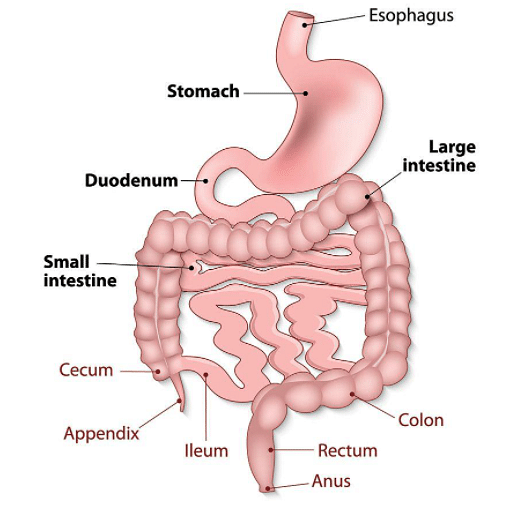
Digestive System
Read More: Human Digestive System
Upper Gastrointestinal Tract
[Click Here for Sample Questions]
The upper portion of the gastrointestinal tract includes the mouth, pharynx, esophagus, stomach, and duodenum. The details about each part of the upper gastrointestinal tract are as follows:
Mouth
Mouth is the first part of the upper gastrointestinal tract. The functions of the mouth are as follows:
- It includes the teeth, tongue, and buccal mucous membranes, which contain the tips of the salivary glands.
- It extends to the soft palate, mouth floor, and tongue bottom.
- The tongue, cheeks, and teeth all work together to chew food, and the lower jaw and upper jaw work together also help in the process.
Salivary glands
Salivary glands produce saliva, which is a fluid found in the mouth and throat. The functions of the salivary glands are as follows:
- Saliva includes enzymes that start the digestion process.
- It also includes antibodies and other compounds that aid in the prevention of mouth and throat infections.
- The parotid, sublingual, and submandibular salivary glands are located under and behind the jaw of humans.
Teeth and Tongue
Teeth is another part of the upper gastrointestinal tract whose function is as follows:
- In the buccal cavity of an adult, there are 32 teeth.
- Food is broken down and crushed with the help of our teeth.
- Later, it is sliced and ripped by the incisors and canines (front teeth).
- Next, it is crushed and broken into smaller bits by the bicuspid and molars (back teeth).
- The tongue is a three-lobed triangular organ with a muscular and meaty appearance. It runs the length of the floor of the buccal cavity.
Pharynx
The pharynx is a part of the digestive and respiratory systems encased in the neck and throat.
- It keeps food from getting into the trachea and lungs.
- The pharynx is responsible for the muscular propulsion of materials into the esophagus.
Esophagus
Esophagus is a muscular tube-like structure that carries food to the stomach.
- The esophagus regulates the action of swallowing after the chewed food enters the esophagus from the mouth.
- It is also known as the oesophagus.
- It is also responsible for transporting required minerals and materials to the stomach.
Stomach
The stomach is the place where majority of digestion takes place. In this, the mechanical processing of food takes place through muscular contractions.
- The stomach is a J-shaped bag-like organ.
- It temporarily stores food before breaking it down.
- The stomach is responsible for mixing and churning food with enzymes and other digestive fluids before passing it to the small intestine.
Lower Gastrointestinal Tract
[Click Here for Sample Questions]
The lower gastrointestinal tract consists of the lungs and small intestines. It extends from the pyloric sphincter of the stomach to the anus. The details about each part of the lower gastrointestinal tract are as follows:
Small Intestine
The small intestine is a 6-7 metre long coiled thin tube where the majority of nutrient absorption takes place. Its functions are as follows:
- Food is combined with liver and pancreas enzymes in the small intestine.
- The small intestine's surfaces absorb nutrients from meals into the bloodstream, transporting them to the rest of the body.
- It is divided into three parts, namely duodenum, jejunum and IIeum.
- The mucosal area in a human being is approximately 30 m2.
Large Intestine
The large intestine is a thick tubular structure that wraps around the small intestine. Its major job is to digest waste products and reintroduce any remaining nutrients and water into the system.
- The leftover waste is subsequently sent to the rectum, where it is expelled as a stool.
- It is also known as colon.
- The intestine is shaped like an arch, starting at the cecum and ending at the rectum.
- The appendix is also part of the large intestine.
Read More: Difference Between Small and Large Intestine
Function of Gastrointestinal Tract
[Click Here for Sample Questions]
The functions of gastrointestinal tract are as follows:
- The gastrointestinal tract will help in the ingestion and digestion of food.
- It is responsible for the secretion of water and enzymes in the body.
- The majority of nutrients are absorbed with the help of the GI tract.
- It helps in the excretion of waste products.
Infection caused by Gastrointestinal Tract
[Click Here for Sample Questions]
Gastrointestinal infections are viral, bacterial, or parasites that cause gastroenteritis, a gastrointestinal tract inflammation affecting both the stomach and the small intestine.
- Diarrhoea, vomiting, and abdominal pain are some of the symptoms.
- The microorganisms that can cause these infections include adenovirus, campylobacter, E.coli, Staphylococcus aureus, etc.
Diseases caused by Gastrointestinal Tract
[Click Here for Sample Questions]
The disease caused by gastrointestinal tract are as follows:
Constipation
Constipation is a functional problem in which you cannot have a bowel movement (or pass stools). In this, your stools are infrequent (less than three times per week) or incomplete. Constipation is frequently caused by a lack of "roughage" or fibre in your diet and a change in your normal routine or diet.
Irritable bowel syndrome (IBS)
Irritable bowel syndrome (also known as spastic colon, irritable colon, IBS, or anxious stomach) is a functional illness in which the muscles of your colon contract more or less frequently than "normal." Certain foods, medications, and emotional stress are all known to cause IBS.
Haemorrhoids
Haemorrhoids are structural disorders caused by dilated veins in the anal canal. Your anal hole is lined with enlarged blood vessels.
- Chronic excess pressure from straining during bowel movements, severe diarrhoea, or pregnancy might cause them.
- Internal and external haemorrhoids are the two types of haemorrhoids.
Anal fissures
Anal fissures are a structural problem as well. They're fissures or cracks in the anal opening's lining. Passing very hard or wet faeces is the most prevalent cause of an anal fissure.
- The underlying muscles that control the movement of stool through the anus and out of the body are exposed by the gap in the anal lining.
- An anal fissure is one of the most unpleasant issues because exposed muscles become inflamed by faeces or air.
- It results in acute searing pain, bleeding, or spasm following bowel movements.
Read More: Gastric
Things To Remember
- Gastroenteritis is caused by viruses, bacteria, and parasites attacking the digestive tract (inflammation of the alimentary canal).
- Both the stomach and the intestine can be infected with them.
- Adenovirus, campylobacter, E. coli, Staphylococcus aureus, and other microbes can cause these diseases.
- Peristalsis is the movement of food through the gastrointestinal tract.
- A valve-like structure appears when the bolus is about to enter the stomach.
- One of the major problems is the amount of water in food.
- If we take adequate water daily, we can prevent many diseases.
Also Read:
Sample Questions
Ques. Define the term anus? (5 Marks)
Ans. Anus is defined as the opening end of the alimentary canal. The rectum, also known as the anal aperture, is the orifice at the end of the alimentary tract. The process of unprocessed or discarded nutrients excreted through the intestines is known as faeces.
- The rectums, or circular muscles that surround the anus control the retention and discharge of faeces.
- The outer anal canal muscles are free, whereas the interior urethral sphincter muscle is reflexive.
- The anus is, in fact, the gastrointestinal system's final part.
- As a result, the anus is one of the most critical regions of the human body for appropriate digestive system function.
- It's also seen in the digestive system diagram and the alimentary canal structure.
Ques. Define the Alimentary Canal. (3 Marks)
Ans. One of the most important portions of the gastrointestinal tract is the alimentary canal. It's a long, continuous muscular tube that runs around the belly and is about 8 to 10 metres long.
- With mouths on the front and the perineum on the rear, it is accessible from both sides.
- It's in charge of meal digestion.
- It breaks it down into small pieces and serves the digested meal for absorption.
Ques. What happens when food enters the gastrointestinal tract. (2 Marks)
Ans. The small intestine absorbs most of the nutrients in your meal, which your circulatory system distributes to other regions of your body for storage or usage. Special cells assist in the passage of ingested nutrients through the gut mucosa and into the circulation.
Ques. How does the gastrointestinal tract work. (2 Marks)
Ans. The GI tract is the route that follows from your mouth to your stomach, small intestine, and large intestine. Food nutrients and water are absorbed in the GI tract to keep your body healthy. Anything that isn't absorbed moves through your GI tract until you eliminate it by going to the bathroom.
Ques. How long does it take food to move through the digestive system. (2 Marks)
Ans. Food passes through your stomach and small intestine roughly six to eight hours after you eat. Food next reaches your large intestine (colon) for additional digestion, water absorption, and undigested food excretion. Food takes roughly 36 hours to pass through the colon completely.
Ques. Is drinking water considered an empty stomach. (2 Marks)
Ans. Liquids usually pass through your stomach fast. For example, just around half of a glass of water will remain in your stomach after ten minutes. Solid foods must often be broken down and liquified further, so they take longer to pass through your stomach.
Ques. What is gastrointestinal bleeding. (2 Marks)
Ans. Gastrointestinal (GI) bleeding is a symptom of a digestive tract problem. Blood is frequently seen in faeces or vomit, although it isn't always visible, even if it causes the stool to appear dark or tarry. The severity of the bleeding can range from minor to severe, and it can be fatal.
Ques. What causes poor digestion. (2 Marks)
Ans. Diarrhoea, constipation, irritable bowel syndrome (IBS), inflammatory bowel disease (IBD), and heartburn are the most prevalent digestive-related issues. An unhealthy lifestyle, bad diet, food sensitivity, or even an infection can all contribute to these symptoms.
Ques. What bacteria causes gastrointestinal infections. (2 Marks)
Ans. Infections of the gastrointestinal tract. The number of bacteria that cause sickness in the intestines is tremendous. The intestinal disease can be caused by bacteria (E. coli, Salmonella, Shigella, Campylobacter, Clostridium), viruses (Norwalk agent, Rotaviruses), and parasites (Giardia, Entamoeba, Ascaris).
Ques. How can food poisoning harm the digestion process. (3 Marks)
Ans. Food poisoning is an infectious condition that has been causing harm to people's digestive systems globally. In this condition, people experience nausea, diarrhoea, and cramps in abdominal pain.
- People seek medical care if they have a high temperature, rectal bleeding, or dehydration.
- Food poisoning treatment focuses on keeping the affected person hydrated.
- Most cases of food poisoning get better with time on their own.
- Prevention is the key to avoid food poisoning.
- It depends upon keeping food preparation areas clean, proper hand washing, and cooking foods thoroughly.
Ques. Why the size of the intestine is equivalent to 22 feet long. (3 marks)
Ans. The size of the intestine is equivalent to 22 feet long because of the following reasons:
- Our intestine is our main defence system.
- It is a part of the body where waste product elimination also occurs.
- Intestines are the home of millions of different vital biochemical processes.
- All nutritional ingredients are stored inside the intestine.
Ques. Which organs are part of the lower gastrointestinal tract. (1 mark)
Ans. The small intestine and large intestine are part of the lower gastrointestinal tract.
Ques. What diseases are caused by the gastrointestinal tract. (2 marks)
Ans. The diseases caused by the gastrointestinal tract are as follows:
- Constipation
- Irritable bowel syndrome
- Annal Fissures
- Haemorrhoids
For Latest Updates on Upcoming Board Exams, Click Here: https://t.me/class_10_12_board_updates
Check-Out:



Comments