



Exams Prep Master
All of the chemicals you come across have some of the other characteristics. You can divide a substance into two portions based on its features and attributes. Substances are often categorized based on their physical and chemical features. Changing the chemical composition of a substance establishes a chemical property. Physical properties, on the other hand, are those that are determined without affecting the substance's chemical composition. Because physical and chemical qualities are both important when researching substances, you must understand the distinction between the two. It will help you gain a better knowledge of the issue if you read it all the way through.
| Table of Content |
Key takeaways: Melting point, boiling point, density, volume, length, shape, chemical stability, acid, base
Physical and Chemical Properties: An Overview
[Click Here for Sample Questions]
The chemical composition and surrounding environment have no effect on a substance's physical qualities. However, when a substance is mixed with another substance, its chemical properties alter. The physical qualities of a substance can be observed without affecting or influencing its chemical structure. On the contrary, it is impossible to examine a substance's physical features without changing or modifying its chemical composition. Melting point, boiling point, density, and hardness are all physical qualities that can be observed in a substance. Chemical parameters such as ionization energy and electron affinity, on the other hand, are important.

Physical and Chemical Properties
While distinguishing between the two sorts of properties, it's vital to remember that changes in physical properties have no effect on the substance's composition. Changes in chemical characteristics, on the other hand, have an impact on the composition of a substance. Furthermore, the difference between physical and chemical qualities is that only the former can be observed using various sensory organs such as smell, taste, or touch. On the other hand, such sensory organs cannot be used to monitor the latter.
Read more:
What are Physical Properties?
[Click Here for Sample Questions]
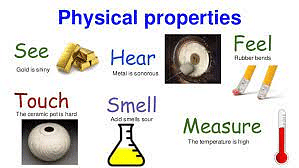
Physical qualities are those that can be measured without changing the matter's chemical composition. A physical attribute can be used to describe the appearance and dimension of a substance. The chemical and molecular composition of the stuff remains constant regardless of the measurement method.
Physical Properties
As a result, physical property is any property that can be measured or detected without the use of a chemical interaction. Physical attributes are further divided into two categories: intensive and extensive properties. The amount of substance has no bearing on the intensity of a property. Intensive properties are those that have to do with the substance's appearance. Color, for example, is an intense feature since it is unaffected by the amount of substance present. Similarly, a substance's melting and boiling points, as well as density, are examples of intense properties.
Furthermore, the widespread property is dependent on the amount of material. When the amount of material is changed, the comprehensive property changes. For example, mass is a broad attribute that is determined by the amount of substance to be measured. Volume, length, and other dimensions that change as the number of matter changes are also significant attributes.
Read more:
What are Chemical Properties?
[Click Here for Sample Questions]
A meaning of a compound property is that estimating the property causes an adjustment of the synthetic design of the substance. A synthetic property of a substance becomes obvious upon compound change or response in the substance. Likewise, a synthetic property shows the capacity of a substance to consolidate with different substances or change into an alternate item.
Chemical Properties
The synthetic organization of a substance is, in addition, a character of the substance; after changing the compound creation, the substance transforms into an alternate substance. Synthetic property can gauge the progressions a substance goes through when it goes through a compound response. Furthermore, when the synthetic response happens, the matter changes into an altogether unique matter.
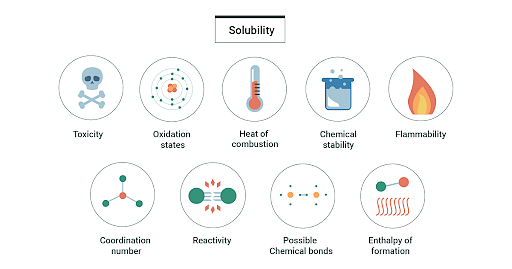
A synthetic property is any property that gets decided when a change happens in the compound personality of the substance. A few instances of substance properties are – poisonousness, the hotness of ignition, reactivity, enthalpy of development, oxidation states, radioactivity, and so forth.
Read more:
Difference between Physical and Chemical Properties
[Click Here for Sample Questions]
| Chemical Properties | Physical Properties |
|---|---|
| When a substance undergoes a chemical change, its chemical properties can be observed or measured. | Physical properties are those that can be observed without causing a chemical reaction. |
| To demonstrate the property, a chemical reaction must be carried out. | There is no need for a chemical reaction in this case. |
| Chemical properties are linked to a substance's chemical bonds. | Such a relationship does not exist between physical properties. |
| It can be used to predict how different substances will react. | It is primarily used to identify or describe a substance. |
| Compressibility, radioactivity, toxicity, flammability, heat of combustion, chemical reactivity, and other properties of a substance are examples of chemical properties. | Molecular weight, boiling point, melting point, freezing point, volume, mass, length, density texture, colour, odour, shape, solubility, and so on are examples of physical properties. |
Conclusion
[Click Here for Sample Questions]
Physical and chemical properties simply demonstrate the various characteristics of the substances. A physical property does not alter or change the composition of a substance; it remains independent of any chemical reaction. Exposure to other chemicals, on the other hand, reveals a chemical property. As a result, this is all about physical and chemical properties and how they differ.
Things to Remember
- Physical properties are those that can be measured without affecting matter's chemical composition. These properties can be used to describe matter's appearance and dimensions.
- These physical properties can also be used to examine and compare various types of matter. Physical properties are classified into two categories: intensive properties and extensive properties.
- Intensive properties are physical properties that are unaffected by the amount of substance present. The amount of substance determines the extent of the properties. This means that when the amount of a substance is changed, its extensive properties change.
- Chemical properties are properties that can be measured by altering a substance's chemical composition. A substance's chemical composition is analogous to its identity; if the chemical composition is altered, the substance becomes a different substance.
- Chemical properties are measurements of the chemical changes that a substance can go through when subjected to a chemical reaction. As a result, in order for the chemical properties to be visible, the sample's structure must be altered.
Sample Questions
Ques: What are the different kinds of physical properties? (2 marks)
Ans: Physical properties can be intensive or extensive.
1. Extensive: It is determined by the amount of matter being measured, such as mass, volume, and length. These properties are external, and they cannot be used to identify the substance. For example, measuring 100g of oil or water does not help you identify whether the substance is oil or water.
2. Intensive: It does not rely on the amount of matter measured, such as colour, viscosity, density, buoyancy, melting and freezing points. These properties are constant, and they can be used to identify the substance. For example, liquid water has a density of 1g/mL, a freezing point of 0°C, and a boiling point of 100°C.
Ques: Give some physical and chemical property examples. (3 marks)
Ans: Physical properties can be measured and observed without causing a chemical change. Temperature, malleability, appearance, texture, odour, colour, shape, solubility, melting, freezing, and boiling point are examples of physical properties. A few more physical properties are volume, mass, length, density, pressure, viscosity, and hardness. When a substance undergoes a chemical change, its chemical properties are observed or measured. Toxicology, chemical stability, the heat of combustion, flammability, reactivity, and enthalpy of formation are examples of chemical properties. Chemical properties include buoyancy, viscosity, compressibility, radioactivity, oxidation state, and the ability to form chemical bonds.
Ques: Which of the following are examples of intensive properties? (3 marks)
Ans: Intensive properties include specific heat capacity, melting point, boiling point, vapor pressure, the heat of vaporization, the heat of fusion, compressibility factor, and so on. Intensive properties are those that are independent of the size or amount of matter being measured, i.e. they are not affected by the sample or substance. When dealing with intensive properties, it is important to remember that mass is an important factor. Students should be aware that the specific heat capacity of a substance is the amount of energy required to raise the temperature of 1 gram or 1 kilogram of a substance by one degree Celsius.
Ques: What exactly is a physical property? (2 marks)
Ans: Different measurements of matter are referred to as physical properties. Color, hardness, malleability, density, and conductivity are the five properties. A change in a substance's physical property does not result in a change in the substance's chemical composition. Physical properties do not alter or change a substance's chemical composition; it remains separate from any chemical reaction.
Ques: What exactly is the distinction between physical and chemical properties? (2 marks)
Ans: A change in a substance's physical property does not result in a change in the substance's chemical composition. A physical property does not alter or change a substance's chemical composition; it remains separate from any chemical reaction. Pressure, state, melting point, and boiling point are all examples of physical properties. A chemical property can quantify the changes that a substance goes through during a chemical reaction and when the chemical reaction occurs, the matter changes.
Ques: Should you focus on physical or chemical properties when studying chemistry? (3 marks)
Ans: You should study both because studying one over the other will not provide you with a complete understanding of the subject. Physical properties are aspects of matter that can be observed without changing the substance's chemical identity. Chemical properties are changes in a substance that can be observed. Physical properties are aspects of matter that can be observed without changing the substance's chemical identity.
Chemical properties can be used to quantify the changes that a substance goes through during a chemical reaction. And, as a result of the chemical reaction, matter transforms and creates new substances. Chemical properties are changes in a substance that can be observed.
Ques: What are chemical properties? (4 marks)
Ans: A meaning of a compound property is that estimating the property causes an adjustment of the synthetic design of the substance. A synthetic property of a substance becomes obvious upon compound change or response in the substance. Likewise, a synthetic property shows the capacity of a substance to consolidate with different substances or change into an alternate item.
The synthetic organization of a substance is, in addition, a character of the substance; after changing the compound creation, the substance transforms into an alternate substance. Synthetic property can gauge the progressions a substance goes through when it goes through a compound response. Furthermore, when the synthetic response happens, the matter changes into an altogether unique matter.
Ques: What are physical properties? (2 marks)
Ans: Physical qualities are those that can be measured without changing the matter's chemical composition. A physical attribute can be used to describe the appearance and dimension of a substance. The chemical and molecular composition of the stuff remains constant regardless of the measurement method. As a result, physical property is any property that can be measured or detected without the use of chemical interaction.
Ques: What are types of physical properties? (2 marks)
Ans: Physical attributes are divided into two categories: intensive and extensive properties. The amount of substance has no bearing on the intensity of a property. Intensive properties are those that have to do with the substance's appearance. Color, for example, is an intense feature since it is unaffected by the amount of substance present. Similarly, a substance's melting and boiling points, as well as density, are examples of intense properties.
Chemistry Related links:



Comments