



Education Journalist | Study Abroad Lead
Organic Compounds can be defined as those chemical compounds that have a carbon component in them. The branch of chemistry which studies the manufacture and synthesis of these compounds is called Organic Chemistry. The term melting point refers to the level of temperature at which the chemical compound changes its state from solid to liquid. Melting points help in determining the purity level of a compound. For example, when we apply heat to a solid item, it will reach the melting point with gradual heating. In case excess heat is provided, the solid will convert into liquid without any change in the temperature.
| Table of Contents |
Key Takeaways: Melting Point, Organic Compounds, Inorganic Compounds, Purity, Impurity, Temperature, Thiele Tube Set-Up, Mel Temp Apparatus, Solids
Determining the Melting Point of Organic Compounds
[Click Here for Sample Questions]
Melting point determination helps in observing the purity of different substances. Pure substances will have a lower degree of melting point around a range of one or two degrees. While substances that have impurities have a higher level of melting point and also have a broader range of melting points. The melting is also impacted by the change in the molecular structure of different substances/components.

Melting Point
Read More: Melting and Boiling Point
Methods of Determining the Melting Point of Organic Compounds
[Click Here for Sample Questions]
There are two commonly used methods for determining the melting points of organic compounds:
- Thiele Tube Set-Up
- Mel Temp Apparatus
Thiele Tube Set-Up
For this method, we need a Thiele tube that is designed to contain oil and experiment with heat along with other items such as capillary, thermometer, a bunsen burner and a rubber band. Here are the steps for the same:
- The substance which is to be observed will be added to the capillary tube, now a rubber tube is tied to it. It is important to ensure that the rubber does not get dipped into the oil, this can lead to the rubber melting.
- The heating will be slow here, in order to properly observe the melting.
- The thermometer bulb and the capillary tube should have thermal equilibrium at the melting point.
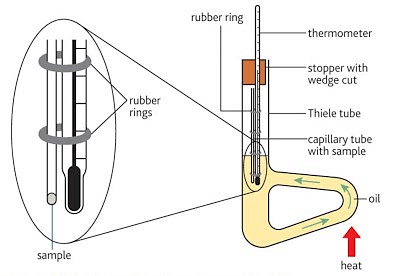
Thiele Tube Set-Up
Read More: Change of State: Melting Point and Boiling Point and its Application
Mel Temp Apparatus
Mel Temp Apparatus includes a thermometer, melting point tube, tube channels, eyepiece and a heating control knob. Here are the steps for this method:
- Insert the thermometer into the thermometer well.
- Now, in the next step, capillaries will be added to the channels present in the front of the thermometer tab.
- Green LED will be switched on for power.
- With the usage of a black heating knob for controlling heat.
- Once this is done, the eyepiece will be adjusted and the sample will be observed using the Mel Temp Apparatus.
- Slow heat should be used to ensure more accurate measurement when observing the melting point. At this stage, the initial melting stage and final melting of all components will be observed. This helps to determine the melting range of a compound.
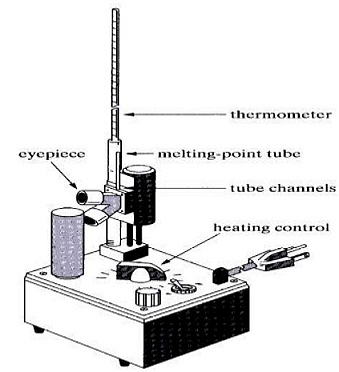
Mel Temp Apparatus
Visual Observations
During melting point determination, we can see several noticeable changes that take place in the three capillaries. The first change might be because of dehydration, change of colour, change in the crystallization state, individual isolated crystals start to melt without the liquid showing up as a cohesive phase, also known as sintering point and condensation in the coolest points of the tube.
Read More: Carbon and its Compounds
Factors Affecting Melting Point
[Click Here for Sample Questions]
Some of the factors affecting the melting point of a substance are as follows:
- Size of the Molecule: the structure and size of a molecule have a huge role to play in the melting point of an organic compound. In case the molecules of a component are close to each other, the melting point will be higher. However, if the molecules are loosely connected the melting point would be much lower.
- Force of Attraction: Force of attraction also has a huge impact on the melting point of a compound. If the force of attraction is strong between molecules the melting point will be much higher, however, if the force of attraction is not that strong then the melting point is much lower as well. In other words, the force of attraction and melting point are directly proportional to each other.
- Impurities: In terms of purity and impurity, pure substances have a rather narrow range of melting points, usually from one to two degrees. However, impure substances, melt over lower and wider temperatures.
Example of Melting Point Determination Experiment
[Click Here for Sample Questions]
Aim: Determining the melting point of benzoic acid.
Materials Required: benzoic acid, thermometer, capillary tube, thread, aluminium block, kerosene burner
Procedure
- Add benzoic acid on the tile and crush the substance until turned into a fine powder.
- Now take a capillary tube and heat one side of the tube.
- Hold the capillary tube between your fingers and thumb.
- Now dip the opened end on the crushed substance.
- Fill the capillary tube with 1-2 cm length of the compound.
- Now attach the tube to the thermometer with the help of a thread.
- This tube should be now placed in the groove of the aluminium block and it should be placed exactly in the middle.
- Place the block in the aluminium block on top of the kerosene burner and start heating the block.
- Watch the substance and note when it starts melting.
- Note the temperature when the substance first starts to melt, naming it as t1. And when the substance is completely melted, the temperature will also be noted as
- Now t1 and t2 will be used to determine the average temperature.
Read More: Boiling Point Elevation: Definition, Formula, Detailed Explanation
Things to Remember
- The chemical compounds with a carbon component in them are known as organic compounds.
- Melting point refers to that level of temperature at which the chemical compound changes its state from solid to liquid.
- Melting Point Determination of different elements is used to know the purity of an object.
- An extremely pure substance has a melting range of one or two degrees while impure substances have a much higher range and tend to broaden the melting range.
- Basically, there are two common methods for determining melting points which are Mel Temp Apparatus and Thiele Tube Set-Up.
Sample Questions
Ques. Explain what is a Melting Point. (3 Marks)
Ans. Melting point, in simple words, refers to the level or range of temperature in which the state of a chemical substance changes from solid to liquid. The melting point of a substance is determined by various factors such as the structure of molecules, level of attraction between the molecules of the substance, and purity or impurity of a substance. Some of the methods used to determine the melting point of a substance include Mel Temp Apparatus and Thiele Tube Method.
Ques. Why is the melting point of magnesium higher than sodium? (3 Marks)
Ans. Magnesium has a higher melting point than sodium because magnesium ions, that is, Mg2+ are positive. While sodium (Na+) is also positive, however, Magnesium ions positive charge is stronger due to which the attraction of electrons is stronger. A stronger attraction between molecules is also a determinant of the melting point temperature of its substance. A stronger molecular attraction also affects the melting point level of the substance. Higher the attraction, the higher temperature required for the substance to melt. Hence, the attraction between molecules in a substance and the melting point is directly proportional.
Ques. Why is the determination of the melting point of substances important? (5 Marks)
Ans. Melting Point is important for various reasons some of which are as follows:
- Knowing the melting point of a substance is important and helps in understanding various aspects of a substance.
- Knowing the melting point of a substance also helps in storage-related problems. On the basis of the melting point, we can decide if the substance needs a warm place or a cold place to store.
- The melting point of a substance is considered important in organic chemistry because it also gives information about the purity of the substance.
- Melting points determination is often used in research and development as well as for quality control in various industries.
- Melting point is also considered important in identifying substances.
Ques. Why can’t we heat the capillary tube directly in order to determine the melting point? (3 Marks)
Ans. Capillary tubes are an important part of various melting point determination methods such as the Mel Temp Apparatus, Thiele tube method. Being a transparent tube helps in observing changes in the substance due to the temperature. Capillary tubes cannot be heated directly to determine the melting point because direct heating leads to uneven heating in substances, and in order to observe the melting point of the substance slow heating is required and direct heating can lead to fast heating, hence, not being able to carefully observe the melting points.
Ques. Explain the importance of the Thiele tube method to determine the melting point of a substance. (3 Marks)
Ans. The Thiele tube method is one of the commonly used methods of determining the melting points. The method is considered useful and advantageous because of many reasons such as
- Firstly, it is the simplest method to determine the melting point of a compound.
- Secondly, the method also helps in using smaller amounts of the substance for the experimentation.
- Thirdly, the Dennis-Thiele tube also has good convection and heat transfer properties.
Ques. Mention the advantages of using the Mel Temp Apparatus in determining the melting point of a substance. (3 Marks)
Ans. Advantages of using the Mel Temp Apparatus in determining the melting point of a substance include
- It is a compact and portable way of determining melting point apparatus, it helps in making the method a bit easier.
- The accuracy of the method is a bit better than the other traditional methods used to determine the melting point of a substance.
- It helps in determining both pure and contaminated substances.
Ques. Differentiate between Melting Point and Boiling Point. (5 Marks)
Ans. The difference between Melting Point and Boiling Point is as follows:
Melting Point
- Melting point refers to the level of temperature when the substance changes its state from solid to liquid in response to heat/ increase in temperature.
- Example: The melting point of water (H2O) is 0 degrees celsius.
- Melting points help in research and development and determining the properties of a substance.
Boiling Point
- Boiling point refers to the level of temperature when the substance changes its state from liquid to gas or, in other words, the liquid changes to vapour in response to boiling.
- Boiling points serves as a determinant of volatility.
- For example, The boiling point of water (H2O) is 100 degrees celsius.
Ques. Differentiate between Melting Point and Freezing Point. (5 Marks)
Ans. The difference between meting and freezing point is as follows:
Melting Point
- Melting point refers to the level of temperature when the substance changes its state from solid to liquid in response to heat/ increase in temperature.
- Melting points help in research and development and determining the properties of a substance.
- Example: The melting point of water (H2O) is 0 degrees celsius.
Freezing Point
- Freezing point refers to the point at which a substance freezes into solid from the liquid state,
- Freezing point helps in preventing radiators from freezing in winters.
- Example: The freezing point of water (H2O) is 0 degrees celsius.
Ques. Why is Melting not considered a chemical change? (3 Marks)
Ans. Melting only changes the substance in terms of factors such as its pressure, composition. However, the basic components of the substance being melted are still the same and hence it is only a physical change and not a chemical change. For instance, water when is turned to ice or when ice is turned into the water the state of the substance from liquid to solid or vice versa. However, the chemical formula of the substance is still H2O.
Check-Out:



Comments