



Content Curator
Stem is the vertical part of the axis from which branches, leaves, flowers, and fruits grow. The stem has multicellular hair and positive phototropic nature which helps to differentiate it from a root. The stem has nodes and internodes. The part of the stem where leaves are grown is called nodes while internodes are the parts between two nodes. The stem of a young plant is generally green in color but often becomes brownish and woody after some time depending on the type of plant. Stem acts as a medium for carrying water and minerals and also carries out photosynthesis.
Also read: Transportation in Plants
| Table of Content |
Key Terms: Stem, Nodes, Internodes, Dense rhizomes, Running rhizomes, Tendrils, Perennation plants
Modification of Stem
[Click Here for Sample Questions]
The stem modifies its structure to perform various functions. The type of modification depends on the function it is to perform. Potatoes, ginger, turmeric, zaminkand, Colocasia have modified stems to store food.
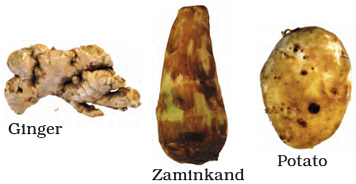
Stems also act as organs of perennation to fight against unfavorable weather conditions. Stem tendrils which develop from axillary buds, are slender and spirally coiled and help plants to climb such as in gourds (cucumber, pumpkins, watermelon) and grapevines.

Sometimes axillary buds of stems modify into woody, straight, and pointed thorns to protect the plant from animals. Examples are Citrus and Bougainvillea.

Some plants such as grass and strawberry, etc., have underground stems which spread to new niches, and the death of older parts gives birth to new plants. Mint and jasmine plant has a slender lateral branch that arises from the base of the main axis and grows in the air for a period, and then it bends downwards and touches the ground.

Rhizome
[Click Here for Sample Questions]
Rhizomes are underground and horizontal stems that have fleshy, non-green, and different nodes and internodes. It looks like the root of a plant so it sometimes becomes difficult to tell the difference. As they stay underground, away from sunlight, they are brownish in color. Rhizomes have terminal buds and they run parallel to the ground. Buds on a rhizome can generate a whole new plant. Also known as root stalks, the rhizome rootstalk grows vertically upwards. Examples of rhizomes are ginger and Alocasia indica.
Different Types of Rhizomes
There are two types of rhizomes, dense rhizomes, and running rhizomes. The rhizome that grows vertically as roots are produced on the lower side and the shoots grow vertically upright from the nodes are called dense rhizomes. Running rhizomes grow horizontally and can grow underground, subterranean, or above the soil. In running rhizomes, the roots and shoots grow from the nodes only, this is the reason for horizontal growth. Dense rhizomes have short internodes while running rhizomes have long internodes. An example of a dense rhizome is ginger while the example of a running rhizome is bamboo.
Characteristics of Rhizomes
- Asexual reproduction becomes possible because of the presence of rhizomes. Ginger and bamboo have rhizomes and reproduce through asexual reproduction, that is, vegetative propagation only.
- Water plants contain a single stem which is a rhizome and is beneath the leaves and flowers, therefore not visible.
- Food is stored in the form of starch in a rhizome. Examples are ginger and turmeric.
- The food storing quality of rhizomes makes it easy for the plant to grow and survive even in harsh weather conditions.
- Some rhizomes grow beneath the ground storing energy in the form of starch and sugar, Stem of these rhizomes are thicker while the rhizomes which grow above the ground have thinner stems.
- The Perennial plants also owe to rhizomes for providing protection and energy from the food stored in them.
- Some developed stems (rhizomes) have weed characteristics which is the reason why they grow fast and spread themselves.
Examples of Rhizomes
Rhizomes can be categorized into three types, underground rhizomes, the rhizomes above the ground, and multi-layered rhizomes.
- Underground stem rhizomes are the most common ones and have huge demand by humans. Bamboo, ginger, grass species, hops, and poison oak are all examples of underground stem rhizomes.
- Rhizomes that grow close to the soil but not under the soil are called above the ground rhizomes. Ferns and irises are examples.
- The multi-layered stem system of rhizomes forms both roots and shoots in several layers from the nodes. Such plants have whorls and different layers of leaves, for example, giant horsetails.
Also read: Biodiversity in Plants
Tuber
[Click Here for Sample Questions]
As ‘tuber’ literally means hump or swelling as derived from Latin, it has a similar meaning in biology. The food-storing fleshy part (stem) of the plant is called a tuber. We can also say that they are the underground part of the branches that swells because of the food that gets stored in them. Tubers grow vertically underground while rhizomes grow horizontally. Potato tubers are one of the most common examples. Tubers have several depressions called the eyes and they act as nodes for the tuber. Most tubers are spherical, oval, or oblong.
Difference Between Rhizome and Tuber
[Click Here for Sample Questions]
Differences between rhizomes and tubers are tabulated below:
| Rhizome | Tuber |
|---|---|
| Roots | |
| Grows horizontally inside the soil | Has fleshy roots and do not grow horizontally |
| Stem | |
| Rhizomes are thickened underground stems. | Tubers are modified stems with starchy interiors |
| Nodes | |
| Nodes bear adventitious roots | Nodes do not bear roots |
| Growth Habit | |
| Rhizomes grow horizontally. | Tubers do not have a well-organized growing habit. |
| Buds | |
| Buds can be seen in the axils of their scaly leaves and also in the form of terminal buds | Buds of tuber are known as ‘eyes’ and are present on the surface |
| Morphological Features | |
| The nodes of a tuber develop into roots and shoots. | The nodes of a tuber develop into both roots and stems. |
| Size | |
| Smaller in size compared to tubers | Larger in size than rhizomes. |
| Representative Plant Part | |
| It is the underground stem. | It is the underground branches of the stem or underground root. |
| Starch Composition | |
| Rhizomes are low in starch content. | Tubers are high in starch content. |
| Types | |
| Predominant classification cannot be found in Rhizomes. | There are two types of tubers-stem and root tubers. |
| Offspring | |
| Rhizomes produce offspring. | Tubers grow in size every year. |
| Examples | |
| Asparagus, Bamboo, Chinese lantern, ginger, Lotus, the Venus Flytrap, Western poison-oak, turmeric, etc. | Anemones, begonia, carrot, cassava, dahlia, oxalis, potato, sweet potatoes, Tuberous, yams, etc. |
Things to Remember [Click Here for Sample Questions]
- The stem is the vertical part of the axis from which branches, leaves, flowers, and fruits grow
- The stem has nodes & internodes, multicellular hair, and positive phototropic nature which help to differentiate it from a root
- Rhizome and tuber are modified stems
- Rhizome has fleshy, non-green, and different nodes and internodes
- Rhizome elongate along the length (elongation from the bud)
- It can be categorized into 3 types- underground, above the ground, and multi-layered rhizomes
- The tuber is the fleshy stem that grows underground vertically
- Eyes in tuber act as nodes
- Ginger, lotus, turmeric are examples of rhizomes
- Carrot, potato, yams are examples of tubers
Also read:
Sample Questions
Ques. What is the role of the stem in a plant? (2 Marks)
Ans. Flowers, leaves, fruits, and branches all grow out of the stem. Stem conducts water and minerals through itself and provides it to the whole plant which is necessary for the growth and survival of the plant.
Ques. Why are there modifications in the stem? (2 Marks)
Ans. To provide for protection, growth, development, and food even in conditions that are unfavorable for the growth of the plant, stem modification is necessary. Gourds and grapevines are the results of modifications in the stem.
Ques. What are the different structures a plant’s stem can modify into? (2 Marks)
Ans. Stems get modified to perform diverse functions such as storage
of food, vegetative propagation, and protection under different conditions. These functions decide which structure the stem will follow. To store food stems grow underground, to survive it outgrows tendrils and to save the plant from animals it grows thorns.
Ques. What are the two types of rhizomes? Explain with an example. (2 Marks)
Ans. The rhizome that grows vertically as roots are produced on the lower side and the shoots grow vertically upright from the nodes are called dense rhizomes. For example ginger. Running rhizomes grow horizontally and can grow underground, subterranean, or above the soil. In running rhizomes, the roots and shoots grow from the nodes only, this is the reason for horizontal growth. Dense rhizomes have short internodes while running rhizomes have long internodes. Bamboo is an example of a running rhizome.
Ques. Write down the process of a rhizome turning into a new plant? (2 Marks)
Ans. Rhizomes grow horizontally and parallel to the ground. They have short internodes and roots growing from the bottom of the nodes. This generates new shoots that grow upwards from the top of the nodes. So when a rhizome is separated from the plant, each piece can grow into a new plant. When new shoots are formed, the stored nutrients become useful for the new plant. This process is known as vegetative reproduction and is another way for rhizomes to produce offspring.
Ques. What are some common examples of rhizome and tuber that are used as food? (2 Marks)
Ans. Ginger and banana are rhizomes that are easily available in vegetable markets for consumption. Ginger grows under the ground while bananas grow over the ground. Potatoes are the most common example of the tuber. Since tubers can only grow underground it is obvious that potatoes grow underground. Yams and sweet potatoes are also examples of food from the tuber.
Ques. Make a diagram of the stem and label the important parts. (2 Marks)
Ans.

Ques. What is the difference between rhizome and tuber on the basis of growth habits, morphological features, and buds? (2 Marks)
Ans. Rhizomes grow horizontally and make an arch shape if they grow above the ground while tubers have no particular growing habit. Rhizomes develop into shoots and roots while tubers develop in roots and stems. Rhizome has buds on the axils of scaly leaves and in the form of terminal buds while buds of tuber are known as eyes which are present on the surface.



Comments