



Education Journalist | Study Abroad Lead
Evaporation is a term many of you might already be familiar with, it refers to the conversion of water from liquid to the gaseous state. Whereas transpiration is a less common term. Both the words have the same concept but evaporation and transpiration are both processes occurring in different environments. Water is the main source in both the process. Through evaporation, water is evaporated into the atmosphere by heating the water surface with the sun. The surface of the water here can be lakes, seas, rivers, ponds, etc. whereas, in the Transpiration process, water is absorbed by the plants via roots, and the excessive water is transferred in the atmosphere through evaporation. In this article, we will understand the processes of evaporation and transpiration, and go through the difference between these two cycles.
Read More: Difference Between Xylem And Phloem
| Table of Content |
Key Terms: Liquid and Gaseous State, evaporation, transpiration, equilibrium, Plants, atmosphere, eco-system.
Evaporation
[Click Here for Previous Year Questions]
When the liquid surface is heated by the Sun, the water evaporates into the air meaning the water changes its state from liquid to gaseous state. Apart from ponds, lakes, rivers evaporation can also take place on any surface having moisture, water, or droplets of water such as trees, soil, etc. Evaporation is an endless process wherein the process takes place until the sun goes down or equilibrium is reached. The intensity of evaporation is higher in summers than in winters. In hydrology, these processes of evaporation and transpiration are collectively termed Evapotranspiration.
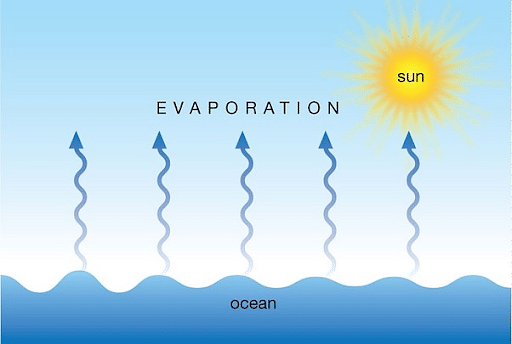
Evaporation
Working process of Evaporation:-
- When the molecules of water strike each other, energy transfer takes place.
- The molecule that absorbs the energy tries to overcome the pressure exerted by the vapors.
- When the molecule attains enough energy to escape the vapor pressure, it escapes the surrounding in the form of gas.
- When these molecules escape into the surrounding, there is a loss of temperature too as the energy transferred reduces the temperature of the liquid and when the evaporation is equal to the condensation rate, the equilibrium is said to be reached and hence the evaporation will stop.
- Throughout the process, only a fraction of molecules will have enough energy to escape from the liquid.
- Evaporation will occur only when the surface of the liquid is exposed to solar energy.
- These escaped molecules will then turn to vapor and can move up in the sky to form a cloud.

Process of evaporation
Factors Influencing Evaporation:-
There are many factors that act as a catalyst in the process of evaporation. These factors are:
- Pressure: Evaporation will occur at a faster rate when there is less exertion on the surface.
- Temperature: Higher the temperature of the water surface, the more will the rate of evaporation as the molecules will possess higher kinetic energy.
- Surface Area: Larger the surface area, the faster the evaporation rate as there will be more molecules per unit of volume that have the potential to escape.
- Airflow: If air keeps on moving over the water surface, the concentration of the substance in the air is less likely to move up, thus increasing the rate of evaporation.
- Inter-molecular force: The stronger the force between the molecules the more energy is likely to be transferred.
- Concentration of the water molecule: If the air contains a higher concentration of the evaporated substance, then the rate of evaporation will be slower.
Applications of Evaporation:-
The process of evaporation is used in many ways in our day to day life, some of which are enlisted below:
- Drying the clothes under the sun
- Ironing the clothes
- Melting of Ice cubes
- Nail paint remover gets evaporated
- Sweat gets evaporated
- To prepare common salt
- To dry wet hair
- Working of a Pressure cooker
Also Read:
Transpiration
[Click Here for Previous Year Questions]
Transpiration refers to the movement of water from the soil into the plant and then evaporating it into the atmosphere. The water from the soil is absorbed by the plants with the help of roots and the excess water is evaporated into the atmosphere via leaves. Water is necessary for plants but only a fraction of water is absorbed by the roots. Water is essential as it enhances growth and metabolism in plants. The absorbed water that is used for growth and metabolism is merely 3% to 5%. The remaining 95% to 97% is evaporated in the atmosphere through transpiration. The process of transpiration is similar to the process of Perspiration in human beings.

Process of Transpiration
Working process of Transpiration:-
- Water is absorbed by the roots of the plants.
- Along with water, some essential nutrients are also absorbed.
- These nutrients and water are transferred to other parts of the plants wherein these nutrients are needed.
- This flow of water from roots to leaves is driven by capillary action.
- The water that is needed accounts for 3% to 5% of the absorbed water.
- The extra amount of water is evaporated from the surface of the leaf.
- The whole process is termed Transpiration.

Evapotranspiration
Factors Influencing Transpiration:-
There are a number of factors that influence Transpiration. They are:
- Number of Leaves: The larger the number of leaves, the greater will be the water loss from the surface of those leaves.
- Number of Stomata: The more the number of stomata, the more will be the pores for transpiration.
- Size of leaf: Bigger leaf size will result in more transpiration as the surface area will increase.
- Light Supply: The pores available on the leaf open up for photosynthesis, when the pores will open transpiration will occur. Hence, the more light, the more will be the rate of transpiration.
- Temperature: An increase in temperature will result in an increase in the transpiration rate.
Benefits of Transpiration:-
Though there is a certain loss of water, Transpiration is beneficial for Plants as well as human beings because:
- Transpiration can boost crop productivity without increasing Irrigation.
- It helps in Ecosystem Management.
- It helps in Watershed Management.
Read More: Difference between Autotrophs and Heterotrophs
Difference between Evaporation and Transpiration
[Click Here for Previous Year Questions]
The basic difference between Evaporation and Transpiration is given in the table below.
| Evaporation | Transpiration |
|---|---|
| Evaporation is a physical process. | Transpiration is a biological process. |
| Water is required for Evaporation. | Plant Cell and stomata are required for Transpiration. |
| Evaporation occurs on the surface of any water body. | Transpiration occurs only in Plants. |
| The process of Evaporation is generally fast. | Transpiration works slowly as compared to Evaporation. |
| Evaporation occurs in non-living things. | Transpiration occurs in living things. |
| Evaporation occurs on the surface of the water body. | Transpiration occurs via Stomata. |
| Evaporation can occur during the night as well. | Transpiration occurs only during the daytime. |
| There is no involvement of nutrients. | By the process of transpiration, plants intake other nutrients as well. |
| The evaporated water helps in the formation of clouds. | By the loss of water, transpiration helps plants to keep their leaves cool. |
| The process will continue until the water is present. | The availability of soil and water determines the process of transpiration. |

Evaporation and Transpiration
Read More: Vascular Cambium
Things to Remember
[Click Here for Previous Year Questions]
- Evaporation is the process of water changing its phase from liquid to gaseous.
- Transpiration is the movement of water into the plants and then into the atmosphere.
- Pressure, Temperature, Surface Area, Airflow, Inter-molecular force, Concentration of the water molecule influence the rate of Evaporation.
- Transpiration is influenced by the Number of Leaves, Number of Stomata, Size of leaf, Light Supply, and Temperature.
- The intensity of evaporation is higher in summers than in winters.
- The higher the temperature of the water surface, the more will the rate of evaporation as the molecules will possess higher kinetic energy.
- The processes of evaporation and transpiration are collectively termed Evapotranspiration.
Previous Year Question
- The water potential and osmotic potential of pure water are...[Neet 1998]
- Water potential is equal to...[Neet 1998]
- At constant temperature, the rate of transpiration will be higher at...[Neet 1992]
- Bidirectional translocation of solutes takes place in...[Neet 1997]
- Process by which water enters in the roots due to diffusion, is termed as….[Neet 1996]
- Most accepted theory for ascent of sap is…[Neet 1991]
- Conversion of starch to organic acids is required for...[Neet 1992]
- When water moves through a semi permeable membrane then which of the following pressure develops?...[Neet 2001]
- Guard cells help in...[Neet 2009]
- Guttation is mainly due to...[Neet 1992]
- In guard cells when sugar is converted into starch, the stomatal pore….[Neet 1992]
- In soil, the water available for root absorption is….[Neet 1991]
- Loading of phloem is related to...[Neet 2001]
- Main function of lenticel is….[Neet 2002]
- When a cell is frilly turgid, which of the following will be zero?...[Neet 1997]
- Which is correct about transport of conduction of substances?...[Neet 1991]
- Which of the following criteria does not pertain to facilitated transport?...[Neet 2013]
- Which of the following facilitates opening of stomatal aperture?...[Neet 2017]
- Xylem translocates...[Neet 2019]
- Which of the following is used to determine the rate of transpiration in plants?...[Neet 1992]
Sample Questions
Ques. What is Evaporation? (1 mark)
Ans. Evaporation is the process of water changing its phase from liquid to gaseous.
Ques. Explain the process of Evaporation. (3 marks)
Ans. When the molecule of water strikes each other, energy transfer takes place. The molecule that absorbs the energy tries to overcome the pressure exerted by the vapors. When the molecule attains enough energy to escape the vapor pressure, it escapes the surrounding in the form of gas. When these molecules escape to the surrounding there is a loss of temperature too as the energy transferred reduces the temperature of the liquid and when the evaporation is equal to condensation the equilibrium is said to be reached and hence the evaporation will stop.
Throughout the process, only a fraction of molecules will have enough energy to escape from the liquid. Evaporation will occur only when the surface of the liquid is exposed to solar energy. These escaped molecules will then turn into vapor and can move up in the sky to form a cloud.
Ques. List down the factors influencing Evaporation. (2 marks)
Ans. Pressure, Temperature, Surface Area, Airflow, Inter-molecular force, and Concentration of the water molecule influence the rate of Evaporation.
Ques. Define Transpiration. (1 mark)
Ans. Transpiration is the movement of water into the plants and then into the atmosphere.
Ques. What Factors influence transpiration? (2 marks)
Ans. Transpiration is influenced by Number of Leaves, Number of Stomata, Size of leaf, Light Supply, and Temperature.
Ques. What is the working procedure of Transpiration? (3 marks)
Ans. Water is absorbed by the roots of the plants. Along with water, some essential nutrients are also absorbed. These nutrients and water are transferred to other parts of the plants wherein these nutrients are needed. This flow of water from roots to leaves is driven by capillary action. The water that is needed accounts for 3% to 5% of the absorbed water. The extra amount of water is evaporated from the surface of the leaf. The whole process is termed Transpiration.
Ques. What are the uses/applications of Evaporation? (4 marks)
Ans. Applications of the Evaporation Process can be seen in day-to-day life some of which are:
- Drying the clothes under the sun.
- Ironing the clothes.
- Melting of Ice cubes.
- Sweat gets evaporated in the body.
- To prepare common salt.
Ques. What are the benefits of Transpiration? (3 marks)
Ans. The benefits of transpiration are:
- Transpiration can boost crop productivity without increasing Irrigation.
- Helps in Ecosystem Management.
- Helps in Watershed Management.



Comments