



Exams Prep Master
The Difference Between Vapor and Gases helps to identify the distinctive features of both phase and substance. The word "Gas" was invented by a chemist named Jan Baptist van Helmont. At that time, CO2 was first identified as Gas. On the other hand, the word "Vapor" originated from the Latin word “Vaporem”. The meaning of this word is steam or heat or exhalation. Vapor can be explained as the phase of gas whereas gas is defined as a substance that doesn't have any size. And the substance of the gas remains in both solid and liquid form at a certain temperature. Here, we will discuss how vapor can be differentiated from gases, along with some important questions.
| Table of Content |
Keywords: Difference Between Vapor and Gases, Difference Between Vapor and Gases, Vapor, Gas, Real Gas, Molecules
What is Vapor?
[Click Here for Sample Questions]
In chemistry, vapor is defined as a substance of a gas. It contains a lower temperature. But with the increasing temperature, it becomes a liquid form. And this is completely different from an aerosol. To liquify vapor, pressure is increased, remaining the temperature at the same stage. For instance, the highest temperature of the remaining water in a liquid form is 647k which can be explained as 374 degrees Centigrade and 705-degree Fahrenheit.
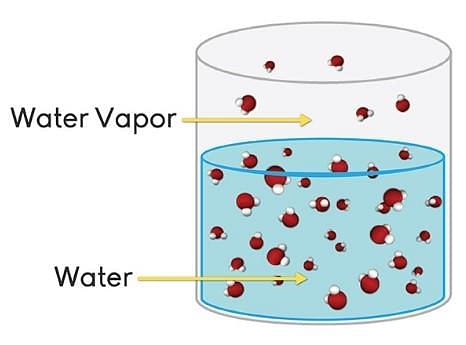
Some examples of Vapor are given below:
- One of the most common examples of vapor is fog.
- Another example of Vapor is used for water. After boiling water, water emits vapor.
Also Read:
What is Gas?
[Click Here for Sample Questions]
In chemistry, gas is considered one of the primary states of matter. It contains particles that exist without any volume and shape. In a normal situation, the state of gas lies between the liquid and plasma form. A gas contains atoms of any one element such as H2, Ar or any compounds like HCl or CO2. Also, it can contain other mixtures like natural gas, air, etc.

Some of the examples of Gas are listed below:
- Oxygen
- Hydrogen
- Ozon
- Chlorine
Below is a list of some of the elements of Gas given.
- H2
- N2
- F2
- Cl2
- He
- Ne
- Ar
- Kr
- Xe
- Rn
Also Read:
Difference Between Vapor and Gases
[Click Here for Sample Questions]
A tabular representation regarding the most important Difference Between Vapor and Gases as per the class 9 chemistry syllabus is given.
| Basis of Comparison | Vapor | Gas |
|---|---|---|
| Concepts | Vapor is a composition of more than two different forms that remain at the room or normal temperature and the real-time. And it remains in both liquid and gaseous forms. | Gas contains different atoms and the state of the matter remains unique under the present room temperature. |
| Movement of Chemical Elements | In vapor, atoms remain systematically and molecules move in a different direction. | Gases contain a range of atoms that exists in them systematically and move randomly. |
| Phases | Vapor does not fall into the definite form called the state of matter. | Gas is considered one of the primary states of matter among others such as solid, liquid and plasma. |
| Existence/Formation under Temperature | Water vapor in the atmosphere exists at a temperature that is below the steaming point of water. | Generally, gases are made above the temperature at a critical point whereas the pressure remains below the critical level. |
| Structural Measurements | In terms of shape, various particles of vapor are not measured. It is proved by using a microscope. | After the microscopic observation, it is defined that gas does not have any noticeable formation. |
Also Read: Difference Between Atom and Molecules
Things to Remember
- Vapor is formed into a solid or liquid form whereas gas is never formed into any shape.
- Molecules of vapor can move in different directions such as rotationally, translationally and vibrationally.
- The particle pressure of each element is the same as the vapor pressure of the original element along with the amount of fraction of the composition.
- Gas contains high kinetic energy. But the space between every particle is considered substantial.
- Molecules of gas consist of intermolecular force that does not have any value.
- The motion of gas particles is not the same and they can hit each other.
- To calculate the proportion of vapor in gas, the partial pressure of it is used.
Also Read: Difference Between Ideal Gas and Real Gas
Sample Questions
Ques. Which method helps to liquefy atmospheric gases? (2 Marks)
Ans: In a cylinder, the atmospheric gases are filled with a piston. After cooling the temperature and giving pressure on it, the atmospheric gas is converted to a liquid form.

Ques. In a vessel, there are 2 litres of gas. And the pressure of it is 760 mmHg. Also, the temperature is persistent. Find out the pressure at the time volume changes to 4 dm3. (4 Marks)
Ans: V = 2 litres
P = 760 mm
V1 = 4000 m3 [1 dm3 = 4 litres]
P1 =>
PV/T = P1V1/T1
760*2/T = P1*4/T1
P1 = 760/2 = 380 mm
Ques. The portion of gas i.e 800 cm3 is collected at a pressure of 650 mm. Calculate the pressure at which the volume of the gas is decreased by 40% from the primary volume and the temperature remains at the same level. (4 Marks)
Ans: V = 800 cm3
P = 650 m
P1 =>
V1 = volume is reduced at 40% out of 800
Hence, 80*40/100 = 320
Net V1 = 800 - 320 = 480 cm3
T = T1
By using the formula, PV/T = P1V1/T1
800*650/T = P1*480/T1
As T is equal to T1
So, P1 = 800*650/480 = 1083.33 mm of Hg.
Ques. The inner volume of a cylinder is 20 litres. And the cylinder is filled with H2 gas where the pressure is 29. Find out the volume of that gas when H2 is there at the pressure of 1.25 and the same temperature. (3 Marks)
Ans: V = 20 litre
P = 29 atm
P1 = 1.25 atm
V1=>
T = T1
By using the formula of the gas,
PV/T = P1V1/T1
29*20/T = 1.25*V1/T
V1= 465 litre
Ques. A container of 748 dm3 is filled with a gas of 561 dm3 and the temperature in it remains the same. What will be the change of percentage after giving pressure? (2 Marks)
Ans: Primary volume = V1 = 561 dm3
Last volume = V2 = 748 dm3
Volume difference = 748 - 561 = 187 dm3
Percentage decreased => 187/748*100 = 25%
Ques. Gas contains a mass that has taken 143 cm3 at the temperature of 27 degrees centigrade and the pressure is 700 mm Hg. Calculate the volume at 300K and the pressure of 280 mm Hg. (4 Marks)
Ans: V1 = 143 cm3
T1 = 27 degree centigrade = 27+273 = 300K
P1 = 700 mm Hg
T2 = 300 K
P2 = 280 mm Hg
V2 =>
P1V1/T1 = P2V2/T2
V2 = 700*143/27 = 280*V2/300
V2 = 357.5 cm3
Ques. The occupied portion of CO2 gas is 30 cm3 at the temperature of 15 degrees centigrade and the pressure at 740 mm. What will be the volume at STP? (4 Marks)
Ans: V = 30 cm3
P = 740 mm
T = 288K
P1 = 760 mm
V1=>
T1 = 273K
By using the formula PV/T = P1V1/T1
740*30/288 = 760*V1/273
V1 = 27.7 cm3
Ques. The pressure of the gas is reduced to 50%. Calculate the temperature by which the volume of gas at STP will be doubled. (3 marks)
Ans: V1 = V1
P1 = 760 atm
T1 = 273K
V2 = 2V1
T2 =>
P2 = 50/100*760 = 380 mm
P1V1/T1 = P2V2/T2
760*V1/273 = 380*2V1/T2
T2 = 273K
Ques. What is the level of pressure needed to compress the air at the temperature of 500 dm3 1 bar to 200 dm3 stays persistent? (3 marks)
Ans: V1 = 500 dm3
P1 = 1 bar
T1 = 273K
V2 = 500 dm3
T2 = 273 K
P2 =>
P1V1/T1 = P2V2/T2
500*1/273 = P2*200/273
P2 = 500/200 = 2.5 bar
Ques. At STP H2 covers 22.4 litres. What is the volume of 2 g of H2 at the temperature of 27 degrees centigrade and the pressure level of 4? (3 marks)
Ans: V1 = 22.4 litres
P1 = 1 atm
T1 = 273K
V2 =>
T2 = 300K
P2 = 4 atm
After using the formula, P1V1/T1 = P2V2/T2
1*22.4/273 = 4*V2/300
V2 = 6.15 litres
Ques. The particles of matter comprise various characteristics. What are these? (2 marks)
Ans: Below are the characteristics of particles.
- Particles contain intermolecular space and intermolecular force
- Particles of matters move without any halts
Ques. What is the number of factors on which wind's velocity depends? (3 marks)
Ans: There are various factors on which wind's velocity depends. All are given below.
- The temperature of surrounding - When the temperature of the surrounding increases different particles contain Kinetic Energy.
- The humidity of the surrounding - It is the volume of water vapor that exists in the atmosphere.
- The surface area of liquid that is exposed - The surface area of liquid is evaporation. When the surface is going up then the evaporation rate increases.
Ques. What is the most common example of evaporation that defines its cooling procedure? (2 marks)
Ans: One of the most common examples of the evaporation procedure is sweating. It needs temperature when it dries. It is generated from the body of a human being.
Ques. What formula is used in Boyle's law? (2 marks)
Ans: The formula used in Boyle's law is given below.
P1V1 = P2V2 [ P1 and V1 are initial pressure and volume values]
[ P2 and V2 are pressure value and gasses volume ]
Ques. What formula is used in Charles's Law? (2 marks)
Ans: Below is the formula used in Charles's Law.
V1/T1=V2/T2 [ V1 and T1 are first volumes and first temperature]
[ V2 and T2 are second volumes and second temperature]
Related Links:



Comments