




The Central Board of Secondary Education has released the CBSE Class 10 Syllabus 2027 for the 2026-27 academic session. CBSE Class 10 generally includes 5 core papers: Mathematics, Science, Social Science, and two language papers, with an optional 6th skill subject. The exam carries 80 marks for the theory paper and 20 marks for internal assessment.
- The 2026–27 syllabus has no major chapter-level additions or deletions, with the curriculum continuing to follow the NCERT framework.
- NCERT textbooks are the primary study resources for CBSE Class 10, covering Mathematics, Science, Social Science, and English Language & Literature.
- Competency-based questions such as case studies, source-based questions, and assertion-reasoning now have a major role, with up to 50% of the theory paper based on competency-focused assessment.
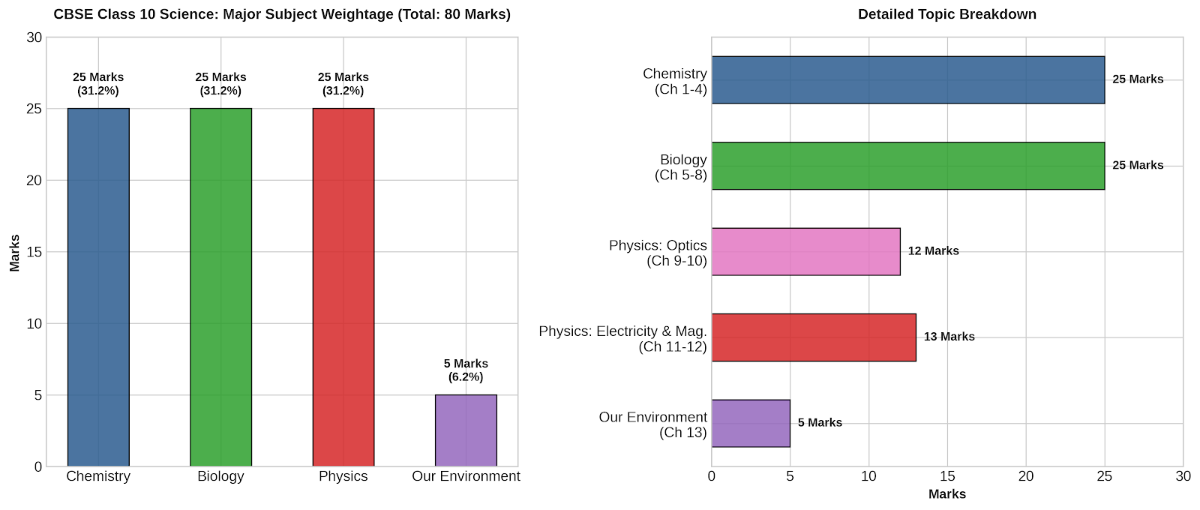
- In the CBSE Class 10 Science syllabus, Physics, Chemistry and Biology carry 25 marks each. Our Environment contributes the remaining 5 marks.
- In Social Science, History, Geography, Political Science and Economics carry 20 marks each.
- The syllabus and subject-wise guidelines for the CBSE Class 10 Syllabus 2027 have been released through the official CBSE Academic curriculum.
Related Links:
- CBSE Class 10 Mock Test (Available): Attempt Free Subject-wise test, CBSE Class 10 PYQs
- CBSE Class 10 Exam Pattern 2027: Subject-wise Marks, Question Types & Marking Scheme
- CBSE Class 10 Notes: Chapter-Wise Notes, Revised Syllabus & NCERT Solutions

Key Summary
- The CBSE Class 10 Syllabus 2027 covers Mathematics, Science, Social Science, English, and a second language, with a 100-mark evaluation for every subject (80 marks theory + 20 marks internal assessment).
- CBSE has introduced a Two-Board Exam System, expanded competency-based questions to 50% weightage, and enforced independent passing criteria for theory and internal assessment..
Official CBSE Class 10 Subject-wise Syllabus PDF Download
| Subject | Official PDF Download |
|---|---|
| Mathematics: Standard (Code 041) / Basic (Code 241) | Download CBSE Class 10 Maths Syllabus PDF |
| Social Science (Code 087) | Download CBSE Class 10 Social Science Syllabus PDF |
| Science (Code 086) | Download CBSE Class 10 Science Syllabus PDF |
| English Language and Literature (Code 184) | Download CBSE Class 10 English Syllabus PDF |
| Hindi A (Code 002) / Hindi B (Code 085) | Download CBSE Class 10 Hindi Syllabus PDF |
CBSE Class 10 Syllabus 2027: Highlights
Before going through the detailed subject-wise breakdown, students should understand the broad framework of the CBSE Class 10 syllabus for the current academic session.
- Several chapters remain permanently deleted from the CBSE 10th syllabus as part of the post-COVID rationalisation exercise, including Periodic Classification of Elements, Sources of Energy, and Constructions.
| Parameter | CBSE Class 10 Exam Overview |
|---|---|
| Test Papers | 5 Core Papers:
|
| Is the Syllabus Released? | Yes. The complete curriculum, deleted chapters, and subject-wise guidelines are released for 2026-27. |
| Conducting Body | Central Board of Secondary Education (CBSE) |
| Syllabus Level | Secondary School level, strictly based on the National Council of Educational Research and Training (NCERT) curriculum and textbooks for Class 10. |
| Question Types | Objective & Subjective Mix:
|
| Exam Pattern | Annual Offline Exam: 100 marks total
|
CBSE Class 10 Syllabus 2027: What's New
For the 2026–27 CBSE Class 10 academic session, there are no major changes to the syllabus, such as adding or removing entire chapters. Instead, CBSE is focusing on changes in assessment and question patterns in line with the NEP 2020.
Over the last few years, the CBSE Class 10th syllabus has evolved from a memory-based system into an application-oriented structure. The major changes for the current session are broken down below:
- The Two-Board Exam System: CBSE has structured a dual board exam model. Board Exam 1 is mandatory (held in February–March), while Board Exam 2 is optional (held in May). If a student opts to take both, the higher score of the two in each subject is reflected on the final marksheet.
- Expanded Competency Weightage: Competency-based questions (case studies, source-based graphics, and assertion-reasoning) now command 50% weightage of the entire theory paper across the CBSE 10th syllabus.
| Feature | Old CBSE System (Pre-2023) | Modern CBSE System (2027) |
|---|---|---|
| Exam Frequency | One final exam at the end of the year. | Two opportunities
|
| Question Style | Direct, theoretical, textbook-definition heavy. | Application-heavy (50% competency-based case studies/real-world problems). |
| Textbook Size | Thicker, comprehensive core NCERT volumes. | Rationalised textbooks with roughly 30% lighter content weight. |
Ques. Has CBSE introduced any new evaluation pattern in the CBSE Class 10 Syllabus 2027?
Ans. Yes. While the core NCERT content remains unchanged, CBSE has introduced the Two-Board Exam System and raised competency-based question weightage to 50%, both of which are central features of the CBSE Class 10 Syllabus 2027.
CBSE Class 10 English Literature Question Paper 2026 with Solutions
| CBSE Class 10 English Literature Question Paper 2026 | Question Paper PDF | Solution PDF |
|---|---|---|
| CBSE Class 10 English Literature Question Paper 2026 (Set 1 - 2/1/1) | Download PDF | Check Solutions |
| CBSE Class 10 English Literature Question Paper 2026 (Set 2 - 2/1/2) | Download PDF | Check Solutions |
| CBSE Class 10 English Literature Question Paper 2026 (Set 3 - 2/1/3) | Download PDF | Check Solutions |
| CBSE Class 10 English Literature Question Paper 2026 (Set 1 - 2/2/1) | Download PDF | Check Solutions |
| CBSE Class 10 English Literature Question Paper 2026 (Set 2 - 2/2/2) | Download PDF | Check Solutions |
| CBSE Class 10 English Literature Question Paper 2026 (Set 3 - 2/2/3) | Download PDF | Check Solutions |
| CBSE Class 10 English Literature Question Paper 2026 (Set 1 - 2/3/1) | Download PDF | Check Solutions |
| CBSE Class 10 English Literature Question Paper 2026 (Set 2 - 2/3/2) | Download PDF | Check Solutions |
| CBSE Class 10 English Literature Question Paper 2026 (Set 3 - 2/3/3) | Download PDF | Check Solutions |
| CBSE Class 10 English Literature Question Paper 2026 (Set 1 - 2/4/1) | Download PDF | Check Solutions |
| CBSE Class 10 English Literature Question Paper 2026 (Set 2 - 2/4/2) | Download PDF | Check Solutions |
| CBSE Class 10 English Literature Question Paper 2026 (Set 3 - 2/4/3) | Download PDF | Check Solutions |
| CBSE Class 10 English Literature Question Paper 2026 (Set 1 - 2/5/1) | Download PDF | Check Solutions |
| CBSE Class 10 English Literature Question Paper 2026 (Set 2 - 2/5/2) | Download PDF | Check Solutions |
| CBSE Class 10 English Literature Question Paper 2026 (Set 3 - 2/5/3) | Download PDF | Check Solutions |
CBSE Class 10 Syllabus for Maths 2027
The CBSE Class 10 Mathematics paper carries 100 marks.
- 80 marks for the theory exam and
- 20 marks for internal assessment.
Students can choose Mathematics Standard (041) or Mathematics Basic (241).
- Standard version features higher-difficulty analytical application questions, while Basic checks core foundational math skills. Constructions are excluded from the syllabus.
| Unit | Unit Name | Weightage | Syllabus Topics |
|---|---|---|---|
| Unit I | Number Systems | 6 Marks |
|
| Unit II | Algebra | 20 Marks |
|
| Unit III | Coordinate Geometry | 6 Marks |
|
| Unit IV | Geometry | 15 Marks |
|
| Unit V | Trigonometry | 12 Marks |
|
| Unit VI | Mensuration | 10 Marks |
|
| Unit VII | Statistics & Probability | 11 Marks |
|
| Total Theory | 80 Marks |
| |
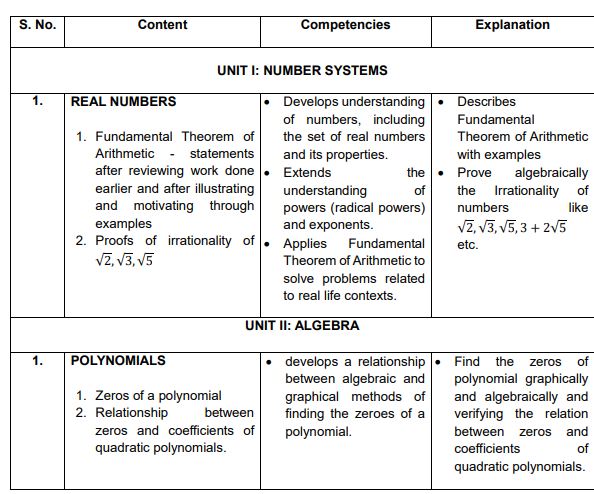
Source: CBSE Class 10 Mathematics Syllabus PDF
Ques. What is deleted from the Class 10 syllabus CBSE for Mathematics?
Ans. Constructions have been removed entirely, along with sub-topics like Euclid's Division Lemma, the area of a triangle formula in Coordinate Geometry, and the Frustum of a Cone in Mensuration.
Also Check:
CBSE Class 10 Syllabus for Science 2027
The CBSE Class 10 Science paper carries 100 marks, with 80 marks for the 3-hour theory exam and 20 marks for internal assessment.
- Chapters such as Periodic Classification of Elements, Sources of Energy, and Sustainable Management of Natural Resources are excluded.
- Up to 50% of the theory paper includes competency-based questions such as case studies, assertion-reasoning, and data interpretation.
CBSE Class 10 Science subject-wise weightage:
- Chemistry carries the highest combined weightage of 25 marks, covering Chapters 1–4:
- Chemical Reactions and Equations,
- Acids, Bases and Salts,
- Metals and Non-Metals, and
- Carbon and Its Compounds.
- Biology also carries 25 marks, covering Chapters 5–8, including
- Life Processes,
- Control and Coordination,
- How Do Organisms Reproduce?, and
- Heredity.
- Physics carries 25 marks in total, with
- 12 marks for Optics (Chapters 9–10) and
- 13 marks for Electricity and Magnetic Effects (Chapters 11–12), while
- Our Environment contributes the remaining 5 marks.
| Chapter | Chapter Name | Topics Covered |
|---|---|---|
| 1 | Chemical Reactions and Equations | Writing and balancing chemical equations; types of reactions: combination, decomposition, displacement, double displacement, precipitation, endothermic and exothermic; oxidation and reduction. |
| 2 | Acids, Bases and Salts | Physical and chemical properties and uses of acids and bases; H⁺ and OH⁻ ions; pH scale; preparation and uses of Sodium Hydroxide, Bleaching Powder, Baking Soda, Washing Soda and Plaster of Paris. |
| 3 | Metals and Non-Metals | Physical and chemical properties of metals and non-metals; reactivity series; ionic compounds; basic metallurgical processes; corrosion and its prevention. |
| 4 | Carbon and Its Compounds | Covalent bonding; versatile nature of carbon; homologous series; nomenclature with functional groups; saturated and unsaturated hydrocarbons; combustion, oxidation, addition and substitution reactions; ethanol and ethanoic acid; soaps and detergents. |
| 5 | Life Processes | Nutrition, respiration, transportation, and excretion in plants and animals. |
| 6 | Control and Coordination | Tropic movements and plant hormones; nervous system; voluntary, involuntary and reflex actions; chemical coordination and animal hormones. |
| 7 | How Do Organisms Reproduce? | Asexual and sexual reproduction; reproductive health, family planning, safe sex vs. HIV/AIDS, women's health. |
| 8 | Heredity | Mendel's laws of inheritance of traits; sex determination (brief introduction). Note: Evolution is completely excluded. |
| 9 | Light – Reflection and Refraction | Reflection by curved surfaces; spherical mirrors; mirror formula (derivation not required); laws of refraction; refractive index; spherical lenses; lens formula, magnification and power. |
| 10 | Human Eye and the Colourful World | Functioning of the eye lens; defects of vision and corrections; refraction through a prism; dispersion; scattering of light (twinkling of stars, blue sky). |
| 11 | Electricity | Electric current and potential difference; Ohm's law; resistance and resistivity; series and parallel combinations; heating effect; electric power (P, V, I, R relationships). |
| 12 | Magnetic Effects of Electric Current | Magnetic field and field lines; field due to a straight conductor, circular loop and solenoid; force on a current-carrying conductor; Ampere's rule; Fleming's Left-Hand Rule; AC and DC; domestic electric circuits. Note: Electric Motor and Generator are excluded. |
| 13 | Our Environment | Ecosystem and environmental problems; ozone depletion; waste management; biodegradable and non-biodegradable substances; food chains and food webs. |
| Total Theory | The syllabus of Science Class 10 CBSE carries 80 marks across 13 chapters; the remaining 20 marks go to internal assessments. | |
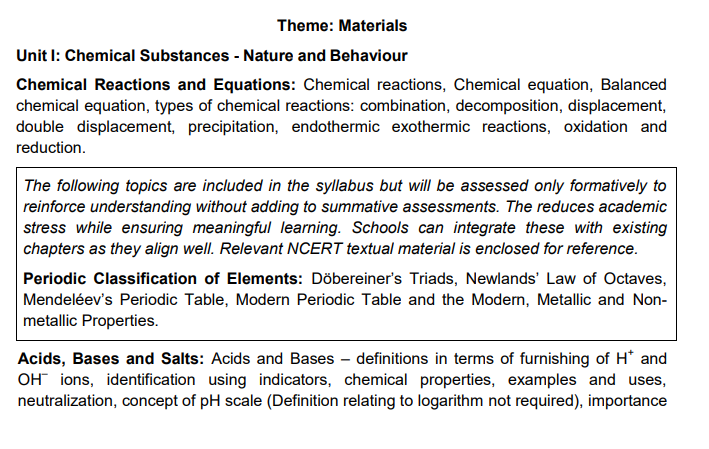
Source: CBSE Class Science Syllabus PDF
CBSE Class 10 Sample Papers 2024-25
| Subject | Sample Question Paper |
|---|---|
| Science | Check Here |
| English (Language & Literature) | Check Here |
| Hindi A | Check Here |
| Hindi B | Check Here |
| Mathematics Basic | Check Here |
| Mathematics Standard | Check Here |
CBSE Class 10 Syllabus 2027: Social Science
The CBSE Class 10 Social Science (Social Studies) syllabus features a balanced curriculum distributed across four distinct textbook disciplines:
- History,
- Geography,
- Political Science, and
- Economics.
The total evaluation carries 100 marks, split into an 80-mark written theory paper (3 hours) and a 20-mark school-administered Internal Assessment.
- Aligned with the NEP 2020 framework, up to 50% of the board question paper under the CBSE Class 10 Syllabus 2027 consists of competency-based questions. It includes map identification, source analysis, case-based text extracts, and assertion-reasoning matrices.
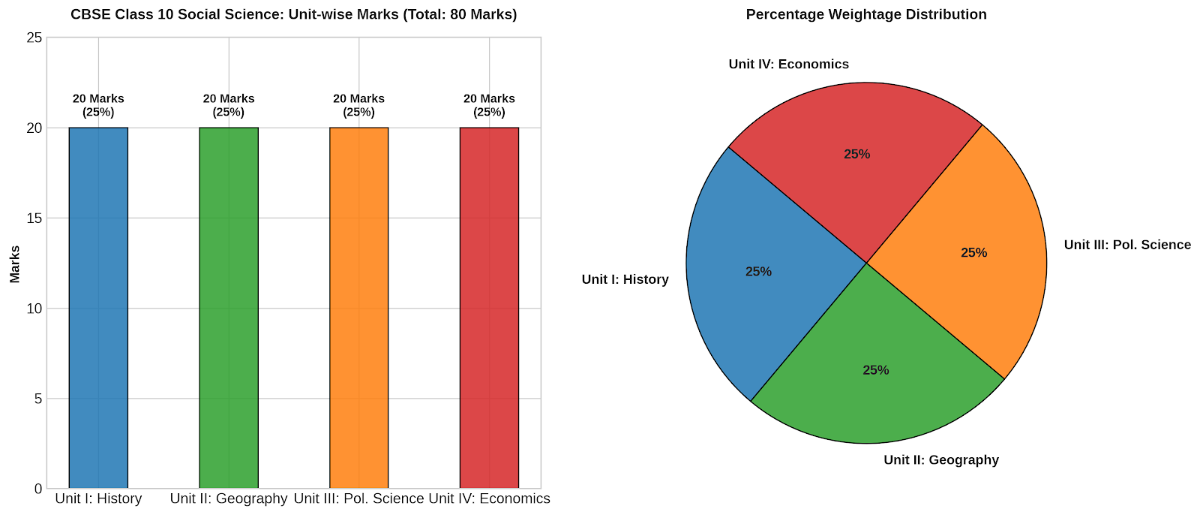
| Unit | Subject / Textbook | Weightage |
|---|---|---|
| Unit I | History – India and the Contemporary World – II | 20 Marks |
| Unit II | Geography – Contemporary India – II | 20 Marks |
| Unit III | Political Science – Democratic Politics – II | 20 Marks |
| Unit IV | Economics – Understanding Economic Development | 20 Marks |
| Total | Core Social Science Theory | 80 Marks |
CBSE Class 10 Social Studies Topic-wise syllabus
| Chapter | Syllabus Topics Covered |
|---|---|
| History | |
| The Rise of Nationalism in Europe | French Revolution and the idea of the nation; nationalism in Europe; Age of Revolutions; unification of Germany and Italy; nationalism and imperialism. |
| Nationalism in India | First World War, Khilafat and Non-Cooperation; strands within the movement; Civil Disobedience Movement; sense of collective belonging. |
| The Making of a Global World | Pre-modern world; nineteenth-century global economy; inter-war economy and Great Depression; rebuilding the post-war world economy. |
| The Age of Industrialisation | Before the Industrial Revolution; hand labour and steam power; industrialisation in colonies; factories; industrial growth; market for goods. |
| Print Culture and the Modern World | First printed books; print in Europe; print revolution; religious debates; print and the French Revolution; India and print; reforms and censorship. |
| Geography | |
| Resources and Development | Classification and development of resources; resource planning; land resources; land degradation; soil types, erosion and conservation. |
| Forest and Wildlife Resources | Forest and wildlife conservation; distribution of resources; community participation. |
| Water Resources | Water scarcity; conservation and management; multipurpose river projects; rainwater harvesting. |
| Agriculture | Types of farming; cropping patterns; major crops; technological and institutional reforms; food security. |
| Minerals and Energy Resources | Types and occurrence of minerals; ferrous and non-ferrous minerals; conventional and non-conventional energy resources. |
| Manufacturing Industries | Importance of manufacturing; industrial location; agro-based and mineral-based industries; industrial pollution and control measures. |
| Lifelines of National Economy | Roadways, railways, pipelines, waterways and airways; communication; international trade; tourism as a trade. |
| Political Science | |
| Power Sharing | Belgium and Sri Lanka; need for power sharing; forms of power sharing. |
| Federalism | Features of federalism; Indian federal system; decentralisation. |
| Gender, Religion and Caste | Gender and politics; women's representation; religion and communalism; caste and politics. |
| Political Parties | Need for political parties; types of parties; national and state parties; political reforms. |
| Outcomes of Democracy | Accountable, responsive and legitimate government; economic growth; inequality and poverty; social diversity. |
| Economics | |
| Development | Development goals; national development; comparison of countries/states; sustainability. |
| Sectors of the Indian Economy | Primary, secondary and tertiary sectors; organised and unorganised sectors. |
| Money and Credit | Money as a medium of exchange; bank credit; terms of credit; Self-Help Groups. |
| Globalisation and the Indian Economy | Production across countries; foreign trade; market integration; WTO; impact of globalisation. |
| Consumer Rights | Consumer awareness, rights and responsibilities; consumer protection mechanisms. |
| Map Work |
|
Also Check:
CBSE Class 10 Syllabus English 2027
The CBSE Class 10 English paper carries 100 marks, with 80 marks for the 3-hour theory exam and 20 marks for Internal Assessment based on listening and speaking skills.
- The syllabus covers Reading, Writing, Grammar, and Literature, with greater focus on competency-based questions, including analytical comprehension, data-based passages, and grammar in context.
| Section | Component | Weightage | Syllabus / Topics Covered |
|---|---|---|---|
| Section A | Reading Skills | 20 Marks |
|
| Section B | Applied Grammar | 10 Marks | Tenses and Modals; Subject-Verb Concord; Reported Speech including commands, requests, statements and questions; Determiners. |
| Section B | Creative Writing Skills | 10 Marks |
|
| Section C | First Flight – Prose | 40 Marks (Literature section) | A Letter to God; Nelson Mandela: Long Walk to Freedom; Two Stories about Flying – His First Flight and Black Aeroplane; From the Diary of Anne Frank; Glimpses of India – Baker from Goa, Coorg and Tea from Assam; Mijbil the Otter; Madam Rides the Bus; The Sermon at Benares; The Proposal. |
| Section C | First Flight – Poetry | Dust of Snow; Fire and Ice; A Tiger in the Zoo; How to Tell Wild Animals; The Ball Poem; Amanda!The Trees; Fog; The Tale of Custard the Dragon; For Anne Gregory. | |
| Section C | Footprints Without Feet | A Triumph of Surgery; The Thief's Story; The Midnight Visitor; A Question of Trust; Footprints Without Feet; The Making of a Scientist; The Necklace; Bholi; The Book That Saved the Earth. | |
| Total | 80 Marks |
| |
Also Check:
Reduced CBSE Class 10 Syllabus 2027: Deleted Chapters
The last major reduction in the CBSE 10th syllabus happened in June 2023, effective from the 2024 exams, and the same rationalised structure continues to be followed for the current session.
- The Reduced CBSE Class 10 Syllabus is a shortened version of the original syllabus. Around 30% of the content was removed by NCERT and CBSE to reduce students’ academic burden.
- The largest reductions are in Mathematics and Science, including the complete deletion of some chapters, while English and Social Science mainly have specific chapters or selected topics removed.
| Subject | Reduced / Deleted Topics |
|---|---|
| Mathematics |
|
| Science |
|
| Social Science |
|
| English (Language & Literature) |
|
Also Check:
Best Books for CBSE Class 10 Syllabus 2027
For the CBSE Class 10 Syllabus 2027, NCERT textbooks are the prescribed books for core subjects. CBSE sets board questions based on the concepts covered in the NCERT curriculum. Reference books are optional and can be used for additional practice.
- NCERT textbooks are the primary study resources for CBSE Class 10, covering Mathematics, Science, Social Science, and English Language & Literature.
- Students can use support resources such as NCERT Exemplar, the Science Laboratory Manual, CBSE map guidelines, and grammar worksheets for additional practice and internal assessment preparation.
| Subject | Prescribed Textbook (Official NCERT) | Essential Support Resource |
|---|---|---|
| Mathematics | Mathematics: Textbook for Class X | NCERT Exemplar Problems: advanced, high-level competency and application questions. |
| Science | Science: Textbook for Class X | Laboratory Manual (Science – Class X): Mandated for the 5-mark internal lab evaluations. |
| Social Science | History: India and the Contemporary World-II; Geography: Contemporary India-II; Political Science: Democratic Politics-II; Economics: Understanding Economic Development | CBSE Map Compendium: Official guidelines for structural board map questions. |
| English (Lang. & Lit.) | Prose & Poetry: First Flight; Supplementary Reader: Footprints Without Feet | Integrated grammar worksheets on the official CBSE academic repository portal. |
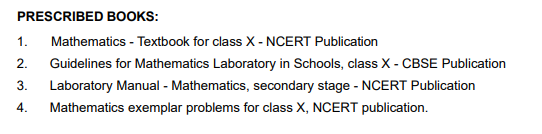
Source: CBSE Class 10 Mathematics Syllabus PDF
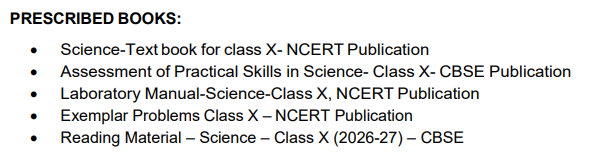
Source: CBSE Class Science Syllabus PDF
Popular Secondary Practice Material (Private Reference Books): If a student has thoroughly completed the NCERT book and the Exemplar but requires extra mock tests or solved question banks, the most commonly used resources include:
- For Mathematics Standard: Mathematics for Class 10 by R.D. Sharma, or Secondary School Mathematics by R.S. Aggarwal.
- For Science: Conceptual topic-breakdown volumes by Lakhmir Singh & Manjit Kaur.
- For all-in-one practice and PYQs: Chapter-wise solved banks from Oswaal Books or Arihant All-In-One Guides.
Also Check:
CBSE Class 10 Syllabus 2027: Preparation Tips
For better performance in the CBSE Class 10 exams, focus on subject-specific preparation techniques along with regular revision and practice.
- Mathematics: Keep a separate formula sheet for quick revision and practise neat diagrams for Triangles and Circles. Standard Maths focuses more on application-based questions, while Basic Maths is more direct.
- Science: Regularly practise and label important diagrams such as the nephron, human heart, and reflex arc. Also, practise balancing at least 5 chemical equations every week.
- Social Science: Write answers in clear, numbered points with suitable subheadings instead of lengthy paragraphs. This makes answers easier to read and evaluate.
- English: Give equal attention to Writing Skills and Grammar. Learn the correct format for formal letters and practise identifying and presenting key data in analytical paragraphs.
| Phase | Timeline | What to Do |
|---|---|---|
| Phase 1: Foundations & Resource Building | Months 1–5 |
|
| Phase 2: Mastering the Competency Pattern | Months 6–8 |
|
| Phase 3: Revision & Mock Drill | Final 2 Months |
|
Based on Reddit student discussions and experience, below are the CBSE Class 10 syllabus preparation strategies:
- Focus on NCERT first: Read the NCERT textbooks carefully and understand the important concepts, examples, and diagrams before using other books.
- Prefer self-study: Class 10 can be prepared well through regular self-study, so coaching is not necessary for every student.
- Start early: Begin the CBSE Class 10 Syllabus 2027 preparation around April or May to avoid last-minute pressure.

Source: Reddit
CBSE Class 10 Syllabus 2027 FAQs
Ques. What subjects are covered under the CBSE Class 10 syllabus?
Ans. The CBSE Class 10 syllabus covers Mathematics, Science, Social Science, English (Language & Literature), and a second language, along with optional 6th skill subjects.
Ques. Is the CBSE Class 10 syllabus reduced for 2027?
Ans. Yes. The CBSE Class 10 Syllabus 2027 continues to follow the rationalised NCERT curriculum introduced in 2023, with chapters such as Constructions, Periodic Classification of Elements, and Sources of Energy remaining permanently deleted.
Ques. Where can students check the official CBSE Class 10 syllabus?
Ans. Students should check the official CBSE academic portal (www-cbse-nic-in) for the latest updates on the CBSE Class 10 Syllabus 2027, sample papers, and date sheet notifications.
Ques. What is the difference between Mathematics Standard and Basic under the CBSE 10th syllabus?
Ans. Both codes follow the identical chapter list under the CBSE Class 10 syllabus maths, but the Standard paper (Code 041) tests higher-difficulty analytical application questions, while Basic (Code 241) tests core foundational skills.
Ques. How much weightage do competency-based questions carry in the CBSE Class 10 syllabus?
Ans. Competency-based questions, including case studies, source-based questions and assertion-reasoning, now carry up to 50% weightage across every subject in the CBSE Class 10 Syllabus 2027.



Comments