



Education Journalist | Study Abroad Lead
Electronic Bulb is the most basic electrical lamp, having a translucent or transparent glass housing, used for the purpose of lighting or illumination. An electric bulb, also known as an incandescent light bulb, is an electric light with a filament wire that is heated until it lights. A wire or electrodes placed in the glass supply current to the filament. Mechanical and electrical connections are usually provided via a socket bulb. Thomas Alva Edison began working on the viable electric bulb in 1878, and the electronic bulb was invented in 1879. The light bulb and the electronic bulb are the same things.
| Table of Contents |
Key Terms: Electronic Bulb, Filament, Electricity, Incandescent Bulb, LED, Halogen Bulb, Fluorescent Electric Bulb, Tungsten, Light, Illumination
What is Electronic Bulb?
[Click Here for Sample Questions]
An electric bulb is a type of light bulb that has a transparent or clear glass cover. It's also called a light bulb. For more than a generation, this basic gadget has been used to provide light.
An electric bulb is a device that creates light when electricity is applied to it. Such a bulb is unquestionably powerful enough to brighten a dimly lit area.
The electronic bulb works on a simple principle that an electric current is passed through a thin filament, which heats up. The bulb shines because heated items typically produce light. The brighter the bulb glows and the “whiter” the brightness it emits as the temperature rises.
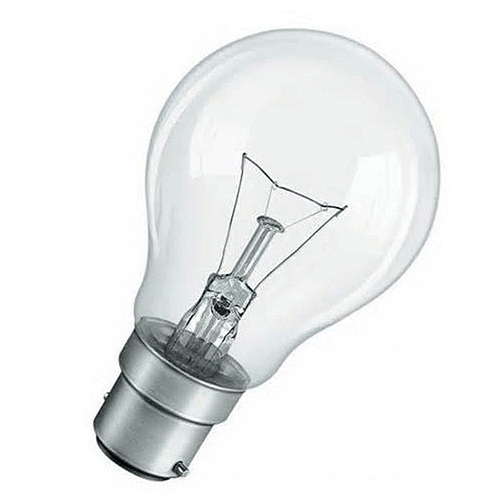
Electronic Bulb
Structure of An Electronic Bulb
[Click Here for Sample Questions]
Electric light bulb is made up of various elements, some of which are visible and others which are not. The globe, or the bulb's exterior, is comprised of thin glass. A light-emitting filament, a stem that holds the filament in place, and a metal base that screws into a socket, such as one found in a lamp or ceiling fixture, make up a light bulb.
The electric light bulb is consist of three main primary components:
- Filament
- Glass Bulb
- Base of the Light Bulb
Filament
The filament, which is a looped thin wire made of tungsten, is employed. Since of its high melting point, tungsten was selected as the filament because it does not melt at high temperatures.
The filament is contained within a globe-shaped glass plate and is connected to the light's base through copper and lead wires. The wires and filament are contained within a glass bulb filled with an inert gas such as argon. Because argon is a non-combustible gas, it protects the filament from burning and extends its lifespan. To create this effect, thin glass is used.
Glass Bulb
The bulb is made of thin glass that prevents air from reaching the filament and so protects it from burning. When electricity is transmitted through the bulb, it travels through copper and lead wires to the filament. The base, which also connects to the electric circuit, keeps the light erect. The power passes from the base to the tungsten filament by copper and lead wires. It causes the filament to glow and emit light.
Base of the Light Bulb
Bulb bases come in two varieties:
- Spiral Base: A piece of lead links the bulb to the electric circuit directly in a spiral base bulb.
- Base of Two Side Nails: It has two pieces of lead that link the light to the electric circuit and has nails in the base.
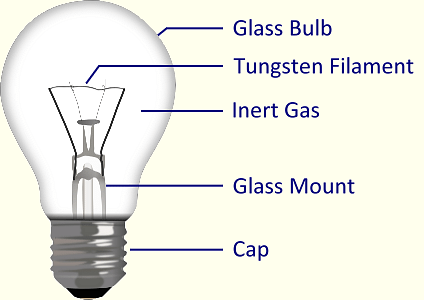
Structure of An Electronic Bulb
Read More: Light Sources
Types of Electronic Bulb
[Click Here for Sample Questions]
Electric bulbs come in a variety of shapes and sizes. The following are the numerous types of electric bulbs in use:
- Incandescent Bulb
Electricity is converted to light in incandescent electric bulbs by passing current via a filament. A thin wire is also referred to as a filament. Electric filaments are primarily made of metal tungsten. The resistance of the filament, in particular, is what actually heats the bulb up. As a result, when the filament heats up sufficiently, it begins to glow and emit light.
- Fluorescent Electric Bulb
By their very nature, these electric bulbs are highly effective. In addition, they produce only a fraction of the heat produced by an incandescent bulb. Furthermore, as compared to incandescent bulbs, fluorescent bulbs endure longer. A fluorescent bulb is made out of a glass tube that is filled with argon gas and perhaps a little amount of mercury. The cathode of this bulb heats up when it is turned on. The cathode radiates heat as a result of this heat.
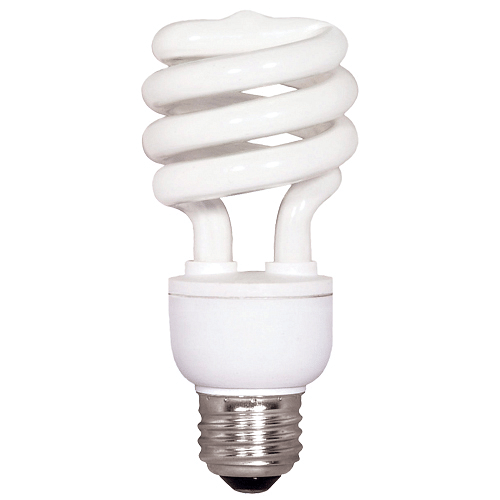
Fluorescent Electric Bulb
- LED (Light-emitting Diode)
An LED (light-emitting diode) is a type of electronic device. It's a semi-conductive chip. In comparison to incandescent and fluorescent bulbs, LED bulbs are more power-saving and last considerably longer. With the exception of fluorescent bulbs, LEDs do not contain harmful mercury. For numerous years, LED bulbs were not as luminous as other types of lighting, and they were also more expensive.

LED Bulb
Read More: Construction & Uses of LED
- Halogen Bulb
A tungsten-halogen lamp, also known as a quartz-halogen lamp or a quartz iodine lamp, is an incandescent lamp. This is made up of a tungsten filament that is packed inside a small transparent envelope. The envelope is filled with a combination of inert gas and a trace amount of a halogen gas like bromine or iodine. This enables the filament to function at a higher temperature than a normal incandescent bulb of equivalent power and longevity. This is believed to create light with better luminous efficacy and a warmer colour temperature.

Halogen Bulb
Uses of Electronic Bulb
[Click Here for Sample Questions]
Some of the major uses of electronic bulbs are as follows:
- The most common source of artificial light is light bulbs (lamps), which are used to illuminate homes, automobiles, and torches.
- It's utilized in table lamps and other portable illumination.
- It's found in automotive headlights and vehicle lights.
- It's utilized for both residential and commercial lighting.
- It's utilized in advertising and decorative lighting.
Advantages of Electronic Bulb
[Click Here for Sample Questions]
The main advantages of an electronic bulb are:
- Bulbs have a longer lifespan than any other type of light.
- Working time varies between 8000 and 15000 hours.
- It is both inexpensive and cost-effective.
- It is simple to set up.
- It is available in a variety of sizes and shapes.
- Produces a significant amount of output
- Because of the lower initial cost, it is less expensive.
- It produces a significant amount of light.
Read More: Electric Field, Potential Difference & Electrical Charge
Disadvantages of Electronic Bulb
[Click Here for Sample Questions]
The disadvantages of the electronic bulb are given as follows:
- They're delicate, and if you drop them, the filament will quickly break.
- In comparison to previous inventions, they have low energy efficiency.
- In comparison to other brands, they have a short lifespan.
- It is inefficient in terms of energy usage.
- A normal lamp's lifetime is around 1000 hours.
- Higher running costs are required.
- It is fragile because it is made of glass and should be handled with care.
- The bulb produces a low number of lumens per watt.
Safety and Precautions for Electronic Bulb
[Click Here for Sample Questions]
Here are some safety precautions to take when working with electronic bulbs:
- Electronic bulbs must be handled with care because they are easily broken.
- The bulb's breakable portions are highly sharp and can penetrate the flesh if they are touched.
- Because the bulb contains chemicals like argon and mercury, it must be handled with care. The human body gets poisoned by mercury.
- When a light bulb breaks, the mercury inside leaks out as vapours or fine droplets, which might land on neighbouring items. Mercury poisoning is dangerous.
- The bulbs should be disposed of properly.
Things to Remember
- An electric bulb is a type of light bulb that has a transparent or clear glass cover. It’s also called a light bulb.
- The electronic bulb is made up of three main components namely the filament, the bulb and the light bulb’s base.
- There are various types of electronic bulbs such as incandescent bulbs, fluorescent electric bulbs, LED (light-emitting diode), and halogen bulbs.
- Electronic bulbs have a longer lifespan than any other type of light with their working time varying between 8000 and 15000 hours.
- Bulbs are very delicate, thus, they must be handled with care as they contain chemicals like argon and mercury.
Sample Questions
Ques. What are the advantages of an LED bulb? (5 Marks)
Ans. The advantages of the LED bulb are as follows:
- Lifespan: A typical LED light has a lifespan of 50,000 hours. It could last up to 100,000 hours, depending on how you use it. This means that an LED light can live for six to twelve years before needing to be replaced.
- Efficiency in Energy: One of the most significant advantages of LED lighting is its energy efficiency.
- Environmental Performance Enhancement: It is becoming increasingly crucial for businesses to be environmentally conscious. Customers are increasingly looking for environmentally responsible solutions.
- Flexibility in Design: LEDs are extremely tiny (about the size of a spec of pepper). As a result, they may be used in practically any situation.
Ques. What is the significance of tungsten in a light bulb? (3 Marks)
Ans. Because of its high melting point, tungsten metal is exclusively utilized to make the filament of an electric bulb. Tungsten filaments may be held white-hot without melting because of their high melting point. Tungsten is used for a variety of reasons, including
- It is a versatile tool.
- At high temperatures, it has a slow evaporation rate.
Ques. How does an incandescent, fluorescent, and LED light bulb works? (3 Marks)
Ans. A conventional incandescent light bulb heats up by conducting energy through a wire inside the bulb. It lights when it gets hot enough. When electricity passes through a fluorescent light bulb, it stimulates a combination of gases inside the bulb, which are then turned into light. When electricity passes through a diode in an LED light bulb, light is produced.
Ques. What is the melting point of filament and it is melted? (3 Marks)
Ans. The filament is comprised of tungsten, which has a melting temperature of roughly 34000 degrees Celsius. When electricity is passed through this filament, the temperature rises and the colour shifts to a yellowish-orange. This yellow colour is emitted by tungsten filaments, which are employed as light sources during the night. The noble gas is injected into the glass covering to absorb the heat produced by the bulb.
Ques. What are the differences between the LED bulb and the Halogen bulb? (5 Marks)
Ans. The differences between an LED Bulb and a Halogen bulb are as follows:
| Basis | LED Bulb | Halogen Bulb |
|---|---|---|
| Efficiency | LED bulbs require less power to produce light. | Halogen bulb requires more power to produce light. |
| Reliability | LED bulbs are more reliable. They range from 30000 to 5000 hours. | Halogen bulbs are less reliable. They range from about 1500 to 2000 hours. |
| Energy Usage | LED bulbs require less energy to illuminate. | Halogen bulbs require more energy to illuminate. |
| Design Flexibility | LEDs are particularly versatile for various mounting arrangements since they can be easily customized for varied applications. | Halogen bulbs cannot be easily customized for varied applications. |
| Cost | LED bulbs are more expensive | Halogen bulbs are less expensive |
Ques. What is used to fill an electric bulb? (2 Marks)
Ans. Argon is used to fill electric bulbs. Argon is a non-combustible gas. The reactivity of inert gases is quite low. Argon warms the tungsten wire filament when the power goes into the bulb. When the filament is heated to a high temperature, it produces white light.
Ques. Describe electric arc lamps in brief. (5 Marks)
Ans. Two sharp rods face each other with a short gap between them in an electric arc lamp. Tungsten is utilized as filament because of its high melting point, strong heat resistance, and ease of fabrication into thin wire. A concave mirror behind the rods also concentrates the light into a single point.
Electric arc lamps are often employed as searchlights and projectors in cinemas. Arc lamps, on the other hand, have the disadvantage of consuming more electricity. As a result, fluorescent lighting is chosen since they consume less energy. They're also popular in homes because they create lighter ones while using less energy.
Ques. What exactly is an electric bulb? (2 Marks)
Ans. An electric bulb, often known as a light bulb, is a type of lighting that has been around for millennia. It has a clear light housing with two wires in the centres connected by a thick wire. The filament is the small wire that runs between them.
Ques. What are the cautions that must be kept in mind while handling an electronic bulb? (5 Marks)
Ans. The cautions related to an electronic bulb are:
- The majority of light bulbs are designed to fit into sockets that deliver high voltage energy. Even if the bulb is out, there remains a significant risk of electric shock if the socket is turned on.
- When incandescent bulbs are turned on, they become extremely hot and take a long time to cool down. Burns can occur if you touch the bulb while it is hot.
- Because most light bulbs are made of glass, they are readily broken. The jagged edges of the shattered glass might pierce the skin.
- When a fluorescent bulb breaks, the mercury inside releases vapours, which can lead to mercury poisoning if inhaled.
Check-Out:



Comments