



Education Journalist | Study Abroad Lead
Temperature is a unit of measurement for how hot or cold something is. Kelvin is the SI unit of temperature (K). Temperature is also measured in degrees Celsius (°C) or degrees Fahrenheit (°F). A thermometer is a device that is used to measure temperature. Thermometers are devices that quantify a system's temperature. When heated, a volume of mercury swells into a capillary tube, forming a typical thermometer.
Read More: Difference between Heat And Temperature
Key Terms: Thermometer, Fahrenheit, Kelvin, temperature, Conversion units.
Temperature
[Click Here for Sample Questions]
Temperature is a measurement of how hot or cold a body is in comparison to a reference object. Two essential ideas are necessary when discussing temperature changes: thermal contact and thermal equilibrium. If two items can alter one another's temperature, they seem to be in thermal contact.
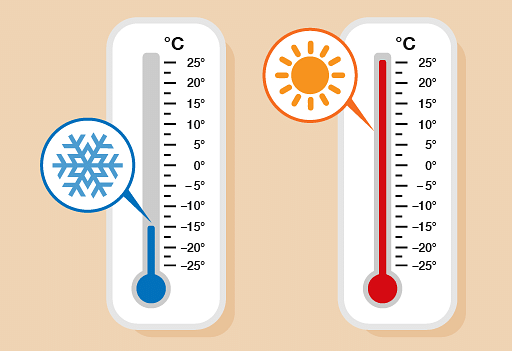
Temperature
If two items in thermal contact can no longer alter each other's temperature, they have reached thermal equilibrium. The two things are in thermal contact if, for example, a carton of yoghurt from the refrigerator is placed on the kitchen counter. Their temperatures are the same after several hours because they're in thermal equilibrium.
Read More: Heat
Thermometer
[Click Here for Sample Questions]
Thermometers are devices that quantify a system's temperature. When heated, a volume of mercury swells into a capillary tube, forming a typical thermometer. The temperature may be determined from the thermometer scale when the thermometer is in thermodynamic equilibrium with an object.
Read More:
Types of Thermometer
[Click Here for Sample Questions]
Different types of thermometers are used to measure the temperatures of various objects such as air, our bodies, food, and a variety of other things. Clinical thermometers, laboratory thermometers, Galileo thermometers, maximum-minimum thermometers, and digital remote thermometers are among the several types of thermometers available. Clinical thermometers and laboratory thermometers are two of the most often used thermometers.
Clinical Thermometer
At home, in clinics, and hospitals, these thermometers are used to measure the temperature of the human body. When the thermometer is removed out of the patient's mouth, it has a kink that stops the mercury from flowing back into the bulb, allowing the temperature to be registered easily.
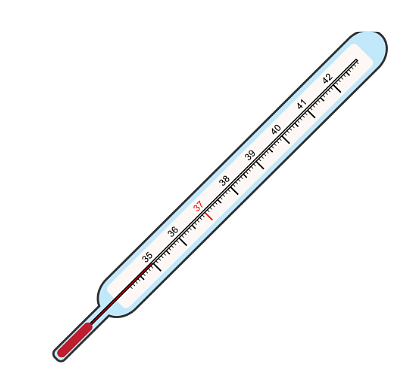
Clinical Thermometer
On either side of the mercury thread are temperature scales, one is in Celsius and one in Fahrenheit. Body temperature is only measured in degrees Fahrenheit since the Fahrenheit scale is more sensitive than the Celsius scale. A clinical thermometer measures temperatures from 35 degrees Celsius (94 degrees Fahrenheit) to 42 degrees Celsius (108 degrees Fahrenheit).
Also Read:
Laboratory Thermometer
In schools and other laboratories, lab thermometers are used to measure temperature for scientific research. They're also used in the industry because they can record temperatures that clinical thermometers can't. When compared to a clinical thermometer, the stem and bulb of a lab thermometer are longer, and the lab thermometer has no kink. A laboratory thermometer only has a Celsius scale that ranges from 10 to 110 degrees Celsius.

Laboratory Thermometer
Read More:
Conversion of Units
[Click Here for Sample Questions]
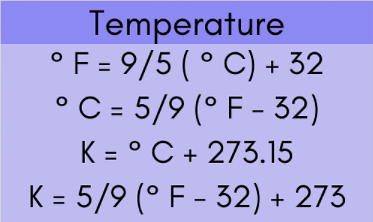
There are many units of temperature which can converted from one to another by using the formulas as follows:
Celsius to Farenheit
The ice point is 0 degrees Celsius, while the steam point is 100 degrees Celsius. The temperature difference between these two points is measured in degrees, which are divided into 100 equal parts. The ice point is 32 degrees Fahrenheit, while the steam point is 212 degrees Fahrenheit, as shown in Figure. The temperature difference between these two points is divided into 180 equal parts. Temperatures in Celsius (C) and Fahrenheit (F) are related using the given equation:
Tc = 5/9 (TF - 32o
TF= 1.8•Tc+ 32°
While the Celsius and Fahrenheit temperature scales are one of the most widely used, there have been various additional scales employed throughout history. The Rankine scale, the Newton scale, and the Romer scale, for example, are all uncommonly employed. Finally, there's the Kelvin temperature scale, which is the most extensively used temperature scale among scientists and is the standard metric system of temperature measurement.
Read More:
Kelvin Scale Conversion
Kelvin scale (K) has the same number of degrees as the Celsius system, but the zero point is set at the triple point of water. When the water in a closed vessel is in equilibrium in all three states: ice, water, and vapour, it is said to be at the triple point. This point is 273.16 Kelvin, which equals.01 degrees Celsius; to convert Celsius to Kelvin, simply multiply by 273.15. Because the degrees are the same in both scales, temperature differences in Celsius and Kelvin are the same.
°C = K - 273.15°
K = °C + 273.15
Absolute zero is the zero point on the Kelvin scale. It is the absolute lowest temperature that can be reached. In 1848, Scottish physicist William Thomson (a.k.a. Lord Kelvin) proposed the concept of an absolute temperature minimum. Thomson predicted that the lowest temperature that could be reached was -273°C, based on thermodynamic considerations.
A variety of strange features have been found with the cooling of matter to temperatures near absolute zero. Superconductivity, superfluidity, and a state of matter known as a Bose-Einstein condensate are among these features.
Conversion of Units
Read Also: Unit of temperature
Things to Remember
- Temperature is a measurement of how hot or cold a body is in comparison to a reference object.
- Clinical thermometers and laboratory thermometers are two of the most often used thermometers.
- Temperatures in Celsius (C) and Fahrenheit (F) are related using the given equation: Tc = 5/9 (TF - 32o), TF= 1.8•Tc+ 32°
- While the Celsius and Fahrenheit temperature scales are one of the most widely used, there've been various additional scales employed throughout history. The Rankine scale, the Newton scale, and the Romer scale, for example, are all uncommonly employed.
- Natural elements such as latitude, elevation, and the presence of ocean currents determine a region's temperature characteristics.
Also Read:
Sample Questions
Ques: Explain why kites and eagles fly without flapping their wings in a few words. (2 marks)
Ans: During the day, the sun heats the air in the atmosphere, making it lighter. Conventional current is created when hot air rises, leaving an empty area for cool or heavier air to sink into. Without flexing their wings, kites and eagles begin to fly along this convectional circulation.
Ques: Explain why the air conditioner is usually installed at a higher level on the room's wall. (2 marks)
Ans: Warm air is much lighter than cold air, therefore the cold air from the air conditioner goes downhill due to its weight, whilst the hot air moves upwards at a lower level and is cooled before returning downwards. As a result of this convection, heat is trapped in the air, and the room warms up faster.
Ques: What are three things that influence a location's temperature and precipitation? (2 marks)
Ans: Natural elements such as latitude, elevation, and the presence of ocean currents determine a region's temperature characteristics. Factors like proximity to mountain ranges and prevailing winds influence a region's precipitation characteristics.
Ques: How does conduction take place? (3 marks)
Ans: The principal mode of heat transport in solid materials is conduction. The vibrations of the particles at the heated end of solid growth as it is heated. These vibrating particles clash with one another, transferring heat to the slower-moving particles nearby. They begin to vibrate quicker, transferring heat to their neighbours. Although the particles stay in their same positions, heat is transported through conduction by the vibrating particles.
Ques: What should we wear in the summer and the winter? Why? (3 marks)
Ans: In the summer, we should dress in white and light-colored clothing, whereas in the winter, we should dress in dark-colored clothing. Black people absorb more heat from the sun than white people. Dark clothing is more comfortable in the cold since we need to absorb more heat to stay warm. We like white garments in the summer because they absorb less heat than dark clothes and help to keep us cooler.
Ques: Describe the occurrence of oceanic currents in detail. (3 marks)
Ans: Temperature by the sun than the water near the earth's poles. It is caused by the sun's rays falling perpendicularly in the equatorial area. As a result, the ocean water expands and becomes lighter in the equatorial zone.
The water in the arctic area, on the other hand, remains frigid and heavy. It results in the passage of warm water convection currents from the equator to the poles.
Cold water heat flows from the poles to the equator just beneath the ocean's surface. Oceanic currents are the name given to various sorts of currents.
Ques: Convert 40 degrees Celsius to Fahrenheit. (3 marks)
Ans: TF= 1.8•Tc+ 32°
Step I: Multiply the number of degrees by 9.
= 40° × 9
= 360°
Step 2: Multiply the result by 5.
= 360° ÷ 5
= 72°
Step 3: Multiply the result by 32.
= 72 + 32
= 104° F, As a result, 40 degrees Celsius equals 104 degrees Fahrenheit.
Ques: How should we take readings with a clinical thermometer? (5 marks)
Ans: To read the temperature on a thermometer, follow the instructions below:
Step 1: Wash the thermometer first with an antiseptic solution, and then with clean water if the antiseptic solution is not available.
Step 2: Hold the thermometer tube in your hand and gently yank it such that the mercury thread in the thermometer tube falls below the 35°C reading.
Step 3: Place the thermometer's bulb under the patient's tongue for roughly one minute. After that, pull the thermometer out of the patient's mouth.
Step 4: Hold the thermometer horizontally in your hand and slowly spin it to read the temperature. A position will emerge when we observe an enlarged image of the mercury thread in its tube. Now, place the thermometer tube level with the top of the mercury thread and read the temperature.
Ques: What Effect Does Cold Weather Have on Wind Speed? (5 marks)
Ans. The wind is a natural phenomenon that we see daily, so it's easy to take it for granted. The processes that produce wind, on the other hand, are complex and depend on a variety of elements, including air temperature, land and water distribution, and even the Earth's rotation.
The wind is created by a pressure difference between air masses, to put it simply. This is analogous to the flow of water from a pressurised supply to plumbing fixtures that discharge water at atmospheric pressure. Because air-handling units supply pressurised air that is delivered through ductwork, commercial ventilation systems work on a similar premise.Temperature differences between air masses have an effect in nature that is analogous to a commercial ventilation system's fans. Due to its lower density, warm air rises over cold air, causing pressure differences. Temperature gradient is a word used by weather scientists to describe the difference in temperature between two sites, and a stronger temperature gradient has the following effects:
- An increase in the pressure gradient between air masses.
- A stronger wind: The temperature differential gets extremely great when a cold front reaches a geographic region in the winter. Because the moving mass of cold air is significantly colder than the air being displaced, this occurs.
During the winter, winds are stronger, which can be explained by the uneven heating of the Earth's surface. In the tropics, solar radiation is rather constant throughout the year, but temperate locations receive significantly less heat in the winter. Polar regions are an outlier, as they receive no sunlight for several months during the winter.
Read More:



Comments