



Content Writer
Hexadecimal to binary conversion yields the equivalent binary number of the hexadecimal number system. There are four distinct kinds of number systems: the binary, octal, decimal, and hexadecimal systems. Every one of these number systems has a base number that facilitates conversion. Their respective base numbers are used to convert hexadecimal to binary. The binary number system plays a significant role in the computer. The computer stores all the data in the binary system language. Hence, it is crucial to convert the binary into hexadecimal.
Read more: Binary to octal conversion
| Table of Content |
KeyTerms: Hexadecimal conversion, Binary number system, Decimal number system, Equivalent number, Data, Base numbers
What is Hexadecimal to Binary Conversion?
[Click Here for Sample Questions]
Hexadecimal to binary conversion is a process of converting a hexadecimal number with a base of 16 to a binary number with a base of 2.
- Due to the fact that computers can only comprehend binary numbers, converting hexadecimal values to binary numbers is crucial.
- As a result, binary numbers are also created from all other sorts of number systems.
- Hexadecimal cannot be simply converted to binary.
- It is necessary to convert the hexadecimal number first to a decimal number and then to a binary number.
Hexadecimal Number System
[Click Here for Sample Questions]
In the hexadecimal number system “hexa” represents 16. Therefore, the hexadecimal system employs 16 digits that consists of both numbers and alphabets such as 1, 2, 3, 4, 5, 6, 7, 6, 9 and A, B, C, D, E, F. Here the alphabet A-F represents numbers 10-15 in the decimal system. It is represented as s16, where s is a hexadecimal number.
Examples: B216, EF616, EF76516
Binary Numbers
[Click Here for Sample Questions]
The binary number utilizes only two digits i.e.0 and 1 these are called bits. The computer only stores the data in the form of binary digits. A byte consists of 8 bits. The binary numbers are represented as b2, where b is a binary number.
Examples: 0101012, 11112, 1011102.
Read more:
| Relevant Concepts | ||
|---|---|---|
| Binary Division | Binary Subtraction | Number Theory |
| Binary Multiplication | Decimal Fraction | Rational and Irrational number |
Hexadecimal Number to Binary Table
[Click Here for Sample Questions]
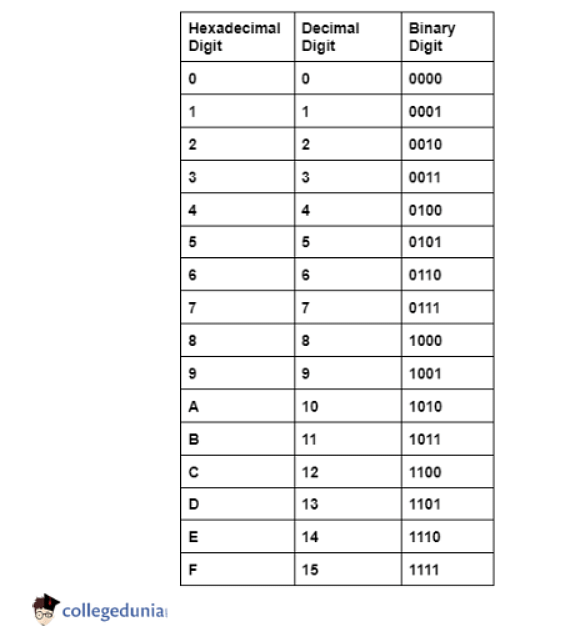
The given table shows the conversion between hexadecimal and binary. For the first few numbers up to 16, the table is provided.

Hexadecimal Number to Binary Table
Methods to Convert Hexadecimal to Binary
[Click Here for Sample Questions]
The hexadecimal to binary conversion can be done in two methods.
- Conversion to binary without table
- Conversion to binary with table
Methods to Convert Hexadecimal to Binary
Conversion to binary without table
Using the appropriate base numbers, this technique involves both multiplication and division of the numbers. The base of a hexadecimal number is 16, the base of a decimal number is 10, and the base of a binary number is 2. The following steps are as follows:
- Step 1: Write the hexadecimal number and then determine its decimal equivalent.
- Step 2: Each digit is multiplied by 16n-1, where the digit is in its nth position, to obtain the decimal equivalent.
- Step 3: In order to get the decimal number, multiply the numbers and then add the result.
- Step 4: To convert a decimal number to binary, divide it by 2, leaving aside the remainder, and then divide the quotient by 2 until it equals zero.
- Step 5: Once the quotient corresponds to zero. The binary number is obtained by placing the remainder in reverse order.
Conversion to binary with table
This method utilizes a direct approach by looking at the conversion table. The steps to convert are as follows:
- Step 1: Note down the hexadecimal
- Step 2: Consult the conversion table to determine the decimal equivalent of each of the given digits.
- Step 3: To obtain the final binary number, add together all the binary numbers.
Applications of Binary System
[Click Here for Sample Questions]
The binary number system plays an important role in the modern world as follows:
- It is employed in data storage, processing and operations in computers.
- It is used in Boolean algebra.
- It is helpful in digital encoding.
Things to remember
- The equivalent binary number of the hexadecimal number system is obtained by converting hexadecimal to binary.
- Hexadecimal cannot be directly converted to binary. Hence, it is necessary to convert hexadecimal into decimal number and then to a binary number.
- The binary number utilizes only two digits i.e.0 and 1 these are called bits.
- The hexadecimal system employs 16 digits that consists of both numbers and alphabets such as 1, 2, 3, 4, 5, 6, 7, 6, 9 and A, B, C, D, E, F.
- Binary language is only comprehended by computers.
- It is also used in data operations in computers.
Sample Questions
Ques. Convert hexadecimal DE816 (4 marks)
to binary using the conversion table.
Ans. Given, DE816
The decimal equivalent of the hexadecimal digits by using the conversion table are:
D = 1310 , E = 1410 , 8 = 810
The binary equivalent of these decimal numbers by using the conversion table are:
1310 = 11012
1410 = 11102
810 = 10002
Therefore, DE816 = 1101111010002.
Ques. Convert hexadecimal 0.A1216 (5 marks)
Ans. Given, 0.A1216
By utilizing the conversion table and excluding the decimal point, the following are the decimal equivalents of the hexadecimal digits:
A = 1010 , 1 = 110 , 2 = 210
Using the conversion table, the binary equivalents of these decimal integers are:
1010 = 10102
110 = 00012
210 = 00102
Therefore, 0.A1216 = 1010000100102.
Ques. Convert A2B16 to an equivalent binary number. (5 marks)
Ans. Given, A2B16
Convert the given hexadecimal to the equivalent decimal number.
A2B16 = (A x 162) + (2 x 161) + (B x 160)
= (A × 256) + (2 × 16) + (B × 1)
= (10 ×256) + 32 + 11
= 2560 + 43
= 2603 (Decimal Number)
Convert 260310 to binary
2 I2603
2 l1301 – 1
2 I650 – 1
2 l325 – 0
2 l162 – 1
2 l81 – 0
2 l40 – 1
2 l20 – 0
2 l10 – 0
2 l5 – 0
2 l2 – 1
2 l1 – 0
2 l0 – 1
Hence, A2B16 = 1010001010112
Ques. Convert the hexadecimal number 3016 to its binary equivalent. (4 marks)
Ans. Given, 3016
Obtain the decimal value of given hexadecimal number as
3016 = (3 x 161) + (0 x 160)
= 48 + 0
= 48 (Decimal value of 3016)
By dividing the value by 2 such that the ultimate quotient yielded is zero.
The binary number obtained is 1100002
Hence, 3016 = 1100002
Ques. What is the binary number system? (1 mark)
Ans. The binary number system uses a base-2 system of numbers. There are only two numbers in this system: 0 and 1. The entire system is made up of combinations of these two numbers.
Ques. What is the hexadecimal number system? (1 mark)
Ans. The base of the hexadecimal number system is 16, and there are 16 symbols total. It has the letters A through F and the numbers 0 through 9.
Ques. What are the characteristics of a number system? (3 marks)
Ans. The major characteristics of a number system are as follows:
- They represent a useful set of numbers, including integers, rational numbers, etc.
- They also provide an exclusive standard representation for each number in the number system.
- They also represent the mathematical and algebraic structure of numbers.
Ques. Convert E16 to an equivalent binary number. (3 marks)
Ans. Given, E16
The decimal equivalent number
E16 = E x 160
= E x 1
= E
= 14 (Decimal Number)
By dividing the value by 2 such that the ultimate quotient yielded is zero.
The binary number obtained is 11102
Hence, E16 = 11102
Ques. Mention various number systems in Mathematics. (2 marks)
Ans. Some of the major number systems are as follows:
- Integer system
- Urinary system
- Chinese numeral system
- Positional system
- Binary system
Ques. How many bits become bytes? (1 mark)
Ans. 8 bits together become 1 byte.
Check out:



Comments