



Education Journalist | Study Abroad Lead
Binary Division is the phenomenon in which two binary numbers having base two can be divided with the use of basic binary division rules. A binary number system, often known as base two, is a counting method that employs two digits: 0 and 1 and expresses numbers in base two. All arithmetic operations can be performed on binary numbers in the same manner that they can be performed on decimal numbers. The operations include addition, subtraction, multiplication, and division.
| Table of Content |
Keywords: Binary number system, binary division, decimal, addition, division, subtraction, multiplication
Binary Division Rules
[Click Here for Sample Questions]
Binary Division rules are the guidelines we need to follow when splitting two binary numbers. Division by 0 has no meaning in Binary division, just as it does not in the decimal system (or any other number system). The binary division rules are as follows.
- 1 ÷ 1 = 1
- 1 ÷ 0 = 0
- 0 ÷ 1 = Meaningless
- 0 ÷ 0 = Meaningless
Binary Division Steps
The long division technique is one of the most efficient and easiest ways to divide binary numbers. The following steps are to be followed while doing a binary division operation.
Division:
In case of division, take the leftmost digit of the dividend, then divide it by the divisor which should be smaller than the dividend. Hence you get the quotient.
Multiplication:
Once the quotient is received, it can be used to multiply the divisor to obtain the product.
Subtraction:
After getting the product we subtract the product from the working dividend in order to calculate the reminder.
Bring Down:
Then the next digit is brought down in the original dividend, put that together with the reminder in the above step and form a new working dividend. This is the step where the whole process is repeated again.
Also Read: Relations and Functions Important Questions
Example – Solve 01111100 ÷ 0010
Solution – The dividend is 01111100 and the divisor is 0010
The value of the number is unaffected by the zeros in the most significant bit in both the dividend and divisor. So get rid of the zeros.
So the dividend becomes 1111100 and the divisor becomes 10.
Long Division Method
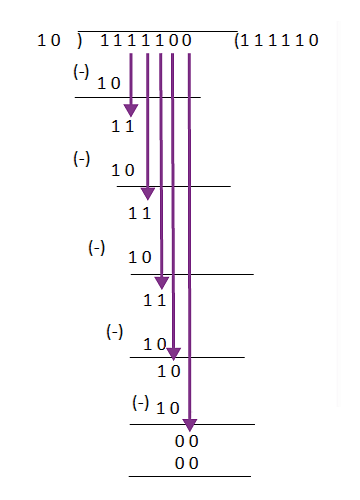
The step by step process is mentioned below.
Step 1: First, compare the dividend's first two numbers to the divisor. In the quotient position, add the number one. Then subtract the value, and you'll receive 1 as a result.
Step 2: Next, bring down the next number from the dividend part; now you have the remainder and the dividend value; repeat step 1 again.
Step 3: Continue to do this till the remainder is zero.
Step 4: Now that you have the remaining value as 0, you have a zero in the dividend portion, so move it to the quotient portion.
Therefore, the resultant value is the quotient value which is equal to 111110 So, 01111100 ÷ 0010 = 111110
Read More:
Decimal Results in Binary Division
[Click Here for Sample Questions]
When the quotient achieved is a non-integer and the division process goes past the decimal point during the division process, one of two scenarios is likely:
- In the first scenario, the division process comes to a stop, resulting in a final remainder of 0.
- In the second scenario, a remainder is found that is either similar to or different from the prior remainder (digit which has occurred after the decimal points were written). In the latter situation, continuing the operation will be fruitless since the same sequence of numbers will occur in the quotient over and over again.
A mathematical symbol known as the bar is employed to deal with such situations. A bar is put above the repeating pattern to show that it will continue indefinitely (i.e., every rational number is either a terminating or repeating decimal).
Also Read: Decimal to Binary Formula
Things to Remember
- In the case of binary division we need to decide whether the number is going to be a 1 or a 0.This makes the calculation much easier.
- The long division approach is one of the most efficient and simple binary operations to calculate binary division, and may be used to solve binary division difficulties.
- Multiplication and subtraction are two other binary arithmetic operations that are used in binary division.
- The binary number system is most widely used in the field of Computer Technology.
- The additions on the set of all irrational numbers are not the binary operations.
Sample Questions
Ques. Solve 10110.1 ÷ 1101 [3 marks]
Ans.

Thus the quotient is 1.101 upto 3 places of binary point and the remainder is 1011.
Ques. Solve 11101.11 ÷ 1100 [3 marks]
Ans.

Thus the quotient is 10.0111 up to 4 places of the binary point and the remainder is 0.
Ques. Express the decimal format of the signed binary number (101010)2 [3 marks]
Ans. The rest of the parts are magnitude parts whereas the first part is the sign part.
Hence the number is: 01010 = 23 × 1 + 21 × 1 = 8 + 2 = 10.
But, the sign bit is 1,
Therefore the answer is : (-2)10.
Ques. The result of 0×1 in binary is? [2 marks]
Ans. The binary multiplication of any number with zero will give the result as zero itself.
Any binary number when multiplied by 0 gives 0 only. e.g. 1101 × 0000 = 0000.
Ques. Divide the binary number (011010000) by (0101) and find the quotient? [3 marks]
Ans.

Therefore, the quotient of 011010000 ÷ 0101 = 101001.
Ques. Convert the binary number 1011 to its equivalent decimal number. [3 marks]
Ans. Given binary number is (1011)2
By using the binary to decimal conversion formula,
(1011)2 = (1×23) + (0×22) + (1×21) + (1×20)
= 8 + 0 + 2 + 1
= (11)10
Therefore, the decimal equivalent of (1011)2 will be (11)10
Ques. What will be the resulting decimal number when (100)2 are converted from binary to decimal? [3 marks]
Ans. To convert binary to decimal,
(100)2 = (1×22) + (0×21) + (0×20)
(100)2 = 4 + 0 + 0
(100)2 = 4
Therefore, the resulting decimal number for (100)2 will be 4.
Ques. Convert the following binary numbers into a base-10 number system [3 marks]
(1101001)2
Ans. For the binary number (1101001)2,
(1101001)2 = (1×26) + (1×25) + (0×24) + (1×23) + (0×22) + (0×21) + (1×20)
(1101001)2 = (1×64) + (1×32) + (0×16) + (1×8) + (0×4) + (0×2) + (1×1)
(11110111)2 = 64 + 32 + 0 + 8 + 0 + 0 + 1
(11110111)2 = 105
Therefore, (105)10 is the decimal equivalent of a given binary number.
Also Check:
CBSE Class 12 Mathematics Study Guides:



Comments